Category: PRABSY MUNDKUR

  • Ad Buzz by Prabhakar Mundkur: Will advertising strike back at consulting cos?

    By Prabhakar Mundkur


    Consulting vs Communication Groups

    In a surprise move, Sir Martin Sorrell may have silenced all the critics who have been proclaiming the death of advertising, as consulting companies have been making forays into digital marketing and advertising. Some investment gurus have even been predicting the eventual take-over of the advertising industry by the consulting industry. Kantar, one of the major companies in the WPP group, collapsed four brands – Kantar Added Value, Kantar Futures, Kantar Vermeer and Kantar Retail – into one brand called Kantar Consulting.  Kantar has already informed their clients about the development and hopes to have about a 1000 staff that consists of analysts, thought leaders and software developers.

    Will the others quickly follow suit?  It remains to be seen, but if they do, advertising is certainly striking back. Old professions have great survival skills, as the oldest profession in the world has proven to us time and time again.


    Social Media inspires Communication themes

    Earlier, brands took their cues from the news, cinema and other fields. Or used topics like another brand’s major event to take advantage and poke fun at them. Remember in 2017 when BMW celebrated its 100th birthday, how Mercedes acted cheekily with this ad?

    It paid BMW a left-handed compliment to make a point about themselves while overtly congratulating BMW.

    They also went all the way and invited all BMW employees to the Mercedes-Benz Museum “to discover the complete history of the automobile” from March 8 to 13.

    Now all that is changing. The latest source of inspiration is what is trending on social media.  While President Donald Trump’s #nuclearbutton tweet might have fazed political pundits, some brands decided to have some fun with the latest topic of conversation around the world.

    Closer home, Amul Butter has for the last 5 decades always capitalized on what is the current buzz. President Donald Trump’s tweet inspired this hoarding from Amul Butter.

    KFC UK and Ireland decided to get cheeky with McDonald’s on Twitter. Many Americans acknowledged they weren’t even aware that KFC existed in that part of the world until their tweet took Twitter by storm.


    Consumer Protection

    When Consumer Affairs Minister introduced a new Consumer Protection Bill in Parliament last week, it might have sent shivers down the Advertising and Entertainment industry in an already cold January.  The bill provided for a fine of INR 50 lakh which of course is unlikely to bother the top celebrities since it represents only a fraction of what they earn through endorsements. What might have seemed to be harsh to them was that celebrities could face up to three years imprisonment for appearing in misleading.  No doubt agents of celebrities would seek clarification on what exactly is misleading advertising.  The Advertising Standards Council of India has already made an offer to advise if an ad is misleading.

    Quite simply, misleading means giving the wrong idea or impression about something. In the case of products, if the claims made in advertising are not honest and truthful, it would mean an advertisement is misleading.  Anyway, the new act is likely to put the brakes on blindly accepting every brand offer that meets the celebrity’s standard fee.  Celebrities are also being careful about how the brand affects their own brand equity.  When Virat Kohli refused to endorse Pepsi last year, he was actually being careful about the repercussions on his own image.


    Creativity vs Effectiveness

    The advertising industry celebrated the Effies with their usual revelry. The Effies typically precede the euphoria of getting ready for the Abby’s which are around the corner. The cynics of the creative awards will quote Dave Trott when he famously said “You are not doing advertising for six million people anymore, but for ten people in the jury, and for a few clients”.   While the creative people are centre stage for the creative award, the effectiveness awards are for the ad-fiddlers as Dave Trott labeled our dear planners.

    However, it looks like the old polarity between creativity and effectiveness no longer holds true.  Increasingly I find that it is the creative agency that also wins the Effie.  And often I find that the best campaigns are quite likely to win both the creative awards and the effectiveness awards.  Hopefully it has nothing to do with the same organisation in India conducting both the awards.


    Having spent nearly four decades in the advertising business with companies like JWT, Havas and Y & R in India, Africa, and Asia, veteran adperson Prabhakar Mundkur is Chief Mentor at HGS Interactive, a part of Hinduja Global Solutions. He was LinkedIn’s Top Voice in India in 2016 andis a prolific writer. He recently set up PrabhakarMundkur.com as homebase for his writings. Ad Buzz will appear weekly on MxMIndia.com. The views here are his own.



  • Is Your Ad Agency Cheating on You?


    By Prabhakar Mundkur


    When the ad agency was on 15% commission there was no need to cheat. Although margins were thin at 3-4%, the ad agency was able to handle its rent, training, staff costs and other overheads and make a decent profit although always much less than their clients. The quality of staff was infinitely better.  When I first started doing the rounds of the IIMs in the late eighties, agencies were not a preferred employer, but it didn’t take long to get there. In the period between 1985-1990, HTA (the erstwhile Wunderman Thompson) hired anywhere between 50-60 young business school graduates every year. And we ran a two-week workshop for them called Entrez Vous typically held at one of the hotels in Marve (in suburban Mumbai). After the training programme, the trainees dispersed to the various offices across the country and formed an incredible buddy network that stood the agency in good stead.

     

    HTA was incredibly honest. I was once hauled up by the CFO of the company because he suspected that I had overcharged a client on a particular job – that I had charged more than the customary 15%. As it turned out, all I had done was charged a service fee for an exhibition in Rajasthan which was legal according to the HTA manual and the service fee I still remember had the billing head B7.  B8 was the production head where the remaining costs for the exhibition were billed like the artwork and the bromides to go over the panels. Exhibitions were charged a service fee because it was highly labour-intensive and if the agency were to just charge for artworks for exhibition panels, the job was highly unprofitable. I had had the client approve the estimate with the service fee and my CFO had to acknowledge that I was both clever and honest!


    My first memory of clients being suspicious of agency earnings was when clients started interrogating film production estimates. I would say this was roughly around 1990.  I found myself being grilled on a particular film production estimate. And I couldn’t believe it. A little later, all film production estimates were going through an external film auditor which was a shame for an honest agency like HTA. Later, I discovered that the problem was with one of our competitive agencies, which used to pad up film production estimates to 25% or over while its client contracts specified 15% on both media and production. The client had discovered an anomaly in the other agency’s film production estimate and was naturally suspicious of us as well. I was a little shocked that any agency could charge 25% when all agreements with clients mentioned the standard 15%. This ultimately gave rise to the emergence of the film production services auditor of which there were a few in the country. They matched up agency production estimates with actual market costs and advised clients accordingly. The objective was to discover the hidden padding of the film production estimate.


    Come the 1990s and agency earnings were rapidly going south. First the 15% agency commission broke down, and then came the major shock to the ad agency – the separation of the media from the creative business. This actually meant that neither the media nor the creative business was earning like before.


    So now it was the media arm’s turn to make a little extra money which was above and beyond the agency contract. In fact, I was once meeting the Chairman of one my largest clients in Asia, to make a very important presentation to him on one of his main competitors. When my Asia Pacific chief heard about my meeting, he at once wanted to accompany me knowing the stature of the client. When I put in a request to the Chairman that my APAC chief wanted to attend the meeting, the man winced. Clearly, he didn’t want to meet my boss. Later, I heard that the Chairman had a grouse against my Asia Pacific Chief because in another Asian country, my agency had not given back the media rebates the agency had earned, which were to be returned to the client as per the client contract. Yes, you guessed it – ultimately the lack of transparency in media rebates gave rise to the media services auditor. It is still difficult to separate ‘co-mingled buys’ that leverage the collective buying power of their clients but aren’t tied to any specific client’s account.


    And so, it has carried on for the last 20 years or so. Nothing has changed. A few weeks ago, a prominent up-and-coming and eminently successful CEO was summarily dismissed because he had been caught cheating his clients on film production costs amongst some other accusations. Tinkering with company P&Ls seemed like the lesser sin. A sad end to a promising career. Of course, he was trying to make his agency rich by maintaining margins much larger than his agency had promised the client globally. What could be the motivation? A really honest guy who probably was just trying to bump up his bonuses.


    I felt a twinge of sorrow when I heard that story. That is the sad downfall of the advertising agency as I knew it, since I first joined the profession in 1977. But who is to blame? I think the clients are to blame for negotiating terms that are so hard, that agencies are left with no option but to find means of increasing their profit. I blame the agencies for negotiating unrealistic terms with their clients just for the greed of handling their business. And lastly, I blame the agency bosses for laying unrealistic targets on their CEOs. In the process the ad agency seems to have lost its moral compass along with its ability to stay alive as it loses business rapidly to the digital agency of the future. Although, one must add, that digital agencies are not invulnerable. There are already stories of padding up hours for fee-based clients. But I am hoping they survive the future better than their predecessor.


    And I also wish agencies – networked and otherwise – relook at the way they conduct their business. Given a significant premium on the marketing spend, transparency is critical in the marketing services business. Clearly there is no room for any monkey business.


    Prabhakar Mundkur is a veteran adperson having worked across geographies leading agencies. He is also a prolific writer and recognised by LinkedIn as its #1 Top Voice in 2016. He writes frequently on MxMIndia. His views here are personal


  • Are corporate titles cheap in Adland?


    By Prabhakar Mundkur


    The Uday Kotak Committee recommendations to SEBI on corporate governance stipulates that the Chairperson of the Board should be a non-executive director. This will affect about half of the top 500 listed companies from April 1, 2020. In the meantime, the ad industry has become very generous with their titles over the last two decades.

    More than 20 years ago, when I was working in Johannesburg, one of my colleagues told me ‘I wish I was working in India’, which came as a bit of a surprise for me. India was still not the most attractive place to work in for people from other countries twenty years ago. (I am not sure it still is ). Perplexed, I remember asking her why. She said she really wished she could have the titles of our colleagues in the Indian company of this multinational agency that we both worked for. It was the days when everyone was a Vice President of sorts. If you were not a VP, you were at least an Associate VP. Else you were a Senior VP or Executive VP. I remember that in one foreign bank those days which was one of my clients it was impossible to find anyone more junior than a VP.

    Have things gotten better for Indian executives in the last 20 years? I certainly think so.

    After tiring ourselves of abusing titles like VP, we seem to have moved on to more ambitious ones. Consider a title I came across a few years ago. The man I met from a very important media organisation said he was Managing Director (West). Now I had heard of Sales Manager (West), Branch Manager (West), but a Managing Director (West)? Seemed a little unusual to me. Because I grew up in an age where Managing Directors were at the very top of every organisation and could not be differentiated by region. After all a Managing Director typically was a board member, who also ran the organisation. Another favourite is COO (South). Typically supposed to mean that this is a branch manager who has reached the height of his or her incompetence, but who has missed the COO bus and still needs to be given some recognition.

    We then moved on to other titles like Chairman. Almost every CEO was unhappy being called CEO. He now wanted to be called Chairman. Twenty years ago, a Chairman typically looked after corporate and statutory affairs but didn’t run organisations while CEOs did. Chairman meant Chairman of the Board. In one particular case which I found most quizzical, there were two Chairmans reporting to the CEO, South Asia. I almost did a double take, when I saw the appointment being announced in the daily press. I thought that Indians had now reached a new high in making corporate titles cheap throwaways.

    In one of the companies that I was working for, we once wanted a person to head business development. Unfortunately for us, the candidate that we selected was fairly senior and he wouldn’t accept anything like New Business Director, which he felt was too cheap for a man of his professional stature. The senior management of the firm was frustrated, because they didn’t want to let his candidate go away, so they approached me on how to solve the problem and to discuss what kind of corporate title would be suitable for a candidate of his experience and stature. It took me only a few seconds to come up with a new improvisation. I said ‘Why don’t we call him Chief Growth Officer?’ I saw a look of relief on the men in suits in front of me. The last I heard, the man accepted the job gleefully.

    The way we are going, I think that no one in any organisation is really happy with his title. After all you can’t keep upgrading the senior positions and forget about more junior positions in the organisation. I would recommend that you call your head of despatch, Chief Logistics Officer, and the person who looks after sanitation in your office be re-designated as Chief Sanitation Officer. After all there seems to be no reasons to leave these poor folk behind. Everyone needs to be an Officer.

    Somehow and for some reason the word Officer is a must. In the old days, officers usually came from the Armed Forces. Remember that old favourite ” An Officer and a Gentleman”? Louis Gosset Jr won an Academy Award for Best Supporting Actor in that film. The title of the film is an old expression from the British  Royal Navy and later from the U.S. Uniform Code of Military Justice charge of “conduct unbecoming of an Officer and a Gentleman”.

    Of course you can’t expect the Officers of today’s companies to be also Gentlemen. While the title of Officer has been given around freely and cheaply, a gentleman who is a chivalrous, courteous and honourable man is not something that can be gifted away. It is something that you need to work hard for and perhaps something you grew up with.

    Although the latest title in vogue is that of Managing Partner. Almost everyone in every company is a Managing Partner. We may have borrowed the term from management consultants I suspect, but I am not sure.

    I read in a newspaper a couple of years ago, that one ad agency was going through some organisational changes, and I found that in the top management there were actually two Managing Directors. The press release explained the need for two Managing Directors by explaining that they need ‘to navigate and accelerate these transformations’. (imagine navigating with two captains on a ship!). Now that’s a new one. Again both the Managing Directors were reporting to a CEO. I hope all of you corporate experts can explain that one to me because I am still quite baffled.

    I guess the next time I see the newspapers I wouldn’t be surprised to see several Managing Directors and Chairmen in the same company. Leaving all of us innocents wondering who is the real boss!


  • The Death of Advertising As We Know It

    Image courtesy : Suzy Hazelwood at Pexels.com


    By Prabhakar Mundkur


    Prediction on the death of advertising started at the turn of the millennium.  Perhaps the first stirrings on the death of advertising almost started with the birth of the internet. Pooh-poohed for most of the time, most advertising folk refused to accept the death of their industry and were filled with a strong sense of self-denial.  The way that people consume media has probably dealt the final blow on the advertising industry.

    When I joined advertising in 1977, advertising was considered an art form. And like most art there was an air of gay abandon about it, that went well with its brand of creativity.


    The Big Bang 

    In 1987, WPP which swooped down on poor old J Walter Thompson who was ripe for an acquisition attack. Poor old ‘Commodore’ Thompson might have flipped in his grave. Ogilvy was acquired two years later. David Ogilvy is known to have called Sorrell an ‘odious little shit’ later softened to ‘odious little jerk’ by the media.

    I call this the first Big Bang in the advertising industry. The culture of ad agencies was to start to change forever. They would become so bottom line oriented that all other lines in the agencies including strategy planning and creativity would start to become affected. You can imagine the shock – a math man running a bunch of mad men.  I was at JWT at that time and the first effect I saw was suddenly the exit of the best minds in JWT.

    The second Big Bang was the painful extraction of the media business from the main agency to create stand-up independent media agencies. In 1998, I was in JWT Shanghai at the time, and we were the second JWT office in the world to create an independent media agency and tear it away brutally from the creative agency. The 15% media commission which was beginning to break down any way suddenly became the norm rather than the exception.  The net effect of this Big Bang was that the media plus creative function was being paid much less than ever before. This resulted in less training, lower salaries, less interest from business school graduates to join advertising, less travel, and less talented people finally willing to join advertising.  In a way it was the beginning of the slow downfall of advertising.


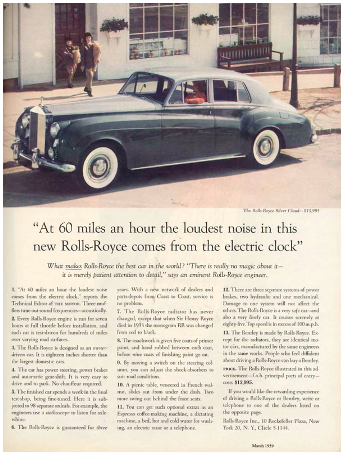
    Famous ads written by Sir David Ogilvy


    Enter the New Millennium

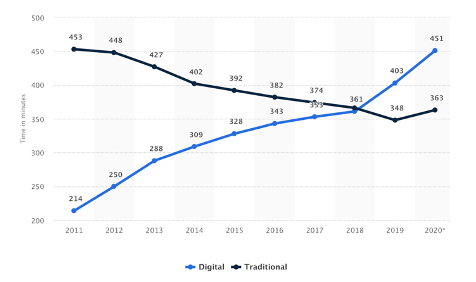
    The new millennium brought with it some profound changes.  The internet was beginning to change the way people live, read, do business, buy, and connect with other people.  In 2004, Mark Zuckerberg launched Facebook.  We learnt a new term called ‘social media’ with its advent. LinkedIn was launched earlier in 2003 and Twitter later in 2006. A host of other social media would completely change the way we live.  So would advertising unfortunately. Because people were spending much less time watching television and reading the newspapers and listening to radio.  In 2019 people spent more time with digital media than with traditional media in the US.


    Time spent per day


    Source: statistica.com


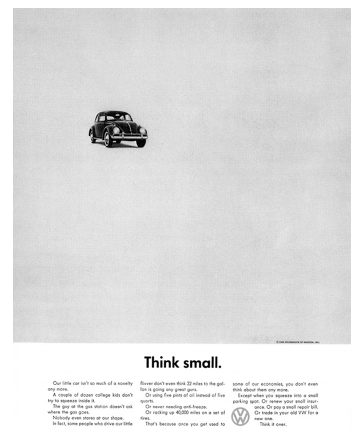
    The world of digital and social media meant new ways of talking to consumers.  This gave rise to new techniques in communicating. It meant that the skill needed to produce the famous Volkswagen Beetle ad by Bill Bernbach that made it a cultural icon that sold millions of cars were no longer needed. One can’t forget of course the degree of difficulty posed to sell an ugly German small car soon after World War II, to Americans used to the luxury of large cars, something the Volkswagen ads achieved admirably.

    1959


    2019


    In fact, the brilliance of the written word employed by master craftsmen like Bill Bernbach and David Ogilvy or the keen visual eye of Helmut Krone was perhaps no longer needed.  In the new millennium creativity had played hide and seek behind a much-abused word called ‘content’. Content was very forgiving of real creativity and happy to make friends with mediocrity.  In contrast to the Think Small ad, the Facebook ad of today for Volkswagen will be judged by the number of likes, comments and shares.  And not purely by how much the ad moves you like the Thing Small ad.  In fact, there seems to be no particular skill this Facebook ad might need either in terms of word or visual craftsmanship.  Suddenly communication had become the domain of data scientists and engineers whose province was machines, algorithms, big data and artificial intelligence. And perhaps creativity was reluctantly but surely taking a back seat.


    How Advertising finally died


    While many predicted the death of advertising no one quite predicted how it would go.


    In the last year, it certainly seems that advertising agencies will get gobbled up by digital agencies in the same group. Grey Advertising is the most recent example which merged with AKQA to form AKQA Group.  Last year similarly JWT merged with Wunderman to form Wunderman Thompson.  And Y&R merged with VML to form VMLY&R. I wonder who is next?


    Suddenly the heritage of a 100 years seems to have gone into the dust. And with the merger goes their history and great creativity of several decades.  When a brand dies, everything it meant to people dies along with it. It is ironic that WPP the group that bought over JWT, Ogilvy, Y & R and Grey is also the company that killed those very iconic advertising agency brands.


    It’s a pity that advertising had to die so suddenly and just get obliterated from the face of this earth.


    Prabhakar Mundkur is a veteran advertising professional and now a prolific commentator. He spent 17 of his 42 years in advertising with the agency once known as J Walter Thompson working with them across three continents. He has also worked with Havas and Hakuhodo. He has been voted Top Voice on LinkedIn, one of the Top Emerging Voices in yourstory.com and has written nearly 400 articles in the last four years. He was once an HMV and Polydor recording artist playing both the guitar and piano and still joins the occasional gig for friends. You will find him on Spotify and Apple Music with his recent compositions. He can be reached via Twitter at @wisecowboy. His views here are personal.