Author: mxmadmin

  • With Moradabad launch, Hindustan now pan UP and Uttarakhand

    By A Correspondent


    Hindustan Media Ventures Limited (HMVL) recently launched its 10th edition in the state of UP from Moradabad. With this, Hindustan completes its footprint across the two states of Uttar Pradesh and Uttrakhand. It is now printed from 18 centres across the states of UP, Uttarakhand, Bihar, Jharkhand and Delhi.


    Commenting on the launch, Benoy Roychowdhury, ED, HMVL said: “Moradabad is a unique region of Uttar Pradesh that has placed India on the global map through its exports of over Rs2,200 crore of brass artifacts annually. Through the launch of our Moradabad edition, Hindustan now serves the entire footprint of Uttar Pradesh and Uttarakhand – two progressive and prosperous states with a rich, cultural heritage.”


    Sharing his views on the launch, Amit Chopra, CEO, HMVL said: “With our launch in Moradabad, we mark the completion of our journey of expansion that began in 2005. We now serve this economically powerful and culturally rich zone. As in our other markets, Hindustan will work to create reader delight through a high-quality newspaper and continuous engagement. We will become partners in progress for the citizens of the region. I am confident that Hindustan will emerge as the preferred newspaper for the people in this region.”


    Rajan Bhalla, (Head-Marketing, Strategic Businesses – HT Media) said: “The core proposition of Hindustan is ‘Tarakki ko chahiye naya nazariya’ – central to our brand and activation campaigns. We approached Moradabad with this very distinct perspective. Our Election Campaign “Aao Rajneeti Karein” reflects our commitment towards the state of UP and creating positive social impact.”


    Hindustan’s Moradabad edition has started with a strong 1.1 lakh circulation, a number that is unsurpassed in that zone. Moradabad launch comes on the back of the recent Aligarh edition launch which continues to progress by leaps and bounds; setting new benchmarks of journalism and reader connect.


    Hindustan Media Ventures Limited (HMVL) is the publisher of the leading Hindi newspaper – Hindustan, Hindi magazines Nandan and Kadambini and the news website livehindustan.com. Hindustan, which is the fastest growing daily in the country has presence in the states of UP, Uttarakhand, Bihar, Jharkhand & Delhi, with a Total Readership of 3.75 crore.


    The company is a subsidiary of the HT Media Group – a diversified media group with interests in Radio, print & online media.


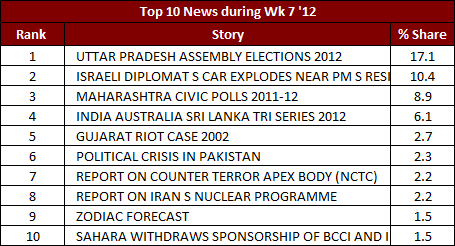
  • TAM NCT Data Wk 7 ’12


    Source: News Content Track – A service of TAM Media Research Pvt. Ltd
    Channels: Aaj Tak, CNN IBN, Headlines Today, IBN 7, India TV, NDTV 24/7, NDTV India, Star News, Times Now, News 24 & Zee News
    Period: Wk 7 – Feb 12 8 to Jan 18, 2012
    Note : Analysis is based on the Telecast duration


    About TAM Media Research


    TAM is a joint venture between Nielsen Company & Kantar Media Research. Besides measuring TV Viewership, TAM also monitors Advertising Expenditure of Television, Print & Radio through its division AdEx India. Since 2004, it extended its presence in the PR Measurement & Analysis space for Corporate/Marketing Clients by setting up a separate division Eikona PR Measurement.


    In 2007, the joint venture introduced RAM (Radio Audio Measurement) service to track Radio Listenership for the Indian Radio Broadcast Industry. In year 2009, TAM launched a division, called TAM Sports that specializes in monitoring Sports Sponsorship ROI.


    TAM Media Research’s objective is to fuel media insights that will drive the growth of the Indian Media Industry.

  • Swad of Success: Regional FMCG firms like Panjon, Bisk Farm, Mapro, raising funds to expand operations

    By Sagar Malviya


    After a gap of almost four years, TV commercial of the once popular Swad digestive candy hit the screens early this month. Swad, which is making a come back, is one of the brands owned by 48-year old Panjon, an Indore-based firm that sells candies to balm and toothpaste endorsed by Shammi Kapoor and Sonali Bendre in its glory days. The plan is to reach out to more states, expand product portfolio and grow sales ten-fold in two years.


    Panjon isn’t alone. Almost half a dozen smaller regional firms such as Bisk Farm, Mapro, Wagh Bakri and V-John, among others, are entering newer states, some advertising for the first time, while others planning to raise funds to survive a fresh salvo by large consumer goods companies that expanded into the turf of smaller rivals last year.


    “While our products are doing well in MP and UP, competition is also getting intense in these home markets,” admitted Atul Kothari, managing director at Panjon, which is in talks with a clutch of private investors to raise funds for expansion. “We are looking to enter Gujarat, Punjab, Haryana and Bihar this year,” he said. The company plans to add more than 1,400 distributors to its existing network of 600.


    So what exactly was the trigger? Well, for one, large FMCG firms have been aggressively reaching out to rural consumers through expanded distribution, which led to smaller regional players losing market share across segments in their core markets.


    Over the past couple of years, P&G has almost doubled its distribution reach and now has a direct reach of 1.3 million outlets, against HUL’s direct reach of 1.60 million outlets. Emami expanded reach by as much as 30 per cent primarily in rural areas, while HUL added more than 50,000 villages to its network just last year. Ditto, in the case of Dabur, which rolled out special rural focused sales initiatives across eight key states and widened reach in 71 high potential districts.


    However, the regional players are now plotting a counter attack, not just in their existing markets but also in newer states. The Rs 500-crore SAJ Food Products that dominatesEastern Indiawith its biscuit Bisk Farm is a case in point.


    “Last year, we entered Karnataka and are planning to reach Andhra Pradesh next month. We aim to have a national footprint by 2013,” saidVijay Singh,MDof Kolkata-based SAJ Food Products. He added that the firm has even discussed internally about coming with a public issue in the next two years.


    But it won’t be easy. And smaller rivals are aware of the fact that price competitiveness with national players would rather be futile with the latter having economies of scale. Hence, they are looking to cash on through their quality proposition rather than being price warriors.


    Maharashtra-based processed food firm Mapro Foods andGujarat’s tea company Wagh Bakri feel that they are better in terms of quality compared with rivals such as Hindustan Unilever. “Large players are very aggressive in terms of schemes and offers. But we believe that consumers want quality and not price-offs,” said Parag Desai, executive director of Wagh Bakri, that is looking to enterPunjaband Haryana.


    Some firms that already have an indirect reach nationally are also keen to distribute products directly and cut costs on intermediaries. Delhi-based Vi-John is reworking its distribution strategy by eliminating super-stockist and instead having selling agents in each state.


    “We are planning to add over 1,500 distributors and 70 stockists to have direct reach in western and southern markets,” said Vimal Pande, CEO of Vi-John Group, which has 30 stockists and 2,500 distributors.


    Modern trade is doing its bit too. “Regional brands need to build stronger consumer connect to keep their consumer franchise or they could expand distribution to add new consumers and grow base,” said Devendra Chawla, president – food and FMCG at Future Group.


    Source: The Economic Times

    Copyright © 2012, Bennett, Coleman & Co. Ltd. All Rights Reserved


  • Realigned DDB Mudra ups ante for APAC push

    By A Correspondent


    After a realigning and restructuring exercise that stretched through to 100 days plus and with several key appointments and a few exits later, the DDB-Mudra alliance presented itself in a new avatar as the DDB Mudra Group at an event in Mumbai yesterday. The event was made interesting by having the APAC, Japan and India Chairman & CEO of DDB, John Zeigler announce the key milestones to the gathering.


    While the top-level realigning at the group was made known earlier to one and all, the event also witnessed a couple of other key announcements from the group. These included the entry of TracyLocke, one of the world’s most awarded shopper marketing agencies into India and the decision to make Water, the strategic branding and design consultancy to join the Interbrand network and represent Interbrand in India.


    With a client roster that boasts the likes of HP, T-Mobile, Starbucks, Johnson & Johnson, Gatorade, Tropicana, PepsiCo, Sony and Unilever’s Lipton, TracyLocke will be managed in India by Pratap Bose, Chief Operating Officer of DDB Mudra Group. According to Jim Sexton, Global Chief Marketing Officer of TracyLocke, “Once we saw the level of retail expertise and comprehensive knowledge of the India consumer and shopper at DDB MudraMax, we knew we had the perfect fit. We look forward to delivering to our clients a unique brand of shopper marketing relevant to each segment of the Indian market. Additionally, we hope to share proprietary marketing tools that we can take from India to the rest of the world.”


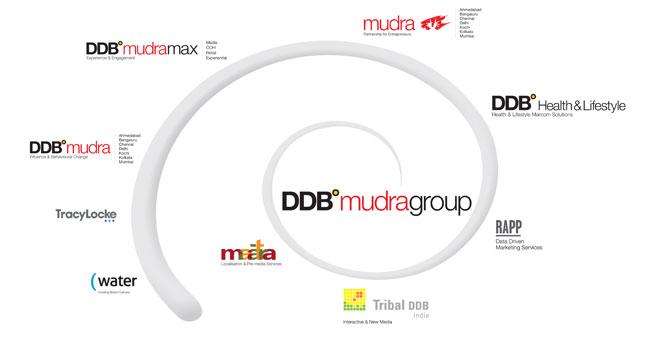
    As for the revitalised DDB Mudra Group, the network in India will be split as DDB Mudra, Mudra and DDB MudraMax. Accordingly the group has adopted a new structure, brand identity, colours and architecture that will drive forward the change. The new structure will comprise eight branded agencies as follows: DDB Mudra – the Influence & behavioural change agency with a pan India presence across Ahmedabad, Bengaluru, Chennai, Delhi, Kochi, Kolkata and Mumbai; DDB MudraMax – the Experience & Engagement agency which offers Media, Out-Of-Home, Retail and Experiential; Mudra – the partnership for entrepreneurs agency with a pan India presence across Ahmedabad, Bengaluru, Chennai, Delhi, Kochi, Kolkata and Mumbai; DDB Health & Lifestyle – Health & Lifestyle Solutions practice; RAPP – data driven marketing services agency; Tribal DDB India – interactive & new media agency; Water – Brand & Design consultancy and Maatra – localisation & pre-media services agency.


    Elaborating on the proposed management structure, Madhukar Kamath, Group CEO and MD, DDB Mudra Group said that while he was proud of Mudra’s past, he is equally excited about the future. According to Kamath, the executive board committee will comprise of Sonal Dabral, Chairman & CCO, DDB Mudra Group, Pratap Bose, COO – DDB Mudra Group, Madhukar Kamath, Group CEO & MD, DDB Mudra Group, Dilipkumar Upadhyaya, CFO and Ajit Menon, EVP – DDB Mudra Group. Excited about the largescale realigning, Kamath said that the new venture would see DDB Mudra emerging amongst the fastest and topmost agency in a few months from now. He was also in praise of his clients of whom he said that about 40 per cent of them access more than one business service of the Group, which speaks volumes of the solutions and services that the group has to offer.


    Earlier, John Zeigler began by highlighting the growth of DDB Worldwide and how it is looking at Asia Pacific, led especially by India, to drive its expansion into the region. “Current figures suggest our growth split as 44 per cent from Europe, 38 per cent from North America, 6 per cent from Latin America and 11 per cent from Asia Pacific. Our core focus would be to increase the pie of Asia Pacific to a large sum going forward and this would be driven by India which is being seen as a leading market in marketing communications by most agencies.” In a one-on-one conversation with MxMIndia, Mr Zeigler was hopeful of deriving a modest growth across APAC as he said, “With the kind of businesses we have in India we should be able to achieve a growth rate of 25 per cent plus. As for our other agencies across Asia Pacific, we had a compounded growth rate in excess of 30 per cent year on year.”


    Mr Zeigler further highlighted how DDB’s model was unique in the sense that it captured both local and global sentiments of its clients and offered services that were unmatched in nature. The idea, according to Zeigler, was to be seen as an agency offering local solutions to international clients who wanted to tap outside markets as well as offering international solutions to local clients who wanted outside exposure to derive local growth.


    On getting TracyLocke to India, Mr Ziegler said, “As one of the leading shopper marketing agencies in US andEurope, TracyLocke brings vital shopper insight and great creativity into our future. The launch in India is its entry intoAsiaand will be providing vast opportunities for the entire DDB Asia Pacific group.” The summit is to be conducted next month and will showcase the experience, skill sets, global practices and learning of the entire DDB Asia Pacific region which has distinguished itself in 2011 with several impressive wins including Spikes Asia’s Network Agency of the Year 2010 and 2011, and AdFest Network Agency of the Year. The summit will be attended by Chuck Brymer, President and CEO of DDB Group Worldwide; John Zeigler, Chairman & CEO, DDB Asia Pacific, India & Japan; and Patrick Rona, Tribal DDB Asia Pacific’s President and Chief Digital Officer for DDB Group Asia Pacific, as well as an overseas contingent of senior agency personnel from across the Asia Pacific region.


  • 5 things that agencies must do to attract top talent

    By Rohit Ohri

    The advertising industry is guilty of ‘criminal neglect’ in its approach to recruiting talent. For an industry that sells original thinking, this is surely creative suicide.


    The good news is that no matter what the size of the company, attracting and retaining talent has more to do with one’s commitment to building a sustainable organisation, rather than how much one pays.


    My core belief on talent management revolves around proactive engagement. If organisations proactively think about how they should keep their employees engaged over a period of time, attraction rates go up and attrition rates fall.


    That said, here are five things advertising agencies must do to attract the best talent: I call it the REACH principle.


    1. Reach wallets

    It’s true that it takes more than just money. But it does take money. Beating the market is neither an attractive nor a sustainable practice when it comes to compensation.


    Many companies ignore this truth and apply a famine and feast mentality when it comes to compensating creative talent. First under-paying, when the company has the leverage and then over-paying later, in order to attract or keep that talent from being snapped up by eager competition. This breeds suspicion and kills loyalty.


    Instead, be relentlessly pro-active in maintaining market parity at every position, with bonuses and incentives for extraordinary results. This creates an environment in which financial resentment is not a motivation for your talent to look for new opportunities.


    Desperate competitors may still over-pay. But when talent feels valued, the premium required to convince them to leave gives you an immediate competitive advantage.


    2. Reach clarity

    Clearly articulate your vision and then build around it. As a species, we are united by our instinct to create. We want to make things… especially, a difference.


    Google’s success is driven by a simple premise – to organize the world’s information and make it universally accessible and useful. A goal that attracts informs and unifies some of the most original thinking of the last ten years.


    Define the change your company wants to make in the world. No matter how local. Nothing attracts like a clearly defined vision of a better future. Being made to feel that one plays a significant role in helping the company achieve its goals enhances performance and builds loyalty.


    3. Reach goals

    Measuring progress is one of the keys to harnessing creativity. A study in the Harvard Business Review showed that a sense of progress is the attribute which people value most in their day. Progress can only be measured on a continuum that has a beginning and an end.


    Defining the difference you want your business to make provides the latter. The former comes from individual reviews – a subject worthy of its own post. Annual reminders of how far the organization has come are also imperative.


    Celebrating the company’s anniversary with a retrospective comparison of where you were a year ago and now stand, is simple and powerful. It helps to reiterate goals and review the course…


    4. Reach out

    Be Open. Be Honest. Transparency is the most over-worked word in the English language at the moment. However, this does not make it less essential to attracting and retaining great people. Don’t build walls around you…break barriers and allow others to do too. If you want your people to respect your view points, respect their’s too.


    5. Reach hearts

    Say Thank You. The artist in all of us needs to be recognized. So does the human being. And yet most companies are slow to praise. Or even to thank. Thanking your people as often as possible is a small acknowledgement that you take neither their talent nor their choice for granted. Respect their choice to stay with you and chances are that they won’t go anywhere else in a hurry.


    These steps require investment – of time – and a little money. Practice them collectively and your company will be irresistible – and invaluable…


    Rohit Ohri is the Executive Chairman at Dentsu India Group


  • ArtistAloud.com is back in a new avatar

    By A Correspondent


    ArtistAloud.com, the digital platform for independent music has been entertaining audiences with the very best in independent music. With support from the audience and musicians alike for two years since its inception, this digital destination is back in a brand new avatar.


    To commemorate the second anniversary and the launch of the re-vamped website, ArtistAloud.com will be celebrating the Seagram’s Fuel Music Day on March 2. Music Day is going to be the longest webcert with around 50 independent artists performing live for the digital audience. 50 artists, 1 stage, Seagram’s Fuel Music Day is an attempt to connect artists and listeners closely. Also, for the first time ever 50 artists will share a stage and a venue to perform for all music lovers across cities, counties, language and genre.


    The Seagram’s Fuel Music Day event that will start at 12pm with artists like Suneeta Rao, Manasi Scott, Shefali Alvares, Shilpa Rao, Harshdeep Kaur, Neha Bhasin performing their favourite numbers. This is the first time ever that 50 artists will come together to perform Live for the webcert. Other stalwarts of music industry like Shankar Ehsaan Loy, Sonu Nigam, Shankar Mahadevan, Kailash Kher are also expected to attend Seagram’s Fuel Music Day to show their support for independent music inIndia.


    The 9-hour long webcert attempts to enthrall the audience with absolute mix of genres. From fusion to pop, Bollywood to rock, Seagram’s Fuel Music Day will have something special for every listener. The event will be relayed live to a global audience on www.artistaloud.com from Rang Sharada in Mumbai.


    The idea was conceptualized by ArtistAloud.com to celebrate their second anniversary. During the last two years, the website has emerged as the most preferred digital destination for independent music in India. With a promise to offer audiences access to more artists, new genres, multiple releases and music videos, ArtistAloud.com is back in a new avatar.


    The website has been revamped with a prime objective of offering unreleased singles – Music First. With the new Artistaloud.com, the consumer now gets a chance to browse the home page that showcases multiple artists and multiple releases at the same time.


    With video consumption on the rise, users will now have access to high quality video content on the website. The new revamped website allows full streaming of songs as compared to the previous 30 second samples.  Besides a new layout and structure, the new site will also subsequently introduce a plethora of properties that will live up to its brand promise- ‘Music First.’


    ArtistAloud.com is now made accessible through 5 touch points- website, WAP, IVR, APPS and social media. The main objective behind the revamp was to make the site compatible with any device – PC, mobile smart phone, tablets and connected televisions.


    ArtistAloud.com is a digital platform that provides music lovers access to unreleased music, which they can sample, buy as well as share with the world. An initiative pioneered by Hungama Digital Media Entertainment Private Ltd, ArtistAloud.com is an opportunity for independent artists to build a connect with their fans and for fans to have access to their music that is previously unreleased and created by the Artist for them. The site currently houses original music from over a hundred artistes – both well known and new.


  • DraftFCB Ulka’s Cogito Consulting & Asterii Analytics Release India 2061 Report

    By A Correspondent


    Cogito Consulting and Asterii Analytics present a fitting finale to the Draftfcb Ulka Group’s 50 Year Celebration, with a projection of whatIndiacould be when the Group celebrates its centenary. After digesting reports from over 150 sources, more than 1000 pages of data, talking to experts, economists, academics, a concise form was put in public domain on February 29.


    Coming from the context and belief that brands have a potential for immortality and last well beyond brand managers and sometimes even companies and owners, it may be necessary to plan for brands well beyond just the next 3-5 years.  The supplement highlights some important scenarios that will help build brands for not just the next few years, but well into the next 50.


    Some key aspects of the report on ‘India 2061’.

    • From a pre-dominant rural population today urbanization will lead to rural population constituting to about 43 per cent of the total population.
    • Average life expectancy to go up to 79 years and number of senior citizens to grow from 8per cent  to about 24 per cent  of the population.
    • Within the next 10 years, literacy levels are projected to jump to 95 per cent  with almost complete literacy achieved by about 2030.
    • Internet penetration will touch 92.7 per cent  with over 1592 million users.
    • Per capita income will be up to Rs11,63,000 from the current Rs. 37,000.
    • There will be an estimated 319 million four-wheelers and 573 million two-wheelers making a total of 900 million vehicles on the Indian roads.
    • Number of air travellers will double every decade andtouch 860 million in 2061.
    • Televisions are expected to achieve a 97 per cent  penetration with over 50 per cent  homes boasting of multiple TV sets.
    • Ad spends are expected to grow to Rs33 trillion by 2061 and contribute a wholesome 1.5 per cent  of the GDP.
    • The movie industry acrossIndiawill produce about 2234 films in 2061 i.e. more than all the Hindi movies produced between 1961 and 1991 in India.


    The knowledge piece has been released in a leading publication and is available on www.cogitoconsulting.com


  • HBO documentary ‘Saving Face’ wins an Academy Award

    By A Correspondent


    Pakistani documentary film ‘Saving Face’, produced by HBO, which uncovers the story of hundreds of people, mostly women who become acid attack victims, was honoured with the Academy Award for best documentary (short) at the 84th Academy Awards ceremony held inHollywoodrecently.


    Every year inPakistan, many people – the majority of them women – are known to be victimized by brutal acid attacks, while numerous other cases go unreported. With little or no access to reconstructive surgery, survivors are physically and emotionally scarred, and many reported assailants, typically a husband or someone close to the victim, are let go with minimal punishment from the state.


    Directed by Daniel Junge and Sharmeen Obaid-Chinoy; Saving Face chronicles the arduous attempts of acid-attack survivors Zakia and Rukhsana to bring their assailants to justice, and follows the charitable work of Dr. Mohammad Jawad, a plastic surgeon who strives to help them go beyond this horrific act and move on with their lives.


    A journey of healing and a battle for justice, Saving Face, the 40 minutes documentary will be premiered soon only on HBO.


    Launched in September 2000, HBO is the English language movie channel available in South Asia (India, Pakistan, Maldives and Bangladesh). HBO brings the best of Hollywood by premiering top blockbuster movies on television first in South Asia through exclusive licensing deals with more than 16 studios and companies.  It is the only English movie channel to feature cutting-edge award-winning original productions year on year. HBO has won 3 Golden Globe Awards this year. HBO Asia is a joint venture of HBO (a Time Warner company) and Paramount.


  • Aegon Religare hijacks ‘i’ from TOI

    By A Correspondent


    Aegon Religare ‘hijacked’ the letter ‘i’ from yesterday’s national daily, The Times of India. The innovation was done to introduce the new and improved iTerm Insurance plan for Aegon Religare. The front page of the TOI in 8 metros carried the letter ”I’ in the masthead and headlines in the colour blue and in small font similar to the ‘i’ used in the word icon in the main copy advertising for Religare.


    Talking about the objective behind this campaign, Mukesh Waje, AVP, Branding, Aegon Religare said, “It is very clearly to announce the launch of a product that has been a pioneer in the market. This campaign is to announce the comeback of an icon. The campaign will unfold further on the web and will heavily rely on this medium. Besides we will have radio and print to support for the duration of the next three weeks.”


    The campaign is designed by Ogilvy and BCCL has partnered on media. Though Mr Waje refused to put the amount spent on the campaign, he added, “We have already started getting calls post the ad and we are positive that the campaign will do well for us.”


    Aegon had earlier created a stir with its KILB campaign during its launch which talks about being underinsured. Last year, during the same time, the company had done another print campaign on the jacket of TOI where the print of the first page was hardly legible, thus asking if one’s insurance was as faint as the words on the paper, again pointing to being underinsured.


  • Radio City Connect’s awareness campaign for Pune Strykers

    By A Correspondent


    Radio City Connect, the event activation cell of Radio City had organised an awareness campaign for the “Pune Strykers” hockey team at the SGS Mall in Pune. The team was launched on-air and on-ground at the same time. The team launch is said to have been a live event in the mall, along with a flash mob and studio shift. A Radio City studio was created in the mall wherein RJ Sonali went live and treated listeners with the grand proceedings of the launch.


    The entire team of ‘Pune Strykers’ introduced themselves to the audience on-ground as well as to the listeners on-air.


    Radio City Connect orchestrated a flash mob where the dancers grooved to the ‘Pune Strykers’ Anthem choregraphed by Piyush Malhotra, a renowned choreographer.


    Adding to the excitement, Radio City Connect incorporated ‘Minute to Win It’ games for contestants. Merchandises like miniature hockey, bags, key chains and pens were given during the entire activity.


    Moreover, a signature campaign was carried out by Radio City Connect that gave the audience a chance to articulate their love and blessings for the team by writing messages and signing on the board.


    Ashit Kukian, COO,Radio Citysaid: “We are delighted to launch the Pune Strykers Hockey Team. As a medium that enjoys immense local relevance and personal connect with listeners, we have been able to cultivate a strong expertise in on-ground activations. This is the first time a sports activity has been launched on-ground and on-air simultaneously. I am glad that the response was much more than what we had anticipated. Our effort to create awareness of the team by reaching out to maximum number of listeners and contribute towards adding popularity to the game of hockey has been successful. ‘Radio City Connect’ which is Radio City 91.1 FM’s full spectrum activations cell provides end-to-end 360 degree brand marketing solutions to all our clients. Our proficiency in executing on-ground activations has propelled this partnership with the World Series Hockey.”


    Mr. Manoj Choudhary, Franchise Owner, Pune Strykers and promoter of Jewel Products said: “World Series Hockey was conceived with the objective of reinvigorating the sport of hockey in India and creating a financially self-sustaining ecosystem for hockey to thrive and grow to become the “sport of choice” for young Indians. We chose Radio City Connect because our team spirit and attitude is synonymous with their brand attitude; leadership, energetic and pep.”


    More than 18,000 people are said to have attended this event which was covered by many leading publications and TV channels.


    World Series Hockey is a joint initiative between the Indian Hockey Federation and Nimbus Sport. An annual event, World Series Hockey will feature “city-based” teams playing against each other in a “home and away” league, culminating into a multi-header playoff to determine the World Series Hockey Champion.

  • Being the best is our trademark: John Ziegler


    After a three-month long restructuring and realigning exercise in India, DDB Mudra Group presented itself in a new and refined avatar to the world on Tuesday. Having found its saviour in Mudra to expand its foot print in to India, DDB Worldwide is ready with a formula and a team that it promises would shake up the Indian advertising and media market and make it a force to reckon with in the coming months.


    Representing the group to make this historic makeover, John Zeigler, Chairman and CEO of DDB Group, Asia Pacific, Japan & India was a picture of hope and accomplishment as he presented to the gathering his views and expectations from the alliance.


    As the leading voice, and overseeing markets that span 21 agencies in 16 countries, and more than 2,500 employees, Zeigler is a great believer in reinvention and what it implies for brands in this global, think local, market. In conversation with Johnson Napier of MxMIndia, Zeigler emphasises on India’s role in the APAC market for DDB Mudra Group, on how rival agencies like WPP are taking a cue or two from his agency and what the agencies of today need to know to stay ahead of the curve. Excerpts:


    Q: How would you assess DDB Worldwide’s growth story across the globe, especially in the Asia Pacific market led by India?

    Across our businesses worldwide, we are looking to achieve a growth rate of 15 per cent. With the kind of businesses we have in India, we should be able to achieve a growth rate of 25 per cent plus. As for our other agencies across Asia Pacific, we had a compounded growth rate in excess of 30 per cent year on year.


    Q: Having upped your stake in Mudra recently and post the overall restructuring exercise in India, it seems to be an affair that was heavy on the investment front. Your comments.

    I would say the investments have really been in terms of people, training, exposing them to the rest of the business operations that we have and we are doing that dynamically every day. From another investment point of view, we see the opportunity to jointly grow our businesses which doesn’t require any investment other than time, talent and people.


    Q: Do you see Omnicom further raising its stake in Mudra anytime soon?

    That is something that will be really dictated by the equity partners comprising of Reliance Group and Omnicom. It is something that will echo with the passing of time. From our point of view, it should happen as quickly as possible.


    Q: You have all along emphasised the importance of emerging markets for the DDB Group. Have you identified any new markets that you plan to tap in the near future?

    We are going to scale up our growth soon in the market of Vietnam. We have just wrapped up an acquisition deal there and will be starting a new business soon. And the other key country for us would be Indonesia. But we would be able to tell you more about these markets only later.


    Q: While the emphasis of the group is on providing 360-degree integrated solutions, it is creative that is stealing the thunder to a certain extent in India. What do you derive of this sentiment? Where does digital fit in this matrix for the group?

    In terms of social creativity, what we have learnt is that the connection of creativity across digital and traditional – there is no wall. We have to look at it as a complete communication opportunity to capture the consumers’ interest and intrigue, the ability to pass it on and for them to become the media. So we are going to be growing digital but not as an exclusive digital entity alone; we’ll be growing digital within the core business as well as specialty part of the business.


    Q: How would you assess Omnicom’s growth story against those of WPP and Publicis Groupe who have also heightened their interest around the Asia Pacific market? 

    Omnicom is very anxious to grow inAsia. We have demonstrated that already. If you look at the last five years, you will see Omnicom has had much greater organic growth than WPP. This organic growth has been complemented by some strategic acquisitions and you will see Omnicom continue to grow much faster than the other groups. Again, our goal is never to be the biggest, it is just to be the best. In fact, WPP has also now changed their slogan to say that being best is better than being the biggest. But that’s only because they have talked about being the biggest, that they are understanding the importance of being the best – like we always have; so they are trying to take an element of that positioning from us.


    Q: Though a sister agency, how has BBDO been growing in India and in Asia Pacific?

    We work differently and therefore I cannot comment as such, but I would say that they have been doing well in India. Obviously we would like to support them and help them sell their services to their clients through the existing base from the DDB Mudra Group. We do share some clients, like for instance we both service Johnson & Johnson, Mars, and others. So we compete and collaborate with BBDO where it is relevant for our client.


    Q: Though not as grave as its predecessor, the slowdown has impacted the growth of the industry to an extent, including in India. What are your views on the global media growth story going forward?

    Most of the agencies are trying to fix the economic crisis situation by leveraging money – making money spread thinner than it should. That’s one of the reasons why banks got in trouble because of bad business practices. I think a lot of people are struggling with the economic crisis because they have tried to cut their cost structures down so far that they have actually started to cut into the value of their corporations. I don’t believe that cost-cutting, mergers and acquisitions, and the availability of finance will help the rest of the world reinvent itself. But I do believe that creativity applied to a business will give any business that uses that well, a competitive advantage. I believe that those firms which access and leverage competitive advantage best will win. I think the countries that are leveraging competitive advantages are winning today. Shanghai, Hong Kong, Singapore are leveraging their strategic expertise, their positioning, their competitiveness and they are benefitting from other areas that aren’t doing so well. But all this has to be seen from a country and a geo-political level, and would, therefore, differ across markets.


    Q: Has this sentiment aroused the apprehensive levels of clients?

    They are very apprehensive as they often ask how we increase our share of returns to our shareholders. There comes a point where the only way to do that is to gain a point from the competitors. And you can only gain more points from your competitors if you are more creative.


    Q: Worldwide, there is a trend of companies opting for CMOs to drive the growth for the organisation. Should ad and media agencies look at this trend as a means to beating the recession blues?

    We don’t have a CMO as such at the top as we work in an executive committee collaborative fashion and we do not believe that one person can manage that through the complexities of all brands and offerings.


    One of the things that agencies have more trouble is that clients have more focus in cutting the cost of an agency then they have put in to understanding how to get best value out of the agency. Until that changes, we cannot reinvent ourselves because we are running on very thin margins, we are trying to be creative and inventive, but we are being constrained by financial controls.


    The first thing that many clients do when they come to an agency is, they say: we do not pay for senior management involvement; that is agency overheads… some clients even come and say: I want to know how much time of your senior management I’m going to get and then we’ll negotiate the rest… those clients are smart because they are buying the best expertise and not just buying heads to do functions and processes.


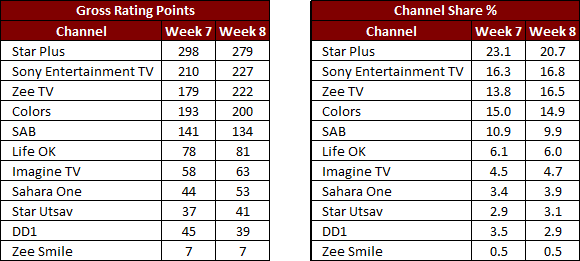
  • TAM Data (GRPs Channel shares of HGECs)- Wk 8 ’12


    Source: TAM Peoplemeter System

    TG: CS 4+ yrs

    Market: HSM

    Period: Wk 7: Feb 12 to Feb 18, 2012

    Period: Wk 8: Feb 19 to Feb 25, 2012


    About TAM Media Research


    TAM is a joint venture between Nielsen Company & Kantar Media Research. Besides measuring TV Viewership, TAM also monitors Advertising Expenditure of Television, Print & Radio through its division AdEx India. Since 2004, it extended its presence in the PR Measurement & Analysis space for Corporate/Marketing Clients by setting up a separate division Eikona PR Measurement.


    In 2007, the joint venture introduced RAM (Radio Audio Measurement) service to track Radio Listenership for the Indian Radio Broadcast Industry. In year 2009, TAM launched a division, called TAM Sports that specializes in monitoring Sports Sponsorship ROI.


    TAM Media Research’s objective is to fuel media insights that will drive the growth of the Indian Media Industry.