Author: mxmadmin

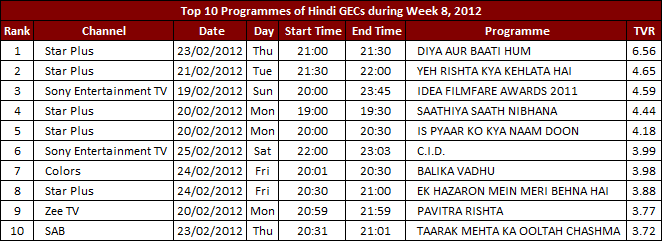
  • TAM data Top 10 programmes on HGEC – Wk 8 ’12


    Source: TAM Peoplemeter System
    TG: CS 4+ yrs
    Market: Hindi Speaking Market
    Period: Wk 8 (Feb 19 to Feb 25), 2012


    About TAM Media Research


    TAM is a joint venture between Nielsen Company & Kantar Media Research. Besides measuring TV Viewership, TAM also monitors Advertising Expenditure of Television, Print & Radio through its division AdEx India. Since 2004, it extended its presence in the PR Measurement & Analysis space for Corporate/Marketing Clients by setting up a separate division Eikona PR Measurement.


    In 2007, the joint venture introduced RAM (Radio Audio Measurement) service to track Radio Listenership for the Indian Radio Broadcast Industry. In year 2009, TAM launched a division, called TAM Sports that specializes in monitoring Sports Sponsorship ROI.


    TAM Media Research’s objective is to fuel media insights that will drive the growth of the Indian Media Industry.

  • [MJR] Quality of journalism has gone up: Mohan Sivanand

    Mohan Sivanand, India Editor, Reader’s Digest talks with MxMIndia’s Archita Wagle about his journey so far, touching on the changes in the field which he has seen in the past 36 years. Excerpts:


    Q: Tell us a little about your background and your life as a journalist.

    I have been in this field since I finished college in 1976. After my Senior Cambridge exams, I did a BSc in physics, then studied for an MA in English and a post-graduate diploma in journalism. Everything I studied has helped me in some way or other. I think and use, both, science and arts every day at work. I joined The Times of India as a trainee in 1977. I worked there for Science Today magazine (the magazine is not published any more). I worked with the TOI group for over six years, till 1983, when I joined Reader’s Digest. I joined RD as an assistant editor, when I was about 30.


    Q: Having been with RD for nearly 30 years, did you never feel that you needed a change or wanted to move to a different publication?

    No, I have not wanted to change jobs. I’ve liked it here.


    Q: How has the journey in these two companies been so far? What have been your learnings from them?

    Both the companies, TOI and Reader’s Digest, have been extremely good as learning experiences and dedication to journalism go.  I had very good editors to look up to, Surinder Jha of Science Today and Ashok Mahadevan at Reader’s Digest. Both these gentlemen gave a lot of importance to error-free content and laid emphasis on fact-checking. Ashok insisted that we learn to respect our readers and never underestimate them. That’s why our magazine is called Reader’s Digest.

    I follow those principles. One should never compromise on the quality of the content. I will hold an article back if I have some doubts about facts or if they have not been properly verified.


    Q: How does the process work?

    The process is the same for everybody, be it our US editor, myself, a staff writer or a freelancer. Even when I write an article, I have to give references and provide my sources to our researchers. The researchers have to double check every fact. They are, generally, the youngest employees who start out in RD with fact checking. Even I, sometimes, check and verify facts.


    Q: Over your 36 years in the industry, what are the changes that you have observed?

    In spite of everything, I feel that there has been a positive growth in the field. The quality of journalism has gone up in the past 30-odd years. I read a lot of articles and I feel that youngsters today are writing very well.  It is a pity that some of the better talent may be going towards the electronic media, but even the print media has people writing extremely well. I read a lot of good stories in many publications.

    Take the example of The Economic Times. It is much better today than it was 30 years ago. Maybe it is because business and markets have developed, and journalists today are well-connected via the Internet and they have access to a lot more information.

    In the past, most youngsters never thought of going for business journalism or working for technology magazines. In those days, we had just one Science Today, but today there are a lot of specialised magazines.

    Despite all the negativity, like ‘paid news’ or advertising interfering in editorial content, I feel that there is a lot of good stuff too. The vast majority today are proper journalists.


    Q: As a part of a magazine that places so much importance on content, what is your take on advertising interfering in editorial decisions?

    Actually, the ad people aren’t allowed to interfere in any editorial decision-making at Reader’s Digest. It is unethical. We have strict guidelines in place. Our ad colleagues can give us ideas just like anybody else, and that’s it. They can’t ask us to publish advertorial content and pass it off as editorial content.

    Most leading American magazines have the same policy. Indeed, some Indian publications bow to advertising pressure. By doing so, they are only killing themselves.

    If they continue to pass off advertising as editorial content, sooner or later the reader will realise what is happening and stop reading the publication. One can always tell the difference between an advertising plug and editorial content. The readership will drop and the publication is the loser in the long run.

    Often the ad executives are short-term employees who only look at short-term profits. They often don’t care about the damage to the publication’s reputation, so editors have to take a stand and refuse any such interference.


    Q: There have been rumours that Reader’s Digest editorial is being shifted to Noida…

    There is a corporate plan to shift to Delhi but nothing has been finalised yet. It has to be a very cautious move, since we can’t train new people overnight for our kind of journalism, our kind of writing and editorial practices.

    India Today Group, which is the Digest’s partner in India, wants to house all their publications under one roof.  We are the only India Today publication in Mumbai… but as of now nothing is finalised.


    Q: Will such a move, in any way, affect the editorial policy or content?

    There will be no change in terms of policy and the kind of content. Nowadays it doesn’t really matter where you are. One can work from anywhere. But as far as our content is concerned, we are the world’s, and India’s, highest-selling magazine, so why would anybody want to tamper with what has been working well so far?


    Q: We hear that RD is also going the digital way…

    Yes, from February 2012, RD can be accessed on tablets, including iPads for a subscription fee of about $1 a month, which is less than the cost of the monthly print edition. Our US parent edition launched its digital version last year. We were a little late, but I believe sooner or later, most of the print publications will have to go the digital way side by side. If you don’t do it, you are risking your future.


    Q: Has there been any drop in readership?

    We haven’t seen any significant drop in the readership. We print five lakh copies a month in India. But we had to move to a digital version before we witnessed any drop. Print magazines will never die out in India, but they may witness some decrease in circulation and that can hopefully be covered by increases in digital versions.

    As of now, the marketing of our digital version has not started with full force. But we will soon, and possibly have some more interactive content for our digital readers.


    Q: Apart from being the India editor of Reader’s Digest, you are also an artist.

    I was an artist before I became a journalist. When I was in college, I used to draw for Shankar’s Weekly, which was India’s equivalent of Punch magazine. I started oil painting in 1991. Between 1994 and1999, I held four solo exhibitions and some group exhibitions of my work.

    But after I became the editor, I stopped exhibiting as I don’t get enough time. My job takes a lot of my time. I still paint and draw, but as a means of relaxing. I will go back to painting full time after I retire.

     

  • Komli Media acquires Singapore-based online advertising network Admax

    By Radhika P Nair


    Online media network platform Komli Media has acquired Singapore-based online advertising network, Admax, in a cash-and-equity deal, said Komli’s CEO, Prashant Mehta. Mehta declined to reveal the deal size.


    With this buyout, Komli intends to expand its reach in South East Asia, which Mehta termed as a billion-dollar opportunity. “We will be able to leverage Admax’s team, expertise and relationships in all the South East Asian markets,” said Mr Mehta.


    Admax, launched in 2006, claims to be the largest online advertising network in the region, with a presence in Indonesia, Malaysia, Philippines, Singapore, Thailand and Vietnam. Admax will give Komli access to a publisher network of over 4,000 local and international websites.


    Komli estimates the online advertising market in the region to be worth approximately $250 – 300 million, and growing at 30-40 per cent per year. “Our target is to become the leaders in the rapidly growing Asia-Pacific market as that will add tremendous value to our global operations,” Mr Mehta revealed.


    Komli, founded in 2006, has followed the acquisition path to speed up growth in different geographies. The Admax deal is its sixth acquisition in two years and the second in the region. In mid-2011, the company had bought out Singapore-based online media sales venture Aktiv Digital. Komli had earlier acquired Australian website representation firm, Post Click, and UK-based online ethnic marketing company Indoor Media


    The company has favoured the inorganic route for acquiring technology as well. In late-2011, the company took over the India business of video advertising venture, Jivox, and in July 2011 acquired mobile advertising and publishing network, Zestadz.


    Admax will be rebranded and the 100-strong team will join the existing Komli team in the region. Komli is targeting to reach $100 million in revenue in the next 12 to 24 months, said Mehta.


    Source: The Economic Times

    Copyright © 2012, Bennett, Coleman & Co. Ltd. All Rights Reserved


  • 5 reasons why March is an unforgettable month

    By A N Chorrea


    It’s March 1. In the good old days on Radio Ceylon or Sri Lanka Broadcasting Corporation, we would hear the song ‘Din Hai Suhana Aaj Pehli Tareekh Hai’. I am not much of a radio person now (especially after Radio One turned Hindi and knocked out all its star RJs), but I think I do see an ad with that playing somewhere.


    So here are my five reasons why March is an unforgettable month.


    1. It’s 30 days and some hours for the year-end. Targets aren’t complete this year. The newspapers say the market’s looking up. But where the sugar are the monies?

    2. It’s the month, when the appraisal process starts in most organisations… chances are it’s already done in the boss’s mind

    3. It’s the month where one needs to make all the tax-saving investments… but where’s the money in the bank?

    4. It’s the month where the kids have their exams. And even if your kids are too small or big or you have none, there are several all around.

    5. It’s the month this year where the Union Budget is going to be announced which is a huge distraction for many big spenders… there are just 31 days in the month and we are losing a few thanks to the holidays (and, yes, Holi too!) and now the Budget too.


    Here’s wishing you a happy March. Enjoy


  • [MxM Radio] I don’t see news as a game changer: Naval Toshniwal, Tomato FM

    By Robin Thomas


    He completed his MBA from Symbiosis Institute of Business Management, Pune in 2003. He joined the radio business of Pudhari Publications and is said to have played a key role in winning the bids for Kolhapur and Sangli FM radio. Naval Toshniwal is the CEO of Tomato FM and Vice President, Pudhari Publications. In conversation with MxMIndia, Mr Toshniwal spoke at length about the success mantra of his talk-based radio station in Sangli. He also shed some light on radio consumption behaviour among the people of Kolhapur and Sangli markets, besides talking about the overall growth and challenges facing the radio industry.


    Q: How would you rate the year 2011 for Tomato FM and the radio industry?

    As every year, 2011 too was good in terms of acceptance of radio as a medium by advertisers. We saw more and more advertisers coming on board and using radio more effectively as a result the maturity and the acceptance of the medium have gone up. In addition to this development the year 2011 also saw bleak in advertising revenues were bleak, although the revenue levels have grown at the corporate level. The same year also saw a lot of content and marketing innovations in radio, a lot of and on ground activities and other activations that have helped the advertisers achieve their final objectives.


    Q: What is the Kolhapur and Sangli market like from a radio consumption perspective?

    Unlike other markets what is more significant about Kolhapur and Sangli is the fact that the overall penetration of radio in these markets is very high. Radio as a medium is very successful here, and it has been so for many years. However, the popularity and penetration of the medium further increased only after the entry of private radio stations. The kind of involvement the people in these two markets have with the medium is very high. The overall acceptance of medium too is very high. The listeners look up to the medium not only for music, but also for regular updates about their cities, their State and the Country.


    Q: Initially Tomato FM was present in both Kolhapur and Sangli, it has now been renamed to Aaple FM in the Sangli district. What was the entire concept behind this move?

    When we conducted a survey in the Sangli district we found out that there was a huge demand for a talk-based radio station which not only allowed the people to listen to experts discuss and debate on various topics but, also allowed them to participate in the discussions. Today, I can say that we have been successful to a very large extend in this format. Earlier there have been various attempts to start a talk-based radio station which more or less did not work. If you are starting a talk-based radio station there must be a very strong local connect to make the channel a success.


    Q: Do you also play music on the talk-based radio station? What is the talk and music content ratio in Aaple FM and what is the station language?

    Aaple FM is a completely local Marathi talk format radio station that plays only Marathi songs. However the majority content in Aaple FM is talk whereas the music content is very low. The songs are played for only 16 minutes an hour.


    Q: The government has approved the MIB’s phase III proposals, e-auctions, news through AIR etc. How do you view these developments in terms of growth in radio?

    Honestly, despite all these developments I don’t see any buoyancy or excitement in the industry. I believe this is because with every development proposed by the government there is also a handicap to it. For instance despite the government allowing news, the source of news is restricted to Prasar Bharati. So what is the differentiating factor here, news will sound same in every station perhaps without any local connect.


  • LMG wins Henkel India media buying duties

    By A Correspondent


    In a multi-agency pitch for the newly acquired portfolio of Henkel, Jyothy Laboratories Ltd has awarded the media buying responsibility of Henkel brands to Lintas Media Group. Mudra Max will handle the Planning mandate.


    The media buying for Jyothy Laboratories is handled by Lintas Media Group and therefore, in a reiteration of their faith in LMG, they have awarded the Henkel business to them as well. Put together, the account is estimated to be around Rs150 crores. The other agencies invited for the pitch were OMD and Mudra.


    K. Raghavendra – General Manager Marketing, Jyothy Laboratories confirmed that the media buying AOR  for Jyothy Laboratories Limited and Henkel will be handled by Lintas Media Group and the Planning mandate has been given to Mudra Max.


    Suresh Balakrishna of LMG said: “We are extremely delighted to have won the Henkel business. We have constantly delivered on the Jyothy Laboratries brands and therefore, this new win not only encourages us, but also spurs us on to deliver better business solutions to our clients at optimal costs.”


    The business pitch was led by the newly-elevated COO, Mr Premjeet Sodhi. “The science that we bring to the process of buying, negotiation, optimization and evaluation, with the help of some of our unique proprietary tools, has made our product truly cutting-edge. We are happy that Jyothy Laboratories has recognized this and this win will ensure that we continuously strive to deliver a better media product to our clients, year after year,” he said.


  • Zee aims to Ditto its DTH success story


    By Rishi Vora


    It is said that one who adapts as per the changing times is the one who succeeds in the long run. Recession or no recession – it doesn’t matter. If organisations continue to focus on what the market needs, success stories will continue to emerge and growth will eventually take precedence over many a hurdles.


    Adapting to the market and launching a relevant product in India’s broadcast sector is Zee Enterprises Ltd; the company that has been credited for making early inroads in the TV entertainment space in India and making it big internationally. It has now set an example in the New Media space with the launch of Ditto TV.


    Punit Goenka

    Ditto TV is India’s first Over-The-Top TV distribution platform offering live TV and on-demand content to end consumers on mobile phones, tablets, laptops, desktops, entertainment boxes and connected TVs.  The product has been brought out in the Indian market with the help of technology partner, Siemens.  “The offering fundamentally turns appointment viewing as a concept on its head,’ said Punit Goenka, Managing Director and Chief Executive Officer, ZEEL.


    On what it means to the group Mr Goenka said: “It adds a different dimension to business model. The idea was to bring cutting-edge wireless broadband digital services to customers across the world. Over the years, we have launched many industry firsts, but this is a launch that I’m excited about; I believe that Ditto TV will transform the way content is consumed and monetised.”


    Vishal Malhotra

    “For our channel partners- namely, for content owners, distributors, retail, OEMs and service providers, Ditto TV creates unique revenue generating opportunities,” explained Vishal Malhotra, Business Head – New Media, Zee Entertainment Enterprises, on what it means to its channel partners.


    Apart from India, the platform will be available in the UK, UAE, New Zealand and Australia. And United States will follow in the priority list, by end of this quarter.

    So yes, it’s an experiment by Zee, but as experts have pointed out, it’s a risk worth taking as consumption patterns of consumers are going through a sea change with the advent of digital technologies.


    Ditto TV will offer features such as adaptive streaming, elaborative programme guide, content recommendation engine and an interface which is integral to enhance the user experience. Moreover, it allows for complete customisation in terms of cost as well as content – where users are given an option to handpick a basket of channels as per their own personal preferences.  Price points start at Rs49, where the consumer gets access to three channels of his choice.


    Yogesh Radhakrishnan, a veteran in the field of TV distribution in India, said: “There are some issues like inadequate bandwidth; broadband connectivity is a pain, but having said that OTT is a technology for the future. For it to reach to the masses, it will take some time.”


    As for the broadcasters, Ditto TV comes in as an additional platform to showcase their channels on. And just as the thought crosses the mind, as to how many broadcasters will Zee be able to get on board, the news is that already 21 channels have agreed to use this platform.


    MSM Group, TV Today Network, BBC, and Zee are a few networks that will allow their channels to be available on the platform. A few important contracts yet to be signed which includes Reliance Broadcast, Star and Times Network. The company expects to offer a complete set of 50 channels shortly.


    The sense is that it is a matter of time before the rest of the industry embraces this new platform from Zee. As informed by Mr Goenka, monetisation via advertising can only happen once it reaches out to a critical mass – at least 5 per cent of the audience which consumes TV content on a daily basis. So there is still some time for advertisers to worry about this new delivery platform. But, that doesn’t make this venture of any less significance for Zee.


    Mr Goenka pointed out that a significant investment has gone into setting up Ditto TV and that he expects his new media division to contribute about 10 per cent to the group in terms of revenue in the next five years. Needless to say that Ditto TV is the first step in the bigger game to boost the company’s digital and new media play.


    On what this means to DTH and cable operators, Mr Radhakrishnan explained: “These are very, very early days. There is no doubt that OTT is the technology of future, but for now, it is just a beginning and not a threat to other distribution channels. Also, it is unlikely to replace the existing mode of distribution channels, as new media and technology comes as a welcome ‘value addition’ to the business.”


    So whether Ditto is able to script a ditto success story that of Dish TV – Zee’s DTH offering, is something to watch out for. For now it looks like a welcome initiative – both from the consumer and the trade point of view.


  • BIGFlix to rev up online movie streaming

    By A Correspondent


    BIGFlix, a part of Reliance Group’s digital entertainment business, and Unisys Infosolutions, a leading 360 degree digital provider of VAS content and enterprise messaging solutions, on Wednesday announced their partnership for online streaming of over 200 full-length feature films and music videos on BIGFlix.com.


    Commenting on the partnership, Shreyash Sigtia, Business Head, BIGFlix Pvt Ltd said: “BIGFlix+, beingIndia’s first and only movie-on-demand subscription service, offers an exhaustive choice of HD Quality movies to the net savvy movie buffs inIndia, at their convenience, across multiple internet connected devices. We are glad to be associated with Unisys Infosolutions, a pioneer in providing value added services. This association is extremely vital for us as it will provide aid in reaching out to masses effectively.”


    “As a constant endeavour to equip consumers with latest blockbuster movies and other video content, this partnership proves to be a step closer to enhance, strengthen and expand the MOD (Movie on Demand) service in India” he added.


    Commenting on the announcement, Shelley Chaudhury, founder and Managing Director, Unisys Infosolutions said, “We have grown significantly from a regional content specialist to a strong contender for digital distribution of Bollywood movies, and the partnership with BIGFlix underscores this.  Through this collaboration, we expect to continue playing an essential role in facilitating movie and music producers in increasing the reach of their content to a wider audience.”


    Unisys Infosolutions has created a catalogue of new and old Bollywood feature and has also featured popular regional movies as well as over 5000 music videos in more than 15 languages, including Hindi.


  • Airtel voted India’s ‘buzziest’ brand

    By A Correspondent


    Leading marketing communications portal www.afaqs.com announced that Airtel is the number one in the results of its seventh edition of ‘India’s Buzziest Brands’ – a poll-based survey aimed at measuring the viral effect and customer conversations garnered by brands across India.


    Airtel, which has been accorded with the coveted “Buzzy Gold” title for emerging at the top, faced stiff competition from Facebook and Flipkart, which bagged the second and the third spot respectively. As per findings of this poll, Airtel is the only telecom operator to place in the top 10.


    The poll was carried out on the website from January 30 to February 7. A total of 60 brands were shortlisted for the poll. Voters were sent a link for voting on their email account to avoid digital ballot-stuffing. On visiting the Poll page on the website, the voters were asked to choose five brands that they felt had the greatest ‘buzz’ in the year gone by from the shortlist of 60.


    List of the 15 Buzziest Brands as per the India’s Buzziest Brand Poll 2012


    1 Airtel
    2 Facebook
    3 Flipkart
    4 Hero
    5 Samsung
    6 Google
    7 Snapdeal
    8 Cadbury
    9 iPhone
    10 Twitter
    11 Vodafone
    12 YouTube
    13 Blackberry
    14 Pepsi
    15 Nokia


  • ICICI Prudential Life launches mobile-specific website

    By A Correspondent


    ICICI Prudential Life Insurance Company Ltd (ICICI Prudential Life) on Wednesday announced the launch of ‘ICICI Pru Mobile Website’ that provides innovative service options to customers through their mobile phones.


    The launch of this mobile website is another milestone in the company’s endeavour to implement technology-centric initiatives to ensure increased convenience and provide the highest quality of service to its customers.


    This mobile website can be accessed by any individual by simply typing in www.iciciprulife.com on the mobile browser.


    With the launch of the mobile website, the company has successfully enabled customers, prospects and its distribution network to avail various service facilities via their mobile phones.


    Speaking on the occasion of the mobile website going live, Madhivanan Balakrishnan, Executive Director, ICICI Prudential Life Insurance said, “Our endeavour has been to introduce technological innovations across our various processes as well as engagements with our customers to ensure increased convenience and efficiency. We closely monitor the changing preferences of an increasingly technology-savvy audience and its need to transact ‘on the go’. The ICICI Pru Mobile website will enable customers to access information regarding their policies as well as enable premium payment through the mobile phones. We are confident that this innovation will be of value to our customers as well as partners.”


    ICICI Prudential Life Insurance Company is a joint venture between ICICI Bank and Prudential plc.


  • Red Digital creates the second successful TweetMob for Mirinda

    By A Correspondent


    Post the announcement of Mirinda signing up Red Digital for its social media duties and in the back drop of having successfully introduced and executed the concept of a TweetMob, Red Digital yet again created a TweetMob on February 24 for Mirinda. The result this time was even better. Twice in two weeks now, Mirinda TweetMob #tags were one of the most talked about topics on Twitter.


    With the hot Indian summer approaching fast, PepsiCo has launched a new campaign for its orange soft drink, Mirinda. The campaign, which orbits around the theme ‘Pagalpanti Bhi Zaroori Hai’, is based on the thought that drinking Mirinda, this summer, is an intense and inescapable experience that leaves one breathless.


    “We think of TweetMob as a flashmob on Twitter where our intention is to take over Twitter and engage the twitterati for a certain duration while plugging the brand connect. After the successful execution of the first TweetMob on February 14, it was a challenge for us to out-do ourselves with the benchmarks we set for Mirinda and, more importantly, prove to ourselves that it was not a one-off success by repeating it in a grander manner. It was great to taste success again and take over Twitter,” said Yashraj Vakil, Chief Operating Officer, Red Digital.


    The TweetMob started at 3pm on February 24 with a simple question asking people what they thought was crazy enough around them to be called #PagalPanti. The TweetMob lasted till midnight during which Red Digital created and managed conversation around the hashtag ‘#PagalPanti’. Through the TweetMob, Red Digital helped connect Twitter and Facebook users who tweeted about the topic with various Mirinda branded hash tags, creating a plethora of endorsements for the brand.


    It wasn’t long before #PagalPanti started trending inIndia. The activity saw 3,700 tweets in the span of 9 hours for @MirindaIndia. Every 50 tweets with #PagalPanti helped the brand reach 7,990 people generating close to 0.6 million views. The brand reach this time was 5 times of what the first TweetMob generated. #Pagalpanti featured among the topics breaking globally and trended in Mumbai,New Delhi,HyderabadandBangalore. @MirindaIndia also saw itself trending in Chennai andHyderabad.


    The TweetMob will happen again on March 2 and the following Friday after that.


    Commenting on the TweetMob and its success, Harsh Jain, Founder & Managing Director, Red Digital said, “Flashmobs are suppose to be innovative, rebellious and spontaneous. With every flashmob now being represented as a Bollywood song and dance activity, we wanted to showcase their true power in other forms. We chose Twitter because it has become a platform for people to share ideas, collaborate, aggregate and explore new things spontaneously. Twitter is both a place where like-minded people can interact as well as a place for rebels to express their views. We are proud to have created and introduced the concept of the TweetMob; success was just a corollary. The independence of ideating with a bold and social brand like Mirinda has given us this opportunity to explore and innovate. We are thankful as well as determined to create and execute many more path breaking ideas through our association with Mirinda.”


    Speaking on Mirinda’s partnership with Red Digital, Ruchira Jaitly, Executive Vice President – Marketing, Beverages (Flavours), PepsiCo India said, “As marketers, we continuously seek ways to engage with the consumers via innovative means. Mirinda’s TweetMobs is a unique innovation on the digital space that utilizes the strengths of the medium effectively to communicate with our consumers on our latest initiative. The idea is fun and youthful and helped to create awareness of our new flavour campaign in a never-before fashion. It is delightful to see the results of this path-breaking idea for the second time in a row.”


  • Zee 24 Taas Ananya Sanman 2011 honours Maharashtra heroes

    By A Correspondent


    Maharashtra has had a special place in the history of progressive India. It has produced leaders who have made a great contribution to the development of the country in all walks of life. Be it politics, music, sports, films, literature, theatre, fashion, business, social service, farming, journalism or medicine, Maharashtrians have scripted many ofIndia’s grand success stories.


    In this fame-obsessed time, there are people doing phenomenal work without any expectation of recognition. There are people who have contributed to the society and served their respective fields with the devotion that can inspire many.


    A man who collects money in the local trains to build a school. A coach who helps kids succeed at the international level in the forgotten game of kabaddi. A police constable who lost his arm while defusing a bomb. These are the real heroes of our society showing real courage in everyday life.


    Zee 24 Taas Ananya Sanman is a unique platform which gives due recognition to these real heroes who have considerably contributed in their sphere of work, but are not recognize, and who avoid the limelight. In the fourth edition of the awards, there are seven categories under which unsung heroes are honoured – Entertainment, Sports, Farming, Education, Environment, Social Service and Bravery.


    The recipients of these honours will be felicitated by the hands of veterans of those respective fields. The event will conclude with a lifetime achievement honour to a legendary person. Zee 24 Taas Ananya Sanman 2011 is being hosted in association with Loksatta. Tata Sumo Gold, LIC of India, Axis Bank, Ideal e-live, and Rambandhu Masale are the associate sponsors, whereas TJSB Bank is the official banker.