Author: mxmadmin

  • [MxM Radiol]: 5 reasons why internet radio scores over traditional radio

    By Anil Srivatsa


    1. Internet radio offers more room:

    The main difference that triggers all other differences between Internet radio and FM radio is the platform itself. The Internet lends more room for flexibility, cost saving and personalization.


    2. Internet Radio offers a variety of choices in comparison to FM radio:

    This is true, particularly in the Indian context. FM stations tend to follow the beaten path for a variety of reasons, but to the consumer it just spells ‘boredom and monotony’. Radio can be classified broadly into mass radio and niche radio.


    InIndia, mass radio is pretty much the order of the day, but it leaves a lot of content-hungry people dissatisfied. Niche radio does not justify the investment from a business point of view, but presents a vibrant opportunity to internet radio operators, who for a lot less money can create and serve these niche content seekers with better quality content in a variety of genres.


    3. Content on Internet radio is more personalized; FM radio caters to collective choices of masses:

    Internet radio is more amenable to personalization at a micro-listener level, with the choice of content being delivered with accuracy according to the taste of the consumer, while FM radio is not as hospitable.


    Of course, Internet radio is a loosely used term that could mean content delivered via the Internet in a linear fashion (non-interactive just like FM) or as an on-demand service (interactive). Linear Internet radio makes available several choices of content differentiation in one place while FM radio is devoid of choice and is, within a specific urban or semi-urban dwelling, limited to the number of frequencies in that region. This makes Internet radio more interesting choice.


    4. The ability to influence opinion on topics and issues on a wider scale:

    FM inIndiagenerally reaches out to the least common denominator while throwing up some specific content catering to special interest. This generally happens when the channel is omni-present in that geographical location, which makes Internet radio look even more obscure. But in reality, Internet radio’s reach is well beyond what a single FM station can do with one channel, giving the flavour of programming more room to breathe and giving it the possibility of more substance and depth.


    However, nothing can compete with FM for super localization en masse …even if one can create and distribute a super local internet radio station.


    5. Internet radio offers broader spectrum of artists and more room to showcase talent:

    Historically NAB, who was then the lobby for AM radio operators, perceived FM radio to be a huge business threat. Today they have embraced it (FM) and are now perceiving the same threat coming from internet radio. Traditionally, on either side of theAtlantic, FM radio is in cahoots with the music labels where there is a carefully orchestrated promotion plan for the labels, sidelining air play for the unsigned bands leaving FM playing the same 20 top of the hour.


    InIndia, too, things are not very different. Large market-leading labels restrict FM radio to play more of their music to ensure constant promotion in exchange for favourable licensing terms resulting in the same disenfranchisement on un-signed quality content. This goes against free speech and violates the anti-competitive spirit of equal opportunity to succeed in business. So, both, from a business and talent perspective, Internet radio is totally unrestricted, allowing small label artists to showcase their talent in all kinds of music and non-music content and without gate keepers.


    Labels today see Internet radio as a threat but in reality it’s an opportunity to discover new talent, promote unconditionally and widen their repertoire. Given the right environment, FM radio would rebroadcast on the Internet in a heartbeat and this in itself tells the whole story.


    Mr Anil Srivatsa is the Co-Founder, CEO Venturenet Partners Pvt. Ltd. (promoters of Spot Radio and Radiowalla)
     

  • [MxM Radio] RAMcheck: Mixed fortunes for Mirchi

    By A Correspondent


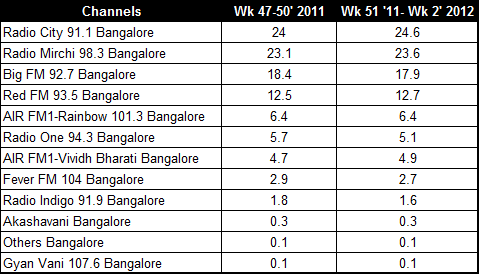
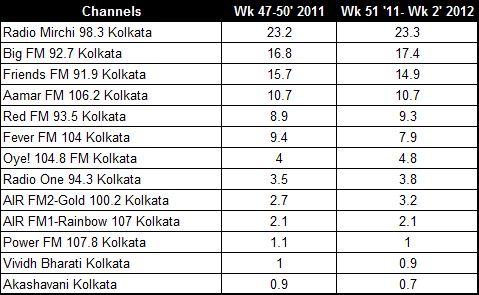
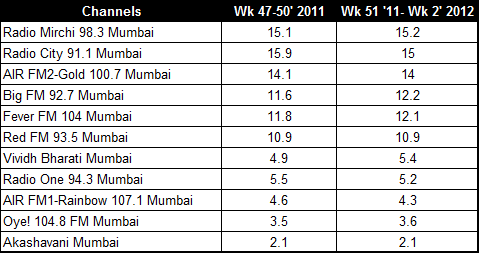
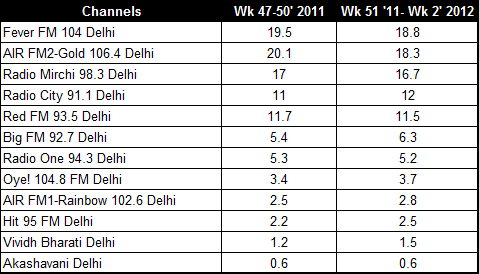
    TAM Media’s Radio Audience Measurement (RAM) – which covers four key metros, Mumbai, Delhi, Kolkata and Bengaluru – released its latest radio listenership figures for Wk 47- Wk 50 (Last two weeks of November and 1st week of December 2011) and Wk 51- Wk 2 (Last three weeks of December 2011 and 1st week of January 2012).


    According to the latest RAM data, for listeners of 12 years and above, and according to radio channel shares, Radio Mirchi, Radio City, Fever FM, Big FM, Red FM, Radio One, Oye! FM were some of the top FM stations in the big four metros.


    Mumbai:

    There is some amount of volatility for the number one spot in the Mumbai market. The latest RAM data for week 51 to week 2 has brought back Radio Mirchi as the number one FM radio station in Mumbai. The lead over Radio City is marginal. What remains to be seen is whether next month, Radio City regains the numero uno position or will Radio Mirchi retain the number one spot. It may be recalled that Radio Mirchi had long retained the leadership position in Mumbai until Radio City toppled it to become the number one FM radio station in terms of market share.


    Ranked three is AIR FM2 Gold which has more or less remained stagnant in listenership share followed by Big FM and Fever FM, ranked four and five respectively. Both Big FM and Fever FM made slight gains in week 51 to wk 2, 2012 as against week 47 to week 50, 2011. The other FM stations in Mumbai market include, Red FM, Radio One, Oye! FM, AIR FM1 Rainbow, Vividh Bharati and Akashavani Mumbai.


    Delhi:

    Once known as a Radio Mirchi stronghold, Delhi today has become quite an unpredictable market for FM radio listenership. This is what wk 51 to wk 2, 2012 RAM data reveals, according to the latest RAM data, Fever FM has reclaimed the numero uno position from AIR FM2 Gold to become the most popular FM station in Delhi while Radio Mirchi continues to rank three in listenership share. Interestingly the battle for the number one position is between Fever FM and AIR FM2 Gold, what remains to be seen is whether Radio Mirchi bounces back to reclaim the number one spot or whether Fever FM continues to lead among the private FM stations.


    A distant fourth is Radio City followed by Red FM and Big FM ranked fifth and sixth respectively. Although Fever FM is leading the Delhi market it has shown a decline in listenership. The other FM stations to have grown in listenership shares are Radio City, Big FM, Oye! FM and Hit FM. The other FM stations in Delhi are AIR FM1 Rainbow, Vividh Bharati and Akashavani Delhi.


    Bengaluru:

    The Bengaluru market has also seen a sea change in FM listenership rankings. Once a Big FM stronghold, the market is now dominated by Radio City which has not only retained its leadership position in Bengaluru, but has also significantly increased its listenership. Close behind Radio City is Radio Mirchi followed by Big FM, a distant third and Red FM ranked four. Radio City, Radio Mirchi and Red FM are the only FM stations to have seen an increase in listenership share on wk 51 to wk 2, 2012 as compared to the wk 47 to wk 50, 2011 RAM data. The other FM stations in this market are Fever FM, Radio One, Radio Indigo, AIR FM1 Rainbow, and Akashavani Bangalore.


    Kolkata:

    The only RAM market which has maintained the status-quo in listenership ranking; Radio Mirchi continues to be the most popular FM station in Kolkata, followed by Big FM and Friends FM continues to rank third. Radio Mirchi is comfortably at number one position in Kolkata with 23.3 per cent of the listenership share followed by Big FM which is a distant second with 17.4 per cent share and Friends FM with 14.9 per cent of the listenership share.


    A distant fourth is Aamar FM followed by Red FM and Fever FM ranked fifth and sixth. Radio Mirchi and Big FM ranked one and two have already seen an increase in their listenership share. The other FM stations in Kolkata to have witnessed growth in their listenership share are Red FM, Oye! FM, Radio One and AIR FM2 Gold. AIR FM1 Rainbow, Power FM, Vividh Bharati and Akashavani Delhi are the other FM stations available in Kolkata.


  • Madhu Trehan & Co to show journos the mirror with Newslaundry.com

    By Shruti Pushkarna


    With the ‘want to turn the mirror’ on themselves, the latest offering from the world of news is the launch of a website called Newslaundry.com. With their unique and explicit tagline, ‘Newslaundry – sab ki dhulai’, the agenda is set from the very beginning. A website which will work as the media’s watchdog.


    The site was launched on February 6 and is the brainchild of one of the pioneers of modern-day news journalism in the country: Madhu Trehan. Ms Trehan founded Newstrack, a video news offering, and newsmagazine India Today.


    The website has been launched with a four-member team and a few others on board. Abhinandan Sekhri, one of the founding partners told MxMIndia: “Newslaundry founders are Madhu Trehan, Prashant Sareen, Roopak Kapoor and Abhinandan Sekhri. We have three in-house writers, other than the founders. We have video editors, production people and directors.”


    So why did Ms Trehan start this? What did she have in mind before she launched Newslaundry? We have the answer from the lady herself. Madhu Trehan told MxMIndia: “It evolved between my partners – Abhinandan Sehkri, Prashant Sareen and Roopak Kapoor. I have always enjoyed creating a product that doesn’t exist. That happened when I started India Today. The leading magazine at that time was The Illustrated Weekly, which belonged to a dated post colonial time. Newstrack was developed because there was no television news other than Doordarshan. Newslaundry is a product which is not a clone of any other website in the world. The nature of it creates a new space.”

    So, could she not have done a similar media analysis show on mainstream television instead of doing it online? Ms Trehan was candid in her reply when she said: “It is because we did a media analysis that showed a channel is a losing proposition, so we chose to go online.”


    However, Mr Abhinandan Sekhri indicated that they did try and go the television way at first: “We did try. We mentioned such a show to various TV channels but they were not ready to put it on their own channel. Also we have so many ideas and so many shows we want to make, and no channel will give us that kind of time. Besides, this is the future. The new irreverent generation consumes media online through mobile devices. Sooner than you think, more people will be consuming media in the online space than conventional TV/magazine. Time will tell which ones work better than others but one thing is for sure – there has to be a change in how we tell our contemporary political and social narratives. News has to be more than it is right now.”


    On whether there is space for such a media website, Sevanti Ninan, Editor, The Hoot, commented: “Yes, there is. There is so much media and so little media watch. There is room for more entrants in this space.”


    Ms Ninan echoed Mr Sekhri’s views on how no television channel is open to self-criticism. “Where is the mainstream TV channel which is willing to carry criticism of itself and its peers?”

    Even though slowinternet speeds could be hurdle in an uninterrupted visual experience online, Ms Ninan is sure that the site will ‘click’ with viewers. She said: “Journalists love gossip. I think Newslaundry.com will click with them, particularly on account of the interviews with media biggies. What Barkha Dutt or Karan Thapar or Vinod Mehta say will give them something to gossip about. The interviews are a strong point.”


    Ms Trehan believes the website will work because “it answers a need that is not fulfilled yet.” In fact Ms Trehan seemed confident of the differentiating factors that NewsLaundry brings to the table. She said: “The difference is that we are combining all of today’s technologies. We have text articles called Criticles. We have what we call Washboards; these are a combination of text, videos and links. We have TV shows webcast. We have cartoons. You cannot do all that on a TV channel. We have the freedom to be far more irreverent. Mainstream TV does not make journalists or journalism accountable. That’s what we aim to do. We ourselves are open to being accountable.”


    On being asked on the revenue channels for the website, Ms Trehan replied that they expect revenues from the usual places. As for now, there are partnerships on with Google (and YouTube). Mr Sekhri added: “Advertising is the obvious immediate way, but in future, this space is going to change dramatically with podcasts and apps. And if anyone wants to put it on air on their channel, we’re more than happy to. We think stuff like this should be on TV too. Being able to take a dig at yourself is a sign of self-confidence which news channels need to have. And if anyone wants to pay us coz they think we deserve it, write in your cheques. Online is the future.”


  • What TV viewers watched in 2011


    By A Correspondent


    Digital viewing of television grew a phenomenal 63 per cent in 2011, indicating the shape of things to come in 2012 and forthcoming years. This and various other results are part of TAM Media Research’s third annual report on television viewing patterns inIndia.


    Titled ‘Impatient Generation’, the report was launched by Union sports and youth affairs minister Ajay Maken at the Indian Merchant Chamber’s ‘Fusion 2012’ conference. Ms. Bhavna Doshi, President, Indian Merchant Chamber and Mr LV Krishnan, CEO, TAM, were also present on the occasion.


    “We conduct such a study every year. The study, ‘Impatient Generation 2011’, is a quick, reader-friendly compilation of TV viewing trends in 2011. It gives a patient update of the impatient world of audiences consuming TV content. This annual feature attempts to update all advertisers, marketers and other stakeholders on how to reach out to their target groups,” said Mr Krishnan.


    Here are some of the highlights of the report:


    The TV Viewing Universe

    • C&S at All India level is currently 126 million Households, Digital Households (42 mn) have grown at 63 per cent.
    • C&S and Digital grew by 5 per cent and 61 per cent respectively in TAM reported markets.


    Viewing trends in key genres


    • Hindi General Entertainment Channels (GECs)
      1. Viewership of Hindi GECs genre has seen a 6.5 per cent dip.
      2. Viewership share of Hindi GECs is 38 per cent of all TV viewing and Top 6 GECs account for 90 per cent of the audience shares gained by the genre.
      3. In 2011, Hindi GEC genre has shown a consistent growth in 1-hour special fiction episodes during Prime Time on Weekends.
      4. Delhi, Maharashtra, UP & Gujarat have been the Top performing markets for Hindi GECs genre across years and the viewership returns from Metros have seen a slight drop.


    • Hindi Movie Channels
      1. Hindi movie genre holds about 15 per cent of total TV viewing.
      2. Number of unique movies aired in 2011 has decreased by 10 per cent.
      3. Both airtime and viewership of South-dubbed movies has seen a clear growth in 2011.


    • Hindi General News
      1. Share of Hindi News genre has witnessed a 10 per cent growth in 2011 after decreasing in 2010.
      2. Returns from News Bulletins has witnessed an appreciable increase while viewing proportion from telecast of Review/Reports has witnessed a decline across years.


    • English Entertainment
      1. Overall GRPs have increased by almost 50 per cent with Reach & Time spent contributing to the gain.
      2. Digital penetration increasing in key Metro markets has led to greater access for the channels.
      3. The growth in Consumption led by Time Spent is showing a 15-20 per cent increase.


    • Kids Channels
      1. The overall genre with 18 per cent share seems to be on a growth path with new channel launches in 2011. Today, 14 channels constitute the genre.
      2. The Reach levels for 10-14 years age band has improved in 2011.
      3. With the increase in number of channels, Kids genre witnessed a continuous increase in viewership share since 2008.
      4. Homes with Kids are faster in adopting to Digital TV platforms with growth rate touching almost 60 per cent in 2011.


    • Sports Genre
      1. Sports genre witnessed 200 million unique viewers in year 2011.
      2. There has been 18 per cent rise in Sports content on TV during 2011.
      3. Live sports coverage continued to garner over 50 per cent of the viewing for any sports content.
      4. 2011 saw 35 per cent growth in advertising volumes, but 70 per cent of volumes continued to be garnered by cricket.


    Launch_of_Impatient_Generation_by_Mr.Ajay_Maken, Hon’ble Minister of State for Youth Affairs and Sports, Ms. Bhavna Doshi, President, Indian Merchant Chamber and Mr. LV Krishnan, CEO, TAM Media Research


    Viewing trends in select regional markets


    • Tamil Nadu
      1. Digital penetration increased by 17 per cent in Tamil Nadu market.
      2. Increase in viewership is because time spent levels increased by 3 per cent in Tamil Nadu market.
      3. Tamil GECs, Music and Sports also witnessed increase in viewership.


    • Andhra Pradesh
      1. Digital penetration has just touched 8 per cent in AP market.
      2. While overall Time Spent on TV is high (over 3 hours daily), its growth is just 1 per cent over 2010.


    • Karnataka
      1. Kannada GECs, News are primarily on a growth track in viewership.
      2. While serials provided almost 3 times ROI, the growth in viewing for this genre has continued to be excellent with an average of almost 20 per cent in 2011.


    • Kerala
      1. Fall in Time Spent by 6 per cent has resulted in overall TV viewing coming down in 2011 but the introduction of new channels has resulted in a growth in viewing again the last few weeks of 2011.
      2. Malayalam GECs dominate with a lion share of 50 per cent with news, movies and music following.
      3. Malayalam Kids Content pick viewing with launch of New channel – Kochu TV.


    • West Bengal
      1. Viewership of Bangla regional has witnessed a steady and fast growth from 5 per cent share in the year 2000 to 43 per cent as of 2011, eating into Hindi channels’ share.

    There has been a growth in ratings for regional movies and events as compared to Hindi movies and events.


    • Maharashtra
      1. Although total TV viewing remained steady, viewership of Marathi yegional has seen a growth over last year.
      2. The growth is seen maximum on Digital TV platforms (31 per cent), as compared to Analog set of viewers (13 per cent).
      3. Unlike 2010, the Marathi GEC genre had prioritized the airtime mostly for the higher ROI generating contents like fiction, movies and reality shows.
      4. Chat shows/ Interviews (on Marathi news channels) now constitute about 12 per cent of airtime, contributing about 14 per cent of total viewership.


    According to Mr Krishnan, the study provides a useful perspective to TV broadcasters and production houses of the where, when and how TV audiences are changing in their tastes and preferences, what content they are rejecting or accepting. “The dynamics that shape an average Indian household viewer’s relationship with TV each day starting from morning to evening is another block that this TAM feature attempts to throw light on,” he said.


    MxMIndia will bring you more viewership trends over the next week.


  • It’s comedy time in English entertainment!

    By Rishi Vora


    English entertainment channels now have one more serious contender, which has already left an impact at its launch. Comedy Central, from the Viacom 18 stable, has taken the No 3 position in the category in week 1, with 14 per cent market share. It may be noted that Comedy Central is Viacom 18’s sixth channel.


    Comedy Central was launched in theUSinitially, and post 2006, extended its presence to other countries. InIndia, it has been launched in seven cities -Delhi, Mumbai, Kolkata,Hyderabad,Bangalore, Pune and Ahmedabad, reaching 20 million households across analog, digital cable and DTH.


    It is said that the Indian version will have localised content apart from the international library of shows.


    Now that the channel is at a reasonable position, the challenge is to keep the momentum going and, slowly but surely, be the No 1 player in the genre. Yes, there are established players, such as Star World and AXN, but Senior VP and General Manager of English Entertainment channels, Viacom 18, Ferzad Palia is of the opinion that Comedy Central has a differentiated offering. It is the first 24-hour comedy channel in English which catersSECAB+ audience.


    On why there was a need of a comedy channel in the English entertainment category, Palia explained: “Comedy Central comes as a light hearted channel in an environment which is so much stressed and depressed; something which came up very strongly in our research.”


    He added: “Also, the audience which we’re catering to are not on the lookout for crime and drama. And the pattern of the TG which we’ve observed is seen to be non-decisive in a way, where there is not much clarity on what the viewer wants to watch. But, with Comedy Central he knows he is going to get light-hearted humour – all the more reason for him to stick around with the channel.”


    With the English speaking population on the rise, consumption of English content too will rise. It is said that 8 per cent of the total population understands English and a subset of that percentage can converse in English. Because English channels reach out to the premium audiences, there are advertisers and brands that look to advertise on English entertainment channels, and Comedy Central is already on the ball as far as tapping advertisers is concerned. It has already got Volkswagen on-board, and a few more premium advertisers will follow.


    Apart from advertising, the channel is looking to add to the revenue via subscription, events and merchandise. “We are catering to an audience which no advertiser can afford to ignore. They’re a bunch of aspiring people, very discerning and those who enjoy quality programming. And this audience looks at English entertainment as the only form of entertainment on TV, apart from sports and movies.”


    Though the channel seems to have carved out a niche within a niche segment (launching a comedy channel in the English entertainment category), Palia disagrees: “Comedy cuts across gender and age. So in that sense, it isn’t very niche.”


    The channel, in next few weeks, will see a full-blown marketing campaign covering, print, outdoor, radio, Internet. The channel was launched with a TV campaign which ran across network channels. Social Media will be one big thrust for the channel as far as marketing is concerned.


    Though the market looks a bit crowded with players like Star World, AXN, FX, Fox Crime, Big CBS channels – Spark, Prime, Love and BBC Entertainment, it will be interesting to see how the genre grows and which channels emerge on the top.


  • Eye on volumes, Coca-Cola to revive Citra after 19 years

    By Ratna Bhushan


    Coca-Cola will revive Citra, a clear-lime drink it bought from Ramesh Chauhan two decades ago but junked in favour of Sprite, in a move that analysts believe is more to target price-sensitive consumer segments than to unlock the brand’s heritage value.


    A person familiar with the top beverages maker’s plans said Citra will be priced about 20 per cent cheaper than existing lime-lemon drinks such as its own brands Sprite and Limca as well as PepsiCo’s Mountain Dew and 7 Up, to target a wider audience and take on smaller brands.


    A Coca-Cola spokesman confirmed the company is introducing Citra in “a few towns in Maharashtra and Gujarat” on a pilot basis. This will be followed by a staggered launch across other metros and bigger cities.


    The move has surprised industry watchers because Coca-Cola’s Sprite, the second-largest soft drink brand in the country after Thums Up, leads the lime-lemon drinks segment, which is the fastest-growing soft drink category in India’s Rs13,000-crore fizzy drinks market.


    Among those surprised is Ramesh Chauhan, who created brand Citra and made it popular in the late 1980s and early 1990s.


    “After keeping the brand in cold storage for so many years, it’s strange they want to re-introduce it now, especially when they have a strong presence in the clear-lime segment,” Chauhan said. “If they are looking for retention and heritage value, then logically even Gold Spot should be revived.”


    When Coca-Cola re-entered India in 1993, it bought out all Parle brands except Bisleri from Chauhan.


    Move aimed at mopping up volumes

    While Citra and Gold Spot were phased out to make way for Coca-Cola’s global brands Sprite and Fanta, respectively, Thums Up, Limca and Maaza were retained. Shashi Kalathil, CEO of management advisory firm Y-factor and partner at private equity fund Exponentia Capital, said the move may be aimed at mopping up volumes. “Coca-Cola probably doesn’t want Citra’s pricing to impact its larger brands. So this could be more of a pricing game and about treating Citra more as a trademark than a brand,” he said.


    Parle brand again

    It’s history that the US major sidelined Parle’s cola brand Thums Up to promote its own brand Coca-Cola for years before waking up to the potential of the Indian brand and backing it.


    Now it seems like deja vu for Coca-Cola as it is banking on a Parle brand once again to push market share in the lime segment. The Coca-Cola spokesman said Citra would not cannibalise its existing lemon drinks because there is ample room for multiple brands in a developing segment like sparkling fizzy drink in a high-potential market such as India.


    Devendra Chawla, president of food & FMCG segments at the country’s largest retailer Future Group, said the move will aid the growth of the clear-lime category, which is already seeing heightened brand activity. “To grow carbonated soft drinks’ per capita in India, apart from growing colas, it’s critical to activate flavours which have natural acceptance from Indian consumers such as lime and mango,” said Chawla, who formerly worked with Coca-Cola.


    India’s per capita consumption of carbonated drinks is just 11 litres a year compared to 34 litres in China and 675 litres in Mexico.


    The lime-lemon category in India has been growing 16-17 per cent a year, ahead of colas at about 11-12 per cent and orange drinks at 8-9 per cent. Apart from being a familiar flavour that Indians consume at home (in the form of nimbu paani), lime-lemon drinks are considered ideal thirst quenchers.


    Both Coca-Cola and PepsiCo have been promoting their brands aggressively in this segment. PepsiCo has Bollywood star Salman Khan endorsing Mountain Dew and actor Sharman Joshi for 7 Up, while Coca-Cola pushes clear-lime drink Sprite and cloudy lemon drink Limca on the irreverent and freshness platforms, respectively.


    Source:The Economic Times

    Copyright © 2012, Bennett, Coleman & Co. Ltd. All Rights Reserved

  • Why FM is more than just a recall medium: Rabe Iyer

    By Rabe T. Iyer


    Old media don’t die! They just bounce back in new avatars. Not so long ago, radio had been written off as dreary, downmarket and not so cool. Television and, later, “new media” were touted as being media of the future. Thanks to advancements in technology and a change in lifestyle, radio has made an incredible comeback.


    FM radio stations are one of the most popular entertainment mediums, offering millions of Indians a great mix of shows covering music, contests, discussions, humour and gossip, delivered in local flavour by popular young radio jockeys.


    Radio is a medium of the senses, bringing the listener’s imagination to life and taking him into an exciting new world of his own. Thanks to local FM stations, marketers have been able to connect with their target group, especially the youth, like never before.


    According to industry experts and analysts, there are 250-300 million radio users today. This penetration is surprisingly more than that of newspapers, known to be the oldest among present day media. In addition, at 145-150 minutes per day, the consumption time of radio is more than that of television, which stands at 140.  Today, 80-90 per cent of mobile users access the radio on their phones.  The fact that the medium is mobile has clearly helped to increase its usage and popularity.


    With the rollout of Phase III licensing, the Indian radio industry is optimistic of huge growth. The industry, which currently brings in around Rs1,100 crore revenue, will see 800 new radio stations across 300 towns coming up.


    Here, radio-based advertising can be used effectively for communication and positioning. It is to be used well since it can target a large audience because of its immense reach. It is useful in increasing awareness about a brand or business and helps in enhancing the brand image. The past couple of years have witnessed a flurry of activity in the FM sector. Not surprisingly, the radio industry of today can be compared to television in the early and mid-nineties, and one that is all set to boom further.


    With carefully worded scripts, brilliantly created situations, and tailor-made strategies, radio advertising is getting more innovative and effective day by day. It is perhaps one of the simplest yet most cost-effective and powerful means of communication in today’s world.


    Studies indicate that instead of two back-to-back commercials on television, one commercial on television and another one on radio give about a 20 per cent higher brand recall. Also, a television commercial, if aired on radio, works very well as the listener can then visualize the entire advertisement. Hardly surprising that over the years, print based publications and television channels have been using radio as a support medium, as a reminder medium, and as a mean to building up frequency.


    As mentioned earlier, another interesting facet of the Indian radio story is the mobile phone explosion and its convergence with FM. This has exponentially increased the width and depth of the market.


    Radio offers tremendous opportunities for advertisers and media planners who need to explore various options, following which they can effectively use the medium in their media mix. Conversely, broadcasters need to develop the market by being more responsive to an advertiser’s needs. This will provide an opportunity for the market to arrive at the final verdict on the effectiveness of the medium inIndia.


    Rabe T. Iyer is Business Head, 92.7 BIG FM


  • [PR Channel] Our approach has been very focused & niche: Veena Gidwani

    It’s been a fulfilling and boisterous ride, to say the least, for one of the most prominent names in the domain of PR – Madison PR. Having made a modest start about a decade ago, the agency today has a roster of clients that most would die to have a hold on. Not to forget the healthy growth numbers that the agency has been posting year-on-year, which have been in double digits for long. None of this would have been possible without the guidance and leadership capabilities displayed by the face of the agency – Veena Gidwani.

     

    Having been involved with the agency since its inception, Gidwani today is singularly responsible for the peak status that it has attained over the years. In conversation with Johnson Napier of MxMIndia, Veena Gidwani discusses her foray into the space; shares her secret to bagging top-notch clients and has a word of advice to the industry so as to get it to be in a more orderly state in the future. Excerpts:


    Your career spans an illustrious three decades, straddling the domains of advertising and marketing. Though your love for the medium is known, what is it about Public Relations that made you take up the profession as a career path?

    My foray into Public Relations happened in 1995. At that point in time, I was employed with the Tatas for their design and creative services company when I was advised by a friend to head a joint venture in the PR and investor relations space. That was when I set up Prima Communications – the corporate image building venture that I was instrumental in setting up and was responsible for delivering growth for the unit.


    During that phase, it was observed that a lot of Indian companies were not communicating effectively with their stake-holders. There was a need felt for them to have a professional service which understands how to communicate and how to do it on a sustained basis. So I was involved with that for some time till 2000 when Sam Balsara (CMD, Madison World) offered me a role at Madison PR and that’s how my journey began over here.


    It’s been 12 years now for me atMadisonand we have grown from a small and limited team to a team that is very cohesive and spread out across four cities. Today we service clients across industry verticals – we focus largely around clients in lifestyle, FMCG, food and also other verticals like consumer durables, financial, hospitality, healthcare and so on. This has enabled the team to have a lot more exposure and experience in handling all kinds of situations and industry and client needs.


    How has Madison PR delivered on the growth front in 2011? How has the start been in 2012?

    We have had a good start in 2012. Most clients have outlined plans for good growth and plans for having new products being launched and so on. Though, of course, in the last quarter some clients have been a little careful in terms of committing a budget, preferring to play a wait-and-watch game. But as the year has begun, the start has been positive so far.


    As for 2011, the year was good for us; we have witnessed double-digit growth. All our offices have added businesses. In Mumbai we added Godrej Tyson and Godrej Locks; inDelhiwe added JK Cement and Ricoh andApolloHospitalsinBangalore… so there have been additions and growth in all offices.


    While on 2011, I would like to share an important thing that happened to me which was my travel to Cannes. Being on the jury, it gave me an opportunity to see PR campaigns from across the world that were submitted. I’d like to add that a lot of good work also happens inIndiabut unfortunately not too much of it is entered. It was a great experience to interact with many agency heads from across the globe and I think that some of the issue that all of us are battling are almost the same across the world. Also, the other interesting thing out there was that there was not a single category that did not have digital as an entry. So it was a great learning experience at Cannes.


    Your client roster boasts an impressive line-up including the likes of P&G, Parle Agro, Britannia, etc. What is it about Madison PR that gets such top marketers to cling on for a long time?

    As an agency, our philosophy has been to work with a limited number of clients but work very closely with them. That’s because PR is such a business that you need to have close interaction with your clients. Unlike advertising, where you create a plan and that plan holds still for the next three months or so, PR is a very dynamic medium- the plan keeps on changing. We may have developed a strategy for this month but if some development happens then we need to incorporate such changes. Also, most often the Marketing people at the client’s end are so busy with their everyday goals, meetings that they do not have the time to share with the media when they have some important developments. As we believe in the proactive approach of being in regular touch with the clients, it becomes easier for us to strategise and execute ideas for them. So that’s one area that we are constantly looking to delight clients in.


    The other important thing is that we believe we have to be creative in our approach. The media landscape today is so competitive that everyone wants a slice of the information that is going out. So how do you stand out and make your communication interesting? You need to be creative in your approach; you need to customise the content to suit the medium. So that’s another value-addition that we offer to our clients.


    How would you rate Madison PR on the parameter of client retention?

    We’ve had clients who have been with us for several years, like P&G, which is our oldest client and continues to work with us. Having said that, we do have clients who work with us for a year or two, and that happens because if the companies are small or privately held and if they feel that do not have much to communicate then they break away from the association. But I can say with certainty that we command a high loyalty rate amongst our clients.


    How do you review your practices each year so as to stay ahead of the curve on a consistent basis?

    We do not work having a delineated or watertight practice. For example, you may have a group that may be working for two separate practices but what we try to do is analyse what are the trends, in which direction is the industry progressing and what is it that we can provide that nobody else is providing and do that more efficiently.


    What is the shift you observe in the way PR as an industry functions today to what it did, say, about a decade ago?

    A decade ago, PR largely meant media exposure and media relations, whereas today it is more holistic communications counsel with specialized services like influencer marketing, word of mouth, events, research and overall strategic planning and execution. Also if you observe, there has been a significant shift in the way the professionally managed clients avail the services of PR agencies. They understand the value of a big and creative idea and they support it. They are willing to give it all the support that it needs in terms of implementation and cost. At the same time they expect us to deliver good outcome and results out of the exercise. However there are several organisations which are not that clued in on the value or merit that PR brings to the table. They fail to look at PR as an area that needs sustained investment or something that needs an ongoing boardroom thought.


    But I would say that there has been a major shift and most professionally managed companies are realising the value of PR. In fact, PR is becoming an integral component of their media plan and very often many of clients invite us to the pitch alongside the other disciplines. We are briefed at the same time as the others so that we can think creatively and come up with ideas and have a concerted and synergised plan for that particular initiative.


    Where do you see Madison PR placed in the PR pecking order amongst its contemporaries?

    We wouldn’t want to rate ourselves amongst the other players based on our size; we are not a big agency. We are a relatively small agency but as I said our approach is very focussed and niche; we want to work with a very limited number of clients and work in a manner where we come up with innovative ideas to build brands.


    What are some of the challenges facing the PR industry in India?

    Talent has been one of the biggest problems facing us and the industry as a whole. Especially the senior staff – it is extremely difficult to find a good fit. One of the biggest problems that we face is that most people want to move on to the corporate side of the business.


    Though I must say that there is a lot of excitement when you work on the agency side of the business as you get to work with multiple brands, you get to see what the other groups are doing on other brands, you get to work with new brands as well as old and reputed brands or somebody who wants to deal with a crisis situation, and so on. There are many such situations that take place here and therefore I would say that the PR agency life is very vibrant.


    Also, it is essential that agencies impart training to its workforce. We do provide in-house as well as external training and workshops for our staff. It goes a long way in preparing them to face the challenges that the business demands.


    Any other challenges apart from talent?

    The other big challenge facing the industry is the way clients want to remunerate agencies. With so many players out there offering their services, people are willing to undercut price for the same. PR, as such, is a very qualitative service; you cannot exactly say that someone has quoted me this rate and why are you quoting me something else? One must understand that there are various elements to this service. Over here, one idea or not missing an opportunity can make a huge difference to a campaign. So proactiveness from the agency and the way they deal with you, all add up to the sum total of value or service that the agency is giving to you. So two agencies of the same size may be offering the same service at varying rates and it is up to the client to take a call on who is the right partner.


    The other element here is that it is a very people-intensive business. Because, besides people and the intellect what else are you really using? So an agency’s idea, people skills and your interaction with people are the key skills that one uses. Also, people costs are going up and clients have to realise that to get good service you have to pay good money – which some clients do. But by and large, most people think that they can negotiate fees and make us work for less and this perception needs to be changed.


    You’ve been involved with PRCAI and have served as president in the past. How do you see the association casting an impact on the industry in a large way?

    I really do not know what is going on over there now but I guess as an industry we need to come together and do more. If everybody gets together we can hope for a smooth running of the industry. We are operating at several levels. At one level we have internationally-affiliated global agencies, then you have the Indian independent agencies, then you have agencies likeMadison, which are part of agency network, you have individually-owned agencies, smaller agencies, etc so the canvas is very vast. This makes it difficult to have standardised norms and practices that each one may follow.


    Have you been approached by an international agency for a joint venture?

    As and when there is some venture to look up to we would consider it but we are happy being as we are right now.


    What is the road ahead for Madison PR in 2012?

    For us to put up a good growth, churn out good campaigns and help clients to get better market shares and enhance the equity of his brands with consumers and stakeholders. Also, we see big opportunities in lifestyle, personal consumption, retail and healthcare sectors with many new entrants and aggressive expansion plans of existing players.


    For us, digital is now becoming important and more and more brands are now going online to communicate with consumers but I think that in 2012 there will be a lot of activity around this arena.


    Finally, will Madison PR be the place you retire at or will you contemplate another career opportunity in the future?

    I haven’t thought about leaving this place; it has been an interesting and exciting journey over here. There are always newer things that come up and one thinks of it but it’s been very exciting and I am looking forward to more excitement in the time to come.


  • SIT’s report makes for exciting TV but bad journalism

    By Ranjona Banerji


    The Special Investigation Team as appointed by the Supreme Court to look at the involvement of Gujarat chief minister Narendra Modi in the Gujarat riots of 2002, particularly with reference to the Gulbarg society case has submitted its report. The report is still in sealed cover. But television spent half of last week going to town over the “clean chit” given to Modi and promptly a number of TV debates were held.


    The BJP, quite relieved to get a break from the behaviour of its ministers in Karnataka, sent out its publicity army in full force. TimesNow insisted that it had exclusive “leaks” from the sealed report while every other channel had their “sources” who told them what was in it.


    Newspapers, however, were forced to be more circumspect, although Times of India did initially blow up this “clean chit” – ironically on the same day that it headlined the slamming of Modi by the Gujarat High Court over his government’s inaction during the riots.


    By Friday morning, newspapers decided to wait for the actual report even as beleaguered BJP spokesperson Nirmala Seetharaman was begging channels to wait for the report. Some like Swapan Dasgupta and Yatin Oza were happy to jump the gun and blame secularists, the Congress, Muslims, activists and other wicked people for blaming Modi.


    Much as all this makes for exciting television, it also makes for bad journalism. One can understand our desire for tamasha but one can hope that at least we have some facts before we start jumping to conclusions.


    * * *


    It was interesting to hear Chief Election Commissioner Y Quereshi telling NDTV how hard the commission has worked to encourage higher voter interest during these UP elections. For some reason, after that the discussion became about low voter interest in Mumbai with lyricist Javed Akhtar and columnist Sandeep Desai holding forth. Quereshi did point out that Allahabad’s track record was worse than Mumbai’s.


    * * *


    The arrival of Comedy Central on our televisions has meant the welcome addition of the Daily Show with Jon Stewart to our homes. It is well worth watching at 11.30 every night as the comedian takes on American and world politicians and politics, among other things. No one is spared, which is wonderful.


    Of course, I understand that all Indian people and things are sacrosanct and far above humour and satire and must never be so sullied but still, kudos to Cyrus Broacha and The Week that Wasn’t on CNN-IBN.


    * * *


    While on satire, Europe has to sometimes win the day for its devil-may-care attitude. The clip about Rafael Nadal and the power of Spanish athletes – implying drug use – on the satirical programme Les Guignols, shown on the French + Canal channel has Spain up in arms. Legal action will be taken says Spain, as this is one more in a series of allegations by various French sportspersons and media that Spanish sportspersons take performance-enhancing substances. The clip, available on YouTube, is very wicked!


  • Ad Strat: Palasa Creative Place

    Sandeep Bomble, Founder, Palasa


    1. Name of the Campaign: Ghost Campaign


    2. The Brief: To promote an exclusive weight loss package by Iosis Medispa


    3. Research insights:

    Everyone today wants to feel good about himself/herself. Keeping this notion in our minds, we came up with a strategy of doing away with the “ghost” lurking inside. This “ghost” is the fat in our bodies that causes the feel good factor to diminish, and eventually, take a back seat.


    Excess of fat in the body causes obesity, leading to many other ailments such as high cholesterol, diabetes, lethargy, cardio vascular attacks and so on.


    Apart from the physical harm fat causes, it also attacks you mentally. An overweight person will feel low, left out and in many cases will also have a severe inferiority complex. Having friends and peers with slim bodies around will only make it worse.


    4. The thought process behind the creative:

    Understanding the insight of how obesity affects one’s life, we realized there is a huge opportunity for making the audience aware about the evils of obesity and provide them the right solutions against it.


    As the insight was strong enough to put across a strong message, we visualized obesity and treated it as evil. The evil that is set free making the man/woman feel happier and lighter with a range of slimming packages from Iosis Medispa.


    5. Media vehicles chosen:

    The leading media was Print, which was supported by Outdoor and the distribution of leaflets in the local vicinity. To make it interactive, the campaign was backed by innovations like the ‘ghost’ stickers pasted on the mirrors of multiplex washrooms, instigating the audience to consider their fitness.


    6. Key issues kept in mind while executing the ad:

    The campaign was built around the insight that obesity is the root cause for some of hazardous evils trapped within the human body. The evil obese figure emerging out of the slimmer man/woman adds enough drama that would act as an immediate hook for the audience. The settings were easy going in nature, expressing that it’s not only about looking good; but feeling good inside. The clutter breaking communication minus vague promises and loud claims, effectively stirred up the message of ‘set free to healthy living’ in a distinctive yet effective way.


    7. Does the treatment do justice to the brief?

    The ad is interestingly dramatized by showing obesity in an evil light, treating it as a ghost. It talks about getting rid of the excessive fat from your body, leaving you happier and lighter from within. The woman and man in the ad were shown in a composed and relaxed state with toned, healthy figure. The personified ghost acts as the bad unwanted fat that has a feel good factor to it once disposed. The ad achieved the desired response as it was different from the usual ‘before and after weight loss ads’, thus, breaking the market clutter to good effect.


    8. What according to you is the differentiating factor about the ad?

    The dramatic execution came out as a refreshing change from the regular ‘Before and After’ slimming ads. The communication set a different tone within the industry, opening up the thinking verses the mundane pre and post differences in the figure. The idea and the expression proved interesting enough to stand apart from the rest.


    9. Market and client feedback:

    This ad received an optimistic review across the market span. It was well understood, across classes, as a clutter breaking ad. The market audience was already weary watching the same clichéd ‘before and after weight loss’ ads done by the competitors. So, the ‘ghost ads’ came out as fresh interesting breeze amongst the muddled space, elevating the brand value.With the ad covering a number of media across, the brand presence was visibly felt.


    Walk-in targets exceeded along with increase in phone calls and queries after the launch of the campaign. The client felt confident about the positive air envelope the brand, Iosis.


  • The Anchor: 4 reasons why one worries about Google

    By Sanjay Mehta


    So you think Google Plus has its set of challenges, as it ambitiously takes on Facebook? Well, I am not even talking about that. My worry is about Google’s core product and cash earner, Google Search!


    Let’s do a quick dipstick here:


    • When you search on Google for information, how fast do you get to the right information that you need? That is, if you ever get it!
    • If the information that you are looking for is not something as basic as “what is the current time in San Francisco?” or “temperature in New Delhi”, there is every chance that information search is a frustrating experience on Google. Do you agree?


    These are the reasons I am concerned about Google.


    1. Not all search queries produce good results on Google

    While Google has been doing a fair amount of innovation in search, and for certain types of enquiries, you can get to the information faster, there are a whole host of search queries that do not lead to good results, and where as a user, you look out for alternative options.


    2. Google’s revenue model on search worries me

    The revenue model is largely an advertising model. An advertiser takes ads on Google, while mapping search words. In other words, if I am a florist, I will likely buy Google ads, for keywords like “florists in Mumbai” or “Valentine’s day flowers” and so on. In short, when someone is searching for words or phrases of these kinds, then I would like them to see my advertisement on the right side of the page on Google. Because, then I would have the best chance of finding a connect to the particular user, and tempting him to click on my ad, and come to my website.


    The other key thing to know and understand is that advertisers typically pay only when someone clicks on their ad and not otherwise. Also, all advertisers do not pay the same amount. The amount that an advertiser pays per click depends on the budget or rate that he has chosen, and it is based on a dynamic demand-supply situation of advertisers and searchers, for that particular word or phrase.


    But, from the point of view of the advertiser, whatever rate he has agreed to pay per click, is his “cost of acquisition”, or the cost to get an interested user, to visit his website. So, who would spend how much on advertising on Google?


    If your business is transportation of very large-sized goods, you may still use Google advertising to get across to people who are looking for such services. But for you then, this is a marketing campaign, and you want a certain visibility amongst your target group. So you would put money here in campaign bursts, and leave it at that.


    On the other hand, if you are an e-commerce company, selling online, whether it is travel services or products, for you, the Google ad is a direct customer acquisition cost, and all the traffic that you pull in from these ads, you have a chance to get them to buy from you, right away. Since there is a way to map conversion from such clicks also, an e-commerce company can quickly calculate the equivalent cost of acquisition, of not just a visitor to the site, but an actual buyer.


    For those who don’t get this, let me explain with an example. Say, a hotel booking company advertises on Google and spends Rs50 per click. Say, 100 people click on the ad. So the cost is Rs5,000. Mapping for conversions from these 100 clicks, he finds out that 20 of those actually made a booking.


    So to acquire those 20 customers, he has spent Rs5,000 or his per customer acquisition becomes Rs250. Now, if his average booking transaction is Rs10,000, he may have no issues in this kind of spend, and may keep doing the spend forever, unlike the advertiser who spends on marketing campaigns in bursts and then goes away.


    Now here is where the challenge for Google comes in.

    All of the transaction-oriented e-commerce businesses are starting to get their own specialized search engines, which do a far better job than what Google does.


    3. If the searcher moves away from Google, so will the advertiser

    Larger and regular monies are spent on Google ads, by companies who have a quick transaction engine on the web – for them, it is direct customer acquisition. However, for most of such needs, users are finding better options to go and search at; over time, users will move away from Google to search for their needs of hotels, flights, products to purchase, movie tickets, etc.


    If the searcher moves away from Google, so will the advertiser who is looking for that searcher. What constitutes the larger spends on Google ads, will take flight and move to more relevant locations to get better returns for their money.


    You don’t buy this argument? Let’s take the spin. Say, you are searching for tickets from Mumbai toChicago. And you are looking to find options. What do you get?


    What I get on Google.com are a lot of ads, on the top and on the right, and in the main search, I get a few clearly SEO-doctored links, and then a few links to travel websites. So yes, if I play around these links, I will get the information that I am looking for, in a few clicks.


    But, I go to any of the leading travel sites instead and punch the same request – I get a quick response in terms of flight options for Mumbai to Chicago.


    And then I go to a travel comparison site like say, ixigo.com, and I get the same search results from several travel sites, simultaneously. Flight options, prices, all at a quick glance, together on the same page.


    So why would I go via Google at all? If, similarly, I was looking for ‘hotel options in Jodhpur’, the experience will be identical to the above. Question again will be that, if I were looking for hotel options, why would I go to Google at all?


    Let’s consider products. Say I was looking for a book, “The Maverick” by Ricardo Semler. What will be my experience?


    Searching on Google gives me stuff about the book, about Semler, reviews, and 1-2 links to Amazon.com.


    Instead I go to junglee.com (the killer app on Indian e-commerce, I reckon), and I get a bunch of options for purchase of the book, with price details, and seller information. Bang on! Exactly what I need.


    Repeat this for most e-commerce or transaction-oriented categories, and you will find a similar challenge. That Google does not give you what you want. There is a specialist platform that gives you perfect results.


    So the bottom line is that people may not start at Google when they are searching for such transaction-oriented information. And this is where the cheese may be moving away for Google!


    This is where the old time Internet service providers and portals went wrong. Time was when AOL and Prodigy and others were the starting point for anyone in theUS, wanting to get information from the Internet.


    Then came portals and search engines. And the game shifted. Sites like Yahoo and Lycos became the default starting points for people, as they offered best recommendations for news, education, entertainments, science, sports, or whatever.


    Then came specialist sites for finance and matrimony and recruitment, and people went there directly, instead of going via portals. I am seeing a similar movement, away from search engines, or rather, away from Google.


    4. Google’s revenue may see a downward spiral

    Considering that search is the main money earner for Google, if they do not correct, this could be the beginning of the southward movement on the revenue front. And that will hurt Google far more than their experiments with social networks – Wave, Buzz, Google Plus, Orkut, etc not taking off!


    I worry for Google.


    Sanjay Mehta is the Jt. CEO, Social Wavelength


  • Expect the same old, same old this Valentine Day

    By Ranjona Banerji


    Television is the favourite whipping boy of most media commentators and, for the most part, not only is it justified but it also great fun. (Is it also a coincidence that most media commentators have a print background?) But this Sunday’s newspapers were so dull that TV seemed to be a brutal relentless machine working its poor journalists to the bone with its constant hunger for more and more news and therefore deserving of much sympathy. I get five newspapers on a Sunday and finished the lot in an hour.


    Most Sunday papers run on a weekly cycle, which means there is ample time to plan and execute. But instead of fresh ideas and stories, we got the same old, same old. It is amply clear that the cutting of newsgathering resources and the desire to replace all talent with an army of sub-editors and, yes, boys and girls has led to a lack of imagination in newsrooms. Is there any point hoping that this is a temporary trend?


    Valentine’s Day, which is tomorrow, therefore threatens to bore us to tears as we read about real and manufactured love, as we did last year and the year before.


    We are constantly told in the media that we have to appeal to young audiences but I refuse to believe that every 20-year-old in the country is a dimwit who has no chance of recalling the same claptrap which was fed to him or her last year.


    * * *


    Can someone in The Times of India please get a promotion quick for wonderful stories to promote the boss’s daughter, so we can stop reading stories about Trishla Jain’s exhibition? The subject seems to have been stretched to the absolute limit.


    * * *


    TV and print seem to have taken quite opposing views on the army chief and his battle over his date of birth. TV was all for General VK Singh and put the government in the dock – and any studio guests who said otherwise were immediately put in the “unpatriotic” category.


    In newspapers however, commentators were more balanced and the dangers of the army chief’s actions were discussed. Now that the Supreme Court has rapped the army chief and the government on the knuckles, a more sober approach is being taken. Well, sort of – some sections of the media have now decided that the army chief must resign to protect his honour.


    This obsession with other people’s honour is a new media phenomenon andIndia’s star cricketers are its usual victims.