Author: mxmadmin

  • The Anchor: 5 tips for holding a successful Tweetup

    By Zafar Rais


    Twitter has emerged as a platform which enables targeted conversations with individuals who have a direct linkage to their brand or industry and have a high opinion within the platform amongst their followers. In order to leverage opportunities with Tweeps, marketers are constantly innovating, and one such activity that proves to be highly successful is the Tweetup.


    Increasingly, this has also given rise to influencer relationship management as an individual business unit within social media agencies.


    A Tweetup is a chance for like-minded individuals from Twitter to come together offline and interact on the basis of a chosen theme. It may act as a relaxed networking event organized by Tweeps or a new route towards launching a product and creating the right kind of buzz about it, through the right kind of people. Tweeps come together to use their collective wisdom and networks to create outreach and support during the event. A Tweetup is a great way for brands to showcase, sample and get feedback on their product or service.


    So how do you ensure a successful Tweetup?


    After organizing a bunch of Tweetups for brands such as Kiehl’s, Star Plus, BIG CBS Network, Karaoke World Championship, to name a few, these are a few of our learnings to ensure you don’t goof up your first one.


    #1 Invite the right kind of people and not just Tweeps with a high follower base. The right mix is what gets you the right engagements and the right outreach. Influencers on Twitter range as per certain topics they constantly speak of. Gain some insights on their tweeting patterns and invite the relevant ones only. Quality over quantity is key here.


    #2 Innovate by offering something different. Most brands adopt the same flow for every Tweetup. The key is to find something exciting or adopt a theme that excites them to attend it, as much as it excites you to organize something different.


    #3 Communicate via an invitation that lets Tweeps know about the highlights of your Tweetup, the hashtag to be used and the venue. Ensure you create subtle opportunities for them to know about your product but avoid a hardsell. Influencers are intelligent and will communicate with their followers according to what they deem fit.


    #4 Networking is key. Innovate by creating instances for your audiences to interact with other people, the brand and your designated hashtag. An effective session by a core speaker or industry expert gives the event a good start but after that, ensure that your influencer manager does his job of keeping them buzzing via fun games, live contests, performances and some alcohol too if the occasion demands.


    #5 Take home evangelists. While it’s great to get your hashtag trending or to increase curiosity about what the hashtag you’re using is all about, a brand must focus on the influencers they have invited, ensuring they go back home as brand evangelists and have built a valuable relationship with you. Your ability to achieve this is directly related to the experience you create for them.


    At the end of it, be warm, friendly and remember the key philosophy of social media – engage!


    Zafar Rais is Founder & CEO of Mindshift Interactive


  • ABCI awards night on October 19

    By A Correspondent


    The Association of Business Communicators of India will be holding their 52nd Annual Awards Nite on the evening of Friday, October 19 at the Crystal Room, Hotel Taj Mahal, Mumbai.  Last year, ABCI received 952 nominations from 32 categories for the 51st Annual Awards.


    ABCI is the only Association in India to recognize and reward excellence in creative Business Communication for the last 51 years. Entries are invited from 32 categories from Print, Electronic & Digital Medium of Business communications like Annual Report, Calendars, In-house Journal, Best Photograph in an In-house Journal, Tabloids, Article, Column, both in English & Hindi languages published in the Calendar Year 2011.  Categories for designing are also included. New Publication & Prestige Publication published from or in the calendar year 2011 are also invited. For more details log on to www.abci.in


    ABCI’s  ComFest12 To Focus On Theme:” Managing Communication in Turbulent Times” ComFest12 – The Mega Annual Event by the Association of Business Communicators of India will this year churn out thoughts from Leaders of the Industry across globe. ComFest 12 will be held on 18th & 19th October, 2012, at the Rooftop Rendezvous, Hotel Taj Mahal, Opp. Gateway of India, Mumbai. Among the star speakers attending the gathering at ComFest 12 are: Dr. Narendra Jadhav, Member Planning Commission, Government of India, Dr. Kai Rolker, Global Head, Communications, Clariant Group, Switzerland, Mr. Maxim Behar, Chairman, Hill + Knowlton, Prague, Mr. Anthony Good, Founder, Good Relations, London, UK, will be the guest speakers. This apart Yanina Dubeykovskaya, Director, Contents, World Communication Forum, Davos, Switzerland & Dr James Gillies, Head, Communication Group, CERN, Geneva based Nuclear Research Lab who in the recent past declared invention of God Particle will be special attraction of the ComFest 12.


  • Ormax launches box-office forecasting model ‘FBO’

    By A Correspondent


    Media & entertainment research firm Ormax Media has announced the launch of FBO, India’s first scientific box office forecasting model. FBO stands for First-Day Box Office. The model forecasts the opening day nett collections at domestic box office for unreleased films upto seven weeks before release.


    The FBO model takes into account a series of input parameters. These include inputs from Ormax Media’s film campaign tracking product Cinematix, which tracks the Buzz, Reach & Appeal of unreleased Bollywood films for almost three years now. Cinematix covers 19 cities across India, accounting for more than 95 percent of domestic box office coverage. Other FBO model inputs include release scale, holiday and festival factors, audience profile and several other such variables on which normative data has been built by Ormax Media over the last four years.


    FBO forecast will be available to subscribers every day, from seven weeks before the release of a film till the day of the release. The model has been tested to accurately forecast the first-day box office collections of at least 85 percent films with less than 10 percent error margin.


    FBO is being targeted at film studios and producers, as well as media agencies and advertisers who associate with films through co-branded promotions and in-film placement. Existing subscribers of Cinematix will be upgraded to an FBO-enabled version of the product at an incremental cost.


    Speaking about FBO, Shailesh Kapoor, CEO – Ormax Media said: “The model is extremely valuable as the box office estimate will be available seven weeks in advance. That will give the stakeholders enough time to take corrective action. Also, it is not a back-of-the-envelope prediction of the box office. It is a statistically tested forecast model that has self-learning built into it, guaranteeing progressively better results with time.”


    The first official FBO forecast was done for last week’s release Barfi, at Rs. 8.80 crore nett opening day at the domestic box office. The actual figures stood at Rs. 8.56 crore nett – an error margin of less than 3 percent.


  • Visa launches ‘Dream to Advance’ campaign

    By A Correspondent


    Credit card company Visa has launched its nationwide campaign Dream to Advance, showcasing how Visa Debit helps fulfil the dreams of Indians – no matter where they are. A story told on television, Dream to Advance urges every Indian consumer to explore, discover and realise their dreams.


    Dream to Advance highlights the benefits of e-commerce and Visa Debit, which enables consumers achieve their ambitions, even if access to financial services in their small towns is limited. The new television campaign went on air recently.


    The concept and story created by BBDO Proximity India, the campaign Dream to Advance is a narrative of a young man who is able to achieve his dream for his village by using Visa Debit. It’s a collaborative effort, dialogues written by Gulzar and directed by Amit Sharma from Chrome Pictures, with legendary music director, Shantanu Moitra who has composed the background score for the emotive commercial. The commercial is shot in Kashmir, the backdrop of some of the most memorable moments in Indian cinema.


    Speaking on the campaign, Uttam Nayak, Group Country Manager, India and South Asia, Visa, said, “With the increasing use of Debit and eCommerce across India including smaller towns and cities, Visa believes in providing accessibility to Indians living anywhere in India to fulfill their dreams. Our new campaign is targeted at the common man and his aspirations. No matter in which corner of the world you are, Visa Debit can help you realise your dreams.”


    E-commerce, combined with electronic payments, is increasing accessibility and providing a higher degree of convenience for consumers. For those belonging to non-metro areas, the shift is empowering and creates a level-playing field as they can now buy the same products that their urban counterparts can. This has helped both e-commerce and the adoption of electronic payments in India’s hinterland.


    The TVC can be viewed on all leading channels across the country. Follow the link- http://www.youtube.com/watch?v=T44lW5FIq2g  to view the television commercial.


  • Jaldi 5 with Raj Nayak: No sex, no violence, no Pakistani in Bigg Boss 6…

    Raj Nayak

    Okay, we’ve cheated. We went out to ask just five questions, but ended up with several interjections, so the Jaldi 5 is a rapidfire 10. Or thereabouts.

    Raj Nayak, CEO, Colors is one of the best minds in the broadcast business.  MxMIndia caught up with him soon after a presser with actor and Bigg Boss host Salman Khan and Endemol India CEO, Deepak Dhar. Mr Nayak was candid when he admitted to MxMIndia that the show was a dampener last year. Guess for the honesty in answering some tricky questions, Mr Nayak deserves to win this critical round.


    01. A ‘paarivaarik’ Bigg Boss? Why junk the USP of catering to the voyeuristic Indian?

    Over the last few seasons, we Bigg Boss became very predictable. Even participants who’ve previous Bigg Boss shows think they need to behave in the same way. Tasks in the house have been very predictive. While the vouyerism is the soul of the show, it has also alienated a lot of audiences. We believe that it is a cult programme, no doubt about it. It is one of the biggest programmes for Colors. Among all the reality shows that we do, it is the most expensive show. There are 59-62 cameras at work. It is an amazing experience.


    Over the last six months whatever we have done on Colors, we have done differently. We scaled up Jhalak Dikhla Jaa. We did not make it just a dance show, but dance and humour. A show like Bigg Boss has a huge cult following. Then we have Salman Khan whose popularity transcends from 7- to 70-yr-olds, he appeals to everybody. Whether it is classes or masses, he is a superstar. Not to leverage his brand appeal would be stupid. This was the thought process then. We thought, let’s convert the show, flip it on and do it on a positive note. Some of the things we have learnt – what we can do, what we can’t do. So we have tinkered with the format a little bit.


    So no voyeurism, no sex and violence?

    The voyeurism will be there. That cannot go. It is the soul of the show. The casting will ensure that all houseguest are achievers. There will be no negativity. Earlier we had people who were newsmakers but they always had something negative. But this year, not one person who goes into the house will be negative. Even if there is voyeurism, there will be a lot of fun element in the show. Even voyuerism will be in acceptable norms.


    And clearly no sex and violence. We want the whole family to watch the show. One can have a good show without having sex or without having violence. Jhalak Dhikla Jaa is good example. That will give you a good indicator of the slotting.


    But someone like Sanath Jaisurya didn’t do very well?

    Yes but what it did was to bring out the wow factor of the show.


    Any Pakistani?

    No, we won’t. We think there is enough talent in this country at this moment and the casting team thought they have enough people they can cast from within the country at this moment.


    02. What are your expectations from ratings? Last year was a dampener and the bar has been rasied much now…

    Yes, last year was a dampener. There is no doubt about it. But the way we are looking it is that we want Bigg Boss 6 to be the most successful season that Bigg Boss has ever had. We have dissected the show from the first to the last frame and you will very many new elements this time. We genuinely believe that it has the potential to become blockbuster. As for the bar, it will always keep raising. You can’t keep looking at the scoreboard because it is different matches and genres. Within the genres, ground and match that we are in, we are sure that we will put on a bloody good show.


    Sur-Kshetra didn’t do well in ratings last week?

    Yes, last week setting the foundation. We hadn’t have Ashaji then.  The show actually started this week. Last week, the show was setting foundation of how the auditions happened in Pakistan and India. I am a firm believer that the show will pick up with every passing week.


    03. Sony pushed KBC to the weekend slot. How will Bigg Boss affect your fiction slot?

    We shifted Khatron ka Khiladi to weekend. We did Jhalak Dhiklaa Ja on weekend. We don’t have a fixed policy. But we felt Bigg Boss is a big show, it is bloody expensive show. And if you have to amortize the cost, you have to run it seven days a week.


    04. Who are your sponsors? Are reality shows value for money?

    We are in discussion with sponsors.


    Vodafone?

    With Vodafone as well and many other players


    The ticket price has gone up substantially this year because we are scaling up the show in many different ways. Hopefully, we will have enough sponsors to achieve our targeted figure.


    See, value for money means different things to different people. But let me put it this way: most reality shows do not make money. While there may be exceptions to the rule,  on a reality show, you normally recover about 70 percent of your investment. There may be some reality shows on which you make 100 percent. But you need to have reality shows for the intangible value they bring to the brand, and to the channel.


    Last year, in-show placements had become a little too much?

    Exactly. Those are the things which we have taken into account. One of the things is that not only Bigg Boss, but also other shows like Jhalak Dhikla Jaa and India’s Got Talent we are very conscious that at the end of the day we have to give value to our advertisers but I think we can do it far more creatively, we can be subtle about it which probably will give more credibility and give more bang for the buck.


    05. What next? The Yuvraj Singh show?

    If all goes well, we should have it either at the end of October or first week of November.


    We are looking at one or two more show formats.


    Reality or fiction?

    Can be either. But we are looking at some more interesting stuff. It may be big or small. You must have noticed that in last six months, we keep reinventing, experimenting with new things. Like Manmohan Singh said, ‘We are not afraid to take risks and we have courage to do so.’


  • Video: Good effort to evangelize print: Vikram Sakhuja, Shashi Sinha & Josy Paul. Sequel planned: Rajan Bhalla

    By Robin Thomas


    On the sidelines of the HT Media event to unveil the book – ‘The Magic of Print’, MxMIndia caught up with some industry players for their views on the evolution of print advertising, the road ahead for the medium and of course their reactions to ‘The Magic of Print’ and whether such initiatives really help the industry?


    1. Vikram Sakhuja, Global CEO, Maxus

    [youtube width=”400″ height=”220″]http://www.youtube.com/watch?v=gleSCF4K05A[/youtube]

    Your reactions on the book – ‘The Magic of Print’…?

    It’s a great book, it’s a beautiful production, it’s got some very good tips. There are some twelve tips to re-create the magic of print and an absolutely mind blowing compilation of ads. I think Rajan Bhalla has done a brilliant job.


    Does the industry need more such initiatives?

    Yes, absolutely. The good thing about these kind of initiatives that it makes you stop back and think, reflect and when you are tuning with some great minds and if something comes out of it, is always nice.


    2. Shashi Sinha, CEO, Lodestar UM

    [youtube width=”400″ height=”220″]http://www.youtube.com/watch?v=9vILEEM6PeQ[/youtube]

    Your  reactions to the book (‘The Magic of Print’)…?

    It’s a lovely book, and it’s got a combination of some great ads, and there are some simple tips. Copywriting is one area which is very difficult for a beginner in advertising to enter into and the ones that have managed to enter into this field can also learn quite a lot from this book.


    On whether the industry needs more such endeavours?

    There are so many business schools, but no one teaches you the craft of advertising. So I believe this is a great endeavour and for a publisher in-house to do this initiative and to inculcate the spirit, I think it’s a great opportunity.


    Does the industry need more innovation for better growth?

    I won’t be worried if innovations happen or not because ultimately if there are a lot many ads on print, innovation will automatically happen. Innovation is something you do for the long term, so I won’t be worried if innovation happens or not. The fact is that advertising in print will continue to grow and as television rates go up, automatically people will come back to print. Whether it takes two years or five years, I won’t be able to predict, but, this will happen.


    A word of advice for print media…?

    Keep providing great content, contents which are engaging and the rest will follow.


    3. Josy Paul, Chairman and National Creative Director, BBDO India


    [youtube width=”400″ height=”220″]http://www.youtube.com/watch?v=h83bzcVtlck[/youtube]

    Your reactions on the book – ‘The Magic of Print’…?

    It’s a good book, well printed, it’s got some nice images and makes me want to spend more time with it and share it with my team and may be even have some discussions on which of those are fantastic work.


    And does the industry need more such endeavours?

    I think more discussions are good because a discussion makes you think about the medium a little more. Basically it is about focusing on the medium and what makes the medium a little more interesting and exciting. So I think that conversations are good, always.


    Does the print industry need more innovations for better growth?

    I am not sure about the word innovation in print because as a reader if I find people coming in the way of my news, I do get irritated. I believe true innovation is when within the context of the page and with respect to the page you can still create magic and still have a point of view that will make people think again or get excited or share things or put it up on their board, then that’s great. However this whole thing of irritation to the reader is not innovation, in fact is suddenly makes the news a nuisance.


    Where do you see creativity in Print media, five years from now?

    Creativity can never die, it’s forever. I expect newer things to happen, more beautiful things, and younger people will bring in more filters to print and we will see beautiful things that we never thought about. So one cannot really predict, creativity in fact evolves.


    What about print as a medium five years from now?

    I think print will take a new avatar. We all know that education is a big necessity in this Country and newspapers will become an integral part of education and it will start finding new audiences and I think it will further penetrate into the different strata of the society. So, newspapers or print media is like a river that will grow very deep and I don’t think it will just die like that.


    4. Rajan Bhalla, Head, Corporate Marketing and Magazines, HT Media

    [youtube width=”400″ height=”220″]http://www.youtube.com/watch?v=1P8utJgX-EA[/youtube]

    On the idea behind initiating- ‘The Magic of Print’?

    Well, I think the magic of Print is our contribution, our effort to help everybody in the industry associated with print advertising to understand how to create the magic in print advertising. I think it is absolutely clear that print is an absolutely great media vehicle from the point of view of showcasing brands and above all lending a lot of credibility to the message. It is time that we all started looking at how great print advertising can be created and this is our effort in that direction.


    On the process that went behind creating this initiative?

    It was a tedious process that lasted us almost a year. We first identified the content of what we wanted to present in the book. Once we had the content right, we then started scanning for the best examples we could find across the globe to fit into that category. We were not so concerned about picking brands from India, we just looked at global advertising as a market place and we looked at just the best in class advertising that was created under every single theme that you will see.


    How have the advertisers responded to the book?

    The book has just launched, so I am very positive that both the media fraternity as well as the creative fraternity is going to view this as a great initiative, which is also going to help clear a lot of thinking that they put into creating great advertising that works for them. So, it is just the beginning and we would like to probably move on this path as we go forward, year on year.


    So, will there be a sequel to this book – ‘The Magic of Print’?

    Absolutely yes; so we would be looking at various genres in which we can actually help impact the print industry, impact print advertising and help our advertisers in different ways. So you can look forward to another such initiative one year from now.

     

  • India secures 38 more shortlists @ Spikes Asia

    By A Correspondent


    The Spikes Asia Festival of Creativity has announced the final six shortlists ahead of this evening’s awards ceremony that celebrate the much anticipated 2012 winners. Over the last few days, 75 jury members have convened in Singapore to judge the best in creative brand communications from the Asia Pacific region.


    Indiahas secured 38 nominations in various categories. With this the total tally of Indian entries shortlisted is 113 (75 announced on Sunday and 38 today).


    In the Best Use or Integration of Gaming and/or Digital Media, Scarecrow Communications’ Reveal Yourself for Danone Narang Beverages has been shortlisted. Shavesutra for Gillette Mach 3 from BBDO India has made it to Shortlist Creative Effectiveness. Out of 68 entries in the Film Shortlist, India has seven nominations that includes Contract Advertising’s Corruption for Morphy Richards, produced by Code Red Films; IPL Carnival by Bang Bang Films; Mumbai Mirror – I am Mumbai by Taproot and produced by RDP India; Taproot’s campaign for Fox Movies titaled Cleavage produced by Asylum Films; Tanjore campaign for Google Chrome by BBH India; campaign for Consumer Education Research Centre by DDB Mudra; and JWT camapign for Nokia titled Hiker.


    The Film Craft shortlist from India has 12 entries that include O&M’s IPL-Carnival entry in Art Direction. In the same category, Google’s Tanjore campaign by BBH India has been shortlisted. The cinematography, Direction, Script, Sound Design category has shortlisted Taproot’s Mumbai Mirror-I am Mumbai campaign. The other entry in Sound Design is also Indian with Contact Advertising campaign for Morphy Richards named Corruption. Editing and Best Use of Music has shortlisted JWT India’s campaign for BBCL titled A Day in the Life of Kerala. Keroscene Films IPL campign, Seats, has also been shortlisted for Best Use of Music. The category also sees Google Chrome’s Tanjore campaign by BBH India and Chlormint’s Leave the Night Behind camapign by McCannIndia.


    Integrated shortlist has two nominations from India: ‘You Shave. I Shave’ campaign for Gillete Fusion by BBDO and ‘A Day in the life ofIndia’ by Taproot for BCCL.


    Print and Poster Craft shortlist has following nominations from India: two entries from Leo Burnett, both for Bajaj Exhaust Fans titled Fish and Socks; Barbed Wire, Nails and Electric Shock for Mentos from O&M; Taproot’s three campaigns for Save or Sisters, and three for Nirma; McCann’s campaign ‘God’ for Security Solutions. Leo Burnett secured three nominations for Cigarette, Fish, and Socks in the Photography sub-category.


    The second day of the festival saw keynote presentations from David Mayo of Ogilvy & Mather, two of India’s greatest creatives: Piyush Pandey and Prasoon Joshi, Andrew Robertson of BBDO, AKQA’s Rei Inamoto, Nick Brien of McCann Worldgroup, Chris Dobson of BBC Advertising, Cirque du Soleil’s Creative Director, Lyn Heward, as well as presentations from Lowe & Partners, Dentsu and Microsoft Advertising. Creativity in Mobile Advertising as well as Consumer Insights and Understanding People were the two topics for The Forum with presentations by the Mobile Marketing Association, PHD, Media Innovation Group and Naked.


    Delegates also took part in Networking After Dark – a unique evening event. JWT Singapore, Lowe Asia Pacific, McCann Worldgroup, Ogilvy & Mather, TBWA and VivaKi, all opened their agency doors for an evening of networking, partying and socialising.


    Today, the jury presidents take to the stage in a series of President’s Addresses with topics including ‘How Media Agencies Can Change the Marketing World’, ‘The Relevant Truth’ and ‘The Eight Habits of Highly Creative People’. Further seminars will come from the likes of Hakuhodo, Y&R and Starcom MediaVest Group. 2012’s new stream of content, The Forum, also continues today with two themes; Creativity in Branded Content and Entertainment and The Creative Future of Technology.


    The Spikes Asia winners along with the winners of the Young Spikes Competitions will be announced and honoured at this evening’s Awards Ceremony happening at the Grand Theatre, Marina Bay Sands.


  • Jaldi 5 with Shailesh Gupta: Both readership & circulation will co-exist & complement each other

    On Friday, Shailesh Gupta, Director-Marketing, Jagran Prakashan was unanimously elected Chairman of the Audit Bureau of Circulations (ABC) for the year 2012-2013. S M Ahmad, Executive Vice President – Marketing of ITC was also unanimously elected as the Deputy Chairman of the Bureau for the year 2012-2013. Sam Balsara, Chairman and Managing Director, Madison World was the outgoing Chairman of the ABC.

     

    MxMIndia caught up with Mr Gupta on the sidelines of a dinner hosted by Mr Balsara on the occasion and sought his answers in the first edition of a new ‘quick interview’ series.


    01.   What will be your priorities as Chairman of the ABC?

    The priority is to bring about a more transparent system, evolve the ABC as a currency and make it a powerful decision-making tool for the industry.


    02.  Over the last few years, the ABC’s role has diminished given the growth of readership as a currency… what will be your attempt to reverse it?

    The idea is not to reverse it. Both Readership and Circulation as currencies will co-exist and complement each other. However, in order to make it more relevant to decision making, the currency needs to evolve with the changing times. The attempt will be to ensure that circulation as a currency regains the confidence of the industry and is of genuine use for decision making by both planners and media owners.


    03.  With the merger of the NRS with the IRS, the readership currency will only get stronger with newspaper marketers. Do you see a further diminishing of the role of the ABC and the currency of ‘net paid sales’?

    The core issue I think is that while the Readership currency has evolved on the one hand, the circulation as a currency has lived in status quo. Also while Readership as a currency will always be a sample-based study, Circulation is the census – therefore, the importance of the NPS is very clear. Rather than the role being diminished, I look at a scenario where we see these studies complementing each other and eventually benefiting the print industry at large.


    04.   One of the charges that many publishers have had is that the ABC – over the last 15-20 years – has failed to take into account present-day practices of invitation pricing and low cover prices of publications. As publisher of India’s largest daily, do you see that rule being amended in the near future?

    It’s too early to talk of the possible amendments. But clearly we will need to march ahead, look at the changes in the environment, and be able to evolve the currency to reflect the changes. For this, we will need to have all publishers on the same page. It will be important to consider suggestions and opinions of all stakeholders to create a robust and transparent currency – one that truly reflects what’s happening in the marketplace.


    05.   In the United States, there’s an ABCi for measurement of traffic on websites. Do you see the ABC in India doing that in the future?

    Too early to comment on that at the moment, but as of now we have a clear priority ahead in terms of restoring the sanctity of ABC as a currency and making it more relevant for the entire industry eco system.


  • Does anyone care about GEC GRPs see-sawing?


    By Meghna Sharma


    The battle of the Hindi general entertainment channels has intensified in the past few months. With most of them showing new seasons of popular shows like Kaun Banega Crorepati, Jhalak Dikhla Jaa, Dance India Dance etc, the competition has not only increased between the channels but also viewers – who wants to watch what?


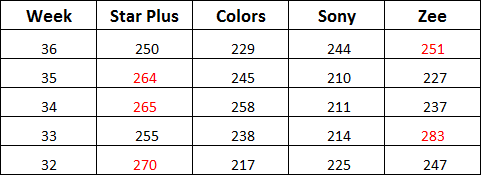
    If the TAM ratings of the past few weeks are studied, it becomes very clear that there is no sure-shot contender for the numero uno position. The weekend which saw the first episode of KBC on Sony made the channel numero uno for the weekend slot. However, overall ratings for week 36 saw Zee in the top slot. Week 35, saw Star Plus in the top place whereas for week 33, it was Zee at number one position.


    The yo-yoing has been going on for sometime now, so who gets affected by this – channels, media planners or advertisers? Or don’t the weekly ratings matter much? MxMIndia spoke to a few media planners/buyers and advertisers to get their perspective on it and to find a few answers.


    According to Anita Nayyar, CEO, India and Southeast Asia, Havas Media, in the GEC space there are four top channels – Star Plus, Sony, Zee and Colors – and their ratings keep fluctuating among themselves, which isn’t a recent phenomenon. “One week, one channel is peaking so the other week it’s another channel’s chance. Also, there isn’t much difference between their GRPs; it’s a matter of only a few numbers that they fall short of each other in the race. Therefore, it’s nothing alarming even for the clients who follow the GRPs to the T. However, we do keep in mind the trends and what gets the eyeballs to the channel. For instance, KBC taking Sony to number slot was expected. One needs to keep such issues in mind and plan accordingly.”

     

    Agreeing with Ms Nayyar, Hiren Pandit, managing partner, GroupM adds that one needs to keep in mind what is the programming mix of different channels. With KBC opening with 6.1 TVR, Sony was bound to reach the top slot. Therefore, one needs to track the new big shows coming up and how they’ll fare rather than worrying about channel shares which keeps see-sawing because of these shows. As for advertisers, they too focus more on shows and its performance rather than channels. Hence, such yo-yoing shouldn’t bother anyone unless it’s a drastic one.


    “I don’t think anyone takes these weekly GRPs of GECs into account; therefore, such weekly see-sawing shouldn’t matter. If one looks at various channels, you’ll see that most of them have reality shows or special episodes or Grand finale etc as their strategy to drive channel GRPs especially on the weekend. Hence, a media planner or buyer doesn’t get affected by it as most of the deals are separate for these (channel driver) reality shows and separate for rest of channel (regular) programs. And to advertisers what matters is the consistent deliveries through regular shows and not these few spike on select shows,” adds Neelkamal Sharma, COO – Buying, Madison Group.


    However, the advertisers feel a little different as GECs which have a vast reach in the country are seen by the advertisers as the best way to reach out to their audiences and brands spend millions to use the visibility given by these channels.


    Kamal Nandi, vice-president (sales & marketing) of Godrej & Boyce Manufacturing explains that as a brand, for them the two things that matter the most are efficiency and effectiveness. “Therefore, as advertisers on these GECs, we do look at cost and ratings points as the two most critical evaluating parameters. Hence, such fluctuations do effect our decisions as we monitor them closely.”


    Similarly, Mayank Shah, Group Product Manager, Parle Products says, “The content of every show on every channel varies. Despite the fluctuations, there are certain properties that continue to be at the top. These shows provide great opportunities for advertisers. However, strategies keep changing. So we do keep these fluctuations in our mind and alter the strategy as and when required. Advertising strategies are based on the kind of viewership a channel has. If a product matches with the channel’s target group, then advertisers will continue to advertise on that channel because the reach is effective. Also, there are various aspects to consider while choosing channels. Hence, the positioning is an important criteria, but not the sole criteria.”


    Hence, one thing is clear, that weekly ratings of GECs might not be considered as the sole criteria by planners or advertisers as much a monthly or the performance of the show in general. But they do matter when it comes to brands spending on GECs to reach their desired audience.


  • Ranjona Banerji: ’cause Arnab Goswami wants to know…

    By Ranjona Banerji


    Suddenly last night, it was no longer “India wants to know” on Times Now. It was “I want to know”. And the nation breathed a collective sigh of kinship – we were all the same as Arnab Goswami, the man who speaks for us all.


    The thing is, you or me or even he may want to know, but who is willing to tell us? The discussion (I still call it that, for want of a better word) on FDI in retail was organised as a sort of cross-examination of Ravi Shankar Prasad of the BJP, since his party is the main opposer of FDI. This meant unfortunately that Prasad was given more than his fair share of time to be disingenuous. Everyone knows (that’s you, me and Goswami, hereon known as “I”) that the BJP was all for FDI when it was in power but has been forced to have a change of heart thanks to being in the Opposition and wanting to win the next election and all that.


    Anyway, Kiran Mazumdar Shaw of Biocon had a big grin on her face through the whole show as she watched Prasad tie himself up in knots and then proceeded to demolish his arguments against FDI in retail. She even accused the BJP of not looking out for the best interests of the nation, which in a sense, stepped quite firmly into Goswami territory. Veteran journalist Kumar Ketkar also pointed to the BJP’s double standards and then looked on amused. There were some bit players as well, but they just provided ballast.
    The upshot is: did we learn any more than we already knew? What an idiotic question. If you want to learn things from television, you should watch Discovery or National Geographic or whatever.


    **


    On CNN-IBN’s The Last Word, Press Council of India chairman Markandey Katju told Karan Thapar that he was all primed and ready to take on anyone who filed any more foolish sedition charges against innocent people and how foolish the sedition law is in the first place. It is heartening indeed to know – and Thapar seemed much reassured – that a retired judge who heads a toothless body which deals with complaints against the print media is going to take on the world and save the people from transgressions on freedom of speech. Some people I fear may have more faith in Arnab ‘Save the Nation’ Goswami.


    **


    By the way, the next issue which Goswami is going to take up is the All India Tennis Association’s decision not to pick Mahesh Bhupathi or Rohan Bopanna for any more Davis Cup ties till June 2014. This is to punish them for their high questionable behaviour in the run up to the London Olympics. Watch out, everyone. L’etat C’est moi.


    While on the subject, DNA seemed to get a scoop over other tennis journalists with the news that Mahesh Bhupathi and Rohan Bopanna are ending their doubles partnership. Bhupathi will tie up Daniel Nestor and Bopanna’s trying to get back with his old partner Aisam Qureshi, whom he had earlier dumped for Bhupathi.


  • Debrief: Pepsi: Not the game, change the ad!

    By Anil Thakraney


    It must take enormous talent to botch up something like this. The creators of the new ad for Pepsi had all the power tools at their disposal: A funky, irreverent brand. Top Indian cricket heroes. The most happening Bollywood star. And a cool idea – Change the game- which packs in potential for super commercials. And yet, it’s all gone terribly wrong.


    In the TVC, designed to promote Pepsi’s association with the current T20 World Cup, the team bus has broken down on the road. Leading to crowds, noise and traffic mess. Ranbir Kapoor arrives out of nowhere, and advises Dhoni and his boys on strategies to use for the tournament. When Dhoni questions Kapoor’s ‘tameez’, the latter explains that T20 lacks tameez.


    [youtube width=”400″ height=”220″]http://www.youtube.com/watch?v=Y8YeNX6l5ek[/youtube]

    An extremely poor ad, I have a laundry list of problems. Boring interpretation of ‘Change the game’. Witless, uninteresting dialogues. Forced irreverence, which falls totally flat. Worse, Ranbir Kapoor looks like he has no idea what’s going on out here. And the cricketers leave you with a feeling they want this shoot done with very quickly, and their bills settled before the first ball is bowled.


    Truth be told, lack of tameez as a thought ties in well with T20 cricket. (That it promotes rowdy behaviour inside the stadia is another story, of course). But a tired, stupid commercial has killed even that little germ of an idea.


    Rating: (On a scale of 1-5): 0. Disaster with a capital D.


  • Colvyn Harris to be South Asia JWT CEO, to be incharge of all JWT cos in India including Contract

    By A Correspondent


    JWT Worldwide Chairman and CEO Bob Jeffrey has announced a leadership restructure to reflect Asia’s growing global importance, and underscore JWT’s commitment to the region’s diverse and vibrant markets.


    JWT’s North Asia Area Director and Greater China CEO Tom Doctoroff and JWT India CEO Colvyn Harris will succeed Michael Maedel in the restructured region.


    Mr Doctoroff will take on the role of CEO, JWT Asia Pacific (APAC), at the end of this year. In this role, he will oversee Northeast and Southeast Asia, as well as Pakistan, Australia and New Zealand.


    Mr Harris will become South Asia CEO (India, Sri Lanka and Nepal) and take on added responsibilities of JWT’s Indian companies, including Contract Advertising, Hungama Digital Services, JWT Mindset and Encompass. Messrs Doctoroff and Harris will report to Mr Jeffrey.


    Mr Maedel, who has spent 40 years in the industry and 22 years in leadership roles at JWT, including eight as President of Asia Pacific, will move into the role of Non-Executive Chairman for Asia.


    “Tom and Colvyn are both dynamic leaders with strong connections to the markets, the consumers and the clients,” said Mr Jeffrey.  “By leveraging the strengths and strategic insights of these two very talented people, JWT is uniquely positioned to maximize growth in this critical and dynamic region.”


    These changes come at a time when JWT APAC, which has an 83-year history in Asia, continues to gather greater momentum. JWT APAC has set multiple benchmarks, bringing home first-time Cannes Grand Prix Lions for Malaysia in 2004, India in 2008, Japan in 2009 and, most recently, China in 2011.  The company has also deepened the scope and scale of the services it offers in the market, from digital to shopper marketing, through organic growth and acquisitions.


    “I am very excited to build on JWT’s past accomplishments across Asia Pacific,” said Mr Doctoroff. “We are in the midst of a revolution of consumer empowerment. I look forward to working with client partners in this fast-changing region to find new synergies between classic brand building and next-stage consumer engagement in the digital era.”


    Mr Doctoroff, who has 20 years’ experience with JWT, continues to display his commitment to building the agency’s footprint in Asia and fostering its ethos of Worldmade ideas. Under his leadership, JWT North Asia has diversified into customer relationship marketing, field marketing, promotion network management and digital engagement. A Detroit native, <r Doctoroff joined JWT in 1992, moved to Hong Kong in 1994, and became the Managing Director of JWT Shanghai in 1998. In 2002, he was appointed Greater China CEO and Northeast Asia Area Director, a remit that included Korea, China, Hong Kong and Taiwan.  Japan came under his purview in 2008, when Doctoroff assumed the role of North Asia Area Director.  He speaks fluent Mandarin.


    Doctoroff is credited as being the industry’s preeminent thought leader on advertising and marketing in China. This past May he published his second best-selling book on Chinese consumers, titled “What Chinese Want.” Prior to JWT, Mr Doctoroff worked for Leo Burnett. He holds an MBA from the University of Chicago.


    The restructuring reflects a renewed focus on India by JWT Worldwide. JWT employs over 1,500  people in India, more than any other single market worldwide, and earns a significant amount of revenue from this critical, high-growth country.


    Mr Harris, who has 33 years at JWT, continues to lead India’s largest and most admired advertising agency as CEO South Asia. He has held various industry leadership roles, including President of the Advertising Agencies Association of India, and has addressed global audiences as a speaker at the World Economic Forum, London Business School and The Wharton School.  Under his leadership, JWT India has built a formidable reputation with a diverse spectrum of traditional, mainstream, activation, events and digital marketing services capabilities.


    “We will continue to build and acquire the most diversified platforms to deliver on the market ambitions of the clients we service, thereby further consolidating our leadership position. Brands are the center of our focus, and with our skills and capabilities we deliver marketing solutions across the most diverse of offerings to meet the challenges of the dynamic markets we operate in,” said Mr Harris. “This new development ensures that our clients continue to have greater access to the best of our services and talent, not only in the country, but across South Asia.”


    Mr Maedel, who will continue to stay in Singapore, will work with Messrs Doctoroff and Harris in an advisory role until he retires 2014.


    “Michael’s exceptional leadership skills have cemented JWT’s reputation as a leader in both strategy and creativity in every region he managed, from Europe to Asia,” said Mr Jeffrey.  “The creative and commercial success that JWT APAC has enjoyed is a testament to his leadership.”


    Mr Jeffrey continued, “Michael is deeply respected by staff and clients, and the entire company has benefited from his vision and guidance. He is an unparalleled resource, and we are thrilled that he will remain a core part of the management team until his retirement.”


    Mr Maedel, who holds a degree in Economics from the University of Vienna, started his career at Young & Rubicam, and in 1985 became Chairman of Ted Bates Werbagentur. Maedel joined JWT in 1990 as Chairman and CEO of JWT Germany, and in 1993 added the role of Area Director Central and Eastern Europe.  In 1997, Mr Maedel was named the President of Europe, Middle East and Africa, and in 2004, Asia was added to his portfolio.  He has served as a member of JWT’s board since 1992.


    “I’ve had the real pleasure of charting a course for our company in some of the world’s most dynamic regions through periods which have seen our industry go through some pretty seismic changes. I’ve also been privileged to work with some of the most talented people around the world,” said Mr Maedel.  “I look forward to working with Tom and Colvyn through this transition period.”