Duroflex sleep provider has unveiled its latest ad film featuring national brand ambassador, Virat Kohli.
Set on the theme of #GreatSleepGreatHealth, the campaign advocates the power of quality sleep in fostering an active lifestyle at any stage of life.
Speaking about the new campaign, Mohanraj Jagannivasan, Chief Executive Officer, Duroflex said: “Our latest campaign sees imaginative storytelling take center stage, presenting our brand ambassador and cricketer, Virat Kohli, in a new avatar. With his unmatched charisma and charm, Virat elevates the captivating TVC and takes it notches higher. The core objective of this campaign goes beyond mere entertainment; it is a celebration of the joys derived from leading an active lifestyle, all made possible through the foundation of restful sleep. We take immense pride in showcasing this creative TVC that seamlessly blends the art of good sleep with the pleasures of an energetic life”.
Conceptualised by Tilt Brand Solutions, Adarsh Atal, Chief Creative Officer, Tilt Brand Solutions added: “We wanted to create a crisp video which encapsulates the essence of our messaging; the importance of sleep in one’s life. We have captured how Duroflex is instrumental in delivering these fundamental needs and strengthening their consumers to power through the day with India’s fitness icon – Virat Kohli.”
Zoya diamond boutique from the House of Tata, presented a new brand film to launch its new autograph collection – My Embrace. Featuring Sonam Kapoor-Ahuja, the film accompanies the launch of Zoya’s new autograph collection ‘My Embrace’ – a signature identifier of the luxury atelier.
Said Amanpreet Ahluwalia, Business Head, Zoya: “At Zoya we have always believed that women should be able to celebrate the joy of being just who they are, irrespective of the many roles they play in life. Our new film journeys to the very soul of Zoya, a word which means ‘alive’. Through this campaign we hope to inspire women to powerfully embrace who they are. The narrative showcases our autograph collection ‘My Embrace’, a talismanic symbol of self-acceptance, created around the belief that you feel truly alive only when you embrace who you are and are comfortable in your own skin.”
Says Ajay Ram, Creative Partner & Founding Team Member at Spring Marketing Capital: “The credit for this collection goes to the mastery of the Zoya jewellery design team. The element of the embrace has been crafted into a most elegant form factor. Our attempt was to recreate the design philosophy in an effortless narrative. Collaborating with Sonam Kapoor allowed us to explore her vibe amidst spaces she finds most joy in, setting the right tone for the collection to come alive.”
U.S. Polo Assn., the official brand of the United States Polo Association and Arvind Fashions Ltd. announce two major business milestones in India: the iconic Legends marketing campaign and the new U.S. Polo Assn. website launch. Both business strategies have been designed to help take U.S. Polo Assn. in India to the next level.
Said J. Michael Prince, President and CEO of USPA Global Licensing, the company that manages and oversees the U.S. Polo Assn. brand: “Arvind Fashions has been a tremendous partner to the U.S. Polo Assn. brand, and we are excited about our future as a power brand, targeting a billion-dollar business over the long term in one of the world’s most important markets. The execution of our strategic plan in India will further solidify our position as one of the top casual wear brands in the country.”
Added Kulin Lalbhai, Vice Chairman and Non-Executive Director of Arvind Fashions Ltd.: “With revenues nearing INR 2000cr, U.S. Polo Assn. is the leader in the men’s casual wear segment in India. We are further investing in energising the brand through multiple efforts including the brand website launch, a new iconic Legends advertising campaign and building new exciting adjacent product categories.”
Cecil Stoughton/John F. Kennedy Presidential Library and Museum/Wikimedia Commons
By Rodney Tiffen
Nearly every biographical commentary on Rupert Murdoch notes how he began with a modest inheritance in Adelaide, principally an afternoon newspaper, and built it into a global multimedia empire. Walter Marsh’s book Young Rupert: The Making of the Murdoch Empire has the distinctive strength of knowing Adelaide much better than any other Murdoch watcher, and studying Murdoch’s Adelaide period in more depth than anyone else.
Rupert’s father, Sir Keith Murdoch, was the most famous Australian newspaperman of his generation. As the dominant figure in the Herald & Weekly Times group for over two decades, he built the country’s first newspaper empire.
But he increasingly resented the chasm between being a shareholder and an employee, no matter how well rewarded. He was determined to leave his son Rupert a tangible inheritance. In the last years of his life, he sought to build his own independent newspaper empire in ways that were far from being in the best interests of the Herald & Weekly Times.
Sally Young’s recently published Paper Emperors: The Rise of Australia’s Newspaper Empires gives a very good account of Keith’s machinations. Rupert would never have allowed any employee of his to behave in the way Keith did.
A great fight
Rupert Murdoch’s father Sir Keith Murdoch (1885-1952). Public domain, via Wikimedia Commons.
After all Keith’s efforts, once the personal debts and death duties were paid, Rupert’s inheritance essentially came down to the Adelaide News. Editing the Adelaide News was Rohan Rivett, Keith’s trusted confidante and Rupert’s mentor and friend from his Oxford days.
Rivett was a distinguished journalist, who had recorded his experiences as a prisoner of war in Behind Bamboo, the bestselling Australian book on World War II. His political leanings were to the left. The Adelaide News was seen as bringing a refreshing degree of social and political liberalism to South Australia’s stuffy politics, although the paper rarely directly challenged the premier, Sir Thomas Playford, by far the longest reigning state premier in Australian history (1938-1965).
Almost immediately, the Herald & Weekly Times morning newspaper – the very establishment Advertiser – sought to drive News Limited out of business by starting a rival Sunday newspaper. Rivett and Rupert fought hard to survive. Not for the last time, Rupert relished the conflict. “It is going to be a great fight,” he told Rivett.
In a front page editorial, Murdoch and Rivett disclosed the behind the scenes actions of their rivals. After a couple of years, the two Sundays fought each other to a stalemate. In the subsequent agreement, in some ways News emerged the better. Rivett and Murdoch had won their first big challenge.
With this threat disposed of, Murdoch, now with the title “publisher”, began his expansion. He bought the Sunday Times in Perth, where free from Rivett’s presence he was more able to indulge his tabloid tastes.
He also successfully applied to get one of the first two commercial television licences in Adelaide, although his lobbying to make this a commercial monopoly service failed.
Marsh deftly documents how Murdoch’s views on the virtues of monopoly and competition varied to suit his immediate interests. Murdoch’s declaration, when he unsuccessfully applied for the first commercial television service in Perth, that he was not interested in building his empire, has not exactly stood the test of time.
Two episodes
The two episodes that later writers always mention about Murdoch’s Adelaide period are the News’ championing of the cause of Rupert Max Stuart, convicted for the rape and murder of a nine-year-old girl, and his firing of Rivett.
Stuart was an itinerant Aboriginal labourer, illiterate, with limited English and prone to alcoholic binges. In December 1958, he was arrested near Ceduna and charged with the murder. The case for conviction rested principally on his confession.
With the threat of imminent execution hanging over him, Stuart had his cause taken up by Father Tom Dixon. A pamphlet by the historian Ken Inglis and coverage in the Adelaide News, driven by Rivett and supported by Murdoch, forced a new trial and then a Royal Commission.
The newspaper’s coverage of the Stuart case became politically controversial and the Playford government brought nine charges against it, including seditious libel. After a prolonged period of suspense, these charges were dismissed.
Putting to one side the drama, uncertainty and high emotion of the case, there are, in retrospect, three groups of opinion on Stuart’s conviction.
First, there are those who think he was guilty and the police and officialdom were essentially correct in everything they did. The second group consists of those who continued to believe in Stuart’s innocence, including Father Dixon and, years later, the investigative journalist Evan Whitton. The third group believed that the police grossly mistreated Stuart and fabricated the case against him, but that he was probably guilty.
Ken Inglis’s book concluded that the weight of the evidence tilted toward guilt rather than innocence. Decades later, Murdoch said:
There’s no doubt that Stuart didn’t get a totally fair trial, although it’s probable that he was guilty. I thought this at the time.
I think Murdoch is overstating the constancy of his opinion here. My guess is that, initially, when Rivett and Inglis took up the cause and later recruited Murdoch to it, they thought Stuart was innocent. After a searching cross-examination of Stuart at the Royal Commission, several of his previous supporters had their beliefs shaken.
The action that most showed Murdoch’s ruthlessness in these years was his sacking of Rivett in 1960. Rivett had been the editor of Adelaide News for eight and a half years. He had given the paper a much stronger financial basis, as well as higher standards of journalism. Before that, Rivett had helped Rupert through his years at Oxford. Relations were almost familial. They went on holiday together and Rupert often stayed with the Rivetts in London.
Despite the close and generally amicable relations between them, Murdoch fired Rivett without warning. Murdoch’s brief letter gave no reason for the dismissal and was never preceded or followed by any personal discussion between the two.
Murdoch later claimed that even after the trauma of the Royal Commission and libel trial, Rivett was being too provocative in his attitude to the Playford Government. Marsh notes that the last month of Rivett’s editorship gives no grounds for such a claim.
The timing, I think, was determined not by events in Adelaide, but by Murdoch’s bid for the Daily Mirror in Sydney. As Marsh points out, Rivett was a friend of the unions, and more inclined to be generous towards the journalists in his employ. Murdoch, with his eyes on Sydney and beyond, wanted his Adelaide assets to be a safe and regular cash cow to aid his ambitions for expansion elsewhere. A quiet, frugal editor was what he now required.
The unsentimental firing of Rivett showed that Murdoch was determined to be in sole charge and would pursue his interests ruthlessly.
Murdoch watchers will be also particularly interested in what other clues Young Rupert gives about its subject’s later behaviour. My suggestion comes in February 1956, when he was caught driving at at least double the speed limit on an Adelaide highway. After Murdoch made his excuses, the police allowed him to drive on, but almost immediately he started speeding again in a school zone, and the same police arrested him a second time.
Already, for this 24-year-old, rules were things that only applied to other people.
Rodney Tiffen is Emeritus Professor, Department of Government and International Relations, University of Sydney. This article is republished from The Conversation under a Creative Commons license. Read the original article.
Young Rupert: The Making of the Murdoch Empire – Walter Marsh is not yet available on Amazon India in paperback or hardcover. However, a Kindle edition is available at Rs 3269.25. Link
Mahindra University has launched the School of Media with two undergraduate programmes spanning digital journalism, mass communication, communication management, and technology-driven computational media-related fields. The new school is the fifth school under the university, after the schools of law, management, education, and the flagship École Centrale School of Engineering.
Said Dr Yajulu Medury, Vice Chancellor of Mahindra University: “The School of Media embodies our commitment to fostering cutting-edge education that addresses the evolving needs of the media industry. With the beginning of the academic session of 2023-24, Mahindra University’s strength stands at over 4,000 students supported by more than 250 internationally acclaimed faculty members. Our multidisciplinary approach, coupled with the expertise of our faculty, will empower students to become leaders and change-makers in the media sphere.”
Added Dr Shashidhar Nanjundaiah, Dean, School of Media: “We are embarking on a journey that will prove to be transformational. In this journey, we integrate technology with humanities, creative with critical, concepts with practices. Our students will have a tripodic grounding in competencies—professional, conceptual, ethical. With this kind of emphasis, our students will learn to understand change and the structural questions around it—whether, why and how. A digital-first curricular and pedagogic approach may sound almost obvious in today’s age, but it must be constructed in the ecosystem of responsible use. Our B.A. students will seek to be ethical practitioners and researchers of journalism, audiovisual production, advertising, public relations, social media, and corporate communications. Our B.Tech. students will not only use AI, AR-XR-driven objects for news, television and promotions industries, but also be competent in media forensics, important in tackling disinformation, the most pressing problem in today’s communication processes.”
Mediker, an anti-lice treatment brand from Marico has launched its new communication campaign – “Mediker On Juey Gone!”
Commenting on the importance of Mediker in the current context, Somasree Bose Awasthi, Chief Marketing Officer, Marico Limited, said: “Mediker’s new TVC encapsulates our commitment to providing effective solutions that address real-life challenges faced by our consumers Powered by 100% Natural Actives of Coconut and Neem, Mediker promises to solve the persistent issue of lice by breaking the life cycle from within thereby bolstering children’s self-assurance and overall well-being, something that is very important to every parent. We are thrilled to introduce this powerful solution that helps assure parents of their children’s well-being and nurtures healthy hair”.
Speaking on the brand film, Deepa Geethakrishnan, Founder MYO creative agency added: “In a functional problem solution category, the big creative challenge was to demonstrate the expertise of Mediker while keeping the story authentic and something the mothers can instantly relate to, but with a smile”.
The news cycle in India is like a yoyo, swinging between one bizarre act by the government to another worship of the PM to one more ghastly act of communal, casteist and gender violence.
Of course, just because the news cycle swings like this does not necessarily mean that the Indian news media follows suit.
A very disturbing video of a school teacher urging students to beat up a classmate went viral this week. From the video it appeared that the teacher was urging the students to hit the boy harder and also what sounded like this treatment was for all “Mohammedans”.
From both the communal angle as well as the child rights angle, the video was painful to watch. Most people who saw it on sites like X (formerly Twitter) were outraged, including several shameless TV people who have consistently egged on anti-Muslim sentiments and violence for the past nine years. The video was shared by many, picked up by news sites and spread across cyber space.
As the internet outraged away, the pincer movement from our strong Hindutva brigade began. The National Commission for the Protection of Child Rights posted that the video should not be shared because it violated the rights of the child, and action would be taken against those who continued to share it. The BJP propaganda website known as “OpIndia” (as in “Opposed to India”, I feel) tagged the NCPR chief and asked for action to be taken against Mohammed Zubair of Alt News, the fact-checking website. The post ended with the line, “let’s get him this time”.
I add that line for all of you who continue to believe that this BJP site is a genuine news site.
Then people identified the school, the boy’s father was located, the teacher was named – Tripti Tyagi, and the Muzaffarnagar Police was also activated. I should not need to specify that the school was in India’s most developed and forward state, Uttar Pradesh, but I shall do it anyway.
The defence of the teacher began in a number of ways: she was differently abled so could not get up and hit the child herself, she was asked by the parents to beat up the child, she was loved by the villagers, she was ashamed, she was not ashamed, the video was edited and she only meant that “Mohammedan children should not be taken to their maternal uncle’s homes by their mothers or they would miss school”, the boy had not done his homework and any number of such stories.
The school was found to be unregistered and unlicensed and apparently shut down. The teacher was “booked” but not further action was taken. There are laws about beating up children, but never mind. Let’s see what happened next.
Which was that an FIR was filed against Zubair for sharing the video. Out of the thousands of people who had shared that video, only Zubair was targeted. Because of his fact-checking stories and his Muslim name, Zubair has been a consistent target. The bullseye on his back was painted by the BJP website, and obviously, the system was activated.
A number of side arguments carried on around the incident: many teachers are like this, this has always happened (the foremost excuse from liberals which translates to “do nothing), this is not “my’ Hinduism, what about the student who was beaten up in Jammu for writing Jai Shri Ram on the blackboard (teacher arrested), where were you when Mahmud of Ghazni did that or that.
But everyone inside themselves knows how deep the hatred has seeped and knows how the mainstream media has played a massive role in fanning those flames.
The internet is now full of other videos of children spouting vile communal propaganda.
And then comes this incident, from a Delhi school:
Sadly, for us all this will soon be forgotten. The G20 summit begins in Delhi in September and the mainstream media will begin collective sashtang pranams (genuflection) to the glory of the Emperor.
Children can now get thrashed with impunity, Muslims killed, Dalits killed, women beaten and raped, Manipur burn and all the rest of it.
Prove me wrong.
Ranjona Banerji is a senior journalist and commentator. She writes on MxMIndia on Tuesdays and Fridays. Her views here are personal.
TV9 Network has launches News9 Mediaverse, its fully integrated digital-first English news brand.
It brings together News9 Plus along with News9 Live. The integrated service, with all three streams feeding one another, wilil define the ‘Mediaverse’.
Barun Das
Said Barun Das, MD and CEO, TV9 Network: “The world has undergone a complete metamorphosis. With the advent of the internet, digitization, mobile penetration, and now AI, it is a completely different world compared to the one we were born in. The world of entertainment media has changed. How could news remain the same? Which is where News9 Mediaverse comes in.”
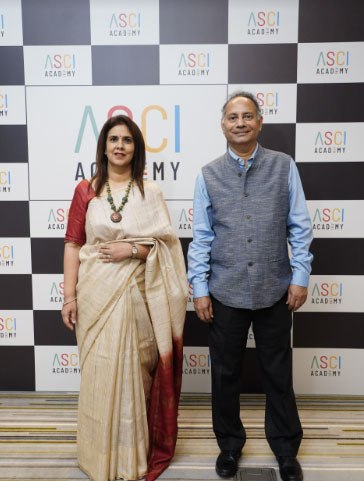
(L-R) Manisha Kapoor, CEO and Secretary General and NS Rajan, Chairman, ASCI at the Academy Launch
The Advertising Standards Council of India (ASCI) has unveiled the ASCI Academy, an initiative poised to amplify the advertising industry’s capacity to create more responsible and progressive advertising campaigns.
The Academy has over 50 founding partners and supporters including Cipla Health Limited, Coca-Cola India Private Limited, Colgate-Palmolive (India) Limited, Diageo India, Hindustan Unilever Limited, Mondelez India Foods Private Limited, Nestlé India Limited, PepsiCo India Holdings Pvt Ltd., Procter & Gamble Home Products Private Limited, several leading universities and colleges, prominent Civil society organizations such as Mumbai Grahak Panchayat, Consumer Voice, CUTS, CMS and others, and, industry bodies like the ISA, AAAI, IAA and ISWAI, as well as research insight organizations.
Said Rohit Kumar Singh, Secretary, Department of Consumer Affairs: “I congratulate ASCI on the launch of the ASCI Academy. In the digital age, preventive actions need strong impetus and encouragement, and the training of industry professionals – current and future is an important systemic intervention. The Department of Consumer Affairs is supportive of such efforts by the advertising self-regulator to foster a culture of responsibility in the advertising industry. We hope that the advertising industry engages deeply with the Academy programs to make their teams better trained and educated on the aspects of advertising regulations.”
Added Vikram Sahay, Joint Secretary, Ministry of Information and Broadcasting, who is part of the ASCI Academy’s Apex Council: “Many congratulations to ASCI on the launch of the ASCI Academy. The Ministry of Information & Broadcasting has always supported self-regulatory mechanisms in the media and entertainment industry. We hope that the resources and support by the Academy would be extremely useful for the online advertisers and platforms.”
Addressing the opening of the academy, NS Rajan, Chairman, ASCI, said: “While ASCI has always had a strong corrective mechanism, we also wanted to harmonise the dynamic interplay between creativity and responsibility and address the broader consequences of advertising on society at large. The ASCI Academy is a big step in this direction which will facilitate a preventive footprint and shape an advertising ecosystem to help the industry to get it right.”
Added Manisha Kapoor, CEO and Secretary General, ASCI: “With short campaign durations, it is important that attention is directed at the point of creation of ads, not just after they are published. When the only ads to hit the market are responsible and compliant, it is a win-win for both consumers and industry. Over the next three years ASCI Academy aims to train 100,000 current and emerging professionals through self-learning and on-campus workshops and sessions, besides programs for research and consumer education. This is a new chapter in self-regulation in India, and we are grateful to all our founding partners for supporting this vision. We hope to add several more believers in this agenda- this is just the beginning”.
Procter & Gamble India has appoints Mukta Maheshwari as the company’s Chief Marketing Officer (CMO). Along with leading the marketing function, Maheshwari will also head the Fabric Care Category for P&G India.
Sharing his perspective, Sharat Verma, Senior Vice President, Fabric Care, P&G India, Middle East, and Africa (IMEA) said: “It has been my privilege and an absolute honour to serve as the CMO for P&G India. The journey has been rewarding and one filled with immense learnings. From every campaign that captured hearts, to each innovation that reshaped industries, our commitment to delivering exceptional results stands as a testament to our unwavering pursuit of excellence. Together, we raised the bar on consumer centricity and brand building and reinforced our brands as both – a #ForceForGrowth and a #ForceforGood. As I extend a warm welcome to Mukta, I am confident that our legacy will continue to thrive, inspiring new heights of creativity, impact, and success. I am only optimistic about what the future holds.”
Ventes Avenues a Mobile AdTech Company announces two senior level appointments. Saurabh Gupta has been appointed as the National Business Head for the Performance Business, while Shriram Narayanmurthy steps into the role of VP of Sales (Branding) for the West & East regions. These strategic appointments mark a pivotal moment for the company, aligning with its vision for growth and innovation.
With Saurabh Gupta and Shriram Narayanmurthy at the helm of their respective domains, the company is poised to navigate the challenges of an ever-evolving market landscape while capitalizing on emerging opportunities. As Ventes Avenues steps confidently into a new phase of its journey, the collective experience and vision of its new senior-level leaders promise to steer the company toward even greater success and distinction.
ZEE TV has refreshed its design interface with an aim to enhance and elevate viewer experience. This unique design approach is brought to life through the visual metaphor called the ‘Circle of Spark’ that ignites life’s most defining moments through inspiring stories and aspirational characters.
ZEE TV’s strategic evolution of its on-screen TV experience leverages design for optimal business impact through enhanced information registration. It augments key aspects such as brand partners’ visibility, providing a distinctive proposition to its esteemed partners. Backed by the latest in ‘Neuroscience’, this intelligent design system captures consumer attention and heightens memorability, enhancing viewer retention of tune-in details and reinforcing platform recall. A holistic understanding of the consumer journey across the broadcast and digital ecosystem and imbibing their behavioural & navigational aspects forms the bedrock of Zee TV’s innovative design approach.
Speaking on the refreshed visual experience, Kartik Mahadev, Chief Marketing Officer – Content SBU, ZEE Entertainment Enterprises Limited said: “As pioneers of the television content landscape, our endeavour at ZEE has been to consistently deliver extraordinary experiences to our viewers. As we touch millions of hearts and homes across the many Bharats through our stories, our approach to design is in being native to culture, which we call ‘Soul to Screen’. This method enables us to be consumer centred and insight driven, making the brand and viewing experience personal. The new design for Zee TV captures the aspirations of the evolving Indian audiences. The ethos of ‘vibrance’ encapsulates the idea of a consumer who is confident, has innate strength and is taking action to shape an extraordinary tomorrow. In this new design language, we have combined cultural relatability with evolving CX trends, creating value for our viewers and advertisers alike, further fortifying our connection with our audiences and brands.”





 The news cycle in India is like a yoyo, swinging between one bizarre act by the government to another worship of the PM to one more ghastly act of communal, casteist and gender violence.