Author: mxmadmin

  • Macro factors impacting volatility in business…


    By Our Staff


    GroupM along with MMA today has launched a marketers’ guide titled ‘Transform to Thrive’.


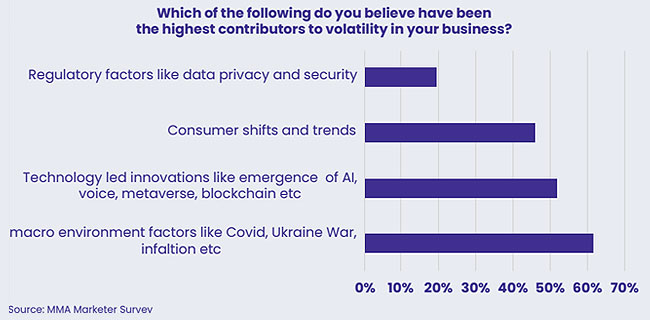
    Notes the report: “In order to strategise on how organisations should “Transform to Thrive”, in an uncertain world, it is first important to delve into the drivers of uncertainty. With the objective of crafting a carefully researched and relevant report, MMA conducted a survey among senior marketing professionals across industries. The findings are what determined the roadmap for various elements of this report. 61% of marketers felt that macro environment factors like Covid, Ukraine war, inflation etc. have been the highest contributors to volatility in business, followed in innovations in technology and a shift in consumer trends and preferences,” adding: “Amidst these uncertain times, marketers also need to expand their focus on protecting their advertising spends from the rising threat of sophisticated fraud. A critical component in achieving this is ensuring safe inventory to engage the “right audience” with advertising campaigns. Brands must adopt a customer-centric advertising approach, prioritising the protection and acknowledgement of their consumers’ interests.”


    Said Prasanth Kumar, CEO – GroupM South Asia”: A marketer’s dashboard is spruced with business numbers, social numbers, service/outages, and innovation, all tied to delivering a superlative experience. This holistic approach ensures that marketing strategies are aligned with business goals, social engagement, service reliability, and innovation, all contributing to an exceptional customer experience. We embrace these trends and strive to provide innovative solutions that meet the evolving needs of our customers”, .


    Added Moneka Khurana, Country Head & Board Member, MMA Global – India: “MMR’23 is a must-read for every marketer looking to thrive in the face of unprecedented change. It provides a roadmap for building a future-proof marketing organisation, one that is agile, consumer-centric, and data-driven, and leverages relevant tools and technologies to power it. At the MMA, we believe that the future belongs to those who embrace 2023 as the year with change being front and centre and are willing to challenge the status quo. This report brings perspectives from 25+ experts from across the ecosystem offering the needed understanding. Grab the MMR – Modern Marketing Reckoner to start your Transform to Thrive journey ”


    Said Amit Jain, MMA India Board Chair; Chairman- L’Oréal India:“The Modern Marketing Reckoner 2023 offers a rich perspective on future-proofing marketing and being agile in the current times. It also drives perspectives on the power of AI, data, tech, and new media to accelerate business growth. We at MMA strongly believe that digital maturity must be measured in the context of key growth drivers to measure success and progress year on year. As the Chairperson of MMA India and L’Oreal India, I am excited to see the influence and shift in mindset this report will have on the marketing community.”


    The landscape of customisation has extended beyond media, with innovative strategies such as QR scans on products to build “always on” engagement, exclusive product bundles for omnichannel, and leveraging the strength of online marketplaces for key occasions. Marketers are urged to embrace dynamic marketing strategies that cater to individual customer preferences and preferences for communication channels.


    Furthermore, building flexible distribution networks that can quickly adapt to changing customer preferences is crucial. Organisations must pace up technological innovation to foster omnichannel growth and digitise supply chains, enabling real-time inventory management and delivery.


    The report can be accessed here –https://drive.google.com/uc?id=1K9951JJbeZqSIkwCjDPWwTqDCT9Nl4Pu&export=download


  • TCS tops Interbrand Most Valuable Brands list


    By Our Staff


    Interbrand, the world’s leading brand consultancy, proudly presents the eagerly awaited list of India’s Top 50 most valuable brands. The unveiling event took place in Mumbai, with Rajashree R, Chief Marketing Officer, TCS, joining Gonzalo Brujo, Global CEO, Interbrand, as keynote speaker.


    Celebrating its 10th year, the Best Indian Brands report has become a definitive guide to the nation’s brand landscape since its inaugural publication in 2014. This year’s edition showcases remarkable growth, with a total list value of INR 8,310,057 million (US$ 100 billion), marking a significant 167% increase over the past decade. Notably, this is the first time the total value of the table has surpassed the US$ 100 billion mark.


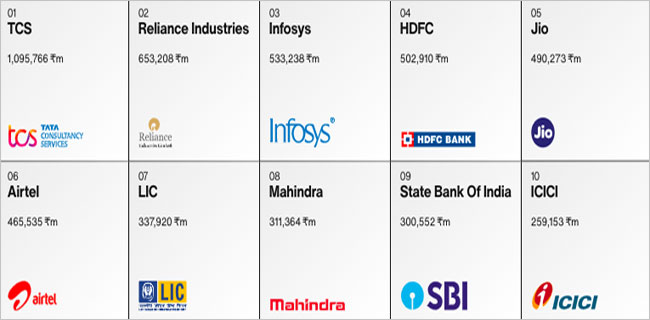
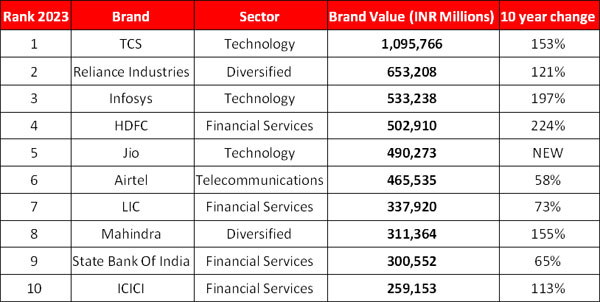
    The rankings for 2023 reveal the following brands as the frontrunners:


    The top three brands alone account for a staggering 46% of the total value of the Top 10 brands. Additionally, the top five brands collectively contribute 40% to the overall value of the table. This year marks a historic moment, as three technology brands secure positions in the top five for the first time in the past decade. The top ten brands in the table have achieved remarkable scores across three of Interbrand’s Brand Strength Factors: Trust, Distinctiveness, and Empathy.


    The total brand value of the Top 10 brands, amounting to INR 4,949,920 million, exceeds the combined value of the remaining 40 brands on the list, which amounts to INR 3,360,137 million.


    Examining the fastest-growing sectors over the last ten years, FMCG demonstrates an impressive Compound Annual Growth Rate (CAGR) of 25%, followed by Home Building & Infrastructure at 17%, and Technology at 14%


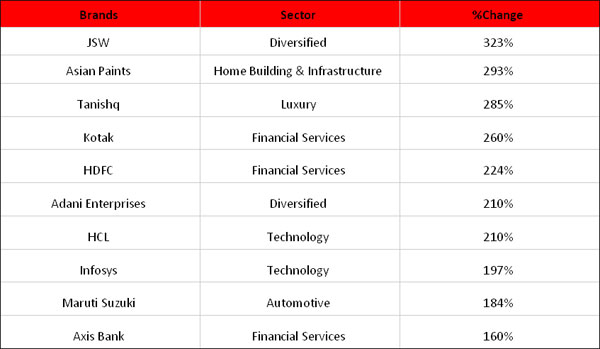
    Highlighting the top ten fastest-growing brands over the past decade:


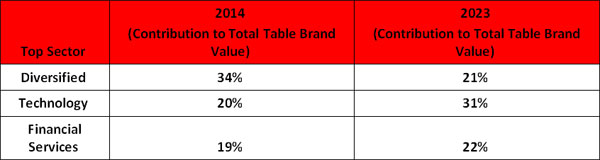
    The technology sector has overtaken diversified industries as the leading contributor to the total table value over the last decade.


    The Home Building and Infrastructure sector has experienced remarkable growth, surging from INR 69 billion to INR 344 billion, closely followed by Technology, which expanded from INR 693 billion to INR 2.5 trillion in the past 10 years.


    While the Financial Services sector still boasts the highest number of brands with nine representatives in the table, the Home Building & Infrastructure sector has witnessed the most significant rise, with seven brands entering the list since 2014.


    Said Ashish Mishra, CEO, Interbrand India & South Asia: “This year’s Best Indian Brands event highlights the remarkable concentration of brand value among the top three and top five brands, demonstrating their strong impact on the overall landscape. It is an extraordinary moment to witness the ascent of technology brands, securing prominent positions in the top five after a decade. The exceptional performance of the top ten brands, particularly in the Brand Strength Factors of Direction, Coherence, and Trust, underscores their strategic focus and ability to build lasting connections. With a total brand value surpassing the combined value of the remaining 40 brands, these leaders exemplify the power of effective brand management. The phenomenal growth of sectors such as FMCG, Home Building & Infrastructure, and Technology reflects their resilience and ability to adapt to evolving market dynamics. Notably, the Home Building & Infrastructure sector has witnessed a remarkable rise, welcoming seven new brands to the list since 2014. As we explore the ‘Brand New World,’ we are excited to celebrate the achievements and potential of these brands and their contribution to India’s economic landscape.”


    Said Gonzalo Brujo, Global CEO, Interbrand: “This year’s list showcases the remarkable growth and evolution of the Indian brand landscape. The significant increase in total brand value, surpassing the US$ 100 billion mark, is a commendable feat and demonstrates the strength and potential of Indian brands on a global scale. We are proud to witness the continued success and innovation of these brands, shaping the future of business in India.”


  • Das ka Dum with Dr Bhaskar Das | The last month of the first half of the year starts tomorrow. Anything you would like to see happening to give H1 a better look-and-feel?

    Bhaskar DasWhat’s your thinking on the question we’ve asked? Well, read the response by Dr Bhaskar Das in the May 31 edition of Das ka Dum and form your view. Read on…

     

    If you wish to access the archives, please go to the Das Ka Dum tab on the website’s top navigation bar or click here: https://www.mxmindia.com/category/columns/das-ka-dum/


    Q. The last month of the first half of the year starts tomorrow. Anything you would like to see happening to give H1 a better look-and-feel?


    A. I am getting a mixed signal: while World Bank update notes that although significant challenges remain in the global environment, India is one of the fastest growing economies in the world. So, overall performance of the economy may be better than other parts of the world, but there are multiple headwinds for many sectors, including M&E, and many specific organisations, for sustaining demand growth consistently. The need of the hour is focused attention to macro and micro environments so that irrational exuberance emanating from the performance of one quarter need not flow to the next. While a growth mindset is a must, one needs to be alert of possible challenges that can torpedo future plans any time. So, conservation of resources and reduction of wasteful practices in an organisation are key.


  • Sanjeev Kotnala: Momentary Brand Affinity – The Demise of Consumer Loyalty

    By Sanjeev Kotnala


    Sanjeev KotnalaMarkets and consumers continue to evolve and present new probortunties to marketers. One of the significant shifts has been the death of brand loyalty. The consumer no longer staunchly supports a particular brand but instead chooses and experiments with different brands for the same occasions or moments. Traditional brand loyalty is all but extinct.


    The Changing Landscape

    Brand loyalty results from the trust, product quality, and positive experiences meeting or exceeding expectations resulting in consumers identifying with a particular brand and consistently choosing/preferring it over other brands. However, in today’s hyper-connected and fast-paced world with democratised information access and the rise of social media, consumers have an unprecedented array of options and are more knowledgeable and discerning.


    Occasion-Based Brand Selection

    Consumers are now comfortable selecting brands that align with specific occasions or moments. The brands must cater to their fleeting trends, moods, needs, desires and expectations. They may even choose and prefer a different brand for the same occasion.


    Personalisation fuels Association

    The emergence of advanced data analytics and targeted marketing strategies has fuelled occasion-based brand selection. Companies use consumer data to create personalised marketing campaigns that resonate with individual preferences and occasions by crafting tailored messages, enticing the consumer to choose products or services.


    The Influence of Social Media and Influencers

    Social media platforms and influencers significantly shape consumers’ choices based on occasions and moments. The influencers often endorse specific brands, lending their credibility and expertise to sway consumer decisions. By aligning themselves with influencers who resonate with their target audience, brands capture consumers’ attention during critical moments and events.


    Redefining Brand Loyalty

    No doubt Brand Loyalty is on the decline. However, consumers still value certain attributes in their interactions with brands. Even in a world driven by occasion-based brand selection, Trust, authenticity, and a consistent brand experience remain vital considerations. When the brand delivers on these, it encourages repeat purchases and word-of-mouth recommendations in a more fluid and situational context.


    Challenges and Opportunities

    Lack of brand loyalty is a barrier to expanding a captive consumer base. The competition is fierce, and there is a constant need for innovation and newer experiences that resonates with consumers across different occasions and moments. There is a need to stay ahead of emerging trends and consumer preferences. Brands must be the go-to choice during specific events and capitalise on opportunities.


    Net-Net

    The era of consumer loyalty has been replaced by momentary brand affinity. Consumers now select brands based on specific occasions or moments driven by personalisation, social media influence, and a desire for tailored consumer experiences.

    While the idea of unwavering brand loyalty may be fading, brands that understand and leverage this shift can still thrive in the age of occasion-based brand selection by delivering authentic and memorable experiences. Brands can still create meaningful connections and preferences among consumers, ensuring success in this landscape of constantly changing consumer preferences, choices and moment-based affinity.


  • ASCI’s updated advertising guidelines for education sector

    By Our Staff


    The Advertising Standards Council of India (ASCI) has updated its guidelines for advertising educational institutions, programmes, and platforms after rigorous rounds of public consultation. The exercise was undertaken with the aim of establishing a set of just and equitable principles that concern a critical industry in the country: education. Public consultation for the guidelines started on March 14, 2023 and concluded on April 15, 2023.


    Education has been among the top violative sectors for the past few years when it comes to advertising. In its Annual Complaints Report 2022–23, classical education ranked second among the top violative categories with 13.8% of total ads that did not adhere to ASCI’s guidelines.


    While ASCI’s existing education guidelines require educational entities to substantiate any claims they make in their advertisements with relevant evidence, this latest update ensures that the advertisers are also mindful that their ads consider the students’ mental and physical well-being. The amendments state that ads by educational institutions, including universities, colleges and schools, coaching classes, EdTech platforms and others that offer education and training programmes should not stereotype students based on their gender, or appearance, nor portray those who score low as unsuccessful or failures.


    Further to complying with the general rules of ASCI’s Code for Self-Regulation in Advertising, and the existing educations sector guidelines, the advertisements of educational institutions, programmes and platforms will now have to comply with the following additional guidelines:


    An advertisement may not show school students compromising on sleep or meals to study as this normalises unhealthy habits which are detrimental to student health.


    While an advertisement may show disappointment with low scores, it must not portray an average or poor scorer as an unsuccessful student or a failure,  or show him/ her/ them as demotivated, depressed or unhappy, or receiving less love or appreciation from parents, teachers or peers.


    An advertisement must not create a false sense of urgency or fear of missing out that could accentuate anxieties amongst school students, or their parents.


    While an advertisement may feature students of any gender, the advertisement must not suggest that certain subjects are associated with particular genders alone. Advertisements must also not suggest that students with high scores are always associated with stereotypical characteristics such as wearing thick glasses. This does not prevent advertisements from depicting such students so long as they do not suggest that only these students are successful.


    Responding to the new guidelines, Rohit Kumar Singh, Secretary, Ministry of Consumer Affairs said: “Education advertising touches almost every citizen in the country. Ensuring the sanctity of advertising in this sector is an important task. The ASCI guidelines address the various issues that plague the sector and we hope that the industry will follow these in letter and spirit. I would like to reiterate that misleading ads are also a violation of the Consumer Protection Act and all necessary steps will be taken to keep our citizens safe”.


    Talking about the amendment to education guidelines, Manisha Kapoor, CEO and Secretary General, ASCI, said: “In addition to ads not being misleading, the updated guidelines also provide for the physical and mental well-being of students, particularly school students. While fierce pressure in education is a reality, advertising must not perpetuate this problem. normalise it or exploit student and parental vulnerability. Based on our Ed-Next study, such issues were identified, and post extensive consultation with different stakeholders, we are now issuing the updated guidelines. ASCI remains deeply committed to consumer protection, and we will continue to update our Code to reflect contemporary and emerging concerns in advertising content”.


  • Yes Bank refreshes brand identity

    By Our Staff


    Yes Bank unveiled its refreshed brand identity created by McCann Worldgroup.


    Commenting on the launch of the refreshed brand identity, Nipun Kaushal, Chief Marketing Officer and Head CSR, Yes Bank, said: “Over the last three years, Yes Bank has been through a transformational journey and has since then, progressed on several strategic objectives to position itself as a strong customer centric franchise. As brand custodians of the Bank, it was imperative to represent the extent of our transformation in the best possible manner. I am delighted to present to you a refreshed identity of Yes Bank, which resonates the ethos and values we uphold, the emotional connection we have with our customers, and our motivation to provide them with a rewarding banking experience. Our campaign tagline ‘Life Ko Banao Rich’, reflects our objective to encourage customers to spend time and make memories with their loved ones, and leave their banking needs to us.”


  • KC Global Media & Prime Video launch Animax + GEM

    By Our Staff


    KC Global Media Network and Prime Video, announced the launch of Japanese entertainment pack, Animax + GEM on Prime Video Channels in India. Animax + GEM offers customers a selection of popular Japanese anime, drama, and variety programmes with English subtitles from KC Global Media’s linear channels Animax and GEM.


    Said George Chien, Co-Founder, President, and CEO of KC Global Media: “Fuelled by passionate fans and the strong following of Japanese pop culture in India, we are excited to bring the ultimate Japanese entertainment experience in collaboration with one of India’s leading streaming platforms. This partnership with Amazon Prime Video marks another significant milestone for us, as we continue our efforts to provide fans in India with greater accessibility across multiple genres of premium Japanese hit series and anime content, anytime, anywhere.”


  • No more tobacco disclaimers needed on OTT, notes survey

    By Our Staff


    We don’t agree with the findings of the report, but are publishing it as is. Perhaps a study of those who have suffered because of tobacco, should’ve also been studied.


    Be that as it may,  Koan Advisory Group, a technology policy consulting firm based in New Delhi, has released a study that challenges the prevailing narrative surrounding smoking habits in India. Released ahead of World No Tobacco Day today (May 31), the report titled The Effectiveness of Tobacco Disclaimers on OTT Content Services: A Behavioural Appraisal sheds light on the primary factors influencing smoking behaviour and questions the necessity of additional health warnings on Over-The-Top (OTT) content services.


    Conducted between March and April 2023, the comprehensive survey engaged 1896 online users across 350 locations in India. Most of the respondents were men aged between 18 and 35. The study found that 66.6 percent of respondents remained indifferent to the depiction of smoking on OTT content services. Factors such as peer pressure, the influence of friends, and mental stress were identified as more significant drivers of smoking habits in India. The report also emphasised that people primarily consume OTT content for recreational purposes and found minimal evidence to support a direct causal relationship between OTT content and behavioural changes.


    Moreover, the study revealed that many respondents questioned the need for additional disclaimers, citing existing content descriptors and age ratings as sufficient. Over 50 percent of participants expressed concerns that additional text disclaimers could negatively impact their viewing experience. The report explains that the prevalence of smartphone usage for OTT consumption, with screens typically ranging from six to seven inches, heightens the potential for distractions and disruption to the overall viewing experience.


    Commenting on the study Vivan Sharan, Partner at Koan Advisory Group said: “Our study assesses the prevailing narrative on smoking habits in India. The findings highlight the minimal impact of OTT content on smoking habits, with peer pressure and mental stress emerging as more significant drivers. As policymakers deliberate on regulations, it is essential to consider the broader context and adopt a balanced approach. By embracing this, we can develop more effective strategies to combat smoking addiction while preserving the immersive and enjoyable viewing experience that audiences seek.”


  • Id8 Media Solutions wins mandate for Amore Gelato

    By Our Staff


    Id8 media solutions has won the integrated marketing mandate for Amore Gelato. As a part of the partnership, Id8 will drive the strategy for the creative, digital and public relations and Social Media planning for Amore Gelato the Italian ice cream brand.


    Said Tanya Swetta, CEO and co-founder of Id8 media solutions: “At Id8 media solutions, our core services are built on the grounds of creating meaningful solutions for our partners. We are delighted to lend our expertise to Amore Gelato, a brand that has been born out of a passion and love for creating authentic Italian Gelato and has been serving up these delights since 2006 in India. The key focus will be to engage with our customers across all strata and age groups. We will leverage our expertise in Integrated Marketing to bring awareness of the brand across the country and globally. We have a vision to create India’s first Italian Gelato brand with a nationwide loyal audience.”


    Yasser Ali, CEO and Co-founder of Amore Gelato added: “We are happy to announce id8 media solutions as our integrated media partners. They come with a strong experience and a great reputation for delivering exceptional results for over two decades through an integrated marketing approach. Amore Gelato was born out of the passion to bring the authentic taste of Italian gelato to India, we’re excited to work with a team that is just as passionate about their work and look forward to a longstanding and successful association.”


  • Dainik Bhaskar picks up Concept

    By Our Staff


    Dainik Bhaskar has launched in Mumbai. Concept agency has been mandated to manage the brand.


    Concept Communication brings with it deep knowledge subject categories coupled with a thorough  understanding of the consumers’ spectrum that influence and impact its PR solutions  something that matches Dainik Bhaskar’s current set of requirements –  to do with their launch and future sustenance.


    Commenting on the win, Vivek Suchanti, Chairman and Managing Director of Concept Communications, said: “Dainik Bhaskar Group and Concept Group have a long-standing association. Trust of brands like Dainik Bhaskar, one of India’s premier brands, is of paramount importance. We are naturally very happy that they have chosen us to partner with them with such a prestigious launch.  We look forward to creating a targeted and effective solution for the brand.”


    Kailash Agarwal, Managing Director of Bhaskar Prakashan Pvt Ltd, added: “We are on a journey to expand our footprint across the country and consolidate our current position of No 1 newspaper. We were looking for strong partners who could help us launch the brand in Mumbai. We found the team Concept both insightful and proactive. We believe that they are the right partners for us in our journey.”


  • KwikFix Auto appoints Kodo Studio as creative agency

    By Our Staff


    Automotive aggregator KwikFix Auto has joined forces with Kodo Studio creative agency, in a partnership that is set to reshape the automotive marketing landscape. The collaboration brings Sreejith Kodoth, Founder & Creative Director, Kodo Studio on board as the Senior Creative Director, KwikFix Auto.


    In an era where brands strive to leave a lasting impression, this strategic alliance between KwikFix Auto and Kodo Studio aims to deliver marketing solutions that will captivate audiences and transform the automotive repair market.


    Said Manshi Modi Chandarana, Co-Founder, KwikFix Auto: “Sreejith Kodoth is a creative genius, and we are thrilled to have him on board as our Senior Creative Director,” “With Kodo Studio’s expertise in crafting visionary campaigns, we are poised to revolutionize the way the industry approaches marketing and branding.”


    The partnership between KwikFix Auto and Kodo Studio marks a pivotal moment in the company’s journey to transform and organize the automotive repair market in India. By leveraging the combined expertise and creative vision of both entities, they will shape the future of automotive marketing, pushing boundaries, and redefining industry standards.


  • Gaming emerging as a source of income: Study

    By Our Staff


    A first-of-its-kind study on online gamers in India has revealed the growing trend of gaming emerging as a career option in India and not just being limited to a means of entertainment.


    The study has been conducted by EPWA in collaboration with the Centre for Justice through Technology (CJT), Vinayaka Mission’s Law School, and Research Foundation-DU Chennai.


    Based on the study, 83% of the respondents consider gaming as either a primary or secondary source of income, highlighting the paradigm shift towards gaming being a viable option that can be pursued professionally. Out of this, 39% consider gaming as a primary source and 44% as a secondary source of income. The study also highlights how gamers have been able to garner better earnings with improved skill sets, and practicing gaming has also encouraged them to take it up as a profession. This new gaming segment, Paid Competitive gaming (PCG), is poised to be one of the fastest-growing segments and is set to reach $16B by 2024, according to a recent report by Newzoo and MPL.


    Another key insight revealed by the study shows how the popular online games played by Indians range across Puzzle, board games and adventure sports as the top choices across demographics and levels of engagement. While AAA games are the preferred choice for gamers aged 16-25, seasoned players gravitate towards Poker, Rummy, Carrom and Puzzles.


    The study also delves deep into the attitude and preferences of gamers in India and shares important data on required skills, family and social support, professional gaming, and the impact of regulations. This qualitative study held in-depth interviews with casual and professional gamers, including online fantasy sports players, and esports professionals, including poker, from across the country.


    Bringing out insights on the earning potential of professional gamers, the study shows how they rely on a diverse array of income sources ranging from Gamer contracts (51%), sponsorships (14%), streaming (5%), content creation (9%), and coaching (21%).


    On the impact of regulations on the online gaming landscape, the study showcases concerns raised by the gamers highlighting how 89% feel high tax through GST & TDS has increased their cost of playing and may force them to seek a remedy through alternate platforms if GST is increased further. The criminalisation of players by state governments & absence of uniform regulations has also been reported as a key concern, with 62% of the gamers being affected by the approach taken by many state governments like Tamil Nadu, Telangana, Andhra Pradesh, Odisha and Assam. The study further delves into the social aspects and the resultant impact on online gamers. Lack of clarity on games of skill and games of chance has led to misconceptions and social stigma, especially for those who play professionally. 71% have reported low family support as a result of this.


    Finally, the study also highlights the need for a conducive and certain regulatory framework to safeguard user rights and promote responsible gaming, ensuring the sector’s potential is realized.