Ideacafe.agency has announced the appointment of Y Srinivas Raju as Chief Strategy Officer (CSO). Srinivas (Srini) joins the team to lead the data, strategy, and research initiatives. With 18+ years of experience, Srini has worked across multiple agencies in different roles – from mainline media planning and research to ad sales, events, media planning, and strategic communication in the OOH space, he has worked on categories spanning telecom, automobile, FMCG, BFSI, Retail, Consumer Durables and more.
Said Nabendu Bhattacharyya founder of ideacafe.agency: “Srini will work closely with the leadership team to develop and execute the strategic marketing planning and consumer insights research for our clients. At Ideacafe.agency he will align with the company’s overall business objectives, striking a balance between strategic brand-building initiatives, technology led products and industry first data led initiatives.”
Fitterfly, a health-tech company, has launched the #WorryNot campaign, a multi-platform initiative to support people living with type 2 diabetes. The campaign aims to help people live worry-free, happy, and healthy lives with the help of technology and personal coaching.
The three films launched as part of the #WorryNot campaign showcase the daily struggles of a person with diabetes – especially food restrictions, lack of motivation to exercise, and the effect of blood sugar fluctuations on sleep. These relatable situations are portrayed in a light-hearted manner followed by the coaches’ interventions which make life easier for the character.
Said Dr Arbinder Singal, Co-Founder and CEO, Fitterfly: “Science and technology have advanced and it is now possible for people to know what exactly works for their blood sugar and defeat diabetes in a simple and worry-free manner. We need to get this message across to each and every person living with diabetes. We want to create awareness and hope, inspire them to take action and live better. Our #WorryNot campaign is aimed at collating a huge bank of user-generated content about the daily struggles people living with diabetes face, and to provide them with a support system comprising of nutritionists, clinicians, fitness experts, and physios, as well as psychologists. We believe that with the right guidance, people with diabetes can enjoy their daily life without any worries.”
Synthesio, an AI-enabled consumer intelligence platform, has announced its new brand name, Ipsos Synthesio. The change reflects the completion of the company’s merger with Ipsos. The rebranding comes as the company expands its capabilities to help brands turn consumer-generated data into actionable insights by combining human and machine intelligence – as recognized by Forrester Research.
Said Andrei Postoaca, CEO of Ipsos Synthesio: “Ipsos Synthesio is so much more than a new name; it reflects the power of the hybrid offering we have been building since 2018 – to provide companies, brands, and agencies with the most complete, accurate, and predictive picture of their markets and buyers. Our solution combines social, search, and survey data from more than 800 million data sources in 80+ languages across 195+ markets, activated by industry and local expert consultants to provide best-in-class market research. By bringing together our AI-powered platform, data science capabilities, and global research teams, we’re uniquely positioned to help brands make better, faster business decisions.”
Said Amit Adarkar, CEO, Ipsos India: “From the previous Social Intelligence Analytics (which used Synthesio) to Ipsos Synthesio, this has greater recall and pull, also as it is the best in class listening tool, that is most advanced, leveraging strengths of both Ipsos and Synthesio. We are now ready to work with clients on a very strong AI driven platform with the rigor of market research.”
Dollar Industries, hosiery brand has collaborated with Saif Ali Khan as the face of Dollar Lehar,the affordable product segment of the brand. The new ad film conceptualised by Lowe Lintas, Kolkata and directed by Uzer Khan is set in the backdrop of Rajasthan.
Said Vinod Kumar Gupta, Managing Director, Dollar Industries Limited: “The lines of distinction between top metros and the rest of India is fast blurring when it comes to making a fashion statement. Increasing disposable incomes coupled with the aspiration to look as stylish as their metronome brethren cuts across Tier 2 & Tier 3 cities. As India’s homegrown innerwear brand, we decided to create a level playing ground for both our premium and economy segment and therefore we needed a communication which would appeal to these new evolving consumer segment who aspire for value-for-money fashion. The first step in that direction was to rope in Mr Saif Ali Khan to add to the style quotient of Dollar Lehar and then have a communication that would reflect his uber-cool persona through a witty plot and a memorable execution in the campaign Mastiki Lehar.”
TBWA creates campaign for TVS Ronin motorcycle to showcase the confluence of modern and retro worlds of motorcycling. The motorcycle has been engineered ground up with unique tech features like Dual channel ABS, Rain and Urban modes and Bluetooth connectivity with voice and Ride Assistance, in a retro design package. Its brand philosophy- Live the Unscripted life – stems from the motorcycle’s unique capabilities, in the city and on the open road.
Vimal Sumbly, Head Business – Premium, TVS Motor Company said: “The TVS RONIN motorcycle has been designed from a blank canvas to reflect the spontaneous, fluidic, versatile and multi-faceted young rider of today. We want our viewers to know there is no right or wrong while living life on your terms. The brand inspires them to explore new things and varied experiences in life without fearing the result. We want them to live the #Unscripted life. And with the TVS RONIN, we are opening many possibilities for them to do it.”
Govind Pandey CEO TBWA India, the agency that conceptualized the idea for the brand, said: “TVS RONIN, the motorcycle defies categorisation. It appeals to modern day ‘Ronins’ who refuse to be boxed, people who are open-minded about possibilities. People who have a knack for making connections between seemingly unconnected people and situations . And creating unexpected surprises. This film represents a serendipitous merger of two genres that ends up creating something unexpectedly delightful.”
We often carry content from The Conversation as it features several articles written by academics from across the world. Mostly from Australia, the UK and the United States, but a lot of it is relevant to us here in India.
By Catherine Jane Archer & Kate Delmo
Parents share content of their children for myriad reasons, including to connect with friends and family, and to seek validation or support.
However, some parents also do this for commercial gain. They manage their children as social media “kidfluencers” – allowing them to work with brands to market products to other children (and adults).
The Australian Competition and Consumer Commission’s latest interim report for the Digital Platforms Services Inquiry has acknowledged key issues relevant to kidfluencers, including privacy concerns and possible labour exploitation issues.
Our research, published recently in the M/C Journal, further highlights how the kidfluencer culture opens the door for possible child exploitation and a host of other problems.
There is a clear need for regulation in this space – and achieving it will require a considered, collective effort.
Is YouTube the world’s most popular babysitter?
Speaking to Forbes in 2019, Eyal Baumel, the chief executive of Yoola (a management company which also manages digital child stars), described YouTube as “the most popular babysitter in the world”.
Since then, the COVID pandemic has prompted a surge in screentime for kids, who are being marketed toys as well as other products normally targeted to adults.
Product lines for kids are big business. In 2021, the global toys market was projected to grow from about US$141 billion to $230.6 billion by 2028.
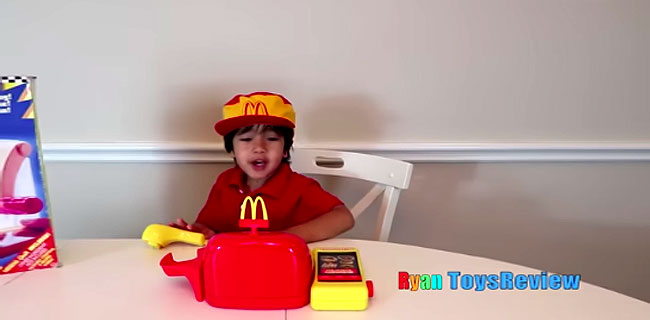
It’s now common to see YouTube kidfluencers marketing toys to other kids through toy “reviews”. But these videos aren’t the same as traditional product reviews. They’re mash-ups that blur the lines between three major genres: reviews, branded content and entertainment.
The most popular toy review channels have millions of subscribers, and their hosts are some of YouTube’s top earners. Ryan’s World is probably the most well-known channel in this genre. Conservative estimates suggest 10-year-old Ryan Kanji’s family earns about US$25 million each year.
Instakids are on the rise
Apart from YouTube (now more popular among kids than television), a significant number of kids and teens are also spending time on Instagram.
According to a 2021 report by child protection organisation Thorn, about 40% of children under age 13 (out of some 750 interviewed) said they’d used Instagram. This is despite the platform ostensibly only being for people aged 13 and older.
For our latest research, we analysed the Instagram accounts of two Australian influencer siblings to better understand the nature of child-to-child marketing in 2023.
Pixie Curtis, age 11, started her online toy store Pixie’s Pix during COVID, when toy sales rose globally. This came after initial success selling hair bows through Pixie’s Bows, a business managed by her mother, PR entrepreneur and reality TV personality Roxy Jacenko.
Pixie’s Instagram account (which has about 136,000 followers), and her brother Hunter’s (20,000 followers), have been used to promote Pixie’s Pix toys as well as other brands and products.
And although Pixie recently “retired” from the toy shop business, she continues to promote products, including her original line of hair bows and other brands’ skincare and beauty products.
Our research identifies key areas of concern, including:
• a lack of online privacy for kidfluencers, who have many aspects of their lives publicised online
• the commodification of children, and the enabling of a culture geared at up-selling them products and services
• the gendered marketing of toys and an increased focus on appearance for girls (which can be harmful for their self-esteem)
• the “stealth” marketing of toys and other products through advertorials.
Regulation is needed now
So far, the French government appears to be the only one that has taken tangible action to regulate the labour of child social media influencers. Under French law, children below age 16 can only work limited hours, and their earnings must be safeguarded in an account made accessible when they turn 16.
France is also considering legislation to regulate “sharenting” – a portmanteau of sharing and parenting that describes the practice of consistently posting content about one’s children on social media.
In the US, the Coogan Act (named after child star Jackie Coogan) was signed into law in 1939 to regulate child labour in the entertainment industry, but no equivalent laws have been enacted for child social media stars.
Nonetheless, the problems surrounding kidfluencing are starting to gain attention around the world.
Last year a UK House of Commons report investigated the implications of influencers targeting children with advertorials, especially those that provide little to no disclosure of the post being an ad.
The committee made several recommendations, including promoting young people’s social media literacy, developing a code of conduct for influencer marketing, and strengthening the powers of the UK’s Advertising Standards Authority and Competition and Markets Authority.
As a result, the UK’s Department for Education is now “open to exploring legislative ways of improving employment protection for child influencers”.
The unintended consequences of regulation
In January, Meta (the parent company of Facebook and Instagram) held its first Summit on Youth Safety and Wellbeing. It might be trying to get on the front foot as regulators continue to scrutinise platforms on issues relevant to young people’s social media use.
But regulating in the kidfluencer space won’t be easy. In March, Utah introduced laws to stop children under 18 having access to social media without parents’ explicit consent – but critics have pointed out the potential negative consequences.
Teens use social media for important connections, including with friends and online support groups. Vulnerable teens may become isolated without online support from their peers. Beyond that, social media provide kids with a sense of enjoyment and identity. Taking this away could do more harm than good.
More work is needed to determine what effective regulation would look like. While parents and educators have a role to play to increase children’s social media literacy, digital platforms and businesses should also step up.
Catherine Jane Archer is Senior Lecturer, Communication, Edith Cowan University and Kate Delmo is Senior Lecturer and Head of Discipline of Strategic Communication, University of Technology Sydney This article is republished from The Conversation under a Creative Commons license. Read the original article.
This was a tricky question, but we couldn’t have not asked it. Here’s Dr Bhaskar Das in the May 9 edition of Das ka Dum. Read on…
Das in the May 5 edition of Das ka Dum. Read on…
If you wish to access the archives, please go to the Das Ka Dum tab on the website’s top navigation bar or click here: https://www.mxmindia.com/category/columns/das-ka-dum/
Q. What’s your view/stand on Gavaskar and Sehwag starring in a Kamla Pasand ad?
A. I know that public opinion (social media too) is abuzz with adverse reactions about national cricket heroes endorsing an alleged harmful category. I use the word alleged because the product being promoted is elaichi which is not a harmful substance.
I must add here that Sunil Gavaskar is very discerning in all that he does and thinks a hundred times before taking an endorsement decision. Am sure he has done his due diligence.
Having said that, I think sportstars – more than anyone else – must be more responsible about their endorsements. There are a million people who adore and emulate Messrs Gavaskar and Sehwag. I am sure they are aware of their responsibility. I hope they are.
Marriott Bonvoy, Marriott International’s extraordinary portfolio of 30 hotel brands and award-winning loyalty program, is inviting corporate travellers to reconnect with each other, create special moments and build memories through its latest campaign, “Spark This Moment”.
To empower and meet the evolving needs of meeting planners and corporate travellers, the new campaign highlights how guests can best maximize their meeting experience.
Said Ramesh Daryanani, Vice President of Global Sales, Asia Pacific: “We’ve seen a strong uptake in MICE bookings, indicating a deepened desire for human connection and face-to-face meetings since the easing of pandemic restrictions. With our diverse portfolio of hotels and resorts across the region, we’re able to deliver a wide range of offerings to meeting planners and corporate travellers to suit their needs, inspiring more meaningful connections and memorable moments.”
Jindal Stainless along with integrated creative and digital agency Social Panga has launched a digital campaign this International Mother’s Day (May 14). The film highlights how our lives tend to make more sense when our moms are around.
Head of Corporate Communications, Jindal Stainless, Sonal Singh, said: “This campaign is dedicated to the backbone of our homes, the true heroes whose selfless love and sacrifices for their children knows no bounds – our mothers. Though the campaign storyline connects a mother’s unconditional love to home-cooked food, the connection between a mother and child is far more universal and deeper. We hope the campaign rekindles our gratitude towards our mothers.”
Gaurav Arora, Co-Founder of Social Panga, added: “The idea that ‘when a child moves away from their home for the first time, they often face the initial struggle of making it on their own’ is everyone’s story. Our aim was to encapsulate that feeling with the selfless love of our mothers, so the audience can find their own story within this movie. As a corporate brand, Jindal Stainless itself has thousands of employees living outside their homes, and thus, the movie brings the point home in the sense of the employees finding the advertising efforts of their employer, relatable.”
News about Manipur eventually filtered into the mainstream media. Accompanied by the news is an endless stream of “expert” commentary. Most of which is enough to scramble your brain, especially if you are unfamiliar with the politics and social construction of the state. And as ever, our experts are topnotch at “confusion worse compounded”, to quote John Milton.
To some, it is all tribal warfare. To others it is all drugs. To some it is religion. To others, plain old politics. Or caste. Or money. Or forests. Or land. Or immigrants. Or neighbours. Because of the media’s obsession with Delhi politics, Narendra Modi and life around the National Capital Region, everywhere else is just some “remote” place where remote things happen.
In reality, if I can be philosophical, there is no real centre. Wherever you are is your centre. When you look up at the night sky, you can assume that the Universe spreads around you from you are. And it is the same for anyone else on any surface.
But not in India. In India, the Indian media remains wilfully ignorant in spite of all our civilisational and technological advances. For some, the centre is where Modi campaigns or makes speeches. Currently, that is Karnataka. The Prime Minister of India is so busy with his “road shows” that he cannot really be bothered about people killing each other in Manipur. He is busy making absurd accusations and even more absurd claims so that his party can win an assembly election and remain in power. Since he cannot be questioned by the mainstream media, he is free to spread his unique combination of bombast and social and political division.
The obsession of the Union government with the “image” of India is inextricably tied in with the image of Modi and to this, the Cabinet and most of the mainstream media fall over themselves to prove their loyalty. If a private weather forecaster predicts a below average monsoon, even that is a blot on India’s image and the weight of the administration has to come down on the forecast like a ton of carbon emission. Wait for videos of Modi stopping the El Nino current with the sound of his speeches alone. I’m joking of course. But am I?
The External Affairs Minister can be heard in a video doing the rounds dismissing the latest Press Freedom Index ratings for India, released annually by the prestigious Reporters Without Borders. Or Reporters Sans Frontieres, an organization which has since 1985 worked in close association with the United Nations to promote the need for a free press, and provides defence and help to journalists on the ground working in conflict areas.
“Some organisation,” said S Jaishankar or words to that effect, as he dismisses RSF. It is unclear why the RSF ranking upsets the Modi government. It has after all worked as hard as it could to reduce the independent media in India to a mere cipher. And the rest to yapping lapdogs. It should be proud that under its watch the Indian media has slipped to the lowest ranking ever. After all, out of 180 nations monitored, India is at 161. Who knows where we may be next year, at this rate?
Meanwhile, let me remind you that all those medal-winning wrestlers, right there in the middle of Delhi, the centre of all things, protesting against sexual harassment and assault, remain largely invisible…
Ranjona Banerji is a senior journalist and commentator. She writes on MxMIndia on Tuesdays and Fridays. Her views here are personal.
Dollar Industries, hosiery brand has collaborated with Saif Ali Khan as the face of Dollar Lehar,the affordable product segment of the brand. The new ad film conceptualised by Lowe Lintas, Kolkata and directed by Uzer Khan is set in the backdrop of Rajasthan.
Said Vinod Kumar Gupta, Managing Director, Dollar Industries Limited: “The lines of distinction between top metros and the rest of India is fast blurring when it comes to making a fashion statement. Increasing disposable incomes coupled with the aspiration to look as stylish as their metronome brethren cuts across Tier 2 & Tier 3 cities. As India’s homegrown innerwear brand, we decided to create a level playing ground for both our premium and economy segment and therefore we needed a communication which would appeal to these new evolving consumer segment who aspire for value-for-money fashion. The first step in that direction was to rope in Mr Saif Ali Khan to add to the style quotient of Dollar Lehar and then have a communication that would reflect his uber-cool persona through a witty plot and a memorable execution in the campaign Mastiki Lehar.”
Shemaroo Entertainment, media and entertainment player, has bolstered its senior leadership team with the appointment of Anuja Trivedi as its Chief Marketing Officer (CMO). Trivedi will lead the company’s overall marketing strategy and will be responsible for driving business growth, leading strategic initiatives and strengthening consumer engagement and will report to Arghya Chakravarty and will be a part of the executive committee.
Hiren Gada, CEO – Shemaroo said: “We are pleased to welcome Anuja to Shemaroo as our new CMO. Anuja’s expertise in analyzing market trends and identifying growth opportunities will be instrumental in our expansion plans as we continue to navigate the ever-changing media landscape. Her ability to develop innovative strategies and create compelling content experiences for audiences aligns perfectly with our mission of delivering exceptional value to our consumers. We are confident that Anuja will play a crucial role in the continued success and growth of Shemaroo.”
Arghya Chakravarty, COO – Shemaroo added: “Anuja’s impressive track record, diverse experience and strategic approach to business and content development makes her a perfect fit to lead our marketing efforts. With her leadership, we look forward to further strengthening our position in the industry and delivering engaging and meaningful content experiences to audiences across India and beyond. I wish her all the very best for her new role as the CMO at Shemaroo.”
 This was a tricky question, but we couldn’t have not asked it. Here’s Dr Bhaskar Das in the May 9 edition of Das ka Dum. Read on…
 News about Manipur eventually filtered into the mainstream media. Accompanied by the news is an endless stream of “expert” commentary. Most of which is enough to scramble your brain, especially if you are unfamiliar with the politics and social construction of the state. And as ever, our experts are topnotch at “confusion worse compounded”, to quote John Milton.