Author: mxmadmin

  • Viacom18 shows its intent with Warner Bros. Discovery agreement

    By Our Staff


    The joint announcement by Warner Bros. Discovery and Viacom18 on Thursday is being looked at it with much interest in M&E circles. This surely more than a new multi-year agreement, making JioCinema India’s new streaming home of HBO, Max Original and Warner Bros. content from next month. It’s the beginning of an aggressive Viacom18 with JioCinema in tow. Clearly, the combination of Jio, Uday Shankar/Jamesh Murdoch and Paramount Global is now beginning to exert itself.


    The partnership with Warner Bros. Discovery, includes exclusive content rights across digital and linear.  The deal includes current and future seasons of HBO’s globally acclaimed series such as House of The Dragon, The Last of Us, Succession and The White Lotus, and returning seasons of True Detective: Night Country, Euphoria, Winning Time: The Rise of the Lakers Dynasty and Perry Mason. Also featured as part of the agreement are highly anticipated HBO Original series including The Idol, White House Plumbers, The Sympathizer and The Regime. In addition, HBO’s esteemed series and documentaries, including Game of Thrones, Sex & The City, Big Little Lies, Chernobyl and Veep, will be available for users.


    Said Clement Schwebig, President, India, Southeast Asia, and Korea, Warner Bros. Discovery: “Warner Bros. Discovery’s brands are incredibly popular across India, and we are pleased to partner with Viacom18 to bring our premium HBO, Max Original and Warner Bros. content to local fans. This new agreement demonstrates our commitment to South Asia as we seek to entertain audiences across more platforms, and further strengthens the scale of our regional business as a whole.”


    Added Ferzad Palia, Head – SVOD & International Business, Viacom18: “JioCinema has become the biggest platform for live sports. We are now on a mission to build the most magnetic destination for entertainment for all Indians. The strategic partnership with Warner Bros. Discovery is a big milestone in our journey to offer the best of Hollywood content to our elite consumers. We believe that Warner Bros. Discovery sets the global standards for premium content and this partnership allows us to create the best and the most comprehensive destination for our users.”


  • TV9 Network to hold News9 Plus Corporate Cup

    By Our Staff


    TV9 Network has launched the News9 Plus Corporate Cup – a three-day football championship set to take place in Pune from May 5 to 7 with 32 teams participating.


    With the Maharashtra government partnering the News9 Plus Corporate Cup, the proposition has garnered a response from the corporate world, including HDFC Mutual Fund, U Gro Capital, BTS, Infosys, Group M, Madison, Wipro, and several others.


    Notes a communique: “The clash of titans will undoubtedly provide a thrilling and electrifying experience, making it an unforgettable event for everyone involved. This tournament is not only about winning, but it also celebrates the essence of teamwork and camaraderie that makes corporate India an unbeatable force. TV9 Network has truly kicked it up a notch by bringing the excitement of football to the business world.”


  • Sony LIV & Applause strengthen partnership

    By Our Staff


    Sony LIV and Applause Entertainment have unveiled their upcoming slate for 2023 strengthening their  partnership. Two new series ‘Kafas’ (Cage) and ’36 Days’ are lined up along with return of other seasonal shows. ‘Kafas’ produced in association with Madiba Entertainment is a social drama series starring Sharman Joshi, Mona Singh, Vivan Bhathena, Preeti Jhangiani and Mikail Gandhi in lead roles and directed by Sahil Sangha.


    The second series ‘36 Days’ produced in association with BBC Studios India is a suspense thriller, directed by Vishal Furia, featuring an ensemble cast including Neha Sharma, Purab Kohli, Shruti Seth, Chandan Roy Sanyal, Amruta Khanvilkar, Sharib Hashmi, Shernaz Patel, Faishal Rashid, Chahat Vig, Kenneth Desai in pivotal roles.


    Said Danish Khan, Head – Sony LIV, Sony Entertainment Television and Studio Next:  “We are delighted to strengthen our long running partnership with Applause Entertainment with an exceptional slate of shows in 2023 and beyond.”


    Added Sameer Nair, Managing Director, Applause Entertainment: “In our shared mission to captivate and entertain audiences through the power of storytelling we are excited to create for Sony Liv a diverse and captivating mix of new shows and returning favourites.”


  • PepsiCo’s Quaker launches nutrition programme

    By Our Staff


    The PepsiCo Foundation, the philanthropic arm of PepsiCo, PepsiCo R&D team and brand Quaker launched ‘Bowl of Growth’ a special nutrition focused programmed in partnership with NGO Mamta HIMC in Pune to provide 1,000 children aged three to five years with wholesome nourishment each day. The interventions under the Bowl of Growth programme are designed with focus on three key pillars – Nutrition, Awareness, and Education.


    Said Dr Pietro Antonio Tataranni, MD, Chief Medical Officer and Senior Vice President, R&D Life Sciences, PepsiCo: “Through our pep+ (PepsiCo Positive) commitment, we are focused on providing positive choices that are better for people and for our planet. The ‘Bowl of Growth’ program is an important step in our efforts with Quaker to support underserved communities in India through education and awareness of the issue of malnutrition, along with the importance of millet and other critical nutrients in a child’s diet.”


  • We’re closed on Monday, May 1 for Labour/Maharashtra/Gujarat Day

    By Our Staff


    Our offices will be closed on Monday, May 1, on account of Maharashtra Day and it being a public holiday with many/ most offices closed. We’ll be back on Tuesday, May 2 with our scheduled updates and newsletters.

    See you then!


  • Boycott: Our weapon to fight surrogate advertising

    Image courtesy Twitter handle @RoshanKrRaii


    By Vikas Mehta


    Vikas MehtaIt’s time to kick a few butts.


    For years, surrogate advertising has been the bane of the Indian communication industry. First it was cigarettes and alcohol and now for the last few years it’s been pan masala.


    More than a year ago, Amitabh Bachchan had raised the hackles of many when the septuagenarian appeared in an ad for Kamla Pasand along with Ranveer Singh. The actor, who once was the darling of the masses, took quite a beating on social media when he first defended his action saying that the ad was part of the entertainment business which provides employment to many people.


    When he was mercilessly trolled on social media and when a national anti-tobacco agency requested him to refrain from endorsing tobacco products, the actor put on a big act.


    He grandly announced that he is terminating his contract with the company, returning their money and also said that he did not know that the silver coated elaichi, which was the product shown in the ad, was part of surrogate advertising. Ha!


    Read that again. He said that he did not know that he was part of a surrogate ad. Mr. Bachchan wanted us to believe that his lawyers and his advisors were so unaware that they had no idea of this malaise called surrogate advertising. His naivety was an act for the ages.


    The campaign had broken out in September 2021 and in October, on his birthday, Mr Bachchan had made the grand announcement.


    But the ads continued. When another round of protests hit social media, Mr. Bachchan’s office released a statement in mid-November saying that they have sent a legal notice to Kamala Pasand, to stop broadcasting the TV commercials with Mr Bachchan immediately, as it was noticed that despite termination of the endorsement agreement ‘ Kamala Pasand ‘ has ignored the same and is seen to continue airing the TV commercials.


    The result: Nothing. Zilch. Nada. No change. Social media got tired, bored, disillusioned of this tamasha and moved on. And the ad continued to be aired. Another version of it was also released. Right through 2022, all major cricket events unleashed the campaign. It went on even in 2023. Till almost the half-way stage of IPL.


    After more than one-and-a-half year of endorsing a surrogate tobacco product, a time when other pan masala brands, no doubt emboldened by the free run that Kamla Pasand had, and featured celebrities like Akshay Kumar, Shah Rukh Khan, Ajay Devgan, Salman Khan; Mr. Bachchan, seemed to have finally persuaded the brand to remove its ad. No, that should read as, the ad was withdrawn after maybe it had run the course of its contract.


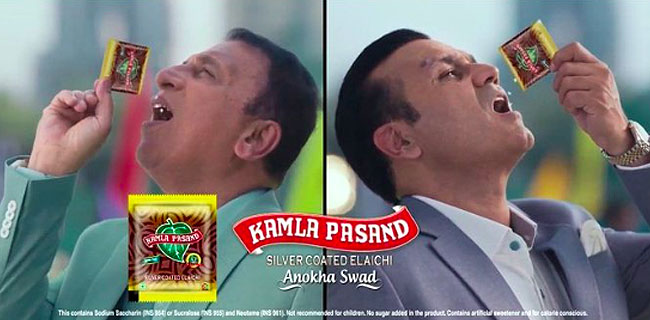
    But the legacy of endorsing a surrogate brand continued. And the culprit this time is another septuagenarian cricketing legend along with a dashing cricketer who has a school in his name.


    Ladies and Gentlemen, let me introduce Shri Sunil Gavaskar, ex-cricketing legend, ex-Sheriff of Mumbai, Padma Bhushan recipient, Arjuna Award-winner, ICC cricket Hall of Fame member as the latest entrant to the tobacco surrogate celebrity endorser Hall of Shame.


    And he is keeping illustrious company. Shri Virendra Sehwag is a cricketer who changed Test cricket with his fearless approach to the game. And now his fearless approach is to endorse a surrogate for Pan Masala. Not fearing that it will influence many people into believing the veracity of pan masala. A Padma Shri recipient, Wisden Cricketer of the year and ICC Test player of the year, Shri Sehwag has also started Sehwag International School in Haryana on a piece of land gifted by the Haryana government. Undoubtedly, he will be a role model for the schoolchildren to consume pan masala.


    It’s really shocking that neither the government, nor the advertising bodies and nor the celebrities themselves have an iota of responsibility to clean up this mess.


    Why are the anti-tobacco advertising laws full of loopholes for the manufacturers to exploit? Or, if there are no loopholes, then why no action is being taken against the offending brands.


    ASCI is a self-regulatory body of the advertising industry. Its rules and regulations are so warped that it is an impotent body which moves to takes action against advertisers after the deed is done. It waits for complaints and it has no legal leg to impose a punishment. It hopes for advertisers to be good boys/girls and accept the punishment, which incidentally cannot be a fine or a criminal complaint or any legal action. After all, the advertisers themselves fund ASCI. So this is a case of the accused having their own kin sitting on judgment?


    Whereas the likes of Messrs Gavaskar and Sehwag are joining in the fun. After all if a Mr Bachchan can earn a few crores, why not them?


    For the media companies, this is the easiest way to recover the millions they have put not their bids. At a time when inflation is high, global recession looms, a category like pan masala which always fears a blanket ban, is welcomed with open arms and big deals.


    The curse of tobacco be damned.

    The curse of a generation being influenced be damned.

    The curse of lingering health issue be damned.

    The curse of making an unhealthy product seem fashionable be damned.

    And of course the legacy of the celebrities will not be damned.


    All the above culprits, specially the celebrities deserve a kick on their backside. Because if a celebrity cannot care for the very people who made him a celebrity, if a celebrity will sell his soul for making his bank balance heftier and if a celebrity will doom a generation just because he thinks he can get away with anything then a kick in the backside delivered by millions of his fan in the form of a boycott may just make him see sense.


    The boycott has been used as an effective tool in the past for political and religious reasons. For once, if we are ready to use this tool for a healthier society, then it will truly reflect the spirit of what the father of our nation meant when he introduced boycott as a weapon. Not just a tool but a weapon.


    Let us boycott the channels which use these cricketers as commentators. Let us boycott the films which all the above film celebrities act in. Let parents boycott the school or whatever institutions or brands these celebrities endorse. Let’s boycott the shows which invite these celebrities.


    Because if we do not boycott them today, tomorrow a few more will endorse an unhealthy product. And the cycle will continue.


    So, stop waiting for the government or ASCI or anyone else to do anything.  Just boycott anything and anyone which is associated with surrogate advertising. 


    And do not expect me to post a link of the ad. I refuse to use it to make a point too. Boycott the ad on you tube. If a friend forwards it, stop it from being forwarded or boycott him.


    Make boycott the buzzword to fight surrogate advertising. To kick a few butts.


    Vikas Mehta is a senior marketing strategy consultant and educator based in Dehradun. He writes on MxMIndia every other week, and sometimes more often. His views here are personal.


  • Ranjona Banerji: No space the wrestlers?

    By Ranjona Banerji


    Ranjona BanerjiThe protests and demands for justice by Indian wrestlers remain at the forefront of social media. But not the mainstream media news cycle.

    Surely you are not still asking why.

    There is a clip doing the rounds of a TV reporter being asked to go back by people at the protests in Delhi. The manner in which Indian mainstream television has aligned with the BJP and its governments, such animosity is not surprising. And many of India’s star wrestlers are BJP supporters themselves: so they know how close the media is to the establishment.

    What is evident, (although is there any likelihood that larger chunks of the media will understand this) is that being a BJP supporter is of no consequence with the current regime, if you make a complaint against a member of the BJP.

    There are reports that accusations of sexual harassment of the wrestlers by the Wrestling Federation was reported by a prominent wrestler to the prime minister himself in 2021.

    In spite of issues like misuse of power, women’s rights, criminal actions, for the bulk of the media the focus remains to try and save the BJP somehow or the other. The accused, Brij Bhushan Singh, is a BJP MP. He has several criminal cases against him. And since pressure on the government has mounted, and the Supreme Court had to step in and ask the Delhi Police to take notice of the complaint, sections of the media have gone out of their way to give Singh a voice.

    Please note, the Indian system of jurisprudence rests on the presumption of innocence. However for the Indian media, this notion becomes a hindrance when it comes to people arrested by the police, especially if they are Muslim. But it is adhered to strictly when it comes to members of the BJP like Singh. Thus he is all over the news, making statements like “hang me”, asking whether people thought he’d been taking some aphrodisiac supplements and making accusations of trafficking against male wrestlers.

    https://www.indiatoday.in/india/story/bajrang-punia-arranged-a-girl-wfi-chiefs-fresh-charge-after-pocso-case-2367251-2023-05-01

    https://theprint.in/politics/was-i-eating-shilajit-roti-wfi-chief-brij-bhushan-says-sexual-harassment-charge-a-bid-to-malign-character/1549404/

    https://theprint.in/opinion/politically-correct/brij-bhushan-sharan-singh-is-no-saint-but-bjp-has-reasons-to-look-away-from-wrestlers-protest/1548795/


    This much space was not given to the wrestlers, many of whom were much lauded by the same media when they won medals for India.

    The Prime Minister of India was busy with the Karnataka elections and with the 100th edition of his ‘Mann ki Baat’ programme. As ever, he was full of praise for himself and his achievements and so was his captive media. The PM even boasted about his government’s “Beti Bachao Beti Padao” programme, which according to him has been a resounding success. No mention was made about the female wrestlers and their complaints. Sexual harassment perhaps does not come under the BJP umbrella of “Beti bachao” or “save girls”?

    The Network of Women in Media (India) has issued an extremely well-worded and thoughtful statement on the issue, and also demanding justice for India’s wrestlers.

    This particular statement stands out:

    “We urge all news media to give this significant protest the grave attention and coverage it deserves. In particular, we urge media organisations that have hitherto blindly supported the establishment to view the wrestlers’ case with empathy and understanding instead of falling prey to politicisation of the legitimate demands of the wrestlers.

    With responsible media coverage, this issue can be the springboard for the media to bring to light the wider truth about how most of our sporting bodies are managed, or rather mismanaged, by their political patrons.”

    NWMI supports wrestlers’ battle for justice

    We careen from crisis to crisis.

    Here’s one more where the media will fail us. Or where we in the media will fail everyone.

    Am I wrong?


    Ranjona Banerji is a senior journalist and commentator. She writes on MxMIndia on Tuesdays and Fridays. Her views here are personal


  • PoV by Pallavi Mathur Lal: It’s time for brands to bring sustainability conversation to consumers

    By Pallavi Mathur Lal


    Sustainability is a complex encompassing term that refers to the ability to maintain resources for use but also for future generations. While it is often associated with natural resources, it includes societal and economic resources. As Sustainability or ESG (Environmental, Societal, Governance) movement gathers steam all over the world, we see many ‘push’ factors for businesses and companies.


    In India, we see many actions of global companies as they follow their global directives as part of the UN Global Compact (2000), to adopt sustainable and socially responsible policies and practices. We see many corporates and businesses, both in public and private sectors, refer to the SDGs (17 UN Sustainable Development Goals formed in 2015) as informing their wider sustainability strategies.


    While Governments, NGOs, and businesses have sustainability mandates, the consumer sphere is still lacking this new infusion of sustainability as a critical focus.


    Sustainability, however, is not easily sold to consumers: In a global survey conducted by Ipsos on consumer attitudes toward sustainability issues, it was found that consumers hold companies and governments responsible for sustainability. They are willing to act but feel that their impact as individuals is limited. This is true if you look at the stats – the responsibility for 71% of global emissions lies with the top 100 companies!

    Brands and businesses, hence, have a crucial role to play in promoting sustainability, as they are major drivers of consumption and resource use. Brands have the window with consumers to communicate directly about their values and benefits. India, however, as a market is not as mature as the Western, more developed markets and so the questions for us are: Are consumers ready for this? Will it help brands to strengthen their relationship with consumers, ultimately moving towards consumers considering, buying, and advocating their brands?

    As per the Ipsos Global Trends survey 2023, in India, 60% of consumers strongly agree that we are headed for environmental disaster unless we change our habits quickly. Even with this realization, we know that sustainability is not an easy sell to consumers – the say-do gap is real. From another BCG Global study we know that while 80% consumers in 8 countries (including India) were concerned about the environment, only 1-7% have paid a premium for sustainable purchases.

    Seeing this hesitation in consumers, brands are also holding back talking about the sustainability benefits for the fear of being perceived as being more expensive and losing consumer approval (and demand). However, in this circle of communication and action, brands need to bring more progressive messaging toward the environment and even the societal action that they take. In this way, they build more value around sustainability.


    What brands can do to establish the right connection?: This is like the chicken and egg situation: Should the brands start talking sustainability first (even when the consumers seem unwilling) or should the consumers start demanding it first and then the brands get into action. Sustainability will come into the conversation sooner than later. There will be some brands which would have started building the connect early and benefiting from it, while other brands will be slower and more reactive.

    In addition, for brands to talk about sustainability and use the right messaging is tricky. Unless brands have sustainability built into their core, into their strategic priority, the messaging can backfire. Consumers are wary of, and call out greenwashing, which can end up harming the reputation of the brand, and examples of Volkswagen in 2015, and of H&M more recently in 2022 are before us.


    So, what can a brand do to establish this right connection with their consumers? Here are some research-backed pointers:

    1. Communicate the Co-Benefit: Sustainability as the key benefit, with a higher price is not going to go down well with the majority. All said and done, we have seen that the mass consumer is not going to pay extra for just a sustainable claim or benefit. Consumers still need to see any product performing well on its functional aspects or cater to them emotionally, with sustainability at best being a co-benefit.

    2. The ‘Push’ doesn’t work: Any ask/ call-to-action that requires a change in set behaviour patterns or a habit is going to be difficult for consumers to adopt. Hence, marketers are looking for ways to make changes in their products and packaging which do not alter or modify the performance of the product, nor does it expect consumers to make substantial changes.

    3. Create the ‘Pull’: An Ipsos meta-analysishas shown that it is important to focus on people, and their problems, rather than just the brand which is providing the sustainability message. No surprises here – consumer-centricity is already a mantra we follow, but this means that we need to dig even deeper into concerns, behaviours, and problems to see how we first highlight the key problem that the consumers are facing. After establishing this, and showing the current non-sustainable practices, a more sustainable solution can be offered by the product or brand.


    Use authentic cues and messaging – Dipping into our cultural heritage, and sustainable practices: The way awareness about the climate crisis is increasing and sustainability conversations are making their way into many aspects of our lives, brands will have no choice but to directly or indirectly cue that they support sustainability, promote some cause, or propagate good practices to stay connected to consumers. Fortunately, we have some particularly good practices in India, from our heritage and cultural roots, that brands can leverage to cue their sustainability leanings.

    :: Living in harmony with nature: Our traditional ways are nature and animal friendly and about peaceful coexistence with them. Some of our religions have us worshipping plants like tulsiand using plants for medicinal purposes and for cooking and flavoring. We also have in our mythology, animals as avatars of gods and goddesses or as mounts, making us sensitive and protective about animals.

    :: Frugal, low wastage, savings ethos: In India, we have an ethos of wasting very little material or food and conserving our resources. Traditionally, we have always saved money for the future. Food wastage is also not in our nature. Worshipping Annapoorna Devi, the goddess of food and nourishment, ensures that we have a respectful relationship with food and food sources.


    Frugality, to some extent, is getting replaced by ‘living life to the fullest’, ‘living for the moment’, YOLO and what have you. However, the frugal mindset does exist in our collective recent memories and can be rekindled by showing the positives associated with the larger good.

    :: Sustainable materials: Our everyday utensils are made of stainless steel and traditionally of brass or copper – unbreakable and non-disposable. This ensures long-lastingness and a one-time investment that pays off for years. Traditionally we have also used banana leaves which can be discarded, are biodegradable, and avoid the use of any cleaning materials. Till even three decades ago, plastic had not made such inroads into our daily lives. We used sustainable materials like paper to wrap things and carry bags. Cloth bags were carried when we left home for shopping and used for bringing back groceries and vegetables. Using earthenware to keep our water cool, was another sustainable way – with refrigerators and ACs being a relatively recent phenomenon.

    :: Sustainable practices: Till some years ago, new clotheswere bought only on birthdays or festivals. Maintaining one’s clothes or other objects around the house (like furniture or upholstery) was a matter of pride and care was taken to preserve them for years. We wore hand-me-downs not only from our own siblings but also cousins and neighbours’ older children. We also had their toys and books. In fact, the ‘pre-loved’ clothing trend is a hark back to the same philosophy. Bathing was from a bucket and not from water-wasting showers.


    With all this context, it seems that brands need to start the conversation on sustainability with consumers already. Consumers understand and are concerned about the Climate, about the environment. The increased conversation – cued directly or indirectly – will help highlight the criticality and will increase the value of a sustainability benefit to the consumers. There are consumers who will appreciate a brand for its progressive portrayals and messaging regarding sustainability, consumers who will bond with brands who start these conversations with honesty and transparency, and consumers who are looking for brands that fit with their own values and ethics.

    Brands also need to look at ways in which their sustainability claims and benefits make the most sense to consumers, by viewing them from a consumer problem-solving perspective. Our recent foray into globalisation and our memories of sustainable practices that we followed not too long ago can become part of these brand-consumer conversations – making them more realistic and relevant to the consumers.


    Pallavi Mathur Lal is Senior Director and Head of the Knowledge Initiative at Ipsos India
     

  • Das ka Dum with Dr Bhaskar Das | It’s World Press Freedom Day tomorrow. Given your four decades in the media, do you think there can really be a true free press in India? Esp for the legacy players?

    Bhaskar DasHere’s a philosophical answer to an issue that concerns the day-to-day functioning of the legacy news media. Without any ado, here’s Dr Bhaskar Das in the May 2 edition of Das ka Dum. Read on…


    If you wish to access the archives, please go to the Das Ka Dum tab on the website’s top navigation bar or click here: https://www.mxmindia.com/category/columns/das-ka-dum/


    Q. It’s World Press Freedom Day tomorrow (May 3). It really is. We aren’t joking. Given your four decades of experience in the media, the bulk of which has been in the news business, tell us: Can there really be a true free press in India? Esp for the legacy players?


    A. This question can degenerate into a polemical debate and camps can be divided in the verdict. The conclusion can be based on heuristics with each camp having loads of evidence to justify the hypothesis.


    So let me look at your question, clinically and delve into the ‘\basics’ of what constitutes Free Press. Can there ever be any free press? Even if one reports objectively, the affected party will always cry foul saying that the reporting is biased. And in the post-truth world, decoding the truth is as good as finding a needle in a haystack. The subject is so subjective that the objectivity of an issue is difficult to substantiate. As they say, we see the world as we perceive, and not as they are. So, I feel there is nothing called absolute free press like there is nothing called absolute neutrality. We are born free and everywhere in chains. I am not saying this. This was opined by Rousseau in the 18th century and seems to me to be relevant even today.


  • Timex launches campaign with Gujarat Titans

    By Our Staff


    Timex India has launched a campaign in association with IPL team Gujarat Titans.


    Speaking on this association, Deepak Chhabra, Managing Director Timex Group India said: “We are thrilled to unveil our latest campaign, ‘Timex – Choice of The Titans,’ in association with Gujarat Titans. Looking at the team’s thrilling performance on ground, we are even more stoked about the success of the campaign among our fans and followers. We look forward to this collaboration with Gujarat Titans and an action-packed season ahead. Timex has a long-standing reputation as a trusted timekeeper, and the Gujarat Titans epitomizes excellence in cricket. We are geared up to increase our consumer base countrywide through this association.”


  • The PM Factor, new show on TV9 Bharatvarsh

    By Our Staff


    In the run-up to the Big Election Year, TV9 Bharatvarsh has announced a show titled ‘The PM Factor’. To air on weekdays at 10.20pm, ‘The PM Factor’ will feature global and Indian thought leaders across domains. The show will decode the India perspective and showcase what truly makes India the toast of the globe, notes a communique.


    Said Paritosh Chaturvedi, Deputy Managing Editor, TV9 Bharatvarsh: “This is a significant year in view of India’s G20 Presidency. The world is looking at India for leadership across domains and the Show will aggregate views of all these thought leaders and capture their India perspective. We will employ an objective stand on what drives global interest in India and how to leverage it to sustain the momentum.”


  • IAA hosts first digital event TechPulse

    By Our Staff


    The India Chapter of International Advertising Association (IAA) hosted its first-ever onground digital event, TechPulse.


    The theme of the event, “Digital Transformation: Implications for Advertising and Marketers,” saw discussions on opportunities and challenges presented by the digital landscape. Said Neena Dasgupta, Chairperson, IAA TechPulse, and CEO & Founder of The Salt Inc Consulting, CEO of Aidem Ventures: “With TechPulse, we brought together some of the brightest minds in the advertising and market industry. Going forward, IAA TechPulse will provide a platform for industry professionals to learn, share, and collaborate on the latest developments in the field.”


    IAA India chapter TechPulse kicked off with a minute of silence in honour of Siddharth Rao, Co-Founder WebChutney (acquired by Dentsu) and Punt Partners. Neena Dasgupta and Avinash Pandey, President – IAA India Chapter and CEO, ABP Network, set the context for the event before a conversation by Megha Tata, CEO Cosmos-Maya, and Anant Goenka, Chairperson, IAA TechPulse & Executive Director, The Indian Express Group, on the change in content delivery in linear and integrated context.


    The main event began with a session by Neeraj Roy, Founder & CEO of Hungama Digital Media Entertainment Limited, on the role of technology in India’s digital foundation and the opportunities it presents for maximizing efficiency. The event also saw a session by Charulata Ravi Kumar, MD of Accenture, on the topic of digital disruption and its impact on socio-economic changes.


    Karthi Marshan, Advisor, Kotak highlighted on the need for cautiously adopting the latest developments specifically in the areas of Banking and Finance. Niraj Ruparel, Emerging Tech Lead at GroupM/WPP presented some novel applications of Generative AI. Tarun Katial, Founder & CEO of COTO App discussed the marketer’s dilemma in the conversational AI era and how to solve it.


    TechPulse also featured a panel discussion on “Marketing Solutions in a cookie-less world,” moderated by Nandini Dias, Former CEO, Lodestar UM. The panel members, Prasad Shejale, Founder & CEO, Logicserve Digital, Sanjay Sindhwani, CEO, Indian Express Digital, Siddharth Dhabade, Managing Director, MiQ, and Neil George, Managing Director, Nivea India, discussed the challenges and opportunities of marketing in a cookie-less world.


    Satya Raghavan, Director Marketing Partners at Google India, highlighted developments happening at Google in understanding consumer behaviour given emerging environmental and contextual constraints. Shilpa Sadana, Associate Director of Sales at Affinity Global Advertising and Ritu Mittal, Head of Marketing and Digital at Bayer Consumer presented a case study highlighting the significance of research insights in formulating creatives for digital platforms.


    The need for integrated media measurement and possible guidelines for it was presented by Priya Choudhary, Director of Business Solutions & Insights at Google India. This was followed by an panel discussion, moderated by Vivek Malhotra, Group CMO (India Today Group) and COO Consumer Revenue, focused on the new world of cross-media measurement. The panel members, L V Krishnan, CEO, TAM Media Research, Anand Chakravarthy, Chief Growth Officer, Omnicom Media Group, Vishal Chinchankar, CEO, Madison Digital, Gowthaman Ragothaman, Founding CEO of Aqilliz, and Prasun Basu, Head of Growth and Digital Transformation, Kantar, discussed the need for cross-media measurement and the challenges that come with it.


    The last session was by Amer Jaleel, former Group Chief Creative Officer and Chairman of MullenLowe Lintas Group, on the importance of creativity in the world of technology, data, and methods.


    The event also announced innovation awards to recognise the enterprises and the foresight of individuals to implement innovative thoughts into action. The innovation awards were identified under four segments – Marketing, Media, Agency and Platforms:

    :: Prasad Pimple, EVP and Head of Digital, Kotak Life was presented the innovation award for going deep into customer mindset segmentation and linking psychographic triggers to behaviour to unlock value across all digital activities.

    :: Niraj Ruparel, Emerging Tech – Lead at GroupM/WPP for diving deep into Conversational AI and Metaverse and bringing the two together to unlock and implement some of the best experienced innovations.

    :: Neha Barjatya, Director Marketing, Google India for combining the power of platforms and the ambition of empowering rural women to create sustained opportunities and strong communities.

    :: Vivek Malhotra, CMO India Today Group and COO Consumer Revenues for innovating on integration content, context and audience behavior to grow the customer base exponentially.