Author: mxmadmin

  • Torrent pharma launches TVC to increase Calcium awareness

    By Our Staff


    Torrent Pharmaceuticals Ltd unveils a campaign to announce the entry of its brand Shelcal 500 as an over-the-counter (OTC) calcium supplement brand. The new campaign #BeShelcalStrong aims to address lack of dietary calcium amongst people by educating them to pay heed to their exhaustion and listen to their aching bones, especially after they turn 40. By depicting everyday instances, the film further highlights the need to supplement one’s diet with Shelcal 500 daily.


    Aman Mehta, Director at Torrent Pharmaceuticals Ltd, said: “With Shelcal’s entry into OTC, the brand is poised to become the largest calcium supplement brand in India. Via this campaign launch, we wish to encourage consumers to take calcium supplements regularly to make up for their dietary deficiencies. #BeShelcalStrong is a strong value proposition that intends to not only build on Shelcal’s brand awareness, but also educate people about calcium’s importance to their diet, which in turn can positively affect their quality of life.”


  • NBDA condemns the IT surveys conducted at the offices of BBC in India

    By Our Staff


    The News Broadcasters & Digital Association (NBDA) expresses its deep anguish over the Income Tax ‘surveys’ conducted at the offices of BBC, a member of NBDA.


    Said Annie Joseph, Secretary General  in a communiqué – While NBDA maintains that no institution is above the law, it condemns any attempt to muzzle and intimidate the media and interfere with the free functioning of journalists and media organizations. Such attempts undermine the basic tenets of free speech as enshrined in the Constitution and severely affect the free and fearless functioning of a democracy.


    NBDA states that such Income Tax ‘surveys’ leads to consistent harassment of the media, which also impacts the reputation and image of India as the world’s largest democracy.  NBDA urges the Government to ensure that any investigation undertaken by it, must be in strict adherence with the principles of natural justice and the prevalent law.


  • Federal Bank launches new brand campaign

    By Our Staff


    Federal Bank launches a new brand campaign. The campaign Rishta Aap Se Hai, Sirf App Se Nahi brings alive the Bank’s work ethic – Digital at the Fore, Human at the Core.


    The campaign is inspired by real life events and that is transposed on to the communication. The ad has been launched in seven languages – Hindi, Marathi, Gujarati, Bengali, Tamil, Kannada and Malayalam to ensure reach across the country.


    M V S Murthy, Chief Marketing Officer, Federal Bank said, “Businesses across the globe need the digital chutzpah, or customer experience as it is known. However, increasingly, efficiency in technology needs to be reinforced by go to people, whom you can reach out to at all points in time. The core idea of Rishta Aap Se Hai, Sirf App Se Nahi TM comes from our secret sauce which includes Commitment, Agility, Relationship orientation, Ethics and Sustainability. It is imperative that we need to be ‘Digital At The Fore, Human At The Core’. This campaign is representative of how we conduct ourselves as a team. We have unified our physical and digital spaces with this approach.”


  • Coffeee.io appoints Hitesh Sachdeva as Head of Growth & Marketing

    By Our Staff


    Gurugram-based Coffeee.io, a tech recruitment startup, appoints Hitesh Sachdeva as Head of Growth & Marketing. He will be spearheading brand and performance marketing, communications & growth functions for the brand.


    Said Amit Veer, Founder & CEO of Coffeee.io: “I am positive that Hitesh will be instrumental in taking the brand to greater heights. He will bring to the table an intuitive awareness of customer behavior by applying his expertise and knowledge of growing tech start-ups pioneering disruptive innovation.”


  • Sanjeev Kotnala: Bigg Boss must take a reality check?

    By Sanjeev Kotnala


    Sanjeev KotnalaThe success of Reality Shows is based on the contestant, the show content and the fans who follow the developments. The show naturally progresses to the finale, where the winner is identified. The finale ends up giving mixed signals and experiences to the fans, and the Bigg Boss 16 finale last Sunday was no different.

    MC Stan lifted the trophy, and fans’ favourite Bigg Boss fanatic Shiv Thakre could only fake his smile as the runner-up. Priyanka, the vibrant contestant and a strong contender, the third finalist, gracefully accepted the people’s verdict. However, the fans were left wondering what MC Stan had done in the show to win the trophy.

    In many ways, MC Stan’s popularity as a rapper and not his stay at the Bigg Boss 16 defined the win. And it is not good for the show, suggesting that the chances for the common man or woman to win in Bigg Boss are over.


    REINVENTING BIGG BOSS16

    Bigg Boss reinvented itself in Season 16. It was a different show in many ways. The creative and content team did wonderfully to bring freshness to the show. There were many successful experiments. The biggest of them was Bigg Boss intervention and decision to play the game. However, the fans feel Season 16 was not mentally or physically challenging for the contestants. The contestant instead had an effortless stay compared to the earlier season.

    The disease of aborting a task or non-participation that infected Khatron Ke Khiladi also affected Bigg Boss16. Many tasks were aborted, and Bigg Boss remained a spectator, lightly penalising the participants. The contestants blatantly questioned Bigg Boss’s actions calling it scripted and biased, used predominately English, and the Bigg Boss did nothing much. Even many visitors used English more than Hindi.

    There was a feeling that the Bigg Boss was towards the mandali. Sajid could get away with Murder. Abdul could not do anything wrong. Shiv and Stan were the favourites. Whereas, Priyanka, Archana and Shalin were targeted time and again.

    The show must analyse how the contestant acted and reacted and how Bigg Boss reacted. It must decide how to overcome and bring a fresh focus in Season 17.


    EXPERIMENT – THE KEY

    The sideshow Bigg Buzz with Krushna was an experiment that needs further refinement.

    Fans were surprised with so many weeks of non-eviction that affected the content of Bigg Buzz. They have their theories on non-eviction. Was it because the participants were promised and given a minimum guarantee of weeks of stay. Or whenever Sajid Khan was nominated, the week went into no eviction mode. Or was the channel unable to get more celebrities interested in the show as wild card entrants forcing the show to have no eviction weeks?

    Shekhar Suman and his acts were liked. The short segment he hosted was quick, pacey and full of humour and sarcasm. It was engaging and had the sharpness the fans appreciated.

    The weekend ka vaar on Friday and Saturday with Salman was usually great fun. However, the fans complained that the star host’s screen time was less. Many unwarranted unengaging, irritatingly silly tasks and interactions were used as a filler on weekends. The tasks, questions, and reactions tended to become too repetitive and lacked originality.

    The channel tried to have some novelty in the tasks for the captain challenge, nomination process and winning the weekly ration. However, these tasks were not as challenging on mental and physical parameters as in the earlier seasons and thus diluted the impact. The audience loves it when the contestants have it hard- but this season was a walk in the garden.


    BIGG BOSS GOES SOFT

    One of the critical parts of Bigg Boss that the viewers liked, admired, and enjoyed was the powerful mystic no-nonsense Bigg Boss. There was an aura of control and discipline.

    In Bigg Boss16, Bigg Boss was too soft. Bigg Boss interaction and engagement with the contestants lacked control and confidence. It was a more professional, friendly counsellor who contestants like Shalin Bhanot, Tina Dutta and Archana took for granted. The banter though a bit humorous and at times dipped in sarcasm, was ineffective. In effect, the contestants used surprisingly light banter with Bigg Boss, thus slowly eroding the overall control.

    Evictions based on direct voting among the participants or through votes within a small subset of the audience or media representatives were not appreciated. The fans want complete control of eviction by public voting.

    The ration and nomination tasks were mildly interesting and not so engaging. Most of the time Bigg Boss lacked control and could not set the right narrative- which was not what the fans wanted to see.

    The captain election tasks and even the Ticket to Finale were tough and hard-fought. In Season 16, they were too easy and did not test the contestants to the level the fans wanted to see.


    THE PERFECT HOST DOST 

    A few episodes hosted by Karan Johar and Farah Khan showed why Salman Khan is the best host for the show. In fact, one cannot think of an alternate personality who could do justice to the task. The difference was apparent. Salman’s control is perfect, and his interaction, playful banter or reprimanding directives and suggestions were perfectly pitched. It helps that contestants look up to host Salman Khan as an industry professional who commands respect. Salman deserves every bit of adulation, admiration, and fee he charges. One hopes to see him continuing to host the future seasons.


    AMPLIFYING THE SUCCESS.

    Bigg Boss16 went out of its way to suggest and reiterate that the trophy is one thing, and the exposure the contestants get from the show is the actual reward. The performance does not go unnoticed and is a powerful platform to give an amplifying flip to the contestant’s future engagements. Nimrit’s engagement with the Ekta Kapoor film. Ekta offering Shalin a show. Gautam and Ankit have already signed new shows. Priyanka is the glam face. Abdu launched a new song and is on his way to Big Brother. Sajid is starting his movie finally. Not everything can be linked or reflected as an outcome of Bigg Boss- but let’s say it was auspicious and shubh for the contestants.


    NEGATIVITY AND REALITY

    Bigg Boss is often criticised for promoting negative behaviour and drama among the contestants. They fail to see the show encouraging positivity and teamwork. The viewers see Bigg Boss being biased and always nudging the contestants towards heated arguments and doubts leading to fights. And one can say that seems partially true.

    I have always held that there is much more to see and observe in Bigg Boss. There is a deep human interaction as the contestants are confined to a defined area with no sense of time and any news from outside. They are competitive and fight for privileges and survival in the show. The way the groups form, the friendships grow, emotions and feelings get expressed or subdued, the encouragement and reprimands, and the negotiations between contestants for votes and interdependence are worth watching, understanding, and discussing.

    It depends on the filter and lens you use to watch the show. Keep seeing the negativity; you can paint the whole show with it. And if you want to read it for human interaction and behaviour, every moment reflects it.


    NET-NET

    Bigg Boss has been one of India’s most successful reality shows and continues to do well. However, it is trapped within some ill-defined self-imposed format constraints which need to be questioned. The tasks and interaction need creative teams to deliver freshness to the show. Hope to see Bigg Boss17 with a fresh set of tasks and innovative interaction and a set of contestants that are not dominated by TV or film but come from diverse backgrounds.


    Sanjeev Kotnala is a veteran marketer and educator. He writes on MxMIndia every Wednesday. His views here are personal.


  • GroupM’s Trends 2023


    With every edition of the annual This Year Next Year report, GroupM also presents its trends for the year. Here’s what it presented to the media and the industry at large on Tuesday.


    Moving towards attention planning

    With the acceleration of digital media and shifting experiences of consumers, it’s important to understand the impact of attentiveness of the consumer as he engages with media/media assets. We have enhanced our understanding on exactly how many impressions for a single medium or multimedia lead to cross-channel optimisation.

    What we haven’t been able to capture is the viewability impact of each impression on intent & purchase. The way forward is an “attention response curve”, which allows for new planning and pricing discussions. New measures like quality cost per thousand [qCPM] are beginning to be explored and traded. We need to ensure q is measured in a way that represents real quality.


    Content breaks boundaries and creates new opportunities

    OTT platforms themselves are becoming popular enough to be licensed into products and promotions. From a marketing and promotion standpoint, brands are looking at leveraging platform like Netflix and Prime Video across their portfolio to create campaigns using multiple shows, movie library and even popular music from some shows. Today we see audience embracing content from multiple geographies and language. A Kashmiri from Srinagar is watching and appreciating Malayalam or Telugu content. We all have seen the audience pan-India celebrate RRR, Pushpa or KGF. We have content in abundance to suite consumption patterns for eclectic/niche audiences as well as the masses.

    Likes of Post Malone (Feeding India), Russ (India Tour), Imagine Dragons & Jackson Wang (Lollapalooza) have come to India in the last 12 months; and on the other end we’ve Diljit Dosanjh performing at Coachella 2023 as part of the festival’s expanded global line up. We will more of this in 2023.

    The myth that’s getting broken is the belief that typically Indians don’t pay for content & experiences. As mentioned above, we see that Indians actually do pay and they are willing to pay premium for some curated experiences.

    From an advertiser POV, these are highly engaged, high-spending audiences, making these events a perfect platform to capitalise on.


    Rise in retail media

    Retail media in India is expected to double by 2027.

    With demand for accountability on every single rupee of ad-spend, retail media offers an end-to-end solution from discovery to shopping, with the ability to connect data between consumer, the online marketplace and brands.

    For publishers, monetisation via retail media amplification with the fusion of data and power of programmatic will be growing demand channel.

    In India, the rise of adspends on digital retail media will depend on how the retail media networks are able to demonstrate the value by complementing search efforts and not competing with them.

    Usage of effective hyper-localised and personalised creative at each stage of the funnel of retail media will be critical in realising the full potential.

    While retail media will be used primarily for CPG, it will also be leveraged by non-endemic clients to find audiences with relevant category usage.

    Challenges will continue to exist on measurability beyond end level attribution.

    At GroupM, we have launched our retail media product named Discovery Commerce. It connects all dots from marketplace insights, media, creative, programmatic to purchase in one funnel.


    Visual search goes mainstream

    Visual Search delivers instant relevance to a consumer search. It allows users to get exactly what they want rather than a lookalike.

    Visual search also allows for conversion of interest in one specific product (e.g. apparel) to the entire collection – expanding the shopping cart It leads to a huge edge on SEO and how we enhance our marketing ROI. While tagging for search typically needed real people to tag individual products, with Visual search the images are SEO ready and increase the chances of discoverability More importantly, marketers can tap into consumers’ state of “What I didn’t know I want” and increase the ARPU.


    New dimensions of omnichannel

    The dramatic shifts in consumer behaviour during the pandemic saw most agile brands shift to multichannel retail, with ecommerce getting a huge surge.

    Post the Pandemic, we are seeing further shifts in consumer behaviour. While ecommerce continues to grow, the rate of growth is slowing down. We are witnessing re-emergence of physical trade, with high street rentals moving up and consumers opting for the joy of physical shopping, touch & feel, etc. We see a rise in “Experience centers” across both traditional and new age brands. The emergence of Metaverse and the growth in AR/VR will power new shopping experiences for consumers.

    Brands will go beyond multichannel to deliver a true omnichannel experience. The first step is to recognize consumers across Physical & Online environments and then give them a seamless, consistent and rewarding brand experience at every touchpoint.


    Democratisation of commerce with ONDC

    ONDC is promising to be the new jewel from the India Stack. What UPI did to payments, ONDC is expected to do to Commerce.

    The momentum gained in 2022 will lead to larger participation from brands and marketplaces to be enabled on the ONDC network.

    Currently over 22,000+ sellers are on this open network.

    With transparency and level playing field for all partners at the core, ONDC will help businesses have more choices, larger demand spectrum and avoidance of search bias.

    To build trust in an unbundled and democratic environment, setting up key elements such as Issue and Grievance Resolution, Scoring and Badging, Reconciliation and Settlement, Cataloguing Services will become important.

    In 2023, we will see emergence of hyperlocal marketplaces. Your nearest Kirana shop can possibly be enabled on the ONDC protocols.

    Birth of ecommerce services companies will increase as India’s share of GMV online increases across categories.

    We see exciting times ahead with screen-to-door commerce enabled by ONDC.


    Sporting nation in the making

    We see a strong move towards localisation of sports, encouraging local/ regional players and providing opportunities for the nation to become a playing nation rather than just a “watching” one.

    While top dollars are being committed at the top of the funnel with IPL and ICC Media Rights, we see apps/platforms democratising sports broadcast space at an amateur level by providing streaming platforms to local sports tournaments and amateur games. It’s essentially developing smaller cohorts of sports enthusiasts who play, watch, support and enjoy their friends and family performing on-field at local, community events. With more Indians becoming fitness conscious and participating in active sports, we see this medium developing further, creating and catering to a niche audience and corresponding set of advertisers


    Inclusivity becoming mainstream

    Indian sports ecosystem went through a metamorphosis in 2008 with the advent of IPL. Cut to 2022, IPL hit an unprecedented high with media rights crossing 100 Cr. per match! While that’s been the headline for the sporting industry, diversity, equality and inclusion has been slowly making its presence felt in the Indian sports arena. We saw early signs of it with Women’s Kabaddi Challenge as a part of Pro-Kabaddi OR Women’s T20 Challenge towards the fag end of regular IPL season. Come Mar 2023, India is ready to host a full-fledged Women’s Premier League with 5 franchises (sold at a whopping total 4670 Cr.) and matches broadcast on Viacom18 network. We expect more of these in days to come.


    Docuseries leading to more immersive sports

    GenZ is greatly interested knowing the “inside scoop” when it comes to the sports world and that explains the plethora of sports docuseries making its way into our television sets. We expect this to go a notch up with the shift in content happening from the production house perspective to the athlete themselves reliving the moment to their own fans on their preferred platforms. From an advertiser’s lens, as LIVE sports keeps getting more expensive, docuseries and ancillary content in sports becomes a great asset to leverage and engage with passionate fans in a different context.


  • EORTV gears for Goa Pride Festival

    By Our Staff


    EORTV OTT Platform and a web streaming app has announced its programming slate hinged on Pride festivals around the world. EORTV has streamed four Pride festivals thus far- Mumbai, Ahmedabad, Jaipur and Goa. Taking a step forward and keeping consumers’ preferences in mind, EORTV has now collaborated with Goa Pride Festival to launch a film making competition. The festival in turn is organised by Moustache Escapes.


    The mission of Goa Pride Festival and EORTV is to uplift the LGBTQIA+ community by raising awareness and providing access to diverse events and opportunities to create content and bring people together in the spirit of celebration, advocacy and community engagement.


    The content of these films that will partake in the competition will have to be based on the LGBTQIA+ community but could be from various genres such as drama, comedy, romance, thrillers, docu-dramas etc.  The next edition of Goa Pride Festival will be held from 7th April 2023 to 9th April 2023 at Sangria, Vagator, Goa. The festival is a carnival of various activities, screenings and performances.  The Goa Pride Festival stands to show acceptance, solidarity, inclusion, love and Pride. With Goa Pride Festival, EORTV Embarks on innovative, Interactive & Inclusive Programming


    Said Deepak Pandey, Founder of EORTV: “Over the past one and a half years, we have witnessed a high appetite for LGBTQ focused movies and engaging content. Since the launch of EORTV, we have curated and produced the best stories on our platform across genres. This new programming slate is going a step further to create a platform for the young talent to create good content and give them a chance to reach a huge viewership through our channel. We are happy to partner with the Goa Pride Festival as our aim is to find strength through love, inclusivity and unite the community with mainstream society. There is no better way of doing it than hands on where we actually give an opportunity to people to come and work with us.”


  • Crosshairs bags PR mandate for Winston

    By Our Staff


    Crosshairs Communication, the Delhi-based Public Relations (PR) and Social Media Agency, bagged the PR mandate for Winston, personal care brand. The agency bagged the account in a multi-agency pitch and will be responsible for mainline and digital public relations along with media duties for the brand.


    On winning the mandate, Stuti Jalan, Founder of Crosshairs Communication, said: “The entire strategy will be crafted to connect and engage with a cross-section of audiences leveraging the brand’s legacy. We are honoured to be associated with Winston, a brand that offers a comfortable personal-care regime at home and makes beauty time the effortless caring time. Looking at our team’s experience and knowledge in this industry and differentiated storytelling approach, I’m confident that we will be strengthening the brand’s affinity and helping the company in achieving its set ambitions.”


  • Lowe Lintas creates multi-film campaign for Jeevansaathi

    By Our Staff


    Matrimony portal Jeevansathi has launched its latest feature Free Chat with a multi-film campaign. Conceptualised by Lowe Lintas Delhi, the campaign aims to draw in potential users to the service by enabling them to message their match directly, without exchanging numbers.


    Through these campaigns, Lowe Lintas showcases how users from both generations – youngsters trying to find a partner for themselves and parents trying to find a partner for their child – use the platform’s new Free Chat feature in their matrimonial journey.


    Speaking about the campaign, Sumeet Singh, CMO, Info Edge India said: “Every generation in India is now pretty tech savvy. When it comes to finding the right partner, it is essential to first know whether they have any similarities with you. With Jeevansathi’s Free Chat feature, we’ve prioritised ease of communication and transparency for our users by allowing them to message their potential match and ask the right questions. We hope this campaign, created by Lowe Lintas, helps us in amplifying this message and makes the process of matrimony easier for our customers.”


    Sharing more insights about the campaign, Mohit Pasricha, Unit Creative Director, Lowe Lintas said, “Young couples have apprehensions; there are things that may not seem important enough to mention in a matrimonial profile but can later turn out to be a deal-breaker in a marriage. We tried to position the feature around that and just showed how an honest chat can help you find your true Jeevansathi.”


  • Rahul Dhamdhere appointed CMO of KidZania

    By Our Staff


    KidZania India appoints Rahul Dhamdhere as Chief Marketing Officer effective from 10th January 2023. He will lead Strategic Industry Partnerships and Alliances, Group Sales and the Marketing departments.


    Dhamdhere, who has been working as Head of Marketing Operations at Nexus Malls for over the last five years, brings to the board his two decades of experience. He is a specialist in development and management of brands and has led the rebranding of several national brands including the rebranding of the Piramal Group and Nexus Malls.


    Said Mahendra Gambhir, Director of KidZania India: “We are pleased that Rahul Dhamdhere has accepted the position of Chief Marketing Officer at KidZania India. He has a broad and quite unique experience in Branding, Marketing & Communications which we believe will be very valuable for our company.”


  • Bata unveils TVC to promote its Sneaker Studios

    By Our Staff


    Bata India, unveiled its Sneaker Studio concept through a youthful campaign. With 300 sneaker styles from 9 brands to choose from, the campaign celebrates the free-spiritedness of the youth and urges them to live limitless.


    Conceptualized by Contract India, the campaign follows the journey of four friends traversing the path of spontaneous life, highlighting how Bata sneakers enable them to live this journey. The film starts with a snippet of Sneaker Studio where the friends are surprised by the range of sneakers available making them spoilt for choice. The film goes on to capture their adventures from jumping in a lake to skateboarding and dancing at a beach party with one constant companion – Bata Sneakers.


    Gunjan Shah, MD and CEO, Bata India Limited said: “Over the last few years, the youth has been increasingly gravitating towards sneakers for their style and comfort. For the Sneaker Studio campaign, we combined the youth’s love for sneakers with their passion for spontaneity and unbridled experiences. We now have over 300 stores with Sneaker Studio concept wherein we offer upto 300 sneaker styles from 9 brands under one roof, offering the largest variety of choices for all the impromptu adventures of the GenZ and Millennials.”


    Added Sagar Mahabaleshwar, Chief Creative Officer, Contract India: “Those spontaneous, careless, fun moments with your friends are meant to be cherished forever. It’s an age when you just want to have fun with your friends. The rush/spontaneity is all that matters to them. This is exactly what we’ve tried to capture in the Bata Sneakers Campaign. It captures the fun and spontaneity of the journey of four friends in a beautiful way. Friends who just grab their Bata Sneakers on the go and head for an adventurous journey to Goa for a concert. We see them cherishing every part of their journey – they drive, skate, party, and splash around in the water. And we also see the vast variety of Sneakers that Bata has to offer. The campaign encapsulates perfectly how Bata Sneakers give you the ease to go limitless and enjoy your journey to the fullest.”


  • AdEx grew 21% in 2022, to grow 16% in 2023: Madison


    By Our Staff

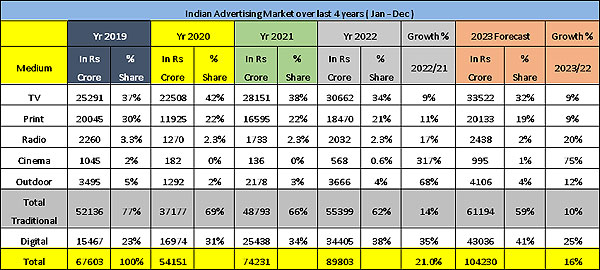
    Madison Media presented its predictions for the advertising industry for 2023.  The highlights of the report were released by Sam Balsara, Chairman, Madison World. According to Madison Media, AdEx has grown by 21% in 2022 to reach Rs. 89,803 crore. AdEx is expected to grow further in 2023 by 16% and will cross the landmark Rs. 1 lakh crore number to settle at Rs. 1,04,230 crores. In 2022, Digital grew by 35% to become the largest medium in AdEx with a 38% share, compared to TV’s 34%. TV grew by a modest 9% vs our projection of 14%.


    Figures at a glance:
     

    Key findings of the report:

    A. Overall:

    1) In 2022 total AdEx grew by 21%, Traditional AdEx by 14% and Digital AdEx by as much as 35%.

    2) Compared to Indian AdEx growth rate of 21%, Global AdEx, according to WARC grew by just 8% in 2022. The Top 11 countries that account for 70% of Global AdEx grew by only 1%.

    3) In absolute terms, AdEx has grown from Rs. 74,231 crore to Rs. 89,803 crore and this is the second highest gain of the last two decades.

    4) Traditional AdEx dominates Indian AdEx with a 62% share, whereas in Global AdEx the figure is 32%.  With a growth of 14% in 2022, Traditional Media at Rs. 55,399 crore, has just crossed its 2019 figure of Rs. 52,136 crore.

    5) Digital AdEx is now the largest medium with a share of 38%, followed by TV with a share of 34%.

    6) The Audio Visual medium contributes to 45.6% of total AdEx. Linear TV at Rs. 30,662 crores and Digital Video at Rs. 10,314 crores, totalling to Rs. 40,976 crores.

    7) FMCG continues to be the largest category, but its share has moved down from 38% in 2020 to 32% in 2022.

    8) Ecommerce has now established itself as the 2nd biggest category of AdEx, growing in Share from 4.9% in 2019 to 14% in 2022.

    9) The Top 5 Advertisers in AdEx are HUL, Reckitt, RIL, Dream11 and Mondelez. There are only 11 Start-Ups in the Top 50 Advertisers List vs 15 last year, confirming that VC money is drying up.


    B. Digital

    1) Digital grew by 35% in 2022, on top of a 50% increase in 2021, to reach Rs. 34,405 crore and has emerged the largest medium in AdEx with a 38% share, overtaking TV.

    2) A 10-year review shows that Digital has grown from a mere Rs. 3,050 crores with a 9% share, to Rs. 34,405 crores with a 38% share today.

    3) Inspite of all this growth, Digital AdEx in India trails behind Global AdEx. Digital share in Global AdEx is 68%.

    4) Video, Social, Display, Ecommerce and Search drive Digital AdEx. Digital Video continues to dominate Digital AdEx and having grown by 40%, has further improved its Share from 29% to 30%.

    5) Social grew the most at 45% and increased its Share from 20% to 22%. Display has grown more modestly at 19% and has lost 3 percentage Share points from 19% to 16%. Search has grown by 32%, but is only 16% of the market.

    6) Ecommerce has registered a 35% growth and now has a share of 16% of Digital AdEx. Whilst Google and Facebook account for the lion’s share of Digital ADEX, Amazon and Flipkart account for almost 80% of Ecommerce spends.

    7) Digital is going to continue to fuel growth of AdEx in 2023. It is expected to grow by 25% to reach Rs. 43,036 crore and increase its share to 41% of AdEx.


    C. Television

    1) TV registered a modest growth of 9%, against our forecast of 14% to reach Rs. 30,662 crore.

    2) In 2022, for the first time we see signs of stress in Linear TV and its Share has come down from a high of 42% in 2020 and 38% in 2021 to a new low of 34%. With increasing spends in Digital, TV has now moved down to number 2 position in the Indian AdEx.

    3) TV has also seen a 8% decline in viewership over the last year, and a 13% drop compared to pre-Covid year 2019.

    4) TV has seen a marginal drop in Advertisers from almost 11,000 in 2021 to less than 10,500 in 2022.

    5) FMCG continues to be the largest contributor to TV AdEx with a share of 45%. Ecommerce, the 2nd largest contributor to TV AdEx, further increased its share from 18% to 20%, followed by Auto which has maintained its share at 5%.  Education has dropped its share from 6% to 4%.

    6) In terms of Genres, Hindi GEC 2 has registered the highest growth of 47% followed by Sports at 22%. News, witnessed a degrowth during last year. Among the regional satellite channels, Tamil continues to rule the roost, followed by Telugu, Marathi, Bengali, Kannada and Malayalam in that order.

    7) TV AdEx is expected to grow by 9% in 2023 to reach Rs. 33,522 crore.

    8) FMCG, the largest category of TV Market, is likely to substantially increase its Advertising budgets, instead of reducing consumer prices because of lowering of raw material inflation.


    D. Print

    1) Print AdEx grew last year by 11% to reach Rs. 18,470 crores, a little short of its pre-covid figure.

    2) Both Volume and Value in Print have gone up by 15% and 11% respectively.

    3) H2 performed well for Print and 58% of its AdEx came from H2 vs only 46% in pre-Covid year 2019.

    4) In terms of category contribution, although, Education de-grew marginally, it has emerged as the largest category in Print overtaking FMCG, which grew by as much as 8%. Two other large categories, Clothing, Fashion & Jewellery and Household Durables grew substantially by over 50%.

    5) In terms of languages, Hindi Publications continue to dominate, followed by English and Marathi, the latter two having grown by 19% over 2021.

    6) We expect Print AdEx to grow at 9% in 2023, to reach Rs. 20,133 crore and reach pre Covid levels.

    With this growth, its Share will be 19%, compared to Global AdEx where it is a mere 4%.


    E. Other Media

    1) OOH AdEx has registered a high growth of 68% on the back of a growth of 69% the previous year, taking the industry to Rs. 3,666 crore and surpass its pre Covid level.

    2) Digital OOH continued to be the growth driver with its big bright, colorful and moving displays.

    3) Radio AdEx has grown by 17% to reach Rs. 2,032 crore, but it is still at 90% of its pre Covid level. Its Share in total AdEx is at 2%.

    4) Real Estate has emerged as the largest category in both OOH and Radio, pipping FMCG.

    5) Although Cinema grew by 317%, it has reached only the half way mark of its pre Covid number of Rs. 568 crore. But with new movies coming up, we expect Cinema to grow by 75% this year and reach Rs. 995 crore, almost upto its pre pandemic level.


    Added Balsara: “Indian AdEx is the bright spot in a relatively dull and uncertain global environment. Our AdEx has grown by leaps and bounds in the last 3 years marked by Covid and the War, except in 2020. However, media habits of Indians are rapidly changing and this is reflected in our AdEx numbers and commentary. Advertisers who ignore these changes will do so at their own peril.”


    Bharat Puri, Managing Director, Pidilite Industries Limited who launched the report said: “Experiment, innovate, know your consumer and don’t be afraid of failure”. He said, “Whilst chasing impressions, don’t forget to make an impression!”