Author: mxmadmin

  • FieldAssist announces new marketing campaign

    By Our Staff


    FieldAssist, a SaaS based technology platform transforming route-to-market capabilities of Consumer packaged goods (CPGs) companies, has announced its new positioning statement titled ‘Proud Partner to Great Brands’. The positioning celebrates its growth and long-lasting association with consumer brands from established enterprises to new-age startups, including Bisleri, Philips, Adani Wilmar, Emami, ITC, Nivea, Haldirams, Licious, Mamaearth and many others.


    Said Paramdeep Singh Anand, CEO at FieldAssist: “Great brands have four prominent attributes. They conquer complex challenges, innovate fearlessly, build new trends & delight consumers throughout their journey. To become, sustain and expand as a great brand, companies need more than a good system. They need a partner their teams can trust. Someone who is agile to innovate for achieving their ambition. Not merely with technology but using deep industry expertise to deliver market-ready solutions.”


    Added Divir Tiwari, Co-founder at FieldAssist: “Our positioning ‘Proud Partner to Great Brands’ is an ode to the consumer brands who trust us in their journey. Their courage to keep fighting challenges is an inspiration for us to simplify complexities of sales and distribution in the CPG industry everyday.”


  • Effective Consumer Choice key for Indian TV Viewers: BIF-CUTS Survey

    By Our Staff


    Broadband India Forum (BIF) and Consumer Unity & Trust Society (CUTS International) have released a Report based on a nation-wide survey of over 10,000 TV consumers to gauge consumer perception with respect to the choice enjoyed for TV channel selection and overall satisfaction. The largest independent and neutral study conducted for the first time in India keeping the consumer perception in mind – for a sample size of over 10,000 TV consumers spread over diverse age, income, milieu and gender groups; the study brings to light some interesting findings which go to strengthen the importance and relevance of TV even in today’s day and age when digital/OTT media and apps proliferating rapidly.


    Key findings of the Study Report:

    1. TV is the most preferred mode of video content consumption: It is worth noting that an astounding 70% of the consumers surveyed felt that television offers a value-for-money proposition, as compared to a mere 27% in the case of digital/OTT platforms and barely 3% in the case of TV apps.

    2. Consumers prefer bouquets: Another telling find is that 54% of consumers surveyed avail of TV channels via bouquets/packages and another 35% do so via a combination of bouquets and individual channels. With an effective total of 89% of the consumers surveyed preferring bouquets, they become an overwhelmingly -preferred choice.

    3. Consumers want more from their subscriptions, even though they prefer bouquets: 40% consumers feel their subscriptions cater to the viewing needs of the entire family. Several consumers felt there is room for their levels of satisfaction to grow, as they want to watch other and new channels that they think they may like. There is need for ‘effective choice’ to be exercised by consumers.

    4. Pricing: Price is the most important factor for choosing TV package subscription for many consumers. Most consumers are subscribed to the basic package offered by the distributors which provide between 100-200 channels. The average charges paid by the consumers are between INR 200 and INR 400 for their subscriptions, on a monthly basis.

    5. Lack of awareness on how to select (or delete) channels and dependence on last-mile TV distributors: Several consumers (31%) claimed that they were unaware of the possibility of adding/removing TV channels from their subscription packages, 51% are not inclined towards adding/removing channels themselves, and only 43% of those who add/remove TV channels found the process convenient. A majority of consumers (60%) rely on manual process of adding or removing channels and require direct intervention from distributors.

    6. Lack of awareness of TRAI’s channel selector app: Around 75% consumers are unaware of the ‘channel selector app’ launched by TRAI in June 2020 to enhance consumer choice. This reinforces the need to improve efforts at capacity building of consumers on a priority basis.

    7. Consumers want better quality of service (QoS) at the last-mile: TRAI introduced QoS Regulations in 2017 that mandate itemized billing, fast and convenience grievance redressal, and assistance with Customer Premises Equipment. However, consumers believe that there is scope for improvement on these parameters. 1 in 5 consumers perceive decline in grievance redressal, assistance with Set Top Boxes (STBs), freedom to choose channels they want to watch, and an increase in number of advertisements. In fact, 3 out of 10 consumers claim to have never received an itemised bill. These are mandatory under the extant regulatory framework (See FAQs). Non-compliance with this framework is indicative of inadequate enforcement at the last-mile of distribution.


    Said Pradeep S Mehta, Secretary General, CUTS International: “The study surveyed over 10,000 subjects across the country to capture the perception of TV consumers with respect to the choice they enjoy when it comes to channel selection and the satisfaction levels with the current choice available. The major findings indicate that there are gaps in the effective exercise of consumer choice as well as channel selection. Efforts to enhance consumer awareness around their rights as well as methods of channel selection are imperative. However, any further regulatory intervention should follow a detailed cost-benefit analysis.”


    The report deduces that Indian consumers have high expectations from their TV subscriptions and bundles, and there is room for consumer welfare to grow if the next wave of regulatory reforms can narrow focus on how to enable effective consumer choice. The mismatch between consumer preferences and channel subscriptions could be minimised if: (a) there are many more efforts at raising consumer awareness (e.g. capacity building through regional consumer cells), and (b) consumers have greater say in deciding their bouquets.


    To ensure that subscriptions reflect consumer choice, the charges for the ‘Network Capacity Fee’ (NCF – see FAQs), could be reviewed. Alternatively, a Network Access Fee (NAF) on a per channel basis could be considered in place of a flat charge for NCF. By this method, distributors could be incentivised for aiding consumers by providing suitable channels and bouquets of their individual choice. The regulator could also support credible consumer organisations in generating awareness, building capacity, and acting as watchdogs for compliance with QoS, convenience in channel selection availability, quality of content, as well as viewing experience and quality of service.


    Added TV Ramachandran, President, Broadband India Forum: “This independent and operator neutral study is perhaps the first of its kind in India, conducted across such a wide and diverse sample size and spread. There is also no evidence-based study till this, which captures the consumers’ perspective and level of satisfaction on TV viewership. In this regard, the study assumes great significance and relevance, especially in the present times, when the general notion is that Digital media & content is impacting the popularity of the legacy and linear TV. The report indicates possible areas for regulatory & policy focus to help in overall improvement of quality of services and consumer satisfaction.”


    The key findings of the study present an interesting understanding of the attributes of Value, Quality and Overall Satisfaction of TV consumers. Last-mile service providers/Distribution Platform Operators remain the consumer’s primary point of contact for TV subscriptions and it is necessary to ensure QoS requirements and prioritise transparency mandates.


  • Wanted: A New Idea of India


    By Ashoke Agarrwal


    Ashoke AgarrwalI am aware that hundreds, if not thousands, of my betters – philosophers, public intellectuals and general blowhards – have said volumes on ‘The Idea of India’. However, as an ordinary Indian, as we enter the week of our 75th anniversary of independence, I feel encouraged to add my two bit.

    And since our notion of who we are is central to the practice of marketing and marketing communication, I am publishing this part of my fortnightly column on developments in the marketing world.

    Imagination and ideas are central to human society. Humanity has progressed from being bands of powerless apes in the animal world to unchallenged rulers of all that survey mainly because of its unique ability to cooperate flexibly as groups of thousands, millions and even hundreds of millions.

    This ability of humans to launch and sustain world-changing projects stems from a core human functionality – the ability to imagine an entity – an idea – that is little to do with physical reality and nurture and strengthen it as an integral part of the collective consciousness.

    In this realm of core ideas that drive human civilisation are the notions of God, Religion, Nation and Money.

    Just as the larger human project, every nation is bound together as an entity by an idea.

    The United States (US), for example, achieved greatness based on its self-image of rugged individualism and meritocracy framed in a federal democracy. An idea that attracted the best worldwide, priming a virtuous cycle.

    However, over the last decade or two, this idea of the US has begun to fade, resulting in a decline from being the world’s hyper-economic, military and cultural power.

    The US needs to reinvent itself, and at the core of this reinvention will be forming a new idea that redefines its self-image.

    Thus, the defining idea, while being the engine that drives its society and its place in the world, cannot be static – it has to evolve with time.

    Currently, politics mire the debate on the idea of India. At one end of the spectrum is the idea of India forged in the Independence struggle, Gandhian ideals and the trauma of the partition. An idea of India as a unique society that values pacifism and eschews materialism and consumerism. A simple living and high thinking paradigm contrast the West’s power-seeking “greed is good” paradigm.

    The idea of India as an ancient civilisation is at the opposite end of the spectrum. Once a superpower that went through a passing phase of subjugation. Now beginning the reemerge as a powerful and rightful leader of the world.

    To my mind, both the above ideas are anachronistic in that both are rooted in the past. Because, to young India, in a world of rapid change, even the past decade, let alone the past century or past millenniums are irrelevant.

    India as a society needs to evolve and nurture an idea of itself that can power its future.

    This idea needs to be rooted in its potential, not its past.

    At the same time, this idea needs to be rooted in reality and not just a rhetorical shift from extolling a glorious future instead of a glorious past.

    Furthermore, this idea should position India uniquely and not just as a me-too in the polity of nations.

    A nation of 1.3 billion people – nearly 18% of the world population- cannot but have an idea of its future without evoking world leadership in some area of human endeavour. We cannot be a nation perennially looking to catch up with others,

    India is a young country with a median age in 2020 of 28.43 years. However, the media age is growing at an annual rate of 2.15%; thus, by 2040, the median age will be above 40.

    It is today’s young who should define the new idea of India. Therefore, this new idea of India has to be aspirational – an aspiration of leading the world in a focused set of essential areas.

    Given the structure of the modern world, this shortlist of essential areas must come from the domains of science & technology or public welfare (health, education and social justice).

    To my mind, global leadership in a chosen set of critical science & technology fields can yield the resources that, if appropriately husbanded, can impact public welfare.

    However, a government committee or even a set of bigwigs will not choose this new idea for India.

    The new idea of India will need to bubble up from the grassroots and percolate through Indian society before it takes hold. But, for that to happen, the nature of public discourse and debate must change.

    Today’s public discourse in India is both toxic and petty. The politicians bicker, and the media megaphones the bickering.

    I believe that a handful of charismatic and articulate young Indians aided by a set of powerful mass and digital media can seed a new idea that galvanizes India. But unfortunately, these seeders cannot come from the political class though they would readily find the media platforms. That well is too poisoned. Political voices today start from a heavy trust deficit and are guaranteed vocal opposition from the get-go.

    Perhaps somebody needs to ‘seed’ the seeders, a ‘Star Chamber’ of well-resourced well-wishers who will carefully identify them and give them the media platforms.

    To sum up, a debate around the idea of India cannot assume that it is an idée fixe.

    An idea of India should be the roadmap to the future and not just a relic of the past.

    A bunch of public intellectuals (let alone politicians) cannot decide on the idea of India. Instead, it is a powerful, evolving emanation from the grassroots that animates the entire society.

    Moreover, such an animating idea of India is not just a nice thing to have but instead a critical ingredient for a vibrant, on-the-move nation. And the only role for the elite and the powerful is to provide the ecosystem to empower such emergence and get out of the way.


     

  • SPAG-FINN partners with SmartCardia

    By Our Staff


    Healthcare communications and advocacy firm, SPAG, a FINN Partners company, has joined hands with SmartCardia, a leading MedTech company dedicated to strengthening the healthcare ecosystem through state-of-the-art predictive and personalized cardiac monitoring devices.


    Dr. Srinivasan Murali, Founder and CEO, SmartCardia said: “We are delighted to partner with SPAG-FINN, a leading global healthcare advocacy firm. We believe that their unique insights in the Healthcare industry as well as their expertise in building narratives will ensure that our India journey is an impactful one.”


    Added Aman Gupta, Managing Partner and Asia Lead, Health Practice: “At SPAG-FINN, we create high impact narratives that not only ensure the best advocacy for our clients in the Healthcare and Health-Tech industry but also tie-in with our core values of being agents of change and ensuring that we make a difference in the world. We believe in SmartCardia’s unique value proposition of strengthening preventive and personalized cardiac care and are delighted to leverage their state-of-the-art cardiac monitoring devices that will enable accessibility to cardiac care simpler even in remote areas.”


  • QYou Media to launch Q Gamex

    By Our Staff


    Following the recently launched digital channels, ‘The Q Kahaniyan’ and ‘The Q Comedistaan’, QYou entertainment network further gears up to announce the launch of ‘Q GAMEX’, a 24×7 gaming digital channel. The channel aims to target young gamers across connected TV and digital platforms.


    Krishna Menon
    Krishna Menon

    Speaking on the announcement of its upcoming gaming digital channel, Krishna Menon, Chief Operating Officer, QYou Media India, said: “At QYou Media India, our unique and socially connected content style is in alignment with what this audience is looking for. The Indian online gaming industry has steadily grown to become a leading market across the globe. With the launch of ‘Q GAMEX’, we aim to cater to the young gaming enthusiasts and become a leading provider of multi-genre channels to audiences who are rapidly adopting connected TV as a primary destination for entertainment purposes. We are delighted to add ‘Q GAMEX’ to our existing portfolio of brands and look forward to developing Q GAMEX as a pioneer in gaming content across digital platforms.”


    According to an analysis by KPMG, India is set to become one of the world’s leading markets in the gaming industry where it is expected to cross 450 million online gamers in 2023, second only to China. Growing steadily over the last five years, it is expected to treble in value and reach an overall value of $5 billion by 2025 driven by a rapidly growing younger population with higher disposable income. With the total number of online gamers growing from 360 million in 2020 to 390 million in 2021, analysts expect steep growth in the sector.


    Leveraging content from a wide array of top social influencers and digital content creators, QYou Media India so far has launched The Q, Q Marathi, The Q Kahaniyan and The Q Comedistaan. The upcoming digital channel Q GAMEX targets the rapidly growing community of online and mobile gamers and will mark the launch of QYOU Media India’s fifth channel.


  • Ekart unveils new brand identity

    By Our Staff


    Ekart Logistics, logistics service providers and the supply chain arm of Flipkart, has unveiled its new brand logo. This comes after Ekart announced the externalisation of its service offerings earlier this year for small and large businesses across the country, to help improve their competitiveness while enabling them to focus on their core business.
     

    Commenting on this development, Mani Bhushan, Chief Business Officer at Ekart, said: “Ekart today is a pioneer in India’s e-commerce supply chain and logistics industry. Over the past several years, the business has evolved and transformed, keeping pace with the evolving digital economy and retail landscape in India. It has developed a tech-enabled pan-India supply chain supported by a large infrastructure footprint. Ekart’s new brand positioning reaffirms our commitment to help lakhs of small businesses, D2C companies, brands and platforms to achieve scale by reaching out to millions of customers across the country. The new brand logo also depicts our vision of becoming synonymous with the growth engines of commerce in India.”


  • Obeetee carpets launches The Didi campaign

    By Our Staff


    Obeetee, luxury carpet maker, has launched The Didi campaign to honour women weavers’ leadership and camaraderie as expansion of women-weavers initiative. The company has continually takes leads for the upliftment and betterment of weaverfolk and their families. The Didi (Elder weaver women) Campaign is an initiative to tell the world the story of weaver women and their heart-warming bond, while simultaneously giving them a voice.


    The Fourth All India Handloom Census, 2019–20, indicates that women comprise of about 72% of the nation’s handloom weavers. Today, over 38 million women weave in India. Since they were little girls, women weavers have handled the majority of pre-weaving tasks like setting up the yarn and looms, dyeing and/or tying and dying yarn and fabric, and hand-embroidering clothing since they are from traditional families of handloom weavers in India.


    Women in handloom communities end up contributing to the allied labour even if they are not weavers because it involves the entire family. The primary weaver on a handloom needs three auxiliary workers, all of whom generally come from the same family and are women. Thus, each knot tied, and each thread woven is much more than just a craftwork, but also a depiction of solidarity between the women weavers as a collective union. Additionally, each carpet woven by a woman weaver goes to every home as a symbol of affection, respect, and care with likes of Obeetee.


  • Nutshell Infotainment Channel crosses 1 mm Instagram followers

    By Our Staff


    Digital entertainment company Pocket Aces’ newest channel, Nutshell, which focuses on non-fiction infotainment content, has crossed the important milestone of 1 million followers on Instagram. The channel has been steadily growing across platforms with a highly engaged audience that consists of a mix of millennials and Gen-Z from Metro Tier I and Tier II cities, clocking in an average of 42M viewers a month.


    Said Andre Borges, Channel Head of Nutshell: “Over the last few months, we have been testing the market to clearly understand what audiences need and want to watch. We have thoroughly embedded Nutshell within communities of people in these interest categories, allowing the channel to have access to a lot of data about what the audiences are thirsty for. After scaling Instagram, scaling our content and subscribers on YouTube and Discord is next for us.” Andre’s understanding of virality and audiences comes from 5+ years of prior experience as a Content Creator, Video Producer and News Production Manager at publications such as Buzzfeed India.”


    Added Rayvanta Kumar, Business Head, D2C Content, Pocket Aces: “At Pocket Aces, we have already built large GEC channels such as FilterCopy and Dice Media, and one vertical focused channel in Gobble. Infotainment is a huge vertical globally, and works amazingly for Indian audiences who love sharing information with their families and friends. We get to use our playbook of the community approach even more deeply here, and that means we are creating a hyper engaged set of audiences. To give advertisers access to these audiences, we are now opening brand partnerships on Nutshell, and have already worked with some early partners such as Amazon Prime, Deserv, Edufund, Basis, Wint Wealth, etc.“


  • Ameesha Patel to promote StarAndDaisy baby products

    By Our Staff


    Remember Ameesha Patel? The actor who nearly faded away is now brand ambassador of StarAndDaisy, a baby and kids products company.


    Said Akshay Arya, Co-Founder, StarAndDaisy: “We understand that Ameesha Patel has been one of the most popular faces with our target audience over the years. The grace and aura that she carries resonate well with the soul of the brand. It is not just the product that we are providing but also a style statement. The panache that the actress brings around unleashes exactly what we intend to convey to our consumers. We certainly believe that we will be able to take the brand to a whole new level while communicating the essence.”


  • Colorbar launches campaign in sync with Sony Music

    By Our Staff


    Earlier this month, Colorbar, a beauty brand, has launched a campaign titled #ColorbarXShringaar in partnership with Sony Music Entertainment. This Instagram campaign has had assorted TV stars and Influencers like Anushka Sen, Avneet Kaur, Nagma Mirajkar, Sameeksha Sud and Arishfa Khan, wearing Colorbar’s newly launched Power Kiss Vegan Matte Lipcolor while dancing to the tunes of Akasa and Aastha Gill’s latest track, Shringaar.


    Commenting on the idea behind the launch, Samir Modi, Founder & Managing Director, Colorbar Cosmetics said, “As a brand, we believe that everybody is free to create their own identity, experiment, and have fun with makeup irrespective of gender and societal perceptions, and conventions. To bring this idea alive, we explored a fun route that could reach our consumers across the country while bolstering the philosophy of our brand. We have specifically reached out to influencers with a fun streak who nudge audiences to embrace their identity. The campaign has seen great receptivity and has resonated well with audiences, besides enhancing their connect with the brand. With 11Million + views, this campaign is a strong step as we progress in our journey from fostering brand loyalty to brand love.


  • Tata Sampann campaign with Manoj Bajpayee

    By Our Staff


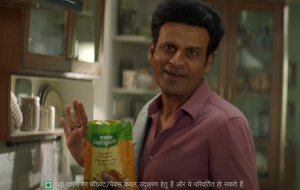
    Tata Sampann, the brand offering unpolished dals, staples and spices, has announced the launch of its latest campaign #JaiseNatureNeBanaya. The ads feature actor Manoj Bajpayee.

     

    Commenting on the campaign, Deepika Bhan, President, Packaged Foods (India), Tata Consumer Products, said: “Our commitment is to bring high quality nutrition to Indian homes. This commitment inspires us to work towards mindful processing, allowing for food to retain its full nutrient potential. The constant obsession for retaining natural goodness is why our products are high quality, high sensorial value – so they taste great. Tata Sampann is Sarvagun Sampann.”


    Added Sukesh Nayak, Chief Creative Officer, Ogilvy India: “We wanted to present Manoj Bajpayee not just as an actor but as a discerning food lover who loves to cook. In this light-hearted campaign he shares with us some simple yet effective tips on how to elevate even the most basic dishes with Tata Sampann dals and haldi.”


  • Time to Cancel the Cancel Culture?


    By Shailesh Kapoor


    Shailesh KapoorWhen I first heard the term ‘Cancel Culture’ a couple of years ago, it intrigued me. The idea that you can ‘cancel’ someone, typically a celebrity, for their unacceptable comments or conduct, especially on a topic of contemporary significance, seemed like an empowering one. It also seemed democratic in its intent, because a group of common people could hold a celebrity accountable for their actions or words, by ‘canceling’ them en masse.


    In India, however, the term did not come with the nuances, such as those around the free speech debate, it carries in Western cultures, where it originated. The semantics changed to “Boycott”, a word that has since been used to attempt cancelation of several celebrities, films and corporates, often for reasons that are more political than moral, social or cultural.


    As I write this, a search on #Boycott on Twitter throws up three prominent suggestions: #BoycottLaalSinghChaddha, #BoycottRakshaBandhan (the film, not the festival) and #BoycottAliaBhatt. All three are related to films releasing this week. Alia Bhatt’s Darlings has dropped on Netflix today, while the other two films, starring Aamir Khan and Akshay Kumar respectively, release on August 11.


    It may not always be easy to trace root causes of such boycotts, because those causes often tend to be more generic than specific. If a community of trolls decides to boycott a particular film or its lead actor, they will find more than a few reasons to do so. It could be a comment made by the celebrity in the past (sometimes a decade ago), something ‘inappropriate’ they wore, a ‘problematic’ character they played in a film in the not-so-recent past, or all of the above.


    The root causes may not always be linked to the bigger celebrities alone. Raksha Bandhan, a film headlined by an actor (Akshay Kumar) who generally has a right-of-centre political image, is being ‘boycotted’ because the film’s writer Kanika Dhillon has been outspoken about topics such as lynching, and has made ‘cow’ references in some of her tweets on this topic. These tweets are not from this year, but have been dug out in the week leading up to the film’s release.


    Then, there’s the generic evergreen trending topic: #BoycottBollywood. Since Sushant Singh Rajput’s suicide in June 2020, the call to boycott the Hindi film industry in its entirety has been a recurring one. It’s been fanned by some within the industry itself, most notably Kangana Ranaut. The industry has also been given the name ‘Urduwood’, a term that suggests how the industry has turned its back on Hindu culture and ethos.


    The underlying politics is apparent even to the most naïve. News channels play their part in furthering this narrative, using subtler variants of these hashtags, but never showing any subtlety of discourse thereafter.


    In times when the Hindi film industry is suffering from an identity crisis, with films from the Southern industries and Hollywood doing better, it becomes a soft target for hardline politics.


    The good news, if one can call it that, is that there is no evidence that such boycotts impact the fate of these films or stars, either in theatres or on streaming. Alia Bhatt, who has been on the ‘boycott list’ of the Right Wing for what seems like perpetuity now, is at the peak of her professional career currently, and has delivered one of the few hits that the Hindi film industry have seen this year: Gangubai Kathiawadi.


    Since the paying audience doesn’t care much, there isn’t much heft that these hashtags and social media trends carry. But they continue to exist, and are only getting more frequent and inane of late.


    It’s perhaps time to boycott the boycott hashtags, to cancel the cancel culture.