Author: mxmadmin

  • Debrief: Kotak hits the clone zone

    By Anil Thakraney


    Another Bollywood classic lifted. Kotak Life promises you guaranteed second income in their new commercial, and the idea is ‘cloning’. The jingle borrows the popular Qurbani film song, and the tinkered words are: ‘Mere jaisa koi meri zindagi mein aaye’.


    In the commercial, people discover duplicates of themselves, much to their delight. And these clones happily assist the originals in their activity. A singer gets a partner to croon with. A chef gets a partner to aid in preparing a delicacy. Another chap gets a look-alike to help him board a moving bus. It’s not a bad idea at all. If the Kotak Life managers are alive to the long term possibilities of the cloning idea, then they are on to a good thing. It can become a powerful brand property. But if it’s just a one-off TVC, then the ad only serves as a cute entertainer, and no more. The real challenge is how they take this one forward.


    [youtube width=”400″ height=”200″]http://www.youtube.com/watch?v=MXvFZqxaEGw[/youtube]

    The one little problem is this: Because all the ad time gets used up in establishing the clones, there’s no chance of telling us exactly how Kotak Life will help us double our income. For that, we have to call/visit them to find out. That’s fine… because you can’t load a brochure on TV… but it also means the idea must be pumped with steroids, else it serves little purpose.


    All said, I like the core thought. Wouldn’t all of us like a duplicate to share our work load? For the politicians, that’s serious double ‘income’, hehe.


    Rating: (On a scale of 1 to 5): 3. Good long term potential


  • Deloitte study says outlook for Indian retail sector gloomy

    By Writankar Mukherjee


    The outlook for the organised retail sector in India is gloomy as the economy is slowing down following a period in which monetary policy was tightened to fight inflation, according to a global study by Deloitte Touche Tohmatsu.


    The study, christened 2012 Global Powers of Retailing, says although the monetary tightening resulted in slower economic growth, it did not bring the inflation down. And because of this, policy makers are faced with the conundrum of slow growth with persistent inflation, it says.


    “Indian retail sector offers significant potential for growth of modern trade but given the recent policy flip flop related to FDI in multi-brand retail, both global retailers as well as existing Indian organised sector retailers appear to have adopted a cautious ‘wait and watch’ approach before committing fresh investments,” says Mr Rajan Divekar, senior director of Deloitte India.


    Mr Divekar says Indian retailers are also customising and fine tuning their business models across retail formats to ensure there is a balance between store expansion and profitability. “The recent liberalisation permitting 100% in single brand retail is a welcome sign especially for select luxury and niche retailers,” he says.


    The Deloitte report says retailers have learned to succeed in emerging markets like China and India as they significantly customise both their market models and product offerings to meet local needs and preferences.


    It says foreign investment in multi brand retail will have a positive impact on India’s economic growth. The move could lead to a rationalisation of the supply chain, greater supply chain efficiency, and greater effective spending power for consumers.


    The study says some retailers may find some silver linings in this otherwise cloudy environment. One positive effect of slower global growth will be the continued dampening of commodity prices. “For retailers, this means some improvement on the cost side of the ledger while retail price inflation in some economies presents an opportunity for improved profit margins, even in the context of slow top-line growth,” says Mr Divekar.


    According to the Deloitte report, the world’s 250 largest retailers recorded sales growth in excess of 5% in fiscal 2010 The figures mark a substantial improvement as compared to 2009, when the group of the top global retailers recorded anaemic growth of just 1.2%. The growth took place despite the end of fiscal stimulus in the US, the crisis in the Eurozone, and tighter monetary policy in key emerging markets like India.


    Source:The Economic Times

    Copyright © 2012, Bennett, Coleman & Co. Ltd. All Rights Reserved


  • Ramnath Goenka Awards presented, heated debate on journalists’ intellect ensues

    By Akash Raha


    The Ramnath Goenka Memorial Foundation hosted The Ramnath Goenka Excellence in Journalism Awards, one of the most prestigious awards that acknowledge excellence in all forms of journalism, print and broadcast, in all languages on January 16 in New Delhi.


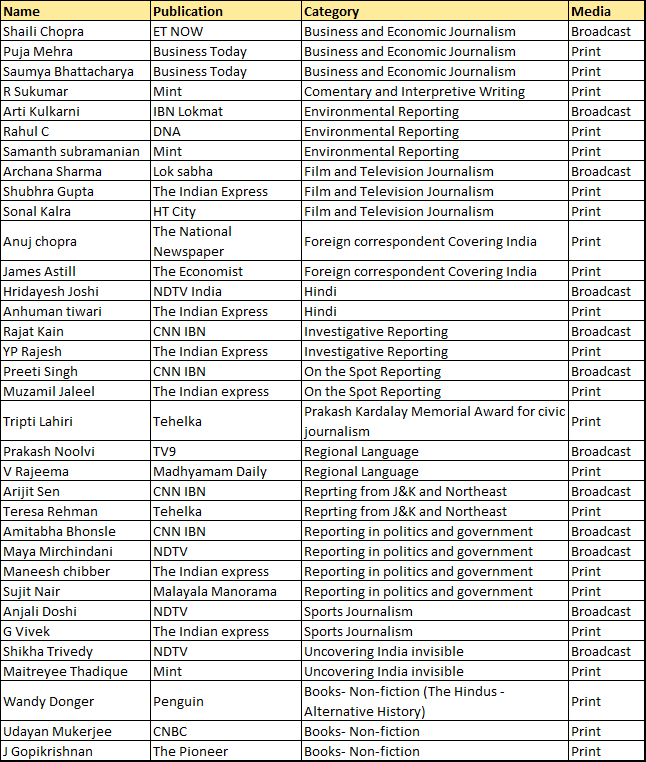
    The awardees for the year 2012 are as follows.


    Like every year, the award ceremony was followed by a panel discussion. This year, the subject based on the Press Council of India chairman Justice Markandey Katju’s observation: “The majority of media people are of poor intellectual level.”


    Justice Markandey Katju was present during the award ceremony and the discussion that followed. There were several politicians, journalists and academicians present, amongst the audience and the panel, who spoke on the topic and ensured that the discussion and debate was at a fever pitch with their war of words.


    Speaking on the issue, panelist Mr Digvijay Singh of Congress party said that there are black sheep in all works of life and the same holds true for the media as well, but to generalize and say that all of them have low intellectual level would be wrong. However, fellow politician and panel member Mr Sharad Yadav of JDU said that times have changed and with that the standards of journalism have fallen too, illustrating his argument by pointing towards the TV channels, who “invest too much in irrelevant news”. He also pointed at the issue of paid news which has tarnished the image of journalists and media houses alike. He said that the proliferation of media has caused the standards of news to fall.


    Furthermore, he said: “the media industry has to be accountable… If the Prime Minister of India is accountable for his deeds, so shall be the media.”


    Some panel members also raised the question whether it was important for journalists to be intellectually strong. According to some, journalism is of two kinds, hard news and opinion – and in the former, one does not need intellect, only moral integrity. LK Advani, who was the part of the audience said: “I don’t think that journalism has failed the democracy. However, there have been a few shortcomings off late. Yet, I will not say that they have low intellectual levels.”


    Digvijay Singh stated that intellect is required in the whole profession of journalism, be it opinion or reporting. However, he added that with the kind of expansion media has seen lately, it is possible that the training of young and budding journalists remains incomplete. He also advocated for accountability and self regulation in media.


    Union HRD minister Kapil Sibal agreed with Sibal: “Putting out information as soon as possible has become the need of the hour for those in visual media. At such times, news which needs to be evaluated is often not evaluated and is broadcasted without any checks. It is not the fault of the journalist, but that of the medium itself.”


    Pratap Bhanu Mehta, an academician, and a member of the panel said that when a state dictates terms as to what is to be broadcasted or not, it creates insecurity. He made his point when he censured Katju’s stand on Dev Anand’s demise, when he said that the news should not have been on the front page of all newspapers.


    Senior journalist and columnist Tavleen Singh engaged in a war of words with Katju when she questioned the credentials of judiciary. Katju evaded the question by asking her to “please confine yourself to the topic at hand… there will be other days for discussion on the judiciary,” but she persisted with her attacks on Katju and his authoritarian comments on media. She went on to say that PCI has to be more active in the future to regulate media, as judiciary is too incompetent to do so.


    Senior journalist Nalini Singh thought it important that journalists and media houses, especially the visual media, should introspect as to what kind of news stories they are doing. She said that usually only 5-6 big stories are followed on and so many news stories are ignored every day. Udayan Mukherjee of CNBC agreed: “A lot of our media are not up to the mark… and I don’t feel resentful of the idea that there is something wrong with the media.”


    When Shekhar Gupta of The Indian Express group was asked how he feels about visual media and the pace at which news is disseminated today he said: “Everybody with a camera is not a journalist, he is only a transmitter of raw unchecked data.” Editorial intimidation is very important and one has to ensure that the news published is factual, in public interest and of public interest.”


    The panel discussion was brought to an end by Mr Katju where he congratulated all the awardees.


  • Corporate India loses interest in cricket with team’s loss

    By Rajiv Singh & Ratna Bhushan


    It’s being marketed as the ‘Agneepath’ series and Team India’s disastrous tour of Australia will most certainly leave brand cricket with severe burns as companies turn to non-cricketer brand ambassadors, pull cricketer ads off air and negotiate a cut in advertising rates.


    The Indian cricket team is staring at a humiliating second consecutive whitewash overseas after surrendering meekly in the first three Tests in Australia on the back of a debacle in England last year, and most cricket sponsors are unable to hide their disappointment as Indian TV viewers surf away from cricket.


    “We were planning to rope in one of the top Indian cricketers for our forthcoming campaign, but have now decided against having cricketers,” says a top official of a mobile handset brand requesting anonymity. “Going by their present performance, it’s not worth a gamble now.”


    Media experts predict that television advertisement rates will fall at least 20% after this series as cricket is fast losing mindspace after hitting a peak following India’s World Cup triumph last year.


    “There’s absolutely no doubt that advertising rates will fall in the forthcoming series,” says Ms Punita Arumugam, media group chief executive officer of Madison, which buys media for Bharti Airtel, ITC and Cadbury Kraft.


    A senior official of Maruti Suzuki, one of the key sponsors of the ongoing series, says the Tests have been a big disappointment for the country’s largest carmaker.


    “While we will continue to invest in cricket, we feel cricket is over-priced. Considering that results of the team have not been spectacular except for the World Cup, we hope rates will be rationalised,” says Maruti Suzuki Chief General Manager – Marketing, Mr Shashank Srivastava.


    While India’s tour of England had a low average television viewer rating of only 1.79, the first two Tests in Australia fared even worse, with ratings of 0.89 and 0.70, respectively, says rating agency TAM. “Several advertisers are in talks to reduce inventory or pull out from cricket,” says Madison’s Ms Arumugam, declining to mention names.


    ESPN-Star Sports, the official broadcaster of the current series, however, has ruled out a drop in prices for the one-day series. Mr Sanjay Kailash, EVP & head of sales, says the company has sold out 70% of ad inventory for the ODIs.


    He agrees that there has been a dip in advertising interest over 2010-11. “But that’s more to do with the general economic slowdown.”


    Media buyers say the broadcaster sold advertisement slots between Rs70,000-80,000 per 10 seconds for Test matches, and Rs2.75-3.25 lakh per 10 seconds for the One-Day Internationals.


    They say these rates will come down as India’s humiliating shows abroad have alienated millions of loyal TV viewers, already dealing with an overdose of cricket. “As long as you cheese off sponsors, it’s still okay. But this time the fans are feeling betrayed and extremely disappointed,” says Mr Shailendra Singh, joint MD of Percept, a sports and media entertainment firm. “No sponsor would put in money if there are no viewers.”


    SOOTHSAYER DRAVID


    It looks like the warning that Indian batsman Rahul Dravid had sounded during his Bradman Oration address in December is turning prophetic. “Empty stands (during Tests) do not make for good television. Bad television can lead to a fall in ratings, fall in ratings will be felt by media planners and advertisers’ looking elsewhere,” he had said.


    Maybe it’s coming true. No brand has signed an Indian cricketer as its endorser since Gulf Oil signed Indian captain Mahendra Singh Dhoni for its lubricant brand Gulf in September last.


    And there are not many television commercials featuring cricketers on air, despite it being a cricket season. Brands such as McDowell’s and Revital, which had been advertising heavily with their cricketer ambassadors till recently, have become conspicuous by their absence.


    Beverage maker Coca-Cola, which had planned to flood shop shelves with 6.5 million ‘Sachin’ special cans to celebrate Sachin Tendulkar’s 100th international century, is still waiting for the magical moment as 10 months have passed after the master blaster scored his 99th during the World Cup. So do many other brands.


    Also, there are not many potential brand endorsers as most youngsters are yet to cement their place and seniors such as Tendulkar, Dravid and VVS Laxman are set to retire. Captain Dhoni’s comment on retiring from one version of the game may impact his demand, while batting and bowling spearheads Virender Sehwag and Zaheer Khan may not be around for too long either.


    WAITING FOR REBOUND


    While Lady Luck may have deserted Team India, brands such as Emami, which had roped in Dhoni in February 2010, still cheer for the team. “Ups and downs are a part of the game,” says Mr Krishna Mohan, CEO (sales, supply chain and human capital), Emami.


    Source:The Economic Times

    Copyright © 2012, Bennett, Coleman & Co. Ltd. All Rights Reserved

     

  • The Anchor: 8 reasons why marketers must not fret over the Indian cricket team’s dismal performance down under

    By Hemant Kenkre


    1. Brand Cricket will always rule the roost over all other sports:

    Yes, the intelligentsia will always be (rightly) talking about promoting sports like F1, EPL, Tennis, Marathon, Badminton etc, but the aam janta (read consumers) will always go gaga when MS Dhoni plays the ‘Helicopter’ shot.


    2. All izz always forgiven:

    The history of Indian cricket’s performance abroad will show you that all is always forgiven: 1959, 1974 and 2011 – badly mauled by England. Bruised by the Aussies in 1999/2000. Did not qualify for the ICC World Cup knockout in the West Indies in 2007 and more. None had a major impact on the followers of game which continues to thrive.


    3. Brand Tendulkar rocks:

    As long as Brand Tendulkar continues to deliver, Indian cricket is in safe hands. His tearful tribute to his late father after smashing a hundred in the ICC World Cup in England (1999) or the many centuries scored by the master when India has lost a series is testimony that people don’t care about the result as long as he is around and delivering.


    4. Unveiling of the new poster boys:

    After Virat Kohli, more poster boys will follow; Ajinkya Rahane, Rohit Sharma  and so on. They will be groomed, manicured and made to look like studs. All ready to be unveiled like new products for the masses to lap up!


    5. Apne maidan mein khelenge:

    India’s next Test series abroad is when they tour Sri Lanka in July 2012, Zimbabwe in July 2013 and take on the big bad wolf, South Africa in November 2013. Till then one can be assured of TRP ratings going northwards with the average Indian watching carrom balls, upper-cuts and helicopter shots played against all comers on the flat batting tracks in India.


    6. Maja, masti aur IPL:

    Just wait till April and the IPL. Once it starts, the disappointments will ‘poof’ into thin air and the aam janta will enjoy the traditional trumpet call, cheerleaders as well as the pyrotechniques of the T20 Dadas.


    7. Public memory is too short:

    Bhool Gaya Sab Kuch, Yaad Nahi Ab Kuch: Very Very Special will be dropped (or forced to retire), there will be heated discussions on primetime news channels about Dravid, Sehwag, et al. The bottomline is, like all the other scams and glitches, the consumer (read aam janta) will not even remember the bloodbath at Melbourne, Sydney and Perth in a matter of few weeks.


    8. Kursi badal:

    The eternal optimist in me still believes that India can turn the tables on the Aussies in the forthcoming One Day series. Please do not forget that in the last series that India played in Australia in 2008, India lost the Test series (Monkeygate etc.) but won the CB (One-day) championship. Time to switch the chair? As I said, all will be forgiven!


    Hemant Kenkre is a former first class cricketer, a commentator on radio and in print and a communications/PR specialist. Amongst others, he also consults with Hanmer MSL.


  • Design takes centre stage at Momentum India 2012

    By A Correspondent


    The National Institute of Creative Communication (NICC) along with the Confederation of Indian Industry (CII) organized a two-day forum titled ‘Momentum India’ highlighting the growing need for industry-oriented professionals in Media and Design.


    Prominent national and international names who attended the event included Prof Theo Groothuizen, India Regional Advisor, ICSID, Counsellor for Science and Technology, Embassy of the Kingdom of The Netherlands; Nick Talbot, Global Design Head, Tata Elxsi; Srinivas Reddy, Director, Glynt Jewels; Michael Foley, Product Designer & Founder, Foley Designs; Sonia Manchanda, Director, IDIOM Design Consulting; BR Swarup, Creative Director Ad campaign ‘Your Moment is waiting’, Kerala Tourism; Ramesh Ramanathan, Senior Advertising Consultant; Wasim Khan, International Fashion Photographer; Pradyuman Maheshwari, Founder Director, MxM India; and Abhijeet Sojwal, Head of Photography and Imaging, Myntra.


    The two-day session included topics such as design and its importance, media and design education destination, media and design education opportunities, media and design careers in industry, industry-education collaboration and the Indian media and design entrepreneur. Besides sessions there were also workshops on the art of photography, toy design, copywriting, TV journalism among others.


    Also read: NICC and CII bring ‘Momentum India’

    http://www.mxmindia.com/2012/01/nicc-and-cii-bring-%E2%80%98momentum-india%E2%80%99/


  • Will Kannadada Kotyadhipati make Suvarna #1 GEC?


    By Tuhina Anand


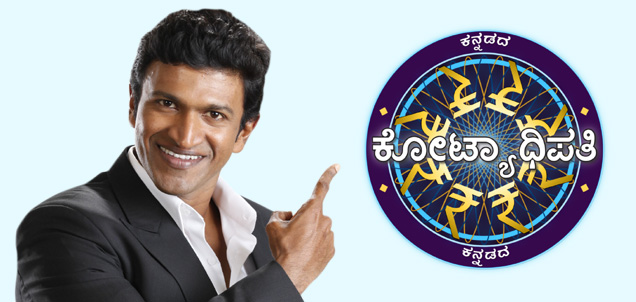
    Kannadada Kotyadhipati (KK), or Kaun Banega Crorepati (KBC) in Kannada, is all set to make its debut on Suvarna, the Star Network’s Kannada general entertainment channel. The show, which will debut in the end of February and will run from Monday to Thursday, is being touted as the biggest format show in Karnataka.


    For the channel, the show will play a pivotal role and people behind Suvarna are hoping that the numbers delivered would do the magic of upstaging the leader Udaya TV. Interestingly, what was unthinkable three years ago can be seen as achievable now, going by the way Suvarna is placed today.


    Anup Chandrashekaran

    As Anup Chandrashekaran, Business Head for Suvarna explained, “In an IMRB tracking, the perception that came about Suvarna was that we deliver fresh ideas and differentiated content and are seen as a young vibrant channel.”


    To reach this level has not been easy, it has taken a strategic shift in the channel’s programming to get newer audience into its fold. This was done by introducing format shows which, according to the channel, is nothing less than social experimentation because of the content of the shows.


    “Of late, only 60 per cent of our GRPs come from fiction. While the format shows ensure that we get newer audience to experience Suvarna, we flank these shows with good fiction that resonates with audience. Ours is a holistic family entertainment channel that includes fiction, non-fiction and movies, and shows what Kannada GEC stands for. We have a healthy mix in terms of SEC demarcation. We have reworked our fiction where we got young protagonists and stories that resonate with the Kannada audience. Our production value is of superior quality and there is a freshness to what appears on Suvarna. This change also shows in our numbers,” added Mr Chandrashekaran.


    Despite the fall in Kannada GE (KGE), Suvarna has grown by 5 per cent in Q4’11 and by 24 per cent in Q3′ 2011. Also Suvarna contributed 48 per cent of KGE’s growth in Q3’11. (TG :CS 4+, Karnataka market. Data updated till wk 53’11). Also Suvarna was the leading prime time channel inBangaloremarket and beat Udaya TV (CS 4+, Wk day19:00-24:00. Wk 41 – 53’2011).


    Even in weekday prime time in Karnataka market, the difference is of 50-60 GRPs and that’s where Suvarna hopes that Kannadada Kotyadhipati will play a major role.


    Considering that KBC has been a successful show in Hindi, especially in 2011, Suvarna is hoping the same magic will work in Kannada.

    The channel has roped in Kannada film star Puneet Rajkumar as the show’s host, and is aggressively marketing the show.

    Talking about the marketing plans, Anil Narang, Head-Marketing and Strategy, Suvarna said, “We have planned to reach out to Karnataka markets in 3 phases. The first is the audition phase and the communication is on how you can register for the show. The response has been better than what we expected and got representation from entire Karnataka. We also have a Facebook page to reach out to new audiences.”


    Mr Narang added, “In the second phase, we will be launching 100 hoardings across Karnataka to ensure visibility. We also have mobile vans that will cover 13 districts and will have a mock KBC set where people can play KBC with a host who will wear a Puneet Rajkumar mask. The third will be the sustenance phase, once the show gets on air, to maintain that the audience.”


    There will be also be print, cinema and TV advertising. The advertising revolves around the idea that ‘knowledge is the key quotient and with basic common knowledge one can win a crore’. The estimated budget could run into Rs10 crore.


    Suvarna is also planning to launch a historical soap along with KK.


  • Media frenzy over VK Singh’s age

    By Ranjona Banerji


    On Monday night, I really thought the world had come to an end, what with India’s army chief suing the government over his date of birth. At least, that’s what I understood from Times Now, Newsx and a random sampling of Hindi channels. NDTV had move on to Pakistan to look at their own crisis, with the military playing its usually stellar role of villain cum hero.


    But by Tuesday morning, oddly, India was no longer at the brink of some terrible crisis. Yes, the army chief’s problems were headlined everywhere and while newspapers found his court action unprecedented, they were not concerned that India was at some crossroads or the other. The issue is undoubtedly serious but TV likes to see everything as a catastrophe or a victory and this attitude can cloud real issues.


    From my point of view, the big story was the ASER report about the tragic state of rural education in India (I confess that column for Mid-Day tomorrow is about this). The report made to the front pages of most newspapers but the attitude of the Times of India, I found most intriguing. A single column on page 1 spent half the space talking about how this report wasn’t the biggest as it claimed to be – as if that was the main point of the exercise. One inside report was about a possible education ombudsman and the other about enrolment of girls being up. Compared to this meagre sampling, DNA, Indian Express, Hindustan Times focused on the revelation that class 5 students cannot even read class 2 textbooks.


    * * *


    The Times of India was the only paper (only?) to carry the story of the possibility of writer Salman Rushdie not attending the Jaipur Literary Fest because of security concerns raised by the government after some hardline Muslim groups objected to his presence. TV is all over this story now and judging from the latest “source” news, the government may well be changing its mind.


    The lack of commitment to freedom of speech and expression from our government agencies remains a worry. The attempts to muzzle Google and Facebook have also got plenty of newspaper space.


    * * *


    The Indian Express had its fifth Ramnath Goenka Awards for journalistic Excellence in Delhi on Monday. Vice-president Hamid Ansari said that “watchdog journalism” is “vibrant journalism”. He also pointed to the more pertinent problem – that the slow corporatisation of the media has led to falling standards. “The slow erosion of the institution of the editor in Indian media organisations is a reality. When media space and media products are treated solely in terms of revenue maximisation strategies, editors end up giving way to marketing departments.”


    The cat is out of the bag as far as the media is concerned and we need to address this issue more seriously than we have so far, no matter how many EMIs will suffer as a result.


    Press council chairman Markandey Katju couldn’t resist a little dig about the poor intellectual level of most media people but that still is the lesser problem. Ansari’s diagnosis is more apt.


    * * *


    One suspects that MS Dhoni must be thanking army chief VK Singh for taking him off headline news!

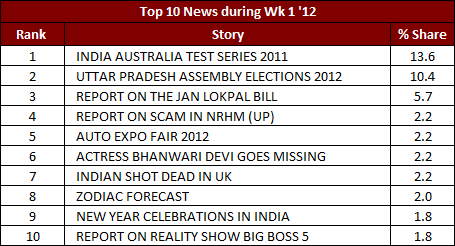
  • NCT Data Wk 1 ’12


    Source: News Content Track – A service of TAM Media Research Pvt. Ltd
    Channels: Aaj Tak, CNN IBN, Headlines Today, IBN 7, India TV, NDTV 24/7, NDTV India, Star News, Times Now, News 24 & Zee News
    Period: Wk 1 – Jan 1 to Jan 7, 2012
    Note : Analysis is based on the Telecast duration


    About TAM Media Research


    TAM is a joint venture between Nielsen Company & Kantar Media Research. Besides measuring TV Viewership, TAM also monitors Advertising Expenditure of Television, Print & Radio through its division AdEx India. Since 2004, it extended its presence in the PR Measurement & Analysis space for Corporate/Marketing Clients by setting up a separate division Eikona PR Measurement.


    In 2007, the joint venture introduced RAM (Radio Audio Measurement) service to track Radio Listenership for the Indian Radio Broadcast Industry. In year 2009, TAM launched a division, called TAM Sports that specializes in monitoring Sports Sponsorship ROI.


    TAM Media Research’s objective is to fuel media insights that will drive the growth of the Indian Media Industry.

  • Case Study: Justeat.in’s campaign to attract foodies

    By A Correspondent


    Campaign: Restaurant Rumble


    Client: JustEat.in


    Agency: Mutual PR


    Aims and Objectives: To provide the foodies in Delhi NCR a platform to pick the best restaurant


    The Background:

    JustEat.in is world’s largest online food ordering portal, which makes it easy for foodies to order food and book tables online. Also the fact that umpteen restaurants are coming up, which provides the customers with a wide variety, is a good development. However, the customers are now in a bother to pick the ones that are actually good. JustEat.in thereby provides a platform to the foodies to voice their opinion about the restaurants they like, and help fellow foodies separate the best from the rest.


    Strategic Insights:

    Justeat.in is an aggregator of the rather fragmented restaurant industry inIndia. Along with providing the users with a convenient, reliable network for ordering food and booking tables, Justeat.in strives to provide customers reviews and ratings, given by fellow customers, about various restaurants. In an attempt to provideDelhiwith an opportunity to rate and review their favourite restaurants, Justeat.in, in association with IFB, has launched Restaurant Rumble.


    Challenges and impediments:


    Initially the struggle was to incentivize the customers to vote.


    Solution:

    The customers were offered exclusive discounts at their favourite restaurants as incentives to vote.


    Result:

    There was an overwhelming response for the campaign with 1 lakh+ votes received so far.


    Learnings:

    We are extremely happy with the responses received till now. And we are looking at  making this campaign an annual one henceforth.

  • Get set for the funny stuff with ‘Comedy Central’


    By A Correspondent


    Viacom18 has announced the launch of its sixth channel, ‘Comedy Central’, a 24×7 channel dedicated to English language comedy content, which will go on air from January 23. The channel is said to have a mix of all genres within comedy ranging from sitcoms to sketch comedy, British comedy, Stand-Up and Gags, among others.


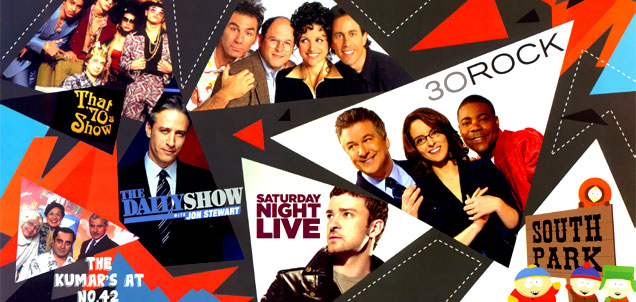
    Comedy Central will air mainly international content with English sub-titles. Some of the popular shows to be aired on the channel are Saturday Night Live, The Office, Seinfeld, The Wonder Years, That 70s Show, The Daily Show with Jon Stewart and SouthPark, to name a few.


    According to Mr Ferzad Palia, Sr. Vice President and General Manager, English Entertainment, Viacom18 Media Pvt. Ltd, although there could be fragmentation in English language channels, the viewership has gone up, so has the time spent viewing English language channels and the reach. He also said that English channels are one of the most under-served genres however there is still a huge scope. “There has been growth in English literacy and in the next four or five years, English language literacy is expected to grow manifold. We also observed that Indians are increasingly able to laugh at themselves, at least a little more than what we used to. There are a number of factors to launch ‘Comedy Central, this are just one of them, thus we feel this is the right time for the launch.”


    He further said: “The format of the channel is the best of comedy. We are picking up the best content from across the world. We have different programmes for different audience in different time-bands. It is a combination of content for the mature audience and for the youth. We have significant and equal doses for both. In addition to these we are premiering about 7 or 8 shows on weekends.”


    ‘Comedy Central’ aims to reach atleast 20 million households across the country at its launch and will be available across analog, digital cable and DTH. While the channel will initially start off with Airtel DTH and Dish TV, it aims to be available across all DTH platforms within the next 60 days. The channel has hired BBH as its Creative Agency while Vizeum is the Media Agency.


    Since 80 per cent of English viewers are said to be from the metros, the content will be largely metro-centric. Even on the distribution front, the channel will be targeting the key metros, namely Hyderabad, Pune, Ahmedabad, Mumbai,Delhi, Bengaluru and Kolkata.


    The business model that ‘Comedy Central’ aims to follow is primarily advertising-led followed by subscription, but besides this, the channel also plans to reach out to the audience through web, mobile and merchandising, among others. The channel plans to create special packages and interaction mechanisms, relevant not just to a particular brand but even the show, for advertisers.


    In a prepared statement, Bob Bakish, President and CEO – Viacom International Media Networks said: “Comedy Central is one of Viacom’s most distinct and successful franchises globally. We feel that the time is now right for Viacom18 to introduce Comedy Central in India, given the growth curve of the Indian television entertainment market.”


    Mr Haresh Chawla, Group CEO-Viacom18 said: “With the launch of Comedy Central, Viacom18 now marks its presence in another under-served genre – English comedy. We are confident of Comedy Central establishing itself as one of the dominant players in the English entertainment space in Indian television.”


    The marketing campaign will be unveiled only after ‘Comedy Central’ has been officially launched. But the channel plans innovations across television, print, outdoor, radio, below-the-line and digital. The marketing plan is also said to involve strategic partnerships with lifestyle touch points like coffee chains, theatres, clubs, gyms, salons, shopping destinations and other hangouts.


    The tagline of ‘Comedy Central’ will be ‘Laugh it Off’. It will target audiences in the age bracket of 15 years and above. Since late 2006, ‘Comedy Central’ has expanded globally with localized channels in Poland, Germany, Netherlands, Italy, Hungary, Sweden, Ireland, United Kingdom, New Zealand, Israel and Spain.


  • NDTV Good Times’ tie-up with Geo TV for Foodistan

    By Akash Raha


    NDTV Good Times, which is all set to host the mega food reality show Foodistan, has tied up with Geo TV to telecast the show in Pakistan. Atul Seth, Vice President - Development, NDTV Lifestyle Limited disclosed this news to MxM India.


    When asked why NDTV Good Times chose to partner with Geo, Mr Seth said: “It is the largest network in Pakistan and the most respected. It has been a beautiful relationship with them so far and we have been in constant touch with the group, and the response from their end has been very good. We would ideally like to do a simul-cast in both the countries, but the timings are not certain as they might clash with some religious ceremony.”


    The show will be launched in Pakistan soon. According to Mr Seth, Geo TV is keen to broadcast and partner with NDTV Group, not just one season, but for seasons that will follow.


    When asked for further details on the deal, Mr Seth clarified: “Right now it’s only about them showcasing our content, but eventually we probably will look at a situation where both partners will co-produce the show. It is still too early to announce as the talk are in nascent stages, but perhaps that is the way forward.”


    The reality show will premiere in India on January 23 on NDTV Good Times. The show will feature 16 chefs from India and Pakistan in a battle of culinary supremacy. At the end of it all, the reality show will have one winner.


    The 26 part series would be judged by eminent food critic, avid traveler and gourmand at heart Vir Sanghvi along with Bollywood actress Sonya Jehan and Merrilees Parker (popular British Chef and presenter). The tri-weekly show will be hosted by Aly Khan and Ira Dubey.


    Announcing the new series, Smeeta Chakrabarti, CEO, NDTV Lifestyle said: “We are absolutely thrilled to announce Foodistan, the biggest food show on the Indian television. Food, as a genre, is in the DNA of NDTV Good Times and we are committed to taking that to the next level with Foodistan. India and Pakistan are two nations who share a common passion for good food. And this love for food is something that binds the two nations, in spite of the numerous differences, which is why Foodistan will appeal to our viewers. We are positive that our viewers will not only enjoy the show but will also connect to it.”