Hungama Digital Services Pvt Ltd has bagged the digital media AoR duties for Timex India and its youth brand, Helix. Timex Group, one of the world’s largest watch makers that designs, manufactures and markets innovative timepieces and jewelry globally, named Hungama Digital Services as the exclusive agency working on their digital platforms, both web and mobile. The agency will manage social media for both the brands, media buying as well applications.
Talking about this, VD Wadhwa, Managing Director & CEO, Timex India, said:Â “The digital medium is fast evolving and presents tremendous opportunity for brands to mark their presence. Given that the measurability of this domain is quantifiable, we at Timex are extremely focused on strengthening our brand presence on this very dynamic platform. We have strategic plans to increase our presence through the launch of brand Webstores, social media pages and impactful search and display campaigns. We chose to partner with Hungama as it is the leader in providing effective digital campaigns to brands across markets and categories. I am very confident of this partnership, as it will act as a catalyst in our journey to become the most influential brand in the digital space.”
Speaking on the winning the account, Neeraj Roy, Managing Director & CEO, Hungama Digital Services said: “We are excited with the win and look forward to a relationship with the Timex Group. With an experienced and award winning team here, we aim to leverage this opportunity for Timex, towards a widespread exposure and an increased engagement in the digital space. Today, India is at the cusp of digital revolution with the advent of 500+ million consumers getting online in the next 3-4 years. We hope to offer integrated digital and experiential services to clients and prepare brands to connect, interact and transact with their customers.”
JWT Singapore recently acquired a 51 per cent stake in Hungama Digital Services Pvt.
Twenty years ago, Gods and mythology, not Aamir Khan, ruled the Indian television sets. In the late 1980s, streets would empty out on Sunday mornings as people sat glued to their TV sets to watch Ramayan and Mahabharat.
Now Zee TV, which is re-entering the slot with a mythological show – Ramayan, hopes to create the same magic. “Ramayan is more than mythology; it is the ultimate story about our culture and family values and relationships. We all grew up on it, and we want the current generation to know about it. We wanted to tell the story, which left an impact on us, all over again…” said Sukesh Motwani, head – fiction programming, Zee TV.
The channel has chosen the 11am slot because it feels that the story needs to be watched together as a family, and what could be more perfect that a Sunday morning. It is happy that the slot is being relived again as various networks are launching shows on the same slot. “For the last few years, no one paid attention to the Sunday morning slot, but now things are changing. However, we do believe that the content is the main criteria which will make the show on that slot a hit or not,” said Mr Motwani.
The channel also believes that times have changed and TV penetration and numbers have increased over decades but the whole Sunday morning experience can be brought back with a story as simple and universal as Ramayan.
Sukesh Motwani
Apart from the story, one more thing common between the original and the new Ramayana is the Sagars. Zee TV has taken on-board Sagar Pictures. MxMIndia spoke to Amrit Sagar, who along with Moti Sagar and Meenakshi Sagar, is set to recreate the classic…
Many networks have showcased new avatars of Ramayan and Mahabharat, but failed to get the same response as the originals. So, how is this going to be any different?
We must keep in mind that the stories for such epics cannot be changed. One has to tell the same story; however, the way it is told can vary from person to person and how lavishly the show is made. From that aspect, we have tried to make it bigger and better than anything seen before. Having said that, we have made sure that the story isn’t compromises with, so, have followed my grandfather’s and Tulsidas’ original.
Audiences and mindsets have changed, so how will you make the show relevant for today’s generation?
We are very much aware of this fact. Therefore, we plan to charm the audiences with the visual effects and sets.
Will we see any new faces on the show? How did you choose the actors to play the characters, especially that of Ram and Sita?
There will be new faces on the show and the ones which people have seen on television earlier are the ones who have never played such characters before. So, it is going to be a different experience for everyone. Also, an image of the god is very individualistic. The actors we have chosen to play Ram and Sita are the ones we thought suited the bill from our view point. We are keeping our fingers crossed… rest depends on audiences and how they welcome and perceive the characters.
There are rumors of clashes because of current failure during the time of the telecast. Do you see that happening today?
It’s difficult to predict that, but I hope we are also able to create the same passion and effect.
Do you think Sunday morning slot will interest youngsters?
Apart from the metros, I think Sunday is like any other day for the rest of the country wherein the day starts early. Also, it is about the family spending some quality time together. Therefore, I don’t think we will face any problem in attracting the audiences – old or young. I’m sure the show will be enjoyed by a whole family together.
What kind of response are you expecting since the show will be aired simultaneously on Zee and DD?
Of course, we are hoping to see a great response from the audiences as the reach will massive. We want to create the same magic again. However, I also know that it will be very difficult to fit into my grandfather’s shoes.
As India gets ready to celebrate her 66th Independence Day, one wonders how much freedom one really has to express oneself – specifically those who are in the creative business. While one has to be responsible when communicating with the masses – be it journalists, or planners for content that is shown on the various channels or the creative agencies that work on various communication strategies for different brands – but there are deterrents to this key element of freedom that the fraternity craves for to express freely.
Keeping these factors in mind, MxMIndia spoke to cross-section of people from the industry to get an understanding on their Freedom Fundas.
Bobby Pawar
Bobby Pawar, Chief Creative Officer and Managing Partner at JWT India is clear that there is no unfettered creativity that exists and that is probably best for a creative agency. He explained: “Our job is to come up with brilliant communication solutions for our clients, hence there is a purpose to achieve. So what we follow is creativity within a box where it is harnessed to achieve maximum result. We partner with various people to come up with this solution and hence we have to listen to various opinions. I do not profess complete freedom for the creative industry.”
However, Mr Pawar would like to have more control over the shape that an idea finally takes and how it gets executed. Also he definitely would like to have more control over the research that is handed to them and definitely over the way an allocated budget on a brand is being invested.
Research seems to be the bane of the creative frat. Rahul Sengupta, NCD at TBWA India too would want freedom from research. He feels that if one wants to do anything that’s trendsetting, often research acts as an impediment to take it forward. As for clients’ demands, Mr Sengupta said: “The client is the one sponsoring the idea, so definitely one would not want freedom from them! I have met clients who are hazards to creativity as well as those who are best guardians of an idea.”
He added pragmatically: “Of course, there are frustrations and there is lack of freedom but if I would rather have freedom from research than clients as latter can be worked amicably to enhance the client-agency relationship.”
We also spoke to people at mid level like Auro Chattopadhyay, who quit Ogilvy recently, who also wanted freedom from research. He said: “Often research might not help in the brand story, but insistence to stick to it hinders creativity.”
A creative hand at JWT pointed that conflict happen when there is no match with one’s creativity and that of one’s higher up. Fortunately, this has never happened with him. He feels that the creative industry gives him much freedom to use his ideas as opposed to many other professions.
However, another stated that hierarchy means towing the line of ideas that the higher in authority believe in. Freedom of creativity in such cases often refers to agreeing to somebody else’s vision.
The case, however, is different in the new medium such as digital where there is largely freedom to execute an idea. Carlton D’Silva, CCO, Hungama Digital, said: “Right now, digital is like the last three slide of a presentation- very much an afterthought. Hence, spend on the medium is miniscule. There is a fair amount of freedom to explore creativity. However, one would like freedom from data as often clients demand for it but in digital especially, when suggesting some new technology and a unique idea to take shape, there is no data available.”
Prosenjit Datta Courtesy BusinessWorld
We also spoke to people from the print and broadcast industry to give us an understanding of freedom they enjoy at work. Cyrus Oshidar, Creative Director at Bawa Broadcasting is credited with creating some unique content at MTV and even pushing the boundaries. His view: “If one only wants creative freedom then one should be an artist. If you are producing or making a show for which a client is paying, then there will definitely be some constraints. Ratings do matter in our business and sometimes might even alter one’s choice rather than giving the freedom to do something which one really wants to. Also, one needs to be politically correct in this country. Even the government which is supposed to protect people’s freedom sometimes backtracks from its duties. One needs to be careful about how they approach an issue without offending or hurting feeling of any section of the society. Honestly speaking, we have too many restrictions which are created by us. There is no true democracy in this country.” Mr Oshidar clearly pointed that freedom in creative business is a myth.
Sucheta Dalal
Prosenjit Datta, Editor, Businessworld, giving his take on the print industry, said: “Every magazine or a newspaper has a certain set of audience and purpose. For instance, a business magazine like ours won’t focus so much on political stories as political or general magazine would do. So, what stories they choose and how they analyse will be different from genre to genre. Hence, it would be unfair to say that there isn’t creative freedom or if media is ‘restricted’. We don’t have any management policy which will hamper or obstruct our editorial approach. A lot depends on the editors too as they enjoy full freedom to how to go about an issue.”
Pointing out the restriction that comes with the economics of business, Sucheta Dalal, senior journalist, commentator and consulting editor, Moneylife said: “With so many newspapers, magazines and news channels making losses, it is hard to say or believe that they are not dictated by marketers. Today, we can even see head of various companies writing with their bylines which wasn’t the case earlier. I don’t know how things are right now as I’m not working with any newspaper at the moment, but when I was with Times and Express, the pressure from the advertisers was quite evident.”
Sunil Lulla
And how is it in television? Said Sunil Lulla, CEO and MD, Times Global Broadcasting: “Over the past decade or so, the television industry has evolved. There is greater sense of self-regulation and discipline as well as maturity on entertainment and news channels. Though there are guides and policies set by regulatory bodies like IBF, industry enjoys the freedom to operate freely. Besides, there is greater acceptance of TV now which enjoys sense of confidence and responsibility. So, there is culture of freedom in media.”
Sudhir Sharma
Said Sudhir Sharma, Producer, Sunshine Productions: “TV as a medium is for the masses and targets everyone from kids to adults to old folks. We make TV shows to entertain. We do follow certain guidelines and censorship which is surely a necessity. By and large we surely have the freedom to make the content we want to show. Creative freedom parameters may vary from producer to producer. Compared to films, TV censorship guidelines are surely stricter keeping in mind that television is accessible on the press of a remote button. In my opinion, we have enough creative freedom and we as makers are progressing and so are the maturity level of audiences.”
Freedom, limited freedom, no freedom… we received no clear answers to our question. However, the fact remains that despite the current slowdown, the fraternity is still managing to survive and thrive in the prevailing system.
Since she was indecisive about her career of choice, Malik opted for Psychology Honours from Delhi University as it was not only a subject of her interest, but would have also helped in any field that she chose later. Fascinated by the ad world, she opted for a diploma course in Advertising and PR and in 1995 entered the world of advertising with little knowledge of media. Her journey began in the industry with four months of training at Lintas Media.
From then on, Hema Malik has spent over 16 years in the industry, and most of these years are with her current agency, Lodestar UM. She manages both media panning /buying, content integrations for clients like TTL, Coke, MasterCard, Whirlpool, HCL, Metlife, etc. She did do a brief detour to TME to handle their Airtel planning business but she was called back by UM.
Recounting her highpoint, Malik said that it came with her client Tata Docomo. It was for this brand that they truly managed to own a unique mindspace among the youth which is not just a target segment but 2/3rd of nation’s population. “We truly imbibed the brand essence of ‘Do the New’ in media and there was nothing USUAL, nothing common and nothing expected in the media launch. We changed the rules of the game from defining the role of each medium to the way they were consumed. The brand was a success with highest new subscriber gain, creating a community of Docomites! And we guys had awards and lots of fun,” she reminisces.
Another highpoint for Hema Malik was Coke Studio. Says Malik: “I was proud to be a member of the team launching this music platform in India. One of the biggest learning opportunities for me driving not just media partnership but also content partnership, consumer engagement initiatives, etc. Excitedly look forward to the next season.”
Apart from a professional stint, Malik is also a trained painter. She finds anything from a blank sheet of paper to a plain wall very stimulating. Hema Malik is happily married and is mother to two kids.
Aditi Mishra has been in the industry for over 16 years, pursuing creation and execution of client-centred communication solutions. Her experience spans across a range of categories like technology, lifestyle, auto and consumer goods.
Working with both Indian as well as multinational clients has enabled Aditi to develop an easy and expert handling of the global client needs while delivering locally relevant solutions on ground. With a passion for crafting innovative solutions to client issues, she has driven the team to win awards at various advertising forum for clients like Coke, Microsoft, Madura Garments and others.
A key member of the Lodestar Universal team, Aditi’s role is to drive the strategic content across offices, ensuring superior communication solution delivery for clients.
Answering MxM’s query as to why she opted for media planning and buying, Aditi said: “I stumbled into it during my management course during my summer training at Gillette where we had to evaluate the role that media played in their mix. Those were the initial years when TV was gaining ground – with new channels being launched and DD started its metro channel. Post training, I was hooked- and it’s only become more complex and challenging ever since!”
We are back with the fourth edition of MxMIndia’s media quiz that happens every Friday. Our quizmaster is Sorbojeet Chatterjee, Vice President – Marketing at Neo Sports. To enter this quiz, simply email the answers with your personal details (Name, email id and telephone number) and a five-word descriptor for Cannes Lions at editor@mxmindia.com with Buzzer#4 in the subject. Standard contest rules apply (see box below).
There will be 3 prizes for Buzzer #4. First Prize: Rs 1001, and 2 Second Prizes of Rs 250.
If there’s a tie, the best descriptor for Cannes Lions will get the prize (note: tie-breaker question will change every week). Last date for sending entries: Thursday, August 16.
 Suhel Seth, Kumar Mangalam Birla, Vir Sanghvi and Jeetendra were shareholders in this news channel for a brief period. Which channel?
 On which news channel would you find the popular weekend programmes – Total Recall and The Foodie?
 A chartered accountant by profession, he is also the brother-in-law of CPI (M) leader Brinda Karat. Identify the icon?
 This gentleman is a former Director General of Doordarshan. Identify his famous daughter?
 BAG films is owned by Anurradha Prasad and Rajiv Shukla and they operate the news channel News 24. What does the acronym BAG stand for?
 Which news channel was launched with the tagline ‘Sharp News for Sharp People’?
 The launch episode of Satyamev Jayate on female foeticide featured 2 journalists narrating their experience of doing a sting operation on doctors in Jaipur. Which news channel had done this sting operation?
 With which newspaper did NDTV tie up to launch an English language local news channel?
 Chelsea Clinton, daughter of Bill and Hillary Clinton, recently joined a news network as a correspondent. Which network?
 Identify the news reporter interviewing General Cariappa on Doordarshan? Today she is interviewed on a daily basis on English news channels?
Winner of Buzzer # 3 is Ms Ritika Misra (Tel No xxxxx 57×63) who works with DDB Mudra Max. Ms Misra wins a Prize of Rs 1001 (yes, for the second consective week!). The second prize winner is Ms Natasha Dhingra of Aidem (xxxxx 96×29) who wins the Second Prize of Rs 501. Congratulations, Ms Misra and Ms Dhingra. Please await our mail, send us your coordinates and we will wire/ courier/ deposit the prize… asap!
Answers to Buzzer # 3
1. Facebook, 2. Orkut, 3. The Accidental Billionaires, 4. CNN, 5. Zynga (Named after Mark Pincus’ pet bulldog Zinga), 6. Tumblr, 7. First video uploaded on YouTube, 8. Facebook Revolution, 9. Shorty Awards, 10. Twitter
1. The families and employees of MxMIndia Private Limited and its associates are not eligible to win prizes. 2. You can send as many entries as you would like. There is no entry fee. 3. In case of more than one all-correct entry, the Tie-Breaker will be the decider. 4. The decision of the Quizmaster and/or the MxMIndia editor will be final. 5. If the winner is not reachable by phone/email, the next best entry will be awarded the prize.
6. By sending your entry, it is assumed that you are in agreement with the rules.
7. Last Date for sending entries for Buzzer # 4 is August 16, 2012.
As the Managing Director, South Asia of one of the fastest growing agencies in India, Shubha George has been responsible for steering MEC to great heights over the past few years. Her passion and decision-making skills have earned her laurels from clients and colleagues alike. In fact she has been giving a tough run for Group M India’s other big agencies who are compelled to perform better and stay ahead in the race to the top. It is her dedication to her work and family that makes her a diva in a true sense.
In conversation with MxM India’s Ritu Midha, Shubha George takes time out to explain her dedication to her profession, how women professionals of today stack up against their male contemporaries and what is it that makes the women TG a hit with the marketers.
Do you agree that men are from Mars and women from Venus?
If you are having trouble in viewing this video, see link
It is true in some cases – not always. If I look at the way in which men and women approach certain things or in their areas of interest, in some cases it is true. But not the way it is made out to be.
To what extent do the preferences and priorities of the two genders differ?
In India in advertising, as that is the sector I am familiar with – there is not too much difference in the way men and women approach corporate world or deal with business etc. I am told that it is more of an exception than the rule, and other industries are somewhat different.
From a consumer and purchase behavior point of view, yes, there are some differences intrinsically in how men and women shop and that does make a difference in how you would communicate to them. Men are easier shoppers than women – who are far more involved and inquisitive. You would rarely find a woman who walks into a store, heads to the isle from where she wants to buy things and heads out. She definitely explores more, and shows interest in things that she did not necessarily plan to buy. Men generally tend to be point A to point B shoppers – so they know what they want, and pick up what they want, and are out of there.
The woman of today, especially from metros and big cities has evolved rapidly and is seen as a key decision maker. What would you attribute this change to?
Women are involved in a lot more stronger way in decision-making processes. But what I find increasingly surprising – and I was also of the view that more and more women are involved in decision making but research that we have done for brands shows that men – even if you look at household products, which are your regular household shopping baskets, in 50% of the households decision is made by the head of the household, which is typically a man. He even makes decisions on things like what soap, paste and oil to buy. So, if you look at a larger set of households, and not only very upmarket and affluent households, role of man is very high. Difference perhaps is that influence of women in purchase decision making is definitely increasing. Reasons for same are greater exposure, more availability of communication tools, higher education levels – even if you go towards the lower end of pop strata of society. They have a point of view and that is communicated even if they are not the people in the last mile – actually going out and closing shopping, but they do influence what goes into that basket. However, there is some distance to go – even as compared to other Asian countries, when it comes to what role women should play.
What, in your view, is the key to reaching the upmarket women in the most effective way?
One of the mistakes we make in the media business is that we assume that women are watching a lot of TV – which is true when it comes to majority of India – but when you get into more SEC A1++ women, the amount of television they watch is relatively lower as compared to the mass based women. The difference is that when we look at planning for premium audiences among men we are very very conscious that they do not watch too much television, and how else and what else should we communicate. But same degree of attention to amount of television they watch is probably not there. So I would say that yes they watch television, but they watch very less of it and they are very selective about what they watch. There are some typical programmes that they follow but it is not that they would have some free time and they would be surfing television. Role of digital media is definitely increasing. Most of them have access to Internet, whether it is on their cellphone, or at home – and they are rather avid consumers of digital media.
Newspapers, especially supplements continue to be read. I am a bit of doubter on the role of magazines – data too shows that it is declining. Apart from that, in consumer groups that we do, and people we meet, instances of reading magazines is very very low.
As for women professionals in media, would you say they have some inherent characteristics that make them excel in the business?
A couple of them, yes. Women have a greater degree of attention to detail – which I think is very important in media business because all said and done, we still deal with a lot of numbers and spreadsheets – and it requires attention to detail. But that is at an operational and executional level. In general, and it is not only true of media, women multitask a lot more. So even when their working world is a little chaotic, they manage with multiple elements of pressure points which are there within that. Women, by and large, tend to be a little more patient – that also helps in an environment like media where there are a lot of pressures. Maybe because, as we know Roda Mehta for example, was one of the earliest successes in the industry, and also from the time the media industry was evolving, a number of women leaders were there. Probably it was very aspirational for other women who were coming in – and also comforting that you already had women leadership.
Finally, how would you define your journey in the media industry so far?
Well I am still here – so I guess it has been good. I really enjoyed whatever I have done till date. I primarily worked with one organization. And yet within that I have been fortunate to have very varied set of experiences. And it is really the strength of Group M that it does offer you opportunities to grow and evolve. I have taken advantage of opportunities that came my way – and it has been fantastic. I would recommend that this industry and particularly the company I work for is a great place for women.
Big Bazaar is the pioneer of organized retailing in India and has been successful in creating many new consumption occasions, which offer unbeatable value to the Indian middle class. One of such landmark properties is Mahabachat, which has been designed to spur consumption around the Independence Day holiday.
This year the challenge was to instill confidence into the property promise of big savings at a time when persistent inflation was dampening consumer spending.
The consumer reality revealed that they harbored a sense of helplessness towards inflation, with no solution in sight. Over the years, the effect of inflation had moved beyond the kitchen to oil prices, fashion, education and entertainment, leading to an increase in the cost of living. At the same time consumer aspirations were also on the rise, resulting in an overall state of dissatisfaction.
As a solution to the current consumer angst, they empowered their consumers with a concrete solution of Mahabachat. The resolve of victory on inflation by participating in Mahabachat was brought alive through the optimistic call to action- mehengai par halla bol. The TVC worked to build an atmosphere of collective hope and confidence. The campaign was supported by TV, print, radio, outdoor and digital medium.
Chief Creative Officer: Sonal Dabral
Office Head: Rajiv Sabnis
Creative Head: Vinayak Nayak, Anand Karir
Creative Copy: Neh Rathi, Anand Karir and Fazal Syed
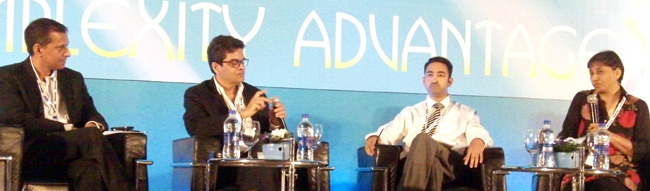
L to R: Jehil Thakkar (KPMG), DD Purkayastha (ABP), Ravi Dhariwal (BCCL, INMA) and Santosh Desai (Future Brands)
By A Correspondent
The second day of the International Newspapers Marketers Association (INMA) South Asia 2012 conference in Delhi threw light on the complexities and challenges of the print newspaper media. The first session of the day was ‘Media 2020: A future backward kaleidoscope’. The session focussed on how the newspaper industry is readying itself to face the challenge from digital media usage.
Mr Jehil Thakkar, Partner, Head-Media & Entertainment, KPMG India made some interesting observations about the levers that are changing the Indian newspaper industry. He pointed out how empirical studies prove that there exists a positive relationship between the wealth of a nation and newspaper readership: “There also exists positive correlation between growth of economies and technology adoption, which has significant potential to disrupt media consumption.”
“The rapid proliferation of new-age devices and growth of alternate media has reduced newspaper consumption by 40 per cent with audiences preferring to access paper via their mobile phones,” added Mr Thakkar. According to him, technology would alter the workings of newspaper industry as coverage would become electronic, delivery would become faster; collaboration would become the key; cloud-based service would become a norm; interactivity through QR and barcodes would see an upsurge.
DD Purkayastha
If you are having trouble in viewing this video, see link
Talking of how things will shape up in 2020, DD Purkayastha, MD & CEO, ABP Pvt Ltd said that the future belongs to newspapers who become hyperlocal as cities reach the saturation point. He said: “Regional publications will grow. And consolidation will happen at a much faster pace.”
Mr Ravi Dhariwal, President, INMA Worldwide and CEO, The Times of India, noted how newspaper of 2020 will undergo a dramatic change. He noted: “Three critical things will emerge in 2020: what brand you own will become important as there will be many more brands on the digital media; curation of the product will become more important as the role of a journalist will shrink and need for analytical news pieces will arise; and business model will change as ad revenue will become a critical source of revenue. As technology improves, and people get more comfortable with using technology, the ad rates would only increase.”
Mr Santosh Desai, MD & CEO, Future Brands India, remarked: “The larger issue that would emerge would be the tension between decentralisation of news media and fragmentation.” The panel, however, coherently agreed that despite the changes and challenges that the newspaper would undergo, it would still exist with the digital media.
The session on ‘Increased circulation; dwindling readership: Is it time to measure ‘access’?’ saw panellists discuss the much-debated measurement metrics available. ‘Newspaper distribution channel: How best to nurture it for the future’ and threw light on the vendors and agents who distribute the newspapers. Moderating the session, Mr Sanjeev Vohra, Executive Vice-President – Audiences, BCCL, said: “The vendor currently exists as an independent businessman and as an investor in newspaper business.” His view was supported by Mr PS Venkat, Vice-President, Circulation, The Hindu, who said that changes are needed in distribution model to enable the vendors to become partners in progress.
Mateen Khan
If you are having trouble in viewing this video, see link
Mr Mateen Khan, Product Head of Lokmat Samachar pointed out how the distribution channel in rural areas is still a problem, while it may not seem so in a metro. Taking the discussion ahead, Mr Rakesh Sharma, CEO, Aaj Samaj & ITV Group said: “There should be distribution points every three kilometres, and more distribution points.” He, however, noted that the vendors will remain the key to distribute newspapers in India beyond 2020. Mr OP Rajgharia, Chairman & MD, Overnite Express Ltd appreciated the effort put in by newspaper vendors to ensure the timeliness of delivery.
‘Needed to be sector-neutral’
If you are having trouble in viewing this video, see link
Bhaskar Das, President & Principal Secretary to MD, The Times of India Group, talks to MxMIndia on curating the INMAÂ South Asia 2012 conference
When I was talking to the organisers, and was given the task of preparing the content architecture of INMA, I told them very clearly that it is not about newspaper industry -it is about business. So, we have to be sector-neutral since principles of business are same. Newspaper is a sub-set of business. This was the first consideration.
Secondly, in my case, the delegates were my guiding point. Why should people attend the conference? Are we going to be just another conference? How do I make it distinctive?
The distinctiveness of the conference is that it creates fluid knowledge; knowledge that one can import when they go back. So, I had to ensure that they learn from each session. That led to the subject. In most of the conferences, people state the obvious. I thought why we don’t address the fact that there are complexities, there are challenges. Being an incumbent player, I realised that if we talk about problems, it is not solved. We should then talk about how we can leverage that problem or challenge. This led me to look for various industries. I scouted the internet, books, academic journals, about what happens when an industry goes through huge challenges, air pockets. There are initial signs of a problem, which I came to know of while researching, such as ‘butterfly effect’ that led to complexity science. This became the theme. The theme has to be intriguing to people rather than being a newspaper conference. The theme was then decided as ‘complexity advantage’. Now that complexity is a given, why not leverage it.
On the audience mix:
This time it has been a record attendance. I am not very happy but you to also have to market it that way. If one can maintain this level of content architecture, attendance will grow. For an event that happens once a year, I will have to sustain noise throughout the year. The community needs to talk about it, so that you can have user-generated content architecture next time. Then, there are regional peculiarities that may not be only one; there are eastern and western peculiarities.
We also have to be industry- or sector-neutral in our audience mix. Why should they be from newspaper industry? Why not from television industry or from client side to discuss business? When people know what you are delivering, I am sure diversity will happen in the audience.
The session was followed by speakers from Pakistan and Bangladesh who spoke on ‘Managing complexity in South-Asian markets – A Pakistan and Bangladesh Experience.’ The session saw interesting insights about newspaper industry in the two neighbouring countries.
Industries across the globe are increasingly learning from other industries to improve their operating efficiencies and innovation capabilities across various spectrum of businesses. ‘Media learning from other industries’ saw three specialists from sectors such as retail, telecom and finance discuss the wisdom that newspaper industry could imbibe, given the onslaught of digital media. The panel discussed how the evolution could gain from the exploration of the new path.
Mr Jaideep Ghosh, Partner, Management Consulting, KPMG pointed out that print media continues to remain the second largest medium in the Indian media and entertainment industry. He also pointed out the key challenges of talent, operational cost, monetizing digital media and fragmentation that the industry faces currently. He said: “Media can leverage data analytics to strengthen the understanding of its customers and build brand loyalty, much like the way telecom, retail and finance sector have done.”
Drawing from the e-retail experience, Mr Rajiv Prakash, ex-CEO, FutureBazaar.com, said, “The audience is increasingly turning Clomosol, which is an aggregation of Cloud+Mobile+Social+Local. Thus, the digital consumer is a channel omnivore, and should be serviced at every touch-point.”
Mr Jairam Sridharan, Head, Retail Banking, Axis Bank said that the newspaper organisations should focus on getting their product on mobile, rather than internet as, “the consumer is leapfrogging the internet and becoming increasingly mobile-savvy.”
The closing session of the two-day INMA conference saw Prof Rishikesha T Krishnan., Chairperson, Corporate Strategy and Policy Area, IIM Bangalore talking about sustainable and thriving media business model that can successfully withstand the vicissitudes of business environment.
He said, “The internet tends to dampen bargaining power of newspaper channels by providing direct avenues of access to customers. But the other hand, it will help the industry to create new substitutes, and new geographical markets will emerge.” He further noted, “The internet has and would result in targeted advertisements, disappearing role of editor as decision maker; fall in advertising revenues and young people moving away from printed newspaper.” The key decision variables, according to him, were how to embrace internet, and change strategy. Giving the example of Schibsted, Norway, he said that the paper now brings readers to its webpage through the front page and even Google was denied the permission to crawl its pages. “This helped them to monetise the banner ad on its front page,” Mr Krishnan said, adding, “Huffington Post has enaged in user-generated content, and its ad revenues are growing. Axel Springer/Bild has extended its brand to other media.”
As Indian newspaper industry struggles with low cover price, growth of paid news, entry of non-traditional players, investment to establish presence in non-metros, the panel at INMA South Asia conference tried to address issues as closely as possible. Whether the industry would learn, and implement the learning remains to be seen.
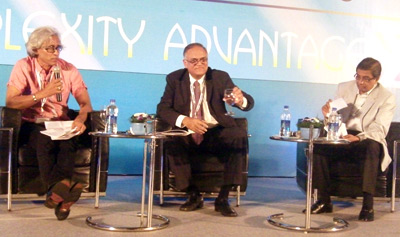
Keeping in line with the theme of the 6th annual INMA South Asia conference, ‘Complexity Advantage’, one of the sessions focused on the complex media markets inSouth Asia.
Titled, ‘Managing Complexity In South Asian Markets: A Sri Lanka, Pakistan and Bangladesh Experience’, the session was moderated by Mr Bhaskar Das, President & Principal Secretary to MD, The Times of India Group. Representing Bangladesh and Pakistan respectively, were panelists, Matiur Rahman, Editor & Publisher, The Daily Prothom Alo, Bangladesh and Mr Javed Jabbar, Chairman & Chief Executive, JJ Media (Pvt.) Ltd and former Federal Minister,Pakistan.
Mr Rahman started the discussion by sharing the complexities and challenges facing media market in Bangladesh: “Media industry can best thrive in a democracy but democracy in Bangladesh in only 22 years old. The dominant political parties are poles apart and can’t even come to a consensus on major national issues. People in the media are threatened, tortured and even murdered. Political interference is a huge challenge and yet there are some resilient media houses playing an important role.”
He added that another challenge is to keep the press free from its owners because many media houses are now being owned by corrupt business owners. Speaking of evolving technology, Mr Rahman said: “Earlier our competitors were only newspapers, but now all electronic media are competing with us. With mobile and digital growing at a fast pace, product offerings have to be modified to suit the needs of both consumers and advertisers.”
Speaking of complexities and challenges facing the Pakistan market, Mr Jabbar said that both India and Pakistan, two nations who have the single most complex bilateral relations, suffer from a lack of awareness about each other. He said: “Countries are societies and nations before they are markets. News media have played a pivotal role in determining a lack of awareness among these two nations. All media are inherently subjective, selective and suppressive.” Furthermore, he said that the question in Pakistani people’s minds today is whether media content eventually makes a difference in governance or violence. Does media content really change things?
As for advertisers, he said: “They are aggressive intruders voracious for media space. Editors and proprietors of newspapers are willing to debase to any level and they are even allowing advertisers to sponsor verses of the Holy Quran. In Pakistan, advertisers in collusion with news media have encroached on space that belongs purely to news content. But at the same time, advertisers are beginning to invest in research which was long overdue.”
Talking of technology and the onset of digital, Mr Jabbar said: “New technology is ubiquitous and pervasive. Media landscape in Pakistan is thriving, especially in terms of IT connectivity and television channels. However changes that are taking place in India in terms of mobile and devices are not as rapid in Pakistan. Innovations are not taking place at a desirable pace.”
Mr Jabbar concluded by stating a common challenge facing all three nations, India, Bangladesh and Pakistan, with respect to media ownership. He said, “Ownership of media should be redistributed through publicly listed companies on the stock exchange so that profit doesn’t become greed.”
If you are having trouble in viewing this video, see link
Like Day 1, Day 2 of the 6th INMA annual South Asia conference also witnessed some interesting panel discussions pertaining to issues facing the news industry today.
The first half witnessed an engaging session on, ‘Increased Circulation, Dwindling Readership: Is It Time to Measure “Access”?’ The session was moderated by Lynn de Souza, Chairman & CEO, Lintas Media Group. The panelists included Paritosh Joshi, Independent Media Professional & Board Member of MRUC; LV Krishnan, CEO, TAM Media Research Pvt Ltd; and Basant Rathore, Vice President-Strategy, Brand and BD, Jagran Prakashan Ltd.
The panel debated the need for new matrices of measurement which can complement the conventional audience measurement matrices, as today the audiences are increasingly becoming platform-agnostic.
Ms de Souza said: “People seem to be very attached to these numbers. But while numbers are important, we need a currency that goes across platforms. We need to be able to measure new forms of readership. From circulation and readership, we need to change our metric to media access.”
Lynn de Souza
If you are having trouble in viewing this video, see link
Mr Paritosh Joshi shared a similar view on the need to look beyond the primary level numbers which he felt are out of date. He said that there are two sorts of media consumption today, structured and unstructured. It is equally important to be able to measure and take into account unstructured media consumption. Just as there are enough screens available today and not just the traditional TV box, he said, the newspaper is not just in the traditional paper form, it is available in other forms across platforms.
Mr L V Krishnan talked of two news aspects coming out in the digital world: “One is the increasing access which is changing things dramatically. The other is multiplicity of brands transiting between different mediums. For instance, a Bombay Times with Zoom or an ET Now with The Economic Times. The nature of one medium declining and the other growing will depend on what the creator of the brand wants to deliver via a particular medium.”
While there was agreement on the importance of numbers and currency, the panelists also highlighted the need to move beyond the existing currency.
Mr Basant Rathore of Jagran said: “Digitization has blurred not just geographical boundaries but also boundaries between mediums. Today we don’t have a clue of numbers in digital media, but they are definitely going to grow. If these can’t be measured, monetization becomes a problem. The advertisers know that the game is moving beyond the existing currency. The research we had till date was about currency but the advertisers are now talking about engagement.”
Mr Joshi added: “The existing measurement systems are accused of fudging numbers. With the new IRS, even real time tracking of interviews is possible. It will be a like a core end satellite model and this will enable us to respond to changes that are happening in the environment. Earlier we looked at data in a cross-sectional slice but what’s of interest to an advertiser is what happens to a consumer through the day. With the new measurement matrices, we are thinking of capturing all digital research to get a horizontal longitudinal view of a consumer’s media movements.”
The panel also agreed on the need for industry to be willing to adopt new matrices of measurement and to support measurement that looks beyond primary access numbers. Mr Rathore concluded: “Numbers will continue to be important because that’s the benchmark for trade to happen. But if you need to grow, it’s important to leverage the media brand across media platforms and so we need to know what’s happening across platforms. And that’s why we need to be open to the measurement of other metrics.”
The sixth edition of International Newsmedia Marketing Association (INMA) South Asia Conference opened to a packed house on August 6 in New Delhi. The theme ‘Complexity Advantage’ was not only explored, but dissected and deconstructed. The sessions at the event saw discussion on various topics ranging from the need of newspaper companies to become multimedia organisations to the future of news, and if cost deflation is an achievable matrix.
Mr Sanjay Gupta, President INMA South Asia and CEO & Editor, Jagran Prakashan Ltd welcomed the delegates and Mr Ravi Dhariwal, President INMA Worldwide & CEO, The Times of India Group, gave the inaugural address. Talking about the volatile Indian newspaper landscape, Mr Dhariwal outlined five key points: “There is great optimism even when things have not been going great economically. There is a very big opportunity in tier II and III cities, which every newspaper is witnessing. On the back of multimedia and strong publishing business, companies have been witnessing double digit growth. However, the newspaper business is being treated as ‘one shot fits all’. Going forward, this strategy will have to change as the consumer needs customisation according to their needs and interests.”
He went on to say that publishing, as a business, has a bigger purpose of being at the forefront of change, and gave the example of TOI’s ‘Lead India’ and ‘Teach India’ campaigns.
His also commented on how advertisers are struggling with value: “We need to deliver and innovate to deliver extra value to the advertiser. My fourth point would be that the competitors need to join hands and collaborate to give better value to the readers and advertisers. If we do not do that now, we might bleed like the newspaper industry bled in the West.” He concluded by saying that fleeting FMCG advertisers who prefer TV as a valuable medium to advertise: “Should be given single rate from all newspapers.”
Mr Bhaskar Das, President & Principal Secretary to MD, The Times of India Group, who acted as a sutradhaar at INMA noted: “The newspaper business is rapidly changing. There is no equilibrium, only punctuations. The businesses today are caught in ‘complexity science’- any business can and will survive if they adapt to the changing environment.”
Mr Nandan M Nilekani, Chairman, UIAI, Planning Commission, Govt of India raised important points about how newspaper industry should integrate its print version with digital format to reach out to the larger, younger audience: “The advancement of computing technology is bringing dramatic changes in how media is being consumed. It is important to understand the interplay of demographics, cloud computing, content, mobility, and access to technology, to create a business model that integrates the disruptive advertising and subscription models.” He summed his theory as: “Get ready for online mobile-aware resident.”
Highlighting the fact that advertisers want quality reach, target richness, engagement, purchase intention, and actionable audiences from the newspaper media, Mr Earl J Wilkinson, Executive Director & CEO, INMA spoke on ‘The new growth path and how to get there’. Talking about the learning and examples from the US and UK markets, he said that Indian newspaper industry is at crossroads because of: growth beyond demographic changes; the struggle being less about circulation but more about readership; delivering value to advertisers even as multimedia and digital pose challenge.
Mr Wilkinson said: “The integration of content across platforms is bound to happen. And this is not true for content only, but also for the readers and advertisers. The problem of complexity does arise across platforms, but herein lies the opportunity. As the integration becomes a norm, the organisation models of newspaper companies will also change. The companies need to ‘aggregate’ and ‘atomize’.”
The new model, according to him, would focus more on competence and value that it gives than the product itself. He further said that most news would be consumed via mobile by 2015. “Mobileand social media would result in exponential engagement. We, as newspaper industry, need to be more relevant to the nebulous pursuit of quality. Going forward, the multimedia organisations need to manage print for profit, and digital for growth,” Wilkinson concluded.
The session on ‘Future of News’ brought interesting perspectives as the panel discussed if the attractiveness of news can be synchronised with commerce and content. ‘Winning the ad growth challenge’ saw industry veterans talking about factors that impact ad revenues.
The highlight of the day was the interesting session with young college students on ‘Walking through the mind of the post-90 born: ‘Creating a newspaper I would like to read”. The session gave interesting insights to the delegates about how newspaper is not a necessarily a chore for the 19-21-year-olds. They consume news on-the-go, and read newspaper “when they have nothing else to do.” Moreover, the young panel highlighted that they preferred going through trending articles and video links, showing how digital was their preferred medium of news consumption.
‘Battle of  Bulge: Is cost deflation a utopian expectation?’ was moderated by Mr Mohit Jain, Executive President, Supply Chain, BCCL. He pointed out the three challenges of newspaper business when it cones to cutting costs, “Globalisation of cost structure, supply chain issues, and volatility of newsprint.” The session spoke on how new business models of publishing and printing newsprint are managing the currency, size and quality; how newspaper companies need to unlock internal manpower potential across board; and effective supplier partnerships.
Mr Ashish Pherwani, Partner-Advisory Services, E&Y noted that newspaper organisations should pool-in their back-end resources, such as printing facility, to cut costs. Mr Pawan Agarwal, Non Executive Director Bhaskar Group echoed Mr Pherwani’s thoughts, and added, “We have created a common infrastructure for two or more of our editions. This helps in capping my Opex and Capex.” Mr Piyush Gupta, Group CFO, HT Media agreed: “Co-sharing is already happening in aviation department. If it can happen there, it can happen here as well.”
Mr Pherwani added: “Every newspaper industry goes through three stages: chopping off wastage; optimisation, and partnering with vendors. Currently, the Indian newspaper industry is going through the third cycle. It is imperative that we build a right product at right price by creating a win-win relationship with vendors.”
The panel also highlighted the fact that harnessing inner potential is important for any and all newspaper organisations to achieve its top-line growth. The panel also noted that what is core to a business and what can be co-shared: this will emerge as a real game changer for a newspaper organisation.
Giving a different perspective to the newspaper session was the speaker Mr Santrupt Misra, CEO, Carbon Black Business and Group HR Director, Aditya Birla Management Corp who spoke on ‘Managing cultural asymmetry in a multi-media organisation’.





 (Experience: 16 years)
 Experience: 16 years
 Â Suhel Seth, Kumar Mangalam Birla, Vir Sanghvi and Jeetendra were shareholders in this news channel for a brief period. Which channel?
 Suhel Seth, Kumar Mangalam Birla, Vir Sanghvi and Jeetendra were shareholders in this news channel for a brief period. Which channel?  On which news channel would you find the popular weekend programmes – Total Recall and The Foodie?
  A chartered accountant by profession, he is also the brother-in-law of CPI (M) leader Brinda Karat. Identify the icon?
 Â This gentleman is a former Director General of Doordarshan. Identify his famous daughter?
 This gentleman is a former Director General of Doordarshan. Identify his famous daughter?  BAG films is owned by Anurradha Prasad and Rajiv Shukla and they operate the news channel News 24. What does the acronym BAG stand for?
  Which news channel was launched with the tagline ‘Sharp News for Sharp People’?
  The launch episode of Satyamev Jayate on female foeticide featured 2 journalists narrating their experience of doing a sting operation on doctors in Jaipur. Which news channel had done this sting operation?
 With which newspaper did NDTV tie up to launch an English language local news channel?
 Â Chelsea Clinton, daughter of Bill and Hillary Clinton, recently joined a news network as a correspondent. Which network?
 Chelsea Clinton, daughter of Bill and Hillary Clinton, recently joined a news network as a correspondent. Which network?
 Â Identify the news reporter interviewing General Cariappa on Doordarshan? Today she is interviewed on a daily basis on English news channels?
 Identify the news reporter interviewing General Cariappa on Doordarshan? Today she is interviewed on a daily basis on English news channels?

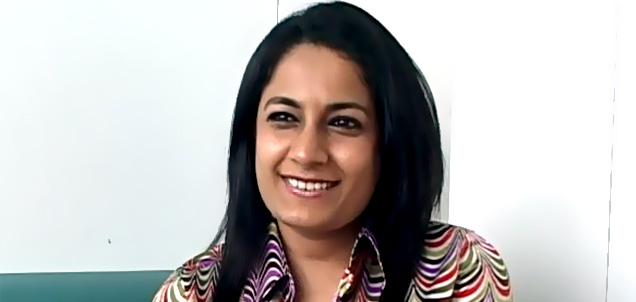 As the Managing Director, South Asia of one of the fastest growing agencies in India, Shubha George has been responsible for steering MEC to great heights over the past few years. Her passion and decision-making skills have earned her laurels from clients and colleagues alike. In fact she has been giving a tough run for Group M India’s other big agencies who are compelled to perform better and stay ahead in the race to the top. It is her dedication to her work and family that makes her a diva in a true sense.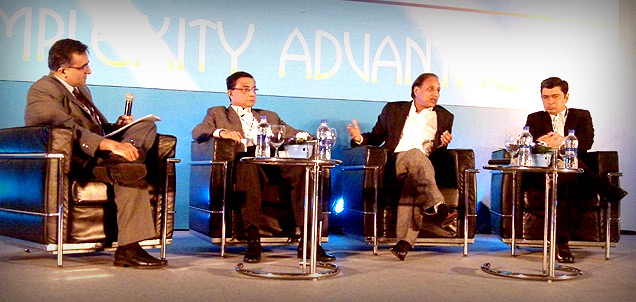
 By Shruti Pushkarna