
Author: mxmadmin

  • Indian ad industry nears 100k cr milestone


    By Indrani Sen


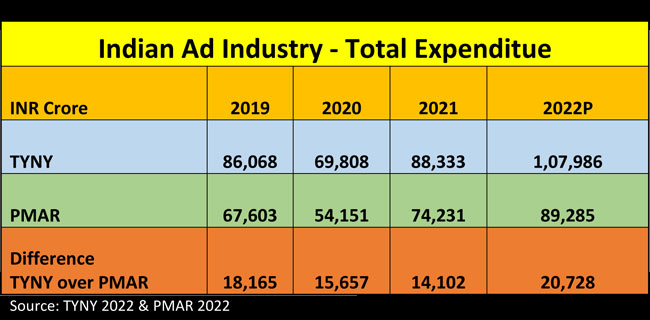
    Indrani SenLast week, both GroupM’s This Year Next Year (TYNY) and Madisons Media’s Pitch Madison Advertising Report (PMAR) got released and their basic findings have already been reported by all business and trade media. The general mood in the advertising industry is exuberant as both the reports have confirmed that AdEX zoomed in 2021, by 37% as per PMAR and by 26.5% as per TYNY in spite of the third wave of the pandemic. In 2021, India was the fastest growing market in the top 10 countries, ranking 9 globally and ranking 5 on incremental ad spend predicted for 2022.


    The current year also promises to be a good year for Indian ad industry with PMAR predicting 20% growth and TYNY predicting 22% growth in adspend in 2022 over 2021. However, this year the two reports raises a paradox, will the ad industry cross INR 100,000 crore milestone in 2022 as predicted by TYNY or touch 90,000 crore as predicted by PMAR? It seems that we will be celebrating the milestone of achieving INR 100,000 crore ad expenditure twice, once in 2022 by GroupM, its constituent agencies and clients and once again in 2023 by another large part of the industry who prefers to use PMAR.


    It is acceptable that two or more research studies done by different agencies may yield different estimates of adspends by media and as long as the trends are the same, all such estimates can be used by the industry. Indian media, advertisers and agencies have learned to live with different estimates for the industry size, growth rates as well as predictions from different sources including TYNY and PMAR. However, as the difference of almost INR 21,000 crore between the estimates for 2022 in the two reports is huge, it may be prudent to analyse the macro level statistics of PMAR and TYNY to find out the source of such huge difference.


    As digital, TV and print account for a total share of 94% to 96% of the total ad expenditure in both the reports, a review of the adspend across these three media will suffice for finding out the sources of the difference in estimates.


    Both GroupM and Madison Media have reported digital as the fastest growing media in 2021 and a continuity in the momentum of growth in 2022. In TYNY, digital adspends has equalled the TV adspends in 2021, where as in PMAR the digital adspends will equal or cross TV adspend in 2022.  Over the last three years, TYNY has been consistently reporting about INR 10,000 crore more in digital media ad spend than PMAR. In 2022 the ad spend in digital media is estimated to be INR 15,533 crore higher in TYNY than in PMAR.
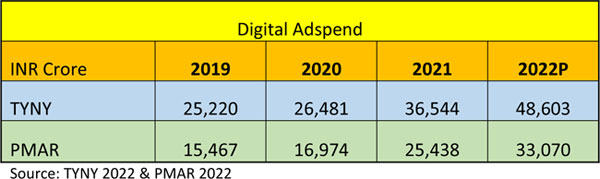


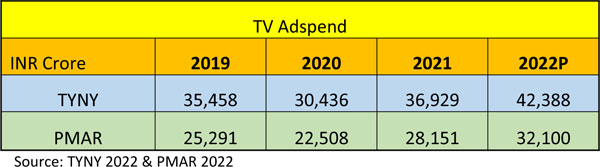
    Similarly, in case of TV adspend, the estimate by TYNY was higher than TYNY by INR 10,000 crore in 2019, which reduced to INR 8000 crore in 2020 and 2021. However, in the estimate for 2022, the same has again become higher by INR 10,000 crore. So, the estimates for digital and TV taken together account for a difference of INR 25000 crore between TYNY and PMAR in their predictions of 2022.


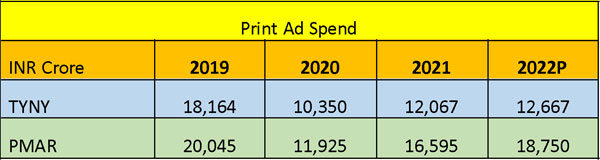
    When it comes to print adspend, the table is turned as PMAR has been consistently estimating higher spends in print than TYNY. In 2022, PMAR’s prediction for print ad spend is INR 6000 crore higher than that of TYNY. So, by combining print with digital and TV and other traditional media, the difference of INR 25000 crore gets reduced to INR 21000 crore.
     

    Source: TYNY 2022 & PMAR 2022


    It seems a bit unfair that TYNY has condemned print adspends in India to almost zero growth in 2022. As TYNY is done as a global report, has this estimate for Indian print ad spend been influenced by the global scenario where in most countries print ad spends have been steadily declining for years?


    I have written about the difference in the findings of TYNY and PMAR earlier in www.mxmindia.com. I know that we will never really get to know the reasons for such huge differences between the estimates of TYNY and PMAR, but it is becoming increasingly difficult to explain the reasons for the same to students of media management in a classroom as there is a danger that they may get confused and lose faith in media research.


    Read past commentary by Indrani Sen at:


    https://www.mxmindia.com/2021/02/so-how-do-the-groupm-madison-forecasts-compare/

    https://www.mxmindia.com/2020/02/a-roller-coaster-ride-of-adspends/

    https://www.mxmindia.com/2020/02/well-pitched-delivery/

    https://www.mxmindia.com/2019/02/indian-ad-industry-are-happy-times-really-here-again/

    https://www.mxmindia.com/2018/02/indrani-sen-mind-the-tv-adex-gap/

    https://www.mxmindia.com/2017/02/what-is-the-real-size-of-indian-ad-industry/

    https://www.mxmindia.com/2016/02/indrani-sen-boomtime-for-media-a-review-of-the-pitch-madison-advertising-report-2016/
     

  • Ather Energy rolls out new digital campaign

    By Our Staff


    Ather Energy, the electric vehicle company, has rolled out a new digital campaign, ‘Kali Ini Electric’, to celebrate its partnership with Kerala Blaster FC for the 7th season of the Indian Super League (ISL). Through this campaign, Ather Energy aims to build recognition for their electric scooters in Kerala and establish a seamless connection between their flagship product – the Ather 450X – and the people of Kerala.


    Notes a communique: “The campaign played on the inherent love and passion the people of Kerala have for football and for their favourite sports teams. The campaign used a background voice-over in the style of the famed Malayalam commentator Shaiju Damodaran to showcase the beauty of an electric game – on the football pitch and while riding the Ather 450X electric scooter. The Ather 450X has seen a resounding response from consumers in Kerala, which is an important market for Ather Energy.”


    The campaign is conceptualised and executed by Stark Communications.


  • Nominees for Critics’ Choice Awards announced

    By Our Staff


    Motion Content Group of GroupM, in Collaboration with Film Critics Guild and Vistas Media Capital has come up the 4th edition of Critics’ Choice Awards to honour the talent in web series, short films and feature films.


    Said Anupama Chopra, Chairperson Film Critics Guild: “We are thrilled to announce the feature film nominees for the fourth edition of the Indian Critics’ Choice Awards.  Despite the challenges posed by the pandemic, the level of artistry and storytelling has not faltered. These awards are a celebration of that indomitable spirit of Indian cinema.”


    Added Prasanth Kumar, CEO – GroupM South Asia: “Despite the pandemic, 2021 witnessed incredible output with breakthrough performances. We at Critics’ Choice Awards believe that we truly are at the forefront in identifying and felicitating creators and their craft for the fabulous work put in. It is important to recognize talent and award them for their best efforts. We are delighted to present the nominations for the outstanding work done in 2021. We would like to thank filmmakers, directors, writers, and artists, who have worked extremely hard to give us compelling movies amid unprecedented competition.”


  • HDFC Life launches new campaign

    By Our Staff


    HDFC Life has launched a campaign #AdhuraNahiPuraInsurance to encourage individuals calculate their ideal life cover with the help of the Human Life Value Calculator (HLV) in collaboration with their financial and life goals. The campaign comprises a series of three films featuring actor Pratik Gandhi.


    Speaking on the campaign, Vishal Subharwal, Head – Marketing, Digital Business, and E-commerce, HDFC Life said: “India has a large population that is either uninsured or underinsured, leading to a high protection gap. With an increase in the young working population there is a greater need for life insurance to secure the breadwinner in the family. Further, the pandemic has enhanced the need for a financial safety net. Human Life Value calculation should ideally be the first step while purchasing life insurance. It ensures that the cover is adequate and fulfils the purpose of the policy. Through this campaign, we aim to create greater awareness of the need for adequate life insurance cover. The films are short, simple, and convey the message effectively. We hope to reach out to a larger audience and enable them to secure their future financially.”


  • Das ka Dum with Dr Bhaskar Das | The Madison and GroupM studies don’t paint a healthy picture for print? Is it time to write the epitaph (for print)

    Bhaskar DasWe asked him this question for two reasons. One, as a media veteran and visionary, his views would be vital. But we know how much he loves print, so did what we love doing most (and fail 101% of times): provoke him. Without any further ado: the February 22 edition of Das ka Dum. Read on…

     

    Btw, it’s World Thinking Day today (Feb 22). If there’s one person whose thinking we admire, it’s our Wizard with Words. What say!?


    If you wish to access the archives, please go to the Das Ka Dum tab on the website’s top navigation bar.


    Q. The Madison and GroupM studies don’t paint a healthy picture for print? Is it time to write the epitaph (for print)


    A. NO WAY. As a general principle I believe some air pockets can’t be perceived as an end of life or journey. I have mentioned in this column that it is important to learn the skill of deaveraging. While any research is directional about an unfolding future, the impact can be unique for individual print companies. I think print media has a very unique space that complements the screen agnostic market place, at both demand and supply side. Besides, print business of the top 20 leading print companies are in pink of health and they have been rising to higher altitudes post some stong headwinds due to pandemic. In a sense , they would be stronger now as they demonstrated their corporate resilience in weathering unfavorable operating environment. Hence I am not a member of the naysayers’ club and won’t be able to write an epitaph for print in India. Business models me ght die but print medium or news in legacy media would not wither away.


  • Selective in our glee and anger


    Ranjona BanerjiBy Ranjona Banerji


    One of the biggest stories of the week was about how the National Stock Exchange, a prime market regulator, was “managed” by a “guru” in the Himalayas, because the CEO and MD Chitra Ramkrishna, was enthralled by him.


    If that fact is not absurd enough, the story, details broken by redoubtable business and financial journalist Sucheta Dalal, co-owner and editor of MoneyLife.in, reveals what was really happening. Ramkrishna colluded with Anand Subramanian, a consultant she hired against all norms, and allowed him to run the NSE, sharing all manner of confidential information with him.


    The Securities and Exchanges Board of India, our market watchdog, allowed this continue for years, asking the NSE to investigate itself. Ramkrishna resigned in December 2016. The details of the subsequent investigation have just been released by SEBI.

    https://www.moneylife.in/article/nse-mismanagement-chitras-weird-himalayan-yogi-and-sebis-weak-order-push-indias-image-back-to-snake-charmers-and-holy-men/66406.html


    Dalal’s investigation and analysis reveal that the NSE’s functioning continues to be irrational and it continues to be given a long rope by SEBI.


    You know what I’m going to say, but even if I’m predictable, I’m not wrong. In any other time and place there would be massive media activity and public anger. After all, the media is full of glee every time the stockmarket goes berserk. It also links market activity with political greatness.


    And yet, when we discover that one of our premium institutions has been not just mis-run but run by fraud and this fraud has been covered up by our prime regulatory body, reactions are limited to the pink papers, to financial publications and to the smaller money world.


    Journalists in a normal world absolutely thrive on allegations of fraud, financial wrongdoing, sexual hanky-panky, lies, mismanagement. But when it comes to the last almost eight years, we are oh-so selective in our glee and anger.


    There are after all, several election rallies, Narendra Modi’s wardrobe changes, and plenty of opportunities to increase hatred against Muslims. Why should the NSE supposedly being run by some Himalayan yogi matter, eh?

    https://www.bloombergquint.com/business/chitra-ramkrishna-sebi-order-if-only-a-yogi-ran-the-nse


    **

    Increasing hatred against Muslims is a full-time occupation not just for the RSS-BJP but also for a number of media houses.


    The assault on students wearing hijabs has continued, even as the sudden ban on head scarves is being argued in the Karnataka High Court. And now the town of Shivamogga is engulfed in sectarian tension, after violence broke out during the funeral procession of a young member of Bajrang Dal, Harsha, 28, a tailor, who was beaten up and died from his injuries.


    The BJP immediately claimed Muslims were responsible and Shivamogga district minister KS Eshwarappa blamed Congress leader DK Shivakumar, while home minister Araga Jnanendra denied any link between Harsha and the hijab issue. The police arrested people with Muslim names, as one would expect, but also pointed to “old rivalries”.


    Despite curbs on large gatherings, a huge mob of Bajrang Dal members accompanied Harsha’s funeral procession, stoning shops and setting fire to vehicles along the way.  The police were forced to use teargas and lathicharges to disperse the crowds.


    I repeat all these facts just to underline the patterns which we see around us over and over again.

    https://timesofindia.indiatimes.com/city/bengaluru/karnataka-violence-mars-activists-funeral-procession-curfew-in-shivamogga/articleshow/89737133.cms


    The escalation of Hindu violence against Muslims is a direct result of the RSS-BJP’s own policies, nothing new there. But the almost total collusion of the Indian media remains a shock, even if we should be used to it by now. TV channels owned by India’s biggest business houses, and some with foreign collaborators like News 18 and CNN, apparently find it acceptable to pit one section of Indian society against another for political gain of the most nefarious sort.


    Sadly, we are trapped in this cycle. As long as the BJP wants to keep the hijab issue alive, as one more way to crush Muslims, the Indian media will continue to play ball. Death and destruction are a small price for them to pay when journalists and media owners remain enamoured of the fascist ideal.


    Ranjona Banerji is a senior journalist and commentator. She writes on MxMIndia on Tuesdays and Fridays. Her views here are personal


  • Sanjeev Kotnala: Missing the taste of tea in the elections

    Sanjeev KotnalaBy Sanjeev Kotnala


    Chai Garam Chai. Tea is my favourite hot drink. It rejuvenates and recharges. It helps you stay awake and it comes in all possible formats. So much so that you can often define how you want your tea. It can be strong- in truckers’ language – 100 KM tea- or the silver service tea with a touch of milk. You could have it with sugar, sugar-free, with Jaggery, salt or even butter. There is Tapri-waali chai people swear by and some prefer the cutting khullad tea at the station. Everyone has their own favourites. And while we are at chai- let me suggest you read the Khyaalon Ki Tapri , a collection of poetry by Meraj Hasan ‘Meem’ best enjoyed over a cup of cutting chai.


    I love a well-made tea; however, I have toned down my consumption with age. My weakness for tea is well known among friends and relatives. but the whole family knows my weakness for tea. I love strong tea, where the tea leaves have been allowed to boil for some time in the water that has mashed Ginger pieces. In the last three decades, I moved from Taj to Bagh Bakri to Brooke Bond Red Label and settled for Society Masala tea. Each has its own taste.


    The tea category in past has done some great advertising that I can watch repeatedly. All about awakening the body-mind and soul, initiation or re-building of relationships and more.


    However, I was a bit surprised at the lack of advertising by tea brands during this election. Even though the election states are major tea consuming markets.


    Were the brands playing safe? Not that I am aware of some ground-level activation.


    I see Anoop Nautiyal and Abhilash Khandekar lamenting on Twitter about the low voting percentage in my native state- Uttarakhand. And, I think that tea brands have missed an opportunity there.


    My respect for tea brand advertising started from the Lipton Tiger tea time– the kadak chai– and the tiger in the woods. At that time, I did not know how ads were filmed, and this one was as kadak (macho) as a tea brand could get.


    Tata Tea The True Awakening.


    Tata Tea took on elections and corruption in a big way. One of the few commercials that one can watch again and again. And the best part, they still make sense and are relevant to the situation.

    The one ad was about the voter asking the candidate for his qualification- and the brand suggesting ‘subah Utho Nahi Jago’ left its mark. Then the brand took the subject to a new situation like the Airport, where ‘Yeh mahashay Nahi jaantey yeh Kaun hai’ brought a smile to the faces of the audience, appreciating the thought.


    And I do think that some of us could have, if possible, shared this SOOCH BADLO ad by the brand in this election. If not the tea brand, the state of Uttarakhand does need such communication. It could have helped awaken the sleeping voters.


    https://youtu.be/vuH3a1QAIek


    Abhi Alarm Baja Nahi Hai ad by Tata Tea openly challenged and took the subject head-on. The national situation at that time provided a perfect context for the call for action. However, one must say that nothing has really changed, and the ad still remains relevant for the category, contextually and conceptually.


    And, of course, the brand’s simple response to the Chai-paani call was equally relevant. I am not sure how much the situation has changed in this context. However, if I am to believe what I read and hear. In that case, Chai Paani is still in the system, and the communication is relevant.


    BROOKE BOND- BONDING TOGETHER


    Brooke Bond has been a brand that took on the idea of reconciliation and fair judgement, ethical values and awakening of a different type. The Brooke Bond Prejudice ad was one such example.


    Brooke Bond did the Father and Son Khumb ad a few years back. It was a simple storyline with much simpler non-intrusive product brand integration that touched you emotionally.


    Brooke Bond took the ‘Swaad Apnepan ka’ to a new level of acceptance of live-in couples. A subject that was still much taboo at that time.


    Brooke Bond Red label extended the game of these relationships with their secularism ad- between neighbours from a different community. The resistance, the hesitation and the final tipping were well captured. And then they another ad along similar lines of two friends with varying restrictions of communities- ‘Swaad Apnepan ka- Maa Ko Sorry Bol Dungs’.


    Wagh Bakri Relationship


    Wagh Bakri tea took on husband-wife relationships to a new level of explanation and adjustments. Both the ads are well made for their time, and well, even at the cost of repeating myself – they are still relevant.


    Wagh Bakri also had a series of three films – Doosto Waali ChaiSister Waali Chai and Papa Waali chai. Each picking on one relationship and linking it to the collective sharing of tea. There was also one National integration film– with tea as the link- but it was too soft for kadak tea lovers.


    Not everyone’s cup of tea.


    Yes, I miss this contextually purpose-led communication by the brands. Can these not be redesigned and calibrated? Why do brands move out of such excellent associations? Must every proposition be killed after some time? Does it compulsorily become stale? Or do we creatively fail to inject the newly evolved context to deliver equally impactful communication?


    The above three brands are examples of finding a nice space- which is relevant and strongly associated with the category- and then they seem to have moved on.


  • Das ka Dum with Dr Bhaskar Das | The fact of matter is that some of the legacy news entities hardly make any revenues from their digital offerings (vis-a-vis print)

    Bhaskar DasFollowing up on yesterday’s question on writing the epitaph for print, here’s another. Do read Dr Bhaskar Das in Das ka Dum dated February 23. Read on…


    If you wish to access the archives, please go to the Das Ka Dum tab on the website’s top navigation bar.


    Q.The fact of matter is that some of the legacy news entities hardly make any revenues from their digital offerings (vis-a-vis print)


    A. So what? It is well known that as a society we are inexorably moving towards a digital world through video, mobile and social media interactions. It is also leading to oligopolies of high tech companies. So digital investment by print or other media companies or other organisations are not aimed at (my presumption) competing with high tech companies, but to bolster their legacy reach and capabilities (rich content, interactivity with their stakeholders, capturing real-time market feedback etc) in sync with a ubiquitously connected world and to serve the millennium and alpha generation. It also protects their legacy business. So generation of big ticket revenue may not be the trigger for investing in digital routes to serve the audience.


  • Media Mantra wins Lovely mandate

    By Our Staff


    Media Mantra has bagged the PR and Digital Communications mandate for  Lovely Professional University.


    Said Aman Mittal, Vice President, Lovely Professional University: “We have established a centre of excellence for providing global avenues to aspiring students. There is a lot happening in the university with respect to our faculty and student achievements, research work and international collaboration. Also, each year, LPU has been reporting sustained growth. Partnering with a communication firm who has a track record of outstretching beyond the convention will help spread information around the developments and  foster our relations with stakeholders including fellow education fraternity and students & parent community. We are happy to onboard Media Mantra as our Communications advisors.”


    Commenting on the association, Udit Pathak, Founder Director, Media Mantra added: “We are excited to collaborate with a renowned name like Lovely Professional University. With years of exhibiting successful PR campaigns for various brands, this achievement is a testimony of the consistent hard work. Carrying forward the well established brand legacy, we hope to leverage our enriched domain expertise and help LPU with the right communication mix to retain transparency, build credibility and sustain trust amongst the stakeholders.”


  • MullenLowe Lintas to be creative partner of Future Generali India Insurance

    By Our Staff


    Future Generali India Insurance Company Limited (FGII) has recently appointed Mullen Lintas (agency) as its communication partner for its creative and social media mandate. The agency will handle full-service responsibilities of FGII, including its communication strategy, with a special focus on digital. The appointment of Mullen Lintas is an outcome of a multi-agency pitch.


    Speaking about the new partnership, Ruchika Varma, Chief Marketing Officer, Future Generali India Insurance Company Limited, said: “As a brand, whose purpose is to be a lifetime partner for the customers and lead with empathy, human-touch, and innovation, we remain heavily invested in not just understanding our customers’ evolving needs from close quarters but also in being at the forefront of launching disruptive and clutter breaking communication, that helps strike a chord with our customers. Our efforts, over the last few years, towards bringing wider acceptance to conversations around mental health in India, is a case in point.”


    Commenting on the creative win, Hari Krishnan, CEO, Mullen Lintas added: “Insurance is a highly regulated category and, therefore, new products & innovations are somewhat infrequent. However, Future Generali has been disrupting the category with great product and service level innovations and, hence, to partner such a brand, is an exciting challenge for all of us. We look forward to re-defining category codes and changing the way consumers evaluate general insurance products. What’s even more satisfying is that this is a win for our integrated, hyper-bundled approach, wherein we will collaborate with our social and advocacy agency, Lintas Live, in this journey, to take the Future Generali brand journey forward.”


  • NatGeo films series on Indian women entrepreneurs

    By Our Staff


    National Geographic has joined hands with Sequoia India to spotlight the inspiring journeys of Indian women entrepreneurs with its brand-new digital series – ‘She Builds’. The six-part series of short digital films will touch upon the lives of seven successful Indian female founders, who are defying the odds by taking risks, dreaming big, and driving innovation in India.


    The series, which will air over two weeks, will feature innovative and inspiring entrepreneurs like Neetu Yadav & Kirti Jangra, Animall, Ashwini Asokan, Mad Street Den, Ghazal Alagh, Mamaearth, Prukalpa Sankar, Atlan, Rashi Narang, Heads Up For Tails, Divya Gokulnath, BYJU’S.


    Said Kevin Vaz, Head – Network Entertainment Channels, Disney Star: “At National Geographic, it is our constant endeavour to bring stories that take our audiences on an immersive, inspiring and sympathetic journey. With ‘She Builds’, we are delighted to bring motivational stories of seven women entrepreneurs who have contributed in changing the narrative of women leadership in India. We understand that short-form content presented in an interesting manner are appreciated and preferred by our audiences, so we are bringing these stories in bite-size formats and premiering them on our highly engaged social media platforms.”


    The films were produced in collaboration with Guneet Monga, CEO & Founder, Sikhya Entertainment Private Ltd. and Executive Producer for an Academy award winning film, and directed by Vijayeta Kumar.


    Added Gayatri Yadav, CMO, Sequoia India and Southeast Asia: “At Sequoia India we have been privileged to meet ambitious and successful women entrepreneurs who challenge the status quo every day, building game-changing businesses to be the pioneering leaders they are. Their stories are inspiring, relatable, and incredibly uplifting. But they just don’t get told often enough. We are very grateful to our founders for giving us this opportunity – and sparking a flame that we hope will inspire many.”


  • DDB Mudra joins hands with Creative Equals

    By Our Staff


    Creative Equals, a UK-based non-profit global inclusion consultancy, has launched #CreativeComeback in India. With successful editions in London and New York, the programme starts with Mumbai to help women, non-binary and gender non-conforming individuals, who’ve taken a career break come back into the workforce. This two-week bootcamp aims to destigmatize career gaps and turn them into an advantage by retraining this creative talent. In association with D&AD as training partners and Diageo, a brand committed to gender equality, the mission is to #BreakTheBias in advertising creative departments of art, copy and design. DDB Mudra Group will provide mentoring support and potential job opportunities to participants at the end of the program.


    Said Deepika Warrier, CMO Diageo India: “At Diageo, inclusion and diversity is central to our purpose of celebrating life, every day, everywhere and we’re committed to creating a working culture in which our people feel like they belong and can bring their authentic selves to work. Today for example, 22% of Diageo India’s overall workforce (as against 7.5% in 2015), 4 of 8 executives in the Excom are women. In our brand & creative side, over 45% of our content work has been led, directed or portrayed by women creators, and over 10% of our work by creators on the gender identity spectrum. We will continue this focus on gender equality and equity throughout the globe, specifically at the creative table, as we know gender equality makes for better, more representative advertising. We know women ‘are 11 times more likely to not work after COVID job loss,’ (The Times Of India, 2021) & also step out during certain life stages and then find it difficult to hit their stride when they return. This is particularly true of the creative industry sector. Creative Comeback helps the industry #BreakTheBias by changing the view on CV gaps to being ‘gifts’. We know when women take a career break, their life experiences bring them back with a deeper perspective.”


    Speaking about how Creative Equals’ mission and actions resonate with their own, Aditya Kanthy, CEO & MD, DDB Mudra Group added: “A lot of the work we have been doing at the DDB Mudra Group aligns perfectly with Creative Equals’ mission. Through the Phyllis India Project we are training women to take on leadership roles and lead creative mandates for the company and the industry. Over 20 women, some of whom are our most talented creative voices, have been through this project. Similarly, the Open Pride initiative is directed at promoting a fair representation of the LGBTQIA+ community at DDB, and also in the creative work we produce. DDB Transit is India’s first internship program for trans individuals, that we have been supporting since last year.”