Author: mxmadmin

  • Criesse Communications starts year with three wins

    By Our Staff


    Criesse Communications, the PR and integrated communications agency, has onboarded three hospitality clients including luxury wellness lodge Aramness Gir, bordering the Sasan Gir National Park and the Conrad htoelin Pune. Also, the agency has witnessed the addition of Hyatt Lucknow’s newly launched China House.


    Said Dennis Taraporewala, Managing Director, Criesse Communications: “Criesse Communications is privileged to welcome these renowned brands to join our family. We look forward to working together and bringing the beauty of these properties through robust and sustainable communications based on innovative & strategic campaigns”


  • Eurosport & Jio TV to air AFC Asian Cup

    By Our Staff


    Eurosport India, Discovery Network’s sports brand and Jio TV Network have acquired the broadcast rights for AFC Women’s Asian Cup India 2022, which will take place from January 20 to February 6. Eurosport India will telecast the tournament on television. Meanwhile, Jio TV will stream the matches of the competition on its online platform and across its network.


    The Football Sports Development Limited (FSDL), who currently holds the media rights for all Asian Football Confederation (AFC) competitions in the Indian subcontinent, has accorded the PayTV broadcast rights to Eurosport India.


    The 20th edition of the AFC Women’s Asian Cup India 2022™ will feature 12 teams, which have been divided into three groups. Group A includes India, China PR, Chinese Taipei, and IR Iran, while Group B includes Australia, Thailand, Philippines and Indonesia. Meanwhile Japan, Korea Republic, Vietnam and Myanmar have been slotted in Group C.


  • Onsurity launches brand campaign

    By Our Staff


    Onsurity, a monthly subscription-based employee health benefits platform, has launched its first digital campaign that focuses on the ‘#GiftOfSurity’ for SME work families. The campaign demonstrates that expansion of health benefits is a vital step for SME and start-ups to pave the way in India’s effort to achieve Universal Health Coverage.


    Commenting on the campaign, Samar Kagalwalla, Head Growth & Marketing, Onsurity said: “We believe our colleagues are like family…a ‘work family’, the GiftOfSurity campaign has captured various perspectives and stories that further strengthen the sense of building trust around healthcare benefits to employees. With our vision of “Healthcare for All” we aim to enable and empower 330 mn SME workforce which contributes almost 29% of India’s GDP.”


  • Das ka Dum with Dr Bhaskar Das | It’s that time of the year when the folks at GroupM and Madison work overtime on their adspend forecasts. Given the uncertainty that prevails, do you feel for the predicament of Messrs Prasanth Kumar and Sam Balsara/ Vikram Sakhuja?

    Bhaskar DasIt’s not a fun question although it sounds like one. Let’s read what Dr Bhaskar Das has to say to this one. In the January 10, 2022 edition of Das ka Dum. Read on…


    If you wish to access the archives, please go to the Das Ka Dum tab on the website’s top navigation bar.


    Q. It’s that time of the year when the folks at GroupM and Madison work overtime on their adspend forecasts announced in February. Given the uncertainty that prevails, do you feel for the predicament of Messrs Prasanth Kumar and Sam Balsara/Vikram Sakhuja?


    A. I am not a member of a club of pessimists. Business has to improve as humanity has to survive. For business, communication is an imperative, irrespective of the screen/ format. What the global network agencies forecast is like a mirror that reflects the prevailing business sentiments , at the relevant time of the research. With the use of sophisticated techniques like AI/ML, it would be more accurate. Even if there is a deviation from empirical facts, the forecasts are supposed to be directional and not predictive. In fact, I look forward to it as a positive direction improves the dopamine effect in my sentiments.


  • KredX fintech unveils new identity

    By Our Staff


    KredX, financial services provider, has rebranded its identity of becoming a one-stop solution for supply chain financing for businesses. As a part of this rebranding, the company unveiled a new logo and a revamped website.


    Said Manish Kumar, CEO and Co-founder of KredX: “Customers are the core of our business and as a customer-first company, we are committed to delivering innovative solutions as per their requirements. We realised that our customers wanted us to take a deep-dive into supply chain finance and to become an end-to-end solutions provider that can cater to all aspects of supply chain financing and not just invoice discounting. Therefore, our rebranding initiative is a sincere effort to showcase this change and our commitment to the cause.”


  • Consumer Attitudes toward Technology


    By Our Staff

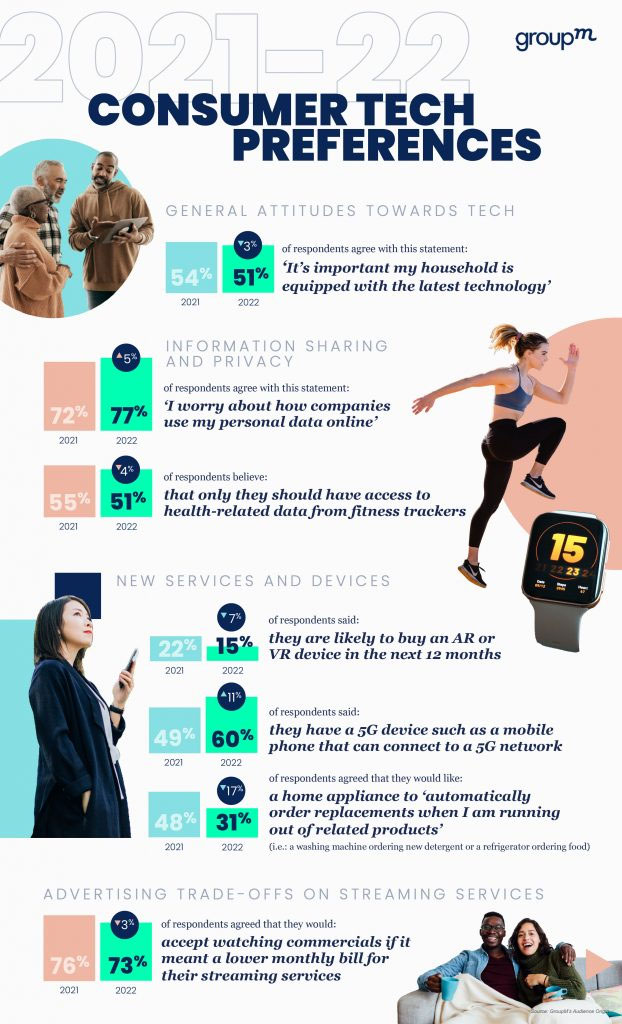
    GroupM, WPP’s media investment group, released its second annual survey on consumer attitudes toward technology in the U.S last week. The results reveal increased concern about sharing personal data, declining interest in buying the latest tech products sooner rather than later, and greater numbers of people confused by technology and its promises overall. Conducted by GroupM’s Audience Origin (formerly LivePanel) in December 2021, this proprietary research surveyed one thousand U.S. consumers on their attitudes toward technology across six general categories: attitudes toward technology, information sharing and privacy, virtual reality-based devices and services, smart appliances, mobile devices and digital services, such as visual search, streaming audio and streaming video.


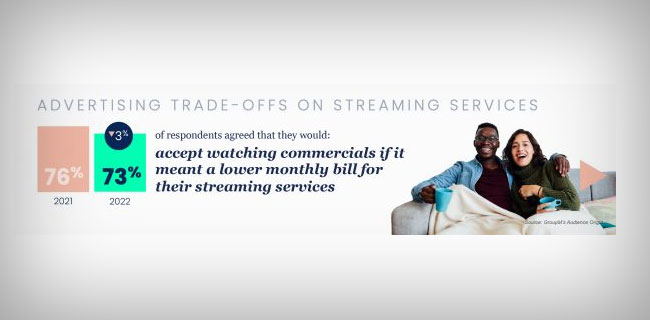
    Survey respondents indicated some material shifts in sentiments around privacy, with greater numbers of people concerned about the use of their data online, fewer willing to share data associated with health trackers or allow smart appliances to automatically refill consumables. Fewer households now believe it is important that they are equipped with the latest technology and greater numbers profess to being confused by new technologies – which we can see in responses to questions regarding VR and AR device access or 5G access – with more saying they will wait until technology becomes cheaper before purchasing devices. Of more direct importance for the advertising industry, a shrinking majority of respondents (73%) said that they would accept having to watch commercials in order to maintain a lower monthly bill for streaming video services versus 76% in last year’s survey.


    These trends reinforce the importance of data privacy to consumers and its implications for marketers—including the need to go above and beyond in securing consent from consumers when collecting or otherwise working with their data-to ensure that consumers experience real benefits from the use of that data and to always be mindful of how third-party data used in campaigns has been aggregated. The results also suggest that marketers could benefit from creating more clarity around how their technology products work and their practical benefits for consumers.


    Finally, the increasing willingness of consumers to pay to avoid advertising in streaming video services reflected in this survey strengthens GroupM’s instinct that, over time, advertising will become a diminishing feature in this channel. This highlights the challenges that marketers will increasingly face in using TV for reach and frequency-based goals in the future: it will be increasingly important for marketers to either more directly manage TV budgets alongside their spending on UGC-based platforms such as YouTube or to look at the use of TV differently, managing budgets for related campaigns more directly alongside those intended for sports, culture, music or other event sponsorships.


    Highlights of the research:

    1. General attitudes toward technology. 51% of respondents agree with this statement: “It’s important my household is equipped with the latest technology” versus 54% in our survey last year. 32% of the population somewhat or completely agreed that new technology “confuses me” in the new survey versus 28% last year. 73% agreed that they “wait until technology becomes cheaper before considering a purchase” versus 69% last year.

    2. Information sharing and privacy.77% of respondents strongly or somewhat agree with the statement “I worry about how companies use my personal data online” in our most recent survey, up from 72% in last year’s survey. 51% of respondents believe that only they should have access to health-related data from fitness trackers. The comparable figure was 55% in last year’s survey. As with last year, only a small share of the population believes that the company that made the device or software should have access (5.4% this year versus 6.9% last year).

    3. New services and devices: VR/AR, 5G and Smart Device-Based Consumables. Virtual or Augmented Reality: 32% of respondents claimed to own a VR or AR device in our most recent survey, with 15% claiming they are likely to buy such a device in the next 12 months. Consumer perceptions of what, exactly, such a device is may not be commonly shared, as last year 39% claimed to own one, with 22% planning to buy one. Looking at 5G devices, 60% of respondents said they have a 5G device such as a mobile phone that can connect to a 5G network, up from 49% last year. Among the 40% of the population without a 5G connected device, more than a third expect to acquire such a device this year. As with VR/AR, consumer understanding of 5G may not fully match the reality of the product, as third-party estimates of shipments of rates of 5G devices in the United States major U.S. carriers imply substantially lower figures. In the world of smart devices, 31% agreed that they would like a home appliance to “automatically order replacements when I am running out of related products” (i.e.: a washing machine ordering new detergent or a refrigerator ordering food). By contrast, the comparable figure was 48% last year. While it is possible the driver of this sentiment change is related to a lack of satisfaction with related products, we also note that this trend is coinciding with greater concerns around privacy illustrated above.

    4. Advertising trade-offs on streaming services. Asked, “If it meant a lower monthly bill for your streaming services, how likely would you accept having to watch commercials?” 73% agreed with this statement in our newest survey versus 76% last year. Access to ad-free or ad-lite subscription services remains high, consistent with data observed through public filings made by the operators of streaming services.


  • Das ka Dum with Dr Bhaskar Das | When you see newspapers saying that they are safe to read and couldn’t be carriers of a virus, should one believe it?  Setback again for newspapers?

    Bhaskar DasNow we know that our Wizard with Words is passionate about print, even though he is equally engaged in other media. Let’s read what Dr Bhaskar Das has to say to this one in the January 11, 2022 edition of Das ka Dum. Read on…


    If you wish to access the archives, please go to the Das Ka Dum tab on the website’s top navigation bar.


    Q. When you see newspapers saying that they are safe to read and couldn’t be carriers of a virus, should one believe it? After all the person doordelivering the paper could be a carrier or may even be infected and not reported the sardi-khaansi? Many housing complexes are disallowing newspaper deliveries as they could be carriers of the virus. Setback again for newspapers?


    A. It’s absolutely gobbledygook. There is no scientific evidence to prove it. In fact, in this so-called Third Wave, I haven’t noticed any such directive given by any housing society. And I think we shouldn’t extrapolate a metro-based superstition on the whole universe called India. The alpha generation (post-2000 born) are also suffering from cold etc in spite of the assumption that they consume news more through the digital media.


  • Axis Mutual Fund launches campaign

    By Our Staff


    Axis Mutual Fund unveiled its new campaign for the upcoming tax season called #ELSSHaiNa. The investor education campaign aims to reiterate the importance of investing in ELSS (Equity Linked Savings Schemes that offer tax benefits under section 80C of the Income Tax Act) as a preferred and hassle-free option to save on tax.


    Said Chandresh Nigam, MD & CEO, Axis AMC: “At Axis AMC, we have always upheld the importance of Responsible Investing. As money managers, it is our duty to not only educate investors about the significance of investing in quality assets over the long term but also help them grow wealth while saving on tax in an efficient manner. ELSS is an option that is known to all investors. But without having spent the adequate time to optimize the right tax planning solution, investors often make hasty decisions and miss out on the most logical and easy option.”


    Said Raghav Iyengar, Chief Business Officer, Axis AMC: “Thanks to the continued efforts by MF industry, ELSS has started to gain widespread acceptance amongst the investor community. However, tax planning is still viewed as a strenuous and chaotic task. We need more awareness initiatives and campaigns such as ours, will be instrumental in connecting with the wider masses. The three distinct narratives of #ELSSHaiNa focus on capturing investment sentiment across age categories, genders, geographies. Furthermore, Axis Mutual Fund’s 360-degree approach for the campaign will leverage the power of digital, TV, radio, and the print medium to resonate and engage with the target audience.”


  • Capgemini Research Institute Report: What Matters to Today’s Consumer

    By Our Staff


    Capgemini Research Institute has issued a report on ‘What Matters to Today’s Consumer’, which reveals the far-reaching impact of the pandemic on consumer behaviour and preferences. Gen Z and millennial shoppers are now more likely to order products directly from brands, and 72% of all shoppers expect to have significant interactions with physical stores once the pandemic subsides – up from 60% pre-COVID.


    More than two-thirds (68%) of Gen Z and over half (58%) of millennials have ordered products directly from brands in the past six months, compared to 41% on average across all age groups. Only 37% percent of Gen X and 21% of Boomer shoppers have ordered directly from a brand in the last six months. For those who have bought directly from brands, almost two thirds (60%) cite a better buying experience as a reason for purchasing directly, and 59% cite access to brand loyalty programs.


    In return for these benefits, consumers are willing to share their data. Currently, almost half (45%) of all shoppers say they are willing to share data on how they consume or use products and more than a third (39%) say they are willing to share personal data such as demographic information or product preferences. However, 54% of all shoppers say that offers, deals, and/or discounts would make it more likely for them to share their data directly with brands.


    Said Tim Bridges, Global Head of Consumer Goods and Retail at Capgemini: “Younger consumers’ willingness to go straight to brands when purchasing goods presents a real opportunity for consumer product companies. This enables them to collect consumer data and helps create a more mature direct-to-consumer channel. Being data-powered enables the consumer product and retail organizations to translate supply and demand trends into intelligent decisions on where best to stock their products, customize products and services, and enhance customer experience.”


  • Eight Buzzwords Wiser


    By Avik Chattopadhyay


    Avik ChattopadhyayTwenty twenty-two has not started the way we expected. The tentacles of the pandemic remain, in fact in newer forms. While we are coming to terms with the Omicron variant, countries like France have moved on to the IHU variety while Israel battles with Florona and the US with Delticron.


    Fanciful names for a killer!

    The WHO could have kept it simpler like Version A, Version B and so on but that might have taken the drama away. Just see the names of the hurricanes, cyclones and twisters and you will get the drift. Guess “I know what you did last summer” would not have sounded sinister enough if it were simply called “Revenge”.


    There is an art to naming and creating terms. It is an age-long craft. Axis sounded ominous while Allied seemed reassuring. New phenomena are explained and referenced better when given an interesting name or term. Conversations become easier when you refer to the group as BRICS rather than saying ‘Brazil-Russia-India-China-South Africa’ every time. Imagine calling the Cold War as the Russo-American Conflict! What would Bond do?! The uninitiated might think that DINK is the third option after DIY and DIFM. Such is the lure of naming.


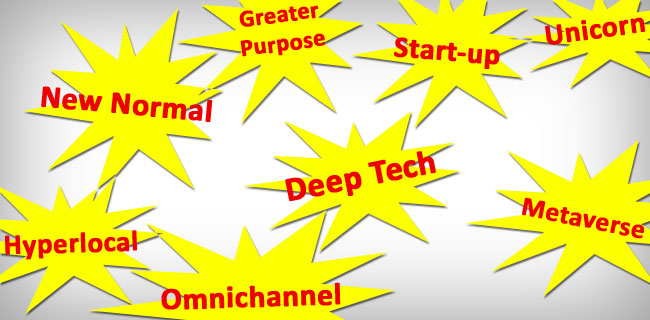
    The pandemic over the last 22 months has thrown up certain names or terms that have caught my fancy. Reading them across platforms and hearing them on innumerable video calls and webinars have certainly made me wiser as I entered 2022. Some did appear pre-Covid but gained traction in terms of usage and ubiquity once the virus hit us becoming buzzwords for brands and businesses.


    New Normal

    This one became a rage in the first 12 months and has now somehow paled in popularity. I could never understand the construct. If it was ‘new’, how could it be ‘normal’? Maybe it was devised as a trick term and that is what made it the subjects of innumerable articles, webinars, and debates. It became a prefix to everything around us…new normal life, new normal work, new normal eating, new normal manufacturing and so on. Guess when we realised that normalcy was taking longer than our comfort levels, we switched to ‘post-Covid’ and this term lost the race. However, an interesting buzzword indeed,


    Omnichannel

    This was the consultants’ blue-eyed term to explain what tomorrow’s strategy would have to be. Enough white papers were written to rephrase another favourite buzzword of the yesteryears – 360-degree-engagement. I took the pains to read through a few of the papers and realised it was as creative as the NDA government renaming existing schemes and programmes as new!


    Hyperlocal

    Basically, “kirana” stores were given a makeover when marketers and consultants [again!] termed them so. For years the local vegetable vendor and the ‘paan’ shop had been doing exactly what the wise men in the metros suddenly realised as the holy grail of consumer connect.


    Greater Purpose

    This was the poster-boy of terms that became a symbol of corporate maturity and relevance. Almost all brands talked about having revelations of their ‘greater purpose’ due to the pandemic and how that has transformed them. Those that never ever bother with fundamental purpose of business now espoused the wisdom of greater purpose. Sadly, the longevity of this fad will be just as long as the effectiveness of a vaccine shot!


    Start-up

    This is my personal favourite. It just makes everything before the birth of this term seem prehistoric. It is as if all businesses that happened before did not start up but stalled up. It is as if nothing previously started as a new idea or from scratch. Every business since ancient times has had to start up before it was built up. It is like saying earlier we had motorcars and now we have automobiles! Massive disruption indeed.


    Unicorn

    Close on the heels of the start-up is this amazing term for businesses that have been evaluated as being worth at least a billion USDs. I understand you need to recognise such stalwarts by giving them a name but why ‘unicorn’? It is a mythical character that could be anything from a bull, goat, wild ass to a horse. Leonardo Da Vinci wrote, “The unicorn, through its intemperance and not knowing how to control itself, for the love it bears to fair maidens forgets its ferocity and wildness; and laying aside all fear it will go up to a seated damsel and go to sleep in her lap, and thus the hunters take it.” I rest my case.


    Deep Tech

    This is a relatively new one and makes you question if there is something called “shallow tech”! I have always believed that all technology is inherently and necessarily deep if it is to be useful and sustainable. The sudden emergence of this term makes one feel that all previous developments and investments have only been the froth.


    Metaverse

    This is the latest as 2021 closed. It is not a new term at all, first appearing in Neal Stephenson’s science fiction novel Snow Crash in 1992 to describe a three-dimensional virtual world, very much like Second Life. Facebook rebranding itself as “Meta” also helped this term become a buzzword now to describe a converged virtual world where ‘avatars’ and ‘NFTs’ are the way to be. The mind boggles!


    As the new year has broken, I have become eight buzzwords wiser. While I still ponder over a few, I am surely amused at the others as transient attempts to ‘brand’ behaviour and consciousness. How many start-ups will become unicorns in the metaverse using omnichannel deep tech to offer hyperlocal solutions in a new normal world that values greater purpose? Do I sound like a consultant? Terribly sorry…


  • Ranjona Banerji: On TekFog and how an app can change headlines within another app

    Ranjona BanerjiBy Ranjona Banerji


    The investigation into the BJP IT Cell app, TekFog, by The Wire keeps revealing how lax and therefore dangerous tech safety — or lack of it — can be. Many, too many say some, live their lives on social media or use it extensively. Not just to communicate but to access news and information. Which can easily become lies and disinformation.


    The second instalment of The Wire investigation shows, for instance, how the app can change news headlines that you view on Whatsapp to change the meaning completely and generate more junk news.

    https://thewire.in/tekfog/en/2.html


    To those who work on tech and social media, this may be old hat. But that is a copout argument. It’s like climate change. Even if the danger has been known for years, even if not enough is being done about it, we can’t just stop increasing awareness of its dangers.


    And like climate change cannot be ignored, the way tech can be used to infiltrate every aspect of your life has to be addressed by the mainstream media with more rigour and precision.


    Sadly, despite all the evidence of how news is manipulated and changed to target political positions, the mainstream media seems blissfully unaware of what’s unfolding around them. You get more information from satirical documentaries and films on the effect of social media and tech on our lives than you do from the journalism side of the media.


    In fact, these satirical takes on the media have not failed to notice to latest kind of journalistic laziness – making an article out of tweets. This laziness would be fine if it was followed up on, if the way in which social media has changed and is changing us was consistently covered.


    “Journalism is the first draft of history” or variations of that self-congratulatory axiom are usually attributed to Philip Graham of the Washington Post. However, there are references to its usage long before that. But whoever said it, if we as the media believe that we have this privilege, we need to be better at it.


    We can no longer be stuck in either extreme political nor celebrity upliftment. Whether we do it lazily through Twitter or with slightly more work through leaks, sources and press releases. We have to place ourselves at the forefront of where humans are changing and who is doing that to them.


    Our TV channels have long abandoned news for primetime viewers. It’s been decades now since media house newsrooms have “outsourced” news gathering to agencies. As long as someone does it, you may think it’s all right. But in effect you’ve abandoned your control to someone else and they may not provide the coverage that is relevant to the times.


    While the media abdicates, the State does not stop its harassment, either openly or through nefarious means, of those who still practise journalism. The extent of the State’s anger with those who show truth to power is evident in this chargesheet filed against Kashmiri journalist Sajad Gul, which says that he is “always in search of anti-government news”.


    That the State thinks this is a crime is an example of the infiltration of undemocratic and unconstitutional thought in our Constitutional authorities.

    https://thekashmiriyat.co.uk/always-in-search-of-anti-government-news-chargesheet-filed-against-kashmiri-journalist-sajad-gull/
     

    Since the controversial abrogation of Article 370, journalists in Kashmir have been at the receiving end of vicious state power. Which is largely ignored by the mainstream media itself.


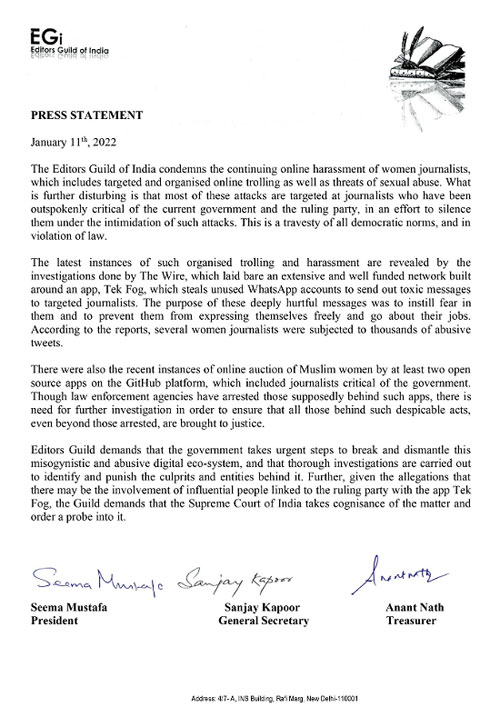
    The Editors Guild of India has now released a statement about TekFog and the BulliApp and SulliDeals cases. It reads in the end: “Editors Guild demands that the government takes urgent steps to break and dismantle this misogynistic and abusive eco-system”.


    But there is more for the mainstream media to comprehend: TekFog, like Pegasus before it, attacks the very lifeblood of the media itself. If spyware hijacks private communication of journalists, if an app can change headlines within another app, it means that journalism and the media itself is facing a worse virus than its own constant capitulations to state power. Agents of The State are successfully destroying whatever little independence it had, from within.


    Ranjona Banerji is a senior journalist and commentator. She writes on MxMIndia on Tuesdays and Fridays. Her views here are personal

     

  • Havas appoints Sumeer Mathur as National Planning Head & Managing Partner

    By Our Staff


    L-R, Ravinder Siwach, Manas Lahiri, Sumeer Mathur
    L-R, Ravinder Siwach, Manas Lahiri, Sumeer Mathur

    Havas Group India has appointed Sumeer Mathur as National Planning Head & Managing Partner, Havas Worldwide India – the creative agency of the group with immediate effect.


    Mathur will be partnering Manas Lahiri, Managing Director and Ravinder Siwach, ED & NCD of Havas Worldwide (Creative) and collaborate with key clients including Reckitt, Citroën, Dabur, Suzuki, William Grant, Tata and Harman (JBL) among many others. He will be based out of the Gurugram office and report to Rana Barua, Group CEO, Havas Group India.


    Talking about this appointment, Barua said: “The last two years have been game-changer for Havas Worldwide India. We have been relentless, focused and committed. This led to exponential growth, effective partnerships, and addition of several marquee clients. We need to now build a strong integrated leadership team that aggressively takes this growth mandate ahead. With Sumeer, Manas, Ravinder, Arindam, Prashant, Geet and all the other leaders forming the core team, it will further fuel our growth and empower us to deliver meaningful, ROI-centric marketing solutions for our clients. I am confident that Sumeer will drive this mandate quite effortlessly.”


    Adding further, Bobby Pawar, Chairman and Chief Creative Officer, Havas Group India, said: “The meaningful difference we make to our client’s business through our differentiated products, digital-led strategic solutions and engaging storytelling, is what led us to the top league in the industry. Sumeer will drive this further. Throughout his career, Sumeer has worked with strong business teams, delivering tangible business results. His keen interest in understanding what drives culture, what motivates consumers, and how digital technologies are reshaping brand interactions will add a tremendous value to our strategic planning function.”