Author: mxmadmin

  • Debrief:Toyota: Yeh Waku Doki kya hai, bhaiyya?

    By Anil Thakraney


    It took me a lot of time to figure what in hell Waku Doki means. It sounded like Japanese to me, so I called a Jap pal for help. And he said it roughly means: ‘Excitedly waiting for something cool to happen’. Toyota has unleashed this Japanese colloquial phrase as the umbrella positioning for two of its brands: Fortuner and Etios. And the other common factor is cricketer Virat Kohli.


    In the ad for Fortuner, Kohli says Waku Doki to a kid who’s bored of playing video games. In the ad for Etios, the young cricket sensation plays the same trick on a heart-broken gal. And no prizes for guessing that in these ads Waku Doki means hitting the road in a Toyota. And once the car comes into the picture, it’s back to the usual shots of interiors and exteriors. And speed and dirt tracks, etc, etc.


    This is dicey stuff. Indians aren’t going to run around looking for a Jap-English dictionary to figure what Waku Doki means. And without that knowledge, the phrase means nothing, it’s pure nonsense. Which means Waku Doki adds no value whatsoever to the communication, and to think it’s the central idea! Worse, they are using it for multiple brands, so each individual brand story gets lost as we are left scratching our heads over Waku Doki.


    [youtube width=”400″ height=”225″]http://www.youtube.com/watch?v=jWSrRYJHwl0[/youtube]

    I suspect Toyota opted for a Jap phrase to highlight the Japanese association of the mother brand. Where was the need for that? Bachcha bachcha in India already knows Toyota is a Jap car maker. They would have been better served by coining a desi expression, something like ‘Jhingalala’. So that at the very least the communication doesn’t go over the head. Though frankly, these gimmicky phrases are suitable for low-involvement products like wafers and candies. And not for vehicles which will set you back by lakhs of rupees.


    Rating: (On a scale of 1 to 5): 1. Incomprehensible and irrelevant.


  • Network18 elevates Kshipra Jatana as group general counsel

    By A Correspondent


    Network18 Group has elevated Kshipra Jatana, EVP & Head Legal, News Networks to Group General Counsel. In her new role, Ms Jatana will oversee legal operations and regulatory matters for all group businesses and joint ventures including A+E Networks | TV18, Viacom18, HomeShop18 and India cast.


    Earlier, Ms Jatana was the General Counsel at Capital18, the group’s investment arm where she was responsible for deal structuring, legal and compliance for its portfolio investments.


    Commenting on this development, Raghav Bahl, Founder & Editor, Network18 said: “Kshipra has been instrumental in managing legal and structuring matters for us, across the group. While, our growth has been led by strong management teams at each of our businesses, the role played by group level talent in driving ‘Network’ synergies cannot be overemphasised.”


    Speaking on this, B Sai Kumar, Group CEO, Network18 said: “Apart from managing legal matters, Kshipra has played a critical role in structuring key ventures and transactions in the recent past. Her unique ability to work across businesses and address a range of challenges, positions her well for the task ahead, as the group moves into a new phase of growth.”


    Ms Jatana added: “It’s been a great journey and has been full of exciting milestones and the opportunity to work with some of the brightest minds in the industry. As a group we are well poised with a strong foot print across all segments of the industry.  The challenge is to enable a strong defensive framework that allows all our businesses to grow while meeting high standards of legal compliance.”


    She brings with her 17 years of work experience in the legal advisory and corporate law space. Prior to joining Network18, she was the General Counsel/Head of M&A at MIH India and has also worked with Star TV and AZB & Partners in the past.


  • Google, HT Media, Vodafone bag ‘Best Companies to Work for’ accolade

    By A Correspondent


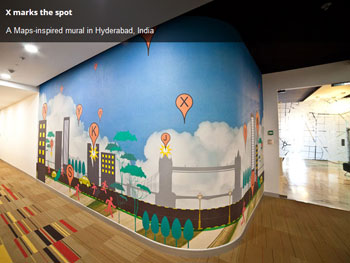
    A Google Maps-inspire Mural in the Hyderabad office. Photograph courtesy: Google.com

    It may not be the best of times to release a report like ‘The Best Companies to Work for’, given the low morale on the economy front and crunch in job opportunities prevailing in the marketplace. But there are companies that prefer to stand aloof from the depressing lot and would like to be counted as being amongst the best places to work for.


    The Economic Times in partnership withGreat PlaceTo Work have released ‘India’s Best Companies to Work for 2012′. The study throws up a diverse line-up of companies as favourites to work for.  Emerging the number one employer is Google India followed by Intel and NTPC at third. Further, five out of the top 10 companies are multinationals, pointing at the role played by global HR practices in stimulating employee satisfaction across workplaces in India.


    The study has been divided into the Top 50 and Top 25 best workplaces. When analysed further, only two out of the Top 25 Best Workplaces are companies which are new to the list of Best Workplaces, the rest having featured in the list in previous years. However, similar consistency is not seen in the Top 50 list in which there are 14 companies which have never featured in the list in India before.


    As for the standings, Gurgaon-based Makemytrip occupies the fourth spot, a drop from last year’s third rank. Amongst the media companies, HT Media Ltd is the only player to figure in the Top 25 list and is ranked 16th.


    Reacting to the win, Rajiv Verma, CEO, HT Media Limited, said: “This recognition is a testament to the strength and integrity of HT Media’s corporate culture. A few years ago, when we crafted a set of long-term goals for our company, we embraced the vision of being an ’employer of choice’. The recognition that we received from the study is a compelling sign that we have been moving in the right direction.”


    Other nominees include Cactus Communications that has been placed at number 20, Cleartrip Travel that is placed at 29th spot, Music Broadcast (operates radio channel Radio City) at number 41, Viacom18 placed at number 48 and Vodafone at number 49.


    In the category of Best in Class, Outdoor Advertising Professionals India Pvt. Ltd. achieves the top spot under Advertising & Marketing; Vodafone India Ltd. is number 2 under Telecommunications; Godrej Consumer Products Ltd., Procter & Gamble, Mars International India Pvt Ltd. and Mother Dairy Fruit & Vegetable Pvt. Ltd. are selected under FMCG; and Google India under IT.


    Some prominent companies that came up trumps across 22 sectors include: Vodafone India in Best Company in Large Organisations (more than 10,000 employees); Makemytrip, Cactus Communications & Cleartrip Travel Services under Professional Services, and HT Media Ltd and Viacom18 Media under Media.


    The study

    TheGreat Placeto Work® framework is based on over 27 years of research of the best workplaces across the globe from employees’ point of view. Some key trends spotted include: overall employee perception of their workplace culture has not changed significantly from 2011 – this is true for all companies, the Top 50, and Top 25 best workplaces in the Study. Thus, while individual companies may have done well or poorly in building trust with their employees, the workplace culture in India Inc., as perceived by their people, remains the same.


    Positive perceptions about their workplace culture continues to be high for senior management category compared to supervisory staff, with 7 per cent less supervisory staff giving positive feedback about their workplace culture. The study further reveals that 75 per cent of employees are below 35 years of age. While they are the majority in most organisations, their views about the workplace culture are significantly less positive than employees over 45 years in age. Only 20 per cent of employees, on an average, have worked in the same organisation for more than five years. There is a slow but gradual improvement in employee perception as one stays longer in an organisation, the study notes.


    As in the previous years, the Top 50 best workplaces are concentrated in Mumbai, NCR and Bangalore, but also have representation from Chennai, Pune, Hyderabad and Ahmedabad. 35 of the Top 50 have more than 1,000 employees, with 14 out of 50 having more than 5,000 employees. Only 7 of the Top 50 Best Workplaces saw employee increases of more than 30 per cent in the previous year, and 6 actually reduced their workforce.


    Also, the percentage of women continued to be low with only 5 of the Top 50 employing more than 40 per cent women employees. Women constitute less than 10 per cent of employees in seven of the top 50. Only three of the Top 50 have more than 30 per cent of their senior management as women. While 15 out of Top 50 best workplaces have employee attrition of over 20 per cent, however, in all major industries, attrition for the Top 50, on an average, is less by one-third to two-third of the industry average.


  • What makes Google top ‘best companies’ list

    By Devina Sengupta


    It is difficult to pinpoint what exactly gives a giant corporation like Google its famous startup culture. Perhaps it’s the independence people enjoy, the absence of red tape or the freedom to disagree.


    Or it could be that the search giant has managed to pick the right lot of people – those who can come up with next big idea, or better still, help a colleague come up with it. And this becomes glaringly obvious to those for whom Google was not their first employer. Ramesh Ravishankar had worked with other firms before he joined Google Hyderabad and realised that this was a wholly different workplace.


    “Bosses work closely with you and you are never penalised for your failures,” he said. This is starkly different from most other companies where numbers and targets are paramount and there is no excuse for not achieving them. “We are in the business of selling ideas,” said Rashi Tyagi, who works for Google’s online sales team.


    A lot of the credit for creating this culture goes to Google’s hiring policy. The company is not always looking for the smartest candidates; it wants people who fit in and that gets gauged by the peers, juniors and bosses in an interview. When Jayashri Ramamurti, currently head of people operations, first walked in for an interview, she was interviewed by her (future) juniors before being accepted at Google.


    “They wanted to know my views on the compensation structure,” she recalled. While this was an unusual experience for Ms Ramamurti, she eventually realised why it was necessary. Google wants people who seamlessly fit into its culture. That’s why it pushes its employees to ask their friends to join them. It takes time for new people to settle into any organisation but if they’re known to employees, the transition becomes easier.


    Newcomers are given six months to watch and absorb Google’s ways of working before being put on a team. Mit Koradia said this led to a smooth transition for him, “Despite being surrounded by IIT and IIM graduates, I wasn’t uncomfortable with the transition at all. On the contrary, I was made to feel comfortable from day one.”


    Teams play a central role in the professional and personal lives of Google’s staff. Whether it’s a query on income tax or a piece of code, all one has to do is create a discussion thread online and the solutions come pouring in. Ms Ramamurti just returned from the US with medicines for an employee she had never met, after seeing a request on one such thread.


    Similarly, when Rashi Tyagi and her US-based colleague faced a roadblock in their project, they needed some clarifications from their Tel Aviv team. Within a few hours, they were patched on to a video conference with the team from Israel.


    At Google, roles are defined but not rigid. The company likes to whet the risk appetite of its employees by challenging them. Ayesha Chauhan was accepted as an account planner and within a few months, was moved to a specialist role, despite being relatively new at the firm.


    During appraisals, metrics are clearly defined and regular one-on-one sessions are arranged so that there is no haziness at the end of the year. The firm is making its reward system more frequent, flexible and fast so that employees will be rewarded for good work immediately. Every business decision has the HR as business partner to ensure that it remains about the people and not merely markets.


    Even the washrooms echo the entrepreneurial spirit of the company with zero per cent attrition. A poster featuring a Google employee talking about his working style is slapped behind the restroom doors. He says: “Keep doing your own thing. Till they fire you”. And firing someone for an idea, no matter how bizarre, is simply not Google’s style.


    Source: The Economic Times

    Copyright © 2012, Bennett, Coleman & Co. Ltd. All Rights Reserved


  • Ranjona Banerji: Foreign media is only credible observer of Indian politics

    By Ranjona Banerji


    There is now only one credible observer of Indian politics – the foreign media in India. We cannot fully assess if a politician is good or bad until a foreign journalist pops by, talks to a few taxi drivers and Indian journalists and then writes a complimentary (good) or scathing (bad) comment piece.


    Now, you’re thinking, aha, sour grapes but far from it. It is all a question of perspective. Indian journalists, especially in Delhi, are too close to the centres of power. They are so familiar with what’s going on and party to so many secrets that they now spend more time discussing whether the blue in Manmohan Singh’s turban has changed in the last eight years. (Some say yes, some say no and the rest are fence-sitters.)


    The foreign media however comes in from far away and has no clue about all this inner stuff. They attend a few parties (these are vital sources of information and political analysis, as those who read through the diplomatic cables made public by Wikileaks will know), meet a few Indian print journalists (bluer, paler, maybe both), they may meet a few TV journalists but that’s for entertainment since they have no political perspective, although I hear they throw really good dinner parties. And, obviously, the few taxi drivers. This is imperative as every traveller knows – one taxi driver can be equal to at least five other potential interviewees.


    Yesterday, I met a cabbie in Mumbai who told me that Indian politics turns on Uttar Pradesh. Now I know. If these foreign political commentators are really smart however, they will never even leave whichever country they come from (usually the USA or the UK). How else have I become a world renowned expert on Barack Obama and David Cameron? (Actually, by watching Comedy Central and Graham Norton.)


    Therefore we now know that Prime Minister Manmohan Singh is a poodle, useless, confused and steeped in doom and gloom. Everyone has said it from Time to the Economist to The New York Times to the Independent.


    The poodle reference can be translated in Indian terms to a puppet. Yes I know, Indian commentators have been saying that for years. But what do they know, eh? (On the other hand, their view has now been authenticated!) Meanwhile I must be off to watch a few more skits on Comedy Central so I can hone my analytical skills.


  • Getit gets Aidem for corporate ad sales

    By A Correspondent


    Media consulting, marketing and advertising sales company, Aidem Ventures, has announced its appointment as the corporate advertising sales representative for Getit for the next 5 years.


    Getit originally pioneered the concept of Yellow Pages in India and has now transformed into an integrated digital media organization specializing in local search and classifieds. It is India’s leading ‘directional media’ platform providing quality leads to businesses and brands, across media and devices, thereby helping their business grow.


    Announcing the appointment, Sidharth Gupta, CEO, Getit Infoservices (P) Ltd. said: “We have appointed a strategic sales partner in Aidem and going by their track record and level of commitment to their partners, we are confident that we can take our business to new heights. The search advertising industry is one of the fastest growing industries in India and trade analysts have pegged it to grow 5 folds in the next year. We at Getit want to ensure that we set the pace for the growth of the industry and appointing our sales partner is a big step in that direction.”


    Through this mandate, Aidem will be responsible for marketing Getit’s synergistic product suite to leading brands, agencies and corporates. While Aidem will be responsible for services to large corporate clients, key brands and agencies, GETIT will continue to sell directly to its SME clients in over 70 cities, through its 1200+ strong sales force.


    “We are excited with the mandate to enhance the advertising potential of Getit that will provide brands with a perfect platform for a sustained engagement with consumers. This partnership also complements our plans to expand Aidem’s footprint in the digital and new media space. It is our constant endeavor to enable the Indian advertiser base to explore lucrative media platforms,” said Kaushal Dalal, Executive Vice President, Aidem Ventures.


    “The effectiveness of creative advertising is significantly enhanced when used in conjunction with Directional ad spends. Getit has tremendous potential and we are glad to be associated with it”, added Neena Dasgupta, Head, Digital & International Business – Aidem Ventures Pvt. Ltd.


  • Good news! End-season sales lure shoppers back to malls & high streets

    By Rasul Bailay, Sarah Jacob & Sagar Malviya


    After a lull of more than two months, Indian shoppers are thronging malls and high streets once again, lured by the end-of-season discount sales, and bringing some relief to nervous retailers.


    Retailers say early signs are encouraging than the same season last year, although these are early days and total actual sales numbers cannot be predicted yet. “So far it has shaped better than last year,” said Kailash Bhatia, chief executive of Pantaloons department chain.


    Dipak Agarwal, chief executive of DLF Brands, that markets products of brands including Mothercare, Mango, DKNY, Alcott among others, said the average sales at the brands under the company’s portfolio doubled in the first week of July compared to the same period in June when the discount sales had not started.


    Retailers have been nervous about whether shoppers would open their wallets amid a slew of negative news on the economic front such as increasing fears of below-normal monsoon rains, slowest GDP growth rate in nine years, US President Barack Obama expressing concerns about India’s investment climate, increasing food prices and prevailing high interest rates.


    After lukewarm sales in May, many brands including Arrow, French Connection and Puma advanced the start of their end-of-season sales to the last week of June instead of the traditional July.


    Now, with a whole host of other retailers joining in with discounts, consumers are back in the street in large numbers, causing traffic jams in main shopping areas this weekend.


    At the Noida Sector 18 market near Delhi, for example, hundreds of shoppers were driving up and down this weekend looking for a parking space.


    “It seemed I was shopping in the US. The sale looked genuine. I bought two Lee and two Wrangler T-shirts, two pairs of Albatross leather shoes and five pairs of sandals for my six-year old from Lifestyle and I paid just Rs7,500,” beamed a shopper holding a clutch of shopping bags at The Great India Place, the largest mall in Noida.


    DLF Brands’ Mr Agarwal says many retailers were apprehensive of the slowdown and through early sales they were trying to avoid an inventory build-up. And he expects consumer spending to remain high in the coming months.


    Jitendranath Patri, head of marketing at Central, a department chain owned by Future Group, shared Mr Agarwal’s optimism. “There is a long festival season starting from August and consumers will have something to celebrate each month during Ramzan and Diwali,” he said.


    Others such as Arvind Lifestyle Brands CEO J Suresh and Indus League Clothing CEO Rachna Aggarwal, however, warn that the positive response to discount sales need not necessarily mean that the good run will continue post August when most of the sales are over. “End-of-season sales never gives the true picture,” said Mr Suresh. “It is more important to see if sales will stabilize after the discount sales period or if a slowdown will continue,” he added.


    Mr Bhatia of Pantaloons said more and more customers now wait to shop during the sales seasons. Almost 30 per cent of Pantaloons’ revenues are generated during the discount seasons for the last four-five years.


    While the footfall has grown this discount season, Mr Patri of Central said the average ticket size of a Central customer too has increased to 2,500 this from 2,300 last year, making it a double whammy.


    A spokesperson for German sportswear brand Adidas AG said the company was expecting double-digit growth at its like-to-like stores during the sales season and it has achieved that target.


    Lavina Rodrigues, marketing manager at Metro Shoes Ltd, which sells multi-brand footwear through 175 outlets across the country, said the company is yet to gauge the sales records for the two-day flat 50 per cent sale this year, but indications are it is same as July last year. She says Metro is generally able to sell almost 60 per cent of the old stocks during the sales periods. In some cities like Rajkot, where consumers are more receptive of the discount season, the company would get rid of almost 85 per cent of the old stuff.


    Source: The Economic Times

    Copyright © 2012, Bennett, Coleman & Co. Ltd. All Rights Reserved


  • ITV to see NewsX get scale with substance


    By Shruti Pushkarna


    It’s been in existence for just a little over four years, but has been making news even before it was launched. Indeed the X factor in NewsX has been the exits – if not those of key staffers running the the channel, then the promoters owning it. In the case of promoters, not once, but twice over.


    The latest is that INX News Pvt Ltd which owns and operates the English news channel NewsX has been acquired by Kartikeya Sharma-led ITV Group. The takeover was officially announced in a press communique which issued late last night and announced to the staff in the afternoon.


    Speaking on the occasion, Mr Sharma said, “This is a logical market expansion for us and enables us to enter the English news domain while strengthening our presence in the broadcast and digital media space.  NewsX has emerged as a quality news provider with great growth potential and making it part of our group’s network of seven regional news channels will bolster news gathering abilities and create multiple synergies all around.”


    ‘Competition, not clutter, in English news TV’


    Kartikeya Sharma took time out from meetings with NewsX staff to speak to MxMIndia’s Shruti Pushkarna on his plans for the channel and the changes he intends to initiate.


    Excerpts from the interview:


    What are your plans for NewsX?

    We intend on getting NewsX back on track. We want to distribute the channel properly everywhere. And we think that the content of the channel is pretty good, it’s just that for whatever reason it’s not been visible everywhere and it’s not been distributed everywhere, so we are going to fix that.


    Will there be any kind of content and resource sharing between the channels, NewsX and India News?

    Yes, there will be because we already run seven regional channels at the moment and we are expanding that portfolio also to 14 in another six to eight months. So there’s a lot of synergy that comes out of it. There’s a lot of infrastructure asset that can be shared, lot of content which will be shared. It even becomes a more attractive offer for planners and other people to pick up a product which addresses different TGs and different age categories and different genres. So it completes our bouquet. We were expanding our regional footprint till now and this will add as a national product that w did not have.


    But there’s already so much clutter in the television news space, how do you intend to make a mark with NewsX now?

    The clutter in the English news market is far less than the Hindi news market. We have five news channels in the English space, whereas you have more than 25 in Hindi. It is a competitive environment but I won’t call it clutter because clutter would be perhaps the right word for the Hindi news market. Yes, it’s competitive, but I still feel there’s a need for a good English news channel which is distinctively different. NewsX has always done things differently and that’s one of the major reasons for us to acquire it, and we’d like to continue that kind of editorial approach which is not about creating too much noise or sensationalism, it’s about reporting things how they are and letting people form their own opinions.


    What changes are we going to see in the leadership…any changes at the editorial level?

    At the moment everything is the way it is, we’ve just taken over and it’s too early to make any comments. But yes, right now everything stays the way it is.


    NewsX has seen a couple of management changes in the past as well but unfortunately the channel never picked up in that sense…what changes can we hope for this time?

    At the moment we are not looking at any changes, it’s too soon for us. The channel has always been very good, I have always watched it and liked the content, it has a differentiating factor to it. The only problem is that it’s not been visible everywhere. No matter how good your content is, if it’s not visible everywhere then you will really miss out. Let’s say you’ve got an exclusive story and you can’t take a lead on it because others will hijack it immediately and take the credit for the story even though they didn’t break it. So this acts as a real dampener for the team which has worked hard to get the story on air. We’ve got a good team over here, they do a good job in terms of content and we would like to accentuate it rather than make any changes. We will tweak it in the right places, we will give it what we think is missing but the backbone of the organization, the product and the content will remain the way it is.


    Is there going to be a name change…NewsX had announced a change of name to IMN News in 2010…

    We are still undecided on it. We will have a couple of consultants talk about it. At the moment there are no plans of changing the name. If there are, we will definitely put it out.


    You and your family have been involved in the case and controversy around Jessica Lal’s murder and there is a lot of speculation in the media on how this might affect or change the channel’s stand on this issue…what would you say to that?

    Well I don’t know what you are talking about. I have been doing my media business for the past five years and it’s completely unrelated to this and I think it is even uncalled for to bring it up and discuss it at this platform. I am a 31-year-old individual who has been working for almost six years in this industry, I run a successful media company and this is my new acquisition, so I don’t understand how is this related in any way.


    ITV Media (Information TV) is the parent electronic media company which broadcasts 24/7 Hindi news channel, India News. ITV Media is part of the Piccadilly Group also owns runs a print division GMI (Good Morning Media India) that publishes daily Hindi Newspaper, Aaj Samaj as well as a weekly Hindi magazine, India News. ITV Media also operates six regional news channels in northern and central India.


    Vinay Chhajlani

    NewsX, which was earlier owned by INX News, was launched with much fanfare in March 2008. Later in January 2009, it was bought over by Indi Media Network, a partnership between then Nai Dunia pr0moter and CEO Vinay Chhajlani and Businessworld Editor Jehangir S Pocha.


    In a joint statement Messrs Chhajlani and Pocha said, “We are happy to hand over the channel to the ITV Group and acknowledge the contribution of the team that has earned NewsX much recognition.  Being part of the ITV Group will help NewsX transcend the limitations of being a standalone channel and give new thrust to the channel’s editorial and commercial development.”


    Jehangir S Pocha

    While Mr Chhajlani’s association with the channel ends with this acquisition, Mr Pocha is likely to continue in his editorial position. Speaking to MxMIndia, Mr Kartikeya Sharma said that there will be no changes in editorial roles at this point of time. He said, “At the moment everything is the way it is… we are not looking at any changes at the moment. We’ve got a good team over here, they do a good job in terms of content and we would like to accentuate it rather than make any changes.”


    Mr Pocha met with the staff in his office yesterday to announce the takeover by ITV Group. He met with the employees and addressed their concerns with the management changes that will come about with the acquisition. Mr Pocha assured the worried staff that there won’t be any lay-offs following the management change. Soon after, the new owners, Mr Sharma accompanied with Mr Satish Jacob (Former BBC journalist) met with the staff and assured them of a smooth transition. Addressing the NewsX team, Mr Sharma said that he liked the content and style of the channel and there will be no changes in that.


    Speaking to MxMIndia, Mr Sharma said that this acquisition completes their bouquet of products. He said, “We were expanding our regional footprint till now and this will add as a national product that we did not have.”


    Commenting on the acquisition, Ms Anita Nayyar, Director (Customer Strategy), BCCL said, “With too much clutter in any genre today, the outcome is going to be consolidation. Television channels – especially in the news space — need deep pockets to run as there is recurring costs involved. Therefore, I think the development is going to work as an advantage for both as they’ll be able to combine and share their resources.”


    Mr Sundeep Nagpal, Founder Director, Stratagem Media added: “The ITV Media which runs two regional news satellite channels, India News Haryana and India News Bihar and a print venture in Aaj Samaj have a very regional presence. They are only popular in Chandigarh and surrounding areas and are doing fairly well there. Buying out NewsX means getting an English news channel into the kitty and for them this means a national footprint. As for NewsX, it’s known that the channel wasn’t performing well in the genre. So, maybe this move will work for both of them.”


    NewsX has been reportedly in the market for a while now and although it has received positive reviews for its content, the channel hasn’t done well in terms of ratings and revenues. While the latest acquisition brings hope for the channel, there is a lot of speculation in the media on the new owners of the channel.


    So, who’s Kartikeya Sharma?

    An Oxford Graduate with BSc Honours in Business Management, Mr Sharma went on to complete his MBA from King’s College, London. In 2004 he took over as Managing Director of Piccadilly Group. He is credited with the launch of the media verticals, Good Morning India and ITV. Under his leadership, a new satellite channel Indianews Haryana was launched in September 2009 and within four months it became the No 1 new channel in the state of Haryana.


    Mr Sharma is the son of leading Haryana Congress leader Venod Sharma and the brother of Manu Sharma, a convict in the Jessical Lal murder case. Soon after the acquisition was announced, there were discussions within the media on how the new ownership will impact the channel’s stand on the controversy around the murder case.


    MxMIndia posed the same question to Mr Sharma and he replied, “I have been doing my media business for the past five years and it’s completely unrelated to this and I think it is even uncalled for to bring it up and discuss it at this platform. I am a 31-year-old individual who has been working for almost six years in this industry, I run a successful media company and this is my new acquisition, so I don’t understand how is this related in any way.”


    MxMIndia spoke to a few journalists who have worked with ITV’s media properties in the past and currently, and they too endorsed the editorial independence that Mr Sharma facilitates. “There was no taboo on covering anything and there is little interference,” a former editor told MxMIndia.  The challenge for companies like ITV, a senior staffer currently working with one of the channels,  said was in managing the company professionally.


    That we guess is a prerequisite for all media companies, and not just for NewsX.


    With inputs from Meghna Sharma and Bureau


    The eXit Timelines


    Peter Mukerjea
    Vir Sanghvi
    Arup Ghosh
    Vinay Chhajlani

    March 2007: Former Star India CEO Peter Mukerjea sets up INX Media which owned INX News. Former Editorial Director at Hindustan Times, Vir Sanghvi was the then CEO of the channel.


    January 2008: Vir Sanghvi quits as CEO of NewsX even before the channel went on air.


    February 2008: Arup Ghosh takes over as the Newsroom Head. Arup Ghosh held senior positions at channels like NDTV, Sahara Samay and Channel 7 in the past.


    March 2008: NewsX is launched, the channel goes on air under Arup Ghosh’s leadership.


    January 2009: Indi Media Company Pvt Ltd, a newly formed company by Vinay Chhajlani, the then promoter and CEO of Naidunia and Jehangir Pocha, Former Editor of Businessworld, buy 100 percent stake in INX Media.


    April 2009: Arup Ghosh exits NewsX as Newsroom Head. A set of lay-offs follow.


    September 2010: NewsX announces its intention to re-brand and re-launch the channel as IMN News


    February 2012: Zee and NewsX talks fail to acquire channel


    July 2012: INX News is bought over by ITV Media.


  • Biggest driver of change for women has been education: Ambika Srivastava

    With nearly three decades of experience in senior positions at agencies of repute like JWT, Lintas, McCann Erikson and the Publicis Groupe, Ambika Srivastava, Chairperson, VivaKi Exchange India, has been instrumental in bringing media planning and buying out of shadows and propelling its growth.


    In this conversation with Shruti Pushkarna of MxMIndia, she focuses on understanding women’s preferences and priorities, marketers’ need to understand them well, and their increased role in making purchase decisions.


    [youtube width=”400″ height=”225″]http://www.youtube.com/watch?v=DUxJ7mzohF8[/youtube]

    Q. It is often stated that women have a very different set of priorities, preferences, and attitudes vis-a-vis men? What is your take on this?

    Yes, women are different. However, some priorities are the same. If you take the example of looking after the children, it’s as big a priority for a mother as it is for a father. I believe there are some universal issues that are as important to men as they are to women. But, yes, the way a woman will deal with something would be very different from the way a man would deal with it.


    There are inherent differences – even at the workplace you will notice that women tend to approach things a little more intuitively than men, who are far more rational. Women tend to be more emotional, they have the benefit of intuition or emotion, whereas men look at life very rationally.


    Q. Do the marketers need a specific skill set to reach women effectively? How would you define this skill set?

    I think the key issue is understanding your consumer, and using that understanding to create powerful way of connecting with your consumer. Marketers do need to understand women – what motivates them, what are their aspirations, what is it that inspires them… So, you need to develop knowledge that is perhaps a little women-centric.


    Q. What in your view are socio-economic forces behind the growth of women as purchase decision makers?

    I think the biggest driver of change as far as women are concerned has been education. And this is not just in India, it’s across the globe. Education has driven them to seek better opportunities, many more women are working today. They are financially independent, and that independence has given them a sense of power and a sense of responsibility. It has allowed them to actually live their dreams.


    Q. What are the key sectors that have gained with increase in purchasing power of women?

    Many sectors have gained. To name a few, I would start with education, because today every mother wants to educate her child – not just in middle income homes but even in the socio economic strata at the bottom of the pyramid. They want their daughters to study and to be able to stand on their feet. So, education is a sector that has benefitted immensely. Women today are more conscious about how they appear at the workplace, so personal care has become a big thing. Apparel, garments etc. too have grown as a big sector. Then you have luxury and leisure sectors – women want to spend on themselves.


    Having said that, it is not just categories that pamper women or address their specific needs.  The fact is that many more women can afford to buy a car or house for themselves, and so Auto and Real estate too have benefitted. And of course, the fast growing category off mobile telephones too have gained.


     Q. Does it make sense to define a set of women as ‘Primetime’ women – and use Primetime TV as the medium to reach them?

    There are two ways of defining primetime, it’s when the largest number of women can be reached. The other criteria is trying to see when is it a good time to reach women when they are not distracted by anything else. We have to remember that women are multi-taskers. Is primetime the ‘me time’ or is primetime simply the largest number of women? If I were to look at the largest number of women, that would be when you have both sets of audience available, working women and the homemakers, and this would typically be in the evening. But if we were to look at the ‘me time’, then perhaps the audiences that you can reach out to through afternoon television or through magazines, would be what I would call ‘prime time’. That’s the best way of connecting and engaging with women consumers.


    Q. You are one of the biggest success stories in media business, what would you attribute your success to?

    I think hard work.  More importantly, I have been very fortunate and blessed because I’ve had a great team. I have worked with some wonderful people who helped me do the right things. Also, I would like to attribute my success to my family that has helped me, and supported my efforts.


    Q. Has being a woman ever been a hindrance?

    Never! I think it is not about being a woman, it is about being a professional. And I feel very strongly about the fact that women tend to get evaluated amongst a set of women professionals. If you are a good professional, regardless of whether you are a man or a woman, you should be actually in that league. So it’s not Top 10 ‘women’ in advertising, it’s Top 10 ‘people’ in advertising. And personally I have really never had a problem.


    Q. What would be your message to new entrants in the media fraternity?

    I think this business is really exciting and very dynamic. Having said that, it’s extremely demanding.  I  believe that people who are getting into the profession need to be prepared, it is a tough profession. You have to be very focused. It’s not just demanding physically, it also demands a lot emotionally and intellectually. Once the new entrants are ready for that, they will be able to strike a good work life balance which can help them really do well.


    Q. The last question, how would you define a Diva?

    My definition of a Diva is somebody I admire, and someone who would inspire me. It doesn’t necessarily have to be a celebrity. I have come across girls who are full of grit and great spirit, who have achieved a lot very young in their life, fought against the odds. And I think from that spirit, there is a huge inspiration. Again in my own office, I find women who are amazing at ideation… at meeting really tough deadlines. So for me, it doesn’t have to be somebody sitting on a pedestal, you look around and you should be able to find that inspiration. That’s really my definition of a Diva.


  • Marketers are targeting women in more and different ways: Lynn de Souza

    By Ritu Midha


    It is an oft-mentioned fact that Indian women have taken a generation’s leap, and are making steady strides towards exploring their full potential. This, indeed holds more true of the urban woman than her rural counterpart – and here too her ambitions and aspirations differ from one social strata to another, Nonetheless, evolved she has.


    In this interview with MxMIndia Diva Upclose, Lynn de Souza, Chairman and CEO, Lintas Media Group, a woman of great substance, reflects on the Indian women of today, her changing role in the society, and also the women power in media industry.


    In your view, how are women defining the new Indian marketplace today?

    Women, today, are playing a much bigger role in consumption of products of all kinds be it services, durables, etc than they were doing maybe twenty years ago. They are involved in purchase decisions which require large investments that may include purchase of a house or even a car. Certainly, when it comes to decision regarding durables in the kitchen, and home furnishings etc, women were always at the forefront of decision making and the same was the approach in case of consumer bill items like food. But when it comes to things like financial investments like higher education of children, these were not under her domain earlier. But research shows that a woman today is an important decision maker, an important influencer – and in many cases actual user in these categories and more. And most marketers are, of course, aware of it.


    Would you say she is evolving at a much faster pace than her counterpart, man?

    The progress that women have made is phenomenal. To give credit to women all over the world, and specifically women in India, they have made progress against all odds. It is not easy in a society where women were not treated on equal footing with men, to come out and perform so well. One expects them to shine in a few sectors, for instance soft ones like nursing, education and services. But in hardnosed professions like politics and finance, it is laudable to see women being there right at the top. It has a lot to do with the education system as well. How much ever we may decry it but women have benefited from it. It also has got a lot to do with the way men have changed in the way they encourage and support women in their career progression. Overall health and growth of economy too has enabled women to come out of the house and still perform.


    However, our sisters in rural areas still have a long way to go. There is a huge dichotomy – I have seen women sarpanches in some village panchayats doing fantastically well but then there are villages where women and the girl child are still ill-treated. Even in some pockets of urban India, one gets to witness ill treatment of women and the girl child. However, if one looks at a larger picture, women today are in a much better situation.


    Have the marketers taken note of the evolution, and, are they able to keep pace with this evolving consumer?

    Marketers are now targeting more and more women and in different ways. About twenty years back, it was the FMCG companies that targeted women by primarily using women’s magazines and the general interest television, largely soaps. However, more and more products are being launched today that target women, including from sectors such as finance, insurance, educational (for children), two-wheelers, consumer durables, etc. One can even see marketers broad-basing not only their targeting, but also the kind of media they use to communicate to these women.


    I recall the way two girls are depicted in the Stayfree commercial – very outgoing and definitely contributing to a progressive society, wanting to see things changed for the better. It is recognition of how marketers are seeing young girls and women where they are not only looking at bringing about a change in their life, but a change in the society as well.


    Talking specifically of the metro woman – is the upmarket metro woman at par with her counterpart in terms of purchasing power parity?

    I don’t know how you want to define purchasing power parity – there are many ways in which one can do it. If your question is whether a woman can buy as much of products that she likes as a man, I would still say no. She may earn, but not necessarily keep whatever she earns for herself or her children. In majority of cases it goes into the overall household pie. A man is more likely to decide what to do with his income. As shown by research, it is still true for a majority of cases. As for salary levels, I believe that there is a slight difference in the kind of salary a woman earns versus what a man earns in some professions.


    Moving on to the media fraternity, it is observed that women professionals are excelling superbly in the way they run a show. What would you attribute this showing to?

    In the media and entertainment sector, women have done well partly because it is a creative sector and partly because they have a greater opportunity to shine on the basis of their own capabilities.


    In the entertainment sector, women have certainly done extremely well. As for media planning, it is a very small industry. There are about ten or twelve agencies – may be employing 2000 people – out of that many women have made it to the top. Some of it is historical – media planning was more of a desk job and girls got into it in early days and stayed there. Having said that, media is a practical profession and women have done well on that front as well.


    You yourself are counted as one among the best in the business. How would you define your journey so far in the industry?

    My journey has been fairly long – about 25 years. It has had its movements in rotation. I have been in media, in integrated marketing…I have done a bit of healthcare, launched our knowledge portals…I have also been involved in training. Interestingly, I have always come back to media. The whole business of media has changed now, and I am happy to have been a part of the change. In many ways, I pioneered the change and am always happy to contribute in whatever way I can. I can see the media environment completely transforming itself and this has a lot to do with the world going more tech-savvy. It is great to be a student of media now, and that is what I am doing right now.


    Among young women from the current lot, which are the ones that have a promising future ahead of them?

    There are a number of promising young women on the creative side of the media owners’ end who are very passionate, very knowledgeable and really wanting to do something for the society. They are not self-centred. As for the media planning industry I would like to mention Nandini (Dias) and Sudha (Natarajan) – both have completely different style of working – but are extremely talented and are doing very well. Another name I would like to mention is Jasmin (Sohrabji) who again is very talented. In fact we have worked together in Trikaya for three years and I still remember the first day she came into the office to work with me. I knew even then that she has a bright future ahead.


    Lastly, a question that’s a slight deviation from the professional front: how would you define a Diva?

    A Diva is a very special woman who may come from any walk of life – she may be from art, culture, politics or business but what characterises a Diva is her ability to stand out. She has the ability to aspire people to be better people because she herself is an achiever through sheer hard work and talent.

     

  • The Anchor: 5 ways you can never get into a jam in the digital world

    By Saurabh Parmar


    1. Be a good listener:

    Digital is a two way communication medium, so before you start talking, start listening to what your customers are talking.


    2. Now understand:

    Get market research experts and your brand custodians to work on all this data and channel the insights to both your online and offline marketing.


    3. Get together:

    Don’t treat digital in a silo, integrate your touch points both in offline to digital banner campaigns, website, mobile, social media with each other. Integration is not just about giving links but really ‘getting together’ mediums to create a cohesive campaign.


    4. Be useful, fun or informative:

    It’s a crowded world out there with millions of brands and products talking. To connect with your customer make sure your message is either useful (What he is looking for), fun (what he will enjoy reading or sharing) or informative (makes him aware and interested)…just a higher media spend does not guarantee you more customers.


    5. Be real, say sorry:

    We all fu ** up, it’s better to admit it and rectify it rather than your customers creating a petition about you or criticizing you on blogs. Even in the virtual world genuineness is appreciated, especially if the response is prompt and correction faster.


    And the sureshot way…hire a better agency: Well the shortest and the easiest way of course is to hire a better agency


    Saurabh Parmar is Founder & CEO, Brandlogist


  • Strategy to use TV & radio simultaneously for max impact: Anand Chakravarthy

    By Meghna Sharma


    That regional channels are not a new phenomenon is evident when one surfs through various channels available today. And the available channels don’t seem to be enough as networks have launched, or are planning to launch, regional channels to tap specific target audience.


    So, when Reliance Broadcast Network launched Spark Punjabi, a regional channel for the PHCHP (Punjab, Haryana,Chandigarh, Himachal Pradesh) region, earlier this year, there was no surprise or shock.s.


    Anand Chakravarthy

    Speaking on the role regional channel play for a network, Anand Chakravarthy, executive vice president, Marketing, RBNL and business head, Big Magic said: “India is not one country, but is formed of various countries. And in the past five-six years, there has been an increase in number of regional channels. Traditionally, only southern states had separate channels, but today the markets have opened up in other states too. And this is because of availability of better quality content.”


    Localization of content has helped channels and networks to know and capture their TG well. Mr Chakravarthy states that it’s not only regional channels which are going local, but also national Hindi GECs too. “Take a look at any primetime show on a GEC – you’ll be seeing the differences – right from costumes to language used by the characters is localized as well as the story of the show. This is because even GECs know that if they do so, it becomes more relevant to a certain set of audience.”


    The network wants to give its audiences a very local feel and want to be seen as part of the region. “We show dubbed international shows, along with specially created programming because it helps us reach our audience better. It’s our USP. And we’ll continue to make shows which are very regional in their approach.”


    However, what is unique about the Reliance Broadcast Network is its strategy to use radio and TV simultaneously to strengthen the hold in a region. “We do a lot of marketing on our radio stations which helps a show’s launch on television, as it is able to create a lot of buzz. We plan to strengthen our regional footprint and our strategy is to launch in regions where we have very stronghold as it will help us and also form a unique advertising  offering which will get us advertisers and help us grow as well,” pointed out Mr Chakravarthy.


    And this is why the channel – Spark Punjabi – along with 92.7 BIG FM, came together to conceptualize BIG Boli Star - a talent hunt contest aimed at promoting Punjabi Boliyaan (a traditional Punjabi form of art). “Punjab has a very rich traditional art forms and Boliyaan have been passed down from generation to generation. Spark Punjabi and 92.7 BIG FM are ensuring that this traditional art continues to flourish, both in the rural and urban areas of the Punjab region. The BIG Boli Star talent hunt is creating a new wave of enthusiasm for traditional Punjabi culture as well as bringing new talent to the forefront.” The show is currently the no 1 reality show in Punjab and was able to deliver a 0.77 TVR in the CS4+ category (week 27).


    The network also plans to launch more regional specific shows as well as two more regional channels in the coming few weeks.