Author: mxmadmin

  • Metro Tyres unveils new visual identity

    By A Correspondent


    Metro Tyres Limited unveiled a new logo along with a new advertisement campaign. The new identity is designed to profile Metro as a company that understands youth aspirations and reaches out to young people, India’s dominant demographic segment, with cutting-edge products.


    “Metro Tyres has evolved significantly over the years with a view to stay ahead of the dramatic changes in the Indian business sector. Today, our company is present in more than 53 countries and is the largest exporter of bicycle tyres and tubes from India,” said Rummy Chhabra, Managing Director, Metro Tyres Limited. “Our new visual identity consists of a re-designed Metro name, appearing in italics to represent motion and speed. Complementing the logo, our advertisement campaign is a story of transformation: from a child to a youth. In doing so, it reflects who we are today and the company we aim to be tomorrow.”


    Metro has an exclusive tie up in two wheeler tyres with Continental, Germany, one of the world’s largest tyre companies. The link with Continental provides Metro with distinct advantages: access to the latest technology in the field and exports to the most advanced economies of the world including USA, Canada and the European Union under Continental brand.


    With a market share of 24 per cent in India, Metro Tyres manufactures close to 30 million tyres and 30 million tubes annually in its seven state-of-the-art plants inNorth India. It is the supplier to Honda Motorcycle and Scooter India, Bajaj Auto, Piaggio, Suzuki, Hero Cycles, TI Cycles, Atlas Cycles, Avon Cycles, among others.

  • Anil Thakraney: BBH must remain the black sheep

    By Anil Thakraney


    So, Sir John Hegarty has sold out his cult hot shop to the Publicis Group. The latter already owned a substantial stake in BBH, but now it’s a complete buy-out. How this acquisition will impact the future of BBH, only time will tell. It will all depend on how the new parent handles the adopted baby.


    BBH definitely gains from the acquisition in terms of financial muscle power. The ’boutique’ agency will now have a lot more moolah in its kitty to play around with. So that’s the good news. The bad news however is the agency has lost its independence. How much ever Publicis claims they will leave BBH alone to carve its own future, the ground reality is that as people change, as leadership changes, and as egos clash, this reassurance can change too. When push comes to shove, the ultimate power lies with the man who signs the pay cheque. That’s the new reality BBH now wakes up to.


    There’s another, larger issue to worry about: Sir John Hegarty and his partners will have run into serious personal money with this acquisition. Good for them, and they do deserve every penny of it. But it’s also a fact that Hegarty isn’t getting any younger, and BBH could come under a cloud when he retires to his farmhouse. Which is likely to happen pretty soon, within the next two years to be precise. As long as the Big Man is around, the Publicis suits will resist the temptation to interfere. Once he’s gone, it’s anybody’s guess how things will pan out. Suffice to say this: BBH, in its new avatar, won’t find it as easy to attract hot creative talent as it did till yesterday. It’s a pucca family member now.


    [youtube width=”400″ height=”225″]http://www.youtube.com/watch?v=MZtDqpdvy7s[/youtube]

    Publicis’s best bet is to allow BBH to maintain Hegarty’s famed ideology, even after Hegarty walks into the sunset: ‘When the world zigs, zag.’ They poke their neck into this and try to tweak it; BBH will immediately lose its magic and turn into just another ad agency. And that would be a pity.


    * * *


    PS: Heineken’s new ad. It’s a simple idea: ‘The perfect beer calls for the perfect bar.’ But the magic has been created by the art director and the production designer. A good example of how superb art direction can really lift a film. I feel like a Heineken already!


  • Maa network goes aggro on OOH

    By A Correspondent


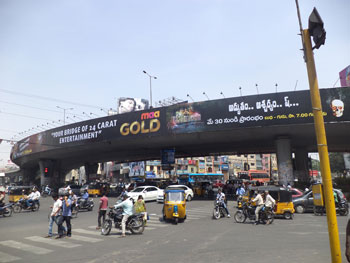
    To target all the sections of Telugu viewing population in Andhra Pradesh, Maa TV has gone out on the streets to promote their programs using the outdoor medium. The channels have been heavily promoted using flyover bridges, unipoles, centre medians and other offside promotions include train & bus branding too. The total outdoor units used are 200 Hoardings, 200+ Centre Medians across Andhra Pradesh.


    The highlight of the campaign was the selection of specific locations to place the outdoor creatives that have additional cut out of characters in heavy traffic areas.


    The channel was promoting their upcoming annual awards function, Cinema Awards 2012 heavily and also 2-month long programs that are running on Maa Gold.


    Maa Television Network has promoted all their programs in major parts of the state -Hyderabad, Vishakhapatnam,Vijayawada, Tirupathi and other few towns. It will be top among the GECs in Andhra Pradesh promoting the programs in a huge scale.


  • The Anchor: Naved Akhtar on 5 things that have changed in advertising

    By Naved Akhtar


    1. Advertising has become a business:

    The pressure to perform is so high that many times creativity is given a miss. There is a role reversal – earlier the creative people were held in high esteem, now the client has become the one leading the show. Advertising has become a business with roles being changed.


    2. Work for awards v/s real work

    There are two different kinds of work that has emerged. The work that is done to purely win awards and then there is real work that is done to drive the product in the market. Twenty years ago one would see the same ads that were have worked for a business also winning awards but now there is just no connect. I think that now the award winning works are more like fine arts and done for self-exultation.


    3. The aura gone from advertising

    In the earlier days, the creative fraternity had an aura around themselves; and were respected for their creative genius. Now advertising is seen as just any other business and the appeal that people emanated who were a part of the business has gone.


    4. TV has become important

    Today television has become ‘the’ medium for advertising unlike earlier where press was given more due.


    5. Fun is low

    I think the fun has gone out of advertising because of pressure of work, win new businesses and remain ahead of competition. There was a time when people were into advertising for love of advertising now this is purely business and means of earning bread and butter.


    Naved Akhtar is the Founder at Shop Design and Advertising


  • Madison gleams with Crompton Greaves

    By A Correspondent


    Madison Media Sigma has just announced the win of Crompton Greaves Ltd. The agency will handle its entire range of products including fans, lights, lighting fixtures, pumps and electric appliances.


    Said Sam Balsara, Chairman & Managing Director, Madison World, “We are delighted to add a reputed global engineering conglomerate like Crompton Greaves in our roster of clients and are confident of helping Crompton Greaves get its rightful share and more in India’s growing market.”


    Vanita Keswani, COO Madison Media Sigma added: “I look forward to working on a new and diverse set of categories and creating powerful media strategies for the entire portfolio.”


    Madison Media, whose gross billing is in the region of Rs 3000 crore, was recently in the news for winning Dixcy Textile’s Media AOR.


  • MIB amends law, asks cable trade to furnish correct DAS info or face cancellation/ suspension

    From the MxM Infodesk


    Although the news was flashed by the wires last week, it got official only on Saturday. The Ministry of Information and Broadcasting has decided to amend the Cable Television Network Rule, 1995 (Cable Rules) making it obligatory for every Multi-system Operator (MSO) and Local Cable Operator (LCO) to provide correct and timely information to the Ministry as and when it is sought for.


    The background: The I&B ministry has been closely monitoring the preparedness of various activities for the implementation of Distributed Antenna System (DAS). The success of DAS depends on timely seeding of STBs at the consumer premises. As such, availability and deployment of set-top boxes (STBs) by MSOs / LCOs are paramount important for the implementation of DAS. Timely availability of accurate data with regard to the seeding of STBs by service providers (MSOs/LCOs) is also critical for the Ministry to ensure digital switch over within the timeframe as well as for taking mid-course corrections if necessary. While assessing the preparedness of DAS in four metros, the Ministry has come across numerous inconsistencies of data provided by the service providers, particularly MSOs, in regard to inventory position of STB and its deployment.


    In the Cable Television Network Rule, 1995(Second Amendment) Rule, 2012, a new rule, namely, rule 10A – Obligation to furnish information – has been inserted making it mandatory for MSOs and cable operators to provide information as and when it is sought for by the Central government or state government or authorized officer or any agency of the Central government. The obligation to furnish information under the amended rule 10 A has been incorporated as one of the terms and conditions of registration of cable operator under Rule 5 A and MSOs under rule 11 D.


    As per sub-section (7) of section 4 of the Cable Television Networks (Regulation) Act, 1995, the Central government may suspend or revoke the registration of cable operators or MSOs if they violate one or more of the terms and conditions of registration. Incorporation of rule 10 A as one of the terms and conditions of registration of cable operators and MSOs will empower the Central government to cancel or suspend the registration of cable operators or MSO if the information sought for by it is not provided by them. This, MIB hopes, will ensure correct and timely submission of information by cable operators and MSOs.


  • Stay solo or scale up with a biggie?


    By Tuhina Anand with inputs from Shruti Pushkarna


    Creative hotshops have always co-existed with the bigger networks and every now and then one hears of a celebrated hotshop being taken over by a network. Publicis Groupe, which already had a stake in BBH, has now taken 100 per cent stake in the agency. Considering that BBH is among the most celebrated creative boutiques, the development makes one think that the lifespan of an independent has become short and for them to scale, being part of a network has become a necessity.


    Bharat Dabholkar, who collaborated his agency Zen Advertising with Publicis Groupe in 1999, is very clear that the only way to scale up is to merge with a network. He said: “When we started, we were servicing homegrown brands; but we realized that with global brands coming in, we had a handicap in getting them on board. By being part of the network, we immediately got access to big, international brands. I think it’s a personal choice, if you are happy servicing a handful of clients, then you can remain independent; but if you have ambitions of growing your outfit, then the way ahead is to merge with a network.”


    Also read:

    Anil Thakraney: BBH must remain the black sheep

    “I have also felt that when a client is small in size or have just started with their marketing activities, they will come to a small agency but after having tasted success with grown ambitions, they ditch the small agency and would want a bigger agency on board. They still might continue to work with small agency, but that usually is on few projects,” he added.


    Giving an understanding of the situation, a well-known financial advisor to media groups said: “First of all, it depends on how well the creative hotshop is doing. My view is that if it’s doing well and wants to scale up, the only way to do that is to align with some network. And the network will align only if you are doing well. If you are just a creative whiz who’s not doing well, nobody will go after you. They will go after you only if you can bring something to the table. I think one has to also look at the age profile of the creative guys. If you are young, then you can afford to be in the saddle of a creative hotshop for a long time without considering the possible money that you can make because you can afford to wait. If you are in the mid 40s, then it’s time to sell it whenever you are at your peak. So that’s an important consideration, what stage are you in.”


    The scale a network offers is one way that helps the creative hotshops. The second is the access to full-time retainers with most of the bigger clients. The advisor echoes what Mr Dabholkar said: “Whatever you see or hear of bigger clients working with smaller agencies, it’s not a permanent relationship and it goes from campaign to campaign. So when you have that scale, you might end up being the only agency on the roster. So that’s an advantage. Also you need to look at networks which don’t have a great reputation in India, they would like to go after these agencies. For instance, Ogilvy would not like to go after anybody because they have a good reputation here. Whereas for a Omnicom, which is internationally well-known for its creative body of work, there’s nobody here in India. So the networks also look at it from that perspective, because it will be an image booster for that group in India.”


    But then what about losing one’s independence? After all in most cases the reason the creative people to start their own outfit is the independence that comes with it as opposed to being with bigger agencies. Mr Dabholkar clarified: “As for losing our independent streak being a part of network, my experience was different. Publicis was a delightful network to work with, as it was understood that we had an entrepreneurial streak so they didn’t interfere in our day to day functioning. However, the big help came in terms of sharing knowledge and supporting us with key inputs on businesses.”

     

    Sajan Raj Kurup

    Mr Dabholkar set up a small agency in Tanzania which has seen positive growth. He is not averse to collaborating this agency to a Network; however he feels that latter would not be interested at this point of time as they wouldn’t see much value in that part of the world in terms of advertising. However, he says that such collaboration helps the people who have worked, as it widens their horizon and opens new windows of opportunity.


    So it is clear that to scale up sooner or later, either selling of stake or some kind of collaboration is required. However, Raj Kurup who started CreativeLand Asia is very clear that he wouldn’t want to sell because he clearly believes in the India growth story, though he is open to partnering on his own terms. He is looking at expanding footprint and opening office in London. CLA already has a regional office in Singapore.


    Even Scarecrow Communications that was set up two years back is clear that they have enough going on their own and wouldn’t want to sell stake but are open to collaborating with partners that will help them in maximizing their potential.

     

    Naresh Gupta

    Naresh Gupta, Managing Partner, Bang in the Middle, who along with partners has got on this entrepreneurial venture recently, said: “There is a future for independents, and a big one at that. Yes BBH got acquired, and some more may get over a period of time, but that for me is the process of evolution. BBH did path breaking work, made a name for itself, and as brand will still stand for the same black sheep thinking even if it’s a part of a network. I see the same thing to happen here.


    Independents will be the new force. They are nimble, they don’t have previous baggage, they will take greater risk, be more lateral in terms of business model, and be a challenge to the large networks.


    The larger networks at some stage will always be interested in the independents precisely for the values of thinking different and taking risks. Till the large networks protect those values, it may not even be a bad thing.”

     

    Prasanth Mohanachandran

    Clearly there are both merits and demerits of aligning with bigger players. Prasanth Mohanachandran, Founder Director, AgencyDigi, said: “A network always has one advantage – of scale. The other advantage they have is, when it comes to multinational brands, most of the brand decisions are not taken in India but in other parts of the globe. When independents come into play, learning is going to be tough because it’s actually two companies talking. The good part about independents is that it is easier for them to think beyond conventional framework. Network agencies think through a set framework, there is a standard process for creative ideation. Also, in independents, egos are smaller.”


    Mr Mohanachandran feels that while scale is important, when it comes to talking to different markets, it might be difficult to take an idea across to different international markets. “If you play cleverly there are ways around it. If you have like-minded partners, it is easy to work with independents. They have the power to take an idea across the globe, someday it will happen, but it’s still few years away.  In a network of course, there is a larger pool of experience behind running an organization. There are more people, in a network you don’t have to worry about too many things so that’s always a benefit,” he added.


    So ultimately, it’s a personal choice. You can remain small and thrive or you can have ambitions to scale up where merging with a network seems a better option. Naved Akhtar and Freddy Birdy have been among the most celebrated duo in advertising who quit and started their own agency in 2003, are very clear that they want to remain independent.

     

    Naved Akhtar

    Naved Akhtar, who quit after spending close to 25 years in mainline advertising, said: “For us it was a question of what we want to do with our life. You can grow and keep running endlessly but we wanted to do our own thing, remain independent and enjoy a quality life. We deliberately don’t want to expand but remain small. We have some big clients like ITC and we are comfortable working with them and never felt that our size was an impediment in delivering.”


    Clearly, there is no clear answer to advertising agencies aligning with large networks. To each it’s own, we guess.

     

  • We’ll continue focus on customer delight, says Myntra’s Bansal

    E-tailing in India has seen some brisk business being conducted by a few players in the recent past. While some may brand the space as crowded, there are a few players who have created a niche and are gaining handsome dividends too. Like Myntra.com, that has been consistently doubling its revenues every 5-6 months for the past 15 months and is currently doing over 8,000 transactions daily. According to Mukesh Bansal, Founder and CEO, Myntra.com, the opportunity to offer the widest catalogue across national and international brands, 24/7 shopping, 30 day returns and Cash on Delivery are some of the features unique to online shopping and have helped grow the market.

     

    In an interaction with MxMIndia, Mr Bansal talks about the growth story of Myntra in a crowded marketplace, on the USP that sets it apart from its peers and what are its plans to derive next phase of growth in India. Excerpts:


    What according to you are the factors that are driving the growth of the e-commerce marketplace in India?

    Some factors that are enabling the growth of the e-commerce in India:


    > Internet penetration:India, currently at 120 million users, is one of the fastest growing internet markets in the world and is expected to touch 300 million by 2015. This has led to opportunities for a vast number of businesses to mushroom online. E-commerce is the largest and the fastest growing segments online.

    > Success of online travel sites & ticket bookings: This has led to increased confidence among consumers to venture into online shopping.

    > Convenience: Widest catalogue across the best national and international brands, 24/7 shopping, 30 day returns and Cash on Delivery are some of the features unique to online shopping and have helped grow the market.

    > Investment from VCs and private players: Investors are looking at e-commerce as a long term investment portfolio as the space has shown tremendous potential to become a multi-billion dollar business.


    How would you analyse Myntra’s growth story in India over 2011-12?

    Myntra has been consistently doubling its revenues every 5-6 months for the past 15 months and is currently doing over 8,000 transactions daily. Our daily traffic has grown to over 4,00,000 visits and our network has grown to cover 1,200 towns and cities across the country. With over 350 of the best national and international brands, Myntra is, today, the largest online retailer in the fashion and lifestyle segment.


    We are also one of the well-funded companies in the space and at the current growth rate, we are confident of achieving our target of Rs500 crore by the end of this financial year.


    The e-tailing space is flooded with players offering the same set of user services, what is the USP that Myntra brings to the table? 

    Back in 2010, Myntra took a bold decision to enter the full catalogue, current season segment to retail merchandise on MRP. Along with the largest catalogue of marquee brands, Myntra was able to target untapped markets across the country coupled with on-time delivery and flexible policies.


    Cash on Delivery as a payment option became an instant hit among our shoppers and today constitute about 65 per cent of our overall business.


    Could you summarize what your core TG of online shoppers looks like?

    Our typical shoppers fall in the age bracket of 20-35 years (SECAB) with about 70 per cent of our shoppers being male. About 55 per cent of our shoppers are from tier 2 & 3 cities with the rest in top 10 cities.


    What is the emphasis you lay on the distribution/delivery across India?

    One of the biggest challenges for any e-commerce player is to effectively manage its supply chain and logistics. At Myntra, we are constantly upgrading our processes to provide a hassle free shopping experience while strengthening our in-house logistic network. We are currently operational in over 12 cities across the country and plan to reach as much as 70 per cent of our customers directly via our own logistic network by the end of this year.


    What is the impetus that you are laying on the marketing/communication plans for Myntra?

    Our latest TVC hit the networks in June 2012 across major national channels. We are now entering regional markets in the south with language specific ads in Tamil, Kannada and Malayalam.


    We are also partnering with various other properties that enhance our fashion quotient.


    Do you think e-tailing is gaining ground in India at the expense of other modes of shopping?

    The overall lifestyle category in India is pegged at approximately $50 billion, growing at 16 per cent CAGR. This is one of the largest categories, not considering travel & tourism. The industry is expected to cross $100 billion in 2015 with approximately 5-8 per cent of this being online. This clearly indicates that the market is big enough for both to co-exist.


    What are the challenges in running a successful e-tailing network in India?

    The biggest challenge for any e-commerce player is to effectively manage its supply chain (inventory, logistics etc) and customer experience. Delivery team and customer support being the two main touch point for an online retailer, utmost importance needs to be given to both these aspects.


    At Myntra, we are constantly upgrading our processes to provide a hassle free shopping experience while strengthening our in-house logistic network. We are also constantly training and motivating our CC teams to imbibe the Myntra core values and pass them on to our customers.


    What are your plans for the next phase of growth in India?

    According to recent reports, online apparel will be a $2 billion market by 2015 and we see great potential to grow in this environment. Our investments in technology, brand and supply chain is already paying dividends and we will continue to focus on delighting our customers.


    We are also adding new features on our interface to aid our customers in their buying process and helping them make the right fashion choice with our fashion blog called Style Mynt.


    Social media is a very important platform for us and we are making steady progress with over 6.5 lakh fans on our Facebook page while Twitter, Google and Pinterest are gaining momentum.


  • The Anchor: 4 steps to stay away from misleading advertising

    By Alan Colaco


    1. Backed by a scientific study

    Ads should be truthful and honest. Before making any claim in an ad, there should be a scientific study in support of the claim. This scientific study should be preferably done by an independent government-approved laboratory.


    2. Support by consumer media research company

    If in an advertisement, one is relying at consumer data for an opinion, then the same claim should be supported by a related consumer media research company.


    3. Use clinical research

    When in an ad, one is resorting to technical claim, it should be backed by a clinical research study, and not consumer studies. Suppose a toothpaste brand is claiming that it cleans 99 per cent germs then don’t ask 100-200 consumers their opinion on the claim, but use a clinical research to support the claim.


    4. Disclaimer should be legible

    If there is a disclaimer that has to go along with the ad, then it should be legible and on television it should appear for at least 4 seconds. The disclaimer should also be on a clear background.


    Alan Colaco is the Secretary General of ASCI


  • ITSAnother independent agency!

    By Amit Bapna


    It’s a hotshop called ITSA. Based out of Gurgaon, the core team behind this creative outfit comprises brothers Emmanuel and Daniel Upputuru, Anirban Mozumdar and Vivek Suchanti.


    While Emmanuel and Anirban have worked together closely in their last stints at Publicis India as national creative director and national planning director respectively, Daniel was heading TAG McCann Delhi till he “got tired of advertising” and took off to study anthropology. Now he is back as chief creative officer, ITSA.


    Mr Suchanti, Chairman, Concept Group, who has invested in independent agencies like Scarecrow and Eleven Brandworks, feels “ITSA is a very different idea and it adds to the offerings from Concept.”


    Speaking exclusively, Anirban said: “ITSA Brand Innovations will create innovative products, services and communication platforms with the intent to patent some new product ideas and innovations.” The team’s inspiration comes from global independents like Ideo, Apple, Droga5 and +Castro.


    Some areas in which ITSA plans to apply for patents include automotive, insurance, youth, music and technology. Says Emmanuel: “We already have a prototype ready for the automotive sector followed by one for the financial services space.” The first launch is expected to go live by August.


    Emmanuel, who has worked in a number of agencies from Contract and Leo Burnett to Saatchi & Saatchi and Ogilvy India, is the eldest of the four Upputuru brothers of advertising. The quartet has the distinction of having worked in Ogilvy Delhi at one point in time.


    Source:The Economic Times

    Copyright © 2012, Bennett, Coleman & Co. Ltd. All Rights Reserved


  • Mobile handset revenues drop 5% to Rs 31k cr

    By A Correspondent


    The Indian mobile handset market saw a drop of 5 per cent in revenues in FY 2011-12. The revenues dropped to Rs31,215 crore from Rs33,031 crore a year back. The annual survey of the Indian telecom industry by CyberMedia Group’s flagship journal for the telecom industry – Voice&Data attributes this drop to de-growth in the feature phones sales as well as lower average selling values (ASVs).


    The 17th annual study ‘V&D 100’ surveyed over 30 mobile handset firms – both multi-national and Indian – selling feature phones, multimedia phones, enterprise phones and smartphones in India.


    The disappearing act by the home-grown handset makers was a big surprise of the year. Barring Karbonn and Lava, none of the Indian handset players could face intense competition. Their main stay – feature phones – saw a negative growth while the entry level smartphones of various companies saw a marginal rise.


    “Indian mobile phone brands that had hoped to make a mark by sourcing Chinese handsets and selling them only on the price plank were in for a big surprise. These players will have to quickly rethink their product, marketing and service strategy afresh to put their house in order,” said Ibrahim Ahmad, Group Editor, Voice&Data.


    Top 10IndiaMobileHandset Vendors: Voice&Data 100 survey 2012
    Revenue in Rs Crore
    Rank 2011-12 2010-11 Change Mkt Share in %
    1 Nokia 11925 12929 -8 38.2
    2 Samsung 7891 5720 38 25.3
    3 Micromax 1978.0 2289 -14 6.3
    4 Blackberry 1460.0 1950 -25 4.7
    5 Karbonn 1327.0 1004 32 4.3
    6 HTC 923.0 450 105 3.0
    7 Spice 790.0 920 -14 2.5
    8 LG 780.0 1834 -57 2.5
    9 Huawei 750.0 626 20 2.4
    10 G’Five 670.0 1326 -49 2.1
    Total 31,215.0 33,031.0 -5 100.0
    Source: Cybermedia’s Voice&Data Annual survey of the industry 2012


    Nokia remained the number 1 player in the handset business in FY 2011-12 with revenue of Rs11,925 crore, despite a 8 per cent  drop. The Finnish company lost market share in smartphones and multi-media segment to Samsung, HTC and Apple, among others.


    Nokia felt its absence in the Android ecosystem dent its performance, it made a head way in the dual SIM phones category but lost out in the smartphone market and ended the year with a market share of 38.2 per cent.


    The Korean giant Samsung, grew its revenues 38 per cent to Rs7,891 crore at the second spot with a market share of 25.3 per cent. Voice&Data analysts attribute Samsung’s success to its rich product portfolio based on Windows, Android and Bada operating systems. Samsung’s Galaxy Note, a hybrid between smartphone and tablet was a trail blazer selling 40,000 units each month since launch in late 2011.


    “As consumers look for applications beyond voice and SMS, the market will see fight for high-end feature phones and smart phones intensify further. Consumers can also look forward to steeper price drops and more features in the same price,” said Mr Ahmad.


    Homegrown handset company Micromax with revenues of Rs1,978 crore ranked third among Voice&Data100 Top10 mobile handset brands, recording a 13 per cent negative growth and a market share of 6.3 per cent.


    The only other Indian player to post revenues of over Rs1,000 crore was Karbonn. The company grew its revenues 32 per cent to emerge as the No 5 player with a market share of 4.3 per cent.


    Among the global companies in the V&D100 Top 10 players, BlackBerry maker Research In Motion dropped the most- 25 per cent – to post revenues of Rs1,460 crore. At No 4, Blackberry had a market share of 4.7 per cent on the back of entry level smart phones last year.


    Taiwanese handset maker HTC saw maximum growth among all the brands surveyed by Voice&Data. HTC’s revenue more than doubled to Rs923 crore to inch a 3 per cent market share.


    The other key players in the Top 10 list include Spice Telecom (Rs790 crore), LG (Rs780 crore), Huawei (Rs760 crore) and G’Five (Rs670 crore),


  • Kapil Tammal promoted as Scarecrow ECD

    By Shubhangi Mehta


    Kapil Tammal

    Kapil Tammal joined Scarecrow Communications, Mumbai as creative director almost two years back and has now been promoted to Executive Creative Director. He moved in from McCann Erickson, Mumbai where he was a creative director. At Scarecrow Communications, Mr Tammal reports into the agency’s co-founders (cum directors) Raghu Bhat and Manish Bhatt and will continue reporting into them.


    On Mr Tammal’s elevation, Manish Bhatt, founder, Scarecrow, said: “Kapil has completed almost two years at Scarecrow. We are now looking at building a strong team headed by Kapil. As a worker Kapil brings in a lot to the table in terms of hard work, quality and he has a wonderful sense of design and idea. We knew hiring him was a great decision, but with his performance he has not left any doubt anywhere. At Scarecrow, we believe in growth of deserving workers and we decided to promote Kapil and credit him for his immense hard work.”


    Manish Bhatt

    Kapil Tammal, now ECD, Scarecrow, said: “It’s been a fantastic year. I’m happy and hoping to build a very strong team and put forth as much as I can in terms of great work.”


    Mr Tammal studied at the Sir JJ Institute of Applied Art and some of the brands he has worked with in the advertising industry, include Vaseline, Pears, Liril, Maybelline, Hanes, Wonderbra, The Economic Times, Onida, Siemens, Britannia, Nerolac, NDTV, Cathay Pacific, BIG Cinemas, EsselWorld Theme Park, NEO Cricket/Sports, Indian Oil Corporation, SBI, UTI, HDFC, Tata Indicom, Eureka Forbes amongst others