Legoland Malaysia has appointed Mindshare following a media planning and buying pitch involving four agencies. The first Legoland theme park in Asia is set to officially open in Johor’s Iskandar development region on September 15. The park will be operated by Merlin Entertainments Group, the world’s 2nd largest visitor attraction operator.
The business will be run out of Singapore, and the S$296 million theme park will feature 7 themed areas over 76 acres with more than 40 family friendly interactive rides, shows and attractions.
“Mindshare won the pitch by being able to bring to the table not just a comprehensive plan, but an understanding of our brand uniqueness. In today’s landscape it’s vital for agencies to stay on top of trends that help brands be effective and cost efficient,” said Thilakavathy Munusamy, Director of Sales & Marketing, Legoland Malaysia.
Mr Munusamy added: “Our selection process was grueling and Mindshare demonstrated the best ability to serve a brand like Legoland.”
Renee Tan will be the regional director for the business, and she and her Singapore-based team will work with Mindshare Malaysia. “We are very excited about handling this launch and adding the brand Legoland to our portfolio,” Mr Tan said.
Speaking about the appointment, Mindshare Singapore, Managing Director Leela Nair said: “We are honoured and thrilled to be working with Legoland Malaysia. They are a unique business, and Lego itself celebrates original thinking. This is the perfect partnership for us, and we look forward to delivering break-through results for Legoland.”
Think of Olympics, and the one word that comes to mind is ‘glory’. With only a few weeks left for the mega event to begin, all eyes (and hearts) will be on the Indian contingent, which is the biggest by far that is being sent to the Games. While that increases India’s chances of bagging more medals, what it has also done is turn the attention of brands towards the aspirants with the obvious intention of improving awareness and possibly, even sales of products.
One brand that is taking the lead in associating with the mega event is Amul. The Anand-based Gujarat Cooperative Milk Marketing Federation’s (GCMMF) Amul has signed a memorandum of understanding with the Indian Olympic Association (IOA) for sponsorship of the Indian contingent.
With this, Amul has become the official sponsor of the Indian team. For Amul, this association would work in two ways: first, allowing it to push its multiple products that have been positioned for the purpose of building stamina and strength and, second, enabling it to encourage aspirants to go out and deliver their best performance at the event.
RS Sodhi
Speaking on the association, RS Sodhi, managing director, Amul, “Amul is committed to strengthening the Olympic movement in India and encourage young generation from all corners of the country to take up sports in a big way.”
With milk being Amul’s core ingredient, the brand believes that milk is nature’s original energy drink and plays a pivotal role in building the physical and mental strength of the athletes.
“India is the largest producer of milk in the world and Amul is not only India’s, but Asia’s, largest milk brand. This association, and activities around it, will help in engaging the youth so that they can enjoy a healthy life,” he added.
In fact, this is not the first time that the milk major has stepped up to push for the cause of promoting sports. In 2011, Amul sponsored the Nether lands cricket team in the ICC Cricket World Cup and Switzerland-headquartered Sauber F1 team at the inaugural Indian Grand Prix. “We use the opportunities available on local and global scale to associate,” explained Mr Sodhi, on the brand’s recent decisions to associate itself with sporting events. “It is a good and positive association to connect with the youth.”
Helping the brand in its mission is media agency Lodestar UM, which is the media agency on record for the company and has helped the brand associate with sporting events at a global level in the recent past.
According to Lodestar UM, such associations will help the brand as India is a young nation with over 60 per cent of the population being below the age of 35 years and sports is a high interest area for them. “Amul has always been involved in raising the bar. The Olympics association has helped place Amul on the global map of international sporting events. We saw a great fit…Amul’s dairy products stand for high energy and complete nourishment and Olympics stand for values like strength, determination, vigour and winning which every person aspires to, and wishes to imbibe and practice in his daily life. We also saw this as an excellent platform for Amul Milk to assert the positioning of ‘World’s original energy drink’,” said Dhruv Jha, business head, Lodestar UM Content & Experiences.
Although the brand has come up with a special campaign on the event for the medium of television, it doesn’t plan to come up with any more. “We are continuing our advertising, but no special Olympics focus has been planned during the Games,” said Mr Jha.
Another motivator, that has always done its bit in raising the awareness levels of Amul with its consumers, will be at it around Olympics too. The eye-catching hoardings that figure the polka-dotted Amul Girl will continue disseminating messages as they always do.
Rahul da Cunha
According to Rahul daCunha, MD and creative head of daCunha Comminucations which created the Amul Girl, one should keep a catch-out for interesting and tongue-in-cheek hoardings during the period. “We have already started the build-up and there is a scope for many more as the Games have so many aspects and characters to it.”
Mr DaCunha is proud to be associated with the brand and now its association with the world-class games. He added: “What can be more Indian than to support the Indian contingent in the Olympics. It’s a very ‘cool’ and prestigious moment for the brand. In the last year and a half, the brand has been getting allied with activities and events which will help it globally too.”
And the attempt doesn’t end with Olympics. Amul plans to keep associating itself with such major events in the future too. “We will like to associate with any good event/series. Our focus is on the domestic market. But yes, Olympics will help in better brand recognition around the world,” said Mr Sodhi.
Mahesh Ranka
Mahesh Ranka, founder & CEO, Indus Sports and Sponsorship, feels that since it’s a home-grown brand, such association will help it create a buzz. “During and after the Olympics, when people will read or see about the games, hopefully, Amul as the brand will be on people’s minds. It’s a very good move by the brand and hopefully other corporates will also learn from it.”
Not just the brand recognition, Amul hopes that the Indian contingent will get the country recognized in the world with a good medal tally as well. “Olympic Games have come to be regarded as the world’s foremost sports competition where more than 200 nations participate. Participation in Olympics is the aspiration of every athlete and with the kind of investments made by our country in this arena to select, nurture and train the best athletes, we are confident that Indian contingent will deliver the best ever performance in the London games and make our country proud.”
So, let’s hope the players take India to new heights at the games while the brand would manage to do its bit and bask in the success as well.
Vertebrand, a brand value management consultancy, has just upped the ante in the intellect and process-based approach to brand building as it announced its JV partnership with Equancy, an International brand, marketing and web analytics/CRM consultancy.
Giving an understanding on how the latest development will help Vertebrand’s offering, Raghu Viswanath, Founder and Managing Director, Vertebrand, said: “From pure knowledge front, the partnership will help us, apart from CRM, Digital Marketing and Web Analytics. The online marketing being the next big wave to hit the country, the partnership will help us in looking at web in a much more powerful way to reach the customers.”
He added: “The entire online marketing is a science in itself and what we see happening on this front is just tip of the iceberg. The partnership enables us to be well equipped to meet digital needs of brands and offer 360 degree digital media offering. We can learn a lot from them and also will help us with existing deals and create completely new opportunity ourselves.”
They understand that online is not about banners or creating a website but is to marry a person’s online behaviour with offline and deliver solutions accordingly. This would mean analyzing data and that’s where Equancy will play a major role.
The partnership would enable Vertebrand to handle marketing and branding projects for Equancy’s global clientele across India initially, extendable to Middle East and Asia Pacific over time, as Equancy’s exclusive licensee for Asian markets.
Right now the JV is a strategic alliance, but in the long run it is understood that Equancy can take majority stake or completely acquire Vertebrand.
Mr Viswanath is bullish on the India story and is of the opinion that despite the falling GDP, India is still better bet than many western countries. For a player looking for growth there is no option but to look at India and Asia and APAC thereafter. With this JV, Vertebrand will become partner of choice for many brands who look at partnering with Equancy this paving way for manifold growth for both the players.
One has to understand that the offering of Vertebrand is unique as it’s a niche consultancy and will get further enhanced with the JV. Post the development, the agency also started hiring senior resources with global exposure to help them in further building the agency’s equity.
Currently, they have offices in Delhi, Mumbai, Kolkata and Chennai. Mr Viswanath quips: “Our role is like that of a movie director where we don’t have any portfolio of work to show to our clients as we are not an advertising agency but like the movie director we shape the brands in the right direction.”
“InIndia, paying money for intellect and strategy is not a habit and we are aware of this but we have seen attitude changing as marketers become more conscious of the monies being spent on brand building. Our offering should not be confused with advertising or designing. It could be best described that we come somewhere when between an advertising agency and brand management,” he added.
Vertebrand is recognized as an accredited Brand Valuation specialist. The company works in diverse range of Industries from Retail, FMCG, Pharma, Automobiles, Engineering and Technology.
For most of us a blog is a destination to put up a view, an experience, a rant, videos and photos – some vivid, others vicarious – and then get back to a mundane life. But five hardcore bloggers from Chennai decided to be an exception when they founded IndiBlogger.in, a congregation of Indian bloggers who totalled some 27,000 at last count.
With a tagline ‘Indians by birth, bloggers by choice,’ the IndiBlogger team fields more than 70 requests daily from wannabe Indibloggers. Vineet Rajan, 27, one of the directors who set up the site said: “We started off trying to just create a directory that allowed bloggers to submit their blogs.”
Over the years, more features have been added based on what the community demanded on its discussion forums. For instance, the site now has IndiVine, a chat application, and Indi-Rank, a ranking algorithm for bloggers in India.
In many ways, in its current avatar IndiBlogger is a social network for Indian bloggers.
“It’s like LinkedIn for bloggers with an exclusive dashboard, and activity feeds that let them track other bloggers’ posts, and more,” Mr Rajan pointed out.
It’s a unique concept and community, but at the end of the day it needs to make money. IndiBlogger’s revenue stream is, what Rajan calls, “earned media”, which he says is what brands are clamouring for. “With its blogs IndiBlogger can help brands build more trust and credibility than any other online media can,” he claimed.
Mr Rajan cites Neilsen Global Trust in Advertising survey, 2011 that shows less than a third of netizens trust ads; in comparison 92 per cent who have faith in peer and word-of-mouth recommendations.
IndiBlogger’s first brand engagement was with Microsoft through a blogger meet in 2007. Since then IndiBlogger has organized 50 such congregations; these have been coupled with over 50 contests with brands across sectors like consumer goods, travel & aviation and retailing among others. Samsung, Pepsi, Hindustan Unilever Ltd (HUL), Castrol, Cleartrip and Tata Docomo are some brands that have engaged with consumers through IndiBlogger.
Last November, HUL’s Surf Excel used IndiBlogger to engage with women bloggers on the site via a blogger contest called ‘Surf Excel Matic #GetSmart.’
Targeted at urban women in the 25+ age group, Surf managed to reach a little over 25 lakh netizens using IndiBlogger and its tools like IndiRank and IndiVine, says an HUL spokesperson. Maximum readers were from the cities of Bengaluru, Mumbai, New Delhi and Pune.
“Bloggers are publishers and the popular ones have a good readership .They know the art of expressing their views and thoughts on a certain topic in an interesting way which also wins them dedicated following over time. The popular bloggers also have good networking skills which they use to publicise the content on their blogs on various social platforms,” said the HUL spokesperson.
When popular bloggers write about a brand and its core message, it reaches their followers and readers of the blog. This also results in a lot of user-generated content for the brand, essentially making these bloggers the brand’s ambassadors, added the HUL spokesperson.
In the Surf Excel Matic contest, although only 41per cent of the participants were women, they garnered more than 55per cent of the entire readership of the campaign, thereby, helping the campaign achieve its objective.
For Castrol, which wanted to engage with passionate bikers, IndiBlogger was an extension of the lubricant brand’s presence in digital and social media. In the ‘Castrol Power1 Biker code of India’ contest, bloggers were encouraged to share what biking meant to them. The contest got 170 entries and the blogs attracted an audience of roughly 1 million viewers within the first 30 days of the campaign.
“Besides creating a powerful platform to engage with bikers, the contest enabled us to gather rich insights about our target group, which is the passionate biker,” said Saugata Basuray, deputy head of marketing at Castrol India.
Besides being an aggregator, IndiBlogger also provides assistance to people who approach the site with technical queries about how to make a blog, how to get a domain name and so on.
A 14-member team spread across Mumbai, Bengaluru, Chennai and Delhi are responsible for maintaining the site, providing assistance and monitoring for offensive content. The blogger meets are mostly outsourced to event management companies who liaison with core members of the IndiBlogger team.
Started with an investment of Rs10,000, the site turned profitable in June
2010 and, according to Mr Rajan, their blogger database grew 37 per cent in 2011-12 over the previous fiscal year. He is wary talking about the company financials but says the website is on track to achieve $2 million revenues by 2015.
Blogs are today gaining currency as a medium for engagement and Kanika Mathur, president, Digitas India, a digital marketing agency, says the influence that blogs can have on a brand is hard to dismiss. “People who go online today are looking for a point of view, so either they get this point of view from the brand or from a third person. Bloggers are a set of experienced people whose opinion has great credibility as they are not from the brand side,” she said.
Ormax Media announced the launch of the new version of its television content testing tool – True Value. Since its launch in 2009, True Value has been the television industry’s certified tool for content pre-testing. The tool has been used to test 146 programs across 19 channels.
The new, enhanced version of True Value now allows broadcasters to forecast the viewership of new launches. The tool is available in three versions – for GEC fiction (Hindi & Regional), for all types of non-fiction (GECs & niche channels) and for kids channel animation content.
True Value has two statistical tests built into its design – Go Or No Go (GONG) Test and Success Test. The GONG Test can be used to decide whether a program should be put on-air at all, while the Success Test can be used to predict if the program will fit the definition of ‘success’, as defined in the context of the genre and the channel.
Shailesh Kapoor, CEO – Ormax Media said: “The previous version of True Value was more directional in nature, while the revamped version is more action-oriented. Its ability to forecast the steady-state viewership of a program makes it extremely useful for taking business decisions in the area of content selection. The television industry has been very supportive of the product, and the new version has been designed to meet their needs even better.”
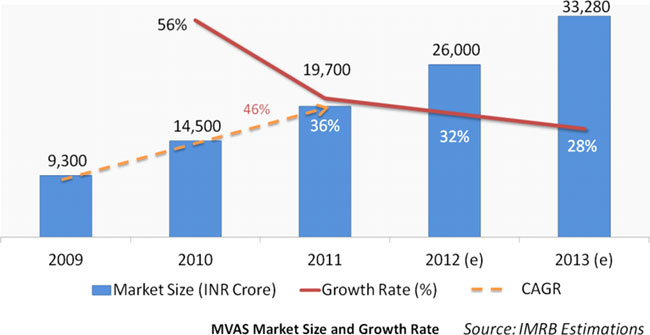
The Indian mobile value-added services (MVAS) market is expected to become a Rs26,000 crore market by the end of 2012, growing at the rate of 32 per cent. MVAS is estimated to further grow to a whopping Rs33,280 crore market by 2013, a growth of 28 per cent. While the conventional MVAS services are still dominant, emerging MVAS services are also rapidly gaining popularity with mobile users. These are some of the findings from the latest IAMAI – IMRB report on Mobile VAS in India.
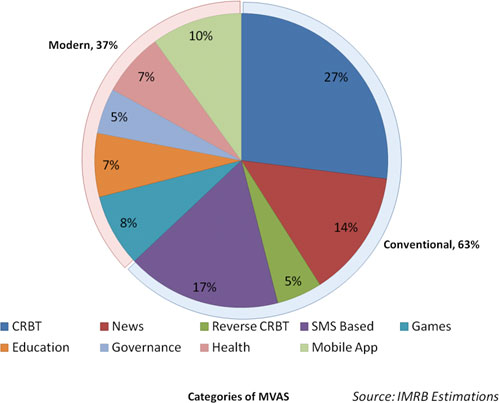
According to the IAMAI-IMRB report, MVAS can be divided into two categories – conventional MVAS which has a market share of 63 per cent and the emerging or modern MVAS which contributes a market share of 37 per cent. While the conventional MVAS services consist mainly of CRBT and SMS-based applications, the emerging or modern MVAS mainly consist of mobile apps and games.
Speaking to MxMIndia on the factors that would drive the MVAS revenues in the long run, Rajiv Hiranandani, Co-founder and Executive Director, Altruist- Mobile2win said: “I am a firm believer that the true growth of mobile VAS is going to come from the rural India. You will see more of services that will help the rural or the small town Indian utilizing the services. In that respect, I believe Interactive voice response (IVR) based services and SMS-based services are going to be big drivers of Mobile VAS. These services could range from basic things like finding the price of vegetables or some information over SMS or finding friends over IVR or IVR-based social networking. These are services that will catch on and will drive revenues in India over the years to come. So for VAS revenues to explode in the country, you need to appeal to the lowest common denominator which primarily resides in the rural India.”
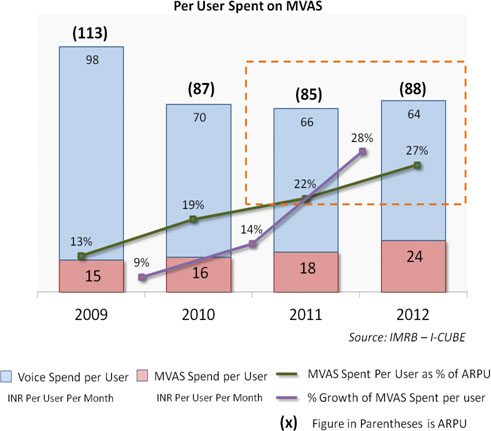
In the last three years, the average MVAS spent per month has risen by Rs9 to stand at Rs24 per month in 2012. The percentage share of per user spend on MVAS in Average revenue per user (ARPU) has been increasing gradually. Even though the ARPU has declined over the years, per user spend on MVAS has gone up by 28 per cent in the last one year. It is now 27 per cent of the ARPU pie. The dependency on voice services is reducing and to increase the ARPU, the emphasis must be put on data services such as MVAS.
The broadcast media is going in for interesting alliances. Last year, Star and Zee tied up to forge a distribution alliance. Prior to that Viacom 18 and Sun had got together. Earlier this year, the Star Plus mega-show Satyamev Jayate tied up with Doordarshan for a simulcast. And now Sahara One’s India-Pakistan music show, Sur-Kshetra, will be aired simultaneously on younger but bigger GEC Colors.
Colors has announced a first-of-its-kind strategic tie-up with the Hindi general entertainment channel (GEC) Sahara One to simulcast the relatively new singing based reality show – Sur-Kshetra.
Produced by Sahara One, in association with Gajendra ‘Antakshari’ Singh’s Saaibaba Telefilms, Sur-Kshetra will be a cross-border musical battle between the Indian Team, captained by Himesh Reshammiya and the Pakistani Team, captained by Atif Aslam. Evaluating the teams and judging the musical talent will be Asha Bhosle (India), Abida Parveen (Pakistan), and Runa Laila (Bangladesh).
The show will be anchored by actor Ayesha Takia and the episodes will also have musical stalwarts like Ghulam Ali, Hadiqa Kiani and Sajjad Ali from Pakistan, and Suresh Wadkar, Ismail Darbar, Alka Yagnik and Sapna Mukherjee from India.
Speaking about the strategic tie-up, Raj Nayak, CEO – Colors, said: “Music has the unique ability to unite people and today, it has brought two channels together. Sur-Kshetra will mark Colors’ foray into the singing non-fiction content segment and we are extremely excited about this new venture. By adding the show to our bouquet of offerings, we are working towards fulfilling our commitment to cohesive viewing, while providing our audiences with unique content keeping them engaged.”
Adding to this, Suresh Mishra, Asst Director, Sahara One said: “With this legendary Indo-Pak musical grandeur, viewers from both the nations and across the globe will witness a new generation of gifted singers. We are very excited about this strategic tie-up with Colors, giving Sur-Kshetra a combination of two large platforms that does justice to the stature of the show”
Stratagem Media Pvt. Ltd, led by Mr. Sundeep Nagpal, began as a media planning hub for medium-sized ad agencies in the early 90s and somewhere along the middle of the last decade, it morphed into a media services company.
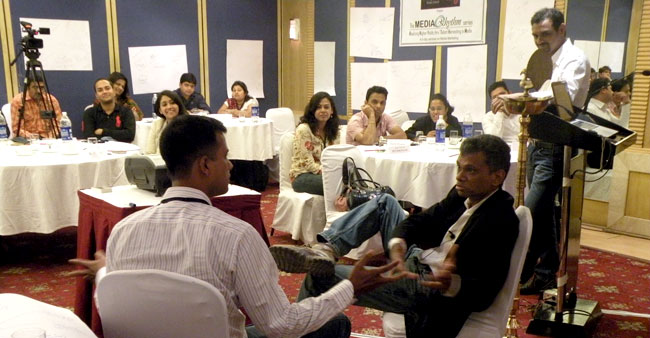
The ‘Media RHYTHM’ series is a recent initiative by the company to enable participants channelize the thought processes that govern modern day practices in media selling.
The initiative engages experts from the industry who jointly conceive and design such programs over hours of discussion to make them as relevant as possible. RHYTHM is an acronym for Realizing Higher Yields thru’ Talent Harvesting in Media. At another level, the programme also serves to orient the thought process in a particular direction and thereby condition the mind.
Mr. Nagpal believes that such open programs are useful for companies which wish to develop talent and knowledge base of select personnel in their sales departments.
The forthcoming program, to be held on July 21, has been conceived as a single-day workshop titled “ReveNEW Concepts and Ideas”. The modules will focus on concepts that are integral to the media business – media evaluation & utilitarian concepts, as well as the subjective aspects that can be used effectively by sellers.
Facilitators like Madan Sanglikar will administer a module on the applicability of new media for new brand and how media houses can build on it. Bharat Kapadia will stimulate participating sellers to think creatively by involving them with certain exercises.
Suresh Balakrishna will engage participating sellers on how to translate the basic tenets of a brand communication into a media-led solution.
Yang Saints and Warriors will be henceforth handling the creative mandates for Red FM. The win comes after a multi agency pitch that Red FM had called for a couple of months back.
Though no confirmation from Red FM could be obtained at the time of filing the report, sources close to the development have confirmed the news to MxMIndia.
The agencies participating in the pitch include names like Lowe Lintas, DDB Mudra, Scarecrow Communications, Law &Kenneth and others.
The incumbent agency on the account is Ogilvy & Mather, who have been handling their creative mandates for the past five years. Even the marketing spends could not be ascertained at the time of filing the report.
Red FM is a property of Sun TV Network, India’s largest television network which has 20 TV channels, 45 FM radio stations, two daily newspapers and four magazines in several Indian languages.
Continuing with the feature we carried on July 2 (Link: http://www.mxmindia.com/2012/07/the-half-year-that-was/), we bring in more views from the industry on the six months gone by. This half-yearly report card is again a mixed bag – while some have had an excellent run, others had few hitches on the way. Here’s bringing views from some leading players of the industry.
Broadcasting:
Rohit Gupta
Rohit Gupta, President, Sony Entertainment Television
So far, it’s been an excellent year for Sony network. And I’m sure it’s been same for the industry, at large. The industry is still growing and there have been no cuts in spends. People are still putting their money in the medium. I’m sure there is no gloom surrounding this industry. Even the 2008 slowdown didn’t affect us. So, there is nothing to worry about too.
Sunil Lulla
Sunil Lulla, MD and CEO, Times Television Network
I would say, it has been testing six months for the broadcast industry. The biggest set-back has been the extension of the digitization implementation. The IBF ran a very good campaign for it but since MSOs couldn’t fulfill the requirements, unfortunately it has to be postponed. My advice to the ministry now would be to take strict actions and make sure the new deadline is met. It is important for the industry since it will shape the industry and help us understand it better too.
By and large, important events in the broadcast industry like IPL, Indian Idol did well and a new show like Satyamev Jayate was launched. However, there is still a gap between how a show performs and what the viewers really want. Hence, I think TAM needs to be more clear and needs to increase its sample size too.
But what really shocked the industry was the new adult timings and ‘A’ restrictions on television. What happened with Dirty Picture’s telecast was regrettable. Nevertheless, after the self regulation imposed by various channels – news and GECs – the quality of content has improved.
As from the business point of view, from January till April, it was good; but May onwards the marketers have had a watchful attitude. It might not impact the industry at large, but a certain sections might get affected. Also, given the current economic climate, one will have to keep a very watchful eye for the near future.
The last six months have been eventful for the broadcast industry. First it was the whole discussion regarding digitization – from notifications to it finally getting delayed. Hopefully, the new deadline will be met as it is positive for the broadcast industry. Also, the new advertising guidelines set by TRAI will make sure that the market doesn’t get diluted.  Such moves will only benefit the industry and help it grow.
However, there has been a slowdown in ad sales and revenue generation. Everyone knows what happened during an event like IPL. It is a slow phase right now, but the costs of purchasing rights are still high. So, it won’t be wrong to say that testing times are ahead.
K Sriram
K Sriram, GM, Vijay TV
The last 6 months in the Tamil GEC space has seen a dramatic change in programming. KBC travelled into Tamil Nadu and with actor Suriya donning the role of anchor. The barrier between the big screen and television was truly breached for the first time. KBC Tamil ensured that prime time television in TN was redefined, as it not only cut across audiences, but also surged ahead of the power cuts and the IPL fever and eroded into SUN TV’s prime time shares. Vijay TV saw a growth of 41 per cent in the year in a market which was otherwise declining. Content came to the fore.
Tamil television also saw the movie acquisition game being taken to another level with Nanban, the hit Tamil adaptation of 3 idiots, being screened within 100 Days on Vijay TV. Another path breaker given that A+ titles before were insulated for a year. Loud and clear in the Tamil GE space – the game just got bigger and in the last 6 months there was only one player playing the game. Competition is sure playing catch up.
Marketers:
Harkirat Singh
Harkirat Singh, MD, Woodland
The overall market in the branded retail segment has been seeing growth. The biggest change that one sees in this segment is that now the growth comes from smaller towns. In the earlier phase, the growth came from metros; and if one ventured into smaller towns in branded retail say a decade back, most likely, things would not fall in place. Now the risk factor in venturing into the smaller towns is much less and there are many players in branded retail who are turning towards these cities knowing that growth opportunity lies there.
For Woodland, last six months have seen steady growth and we intend to open 60 stores this year, though the rider is to expand but be selective. The market, I would say, has been slow. But that is the trend I would say during a particular time of the year where each year business is slow and picks up only later. As for retail, I think the market is vibrant and the sector has been seeing activity and is slated to see increased activity with FDI in retail being relaxed.
Vikas Jain
Vikas Jain, Executive Director and Co-Founder, Micromax
For the mobile phone industry there has been no concern about consumption, as the demand for new sets continues to be on rise. The change being that now the customers are well-educated on the mobile sets they want to buy and with change in technology there have been change in the preference on the type of mobile sets. The key, therefore, is to recognize and anticipate the product in demand and meet the needs of consumers. The players need to create a roadmap of the products to be launched rather than get carried away by technological changes. Keep an eye on the changing trends and tweak the launches accordingly.
On the flip side, the devaluation of rupee has put pressure on the margins and Micromax being a player that vouches for being cost effective will not yield to increasing prices of the phone sets. As for following any trend on cost cutting on the marketing and communications front, we have not done any. We continue to be associated with Bollywood and Cricket and would associate if any good opportunity came to us.
Media Agencies:
PM Balakrishna
PM Balakrishna, COO – Allied Media
I think the months of April-May were on par but June was not so great. The feeling is that of a slowdown for sure. But an advertising perspective there is cause for worry. It’s a reflection of the economy not looking good in the past few months with petrol prices seeing a hike, inflation seeing a rise and other such factors. These factors play a part in the way media spends pan out.
Where television is concerned there were some properties that did well like the Euro Cup recently and also the IPL before that, but then there are signs of slowdown with advertisers not being too keen to be associated with properties and also with the rates coming down. With Print, which sees ads from sectors like Real Estate and so on, there was a sudden upsurge that was seen in June with most property dealers advertising a lot in dailies and magazines. But that may be a sheer sign of desperation because transactions are not really happening or consumers are not really picking up stocks. There has not been a surge from other sectors as well and they are treading cautiously. So if one were to do a quarter to quarter analysis, one would see that there has been a decline in April-June this year compared to the same quarter last year.
As for the revival, what I have observed recently is that clients have been drawing up plans which they might want to unveil soon, probably around the festival season. But I think overall, the growth will meander along in the next quarter also. Probably the last four months of this year may turn out to be good but whether it is enough to offset the slow-burn over the first six months – I am not too sure.
Anamika Mehta
Anamika Mehta, COO – Lodestar Universal
Although we are six months into the year, I do not think the industry will record the original projections that were forecasted. We are just into the first quarter and therefore we cannot conclude much but overall some categories are seeing a slowdown. Sectors like real estate and finance have seen a slowdown in the spends but FMCG companies are yet to go slow. They are playing a cautious game though.
Also, much of the growth is also the result of the current economic conditions which do not look good at the moment. But it will not be all gloom and doom as is being witnessed in Europe but it will also not be a great story as was being propounded forIndia. Also, one cannot predict the exact figure beyond a point but the approach is going to be that of caution.
Sundeep Nagpal
Sundeep Nagpal, MD, Stratagem Media
I would say the media industry in India is already feeling the effects of the economic gloom that has been in the works for some time now. From what I have been given to understand the first quarter of this fiscal has been reasonably difficult. In fact nothing can be said about the trend that will emerge in the next six months as there is some amount of scepticism in the industry. Unfortunately, in our industry fluctuations are happening faster than what we have witnessed before – whether up or down. It takes a lot of deeper understanding and attention to details if one has to figure out what the current media scenario correlates to. Frankly, even I do not have an answer to that. It’s very easy to say that it is dependent on the overall global or Indian outlook but that is too macro a view to attribute to. If I was a media planner, I would be looking at ways to look out for the early signals and accordingly find out the relevant methods to adopt. Overall, the industry may just about see a decline in its growth numbers for 2012 than what was originally anticipated.
Advertising:
Arvind Sharma
Arvind Sharma, Chairman, Indian Subcontinent, Leo Burnett
As the GDP numbers have been showing a slowdown, one can see that it is getting reflected in the advertising spends too. While at peak the advertising industry was showing a growth of 25 per cent, it would be somewhere around 7 per cent in the first half of 2012. At individual agency level, while we have seen a growth on 40 per cent in 2010 and 25 per cent in 2011, in the first half of 2012 we would see a growth of around 15 per cent. But I think at an individual agency level we still can manage fairly good growth as India has close to Rs35,000 crore advertising expenditure hence the need of the hour is to get aggressive and lay claim to the bigger pie from that budget. This will happen from organic growth from current clients to acquiring new businesses. This growth will also come from making our offering robust.
If one were to look at growth, then in our case, I would say that we have seen growth from our existing clients but growth from new clients or from new major initiatives have been significantly less. However, I would say that the mood currently is to be cautious.
PR:
NS Rajan
NS Rajan, Managing Director, Ketchum Sampark
While we have grown by about 20 per cent in the first half, we are witnessing headwinds gathering across various sectors which can in turn affect growth in these segments and consequently the PR business in the second half.
Also margins could be under pressure in the coming months as the increased cost of servicing may not be compensated by incremental revenues unless the economic environment changes significantly which can lift up sentiment.
MBA from a leading business school in the American Midwest, two years with a boutique investment bank in Boston and then this young man lands up for a chat about what he needs to do to get a job in the media.
It is still easy to think there is a clear demarcation that sets the media apart from the rest of the world. Aamir, Ashton, Arnab and Aishwarya are in the Media. (They don’t even need surnames to identify them). Media people ‘need no introduction’. Us grunts have nothing worth introducing and thus, don’t need to be introduced.
Or is it so simple?
There were the Media people but they were few and readily identified as such. M J Akbar dazzled us with his insight in columns for a newspaper he edited. Rajat Sharma put people into the dock, quite literally, as he hosted a talk show. Derek O’Brien got all of us furiously scratching our heads even as he quizzed school kids. Madhuri Dixit sent testosterone levels into orbit merely by counting from 1 to 13. And Lalu had to invoke Sridevi’s cheeks in search of a universally comprehensible metaphor for Bihar’s roads.
Then Tim Berners-Lee came along and changed everything, although for years after he thought up hypertext in an obscure corner of CERN, we would scarcely have known it.
By the late 90s, regular blokes discovered that it was possible to find a wider audience for their periodic rants on WWW than they previously could muster around a water cooler or in a cafe. The web log, then portmanteau-ed to weblog and finally truncated to blog was born either in 1995 or 1997 (you can find an interesting history here).
Then blogger came along in 1999, bang in the heady days of the Dotcom Boom and setting up a blog became Luddite-proof. From the very beginning, the blogging community had a wide range of interests and capability. The largest majority would create an account in an idle moment never to visit it ever again. A few would invest time and effort in their posts and endeavour to reach out to an audience with regular, engaging updates. Remember that these were people operating far away from the conventional notion, but what they were doing was indisputably publishing.
Everyman had just stormed Fortress Media.
It began with the written word. Soon enough, authors had found ways of adding pictures to their words. And the web was becoming more clever all the time. It was able to transport not just text but sound and video too. Also, devices to record audio and video had started to shrink in price and size even as they got massively more powerful, thus putting near professional quality sound and image acquisition within reach. Events unfolded at a rapid pace thereafter. Amazon pioneered a lightweight handheld device for reading digital publications. The Kindle was a runaway success and for the first time, books could be self-published by anyone with a good idea and capable penmanship without ever being imprinted onto the dead-tree medium. Soundcloud allowed wannabe speakers, singers and instrumentalists to distribute their art and craft without surrendering themselves to the crafty gnomes of the music industry. Youtube opened doors for every standup comic, ballerina, burlesque queen and cute kitten to show off its talents on glorious Technicolor video.
But wait, we were talking about an investment banker contemplating a career in the media. So what’s with this long riff about what we now refer to, rather condescendingly I might add, as User Generated Content?
Well, it wasn’t just individuals that got inspired to start using the all new powers of WWW to talk to their “Audience”. Businesses of every stripe saw the opportunity too. To be rather more honest, what they saw was consumers – happy and irate, sounding off about their brand experiences in these wide open spaces and were left with little choice but to deal, for better or worse, with what they were getting. Surely we’ve all heard the now almost apocryphal story of Coca Cola’s attempt to take down a fan page on Facebook that spectacularly backfired? To the point where they had to pretty much say ‘Let bygones be bygones and let’s be friends’? (Moral: Don’t clobber, co-opt).
You see what’s happening here. Companies and brands were becoming broadcasters and publishers.
At no time before in the history of our human civilization has communication across every conventional fence and barrier been so easy, inexpensive and by implication pervasive or ubiquitous. And barring the rare exception, individuals and entities find it more productive to be participants in this endless feast of reason and flow of soul than mere mute spectators. There’s even a taxonomy to describe different levels of involvement with media: Paid media are, as the name suggests, those that you have to buy access to. Earned media are where the media voluntarily carry news or content about you. Finally, owned media are, again as evidenced by the name, those that you own and control. Who doesn’t want earned and owned media?
And what was it that we were talking about when we began this ramble? Ah, yes. A job in the media.
I told the young man, he could stop looking. After all, every job- FMCG, Banking, Automobiles, Telecommunication, <insert randomly chosen industry name here> eventually, was going to be a job in the Media.
Paritosh Joshi was until recently CEO, Star CJ. He has been a marketer, a mediaperson and a key officebearer on industry bodies. He is Strategic Advisor, Ormax Media. He can reached via his Twitter handle @paritoshZero
VR Padmanabhan joins RK Swamy Media Group as General Manager, South. Mr Padmanabhan has previously worked with MEC Chennai, Mediacom (Group M Singapore), Motivator (Malaysia) and Euro RSCG (Bangalore/Chennai). His last assignment was as an entrepreneur and consultant at Linear Communications
Speaking about this development, Sandeep Sharma, President RK Swamy Media Group said: “Padmanabhan joins our senior management team and has a clear mandate to manage and grow the south market. He has quality experience in the media domain and has worked on FMCG, IT, Telecom, Retail, Auto sectors in India,South East Asia and has considerable experience in managing the south market. His astute understanding of brand needs in the context of media will help offer superior solution to our clients. He will be based out of our Chennai office.”
RK Swamy Media Group comprises of four units – Media Direction, Digital Direction, Hansa Media and Hansa Outdoor. It is part of RK Swamy Hansa, a leading marketing communications and services group, serving over 150 companies in India and the US. With around 1100+ professionals, the Group offers Creative and Media services, Market Research, Direct/CRM & Advanced Analytics, Events and Activation, Healthcare Communication, PR, Social & Rural Communication and more.
 Legoland Malaysia has appointed Mindshare following a media planning and buying pitch involving four agencies. The first Legoland theme park in Asia is set to officially open in Johor’s Iskandar development region on September 15. The park will be operated by Merlin Entertainments Group, the world’s 2nd largest visitor attraction operator.
 “Mindshare won the pitch by being able to bring to the table not just a comprehensive plan, but an understanding of our brand uniqueness. In today’s landscape it’s vital for agencies to stay on top of trends that help brands be effective and cost efficient,” said Thilakavathy Munusamy, Director of Sales & Marketing, Legoland Malaysia.



 Vertebrand, a brand value management consultancy, has just upped the ante in the intellect and process-based approach to brand building as it announced its JV partnership with Equancy, an International brand, marketing and web analytics/CRM consultancy.