Author: mxmadmin

  • NBT launches NCR edition with hyper-local pullouts

    By Akash Raha


    Navbharat Times (NBT), the Hindi daily from Times Group, is launching its special NCR edition in order to further strengthen its position in Delhi-NCR. There will be no change in the pricing and it will remain Rs2.50 per day. Understanding the latent need and growing popularity of regional content amongst its readers, Navbharat Times decided to tailor its offering accordingly.


    Ranjeet Kate, Director Languages- Bennett Coleman & Co. Ltd said, “Of late, media buying behaviour has seen a lot of change. Advertisers see language dailies as a medium providing valuable and sizable reach in key markets like NCR. While on the other hand, ‘readers’ of such fast-paced cosmopolitan cities see newspapers as a trustworthy guide. We can deliver value in such a scenario with a customized NCR edition for both our readers as well as the advertisers.”


    For most of the advertisers, NCR is an important territory. Advertisers who are advertising inDelhican takeDelhi+NCR package at a nominal add-on cost.


    The NCR edition will not only retain its special Delhi and national content but will also offer a complete coverage of the state-level news in UP and Haryana. This special NBT-NCR edition will be available in all the five suburbs (Ghaziabad,Faridabad, Gurgaon, Greater Noida and Noida).


    Readers in these areas will also get the hyper local city pullouts in their respective regions, along with the main issue. Regionalizing the main issue will make the product offering appear more promising and customized for its NCR readers.


    Aman Nayar, Brand Manager- Navbharat Times said, “Most advertisers who advertise in Delhi would also want NCR and giving the minimal add-on rate, NBT intends to add most of its NBT Delhi advertisers to the NCR edition. The sizable local advertising, of course, will be done separately.”


    NCR has always been a booming vibrant market. It has been witnessing huge growth in job opportunities, increased urban migration, increased housing projects and huge investments in the transport infrastructure.


    From the advertising point of view, tapping the NCR market has always been an area of interest for all advertisers, as they always look out for mediums which have deeper engagement levels with their audiences. NBT, which aims to be seen as a value provider for its readers as well as advertisers, intends to keep experimenting and expanding in newer and relevant territories.


  • [PR Channel] The digital revolution: Opportunities for PR

    By Luna Biswas


    It would be incorrect to say that traditional media is losing its sheen from the perspective of news vis-a-vis the digital media. While the latter is gaining ground, it is imperative to understand how the internet can be effectively used to position communication from PR perspective. In today’s day and age, web provides the platform to create and publicise content without waiting for a newspaper to print the same. Every individual has the power to write/upload about anything, be it good, bad or ugly without being vetted.


    The problem that comes to the fore is the legitimacy. While online versions of newspapers and portals have the credibility factor, it is the individual who can – through blogs and social media – impact a brand, for that individual has a captive audience who trusts him more than they trust a news item. and this is where the difference between traditional and online media is for the PR community. a potent tool that has to be integrated and monitored for reaching out to the key target audience.


    Where, then, is the solution? For PR agencies it is impossible to overlook the digital world. Every available tool counts to create an effective public relations campaign. The paradigm shift, or at least partial shift, has to be from depending on social networking sites and moving towards creating online mastheads for clients. Social media or social networking sites have to be used as tools and not the end means to reach out to the target audience. The problem with social media is that it doesn’t engage customers with brands after a point in time but actually takes users from brands.


    Integrated communication agencies need to advise clients, and create for them a strong masthead by sourcing their audience from the social media spaces. Unless a digital campaign encompasses the “own” space for audience to engage with a company/brand, the campaign will not be successful. a platform has to be created where the audience can engage with the brands in terms of proactive interaction.


    Dell and apple are two great examples that have created platforms to communicate with customers and vice versa. What they have ensured is that the audience uses “that own” space to interact, vent their ire and communicate requirements. From a digital campaign perspective, it is something that needs to be deeply looked into. The mechanism used by these companies has resulted in keeping the audience on one platform, without them using another platform to complain or run down the brand.


    a successful online PR campaign has to be evolved keeping in mind how best the consumer can be attracted and kept within the precincts of the brand for which the communication has been devised.


    For this to take place, communication agencies need to make two elementary changes in their outlook towards the digital space. First, they need to recognise the need to build unique spaces because they are the mastheads of the digital world, not simply search tags or social media ‘like’. For each brand and company, the agency has to build different grand strategy of owning the constituents and making their masthead the most powerful gathering point for the brand.


    The planning of these spaces has to be unique for each brand, and based upon content power that drives conversations around the brand. Like advertising, which has learnt that the most effective way to build memorable brands is by creating cultural connects, the chore for integrated communication managers will be to create new spaces where the audience is offered the entire gamut of experience that he would experience from a newspaper. The current approach of engagement with social media is dangerously short-sighted because the brand is engaging in a conversation with the audience.


    Luna Biswas is Vice President, Member-Leadership Team, Hanmer MSL Communications Pvt. Limited. a part of the MSLGROUP


  • M-commerce is the way to go in 2012

    By Rishi Vora


    The Q3 report for 2011, which was released in December 2011 by BuzzCity, a global company which serves advertisers and publishers of mobile internet sites, augurs high growth prospects for mobile commerce (m-commerce) , which grew by 30 percent from the second quarter in 2011, in India.


    According to the report, a major portion of the growth came from mobile content players, but there were a few financial services brands that also ran promotions.


    BuzzCity, headquartered in Singapore specialises in mobile internet advertising and India tops its priority list among emerging nations. BuzzCity has served more than three billion ads in India alone – it tops the list of ads served by a company in the Asia Pacific region.


    BuzzCity’s India operations were started four years ago when the Mumbai office was set up, at a time when mobile internet, as a medium, had just begun to gain momentum.


    K F Lai, co-founder and CEO, BuzzCity said, “India is one of the most important markets for us. It contributes a significant chunk of revenue to our global network. Though the market is still small in size, it is beginning to open up and 2012 should see many advertisers and content players invest in the medium.”


    The report also stated that while Indian market was heavily male-dominated as far as usage of mobile internet was concerned, the sheer size of the market still gave advertisers reach into a substantial demographic of over 14 million unique users.


    Sharing his view on the Indian market, Mr Lai said, “There are about 150 million mobile internet users in India, these numbers are bigger than internet numbers, thanks to the mobile penetration and the decreasing price-points of smart-phones, 3G services and so on. We will also see increase in the number of mobile internet users, with tablets becoming popular, it means better user experience, opportunity for brands and for publishers – it means serious business.”


    Mr Lai believes that 2012 will be a year where m-commerce will evolve in a big way. India has already seen unprecedented growth in e-commerce. The key for the industry, however, is to maintain high levels of trust among consumers and transparent dealings. If proper care is taken, it is a medium which can pay rich dividends to brands in India.


    The report also revealed that in 2011 Nokia was the most popular handset brand for internet access (64.81 percent), followed by Samsung (11.85 percent). The generic mobile phones, known as ‘white-box handsets’, cumulatively accounted for a marginally higher share than Samsung at 11.95 per cent.

  • Media & Adland Wishlist 2012


    By Anil Thakraney


    The Indian media, in general, has got a number of things right. It puts serious pressure on the ruling government and sometimes the judiciary, so that the right things happen, and they happen fast. This crusading spirit is important in a slow- moving, chaotic nation like ours, so kudos on that front.


    However, there are a number of things that are not so right with our media, especially the mass media, and here’s hoping we get to see some course correction in the coming years. Here’s my Top Ten wish list.


    1. Radiagate was a wakeup call for all journalists. When access to the rich and powerful gets too close, one needs to quickly draw a line and back off. Some didn’t, and are lucky to still have their jobs. The scandal brought immense disrepute to the profession, and credibility will be hard to restore completely. Here’s hoping in the future the Indian media remains free of any such nonsense. We can’t afford it.


    2. The Broadcast Editors’ Association put out a 10-point code of conduct for news channels on how they should cover the Bachchan baby birth. And the very private family event passed off very privately without the channels breathing down their necks. What one would like to see in the coming year is that this practice becomes standard operating procedure during private celeb moments, and there is no need for codes any more. This would also delight Shri Katju.


    3. While it did change to a certain extent as the year closed, most editors behaved like Anna Hazare’s cheerleaders all through the year 2011. This is not just unfair, it’s against the fundamental principles of journalism. Here’s looking forward to less bias and more balance in the year 2012.


    4. It’s very clear that our media houses have aligned themselves with various political parties, and their respective biases keep becoming apparent even to the layman. This must change for sure, starting from 2012. Media without objectivity is like Rakhi Sawant without silicone. No one wants that.


    5. No more paid news. Repeat after me children… no more paid news. Repeat after me children… no more paid news.


    6. Here’s hoping all those TV anchors who indulge in hysteria and drama are promptly transported to the Bigg Boss house in the coming year. And are not allowed to enter newsrooms again. The junta wants news and views. Not nautanki.


    7. No more front half-pagers in the coming year. Where advertisers demand that the front page be vertically slashed. A fatwa needs to be declared against proprietors who agree to this criminal practice.


    8. Would like to see some kickass innovations in the print media this year. Both, newspapers and magazines. The digital media threatens big-time, it’s like a wolf at the door, and our old-world editors continue to pretend nothing’s happening, as they dish out the same tired stuff. I am also hoping editors who refuse to re-invent are shown the door before 2012 closes.


    9. Really wish that in the year 2012 the maha excitable radio jocks shut the eff up and play the effing music. Even if all the radio stations play the same ten songs at the same time.


    10. All the girls in the TV newsrooms need to glam up. I noticed the nails are becoming brightly coloured these days, but I want to see more. I mean, if I am stuck with the likes of Abhishek Singhvi, Chandan Mitra and Mani Shankar Ayer discussing the same tosh night after night, I need some joy to come from somewhere.


    Ad World 2012

    The Indian ad world, though it gives many awards to itself, hasn’t really set the world on fire. Okay, so we do score the odd international award now and then, but clearly we have a long way to go. Aside from that, our ad guys will face many serious challenges in the coming years, and quite frankly, I am not sure the industry leaders are ready as yet. I still get a sense of complacency and self-satisfaction when I meet agency bigwigs.


    Here are ten changes I would like to see in 2012.

    1. Once and for all, ad agencies must set aside their rivalries and egos, and must come together to work out a fee structure. It’s obvious the agencies are underpaid by their clients, and this puts serious pressure on their resources. This is also a common complaint I hear from agency heads. Well, grumbling won’t solve the problem. Start the New Year with many beers, and figure a way out!


    2. I think hot shops are back with a bang in the ad world, and in the coming year they will put real pressure on the large networks. Aggie and Padhi are just one example, but I predict more people will quit large agencies and set up their own boutiques. Since their rates will be lower, many clients will be tempted to defect from the traditional agencies. And I think this is a good development as it will result in superior work overall.


    3. Experts in TV media continue to head ad agencies, and I am hoping at least a few agencies will smash this system and promote young creative chaps skilled in the new media. Because old-world creative directors generally don’t understand the digital space, and they need to make way for the young geeks. Sooner the better.


    4. Simultaneously, I wish in the year 2012, youngsters in the ad agencies get off the internet (and that includes Facebook) and spend some time in the villages and small towns. There is a dire need for agency staffers to be well rounded in their skills. This is not Singapore. This is India, and a whole lot of people are still looking to buy their first colour TV.


    5. I wish ad agencies would bring back the lost pride into their strategic planning function. The number one reason many suits quit the business to join the world of marketing is the lack of brand planning within ad agencies. Ad agencies have become creative sweatshops, and this leaves no work for managers but to be good executors. Starting 2012, I am hoping this changes, because it’s bleeding the ad world of its talent.


    6. Dear Creative Director, please, please, please do at least ONE nice press ad in the year 2012. I beg of you. People still read newspapers in this nation. Puleeeeaze!


    7. I know the media buying function is now completely divorced from advertising. And it is my belief that this has badly affected media innovations. I recall those days when the three of us – the account executive, the media planner and the creative director – would lunch together and crack ad ideas. I hope at least once in the year 2012, Balki, Lynn and their client servicing person share a drink and discuss brands.


    8. No fake ads in 2012. Repeat after me, children. No fake ads in 2012. Repeat after me, children. No fake ads in 2012. Repeat after me, children.


    9. No noisy TV commercials in 2012. People don’t buy from shriekers. Repeat after me, children. No noisy commercials in 2012. People don’t buy from shriekers. Repeat after me, children.


    10. I am hoping at least one brand will show all of us how to exploit viral magic on the internet in 2012. At least one brand will become the Kolaveri of 2012.


    Cheers!


    Anil Thakraney has worn various hats in advertising and as a journalist for around 25 years. He is editor-at-large, MxMIndia. The views expressed here are his own.

    Visual: Rafiq
     

  • Ad Strat: Vodafone ‘Zoozoos’

    Rajiv Rao NCD,Ogilvy&Mather


    Name of the Campaign/Ad: Vodafone ‘Zoozoos’


    The Brief: Talk about the various VAS (Value Added Services) that Vodafone has to offer in a way that’s clutter breaking and also keeping in mind the chaos of advertising on IPL, India’s most watched show on TV


    Research: Previous IPL experience showed us that the same people were watching the matches every day. Hence there was a high level of impatience when it came to watching the same communication over and over again. We took that learning on board and decided to treat even communication like content – something new to look forward every day.


    [youtube width=”400″ height=”200″]http://www.youtube.com/watch?v=te5kc5PFZFY[/youtube]

    Key issues: The ads were to be universally understood and enjoyed. Another challenge, because we were working with a large number of scripts, was to keep the freshness going. Third issue was purely operational – actually pulling off such a large number of films in one go was in itself a huge challenge.


    Media vehicles: While it was principally led by television, this was a truly 360 degree campaign involving digital, outdoor, retail, radio and experiential media.


    Market and client feedback: Two words: HUGE HIT. The campaign resulted in a spike in VAS uptake. On brand health measures, the campaign helped the brand overtake the market leader. It was awarded for creativity and effectiveness at the Abbys, AME, Spikes, Effies and the Vodafone global awards, amongst others. An exclusive line of zoozoo merchandise is a regular feature at Shoppers Stop outlets. The campaign was the most viewed viral in the world for a whole month. It helped the brand garner 2.5 million fans. The success of the Zoozoos is not in that India fell in love with them, but in that the love affair is still as fresh and going strong after 3 years.


  • Astro Forecast 2012: What the Stars Foretell for Media & Marketing Professionals


    The falling markets, beginnings of an imminent economic meltdown, social unrest and outbursts threatening to overthrow the established norms and systems, the innumerable political upheavals and many natural and man-made disasters – the year 2011 has seen it all and more. As we gear up to bid adieu to this eventful year, anxiety about 2012 is bound to cloud our minds. What will the new year bring with it? Will it mark an end to the trials and tribulations of the year gone by? Read ahead to know what Ganesha foresees for the year 2012.


    The year 2012 is going to be all about ‘changes’ and ‘transformations’. The year may well be called the year of ’21st century’s Renaissance’. Many of these changes will be for better, while many of these may also mean more turmoil. Remember that this transition is not without reason. The last decade, not just the last year, has seen a plenty of tumult. After numerous civil wars, natural calamities, political and economic crises, confusing circumstances and mixed signals, it is obvious that we gear ourselves up for some serious overhaul. And, hence the need for such a big shift!


    In 2012, the theme of transformation will also extend to a personal level. People may see themselves changing, absorbing, reacting, rebelling, adapting and, above all, evolving with the change in their metaphorical ecosystems. All the sun signs will need to be ready to welcome and embrace the change, as only then they will be able to extract the best out of some of the enchanting planetary aspects lined up for the year 2012. Out of the major planetary events lined up for the year 2012, two will exert a marked influence on almost all sun signs.


    The movement of Saturn, as it leaves Libra, in October 2012 will be hugely significant to all signs. It will make many signs heave a sigh of relief, but by then, many may have learnt some of the biggest lessons of their lives. The other major planetary event shall be the movement of Neptune, after 14 long years, from Aquarius into its own sign Pisces. Spirituality will surge, and so will the people’s faith in goodness and justice. Many individuals may see their belief system and outlook towards things getting altered with the events of the year. The best strategy for all the sun signs to maintain this year would be to keep a calm, composed and rational approach. Sorting out priorities and giving due time to loved ones and one’s own health will also help.


    Remember: All the changes may not take place at one go, but the year 2012 will surely see the beginnings of this long-term, crucial process. A process that will, in some years, create a new history. And, a process in which nature, history, anthropology, religion, politics, economics, media, globalization all will play their due parts. Whatever be the case, we sincerely hope the world becomes a better, more peaceful and evolved place to live in.


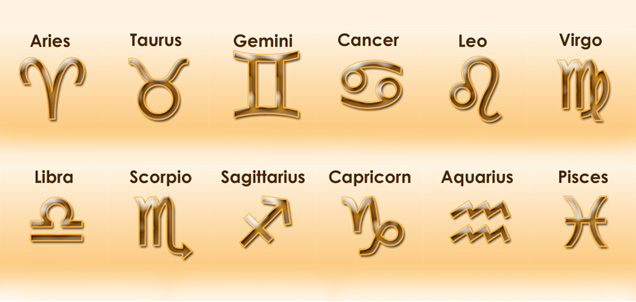
    Click on the links below to read the 2012 forecasts for the 12 sun signs,


    Aries (March 21 – April 20) Libra (September 23 – October 22)
    Taurus (April 21 – May 21)
    Scorpio (October 23 – November 22)
    Gemini (May 22 – June 21) Sagittarius (November 23 – December 21)
    Cancer (June 22 – July 2) Capricorn (December 22 – January 20)
    Leo (July 24 – Aug. 23) Aquarius (January 21 – February 19)
    Virgo (Aug 24 – Sept. 23) Pisces (February 20 – March 20)


    GaneshaSpeaks.com is #1 in India and #3 in horoscope portals on a global level. It offers accurate, reliable and trustworthy services online and on 55181(at premium rates) on all major telecom providers in India. Content syndication for print, TV, online, telecom and apps is one of the major verticals in GaneshaSpeaks.com. For more details, call +91-79-61604100 or send an email to contact@ganeshaspeaks.com.

  • The Anchor: 12 media conglomerates to watch out in 2012

    By Pradyuman Maheshwari


    It’s the season for lists and as one who enjoys making (and reading) them, I couldn’t help volunteer to write this one. There were other contenders too for the 12, but these came out top, and not without reason.


    Here goes (in alphabetical order):

    1. BCCL:

    If this were a brands’ list, Bennett, Coleman and Company Limited’s products would make for at least five in the Top 12. There are various reasons why I am going to watch BCCL very closely.


    1. The editorial stand taken by flagship Times of India and Times Now in the election season. It was after TOI’s belligerent stand that Suresh Kalmadi came under fire and later the Anna Hazare movement gained much legitimacy.

    2. How TOI publications takes on regional superpowers: in markets like Chennai, Kolkata and Hyderabad with The Hindu, Telegraph and Deccan Chronicle respectively (they haven’t been able to outwit them), their entry in Kerala and managing markets like Maharashtra where competition will get stiffer.

    3. Times Now: Times Now = Arnab Goswami. He can disrobe any political leader on his day and asks the tough question like few others, but it’s not that the channel is invincible in the ratings game as there have been weeks when we’ve seen it trailing.

    4. Paid Content. The Times of India model of paid content may be the most aboveboard, and it has indeed put a line under the mastheads of Bombay/Delhi/etc Times that each of them is an ‘Advertorial, Entertainment Promotional Feature’, but that’s not enough. An announcement to that effect must be made on and off on the first page of the main paper which carries a pointer to the supplement.

    5. The new leadership team: Their vision and ways have been much discussed outside the portals of the Times offices. (One of the many reasons why I am going to be attending ad-tech Delhi next month is to witness director Satyen Gajwani’s keynote).


    2. Dainik Bhaskar

    If there’s a newspaper group in the country that continues to surprise all with the rapid strides it is taking in publishing, it’s decidedly Dainik Bhaskar. From the time it started the Jaipur edition a decade and a half back, there’s been no looking back for Bhaskar. The group has been diversifying aggressively over the last few years, given that it achieves much strength from its publishing ventures, its face-off with rivals will be watched closely.


    3. Dainik Jagran

    Publishers of the largest daily newspaper, the Kanpur-based group has its eyes set on some big things. The acquisition of Mid-Day saw the expansion of Inquilab and a clumsily handled shutting of two English Mid-Day editions. But its war chest is intact and expect some big announcements of acquisitions from the stable this year.


    4. Government of India

    What’s the government doing in a companies to watch out for list. Well, that’s because one can’t really do without in almost everything a media company does. Last year, we saw the ministry of information and broadcasting flexing its muscles way too much. Regulation, wage structure, renewals of licences and, of course, stray to outlandish comments from the various powers that be. Note: the DAVP which routes all ads to papers could play a crucial role in an election year.


    5. HT Media

    It publishes two newspapers I enjoy reading – Mint and Hindustan Times, but there’s more reason for it to be featured here: the group has been growing steadily across its various markets, and especially Hindustan which has seen a phenenomenal rise in certified readership over the last two years.


    6. MSM

    Its three big GEC rivals – Star, Zee and Colors – won’t let it breathe easy, but 2012 could see a golden opportunity for the Multi Screen Media to outshine the big ‘uns. Some of Sony’s fictions are doing remarkably well, the Sab TV magic continues, it’s IPL time soon and other channels aren’t just bystanders. Could MSM be the numero uno by this time next year? It’s tough, but not impossible.


    There are six more in the list. But as they do on entertainment television, read about them in the second part tomorrow (as part of Mediaah! which I plan to write more regularly from now on).


    Buzz me if you have a story to tell and gossip to share. Confidentiality assured. Andar ki baat will stay under. There are various ways you can reach me: pradyumanm[at]mxmindia.com, BBM @ 23050B5D, Whatsapp/Gtalk pradyumanm[at]gmail.com, @pmahesh, 98338 76278.


    Disclaimer: Although Pradyuman Maheshwari is CEO of MxMIndia other than being editor-in-chief, he chucks those hats while writing Mediaah! So, the views expressed here are entirely his own and not those of the website and the team that runs it (especially the National Sales Head!).


  • 2011 ends with a whimper

    By Ranjona Banerji


    After all the drama of 2011, it ended with a bit of a whimper, news-wise. It was like a news hangover, where the first day of the year doesn’t quite live up to the excitement built up the day before. So after the fall of Hosni Mobarak, the death of Osama Bin Laden, the end of Muammar Ghadafi, the rise and dip in the fortunes of Anna Hazare, the suspended animation of the Lokpal Bill, the winning of the cricket World Cup, the Indian Test collapse in England, the 100th 100 that never happened, 2011 went away quietly. And 2012 just about crept it.


    TV channels took a well deserved weekend holiday. After all, the Lok Sabha and Rajya Sabha arguments – oops, sorry, debates – over the Lokpal Bill kept everyone up through the night for several nights in the last week of the year. Our star anchors were saving and serving the nation long beyond their normal working hours as they assessed the situation for their viewers or repeated whatever their reporters said, whichever was applicable at the time.


    Weekend news TV therefore was a medley of old film songs and some the-year-that- was programming, which also included plenty of songs though not necessarily old. The news that the prime minister was greeted by black flags in Amritsar ran a full 24 hour news cycle. Monday morning’s newspapers just nodded at this information.


    **


    Weekend newspapers took us through the year with images and reminder and trends for the future but it was a bit lacklustre, a been-there-done-that nod to print traditions.
    By Monday morning, it was back to news as usual and the economy was back in business. Mumbai celebrated New Year’s Eve quietly and with better behaviour than before. A mob molested a girl in Gurgaon, says the Hindustan Times, and the police had to do a lathi-charge to get matters under control. There were also deaths in the national capital, unlike Mumbai which also saw a drop in drunk-driving cases.


    **


    Cricket is also back in the headlines as the second Test match in Australia is ready to get underway and hopes and dreams start rising again.


    **


    In a sense, the wishy-washy end to the Lokpal bill has sort of dampened enthusiasm. The movement itself petered out, Anna Hazare has been hospitalised and the future of the bill seems shaky. This has left a huge void which is yet to be filled.


    In 2012, will the media find a new cause or will it be back to the boring task of making do with the news as it happens?

    Hmmmmm.

  • Debrief: Google Chrome: Real marries virtual

    By Anil Thakraney


    Excellent advert from Google Chrome. Taking their global idea forward, which is ‘The web is what you make of it’, they have Indianized the concept quite wonderfully. It’s about explaining to a layman how easy it is to expand your business by creating your own website.


    The TVC features an artist from Tanjore (Tamil Nadu). His miniature paintings aren’t selling much, and the man looks pretty disillusioned. He then creates a website for his work, and soon his fame spreads far and wide and he turns into a flourishing entrepreneur.


    But the magic lies in the execution of the commercial, it’s a combination of the real and the virtual, and it’s difficult to describe it. Watch the TVC.


    [youtube width=”400″ height=”200″]http://www.youtube.com/watch?v=8ZYIBQqRodA[/youtube]

    Now here’s a commercial where everything comes right. The idea, the direction, the editing, the setting, the casting, the music score… all come together literally like a work of art, and effortlessly communicate that Google Chrome can make you prosper in your line of activity. It’s actually a very basic thought, but the fabulous execution takes it to another level.


    Also, it must be said, this is a risky storyboard. Things could easily have gone horribly wrong with a mediocre treatment. Full marks to Google Chrome and their ad agency for taking that risk. It’s paid off.


    Rating: (On a scale of 1 to 5): 4. Art and science come together seamlessly to create magic.


  • Zee zeal comes to the fore


    By Rishi Vora


    The year 2012 promises to be a memorable one for Zee TV, with a celebration to mark the channel’s completing 20 years of being in the broadcast business.


    Besides completing 20 years of being in the broadcast business, the channel is expecting to climb the GRP ladder and look to attain leadership position. The road has been patchy at times, competition has stifled its growth and the channel has not quite delivered as per expectations. But, in all certainty, one can say that Zee is one channel which has stuck with the idea of being a family entertainment channel, one that does not believe in spending millions on celebrities, and one that is known to be profitable in the business.


    The company is planning to celebrate its 20 years with a campaign that’ll communicate the brand’s philosophy. Though finer details of the campaign are not known, it is learnt that the channel is looking to work more towards the channel brand Zee besides regular marketing campaigns to promote fiction and non-fiction shows.


    Akash Chawla

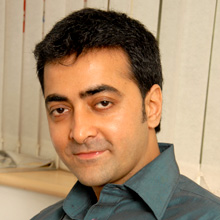
    Marketing Head of the group’s national channels, Akash Chawla admits that Zee has in the past few months taken a beating as far as ratings are concerned. But, at the same time he is of the opinion that 2012 is the year where they will look to change their ranking, where the idea is to be the No 1 player in the next 12 months.


    “We will go step-by-step in achieving that goal,” he said. He also mentioned that the first goal will be to reach the No 2 position in the next four months.


    Content will play a major role and as a part of the strategy, Zee will look to bring international formats, something which they haven’t tried their hands at in the past. While that is true, the channel will continue to launch home-grown formats too. Recently, the channel launched a couple of fiction shows and is looking to promote them on the back of reality show – Dance India Dance 3 (DID 3), a reality dance format show which Zee is betting big on.


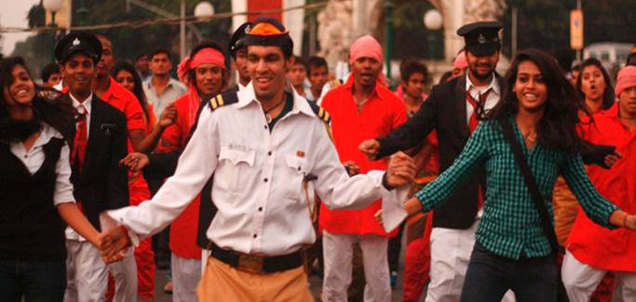
    A lot of work has gone in the new media initiatives, promoting DID 3. The channel recently organised a flash mob with the idea to promote the concept of ‘dance’ among viewers (see photograph). Besides that, contests on Facebook, hoarding, press, TV spots supporting the mega campaign. “The idea is to have a dialogue with the viewers. Even in the case of our press ads, we have tried to make a dialogue with our viewers, explained Chawla. “He further added, “We also did a flash mob because we thought it was a great idea. We were launching the show at a peak of a season where people tend to move out a lot. Also we did this when it was a holiday season, so footfalls in public places are likely to be more. If at the end of the day, I can make people dance along with Dance India Dance, the message is there, the engagement is there. The recall value increases.”


    Zee Cine Awards will happen in Macau on January 21 and be aired on the network on February 5. The show is promoted across all countries where Zee operates; however, marketing activities are being carried out country wise, where there will be different ideas, contests and marketing plans for different countries. Ditto with sponsorships, where each country will have a different presenting sponsor. For India, the channel has got on board Pan Bahar as the presenting sponsor.


    The campaign will cut across outdoor, print, radio, on-air promotions and interactive contests. It will also widely explore the digital space including social media, mobile-based apps and forge strategic tie-ups in every region to ensure a 360* connect with Indian as well as international audiences. This coming together of Zee’s global marketing teams will see more than 30,000 promos running across its global network in 168 countries.


    The story doesn’t end here for both Chawla and Zee Group for that matter. From a network point of view, there is a renewed thrust on Zee Classic. One of the three channels that were launched to be on the digital platforms initially. Zee Premier and Zee Action being the remaining two. Having defined a niche for Zee Classic and the fact that the channel has already about 500-odd movies to engage the audience with, the task at hand for Chawla and team is to market the channel more aggressively to that specific niche. The channel launched a new show called Classic Legends, presented by Javed Akhtar.


    Digitisation will help boost channel’s profits. It also opens up a whole new channel for marketing. Dish TV being a sister company, and reported to be the largest among DTH players, Chawla says it makes more sense to leverage that platform and generate as much traction from there in promoting the channels shows, particularly reality shows – DID 3 in this case.


    So a lot happening. DID 3, Zee Cine Awards, the new media thrust, the plan to be No 2 in four months and No 1 in a year’s time. The task is mammoth as Sony and Colors too are eyeing the No 1 spot. So these are testing times for Zee. Will the pressure of expectations defeat the channel’s ambitious moves? Or will it come out victorious?

  • The MxMIndia LookBacks for 2011


    LookBack 2011 coordinated by Ritu Midha


    By Ritu Midha

    The year 2011 has been full of ups and downs for the global economy. While it started on an optimistic note, the projections have been revised downwards several times since.


    LOOKBACK 2011
    The Year in News Media (Ranjona Banerji)
    Middle India on overdrive (Nielsen report)
    Top TV & Print Spenders
    The Year for GECs
    The Year for News TV
    What creative & media agencies won
    People Movements
    The winnings
    Filmwallahs dominate endorsements
    11 Noteworthy Happenings (Tuhina Anand)

    India was no exception – though it was largely due to the global slowdown – the government’s foot-dragger approach to many a policy, and high inflation rate did not help the matters any.


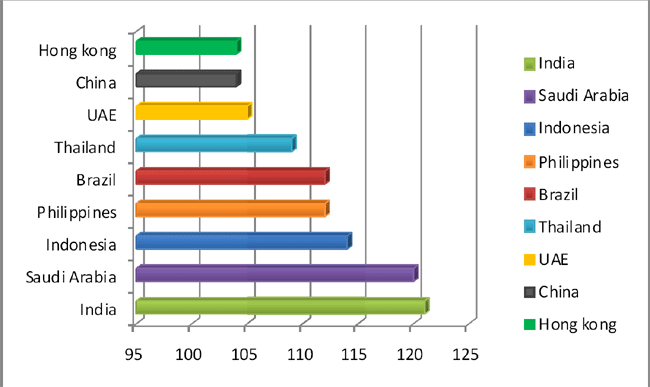
    The slowdown has led to tightened purse strings, however as per a Nielsen report, ‘Global Online Consumer Confidence, Concerns and Spending Intentions – 3rd Quarter, 2011’:  consumer sentiment in India is the most optimistic in the world, for the seventh quarter in a row. (Data Source: Nielsen global consumer online confidence survey, Q3, 2011)


    Click here to download the report from Nielsen website


    As for the economy, in January, World Bank predicted that in the year 2012, India would grow at a pace of 8.7 per cent (and the oft-compared economy, China would grow at a slower pace of 8.4 per cent).


    There is too much water under the bridge since then, and current fiscal is now expected to show growth figures of around 7%, as per Fitch, the credit rating agency.


    However, hope is back for 2012, with credit rating agencies reaffirming India’s ratings in the fag end of 2011.


    Moody’s, in a recently released report, reaffirmed India’s sovereign rating at BAA3. Though it has added that growth downturn is likely to persist for two more quarters.


    As per data released by Fitch in December 2011, the economy is likely to grow by 7.5 per cent in 2012-13. Though, in the current fiscal it is likely to be around 7 per cent.


    Interestingly, the government’s forecast is 7.5 per cent growth in the current fiscal. In its mid-year review released in mid-December, the government revised the growth projection to 7.5 per cent from 9 per cent forecasted in the pre-Budget survey.


    Another good news coming at the end of the year is easing out of food inflation. The index stood at 1.81 per cent in the period up to December10, 2011, while in the previous week it was at 4.35 per cent. The reason behind the improved numbers is the fall in the prices of cereals and vegetables.


    Inflation, till now, has led to a sharp increase in raw material prices, hurting the FMCG companies. As a result, leading FMCG companies like Hindustan Unilever, Procter & Gamble, Reckitt Benckiser, Godrej Consumer Products, Marico and Dabur were compelled to increase their product prices.


    However, according to a report by FICCI, the Indian FMCG market is now expected to grow at rate of 10 per cent (current estimates: Rs 2,600 crore) over the next 10 years and reach a size of Rs 4,13,000 crore by 2015, which would further increase to Rs 6,65,000 crore by 2020. It is good news for media fraternity, as FMCG is their main stay.


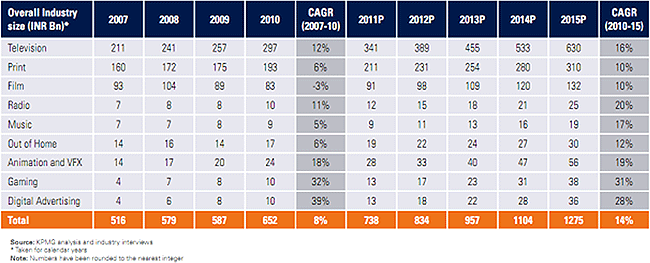
    In this back drop, let us check growth expectations of the media industry. In the beginning of the year, KPMG had predicted that the industry size would grow to Rs 341 billion – an approximate growth of 16 per cent.


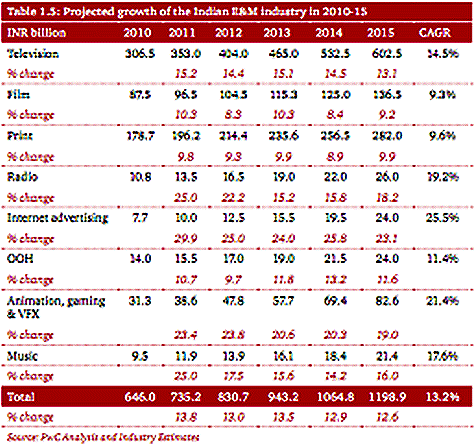
    Meanwhile, as per PricewaterhouseCoopers estimates, the entertainment and media (E&M) industry in 2010 stood at Rs 646 billion as compared to Rs 580.8 billion in 2009.  This was lower than the projected growth rate of 15.1 per cent for last year. The reason for lower growth rate was the decline witnessed in the film segment. The other two key industry segments: television (15.4 per cent growth as compared to 15.6 per cent projected) and print (10.7 per cent as compared to 8.5 per cent projected), showed good growth. As per the estimates, the E&M industry size would have been Rs 735 billion for 2011, but this does not look achievable now.


    In December, both Zenith Optimedia and group M indicated a sluggish growth for 2012 globally.


    As per Zenith Optimedia, global ad spending in major media will grow to $486 billion (4.7 per cent growth). It had earlier predicted a 5.3 per cent growth in 2012. However, Asia Pacific (excluding Japan) is expected to grow by an average 10.4 per cent a year and 33 per cent of the global growth is expected to come from the four Bric markets (Brazil, Russia, India, China).


    Group M, meanwhile expects a 6.4 per cent increase in global ad spending in 2012, As for 2011, it expected to show a 5 per cent increase in ad spends over 2010, to $490 billion.


    As for India, the experts believe that growth rate in 2011 would be in single digits, while Zenith Optimedia prediction of around 11% growth might hold true of 2012.


    Look out for the second part of our yearenders tomorrow

  • Done deal? Mukesh Ambani to enable Raghav Bahl to pick up ETV. RIL likely to invest Rs 1.5k cr for 30% & 4G rights

    By R Sriram


    Reliance Industries is embarking on a major diversification into the media and entertainment sector with the Mukesh Ambani firm agreeing to fund a transaction that will result in a sizeable stake for itself in a company controlling two of the industry’s largest businesses, the Network18 Group and the Eenadu Group of channels run by the Hyderabad-based Ramoji Rao.


    People close to the transaction, which has a number of stages, told ET that an RIL subsidiary will help the promoter group of Network18 fund the rights issues of its two listed entities, Network18 Media and Investments, which runs the portal moneycontrol.com, and TV18 Broadcast Ltd, which operates a number of business and general news channels, notably CNBC TV18 and CNN-IBN.


    ET was not able to independently verify the amount to be invested by RIL, but people with direct knowledge of the transaction estimated it to be more than Rs 1,500 crore. The money from RIL will help Mr Raghav Bahl, the promoter of the TV18 Group, subscribe to the rights issues of both the listed companies, Network18 and TV18. The full amount expected to be raised through the rights issues is estimated at over Rs 3,500 crore.


    The boards of TV18 Broadcast and Network18 Media will meet on Tuesday to discuss plans for a rights issue. Mr Raghav Bahl did not respond to an email questionnaire; a Reliance group spokesperson also remained silent, while Mr B Sai Kumar, the CEO of Network18, declined comment.


    Times NOW and ET NOW, owned by Bennett, Coleman & Co. Ltd, the publisher of The Economic Times, compete with some of the television channels owned by Mr Bahl. The strategic investment by RIL will be used by the Network18 Group to retire debt and eventually buy out RIL’s stake in Eenadu, the pan-India vernacular language channels owned by Mr Ramoji Rao.


    RIL sources said they had invested Rs 2,600 crore in the Eenadu Group through a subsidiary giving it ownership of all businesses apart from its Telugu channel, in which it owns 49 per cent. The transaction, once complete, will result in RIL recovering most of its investments in Eenadu. Messages and an email sent after business hours to the office of Mr CH Kiron, the managing director of Ushodaya Enterprises, the holding company of the Eenadu Group, did not elicit any response.


    By its own admission before the Andhra Pradesh High Court, Reliance Industries has said it has invested Rs 2,600 crore in entities of Mr Nimesh Kampani-led JM Financial Group, which in turn had invested in Ushodaya Enterprises. The AP High Court is hearing a petition alleging the investment was a payoff to Mr N Chandrababu Naidu, the former chief minister of Andhra Pradesh, an allegation RIL has denied in its affidavit. RIL’s deal with Mr Bahl, likely to be announced on Tuesday, is expected to create a powerful national news and entertainment company spanning several regional languages as well as English and Hindi.


    RIL to get Exclusive Rights to Content


    RIL, people close to the transaction said, is expected to hold an economic interest equivalent to a 30 per cent stake in the promoter group of companies, with the original promoter Mr Bahl owning 51 per cent and all voting rights.


    Further, RIL will have exclusive rights to content from 30 channels and web properties of the two media houses, which will lend a competitive edge to its broadband services to be rolled out later this year.


    RIL is laying the groundwork for national 4G broadband services expected to be launched sometime this year. Content for broadband services is generally outsourced, but RIL will have an advantage over others with this transaction which will give its subscribers a wide variety of channels ranging from general entertainment to news and movies.


    Earlier on Monday, Mr Sai Kumar, in a letter to all employees of TV18, hinted at a solution to the group’s debt problems. “Let me also take this opportunity to tell you that we are very close to addressing our debt levels and related issues which have been reported by various media in the last few weeks. We will learn the details from Raghav pretty soon,” said Mr Sai Kumar, who took over as CEO after the sudden resignation recently of long-time CEO Mr Haresh Chawla.


    The money is likely to be invested directly in companies controlled by Mr Raghav Bahl, such as RB Holding Pvt Ltd and RB Investments Pvt Ltd. These companies own 30.34 per cent stake in Network18 Media while Mr Bahl holds 9.03 per cent in his name. Network18, in turn, is the main shareholder in TV18 Broadcast with a 49.98 per cent stake. The two companies have suffered heavily in the downturn triggered by the financial crisis of 2008-09. While revenue growth has been strong, profits have plummeted and borrowings have soared.


    At the end of March 2011, Network18 had debt of Rs 1,777.89 crore. Its profit for that year fell 87.27 per cent. TV18’s debt stood at Rs 550.54 crore while profit fell 17.40 per cent. The markets have punished the two companies. Network18′ s market cap is down 171.57 per cent since January 5, 2009 while TV18’s has fallen 560.23 per cent in the same period. Mr Bahl’s companies also have a distribution joint venture with the Chennai-based Sun Group, called Sun18. It is not known if Sun’s channels, among the strongest in the south, are a part of this arrangement. American giant Viacom too has a joint venture with Mr Bahl for producing movies.


    Source:The Economic Times

    Copyright © 2012, Bennett, Coleman & Co. Ltd. All Rights Reserved