Author: mxmadmin

  • 2012 for Libra

    You will practically heave a sigh of relief as the year 2011 wraps up, says Ganesha. The year 2012 will be all about changes – for good! Your personal, social, financial and spiritual life is likely to undergo a transition. The storms of the past may not be over, but they definitely will abate. It’s time for re-evaluations and second chances, and that includes a relationship that you may have thought as irreparable. Ups and downs in your personal and professional realms are possible, but aren’t they for everyone, exclaims Ganesha! Health will be fine, but there will be burdens, many of which would be self-invited. Stress and tension may be the rightful results of all the over-work! Look to de-stress using relaxation therapies. You may also plan to refurbish your home, which will help you take your mind off for some time. Unexpected expenses are likely to mount. And your love life may not improve dramatically, but it will, in its due course. For now, just hang on, and turn to divine help and spirituality, for a better tomorrow, says Ganesha!


    Home and Family Life

    Your home and domestic life is getting influenced by a variety of factors. In 2008, Pluto moved into your 4th House of family and home, and it’s going to be anchored there for many more years. It is, therefore, likely to impact your domestic life greatly, indicates Ganesha. Your relationships, emotions, and domestic life in general are going through a lot of changes. This year too, there are likely to be minor and major changes on your home front. Many negative aspects and shortcomings will be made manifest, but take it as a clue to become aware of these and take appropriate steps to purge yourself of their deleterious effects. It will not be easy, but the detoxification process is going to take place whether you like it or not. And, thus there is no point in resisting it; just let it happen, because it’s going to bring positive changes in its wake. Saturn, your family planet, is going to be in your own sign for the better part of 2012, making you devote more time to your domestic life.


    Love and Social Life

    Uranus moved into your 7th House in the year 2011, and shall stay put there for six more years. This indicates a lot of changes as far as your current relationships are concerned. Expect these changes to be a mixed bag – some good, some bad. The strength of your love and friendships both may be tested. If these relationships are deep-rooted, they will survive the storms, assures Ganesha. But superficial ones may not stand up to the test. By the time Uranus moves out of your 7th House, you will have realised who your good friends are, and who are/were merely fair-weather buddies. This aspect applies to not only your personal relationships but also to business partnerships. Ganesha will help you through all this, hence have faith and carry on, without being bitter or vindictive. However, marriage is not on the cards this year. In fact, you need to eschew it.


    Health

    The year 2012 looks definitely better on this front, affirms Ganesha. Your health is going to get better with each day, rather. But you may still not be able to breathe easy. Though things are getting better, you still need to be very careful about you health, and keep a safe distance from hazardous situations. Your 6th House of health, which was vacant last year, becomes strong after February 3rd, which indicates that you will take your health seriously, says Ganesha.


    Career and Finance

    Brace yourself for a rough ride in the year ahead, as far as your finances are concerned. This is because Uranus is aligned squarely with your financial planet, with which Saturn also is making an unfavourable aspect. However, Saturn’s aspect is not as powerful as last year, so you may get a few moments of respite. These two aspects indicate that you will have to work much harder than usual to achieve your financial targets, says Ganesha. There may also be many upheavals in your financial situation this year. Some of them could be bolts from the blue! And some, minor whiffs in comparison to others. By the end of the year, your whole outlook on finances will have undergone a change, not just how you earn and spend your money but even your financial strategies. But, then a lot also depends on financial conditions in the world around you. A word of consolation from Ganesha here: Be patient, and you may see sunshine financially, once the dust settles. Some disturbing financial dealings may set you back for some time, but eventually you will be able to see the real good come out of it.


    GaneshaSpeaks.com is #1 in India and #3 in horoscope portals on a global level. It offers accurate, reliable and trustworthy services online and on 55181(at premium rates) on all major telecom providers in India. Content syndication for print, TV, online, telecom and apps is one of the major verticals in GaneshaSpeaks.com. For more details dial +91-79-61604100 or send an email to contact@ganeshaspeaks.com.



  • 2012 for Sagittarius

    Most of the long-term planets, with respect to the sign of Sagittarius, will remain scattered for a greater part of the year 2012. This indicates that, akin to the planets, your interests too will be scattered, even confused, indicates Ganesha. Remaining centred and concentrating on your main goals could be a task! The good thing is that your energy levels will be at an all-time high and barring a few seasonal illnesses, you will enjoy good health throughout the year. Your mind and heart may gravitate towards spiritualism like never before, more so since your family life may have been disturbed or vacuous. This shift, thanks to Neptune, may alter many of your previously held beliefs and attitudes. It may make you more sensitive and compassionate towards your family. Single archers may be soon changing their relationship status to ‘committed’. On the work front, you’ll excel, and may see a surge in your creativity. Job opportunities may arise from nowhere, hints Ganesha. Although financially, you are safe, you’ll need to manage your expenditure.

     

    Home and Family

    Your domestic life has been through plenty of upheavals due to Uranus’ presence in your 4th House. However, Uranus has moved out of the House and the circumstances have become less demanding. When Neptune enters your 4th House on February 3rd 2012 to stay anchored for the next 14 years, expect your attitudes and outlook to change greatly, foretells Ganesha. It’s not only you but also your family members who will visibly be calmer, and will feel inclined towards spiritualism. Neptune will also uncover all sorts of secrets, which may sometimes shock you, and may sometimes pleasantly surprise you. However, you will feel lighter and calmer at the end of it.


    Love and Social Life

    Venus’ unusually long transit indicates you will get into a serious, committed relationship. Moreover, when Jupiter will enter your 7th House on June 11th 2012, the romantic possibilities will be more potent. Your romantic endeavours are likely to be successful this year, predicts Ganesha. If you are unmarried, this year could bring you into contact with your life partner. This transit also indicates that you will function like a go-getter, take charge of your life and won’t wait for things to happen. You are determined to get what you want. Go, chase your dreams! Ganesha’s blessings are with you.


    Health

    Your health will not cause any concerns with Jupiter, your ruling planet, placed in your health House till June 11. As a result of this aspect, you will enjoy good health, and will most probably be focused on maintaining good health and fitness. However, don’t take your health for granted, especially from June 11 to July  2012. Your relationships and health are correlated as Venus is your health planet. So if you encounter any problems on the health front, Ganesha advises you to review your relationships first, so that you can identify the root causes and restore harmony.


    Career and Finance

    It is the right time to get rid of excess baggage, eliminate wasteful expenditure, throw out all the things that you don’t need any more, maybe invest surplus funds more profitably, or even realign your financial goals, says Ganesha. Pluto in your finance House indicates that there may be an inheritance coming your way. You may be all set to get an increase of revenue from your insurance and royalties. Ganesha throws in a word of caution here and says that you should manage your debts very carefully and wisely. Take loans only for constructive purposes, because borrowings which won’t generate revenue will surely become burdensome for you.


    GaneshaSpeaks.com is #1 in India and #3 in horoscope portals on a global level. It offers accurate, reliable and trustworthy services online and on 55181(at premium rates) on all major telecom providers in India. Content syndication for print, TV, online, telecom and apps is one of the major verticals in GaneshaSpeaks.com. For more details dial +91-79-61604100 or send an email to contact@ganeshaspeaks.com.


  • Life OK’s gr8 start with 87 GRPs (report + analysis by Stratagem)

    By Rishi Vora


    While it may be still early days to declare Star India’s new channel Life OK as a success story in the Hindi GEC market, there is no doubt that it has delivered on the network’s goal No 1, which was to make an impact on the industry.


    The primary objective, as cited by a few industry observers, is to compete with the Sony and SAB TV combo, so that Star as a network could have a commanding position in a market which is now seen as hyper-competitive.


    So Life OK has clocked 87 GRPs in its first week, surpassing Colors’ 81 GRP launch back in July 2008. It may be recalled that Colors had left no stone unturned for the launch. The strategy was to start with the big-ticket show Khatron Ke Khiladi (with film star Akshay Kumar in a way giving a solid push to the channel), aggressive marketing, fiction shows, mythology, so on and so forth.


    One may argue that Colors was launched as the flagship channel of a joint venture company of two broadcast majors – Viacom and Network 18. Life OK in that sense is Star India’s second offering in the Hindi GEC sector. But, that has very little to do with what the channel has achieved in the first week as Star officials say that the idea is to compete with every channel in the market, it doesn’t matter if it means competing with elder sibling and No 1 channel Star Plus.


    An interesting observation: Imagine and 9x were launched in the same year (2008) and registered 55 and 21 GRPs respectively. Both the channels gradually grew in GRP terms, but as the market became competitive, the going for both channels became tough. While Imagine is still around (currently placed at No 7 with 67 GRPs), 9x may be on air, but even though it has been acquired by Zee, it has failed to create an impact . Of course there are several reasons attached to why the channel tasted early success and witnessed one of the most dramatic and talked-about downfalls.


    As for Life OK, its success at this stage can be attributed to the following: A sensible approach to launch the channel with a unique philosophy, marketing blitzkrieg (it is reported that Star India made an investment upwards of Rs 700 crore to launch the channel. The campaign, which is in full swing now, saw a three-day roadblock across Star India’s network, an outdoor plan reaching 100 towns, a week-long digital engagement programme which included an eight-hour-long concert, and of course getting Madhuri Dixit as the Sutradhar (storyteller). Plus, the fact that the channel did not bank on one particular show to deliver, and rather offered viewers a package of differentiated programming, the strategy to cut down on advertising inventory – all these factors put together have produced rich dividends.


    Official comments from the senior members of Star India and Life OK could not be obtained at the time of this report. However, industry observers believe that Life OK has what it takes to be a serious contender in the Hindi GEC market.


    Ashish Bhasin, Chairman India and CEO South East Asia, Aegis Media, observed, “Life OK as a channel has great potential.  However, the true test of a channel is after it has settled down for a few months. It is sometimes easy to get content for a short period but sustaining it on an on-going basis becomes a challenge. Ultimately, in my view, content drives the fate of any channel. If Life OK is able to sustain good quality content on an on-going basis for two or three years, it can definitely become a serious player. On the other hand, if the quality of the content starts to drop after the initial launch, then it’ll have a struggle ahead for itself.”


    Havas Media CEO – India and South Asia Anita Nayyar said, “With the kind of marketing backup and hype, the opening seems good and certainly a hike from the Star One deliveries. However, two-three weeks of sampling will continue and the actual stability will start setting in after a few weeks. Coming from the Star Network, the programming quality is very good.”


    On whether it will pose a challenge to the top players – Star Plus, Sony, Colors and Zee, she said, “It will be a strong competition in the GEC category for the No 3, 4 and 5 slots. Not sure about whether it will be another success story as big as Colors, as it had the advantage of differentiated content on the social platform when it launched. The content is interesting and should help stabilise around 60-70 GRPs from here.”


    In an earlier interview to MxM India, Star India COO Sanjay Gupta had mentioned that the No 4 position in the GEC line-up (currently held by Zee) would be a first good milestone to look at. In week 52, Zee is at 208 GRPs. Though he did not put a timeframe, going by what experts have to say, the channel will need to pick up on its early momentum and get there by bringing differentiated content – something Colors did very successfully.


    While Imagine has slipped to No 7 position and SAB is at No 5 with 122 GRPs, it looks like a serious battle from here on.


    An analysis by Stratagem Media Pvt Ltd on the launch of Life OK.Background 

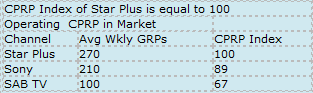
    It is a jungle out there in the media business. If you win the battle, you still have to worry about losing the war. Recently the Star Network launched another GEC called Life OK. Probably in the wake of competition from the Sony and SAB TV combo.The table 1, below depicts that the Sony and SAB combo was just about edging out Star Plus from the top GEC position, especially if it came at a more attractive rate (CPRP), as estimated in the table below.So, the not-so-hidden agenda of the Star network for Life OK would be to combine it with Star Plus and thereby fend against the Sony + SAB offensive, but without devaluing their trump card (i.e. Star Plus itself). Therefore, how would the new channel Life OK have to price itself, to overcome the Sony + SAB threat?


    Stratagem Media has undertaken a simple exercise to answer this question, for different levels of performance of Life OK.


    Objective of the exercise: To derive the CPRP Index of Life Ok @ different level of GRPs, if the CPRP of Star Plus is 100?


    Methodology: If the CPRP of Star Plus is 100, then what should the CPRP of Life OK be, if they have to match the CPRP of the Sony + SAB combo at different GRP ratios between the 2 channels.


    In the exercise below, the ratio of GRPs purchased between Life OK and Star Plus is assumed to improve in favour of Life OK, as its performance improves.


    *At these CPRPs, the Star Plus and Life OK combo will be as cost-effective as SET and SAB combo.


  • Chris Thomas: BBDO India’s performance has been fantastic

    By Tuhina Anand, Video-Shruti Pushkarna
     

    Chris Thomas, Chairman and CEO of BBDO in Asia, Middle East and Africa and Chairman of Proximity Worldwide, has spent over 25 years in the communications industry, and the majority of his time working for BBDO. In an exclusive interview with MxM India, Mr Thomas shares his views on the network and his view on BBDO’s performance in India and the road map ahead.


    Q: Are you satisfied with the way BBDO brands are performing in India?

    I think we’ve seen tremendous developments in the BBDO brand in the last three years. Our partnership with RK Swamy BBDO has been a tremendous success and continues to grow and develop. BBDO India has been ranked as one of the most creative and the most effective networks in India.


    Chris Thomas on BBDO expansion plans

    You measure their performance at Cannes, by winning the first Indian effectiveness awards at Cannes; there has been tremendous progress.


    BBDO India’s performance has been fantastic. We’ve gone from nothing in BBDO India to an agency that punches well above its weight in terms of size, is winning on the world stage, is developing our multinational clients’ businesses and brands in a way that’s highly compelling and effective.


    Q: With the recent development of Mudra, would it in any way also affect the scheme of things for BBDO?

    Well, that is a tremendous commitment and recognition of the importance of the Indian market. For Omnicom, there’s been a long standing relationship with Mudra. Obviously from the BBDO perspective, Omnicom’s continued commitment to the Indian market is very important and supportive.


    Chris Thomas on Omnicom Mudra acquisition

    Q: Are you looking at expanding your footprint any further? If yes, where would it be?

    The only thing I’m looking at expanding is quality. What I’m always interested in, is doing great work that’s talked about and moving consumers in the Indian market. If we have specific needs to be addressed in specific geographies, then we develop those needs. But the most important thing to expand is to make sure that we are doing the best work in the market and expansion comes after that, not before.


    Q: So if you were to define BBDO, would you say it’s small, mid-sized or big?

    BBDO is a network around the world, so obviously it’s enormous. But it’s not what we focus on, what we focus on is on being good. BBDO is defined by what we call the work, the work, the work, producing the best and the most compelling commercial content on behalf of our clients.


    So in this market, we absolutely live up to and deliver on that promise, and that’s why it’s been fantastic for our clients.


    Q: In the current times, what are the two challenges that you are facing?

    The challenge… it’s true in all of the Asian markets, it’s around the world, I think. But I think particularly in India and China, the key for all of our networks is to make sure that we are attracting the best people into the industry, we are retaining them and we are developing and growing them. So for me, I spend a huge amount of my time on attracting talent, developing our talent, and making sure that we have got an unfair share of great talent.


    Chris Thomas on current challenges

    Q: So what is your formula for attracting talent?

    Well we have a phrase, ‘culture eats strategy for breakfast’, and what we mean by that is, it’s about the power of the brand and the power of the culture. The fact that we are indisputably the most creative network in the world, the fact that this year we’ve been ranked as the No. 1 effectiveness network in the world means that we have a very powerful culture, we are aligned around a set of beliefs and what we care about, and that tends to attract good people. And that’s what we preserve and protect at all cost. So culture ahead of anything else.


    Q: We’ve been hearing about a talent crunch but there’s also the issue of being paid well. Is that an issue or is it being blown out of proportion?

    I think there’s a difference between accountability and effectiveness, and I think as an industry, we are spending quite a lot of time thinking about accountability. There are things we can count, like the cost of production, cost of media and so on. And we need to be concentrating a lot more on effectiveness and the value we add as a business to our client’s business. If you do that and you can demonstrate that case and that value, then you can command a premium. But it’s for the clients to see value and that’s about generating effectiveness and effective work. And I think if you can get that right, then the remuneration conversation can follow from there.


    Chris Thomas on his formula for attracting talent

    Q: Can you tell us about Proximity in India?

    We launched Proximity about a year ago now. Obviously as a network, it’s a rapidly growing direct CRM and digital network. I think there’s been a huge amount of conversation around social media, digital CRM, and we are seeing good growth in that business and I think that will continue in India as digital media, broadband penetration, use of mobile – which is enormous in this country – continues to grow, there are tremendous opportunities ahead.


  • NCT Data Wk 51 ’11


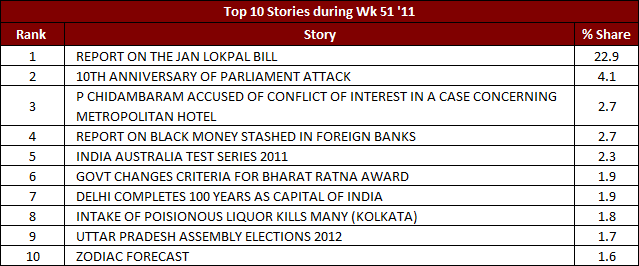
    Source: News Content Track – A service of TAM Media Research Pvt. Ltd
    Channels: Aaj Tak, CNN IBN, Headlines Today, IBN 7, India TV, NDTV 24/7, NDTV India, Star News, Times Now, News 24 & Zee News
    Period: Wk 51 – Dec 11 to Dec 17, 2011
    Note : Analysis is based on the Telecast duration


    About TAM Media Research


    TAM is a joint venture between Nielsen Company & Kantar Media Research. Besides measuring TV Viewership, TAM also monitors Advertising Expenditure of Television, Print & Radio through its division AdEx India. Since 2004, it extended its presence in the PR Measurement & Analysis space for Corporate/Marketing Clients by setting up a separate division Eikona PR Measurement.


    In 2007, the joint venture introduced RAM (Radio Audio Measurement) service to track Radio Listenership for the Indian Radio Broadcast Industry. In year 2009, TAM launched a division, called TAM Sports that specializes in monitoring Sports Sponsorship ROI.


    TAM Media Research’s objective is to fuel media insights that will drive the growth of the Indian Media Industry.

  • The Anchor: 11 noteworthy happenings of 2011

    By Tuhina Anand


    #1 The Dentsu deal. This was one of the earliest developments of 2011, creating a buzz when Sandeep Goyal made a fortune after selling his 26 percent stake in Dentsu India. Denstu Inc, the Japanese company which had a JV with Goyal’s Mogae Group became the sole owner. This development later saw some senior appointments like Rohit Ohri moving out of JWT to be the Executive Chairman of Dentsu Group India and much recently appointed Divya Gupta as the CEO of Dentsu Media.


    #2 World Cup comes home. India gave a stupendous show of its cricketing prowess when it lifted the World Cup. The series was a great opportunity for advertisers to get maximum eyeballs while ESPN Star Sports got the status of the official broadcaster of the series. Captain Cool, MSD walked away not just with the cup but also was given the title of the most influential Indian in Time’s list. Not to forget all the endorsement deals that the Indian team got post the win.


    #3 UTV-Disney deal. This was the mother of all deals when Walt Disney declared to buy stakes of UTV Software Communications. The deal is valued to be around Rs 2000 crore. Walt Disney already had a majority stake in UTV. The former will launch an offer to delist shares of the latter which will begin early next year.


    #4 Tough time for Kalaignar TV. The DMK run Kalaignar TV was in the news albeit for the wrong reasons. It got dragged in the 2G spectrum license episode and the brand took a further dip with its MD Sharad Kumar behind bars. This was one incident that Kalaignar would like to forget but its easier said than done especially because its taxpayers money that has been misused if the paper trail is proved correct.


    #5 Appointments and Dis-appointments. Ashish Bagga was elected President of The Indian Newspaper Society for the year 2011-Uday Shankar of Star India for was re-elected as the President of the Indian Broadcasting Foundation (IBF) for his second term. Also Shashi Sinha of Lodestar was elected as the President of Ad Club Bombay. After being with TV Today Network for almost 16 years, G Krishnan, the Chief Executive Officer and Executive Director quit. Haresh Chawla, the CEO of Network18 Group too decided to call it a day. Meanwhile Raj Nayak filled in the place left vacant by Rajesh Kamat when he took over as the CEO for Colors.


    #6 Justice Katju’s policing. Press Council Chairman, Justice Markandeya Katju had earned the ire of media by constantly trying to police media and gag the freedom of press. His suggestions to bring media under strict government purview and his thoughts on objectionable content had many in media being vociferous in their protest.


    #7 Rise of independents. The year marked the rise of independents in the advertising agency business who did well and earned name purely on their talent be it Taproot India with their fabulous work on Airtel and Pepsi or Creativeland Asia winning applauds at international awards arena.


    #8 AdAsia in Delhi. Delhi became the place to be for the advertising folks from around Asia who gathered for AdAsia. It was in 2003 that AdAsia was held in India in Jaipur and it came back only in 2011. The lineup of speakers was enviable and the number of delegates impressive. Thus a stimulating conference for all present.


    #9 Omnicom stake in Mudra. The Omnicom Group that has been trying to gain greater foothold in India managed to do so by taking a majority stake in Mudra. Post this Mudra also made its first structural change where it would be known as DDB Mudra and have DDB, Mudra, and Mudra Max under its umbrella.


    #10 Bobby and JWT shake hands. Bobby Pawar declared his intention to move out of Mudra soon after the Omnicom deal, thus giving enough fodder to the media to speculate on. His next destination is JWT and promptly Colvyn Harris took the opportunity to set his agency in order and went appointing three NCDs and a CCO at the helm. They sure will have their hands full in the New Year.


    #11 Anna Hazare’s magic. Who would have thought that a septuagenarian clad in Gandhi topi would become the most recognized face of 2011 and maybe even scoring more than Salman Khan in his meteoric rise to popularity? Not to mention that his fasts and LokPal Bill has taken enough of newsprint and debates on TV and has become a trending topic on the social media.

  • Anil Thakraney: The trick Anna missed

    By Anil Thakraney


    So, Anna Hazare’s Mumbai campaign suffered a serious setback. Only a few thousand ‘fans’ landed up, though expectations were of lakhs of people joining in. In fact, I was so mortally petrified of the projected traffic chaos, I made sure I did not plan any travel in the city… I stayed hidden under my bed like a coward for the period of the planned agitation.


    Quite clearly there are many reasons why the dharna flopped, and I won’t go into them out here, that’s for columnists in the mass media to worry about. But I must say this: For Mumbai, which is not a politically active city unlikeDelhi, Team Anna needed to think out of the box to get the crowds in. For one, they needed to hire a professional event management company, which would have organized entertainment and refreshments for the attendant junta. People are already fatigued of the Lokpal issue, and there have to be add-ons if Mumbaikars are tempted to give up their routine lives and spend three whole days at the MMRDA grounds. I am quite sure some event companies would have slashed their fees for the noble cause.


    Two, and no I am NOT kidding about this, Team Anna ought to have done a promo tie-up with Bollywood, without making a song and dance of it. For example, Don 2 released around the time of Anna’s Mumbai chapter. Could they not have tied up with Farhan Akhtar and Shahrukh Khan? What’s the worst that would have happened? SRK asking people to watch his flick, that’s about it. He does that everywhere, anyways. But in return, his presence would not only have pulled massive crowds in, it would have got Parliament on the edge. And the media would have shown much more interest in the event, even the Page 3 journos would have landed up.


    I am sure some of you might think I am trivializing a serious issue out here. Well,

    I am not. Because it’s quite clear to me that poor old Anna Hazare does not have the money or the means or the charisma to send Mumbai into a tizzy. He needed help. He needed to be clever. Because after the Mumbai flop show, even the Anna loyalists are having second thoughts about a solid Lokpal bill. And many fans across the nation seem to be losing faith in him.


    It would be a terrible loss for the country if Anna sahib were to fade away into oblivion. It’s time to think different.


    * * *


    PS: Since I am always cribbing and carping about the Indian media, I have decided to be nice in my last post of the year. For the entire year 2011, news channels behaved liked hysterical cheerleaders for Anna Hazare, thereby throwing all professionalism out of their studios. But as the year closed, I noticed a sense of calm and fair play across the board. The debates were more balanced and nuanced. Even Arnab Goswami was unbiased!


    Let’s hope we get to watch more of this in 2012. Happy New Year!


  • Registered papers in India is 82,237, Hindi & Eng lead in no of print entities

    By A Correspondent


    The press registrar, T Jayaraj, Registrar of Newspapers for India (RNI), presented the 55th annual report ‘Press in India’ 2010-11 to Uday Kumar Varma, Secretary, Ministry of Information & Broadcasting (I&B).


    Speaking on the occasion, Mr Varma said that the annual report was a compendium of interesting data containing status of print media in the country. He also suggested that based on the previous years’ trends, a comparative analysis of different newspapers in circulation, their growth over a period of time and further comparative statements could be presented through graphs in the next year’s annual report. This would add value to the report, thereby becoming an important reference point for key stakeholders in the industry.


    The Annual Report highlighted key trends for the Indian press in 2010-11. The analysis provided a broad overview about the general trend of the Indian press based on the number and claimed circulation of newspapers.


    The total number of registered newspapers stood at 82,237. The number of new newspapers registered during 2010-11 stood at 4853. The percentage of growth for registered publications over the previous year was 6.25 per cent.


    The RNI approved 13,229 titles for the year 2010. The largest number of newspapers and periodicals registered in any Indian language was in Hindi at 32,793. English had the second largest number of newspapers and periodicals which was 11,478. The total circulation of newspapers stood at 32,92,04,841 as against 30,88,16,563 copies in 2009-10. The number of annual statements received in RNI for the year 2010-11 was 14,508 against 13,134 in 2009-10 registering an increase of 10.46 per cent.


    As per data from the annual statements, the highest number of newspapers were published in Hindi (7,910), followed by English (1,406), Urdu (938), Gujarati (761), Telugu (603), Marathi (521), Bengali (472), Tamil (272), Oriya (245), Kannada (200) and Malayalam (192).


    In terms of circulation, Hindi newspapers continued to lead with 15,54,94,770 copies followed by English with 5,53,70,184 copies. Urdu press had a figure of 2,16,39,230 copies.


    The report is a statutory requirement under Section 19 G of the PRB Act, 1867. It is an analysis of the Indian Press which focuses mainly on circulation as claimed by the newspapers. It also carries different chapters viz ownership of newspapers, analysis of daily newspapers, language wise study of the press and analysis of registered newspapers. The source of information of the report is the annual statements submitted by the publishers of newspapers and periodicals in accordance with 19 D of the Act.


  • Ganeshaspeaks forecast 4 media & mrktng pros – Part 2: Libra, Scorpio, Sagittarius, Capricorn, Aquarius & Pisces

    Here’s the second part of the astrology forecast from Ganeshaspeaks.com for media & marketing pros for the Libra, Scorpio, Sagittarius, Capricorn, Aquarius and Pisces sun signs.


    Libra (September 23 – October 22)
    Scorpio (October 23 – November 22)
    Sagittarius (November 23 – December 21)
    Capricorn (December 22 – January 20)
    Aquarius (January 21 – February 19)
    Pisces (February 20 – March 20)


    GaneshaSpeaks.com is #1 in India and #3 in horoscope portals on a global level. It offers accurate, reliable and trustworthy services online and on 55181(at premium rates) on all major telecom providers in India. Content syndication for print, TV, online, telecom and apps is one of the major verticals in GaneshaSpeaks.com. For more details, call +91-79-61604100 or send an email to contact@ganeshaspeaks.com.


    For those who missed it yesterday, here are the links:


    Introductory Note
    Aries (March 21 – April 20)
    Taurus (April 21 – May 21)
    Gemini (May 22 – June 21)
    Cancer (June 22 – July 2)
    Leo (July 24 – Aug. 23)
    Virgo (Aug 24 – Sept. 23)

  • The Year in the News Media


    By Ranjona Banerji


    This year started with a hangover – like all New Years should. But unlike the pleasant pain that goes with the knowledge of a party that may have meant over-indulgence but was fun just the same, the media started 2011 with one of those truly mammoth unpleasant hangovers.


    The outcome of the Radia tapes was, at best, a loss of reputation for a few well-known journalists but at worst, a loss of faith in the media as an institution. Public knowledge about the somewhat questionable dealings between journalists and publicist Niira Radia meant that the media could no longer hide in those famous ivory towers. Even more unfortunate was that the finger of suspicion was pointed at all journalists because of the transgressions of a few. It did not help matters that although Vir Sanghvi lost or surrendered his influential column Counterpoint in the Hindustan Times, Barkha Dutt did not just continue with NDTV, but went from strength to strength.


    So it was a somewhat cautious Indian media which initially tackled the phone-hacking scandal in the UK and the closure of the Rupert Murdoch-owned News of the World. Here was journalistic excess in order to get a story taken to a whole other degree – criminality. The tabloid press and the British public and celebrities have historically had an interesting and confrontational relationship. But the desire to delve into every aspect of the lives of the rich and famous – without the reverence shown in our part of the world – made for big sales and bigger profits. The readers loved the sleaze and watching the powerful cringe.


    But this scandal was something else. It was newspapers hiring investigators to pry into the private lives of ordinary citizens and using dubious methods like hacking into voicemail messages to gain information. One reporter lost his job for spying on British royals; but what was the punishment for breaking into the cell phone of a murdered teenager, deleting her messages and not only giving hope to her family that she was still alive but also materially distorting a police investigation into her disappearance?


    As it turned out, the reprisal was fierce and final: a newspaper which was over 150 years old was shut down and the British parliament had a public questioning of the owners and editor of News of the World – Rupert Murdoch and his son James and Rebekkah Brooks.


    The world’s media watched shocked as skeleton after skeleton popped out of the News of the World and NewsCorp cupboards. But surely there was no room for complacency here in India. After all, the problem was not just the Radia tapes; it was also the elephant in the room – paid news. Media houses – without or without the collusion of journalists – had been selling editorial space to political parties. The reader or viewer, of course, was left in the dark and assumed s/he was reading or watching real news stories.


    In the midst of all these depressing signs that some media introspection was required, we had all the uncomfortable revelations by Wikileaks, which turned international diplomacy on its head and exposed lies about the US role in the Iraq war and the black money held by European banks. The subsequent arrest of Wikileaks editor Julian Assange in the UK, on an old sexual assault charges filed in Sweden added to the drama. Was Assange really guilty as charged or was this an international conspiracy to get him extradited to Sweden and from there to the US to punish him for publishing secret cables and other information on the internet? The jury’s still out on that one.


    Wikileaks, though, emphasised once more how the internet was changing journalism and anyone who ignored it, did it at their own peril. Social media is playing the role of a catalyst in creating public opinion outside of the traditional media. The traditional media may not be destroyed but it will be damaged if it does not pay attention.


    Back in India, though, we still had a couple of dramas to play out. The new chairman of the Press Council of India, retired judge Markandey Katju, decided that he didn’t want to be head of a toothless body that was limited to the print media. He proceeded to write a series of articles attacking journalists, calling them frivolous, badly educated and shallow. He listed the sort of news that should be carried and slammed the choices made. He also said that the Press Council’s ambit had to be increased to include television.


    Katju may have been wrong and he may have been right in his opinions, but unfortunately for him, the Press Council remains toothless. And besides, instructing newspapers and TV channels on what aspects of news should and should not be carried impinges directly on the freedom of the press. No one spared Katju and so he quickly backtracked a little.


    Then, perhaps just to prove Katju right, media coverage of the Anna Hazare-led anti-corruption agitation proceeded on just those shallow, one-sided and breathless lines that the former judge had bemoaned. This protest was covered as if it was the only one the country had ever seen. Numbers were inflated or exaggerated. Those who questioned aspects of the Jan Lokpal Bill were shouted down as enemies of the people. As is inevitable, the print media could not sustain its adoration of this movement and started asking uncomfortable questions. TV however continued with its happy path of supporting this “national movement” at all costs until, slowly, a bit of reason leaked into the emotion.


    The doubts had crept into TV studios after the standing committee submitted its version of the bill but the Anna Hazare movement remained adamant on its own stand. But it was really the indifference shown to the movement by the people of Mumbai which ended that love affair. Rather than focus their cameras on 4,000 people pretending they were 40,000, TV cameras panned empty grounds showing us how low the turnout was.


    In journalism, as in life, there are no absolute truths. But there are facts. In 2011, the facts have shown that the people are watching the media. And there’s hardly any place to run or hide. Like we’re forcing politicians and government servants to come clean on their dealings, a little bit of spring cleaning by the media would not be amiss in 2012.


  • We’ll be back in the new year…

    MxMIndia wishes you greetings in advance for the new year. Have a great time bringing in 2012.


    Party responsibly. Please, please don’t drink and drive. We’ll be back on Monday, Jan 2.


  • Flash mobs may lose sheen if overdone

    By Neha Dewan


    There was nothing unusual about the busy weekend evening at Ambience Mall, Gurgaon, in the second week of December. Christmas was just round the corner, and the mall was thronged by scores of shoppers eyeing bargain deals.


    It changed at 6 pm when suddenly a large group of people gathered and broke into a dance that lasted a few minutes and ended with the signature Nokia tune. It was one of the flash mobs that the Finnish mobile phone maker organised simultaneously across six cities to mark the launch of its Lumia smartphone.


    It took most onlookers by surprise, but many shoppers have seen other such song and dance in recent times.


    Flash mob-when a group of people suddenly assemble in a public place to perform a dance or any other short entertainment act and then disperse quickly-is perhaps the hottest marketing buzz in the country, but analysts warn it will lose its sheen because marketers are overdoing it.


    Often used for the purpose of entertainment or to spread awareness about a social cause, flash mob has its modern day origin in 2003 when it was first held in a retail store in Manhattan, the US.


    However, in India the flash mob kicked off in big way last November when 23-year-old Shonan Kothari led a 200-people crowd to dance to the tunes of ‘Rang de Basanti’ at Chhatrapati Shivaji Terminus railway station in Mumbai. The event was a grand success, getting several views on YouTube.


    Since then, there have been a string of flash mobs organised by brands, TV channels, NGOs across leading malls in Delhi, Mumbai and Bangalore to promote shows, create awareness and generate buzz. And here lies the danger-killing the hen that lays golden eggs.


    Moreover, in some cases, brands end up advertising before the show, either through social media or through word-of-mouth, which dilutes their spontaneity.


    Too much, too soon? Maybe, that’s why brand experts sound a word of caution against using flash mob frequently.


    And this is what made Arjun Sharma from deciding against having a flash mob last year. “We thought it would be predictable to do it again in 2011,” says the director of Select Citywalk Mall in South Delhi, who organized a flash mob in 2010. However, Mr Sharma does plan to organise another one-most likely on Valentine’s Day in February.


    “It’s a fabulous way of community building as it leaves an image in the minds of the consumer.”


    Perhaps that explains the need of many brands to get associated with this ‘surprise’ quotient. Santosh Desai, CEO of Future Brands, calls it a classic case of ‘interactive advertising’. “There is much talk about creating experiences for the consumer. And this acts as the perfect medium to give them that.”


    Ashley Lobo’s Danceworx, which organised a flash mob on the Christmas weekend at DLF Promenade mall in the capital, now gets at least 4-5 queries a month for such shows. But Heemanshu Sharma, choreographer at Dancework, says flash mobs should be limited. “I think flash mobs can be far more productive if used less. Otherwise, they tend to become very predictable,” says Mr Sharma.


    Source:The Economic Times

    Copyright © 2012, Bennett, Coleman & Co. Ltd. All Rights Reserved