Author: mxm_india

  • The Pitch returns to Indian TV

    By A Correspondent

    BloombergUTV, India’s premier business channel, today announced Season 2.0 of The Pitch – India’s Biggest Business Reality Show. The channel is inviting potential entrepreneurs with sound business ideas to send in their entries through www.yourmoneysite.com/thepitch. Surviving a gruelling series of tasks given by India’s biggest business leaders, the winner stands to receive a funding up to Rs 5 crore to execute their business plan.

    The Pitch aims to identify, evaluate and encourage potential entrepreneurs who not only have the most deserving business ideas, but also possess the critical skills required to execute those ideas successfully. Following the nationwide call-for-entries, a jury comprising of highly renowned professionals will shortlist the participants who will be called to make their elevator pitches in Mumbai. The jury and angel investors will closely evaluate these shortlisted aspirants not only on the merit of their business pitches, but also on their individual brilliance and identify the finalists who will appear on Season 2 of The Pitch.

    Mr Deepak Lamba, Business Head, BloombergUTV said, “Through this show, BloombergUTV continues to strengthen its commitment to enrich the business news viewing experience. We encourage the spirit of entrepreneurship in the country and the response to Season 1 of The Pitch goes to prove that there is no dearth of ideas in the country. We will not only identify the next big business idea but also the most deserving entrepreneur who has the right balance of all the necessary elements required to succeed out there.”

    To enhance the experience of The Pitch, BloombergUTV has established strategic partnerships, each adding a distinct value to the proposition. The Centre for Innovation, Incubation and Entrepreneurship (CIIE) at the Indian Institute of Management, Ahmedabad (IIM-A); The National Entrepreneurship Network (NEN), LinkedIn are among several organizations and communities who have joined this unique platform to promote entrepreneurship in the country.

    This season of The Pitch is presented by Samsung Electronics and will see participants benefiting from the multiple features and utilities of the Samsung Galaxy Tab 750, from using the wireless keyboard to prepare for their documents to presenting directly from their tabs and of course receiving their tasks.

    Aspirants can send in their entries through www.yourmoneysite.com/thepitch or SMS PITCH to 59995 | ZipDial 022 33010050 for more information. The Pitch is scheduled to air exclusively on BloombergUTV from November 2011.
  • Manipal mandate for RK Swamy

    By A Correspondent

    R K Swamy BBDO has won a three-year mandate to handle Corporate Communications for Manipal Health Enterprises (MHE), the company behind one of the largest tertiary care hospital chains in India.  The two month long pitch process included Ogilvy and Mudra besides others.

    Mr V V Vijaygopal, President (South), R K Swamy BBDO, said, “We are very pleased to work with one of the leaders in healthcare and healthcare management. Our task will be to enhance the leadership position the client has – through creative innovation and strategy.”

    R K Swamy BBDO is part of R K Swamy Hansa, a leading Marketing Communications and Services Group, serving over 150 companies in India and the USA. With 1200+ professionals, the Group offers Creative and Media services, Market Research, Direct/CRM & Advanced Analytics, Events and Activation, Healthcare Communication, PR, Social & Rural Communication and more.

  • Rio to host first digital journalism fair

    By A Correspondent

    The first exhibition dedicated to showcase digital journalism related products and solutions will take place in Rio de Janeiro, Brazil in December. Digital News Show (DNS) will be attended by an audience of students, news executives, online media professionals and people interested in new media.

    Stands of media groups – as well solution development companies for the digital journalism industry – will take part in the event to display the latest innovations in this environment. Augmented reality, mobile applications, interactive infographics, QR codes, digital editions and publishing systems are some of the attractions that will be exhibited at the fair.

    In the two-day event, visitors will have the opportunity to interact with the technologies shown by exhibitors, and to purchase gadgets like tablet computers, smartphones, e-readers and digital cameras at attractive prices. Digital News Show will also realize discussion panels with online journalism related topics, such as ‘Interactive Infographics and Data Journalism’, ‘Investigative Journalism in the Digital Age’, ‘Newsgames’ and ‘News Content for Smartphones and Tablets’.

    Digital News Show is a production by Jornalistas da Web, an 11-year-old Brazilian website that covers the relationship between journalism and new media. The event will take place on December 10 and 11, at the SulAmérica Convention Center, in downtown Rio de Janeiro. The stands can be booked by exhibitors now. Tickets go on sale soon at www.digitalnewsshow.com.

  • UTV Stars to do catwalk show with People

    By A Correspondent

    After a successful launch, UTV Stars – The Official Channel of Bollywood has announced its partnership with People magazine for ‘The Best Dressed Show 2011’.

    The event will see an exclusive fashion show by ace designer Manish Malhotra. Walking the ramp as the showstopper will be actress Priyanka Chopra, who will also feature on the cover of the annual issue of People magazine, featuring the Best Dressed People of the year. The event is sponsored by Mercedes-Benz, World Gold Council, Teachers Origin, Schwarzkopf, Vero Moda and Jack&Jones. This association marks the beginning of a long-term partnership with People for more such on-ground initiatives.

    Commenting on the association, Mr Nikhil Gandhi, Business Head, UTV Stars said, “UTV Stars has been able to etch a strong mark in the Bollywood, lifestyle and fashion space in a very short time. It has an urban upmarket appeal  and we have already tied up with like minded partners to make the 360 degree experience more holistic and true to the brand. I am happy to announce this association of UTV Stars with People magazine for the Best Dressed Show as out first such initiative among many others planned in the coming year”.

    Now in its third year, the India edition of People magazine is one of the fastest growing magazines across genres. Says Mr Indranil Roy, President, Outlook Group, “People magazine’s internationally acclaimed titles like Best Dressed, Sexiest Man Alive, Most Beautiful are getting very popular among celebrities and with readers in India. The ‘Mercedes Benz Best Dressed Show’ is our endeavour to popularize these titles further. We’re glad to partner with UTV Stars and amplify this property on national television.”

    UTV Stars now plans to extend its 360-degree presence with many such associations and prominent on ground properties. The brand has already initiated Advertiser Funded Properties, providing advertisers customized solutions and communication packages on air, on ground, on mobile, web, digital etc.

  • Prithviraj Banerjee joins Rediffusion Y&R

    By A Correspondent

    Rediffusion Y&R, Mumbai has ramped up its Planning team with the appointment of Mr Prithviraj Banerjee as one of its vertical heads for Planning.  He will report into Gautam Talwar, Chief Strategy Officer, Rediffusion Y&R.

    Mr Banerjee comes from BBH London where he was the lead on Vodafone VIP, Vodafone Enterprise Business unit and Kronenbourg beer.  Prior to BBH-London, he was with BBH-India and Leo Burnett.

    Mr Banerjee has worked on Vaseline (full portfolio), Lakme Beauty Salons, World Gold Council, Etisalat, Globalcom, Reliance Mobile, Asia Pacific Breweries and BIG TV.  In addition he has worked on several successful pitches.

    He has a Master’s degree in International Marketing from Leeds University, and his passions include travelling, photography and single malt whisky.

    Mr Gautam Talwar, Chief Strategy Officer, Rediffusion Y&R said, “Prithvi brings to the table an interesting mix of passion and experience. He also has the advantage of having worked on both Indian and global brands and we believe that he will be able to add key strategic insights into all brands and businesses that he works on. The team is excited to have him on board on some of the key brands in the Mumbai office.”

    Mr Banerjee said, “I am extremely excited to be a part of an organization that displays such high levels of passion and talent through every single employee. From day one, I have been greeted with great conversations and points of view that are truly evolved. I am honored to be a part of the team, and am looking forward to adding to the already-powerful strategic skills of the agency.”

  • Manza gets a dose of fashion

    By A Correspondent

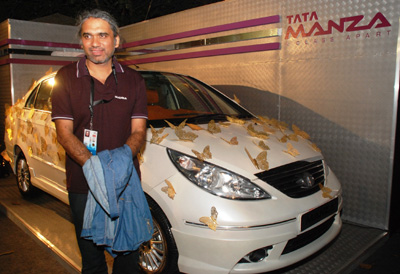
    Luxury sedan Tata Manza has associated with the most glamorous event in the country – the Wills India Fashion Week. In partnership with the world-renowned fashion designer, Rajesh Pratap Singh, Tata Motors showcased two specially accessorized Tata Manzas, at the show.

    The fashion maestro has designed an exclusive theme-based collection which was exhibited at the Wills India Fashion Week. The collection theme is inspired by a road trip which Rajesh undertook in the villages of Orissa. The show attempts to initiate a dialogue and thought process on what is the relevance of handloom in the country.

    Commenting on his collection, Mr Singh said, “Ikat is not a print, yet, worldwide there has been an attempt to replicate Ikat digitally or through a screen print. Through this collection, we would like to raise awareness and strike a healthy discussion on the relevance of an indigenous craft. Ikat is just one of the many rich possibilities every pocket in the country has to offer and we must cherish and encourage this rich heritage.”

    Focusing on ‘Ikat’ and handloom textile weaves, some of the experiments are part of this collection. This magical collection was showcased by famous models. The theme of Rajesh Pratap’s collection have been integrated on two specially accessorized Tata Manzas, which were the show-stoppers.  Interiors of the car have been inspired by Rajesh’s collection colour theme and the exterior of the car adorned butterflies with gears, which represented a true integration of style and engineering.

    In February 2011, Tata Motors introduced the newly refined Tata Manza series. The Tata Manza has been given a fresh new look with refined premium dual tone interiors & fabric seats and exterior make over, delivering class apart driving experience in the sedan market. At Tata Motors, product development and upgradation is a constant endeavour.

    Rajesh Pratap has partnered with Tata Motors’ styling team which operates from its state-of-the-art styling studio, at the car manufacturing plant in Pune. Rajesh Pratap’s rich experience in the fashion industry and thorough knowledge about design aesthetics will further help Tata Motors in enhancing the Tata Manza’s design. He will be helping the team to further enhance the design and stylise the interiors and exteriors of the Tata Manza.

    “It has been a pleasure and an honour for me to be associated with the Tata Group, a proud Indian brand with values that inspire everyone in the industry. Tata Motors have an exceptional and dynamic young team that is going to change the way India drives.  I am truly excited to be involved with this project”, added Rajesh.

    Rajesh Pratap’s attempt in the Tata Manza design project is to achieve an equilibrium between handmade and high-tech, where one enhances the other, providing real solutions, a pure aesthetic. Tata Motors will be developing 1,000 Tata Manzas, incorporating design inputs from Rajesh. The limited edition cars will be launch in 2012.


    About Mr. Rajesh Pratap Singh:

    Currently based in New Delhi, Rajesh Pratap Singh belongs to Rajasthan in India. Subsequent to his graduation from NIFT Delhi he worked in the Fashion Industry for two years in India and Italy before introducing his own line of men’s and women’s clothing in 1997.


    Rajesh has over the years created his unique signature style that subtly draws from his Indian roots to craft artisinal garments that stand apart due to their faultlessly clean lines, careful detailing and international silhouettes. His work epitomizes simplicity, yet on closer look reveals his obsessive attention to detail. Rajesh’s reserve reflects in his styling which combines the modern with the traditional in an understated design aesthetic, with a global appeal. He is also closely associated with Indian fabric mills and has had developmental and research based collaborations with several of them.


    About Tata Motors:

    Tata Motors is India’s largest automobile company, with consolidated revenues of Rs. 1,23,133 crores ($ 27 billion) in 2010-11. Through subsidiaries and associate companies, Tata Motors has operations in the UK, South Korea, Thailand, Spain and South Africa. Among them is Jaguar Land Rover, the business comprising the two iconic British brands. It also distributes Fiat cars in India, and has an industrial joint venture with Fiat in India.  With over 5.9 million Tata vehicles plying in India, Tata Motors is the country’s market leader in commercial vehicles and among the top three in passenger vehicles. It is also the world’s fourth largest truck manufacturer and the third largest bus manufacturer. Tata cars, buses and trucks are being marketed in several countries in Europe, Africa, the Middle East, South Asia, South East Asia and South America. (www.tatamotors.com)


    Issued by:

    Debasis Ray

    Head  (Corporate Communications)

    Tata Motors Limited

    Phone: 00 91 22 66657613; E-Mail: qv@tatamotors.com

    www.tatamotors.com

  • Hyundai Eon: India Yawn

    Hyundai, reportedly, has spent obscene sums of money to perfect their new little hatchback called Eon. And I wish a very small part of that moolah had been kept aside for creating some wonderful advertising. The zippy, stylish car deserves it. Sadly, their launch commercial is a total wash out. And the less said about the press ads the better.

     

    What happens in the ad is what happens in every second commercial inIndia. Youngsters having fun. Youngsters partying. Youngsters doing masti. Youngsters doing blah, blah, blah. And this, as you can expect, is peppered with the usual shots of the car in action. In short: No idea. No interesting story. No engaging situations. Every single principle of good advertising trashed. The result: Eon stays as just another car launch in the Indian market. And we’ll suss it out when we have the time.


    Criminal waste of money. Here’s a small car that’s determined to threaten the popular Maruti Alto, that desires to becomeIndia’s No 1 entry level car, and the ad doesn’t give you a single reason why you should be excited. If 900 crore rupees (wow!) has gone into the R&D, surely there are interesting facets of the car that need to be highlighted.


    ‘India On’, the ad says. Maybe it is. But the ad certainly is not on.


    [youtube width=”350″ height=”250″]http://www.youtube.com/watch?v=WgAFK95qlm4[/youtube]
    Rating: (On a scale of 1 to 5): 1. For a good photocopy job!


  • Anil Thakraney’s Debrief: Very touching

    Brilliant start by Cadbury to the Diwali festival season. Their new ‘Lonely Maa’ commercial tugs at the heart-strings. It’s a simple treatment. An elderly lady is seen struggling with the computer to connect with her son who lives in another city/nation. And that insensitive chap only communicates with her via the web. Because he’s too busy focussing on his career. The poor lady isn’t able to log in, accidentally spills tea on the comp, and looks utterly lost, dejected and lonely.


    Outstanding. And here’s why: The chocolates aren’t rammed down our throats, the brand comes across as this nice, gentle soul who reminds you of your responsibilities. This endears us to Cadbury. The insight is timely and relevant. Many youngsters give their careers top priority, and find no time to spend with their aged parents. And they imagine that virtual connect is good enough. It isn’t! And most importantly, the treatment. The film is executed with so much heart, as a viewer, you badly want to reach out to the old lady and comfort her. Help her. Take care of her. And this is how brands build an emotional bond with their consumers. Way to go!


    I would be very surprised if this ad doesn’t win many trophies.


    Rating: (On a scale of 1 to 5): 5. This is what advertising ought to be.


    Anil Thakraney’s ad review column DeBrief appears twice a week.

  • Anil Thakraney: Deccan Herald’s Mission Impossible

    By Anil Thakraney


    Having learnt to live a life in India where just about anything is possible, nothing ever unnerves me. But I must say I woke up on Sunday morning to rather shocking news, it totally rattled me. No, not that Anna Sahib is going on another fast (that’s no news, really), but that Bangalore’s Deccan Herald has launched a Delhi edition. To be honest, I am still reeling from this totally sensational khabar.


    Here are few reasons why the Deccan Herald simply CANNOT be undertaking this suicidal mission: One, newspapers are closing down all over the world. And India, because of its massive reading population and a continuous flow of new readers, will survive this danger for some more years. But closures will happen, it’s only a matter of time. In fact, quite ironically, Deccan Herald’s foray into Delhi comes close on the heels of Mid Day’s closure out there. Given that, prudence lies in beefing up strong editions and putting all the resources into your main markets, so that the demise can be postponed as much as possible. One would imagine that the proprietors of the Deccan Herald would go all out to spruce up their Bangalore edition. And what do they do? They go to Delhi! Wow!


    Next. Delhi is a very crowded newspaper market, and it’s pretty much dominated by the very deep pocket wallahs, the TOI and the HT. It took the Times many years and lots of moolah before it could manage to eat into HT’s market share. And there are other cash rich players too. In this fish market scenario bravely trots in the low profile southern Deccan Herald, hoping to make a dent in the market. And from what I know, owners of the DH aren’t exactly loaded like the owners of the TOI and the HT, so they will always struggle to get noticed.


    And finally, what sort of freshness can the DH bring to an alien territory? The name ‘Deccan’ itself cues south of India. Why would a Dilliwallah be interested in finding out from a southie what’s going on in his backyard. And where he must wine and dine. Makes no editorial sense at all.


    Well, all I can say is that the publishers of the Deccan Herald are either being very brave. Or very foolish. Either way, let’s wish them luck. They’ll need loads of it.


    ***


    PS: Some of the more enterprising ex-O&M guys organised an agency reunion in Mumbai last week. To catch up and mark David Ogilvy’s 100th centenary. Was fantastic meeting the old boys and gals, it felt like homecoming. I must say this: no reunion brings me as much joy as the one with the Ogilvy gang. Not school, not college, not other organization reunions. Must be Sir Ogilvy’s magical touch. Can’t think of another reason.


    Anil Thakraney is a Mumbai-based columnist and commentator and is a former adman and editor. He is Editor-at-Large, MxMIndia. The views expressed here are his own.

  • ‘Social media is an explosion’

    By A Correspondent

    Companies in India have gauged the might of social networking and are currently spending over Rs 1,200 crore with 30 to 40 per cent of marketing budget on digital media according to the findings of a study titled ‘Explosion of Social Media: Transforming The Corporate Business Scenario,’ by The Associated Chambers of Commerce and Industry of India (Assocham).


    Releasing the highlights, Assocham secretary general DS Rawat said, “Goods and services worth about Rs 23,000 crore are traded currently on the social networks across the world and the figure is likely to swell to about Rs 1.35 lakh crore by 2015 with India’s share likely to cross Rs 10,000 crore mark during the course of next three to four years.”


    It was observed that majority of start-ups, leading national and international companies operating in India are embracing the social media to enhance their business and on an average spending anywhere between Rs 2 lakh to Rs 50 lakh a year on social marketing campaigns.


    A large number of national and multi-national corporations in India are using the services of social media management companies that help small, large brands to manage, heighten their social network presence and maximise their exposure in the newsgroups and newsfeeds of the people logged on the social networks.


    “The significance of social media in the current scenario can be gauged from the fact that the department of information technology (DIT) has recently advised all government departments to make the most of social media in their day-to-day work and communicate with citizens effectively,” said Mr Rawat.


    Assocham interacted with about 1,400 directors, chief executive officers, chief financial officers, chairmen, managing directors, executive directors et al from sectors as diverse as BFSI (banking, financial services and insurance), auto, FMCG, manufacturing, IT, telecom, biotech, education, infrastructure, consumer packaged goods and healthcare to ascertain the extent of their spending on online activities and about 75 per cent of them said that they have doubled their spending on social media this year.


    “Companies both large and small are turning to social media platforms as the percentage of internet users on social networking sites continues to climb,” said Mr Rawat while releasing the survey that was carried out in Ahmedabad, Bangalore, Chennai, Delhi, Kolkata, Mumbai and Pune between April and August. “Brands today cannot afford to ignore the significance of social media as a key medium to target their identified customers and connect with them,” said Mr Rawat.


    Companies are taking advantage of social media to advertise, launch new products, study consumer behaviour pattern and communicating, interacting directly with their customers and wooing new clientele. Assocham interacted with 200 representatives of various companies in Delhi and about 60 per cent of them said that they have a dedicated staff who work round-the-clock and are constantly plugged into the web to monitor online traffic on their web portals.


    As many as 110 respondents said that they have hired employees specially for their social and interactive media cell who perform the task of tracking conversations, blogs, discussions, chats on social networks to ascertain the consumer preferences and perceptions towards their products and services. Nearly 40 per cent of respondents in the city said that started their campaigns on social networking websites with a tiny budget and clocked revenue of about three to four times their budget in a span of about five to six months terming it a successful venture.


    Almost all the respondents said that their dependency on traditional print media for advertisements has reduced drastically and people logged on social networks are their core target group and social media allows them to directly interact with consumers Currently, there are over six crore mobile internet users and about eight crore users using internet across India.


    Facebook, Twitter, YouTube, Google+, Linkedin, Orkut, Hi5, Friendster and BigAdda are certain popular social networks used by companies in Delhi to carry out their social media campaigns. “Low cost coupled with higher visibility and wider reach on social media is the grave reason behind this surge in number of companies cashing in on inevitable social media platform to reach young customers as highest number of active social media audience in the country is in the age group of 15 to 25 years,” the Assocham study emphasizes.


  • The sunset gets closer…


    By A Correspondent


    The Lok Sabha has passed the much-awaited Bill for digitization of Cable TV in India with the assurance that cable operators will not be harmed from the proposed move. The digitization sunset date for the four metros is June 2012. For complete digitization of cable sector in cities with population of more than one million, the date is March 30, 2013, all urban areas by September 30, 2014, and the entire country by December 31 2014.


    Information and Broadcasting Minister Ambika Soni said that the move to convert Analog TV into Digital will bring India on par with other countries like US, Britain, Korea and Taiwan.


    As a matter of fact, digitization of TV will bring subscription revenues for broadcasters and of course the elimination of carriage fees from the broadcast ecosystem – something which, as experts believe, would eventually happen as complete digitization would set in. As for now, carriage fees is one big challenge all broadcasters are facing. Industry estimates suggest that roughly 20 per cent of a channel’s cost account for carriage fees. As per the new regime, all satellite channels will be beamed to houses through set-top-boxes.


    While most members supported the Bill, a few raised their voices against content being broadcast on some channels and the unjustifiable hike in the cable rates. Soni assured Cable operators that the move will not render them jobless, and that the government’s major concern was the viewers’ interest. She said that an enabling provision had put in place to the effect that only Rs 200,000 to Rs 300,000 would be needed by cable operators to move to digitisation.


    On the prices of set-top-boxes, she said, “The prices of set-top-boxes will fall. These will be available on installments and rent. Also, viewers don’t have to take a whole bouquet of channels. TRAI will impose a tariff capping for subscribing to channels.” She also said that digitization would provide consumers a la carte selection of channels and video-on-demand among other things.


    She added that the Headend-in-the-sky (HITS), which had so far failed, would take off with greater investments


    The ordinance was passed earlier this year to meet the deadline set for full digitization by December 31, 2014. The government will complete the process in four phases starting with metros.


    The Bill will now go to the Rajya Sabha for passing and then go to the President for her assent after which it becomes law. Mr Dinyar Contractor, Editor-in-chief, SCATMAG, is of the opinion that it is only a matter of time before Rajya Sabha will pass the bill.


    According to Mr Devendra Parulekar, Partner & Segment Champion – TV Distribution Ernst & Young, the development is a positive one as this will lead to transparency in the entire system while creating a win-win situation for every stakeholder. “Digitisation will provide customers with wider choices, better signal quality, HD content and niche content tailored to suit niche audiences.”


    Whether there will be an effect on pricing, he said, “With hyper-competition, I don’t think price points will rise significantly; they will more so be determined by the market forces. ”


    On what it means to MSOs, Mr Parulekar said that MSOs focus will shift from B2B to B2C. However, due to the short implementation time-frame, he said that MSOs are likely to lose round one of the battle to DTH players, who have already invested in mature back-end systems. She also said that there were punitive clauses against cable operators, MSOs or DTH operators who failed to show the must-carry channels, including the Lok Sabha and Rajya Sabha TV channels.


    “The jury is still out on how the sector would fare in the medium to long term, as digital cable+broadband has some inherent technological advantages over DTH, as well as the advantage of personalised service that cable offers to end-subscibers. These service enhancements will need infusion of large funds and hence the sector may see some transactions (M&A activity). With increased transparency in collection of subscription fees as well as tax collection, broadcasters can de-risk their revenue streams versus advertising revenue that they are presently overly dependent upon,” he added.


    Big story image: Fotocorp

  • Digitization’s sunset date may be delayed

    By Akash Raha


    The process of digitization is unlikely to be over by December 31, 2011, according to key stakeholders among broadcasters and cable organizations. The sunset date for digitization is therefore expected to be extended further, as it seems to be going nowhere at the current pace. The stakeholders say this is because of lack of clarity on the part of the Government, which needs to enable the industry to change over smoothly from analog to digital.


    The issue of digitization was discussed at length at Focus 2011, a seminar organised by The Associated Chambers of Commerce and Industry of India (ASSOCHAM). The theme of the event, From Analog to Digitization, was held on September 9, 2011 at New Delhi.


    Earlier in the day, Mr Choudhury Mohan Jatua, Honourable Minister of State, Ministry of Information and Broadcasting said that he was hopeful that the process of digitisation will happen in the stipulated time. He said that his government was doing everything to make it possible, but that to make it possible, the industry itself needs a lot of self-discipline. He said that the changeover from analog to digital is desirable and also compulsory.


    The romance with digital is on and the era of digital is here, said Mr A Mohan, VP, Zee Networks, kicking off a discussion session moderated by Gunjan Gupta of Deloitte. However, he said, there are several problems on the route to digitisation. The three-fold challenges that he pointed out were investment issues, finding a viable economic model in the digital era, and inter-connection issues. Subject as it is to a variety of taxes such as entertainment tax, service tax, VAT, entry tax and so on, he said, it is very difficult to make any profit. He appealed to the government to rationalize the taxes on the industry. Talking about investment, he said that the Government of India must change its FDI policies, which would help with more funding for digitisation.


    Ms Roop Sharma, President, Cable Operators Federation of India (COFI), said, Digitization cannot happen by the sunset date unless the government faces its problems and challenges. Moreover, the government has to come up with a phase-wise plan for digitization, as we cannot expect it to happen overnight. Awareness has to be spread, and consumers need subsidies to accept digitization. Ms Sharma, a member of the task force for digitization, and she rues that even after several meetings there is no clarity as to how the government plans to go about digitisation.


    Mr Sugato Banerji, CMO  DTH, Bharti Airtel, cited several advantages of digitization, beginning from safeguarding national security to more subscription-based revenue for broadcasters. He went on to say that the age of digital will benefit the whole ecosystem  consumer, broadcasters, government and cable operators. Mr Pulak Bagchi, Vice President, Star India too spoke about the advantages of digitization and said, If we intend to digitize in right earnest, the government has a huge role to play.The industry is set to provide 4 percent of the country’s GDP (excluding agriculture). Yet, the investment required for digitization of the whole country is set to be 15 billion USD. He also said that digitization would eliminate cable wars and prevent tax leakages for the government.


    With 35 million digital households, India is going to be the largest digital market said Mr Siddharth Jain, General Manager, Network and Content Distribution, South Asia, Turner International India. He went on to say that the success of any venture depends most on the consumer experience, which the industry has to keep in mind. Content is king, and yet content has a cost.


    Mr Raman Kalra, Director and Partner, IBM said that while in future content is going to be the key and content is poke about the future of the medium and said that eventually, content is going to be the key and that is exactly what the customer wants. At the same time, you can’t just thrust technology on him; the convenience of consuming content is also very important.


    Mr Rohit Bansal, CEO and Co-Founder, Hammurabi & Solomon Consulting, voiced his concern over government’s method of setting deadlines, and he fears that such deadlines won’t get translated.


    He said, Digitisation has its own advantages, and even though some incumbents are trying to resist it, everyone has to come together and volley for it. The I&B ministry, TRAI and all other stakeholders have to rise to the occasion and do their bit.


    The recently accepted TRAI recommendations for the implementation of digitisation of broadcast systems in India is expected to open up new opportunities for a broader ecosystem (content providers, broadcasters, equipment providers etc). Yet, there are several challenges en route to migration from analog to digital. The revenue opportunities are substantial, and all that is needed, it seems, is synergy between the government and the stakeholders to make the sunset date possible and viable.