Author: mxm_india

  • Magazines need to be more open: Volvo MD Tomas Ernberg (Video)

    By Shruti Pushkarna

    In today’s digitalized world where advertisers and marketers have options aplenty to choose from, when it comes to their vehicle of communication, traditional media has a tough battle to fight, feels Mr Tomas Ernberg, Managing Director, Volvo Auto India Pvt. Ltd.

    Speaking at the 38th FIPP World Magazine Congress 2011 in New Delhi, Mr Ernberg said, “The world is going for the digital and that’s why there’s a scary scenario for magazines, so to say…”

    Sharing a client’s perspective, Mr Ernberg said that the marketer feels a bit blind when it comes to ROI from putting an advertisement in magazines. “If magazines could be more open and could find more information about the customers, the subscribers…especially psychographics, it would give the marketers a very good platform to decide which magazines to advertise in”, added Mr Ernberg.

    Advertisers and marketers, emphasized Mr Ernberg, are looking to engage their audiences in entertaining and effective ways, so even though creative content is at the heart of all communication, magazines which are proactive and transparent in sharing information with clients, are the ones which will survive.

    Having spent 17 years at Volvo, Mr Tomas Ernberg took over as company’s Managing Director in July this year. In his last position as the Regional Marketing Director in Dubai, he managed 13 markets in the Middle East and North Africa. Mr Ernberg started his journey with the Swedish auto manufacturer in 1994 as the Tourist and Diplomat Sales Manager at Volvo Cars, Turkey.

    [youtube width=”350″ height=”250″]http://www.youtube.com/watch?v=XyYQZEWhdGM[/youtube]

  • Dina Thanthi takes over Metronation Chennai

    By A Correspondent

    New Delhi Television Ltd. (NDTV) and Kasturi and Sons Ltd (KSL) have entered into an agreement to sell their respective stake in Metronation Chennai Television Ltd (MNC). The stakes have been sold off to Educational Trustee Company Pvt Ltd (ETCPL), promoters of Tamil Daily Dina Thanthi.

    The deal is worth Rs 15 crore after the completion of which Metronation Chennai MNC will become a 100 percent subsidiary of ETCPL.

    Metronation Chennai Television Ltd was a joint venture of NDTV and The Hindu wherein MNC operated and managed Chennai’s first and only city-specific English news and current affairs channel, NDTV Hindu.

  • Nissan launches film audition on Facebook

    By A Correspondent

    Nissan India and actor Mr Ranbir Kapoor are searching for 20 passionate members of the public to star in the world’s first Bollywood movie auditioned entirely on Facebook.

    From October 19, movie-fans will be able to join in one of the world’s largest on-line talent hunts by uploading a short clip of themselves dancing for a chance to appear alongside Mr Kapoor in the three-minute Bollywood blockbuster – New Star of India.

    Members of the public will vote to decide who the 20 lucky co-stars will be, and will also help produce the movie by shaping the plot, choosing the music, picking the wardrobe and naming the characters.

    As well as being screened to millions on Facebook, New Star of India will be premiered at exclusive red carpet events in cities across India in January 2012, where there will also be a chance to win one of six all-new Nissan Micras.

    Mr Kapoor said, “I’m incredibly excited to be involved in this ground-breaking movie with Nissan – no-one’s attempted anything like it before. Speaking to all Bollywood fans out there, this is your once in a lifetime opportunity to join me in the magic of the movies. I’m looking forward to seeing your auditions and can’t wait to meet my co-stars, so get dancing, get voting and get involved!”

    Taking part couldn’t be easier. All would-be stars have to do is record a 45-second audition of themselves via their webcam, smartphone or video camera showing off their best Bollywood moves and upload it to the dedicated New Star of India page on Facebook, www.facebook.com/nissanindia.

    There are just three steps to stardom…

    1: Choose your favourite soundtrack on the Facebook page

    2: Get dancing – either solo or with up to nine friends

    3: Upload the clip to the site

    Nissan will also be taking New Star of India on the road and will be touring shopping malls across the country to film live auditions in Mumbai, Delhi, Bangalore, Chandigarh, Kolkata, Pune, Ahmedabad, Hyderabad and Aurangabad from October 22 – check the Facebook page for details.

    Even non-dancers can get involved. Everyone who votes, shares or takes a test drive from Nissan’s model range will be entered into a competition to win one of the hottest tickets in town – a chance to attend one of the movie premieres and win a Nissan Micra.

    Mr Kiminobu Tokuyama, Managing Director of Nissan Motor India Pvt. Ltd said, “Nissan is all about innovation. It’s in the cars we build, the way we do business, and now we are offering members of the public a genuine world’s first – an opportunity to become a Bollywood star”.

    Mr Kapoor added, “I love that this movie is going to take 20 people from their living room or bedroom and onto the movie set in three simple steps. If you’ve ever wondered if you have what it takes to make it in Bollywood, now’s your chance to find out!”

  • Newspapers’ reach greater than internet’s

    By A Correspondent

    Newspaper circulation declined in print world-wide last year but was more than made up by an increase in digital audiences, the World Association of Newspapers and News Publishers (WAN-IFRA) has said in its annual update of world press trends.

    “Circulation is like the sun. It continues to rise in the East and decline in the West,” said Christoph Riess, CEO of WAN-IFRA, who presented the annual survey Thursday at the World Newspaper Congress and World Editors Forum in Vienna, Austria.


    The survey found:

    – Media consumption patterns vary widely across the globe. Print circulation is increasing in Asia, but declining in mature markets in the West.

    – The number of titles globally is consolidating.

    – The main decline is in free dailies. “For free dailies, the hype is over,” said Mr Riess.

    – For advertisers, newspapers are more time efficient and effective than other media.

    – Newspapers reach more people than the internet. On a typical day newspapers reach 20 percent more people world-wide than the internet reaches, ever.

    – Digital advertising revenues are not compensating for the ad revenues lost to print.

    – Social media are changing the concept and process of content gathering and dissemination. But the revenue model for news companies, in the social media arena, remains hard to find.

    – The business of news publishing has become one of constant updating, of monitoring, distilling and repacking information.

    – The new digital business is not the traditional newspaper business.


    Mr Riess’s presentation focused on six key areas: the media consumption shift; economic developments; newspaper circulation and number of titles; advertising expenditure by media; newspaper revenue; and internet versus mobile.

    This represented a significant shift from past versions of the world press trends survey, which WAN-IFRA has been carrying out since 1988. Long a statistical compendium of information from more than 200 countries, the 2011 report focuses on the 69 countries that account for 90 percent of global industry value in terms of circulation and advertising revenue. “We’re concentrating on value rather than volume, focusing on key numbers in key markets,” said Mr Riess. “Our approach puts a premium on insight over numbers.” This reflects feedback from industry stakeholders, as part of the new WAN/IFRA review. But the survey will continue to monitor all countries.


    Media Consumption Shift

    When measured in minutes per day, media consumption patterns vary widely. For example, television dominates in the United States, internet accounts for one-third of media time in Austria, and digital gets just a fraction of consumption time in Russia. Time spent with newspapers is low when considering their impact and influence on society, compared with other media – and to their advertising revenues.

    “Newspapers have always had a lower percentage of the time spent by the media user, relative to the high advertising revenues that newspapers produce,” said Mr Riess. Newspapers account for 8 percent of media consumption time, but 20 percent of all advertising revenue. “We have always been extremely efficient in using the time of our readers. But now we are in a more challenging environment, because readers are more promiscuous, they have more choices, they read newspapers with less frequency. We have to do more to attract them, find new ways to garner loyalty.”

    There is no doubt that internet consumption is increasing world-wide, to the cost of broadcast more than other media, the report found. Radio consumption. in terms of minutes per day has fallen 23 percent since 2006, compared to 7 percent for newspapers, it found.


    Economic developments

    There appears to be a structural shift in advertising and newspaper revenues. Long mirroring the growth and contraction of Gross Domestic Product, both global advertising revenues and newspaper revenues appear to be decoupling from their patterns related to GDP.

    In the 20 years to 2001, advertising revenue increased more than GDP in an upturn, and fell farther than GDP in a downturn. “But this has not been true since the 2001 downturn,” said Mr Riess. “After 2001, we have had good growth in Asia, but, contrary to the previous 20 years, advertising revenues increases were not higher than GDP during a recovery. And we have a greater decoupling of newspaper advertising revenues, which don’t follow the recovery as in the past. We have a structural change in general, especially in newspapers.”


    Newspaper circulation

    Daily print newspaper circulation declined from 528 million in 2009 to 519 million in 2010, a drop of about 2 percent. But what has been lost to print has been more than made up by digital newspaper readers. Digital audiences are typically a third of print readership. So against a 2 percent decline, digital growth is significantly greater.

    In fact, when measured in terms of readership, newspapers reach 2.3 billion people every day, 20 percent more than the 1.9 billion that the internet reaches world-wide.

    But the significance of this is not the total numbers, but in changes in purchasing patterns. “We get readers, but less regularly,” Mr Riess said. “It’s the same with digital – the problem isn’t visitors, but frequency and depth.” Mr Riess said the patterns required a reconsideration of newspaper subscription models, and of finding new ways to convince readers to come back.

    Again, circulation patterns vary greatly world-wide. In the Asia Pacific region, circulations increased 7 percent from 2009 to 2010, and 16 percent over five years. Latin America also saw significant circulation increases – 2 percent last year and 4.5 percent over the past five years. But drops occurred in Europe – 2.5 percent year-on-year and 11.8 percent over five years in Western Europe and 12 percent last year and 10 percent over five years in Eastern and Central Europe. The decreases were greatest in North America, where newspapers have lost 11 percent of circulation year-on-year and 17 percent over five years.

    The number of newspaper titles worldwide increased by 200 in 2010, to 14,853, but the rate of increase is slowing due to consolidation in many markets as publishers close unprofitable titles and the number of free newspaper titles decreases worldwide. This was particularly pronounced in Eastern Europe, where freedom of expression led to the creation of numerous titles that were not sustainable economically. The number of newspaper titles declined 4 percent in Eastern Europe in 2010, and 8 percent over 5 years.

    In fact, free newspapers took a big hit in 2010 – a drop in total distribution to 24 million copies from a high of around 34 million in 2008. “The hype is over,” said Mr Riess. “In many cities, too many free titles were launched. There were newspaper wars. Now the market is maturing, and though the number of titles has declined, there are still opportunities.

    Mr Riess noted that free newspapers have a strong impact on younger audiences. “Free newspapers added energy to our industry,” he said. “They encouraged a lost younger generation to read newspapers, and this was positive.” Audience research across European cities where free newspapers are available shows that readership among 15- to 24 year-olds is 50 percent higher for free dailies than for paid-for dailies.

    Newspaper readership is highest in Iceland, where 96 percent of the population reads a daily newspaper, followed by Japan (92 percent), Norway, Sweden and Switzerland (82 percent), and Finland and Hong Kong (80 percent). Japan is the leader when it comes newspaper sales, with the average circulation of its newspapers at 461,000 – an enormous total. Austria comes second with an average of 162,000 per title.

    But bigger isn’t always better, said Mr Riess, noting the worldwide circulation average is about 17,000 per newspaper. “Newspapers are about communities, either of geography or of interest,” he said. “It is in satisfying these communities that newspapers can still flourish.”


    Advertising expenditures by media

    Television continues to be the world’s largest advertising medium, with a total ad expenditure of 180 billion US dollars in 2010. Newspapers were second with 97 billion, followed by internet (62 billion), magazines (43 billion) and radio (32 billion).

    But newspapers are lagging behind both television and internet when it comes to growth trends, and internet is outpacing both, the survey found. Internet advertising grew 22 percent year-on-year in Asia in 2010, compared with 11 percent for television and 3 percent for newspapers. In Europe, internet advertising rose 14 percent from 2009, compared with 9 percent for TV, while newspaper advertising fell 1 percent.

    In South America, internet advertising rose 31 percent year-on-year in 2010, compared with 19 percent for television and 6 percent for newspapers. In North America, internet advertising was up 13 percent and television 8 percent, while newspaper advertising fell 9 percent. Internet’s share of the advertising market has surpassed newspapers in the United States, and will reach newspaper levels in Europe and Asia very soon.


    Newspaper revenues

    Newspaper advertising revenues took a big hit in the global recession, but the decline slowed in 2010. Globally, newspaper advertising revenues declined 23 percent over five years and only 3 percent last year.

    In North America, newspaper advertising revenues were down 17 percent for the five-year period but increased 1 percent last year. In Western Europe, they were down 12 percent over five years and up 2 percent last year. Eastern Europe saw advertising revenues fall 3 percent over five years and 3 percent last year. In the Asia Pacific, newspaper advertising revenues were down 1 percent over five years but up 4 percent last year. In Latin America, the revenues declined 23 percent over five years and 3 percent last year.


    Mobile vs internet

    Which offers a better business model for newspaper companies – internet or mobile? Again, it depends on the market, said Mr Riess, and there are wide variations around the world.

    In Russia, for example, mobile penetration is 130 percent compared with 30 percent for internet, so clearly mobile offers better opportunities. The same goes for India, where 60 percent of its 1 billion population has mobile telephones. In the United States, where the penetration of both mobile and internet is high, both platforms offer opportunities.

    The internet advertising model has been well-established, but most of the revenue goes to search engines – 65 percent to Google alone.

    On the mobile platform, the paid-content model is well-established, since users accept monthly contracts, pre-paid phones and paid-for apps. But here too, new players – Apple and the mobile operators – take a large share of the revenue. “If we’re not careful in the newspaper industry, they will take away our business,” Mr Riess said.

    “But this world isn’t easy, it isn’t either internet or mobile, there will be different ways to use these channels and there will by hybrid ways – like tablets – that will use both the paid content and the advertising models. Every company has to look at its target group and readership, and this group defines how best to reach it. And this has to be reconsidered constantly.”

    WAN-IFRA, based in Paris, France, and Darmstadt, Germany, with subsidiaries in Singapore, India, Spain, France and Sweden, is the global organisation of the world’s newspapers and news publishers. It represents more than 18,000 publications, 15,000 online sites and over 3,000 companies in more than 120 countries. Its core mission is to defend and promote press freedom, quality journalism and editorial integrity and the development of prosperous businesses.

    Learn more about WAN-IFRA at http://www.wan-ifra.org or through the WAN-IFRA Magazine at http://www.wan-ifra.org/magazine.
  • New programming to make BIG CBS bigger

    By A Correspondent

    BIG CBS Networks Pvt. Ltd., an equal joint venture between Reliance Broadcast Network Limited and CBS Studios International, has announced its new fresh programming line-up and future plans for its channels. The network, which went live with three channels in a record breaking time of under six months, has captured hearts of the discerning Indian audiences and stands as the No 1 English General Entertainment Network today.

    In keeping with its promise of offering the latest seasons of programming, airing concurrent to the US, the channel has acquired fresh content from leaders in the international entertainment space like Boman Bridge, Alfred Haber, Bobby Goldstein and Medi-Asia. Offering audiences more than 25 hours of original fresh programming each week, on each channel, the Network offers audiences a further assortment of programming, and advertisers, the best platform to partner with for their brands.

    Speaking on the occasion, Mr Nikhil Mirchandani, Business Head, Television Channels, Reliance Broadcast Network Ltd said, “We are very pleased with the way the channels have shaped and delivered. The channels have grown the market and we have been able to successfully bridge the existing void in international quality programming that existed. We now enter our next growth phase and are completely equipped with our hand-picked shows that match the tastes and sensibilities of our target audiences.”

    Mr Mirchandani further added, “BIG CBS’ programming is in keeping with our endeavour to offer Indians the latest, freshest and hottest content straight from America. Today, audiences have evolved and are looking for more than just soaps and films. The well travelled Indian viewer is always looking for quality content and we continue to bring the best of American television to our viewers here. Also, our effort to give audiences India-grown content has worked excellently for us with the overwhelming response to India’s Sexiest Bachelor. Tracing this success, BIG CBS is now launching the next Indian property, India’s Glam Diva. With this and more shows planned BIG CBS Network is poised to become a network to reckon with.”

  • Lowe aims high

    By A Correspondent

    Lowe Lintas, one of India’s largest and most storied communication groups has won a staggering number of new accounts across the country this year. In just the first 9 months of this year, the agency has signed on 80 new clients; and with three months left to go this year, is hoping to cross the 100 mark for the year. Lowe Lintas has won these businesses across the country – in both metros and non-metros; and in advertising and in specialist communication fields like PR, Healthcare, Rural and Design.


    So while wins for Lowe Lintas’ advertising division include names like Suzlon, 3M,Tata Interactive, Birla Ultratech, Videocon D2H, GE Healthcare, UIDAI, Muthoot Pappachan Group and Expedia; its specialist PR division, LinOpinion’s wins include businesses like Tourism Victoria, Starwood Hotels & Resorts,  Samsonite and Times Now.  Lowe Lintas’ specialist Healthcare division, LinHealth’s wins include Cadila Pharmaceuticals, Bayer Pharmaceuticals and Sun Pharma; its specialist Rural Communications division, LinTerland has been signed on by Johnson & Johnson and Nokia.


    Speaking on this performance, Mr Joseph George, CEO, Lowe Lintas India said, “I personally believe that the tremendous equity that Lowe Lintas enjoys is under leveraged. Which is why, we set ourselves an aggressive growth target for 2011 and simultaneously went about putting in place an “enabling eco system”. I am happy to say that the first three quarters have been spot on plan; with every win making everyone across levels and functions hungrier the subsequent quarter. What is equally gratifying is that we have been able to win businesses across not just diverse categories, but also across all our offerings – Lowe, LinOpinion, LinHealth, LinTerland, LinProductions, LinTeractive and dCell.”

  • Travel industry to lead e-commerce trade in India

    By A Correspondent

    With a booming retail market and over 100 million internet users in the country, e-commerce is likely to enter a high growth phase in coming years, economic advisor at the Department of Information Technology Mr BN Satpathy has said.

    Travel will continue lead the online trade of goods and services in India and globally as new business models emerge in e-commerce space, he said while addressing delegates at a conference organised by The Associated Chambers of Commerce and Industry of India (Assocham).

    Mr Satpathy said the government is working on a new Information Technology Policy which will propel the growth of low-cost, internet-enabled and hand-held devices. He asked business chambers like Assocham to be an interface so that industry data gathering and dissemination can be made online.

    Chamber secretary general Mr DS Rawat said the market size of e-commerce industry is expected to be Rs 46,520 crore by December 2011 with 81 per cent travel transactions and 6 per cent product purchases.

    “India is poised to be one of the top e-commerce hubs in the near future as number of internet users boom. This will bring in a new revolution in retail industry,” he said, adding that the size of e-commerce globally is about 700 billion dollars.

    Accelerated innovations have expanded the online retail market to $241 billion in Europe, $176 billion in the United States, $76.4 billion in China and $10.3 billion in India.

    The Indian retail industry is currently estimated at $520 billion and e-commerce is a sub-set of it. With high GDP growth rate figures, young population with a median age of 25 years, large and relatively insulated rural tracts coupled with people’s hunger for achievement, the country is projected to witness maximum growth coming from tier II and tier III cities.

    At present, small towns contribute 40 percent of all e-commerce transactions due to increasing broadband penetration. Industry experts say the numbers of people who have ever used internet and personal computer literates have increased to 88 million and 119 million respectively.

    India has the second fastest growing travel market globally which is estimated at $42 billion. Of this, the online travel market is expected to grow from $2.9 billion in 2008 to $7 billion by next year.

    Others who spoke during the conference were Mr Balendu Srivastava, group business director of e-Tech Group at IMRB International, Mr Kashyap Vadapalli, director of Category Management at eBay India, Mr Dhruv Shringi, co-founder and CEO of yatra.com, Mr Harish Bijoor, CEO of Harish Bijoor Consults Inc and Mr Bikky Khosla, CEO of tradeindia.com.

  • 2nd Guru Mantra with Phaneesh Murthy

    By A Correspondent

    Entrepreneur magazine in association with Client Associates is presenting the second edition of its Guru Mantra lecture series with Phaneesh Murthy, CEO of iGate Patni, better known as the man who built a US$1 billion empire in just seven years.

    An alumnus of the Indian Institute of Management Ahmedabad and Indian Institute of Technology Madras, Murthy began his journey in 1992 as a part of Infosys. His contribution to Infosys has been widely regarded as one of the major reasons why Infosys became the IT giant that represented the booming Indian economy along with other luminaries. Since his exit from Infosys in 2002, Murthy has served first as the founder of US-based consulting firm Primentor and then as the co-founder of Quintant Services in 2003.

    The latter was acquired by iGate in 2003, bringing Mr Murthy to the top of a major IT giant once again. At iGate, Mr Murthy has helped to improve the company’s performance by bringing in a new management team, changing the firm’s business models, putting emphasis on higher offshore revenue contribution, increasing resource utilization, amongst other measures.

    Mr Murthy also spearheaded iGate’s acquisition of Patni Computers, the sixth largest IT company in India for US$1.22 billion, creating an IT behemoth that employs a talent pool of 26000 people to deliver solutions to 360 Fortune 1000 clients across the Americas, Europe- Middle East-Africa, and Asia-Pacific.

    Mr Murthy will be talking to a select gathering of established entrepreneurs, venture capitalists, and corporate executives at the ITC Grand Central, Parel on October 18, 2011 at 7.30 pm. The talk will be followed by an interactive Q&A session on the Indian entrepreneurial ecosystem with the audience, where Murthy will discuss his trials and tribulations as an entrepreneur and what it takes to succeed in the modern economy.

    Registration for the event is at entrepreneurindia.in/gurumantra.

    MxM Media will help to take the event to the relevant online community as the Online Media partner.

    Organized by Entrepreneur magazine, Guru Mantra is a lecture series that celebrates the spirit of entrepreneurship, organized at premium venues across different cities. Every session has a successful entrepreneur as the guest mento who shares his or her entrepreneurial journey with the attendees, followed by a Q&A session where the attendees get a chance to ask questions specific to their business.

  • Sony serial’s title track goes the music video way

    By A Correspondent

    ‘Saiyyan Naino Ki Bhasha Samjhe Na’, the title track of Kuch Toh Log Kahenge, has become a rage right from the moment the promos of Kuch Toh Log Kahenge went on air. After the huge success of the title track, Sony Entertainment Television has launched a music video, which captures the magical chemistry between the lead couple Mohnish Behl playing Dr Ashutosh and Kritika Kamra playing young Dr Nidhi Verma.

    The excellent music, background score and the approach towards the title track of the show brings alive the theme of delicate and fine romance that will be budding between the lead protagonists. The enchanting video has been directed by Sony Entertainment Television’s on air promotion team and the music has been rendered by Mr Abhishek Arora. Singer Ms Sukanya Purkayastha of who rose to fame with ‘Kaisi Hai Yeh Udaasi’ from Kartik calling Kartik has lent her voice for the title track. The creative team at Leo Burnett, who have created the advertising campaign for the show and filmmaker Mr Gajaraj Rao, have created the lyrics of the song.

    Mr Danish Khan, Senior VP Marketing, Sony Entertainment Television said, “Since the time, the promos have hit the air, we have witnessed the rising amount of popularity of the title song amongst the viewers. Seeing the popularity of the song we decided to shoot the music video which has been created keeping in mind two important elements of the show – love and hesitation. With Kuch Toh Log Kahenge, we are hopeful to bring good old romance back on Indian television.”

    Kuch Toh Log Kahenge is a story of a budding love relationship between two doctors from diverse generations. Ashutosh (Mohnish Behl), a 38-year-old surgeon is married to his duty and is a disciplinarian, while Nidhi Verma (Kritika Kamra) is a 24-year-old carefree, jovial, MBBS graduate. The show is a striking portrayal of how both grow into a strong liking towards each other, eventually falling in love but are unable to express their feelings to each other due to the age gap.

    Kuch To Log Kahenge is aired every Monday to Friday at 8 pm on Sony Entertainment Television.

  • Skoda Rapid debuts on NDTV show

    NDTV’s long-running automobile-based programme The Car and Bike Show has completed 400 episodes, and eight years on air. To celebrate this India-first milestone, NDTV will broadcast the show’s first-ever studio-based format programming. Considering the show as the right platform to debut its new car, Skoda unveiled the Rapid on the sets of the show.

    The special two-part series will be aired on Saturday, October 15 at 1.30pm and Sunday, October 16 at 7pm on NDTV Profit.

    Hosted by Mr Siddharth Vinayak Patankar, NDTV The Car & Bike Show is one of India’s most awarded automobile programmes. It has been the most watched show in its genre and has held pioneer status since inception. Mr Patankar, Editor-Auto, NDTV, said, “We began in October 2003, with the intention of presenting the best from the world of automobiles to our viewers – and I mean the whole world. I am happy that the original intent remains intact, and we have been able to build on that foundation to challenge our own boundaries and continue to excite our faithful audience.”

    Mr Anand Mahindra, VC & MD, Mahindra & Mahindra said “I am partial to Siddharth and the show, given our old association but even objectively speaking I think Siddharth and the NDTV team have done an outstanding job. I think the fact that its covered in all the channels on NDTV network makes its reach very wide and therefore it has a tremendous impact on car lovers throughout the country.”

    Mr Thomas Kuehl, Board Member-Sales & Marketing, Skoda Auto India said, “We are launching the next big leap for Skoda this year. It is our new C Segment car, and we thought it would be a good idea to exclusively debut it on NDTV Car and Bike Show. This in a way is our birthday gift for the great show. It will be the all new Skoda Rapid. It is the most accessible limousine in the Skoda world now. We are starting with the compact limousine first. So the first market for Skoda worldwide is India to launch the first compact limousine.”

    Skoda also announced new base variants of its Yeti and Superb on the show.

  • Magazine readership looking up

    By A Correspondent

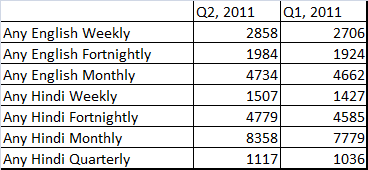
    Magazines have been witnessing a bit of rough weather of late. It is not an Indian phenomenon but is being witnessed worldwide. However, this IRS Q2, 2011 shows an increase in readership of both Hindi and English magazines as compared to Q1, 2011. Here is a quick look at AIR for the same:

    Readership in this duration has increased for Kannada and Telugu publications also. For Assamese, Gujarati and Marathi it has gone down – while for other languages the response is mixed.

    Keeping the focus on English and Hindi magazines for the purpose of this article, is it safe to assume that this IRS marks the revival of magazines? Says Anita Nayyar, CEO – Havas Media, India & South Asia, “This IRS certainly indicates better health for magazines but not necessarily revival.”

    Rajni Menon, Associate Vice President, Carat Media India, too believes that it is not really the revival of magazines and mentions two reasons for marginal upward trend for the magazines. She said, “The Week and Business World have been actively working towards increasing readership and it has had an impact in the market. Secondly, new magazines which were not captured in IRS earlier, eg 2010 Q2 IRS did not cover the following magazines – Outlook Profit, Economist, People, Life Positive. The biggies like India Today, Outlook have seen only marginal shifts only.”

    However the experts believe that there is definite scope of growth in niche and special interest publications, which have shown an upward trend. Ms Nayyar said, “Niche magazines are doing better than mass magazines.” Ms Menon endorsed this, “There has been growth in numbers for niche magazines : India Today Travel Plus, Good Housekeeping, Femina WTW, so that could show an indicative trend along with the fact that one does see more new magazines on the stands every few months. Travel, Women, Lifestyle. “

    However, a major issue faced by media planners and buyers is that a number of niche magazines are not tracked in IRS. As per Ms Menon, “We still can’t make a definite decision on magazines because there are so many in the market which are not covered by IRS. Mainline magazines like Open and Tehelka are yet to be covered, so seeing new niche magazine get covered is a long shot.

    Ms Nayyar too stated that niche and special interest publications are set to grow, but most niche magazines are not tracked.


  • Star’s Hollywood Blockbusters aims to thrill

    By A Correspondent

    Star Movies, India’s leading English movie channel, presents Star Movies Hollywood Premieres; an initiative that brings exclusive screenings of Hollywood titles for their fans a day prior to their official theatrical release by leveraging the strength of their studio tie-ups.

    To be a part of this experience viewer will have to participate in a simple contest and answer questions that will be broadcasted on Star Movies and their India Facebook fan page. Lucky viewers will get a chance to attend the exclusive premier screening of the latest upcoming movie titles by Star Movies Hollywood Premieres. Star Movies kickstarts the initiative with its inaugural movie premiere of The Three Musketeers on October 14 at select theaters in Mumbai, Delhi, Bengaluru and Kolkata.

    The channel also holds the exclusive rights to premiere other Hollywood biggies like ‘In Time’, ‘Twilight Saga- Breaking Dawn’ and ‘The Darkest Hour among others.