Author: mxm_india

  • ET summit to focus on solutions for poor

    By A Correspondent


    The third edition of the ET Financial Inclusion Summit, being held on December 7 at from 9am at The Oberoi, New Delhi, is on the theme of ‘Customer-Centric Finance: Steps toward Sustainable Solutions for the Poor’. The keynote address will be delivered by Montek Singh Ahluwalia, Deputy Chairman of the Planning Commission.


    The summit intends to take stock of the current scenario and focus on customer-centric financial inclusion, whether it needs to redesign what it offers so as to attract the poor and enable them financially, and to explore sustainable solutions for the poor in the realm of financial services.


    The topics that will be covered in this session of the ET Financial Inclusion are: Regulations that Protect the Poor – Perspectives on the recent RBI regulations and Draft MFI Bill; Designing Insurance to meet the needs of the poor; SHGs, No Frill accounts and Beyond: The Government’s role in Financial Inclusion; and Alternative MFI Financing: Diversifying beyond Bank Funding.


    Some of the other prominent speakers are:
    A P Singh, Deputy Director General, Unique Identification Authority of India.
    Anurag Jain, Joint Secretary (IF), Department of Financial Services, Ministry of Finance, Government of India.
    Gregory Chen, Regional Representative for South Asia, CGAP.
    Sameer Kochhar, Chairman, Skoch Group.
    V Saikumar, OSD – Life, Insurance Regulatory and Development Authority.
    Shahid Vaziralli, Programme Head, Centre for Micro Finance.
    Sanjay Datta, Head – Underwriting and Claims, ICICI Lombard General Insurance Company Ltd.
    N C Kulbhe, General Manager, Bank of India.

  • Mid-Day shuts Delhi & Bengaluru editions, to focus on Mumbai


    By Rishi Vora


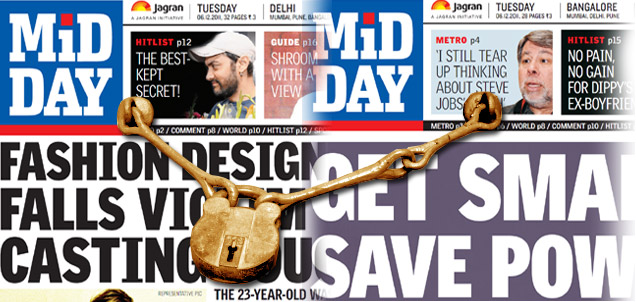
    After having tried out the Delhi and Bengaluru markets for a few years now, MiD-Day has finally decided to shut its editions in the two metros. The focus, as company officials inform, will be on Mumbai from now on, where the idea is to increase the paper’s circulation and enhance profitability.


    Mr Manajit Ghoshal, MD and CEO, Mid-Day Infomedia said “Advertising revenue in the two markets was on the decline, and so we have now decided to focus on our Mumbai edition.”


    Addressing the staff, he wrote in a mail on Monday evening, “It’s with a heavy heart that I have to announce the closure of MiD-Day – Delhi and MiD-Day – Bangalore editions. Tomorrow’s issue will be the last issue for both the editions. This has been necessitated by the prolonged losses we had to incur on these editions. The idea behind starting these editions was to establish these brands in these cities and make a difference in the lives of the citizens there. We had begun well and were appreciated for the quality of product we put out. However, in a corporate scenario, the books need to be balanced. Due to the ever increasing competition in the print media space, the funds required for breakeven in these cities kept escalating. Finally, we had to take this call. We will however, continue to maintain a news bureau in Delhi and our sales offices in Bangalore and Delhi.


    “By cutting our losses in Delhi and Bangalore editions, we will be able to bolster our circulation in Mumbai. Apart, from the plan to channel these investments, Jagran group (our parent company) will invest a large sum in boosting MiD-Day’s circulation in Mumbai. This will give our sales guys across the country to pitch Mumbai MiD-Day to clients and agencies in a new light. We need to now concentrate on building brand MiD-Day in Mumbai and monetizing Mumbai MiD-Day’s large increase in circulation and in this our sales colleagues in Delhi, Bangalore and Pune will have to play a significant part. Gujrati MiD-Day and Inquilab continue to go from strength to strength. We are increasing the circulation of GMD at a brisk pace and will continue to do so. Inquilab has flourished in the north and we now have 14 editions in all and are far ahead of any competition in the Urdu space.


    “MiD-Day Pune is an extension of MiD-Day Mumbai just as the Pune city is an extension of Mumbai. MiD-Day Pune will continue to run at an ever increasing pace and we will be monitoring the Pune media market keenly to spot opportunities to improve the circulation of MiD-Day Pune.


    “We will continue to invest aggressively in our digital properties as we believe that this is a medium whose time has come.


    While the shutting of the Delhi edition has been rumoured for a while, the same cannot be said for Benguluru. A senior member from the MiD-Day Benguluru office who did not wished to be named said that the letter took everyone by surprise.


    The paper was launched in the garden city in 2006. On why the edition failed, Mr Anil K Sathiraju, AVP and Head – Mudra Max Bengaluru said, “MiD-Day is a Mumbai paper, positioned as the traveller’s paper. The reason it didn’t work in Bengaluru is before it was launched, there were newspapers that had been in the market for ages and MiD-Day came with a different positioning which wasn’t right for a market like Benguluru.” He further added that the paper’s stagnant circulation was an indication that brand MiD-Day wasn’t very popular among readers, which led to a greater perception problem.


    The Delhi edition, as is known, was first launched in 1986, and within three years of launch, it was sold to industrialist Lalit Suri’s family. Then again in 2006, it went up for sale and was bought back by Mid-Day Multimedia. Madison Media CEO Ms Basab Datta Chowdhury feels that it was purely on the basis of market reality that the Jagran Group chose to shut the Delhi edition. “It’s a call that you need to take. If a product is not delivering as per expectations, and if you feel that shutting shop is the only way, then the sooner you do it, the better it is. The paper tried its best in Delhi, it didn’t work out. It’s doing well in Mumbai, so the decision to focus there.”


    Citing similar reasons is Mr Sundeep Nagpal, Director of Stratagem Media and a veteran planner who has been following the print media (and MiD-Day specifically) closely. In fact, he is of the opinion that the daily could have done better in its marketing efforts, especially in Benguluru to increase circulation and readership. Mr Nagpal said, “The scope for a No 4 or No 5 newspaper in any language category, to generate both readership or advertising revenue, especially in a cosmopolitan market/ metro, is quite minimal. Both, Delhi and Bengaluru were already dominated by giant groups like TOI, HT, and even Deccan Herald, not to mention others like Indian Express etc. And so they proved to be the big hurdles for Mid-Day, despite the fact that Mid-Day was always supposed to be an evening paper. Also, given the landscape of the public transport in these cities, vis-a-vis that in Mumbai, the scope for Mid-Day to find traction as a commuter’s paper, was also considerably lower than that in Mumbai. And lastly, as a late entrant in these markets, the paper also required very aggressive promotion, perhaps of the likes that we saw in the case of DNA and Hindustan Times in Mumbai.”


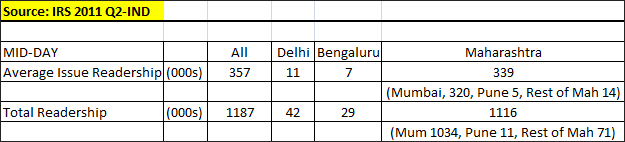
    The recent IRS figures (2011, Q2) indeed don’t show a good picture. The papers average issue readership in Delhi stood at 11,000, while in Benguluru, it was 7,000 (see table). Now that the two non-performing markets have been shut, and with investments to pretty much go to Mumbai, it will be interesting to see how the paper picks up on circulation in the city and whether it is able to pose a greater challenge to the market leaders.


    Lock image: Nuttakit

  • Nature Valley ties up with Aircel Chennai Open

    By A Correspondent


    Snack bar manufacturer Nature Valley has announced that it has come on board as the official “Healthy Snack Partner” for the Aircel Chennai Open 2012. The 17th edition of India’s only and south Asia’s leading ATP World Tour event will be held from January 2 to 8, 2012, and will see in action an impressive line-up of Indian and International players including world number 9 Janko Tipsarevic and world number 10 Nicolas Almagro.


    Further to associating with Aircel Chennai Open for the first time, Nature Valley has taken a key initiative in giving scholarships to highly ranked young tennis players who will be selected by Tamil Nadu Tennis Association (TNTA).


    Commenting on Nature Valley’s association with 2012 Aircel Chennai Open, Arindam Haldar, Director – Premium Foods for General Mills India, said, “Aircel Chennai Open has emerged as one of the most prestigious sporting events in India. Nature Valley is delighted to be associated with Aircel Chennai Open 2012 as the official ‘Healthy Snack Partner’ of the event. To become a part of such global sport/event is a natural fit for a successful global brand like Nature Valley. Nature Valley Granola Bars are all about wholesome, healthy and tasty snacking which suits the requirements of tennis – a health and fitness sport.”


    Elaborating further about the association with tennis, he said, “Our granola bars are convenient, wholesome snacking options for players during tough training sessions and hectic travel schedules. We look forward to a successful partnership with a fast-emerging and leading sport like tennis in India starting with Aircel Chennai Open 2012, and we see a long-term synergy through this association.”


    Ashu Jindal, COO, IMG Reliance said, “The growing support from global corporations such as Nature Valley is yet another testament that the Aircel Chennai Open has built the reputation of being the definitive ATP World Tour event in South Asia. I am certain sure this is the beginning of a long and mutually beneficial relationship between Nature Valley and Aircel Chennai Open.”

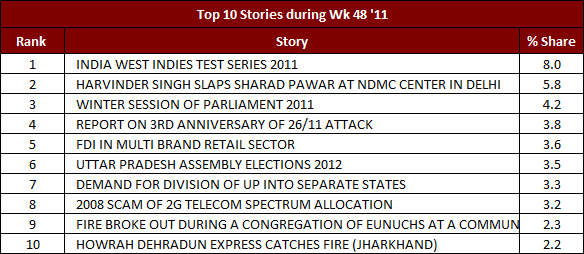
  • NCT Data Wk 48 ’11


    Source: News Content Track – A service of TAM Media Research Pvt. Ltd

    Channels: Aaj Tak, CNN IBN, Headlines Today, IBN 7, India TV, NDTV 24/7, NDTV India, Star News, Times Now, News 24 & Zee News

    Period: Wk 48 – Nov 20 to Nov 26, 2011

    Note : Analysis is based on the Telecast duration


    About TAM Media Research


    TAM is a joint venture between Nielsen Company & Kantar Media Research. Besides measuring TV Viewership, TAM also monitors Advertising Expenditure of Television, Print & Radio through its division AdEx India. Since 2004, it extended its presence in the PR Measurement & Analysis space for Corporate/Marketing Clients by setting up a separate division Eikona PR Measurement.


    In 2007, the joint venture introduced RAM (Radio Audio Measurement) service to track Radio Listenership for the Indian Radio Broadcast Industry. In year 2009, TAM launched a division, called TAM Sports that specializes in monitoring Sports Sponsorship ROI.


    TAM Media Research’s objective is to fuel media insights that will drive the growth of the Indian Media Industry.

  • Mid-Day Delhi & Bengaluru closure a shame

     Ranjona Banerji


    The day started with the sad news that Mid-Day was closing down its Delhi and Bangalore editions with immediate effect. Undoubtedly the owners have their reasons but it is still a shame.


    Having worked with Mid-Day many years ago and also having been part of a publication which shut down years before that, I can feel the pain. Commiserations to all involved.


    **


    Part of Tuesday on television and twitter was about Kapil Sibal wanting websites like Google and Facebook to screen “offensive” content on the internet. Outrage broke out on all levels. So far, except for China, no government has had much success with patrolling or reining in the internet, so good luck to Sibal and the government. Initial reactions have been largely over the top with twitterers and TV commentators rushing to protect India’s democracy, Article 19 A and so on. Without irony (actually irony is conspicuous by its absence on Indian television), Times Now rushed to Varun Gandhi to get his opinion on free speech, he of course, is known for an infamous hate speech.


    **


    Kudos to Mumbai Mirror on its story that “fans” were paid Rs 300 each to cheer for Hollywood star Tom Cruise, who was on a Mission Impossible promo visit to India. Since almost nothing in the media appears to be real, when it comes to entertainment, why not pay for a few people to cheer? The whole celebrity-entertainment culture appears to be a carefully constructed falsehood – and the media is an integral part of this.


    Sadly for the PR genius who came up with this scheme, the death of cinema stalwart Dev Anand pushed Cruise off the main Indian news pages and segments. Also, isn’t Rs 300 a bit cheap for a star as big as Tom Cruise?


    **


    Congratulations to film star Aamir Khan and his director wife Kiran Rao on their new baby. Good for them that they told the world it was through an In Vitro Fertilisation-surrogate process, thus giving untold free publicity to the expensive IVF process and its doctors. But is this headline in Hindustan Times’ HT Café appropriate: “Baby Boy! Produced by Aamir Khan, Directed by Kiran Rao’?


    Cleverness gone too far, I think.

  • After TVCs, the next best thing


    By Shubhangi Mehta


    Commercial advertisers often seek to generate increased consumption of their products or services through “Branding”, which involves the repetition of an image or product name in an effort to associate certain qualities with the brand in consumers’ minds.


    The marketing mix has been the key concept in advertising. Suggested by Professor E Jerome McCarthy in the 1960s, the marketing mix consists of four basic elements, famously called the Four Ps. They are Product; Price, representing the process of determining the value of a product; Place representing the variables of getting the product to the consumer like distribution channels, market coverage and movement organization; and Promotion, the process of reaching the target market and convincing them to go out and buy the product.


    There is a plethora of ways to do this. The modes of advertising include television, radio, online, OOH and then these further have various categories in them.


    Television is generally the first choice for most of advertisers, but what about radio, digital and OOH?


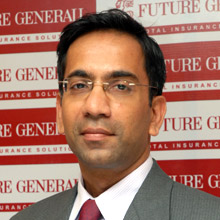
    Prasoon Joshi
    Abraham Allapatt

    Prasoon Joshi, Executive Chairman, McCann Worldgroup, commented, “It’s all about the requirement of a brand, it depends on a particular brand as to what marketing mix is to be used. There might be a brand for which I may not even use television, but might go in for a local newspaper etc. Hence it is not possible to choose a particular medium over others across the board.”


    Abraham Allapatt, Head – Brand & Corporate Communication, Future Generali India Life Insurance Company Limited, said, “Frankly, one cannot definitively state that one of these mediums is the best (after TV) simply because each of them has pros and cons. Radio is good if one wants to reach out to young/upwardly mobile urban customer prospects with a limited budget – especially if you have a powerful/simple message and creative to deliver, but it’s limited in terms of reach.


    “Similarily when we talk about print, it can target specific audience and is quick in reach but again it is a little expensive as compared to other media (cost per reach) and it is relatively limited in terms of reach at an overall level versus TV.


    “OOH is a powerful reminder medium for topical messages but is a relatively disorganised sector/medium. There is no science to measure impact/effectiveness. Large agencies use some tools to add some science to measurement, but it is still not too dependable.


    “Digital is focused down to the individual and is measurable accurately and instantly. It is very good for reaching young, urban, upmarket segments, plus it is cost-effective and an image driver. The only issue is that it is still limited in reach to large cities/income segments.”


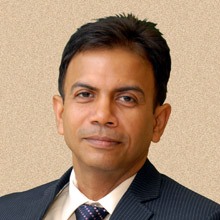
    Apurva Purohit

    Apurva Purohit, CEO, Radio City 91.1 FM, said, “Radio as a medium has the ability to impact millions of Indians due to its wide coverage. And that’s just one of the multiple benefits of the medium! It enjoys a deep personal connect with listeners, allows marketers to create customized and local communication for pocketed audiences, and offers extensive on-ground engagement prospects to supplement advertising campaigns. Such offerings make the medium superiorly effective and attractive for marketers.


    “Radio has an edge over other media due to the local relevance that the medium offers. Advertisers seek to maximize efficiency of their marketing spends by looking at micro targeting communication to consumers in focus markets. Radio serves as a key medium to fulfil this need with its ability to create customized and local communication for the relevant target audience.


    “Another important feature that gives radio a one-up is that it’s an anytime access medium. Hence, advertisers can reach their consumers anywhere, anytime. Different sets of people tune into radio at different points of time and therefore the medium is consumed across the day. This is unlike print which is mainly consumed in the morning and TV which is mainly consumed at night.


    “Of course, the medium’s cost-effectiveness is unquestionable. Radio is far more inexpensive than print. If you need a local media plan you will pay six times on print, while at one-sixth you will get the same kind of reach and frequency on Radio.”


    Sanjay Tripathy

    Sanjay Tripathy , Executive Vice President – Head Marketing and Direct Channels at HDFC Life, said, “Choosing a medium will always be the prerogative of a brand marketer depending on his/her key objectives. While Television is the most preferred medium for marketers because of the kind of reach and opportunity for quality of communication it provides, Print comes a close second because of its ability to provide detailed information about the product/ service. This medium is also hugely preferred because the circulation and readership numbers are measurable unlike Radio and OOH, which are usually used for local, last mile reach. Contrary to popular perception, in a highly populous country like India, print still has a lot of scope for growth in the interiors where literacy is still catching up. Print provides flexibility in terms of customisation as per the regional target audience. However, the characteristics of the target audience influence hugely in terms of ‘where’ would the marketer best capture their attention, leaving a lot of scope for exploring different media channels. Especially in case of digital – the new-age innovative medium, which is my personal favourite and which, I believe, has a lot of potential over all the other media. Going forward, as most people are spending more and more time online and on social media, these will emerge as preferred media for brand engagement.


    Kalyan Kumar, CMO Games 24×7.com, said, “Being an e-commerce company, our vote will definitely go to digital. Digital is growing rapidly and has a great future scope. If there was a medium to be chosen after television, then hands down, my vote goes to digital.”


    Ranjeev Vij, Vice President, Head – Proximity, said, “We cannot isolate and say that digital is the only preferred choice. It works best when used in tandem with traditional media. For example look at “Quaker Mission to Make India Heart Healthy Campaign” done by BBDO/Proximity India in 2009 where TV and print ads were linked to the website (www.goodmorningheart.com) and the website led people to social media sites, which helped create buzz, conversations and relationships between consumers and the brand. What digital does brilliantly over other medium is that it helps build relationships and brings customers close to brands by enhancing user experience. Digital is best used to ‘amplify’ everything we do to the power of millions.


    “For marketers Digital provides real-time access to data and analytics, instant feedback on campaigns, product/service quality, etc. along with better understanding of consumer journey and behaviours. This data if mapped properly can help brands massively multiply the results of their marketing initiatives.”


    News paper image: Nuttakit

  • Tata AIG focuses on building strong foundation

    By Shubhangi Mehta


    Tata AIG Life Insurance Company Limited (Tata AIG Life) has released the first in its series of a new communication campaign envisaged by Bates, that restates the importance of indoctrinate strong values and foundations by parents amongst their children. The crux of the communication leverages a strong insight that when the foundations are right, the future is protected.


    Tata AIG Life has a long-term brand-building programme, which commenced in 2004 and is supported each year.


    Tata AIG always emphasises on creating a future by nurturing a strong foundation. Whether it’s the way Tata AIG life runs its business, the way it equips its employees or the way it looks at its customers, it makes sure that every relationship stands on solid foundations. For Tata AIG, when the Foundations are right, the Future is protected.


    Vikrant Ramachandra, Vice President, Brand Marketing, Tata AIG Life Insurance Company Limited said, “At Tata AIG Life, we have always believed in creating a future by nurturing a strong foundation. The principle that a strong foundation means a protected future is at the core of the new brand strategy. Our focus on Protection is reflected in the slew of products launched in the recent times, like Tata AIG Life Gyan Kosh, Tata AIG Life InvestAssure Maximizer and the new products about to be launched. The brand communication strategy will reflect this. One of the critical initiatives recently launched by Tata-AIG Life is the launch of the Premier agency. This will foster skills development with a view to creating a professional and productive agency force through mandatory and structured training targeted at ensuring they focus on the customer need.”


    There is a huge and latent need for financial instruments for long-term savings and protection in India. A Swiss Re report on ‘Mortality Protection Gap’ in Asia Pacific indicates a sizeable mortality protection gap in India. The gap which was to the tune of US $ 2045 billion in 2000 had more than tripled to US$ 6676 Billion in the year 2010. This is the third highest amongst countries in Asia Pacific after China and Japan. Tata AIG believes that right now India needs long-term savings and protection products and so their offerings will emphasize these two aspects driving alignment with customer’s needs.


    For their ongoing campaigns, Protection of Life and Health will form the backbone of the Marketing Program. Mass Media Advertising will be extensively supported by intensive Training Program for its Premier Agents at Tata AIG Life. Additionally, Ground Events like Healthy Living Program, which raise awareness on healthy living amongst school students, will make the strategy vivid.


    Its creative mandates are handled by Bates and media mandates by Madison.


    Vijay Sinha, Senior Vice President & Head of Marketing of Tata AIG Life said, “Our core competence is in the area of managing an individual’s financial risks by developing relevant, compelling and differentiated protection-centric products to meet this staggering Protection Gap in India. In line with our core competence, we at Tata AIG Life have always prominently echoed the need to create a sound and steady future by building and nurturing a strong financial foundation. This very principle is at the heart of our latest communication.”


    Commenting on the creative idea, Sonal Dabral, Regional Executive Creative Director & Chairman (India), Bates, said, “If we look at the world around us today, with its rampant consumerism, the thought of the fundamental values passed on to us by our parents getting eroded in the near future is quite scary. The ‘Thank you’ film is relevant in such times not only from a brand point of view but also from a social point of view. Inculcating the right values in our children in today’s fickle times is what will help our nation achieve her true potential. The idea of imparting the right fundamental values, along with the opportunity of engaging the consumers in a relevant manner is what is most exciting about this campaign.”

  • Hard Knocks: Crossed signals over FDI

    By Anil Thakraney


    I often wonder why international corporates even want to invest in a messy country like India. Why do they wish to take on all the headaches of operating inside such a chaotic nation. The answer, I suppose, is the market saturation in their own lands, and a raging desire to capitalize on the booming spending populace of this third world nation. Which makes the suits risk an entry into this snake pit.


    Well, all I can say is that these companies are either gutsy or desperate or both. If I was an international investor, I would quietly park my money in China. Or even Vietnam and Indonesia. And fly over India. Look at all the tamasha that just happened over the issue of FDI in multi-brand retail. And now it’s been put on ‘hold’… an euphemistic way of saying that the government chickened out of the deal. Here are the three messages we just sent to the global businessmen:


    1> The Indian PM is lamer than a lame duck. He has the vision, but lacks the ability, wherewithal and support to push new projects through. That, not just his rivals and allies, even his own party men can upset his plans at any time.

    2> Even if the FDI in retail bill gets passed, which is now a very remote possibility (even Baba Ram Dev doesn’t like it!), it’s left to the various states to accept or reject it. So you could be present in Delhi and Mumbai but missing in Bangalore, Kolkata and Chennai. And when the state government changes, there’s no surety the new government won’t kick you out of the city. So there’s never any hope of stability.

    3> Goons of various political parties are always ready for some action on the streets. So to pacify a particular vote bank segment, there’s always a chance that they will strike your super expensive store. Shattered glass panes, damaged wares and bruised business could be just a stone’s throw away.


    Yes, India is a hot destination for dhandha. But only for the steely, hardy, brave risk-takers.


    ***


    PS: Quite liked the rich tributes various TV channels paid to Devsaab immediately on the news of his death. The best package was put out by Times Now (pretty much non-stop coverage) and Aaj Tak (the only channel that told us some untold Dev Anand tales). The only disappointment came from NDTV. On a day like that, when the whole nation was humming Dev’s classics, they ran an hour-long, maha-boring prime time show on parliament adjournments. From the sublime to the ridiculous.

  • Red Bull, Levi’s, Pepsi etc target young urbans via gigs

    By Rahul Sachitanand


    If the celebrated Woodstock music festival of 1969 was to be held in India today, its billing of “Three Days of Peace and Music” would have to be tweaked to “Three Days of Pepsi and Music.” Live gigs are indeed the flavour with a young nation, and a host of lifestyle and consumer brands from Red Bull to Levi’s and Pepsi are pulling out every trick from the marketing manual to get their attention. The festive season is when live acts crank up the volume. In mid-November the second edition of the Bacardi-led NH7 Weekender in Pune spread over three days and six stages gave audiences a rare dose of multi-genre music, prompting international writers to compare it with the UK’s legendary Glastonbury Festival.


    The pace quickens by the year-end when the Sunburn extravaganza gets going on the beaches of south Goa, with brands like Lenovo and Colgate riding on the electronic dance music festival. “Live music is a great way to build our engagement with our customers,” says Bacardi India’s marketing head Arvind Krishnan. “We today have people willing to listen to new sounds and try new formats, helping the growth of live music. We want to ride this change.” Besides leading the NH7 event and bringing top acts such as electronics artiste Prodigy to India, Bacardi has also supported another event called Together Mix, which looks to push live music into the hinterland.


    Krishnan says, “Live music allows us to give our consumers a holistic brand experience.” Pepsi, for its part, believes it needs to be in every youth destination – live music is one of them. “We believe in constantly encouraging Youngistaan to follow their passions, live their dreams and change the game,” said Sandeep Singh Arora, EVP – marketing, cola, PepsiCo India in a statement.


    Across India, the live music event revolution is gathering steam. NH7 had over 25,000 people attending the festival, double the number a year ago, according to event organisers. There were more bands and larger stages too in keeping with an exponentially larger audience turnout.


    At Sunburn Goa the number of artistes is expected to double to 90 this year, while attendance too is expected to go from around 45,000 to around 100,000. In Bangalore, the cult live music event called Strawberry Fields, which focuses on independent and upcoming performers (it charges a minimal charge to bands and has no entry fee for attendees), is adding 500 to 1,000 people to its audience every year. And at the second edition of the Mahindra Blues Festival to be held in February 2012, thousands are expected to turn up in Mumbai to listen to five top international artistes, attend music workshops, eat blues brunches and browse through thematic displays.


    The world’s largest denim vendor Levi’s is one of the many brands eager to ride the explosive growth of live music in India. Recently it had indie (independent) folk fusion band Swarathma play for a group of blind children, as part of its “Go Forth” initiative to support meaningful causes.


    “We are hoping to raise awareness and support for a diverse range of pioneers around the globe. Swarathma performs free concerts for those who do not have access to live music, using music to raise social consciousness and bring hope to underprivileged people in India,” says a spokesperson for Levi’s in India. Another firm that is allying with live music is energy drink maker Red Bull, which engages with the music scene in two ways.


    All events are properties that are developed, planned and executed by in-house teams. For instance, there is the Red Bull Bedroom Jam, a platform for amateur bands to have a video shot by Red Bull and be a part of a live stage tour. The firm also works with festivals such as NH7 and Sunburn to reach out to its consumer base. “Red Bull strongly believes in working in playgrounds where talent needs support,” says a company representative. “India has a huge pool of live acts. Giving these bands platforms like Red Bull Bedroom Jam, Red Bull Music Academy Bass Camp allows these artists to truly expand their wings.” Red Bull takes pains to point out that these events are owned and operated by internal teams and are not just sponsored events.


    In contrast to the energy of Red Bull, brands are finding new avenues of growth in much more sedate confines. Across the dozens of halls or sabhas that host top Indian (mainly carnatic) music and dance shows during December and January, an increasing number of brands are looking to make their mark. While Chennai-based public sector banks such as Indian Bank and Indian Overseas Bank and the likes of Nallis Silks have been sponsors of events for years, if not decades, newer names such as Axis Bank, Hyundai, Airtel, Aircel and Vodafone have either established their presence-or plan to – during this month long season.


    The growth of live (and independent) music has compelled Sony Music to launch a label called Day 1, which hopes to be a broad platform for independent music in India. Under Day 1, there are two sub-brands, Folktronic (music with Indian influences) and Zomba (urban lifestyle music). “Independent music has reached an inflection point in India,” says Sridhar Subramanium, president, India and Middle East, Sony Music. “The internet and social networks have helped build a pool of talent and make it easy to build a community of listeners for them, in the absence of TV channels and radio stations which would traditionally play their music.” This growth in independent, live music has also made it more appealing to a broader section of brands, beyond the traditional staple of liquor and beverage makers these acts traditionally rely on.


    V G Jairam, a partner with Oranjuice Entertainment, a live music production house in Mumbai, says there has been a sharp growth in independent live music acts across India. “I think the indie space is booming. There is a sense of pride in the consumer to see homegrown bands and this is adding to the growth,” he explains. With growing awareness of emerging live music, music bands are also able to use the web to popularise their music at low or no cost. For instance, a recent show at Mumbai’s Mehboob Studio was almost entirely crowd-sourced. “Music is a powerful tool to connect emotionally with your consumers and get embedded in their minds,” he adds.


    Branding expert Harish Bijoor, who runs an eponymous consulting outfit in Bengaluru, says that any event that is youth-centric will have an umbilical connect with brands. While the mobile phones and services are perhaps the most ubiquitous of these items, several other categories including apparel, accessories, consumer goods and even real estate could leverage live music to make this connect, he says. As live music goes mainstream, brands should consider making select long-term and strategic investments in some of these properties, says Joji George, CEO of Percept Sports and Entertainment, organisers of Sunburn. “These associations are no longer a few hoardings and banners; they need to think beyond and invest in building destination events,” he says. George points to marquee events such as the Glastonbury festival and the Montreux Jazz Festival in Canada as models of live music development.


    Source:The Economic Times

    Copyright © 2011, Bennett, Coleman & Co. Ltd. All Rights Reserved

  • China, India to drive growth of global advertising market

    By Samidha Sharma


    Emerging markets like China and India will drive growth for the $464-billion global advertising market in 2012, according to Publicis Groupe, the third-largest communications group in the world.


    India (the 16th biggest ad market in the world), along with China, Russia and Brazil , over next three years, will account for 33% of the global ad expenditure growth, said a report by Publicis’ media agency ZenithOptimedia, released on Monday.


    Buoyed by this growth the French advertising conglomerate , owner of agencies like Leo Burnett and Saatchi & Saatchi, is on course to triple its business in India over the next three years, said Jean-Yves Naouri, COO & Executive Chairman of Publicis Worldwide. “In the next five years, India is expected to be among the top ten ad markets in the world,” Naouri, told TOI. Naouri is tipped to take over from Maurice Levy who has been at the helm of the Paris-based group for over two decades now.


    “For us growth will come organically, and also through acquisitions if we do not have the scale and capability in some areas. But so far we are progressing very well as far as closing the gap with WPP goes,” Naouri added. Publicis Groupe took over Gomye, a Chinese full-service digital agency, last week and has made several acquisitions in the local market there but has not replicated the model in India . China is already a top five market for the group.


    In Mumbai, for the annual board meeting, he said the importance of India is growing as now many of its agency heads in India are directly reporting into the headquarters . “We are not talking of Asia-Pacific as a region, now India and China are reporting directly to the group. It’s a sign that these are the markets for the future. I am spending most of my time in these countries be it Mexico, China , Brazil or India,” he said.


    With the growing focus on India, the group may also look to increase its digital offerings here, through the introduction of Razorfish, which it acquired from Microsoft for around $530 million in 2009. Revenue from the digital stream for the group globally touched 30% this year while developing markets contributed as much as 25% to the overall revenue. “We have been pretty much ahead of the curve in the digital space with Digitas already present here, we may look to expand our portfolio but it is not a necessity,” he added.


    Referring to the forecast made for 2012 by its media agency, he said the slowdown in the Western markets had not impacted ad spends like it did in 2008. ZenithOptimedia said the global ad expenditure will grow 4.7% in 2012 up from 3.5% in 2011 accelerated by the Olympics, the European Football Championships and the US Presidential election.


    “Businesses are cautious as the debt crisis has hit us hard but the impact is pretty moderate. In India, the inflation rate has been high and the growth has slowed but so far our agencies have performed pretty well with a double digit growth,” Naori said.


    Source:The Economic Times

    Copyright © 2011, Bennett, Coleman & Co. Ltd. All Rights Reserved

  • The world according to JWT, in 2012


    By A Correspondent


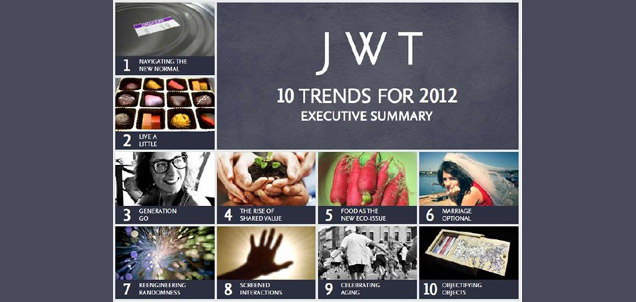
    Ad hotshop JWT feels that in 2012, the economy will push brands into opening up more entry points for cost-sensitive consumers as the “new normal” becomes a prolonged normal in the developed world while at the same time, tough times will generate an unprecedented entrepreneurialism, with the so-called Lost Generation of youth becoming a uniquely resourceful group that creates their own opportunity. The above findings and plenty more, are the result of their annual forecasting exercise – the seventh in the series – of key trends that will drive or significantly impact consumer mindset and behaviour in the year 2012.


    JWT’s ’10 Trends for 2012′ is the result of quantitative, qualitative and desk research conducted throughout the year for the report. It includes inputs from nearly 70 JWT planners across more than two dozen markets and interviews with experts and influencers across sectors including technology, luxury, social responsibility and academia.


    “With our annual trends forecast, we aim to bring the outside in-to help inspire ideas beyond brand, category and consumer conventions-and to identify emerging opportunities so they can be leveraged for business gain,” remarked Ann Mack, director of trendspotting for JWT. “Trends, like any complex and dynamic human phenomenon, are not preordained-once they are spotted, they can be shaped.”


    Previous trends that have been forecasted over the past years include: “De-Teching” in 2011 (more people logging off, at least temporarily, to get a break from technology); “Location-Based Everything” in 2010 (the explosion of location-based or -aware services that leverage data from mobile phones); The Small Movement” in 2009 (the shift away from “bigger is better” in everything from homes to cars to mobile technology); and “Radical Transparency” in 2008 (the “nothing to hide” ethos seen in some online behaviours).


    The top 10 trends that have been predicted for 2012 are as follows:


    1. Navigating the New Normal

    As the new normal becomes a prolonged normal in the hampered developed world, more brands in more categories will open up entry points for extremely cost-sensitive consumers. Marketers will find new opportunities in creating stripped-down offerings, smaller sizes and otherwise more accessible products and services.


    Example: In the US, Heinz is introducing several reduced sizes at a suggested retail price of 99 cents, including a 10-ounce ketchup pouch and a 9-ounce yellow mustard, as well as mini Worcestershire and Heinz 57 sauces.


    2. Live a Little

    Faced with constant reminders about what to do (exercise more, eat better) and what not to do (smoke, overspend), and fatigued from several years of austerity, consumers will look for ways to live a little without giving up a lot. People have been exercising more self-control, and increasingly they are looking to let loose once in a while: indulging in sinful things, splurging on treats and escaping from today’s many worries.


    Example: Whiskey in South Africa, premium beer in the U.K and cheap eclairs in India are small indulgences that consumers with little to spend are enjoying.


    3. Generation Go

    While twenty-somethings in the developed world feel they’ve been dealt an unfair deck, many are finding opportunity in economic adversity. Out of continued joblessness or discontent with the status quo will spring an unprecedented entrepreneurial mindset, enabled by technology that obliterates traditional barriers to entry. A so-called Lost Generation will transform itself into a uniquely resourceful cohort.


    Example: More than half of Millenials in the US agreed that if they lose or have trouble finding a job, they’ll start their own business, according to a JWT survey, up from 25 percent in 2009.


    4. The Rise of Shared Value

    Rather than simply doling out checks to good causes, some corporations are starting to shift their business models, integrating social issues into their core strategies. The aim is to create shared value, a concept that reflects the growing belief that generating a profit and achieving social progress are not mutually exclusive goals.


    Example: Philips is partnering with the Dutch government in a bid to provide affordable, sustainable energy solutions to some 10 million people across 10 sub-Saharan African nations by 2015.


    5. Food as the New Eco-Issue

    The environmental impact of our food choices will become a more prominent concern as stakeholders-brands, governments and activist organizations-drive awareness around the issue and rethink what food is sold and how it’s made. As more regions battle with food shortages and/or spiking costs, smarter practices around food will join the stable of green “best practices”.


    Example: U.K. supermarket Sainsbury’s featured a summer promotion in 2011 offering customers who asked for cod, haddock, salmon, tuna and prawns an alternative, more sustainable species such as herring or mackerel for free.


    6. Marriage Optional

    A growing cohort of women is taking an alternate life route, one that doesn’t include marriage as an essential checkpoint. Both in the West, where this trend is building, and in the East, where it’s gaining momentum, “happily ever after” is being redefined as a household of one, cohabiting or single motherhood.


    Example: In 2010, a third of Japanese women entering their 30s were single, while 37 percent of all Taiwanese women 30-34 were single.


    7. Reengineering Randomness

    As our individual worlds become more personalized and niche-and the types of content, experiences and people we are exposed to become narrower-greater emphasis will be placed on reintroducing randomness, discovery, inspiration and different points of view into our worlds.


    Example: Airtime, due to launch at the end of 2011, is being touted as a random real-time video chat platform where strangers will be “smashed together”.


    8. Screened Interactions

    More flat surfaces are becoming screens, and more screens are becoming interactive. Increasingly, we’ll be touching them, gesturing at them and talking to them – and becoming accustomed to doing so as part of our everyday behaviours. This is opening up novel opportunities to inform, engage and motivate consumers.


    Example: In New York, a restaurant at high-end department store Barney’s features 30 individual screens in a large communal table that’s covered in glass; diners can digitally order their meal, then browse the store’s catalogue while eating.


    9. Celebrating Ageing

    Popular perceptions of ageing are changing, with people of all ages taking a more positive view of growing older. And as demographic and cultural changes, along with medical advances, help to shift attitudes, we’ll redefine when “old age” occurs and what the term means.


    Example: To appeal to Gen Xers and Boomers, Polish beer brand Zywiec launched a campaign with the tagline “The best is ahead of you”. Commercials showed older male celebrities including actors, a boxer and a cartoonist, speaking about their lives, offering insights and advice.


    10. Objectifying Objects

    As objects get replaced by digital/virtual counterparts, people are fetishiZing the physical and the tactile. As a result, we will see more “motivational objects”, items that accompany digital property to increase perceived value, and digital tools that enable creation of physical things.


    Example: Sincerely’s Postagram app allows vacationers and others to turn snapshots into snail-mailed postcards. Similarly, Postcard on the Run reminds potential users that for recipients, a physical card is “a real keepsake they can hold close to their heart, put up on the fridge or display at work”.
  • The Anchor: 5 reasons you know your OOH campaign is working

    By Ishan Raina


    #1 Flexicreation:

    The medium offers an advantage of Flexicreation i.e. creating customized ads and content according to the medium. This can be done by customizing the existing ad for the medium or digitizing an existing ad / leaflet and making it an audio visual ad. Flexicreation for the same medium is impossible in any other audio visual medium. The future will be and has to be the contextualization of the content and advertising messages. For Colgate, we customized the ad for the medium by highlighting the important messages to make it more impactful.


    Example – Colgate Pro-Sensitive Relief:

    Ad Recall: Of the people who had seen the ad 39 % have linked it correctly to Colgate Sensitive Pro – Relief.

    Reach Builder: 32% of the respondents (in the exposed set) were exposed to the ad for the first time through OOH MEDIA screens.


    #2 Flexicasting:

    OOH Media has been the most flexible medium today and gives a chance to slice and dice the message of the campaign as per the kind of audience an advertiser would like to reach. The client can select the locations, cities, frequency and language as per their requirements. Flexicasting provides an advantage of getting as local as possible just like an outdoor but with the power and capability of Audio-Visual. Other mediums are struggling with it and it comes naturally to Digital OOH. For Maruti, we used Flexicasting to advertise different brands in different locations to reach the correct audience.


    Example – Maruti

    Screen Recall: More than 90% of the respondents recall seeing OOH Media screens

    Ad Recall: 65% unaided recall of the ads on OOH Media.

    Reach Builder: 45% of the respondents were exposed to the ad for the first time on OOH Media


    #3 Content Integration:

    Content Integration helps in creating a contextual connect for the brands. The role of content is thus becoming very important in this medium and OOH Media continuously experiments with content to make it more relevant for the audiences and thus attracting more eyeballs. We have always been creating many on-screen properties which are topical, social or based on current happenings. Content Integration is another important area with a huge scope of dynamism and properties like travelogue, home-sweet-home, calorimeter, Green horns etc creating L-Band, Aston Band with the brands which helps them build a perception rather than direct selling. OOH Media customizes in-house content as per the client’s requirement and offering to make it contextual. For GSK- Horlicks Foodles we had created an L-Band on the Content Property called Caloriemeter which was the calorie consumed in the food and Foodles was talking about healthy and tasty eating habits on the LBand.


    Example: GSK Horlicks Foodles:

    Screen Recall: More than 100% recall for OOH Media screens

    Ad Recall: 69% of the respondents recall seeing the Horlicks Foodles ad at a Spontaneous Level

    Reach Builder: More than 24% of the respondents at work and play were exposed to the ad for the first time on OOH Media


    #4 Static Fabrication:

    Static Fabrication is one of the important aspects developed lately. Any brand offering is fabricated around the screens in the static format to create a better impact and creates the visibility for the brand 24 X 7. While the campaign runs on the screens, the static fabrication around the screens adds to the visibility. For Samsung, had advertised for Galaxy Tab in selected screens to reach the target audience and had done static fabrication on these screens to create hype for the brand.


    Example: Samsung Galaxy Tab Campaign:

    Screen Recall: More than 100% recall for OOH Media screens

    Ad Recall: 43% of the respondents recall seeing the Samsung Galaxy Tab ad at an unaided level.

    Reach Builder: More than 26% of the respondents at work and play were exposed to the ad for the first time on OOH Media


    #5 Vicinity Marketing:

    Vicinity Marketing is something that can be used very well by clients in this medium and is ideal for retail. This helps in creating awareness about the brand or the offer in the vicinity to drive footfalls. We have a lot of case studies where the use of vicinity marketing has resulted in the increase of footfalls. Citibank, did Vicinity Marketing for high net worth individuals by selecting limited screens with a very high exposure in Mumbai, Delhi NCR.


    Example – Citibank Reward Points:

    Screen recall: 100% of the respondents recall seeing the OOH Media screens

    Ad recall: 80% recall amongst 157 people who were interviewed of which 52% recall it at a TOM level and 93% recall it at an unaided level


    Reach Builder: OOH MEDIA Reaches Out To MEDIA LIGHT/MEDIA DARK/HIGHLY MEDIA FRAGMENTED AUDIENCES : 35% Respondents Were Exposed To The Ad For The First Time On OOH Media


    Ishan Raina is MD and CEO, OOH Media (I) Pvt. Ltd.