Author: mxm_india

  • Industry veterans to train @ Stratagem Media’s Media Rhythm 4

    By A Correspondent


    Stratagem Media, an independent media services company led by Mr Sundeep Nagpal, has been fairly active in the field of media training – an area which Mr Nagpal has, for many years, specialised in. The latest in the company’s list of training programmes is the Media RHYTHM series, which he started a couple of years back. The idea was to provide hands-on training to media professionals in the area of sales and help them overcome severe impediments in today’s media selling environment.

    RHYTHM is an acronym for Realising Higher Yields through Talent Harvesting in Media. The company has so far done three rounds of Media RHYTHM; and the previous ones have had Chairman of Madison World Mr Sam Balsara and former Zee CEO Mr Pradeep Guha flagging off the events.

    The fourth round is all set to take place on December 2-3, 2011 in Mumbai, and MxMIndia is the web partner for the event which has five modules – Print, TV, Radio, Digital and Outdoor.

    The list of speakers includes media veterans such as Mr Bharat Kapadia, Mr Suresh Balakrishnan, Mr Madan Sanglikar, Mr Jairaj Padmanabhan and Mr Nagpal himself. Topics that will be covered are: ‘Adding relevance to Value’ by Mr Kapadia, ‘Customising business solutions to meet business objectives’ by Mr Balakrishnan, Does Digital really work’ by Mr Sanglikar, and Strategising before, during and after every move in a media sale by Mr Padmanabhan. Mr Nagpal will talk on ‘When, how and how much to use the science behind media decision making’.

    Mr Nagpal is optimistic of putting up a good show. Talking to MxM India he said, “Stratagem Media has always believed in giving hands-on training to media professionals. There is so much that youngsters can learn, on how they can develop their skills and also how to start thinking and implementing effective selling strategies. ”

    Mr Nagpal further said that the workshop will give participants insights on things like how to close deals in the least possible time and how to understand the thought process of a media planner better. He feels such interactive workshops provide an opportunity for media companies to harvest talent of a select few ad sales personnel which they think are the future.

    Mr Kapadia said “Media RHYTHM is not like the regular seminars. It is more like the closed-room sessions, where participants get a chance to interact more and participate, unlike large forums and industry gatherings. The hands-on approach towards training is what makes the whole experience better.”

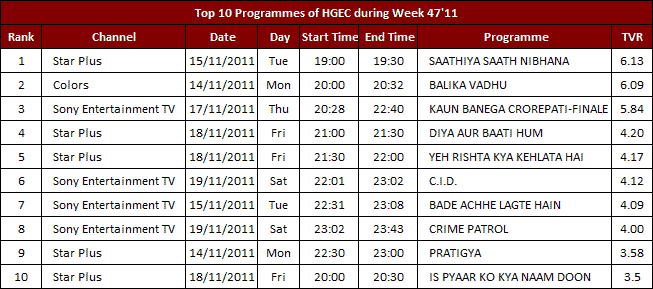
  • TAM data Top 10 programmes on HGEC – Wk 47’11

    Source: TAM Peoplemeter System

    TG: CS 4+ yrs

    Market: Hindi Speaking

    Market Period: Wk 47: Nov 13 to Nov 19, 2011


    About TAM Media Research


    TAM is a joint venture between Nielsen Company & Kantar Media Research. Besides measuring TV Viewership, TAM also monitors Advertising Expenditure of Television, Print & Radio through its division AdEx India. Since 2004, it extended its presence in the PR Measurement & Analysis space for Corporate/Marketing Clients by setting up a separate division Eikona PR Measurement.


    In 2007, the joint venture introduced RAM (Radio Audio Measurement) service to track Radio Listenership for the Indian Radio Broadcast Industry. In year 2009, TAM launched a division, called TAM Sports that specializes in monitoring Sports Sponsorship ROI.


    TAM Media Research’s objective is to fuel media insights that will drive the growth of the Indian Media Industry.

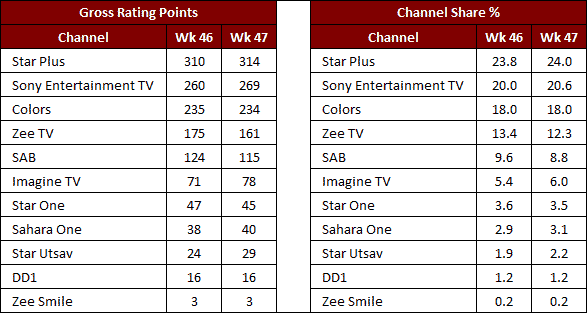
  • GRP Channel shares of HGECs- Wk 47 2011

    Source: TAM Peoplemeter System

    TG: CS 4+ yrs

    Market: HSM

    Period: Wk 46: Nov 6 to Nov 12, 2011

    Period: Wk 47: Nov 13 to Nov 19, 2011


    About TAM Media Research


    TAM is a joint venture between Nielsen Company & Kantar Media Research. Besides measuring TV Viewership, TAM also monitors Advertising Expenditure of Television, Print & Radio through its division AdEx India. Since 2004, it extended its presence in the PR Measurement & Analysis space for Corporate/Marketing Clients by setting up a separate division Eikona PR Measurement.


    In 2007, the joint venture introduced RAM (Radio Audio Measurement) service to track Radio Listenership for the Indian Radio Broadcast Industry. In year 2009, TAM launched a division, called TAM Sports that specializes in monitoring Sports Sponsorship ROI.


    TAM Media Research’s objective is to fuel media insights that will drive the growth of the Indian Media Industry.

  • Gouri Dange: The Media Menu Card

    Talking of paid news, it’s interesting to see how it all works. Meaning the modus operandi. Not just the big-ticket paid news where political parties and heavyweights slip big bucks to large newspaper and tv corporations.


    I’m talking about the mere-mortals path to godhood via the media. Well if not godhood actually, at least the pay-your-way route to your five-minutes-of-fame. Everything’s on sale, going by Media Menu Cards that doctors, lawyers, academics, business people, sportsmen, performers et al have been getting via email over the last couple of years. They are sent by big papers and small, national as well as local and some tv channels too.


    Here’s a sample menu card, with the cunningly worded introduction.

    Dear So-and-so

    Your contribution to society is a matter of pride for us. It would be our pleasure to feature you and your achievements in our paper. Your valuable opinions are also solicited on matters of importance in our city. Please contact Ms X or Ms Y (note, they are interchangeable, the first is a journo and the second is an adgirl from the publication) after going through the contents below.


    Page 3 package

    Rs 4,000/- + taxes for parties

    Our Deliverables : Your presence at any Page 3 event, and/or your and your spouse photograph.

    Rs 8000 + taxes (photos to be provided by you) for family wedding

    Our Deliverables: Event will be reported, pictures of you and any important guests will be featured.


    Opinion-maker package

    Rs 8,000 + taxes
    Our Deliverables : Your views solicited and quoted in stories relating to your field of operations.


    Conference reporting package

    Rs 5000+ taxes (local); Rs 8,000 + taxes national; Rs 10,000 + taxes international. (with photo to be provided by you)

    Our Deliverables : When you attend a conference as a speaker/delegate, it will be our pleasure to report your contribution to the proceedings.


    Hospitalization

    Rs 5000/- taxes

    Our Deliverables: Successful emerging from surgery or illness will be reported, along with pictures (our photographer will be sent).


    …and so on and so forth, you get the point! There are these packages offered foreign trips, awards, donations that you make, stuff that you publish, charitable visits that you undertake to cancer-struck kids and slums…all of it can go up there as news, if you tick the right choices in the Media Menu Card.


    That last one is my favourite – I mean I had never thought of coming out of hospital as news, unless you were a loved leader, or a jailed corporate type pretending to be ill, or had climbed Mt Everest and were in hospital for exhaustion. And one would imagine that the ordinary person wouldn’t particularly like to be shown wheeled out of somewhere. But it looks like there is some valuable brand-enhancement to yourself by being hospitalized. Go figure! Perhaps the hospitals involved are also being contacted as we speak, for their frontage to appear in the papers, at a price. But hell, everything is on sale, so why not!


    While I haven’t been offered this Media Menu Card myself (what, I’m not a potential news-client? My money’s not good enough for these people?), I and other book writer friends have been offered similar menus, by bookstores. Not the ordinary corner bookstores that invite you to actually talk about book; and not the ones where I have launched all my books without paying a penny. But a few other new entrants, that go by lofty names. Their ‘bill of fare’ goes something like this. On an ascending scale starting from Rs 8000 right up to Rs 25,ooo (this was last year, perhaps the rates have gone up in a year), you are offered packages like:


    > venue

    > seating

    > sound

    > f&b (tea and cookies for 40 people)

    > art work for invitation card

    > invitation to our databse


    Write out a larger cheque and you can get
     

    > media presence

    > venue

    > seating

    > sound

    > f&b (tea and cookies for 40 people)

    > art work for inviation card

    > e invitation to our databse


    Then come options where you pay for the book to be stacked on the cash counter. Perhaps they haven’t thought of it yet, but they could easily offer you a package in which a stack of your books accidentally falls on people’s heads.


    And then come the more expensive add ons that maketh or breaketh your book, they say:


    > Your book banner up for 4 weeks in our store


    And the crowning glory that is within easy reach if you’re ready to fork out more mullah:


    > All of the above facilities for your book, PLUS it is placed on our bestseller list for eight weeks running.


    Somebody pass me the antacid, this menu’s a little too rich for me.

  • Let’s look beyond Kasab!

    By Ranjona Banerji


    Newspapers in Mumbai this week will be full of articles and opinions about 26/11 this week as it’s been three years since terrorists ran amuck all over Mumbai in November 2008, killing and maiming. I have to confess that I have done it as well with my column in Mid-Day. However, I cannot quite understand why there is so much focus on the money spent on Ajmal Kasab, the sole terrorist who was caught. Kasab has been sentenced to death and is awaiting a Supreme Court appeal. Most of the money, as the newspapers tell us, has been spent on securing Arthur Road jail which surely should have already been done considering the number of terrorists and underworld characters who live there. In which case, the story should be: why was Arthur Road jail not secure enough to house one terrorist?


    The big stories for me out of 26/11 start with the shoddy investigation into whoever helped the terrorists on the ground – considering the two put forward by the police were acquitted? After all, convicting Kasab was inevitable, given the evidence against him and he is now within the judicial process on his way to the gallows. But what about those of us who are still alive – what has been done to secure Mumbai since? What about all the promises about equipment for the police? Is there enough electronic surveillance? Where are the boats which the Coast Guard can actually use?
    Hopefully, our newspapers will give us more and get out of this Kasab focus.


    **


    It is good to see Indian TV getting interested in the renewed revolution in Cairo. Suddenly, it’s been headlined on a few channels after the Arab Spring was ignored for weeks in India as if a Bollywood-cricket-faff-filled Indian brain could never be interested in anything else.


    **

    Is it good journalism or bad that the birth of Aishwariya and Abhishek Bachchan’s first baby was treated with kid gloves? I would have thought that in these hard-boiled, in-your-face paparazzi times, good manners would have been thrown out of the window. Even worse, everyone just fell in with Amitabh Bachchan’s requests? Come on, this is not the way a free, independent media behave. Whoever said that we had to be polite and non-intrusive?


    It is true that I care a hoot about this child (I think it’s been born because I saw a picture of Amitabh carrying it out of hospital) but the rest of the country surely wanted to know? Who does the media owe first loyalty to? Readers and viewers, surely!


    **


    Those interested in the run up to the US presidential election should try and catch the debates between the Republican Party hopefuls on CNN. It actually makes for compelling and amusing viewing as candidates rip into each other or trip up. Nothing like watching a politician looking bad – whichever country he or she belongs to!

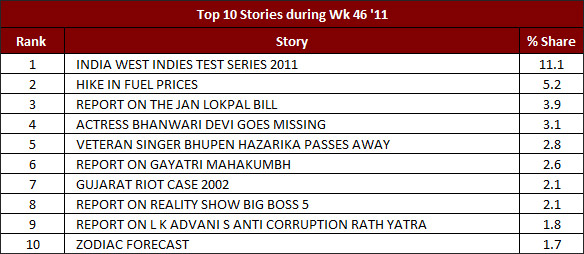
  • NCT Data Wk 46 ’11

    Source: News Content Track – A service of TAM Media Research Pvt. Ltd

    Channels: Aaj Tak, CNN IBN, Headlines Today, IBN 7, India TV, NDTV 24/7, NDTV India, Star News, Times Now, Zee News & News 24

    Period: Wk 46 – Nov 6 to Nov 12, 2011

    Note : Analysis is based on the telecast duration


    About TAM Media Research


    TAM is a joint venture between Nielsen Company & Kantar Media Research. Besides measuring TV Viewership, TAM also monitors Advertising Expenditure of Television, Print & Radio through its division AdEx India. Since 2004, it extended its presence in the PR Measurement & Analysis space for Corporate/Marketing Clients by setting up a separate division Eikona PR Measurement.


    In 2007, the joint venture introduced RAM (Radio Audio Measurement) service to track Radio Listenership for the Indian Radio Broadcast Industry. In year 2009, TAM launched a division, called TAM Sports that specializes in monitoring Sports Sponsorship ROI.


    TAM Media Research’s objective is to fuel media insights that will drive the growth of the Indian Media Industry.

  • JWT restructures to bring in 3 NCDs


    By Tuhina Anand & Shubhangi Mehta


    After roping in Bobby Pawar as its Chief Creative Officer and Managing Partner, JWT is now bringing in more changes in its team structure which Colvyn Harris its CEO dubs it as `transformational changes’.  It is learnt that JWT has brought in a three National Creative Director structure which includes Swati Bhattacharyya in Delhi, Tista Sen in Mumbai and Senthil Kumar down South. All three NCDs will have a team of ECDs under them and when Bobby Pawar joins which will probably be in March 2012 as the CCO , he will spearhead this structure.

    Ms Bhattacharya has been heading the GSK business at JWT while Ms Sen and Mr Kumar have been Executive Creative Directors at the agency.

    On the restructuring, Mr Harris said, “I cannot think of 3 more deserving and talented people who have imbibed the best of JWT values and who believe in the JWT Company. It has taken us some time to recognize that their current roles and responsibilities far exceed what national creative directors in other agencies are responsible for. Given the sheer scale of our operations, and our most admired line-up of India’s finest and the world’s most admired brands, it was imperative to recognize the creative leadership team with a designation based on their role.”

    “Given the exigencies of the market and the pressure which is being brought to bear on us to improve our creative work – especially from clients who are in the more competitive categories – we believe that the combined skills and talents of Swati,Tista and Senthil will be able to provide the best solutions for our clients, our brands, and our people, added Mr Harris.

    Talking to MxM India on the creative pillars that JWT is creating, Mr Harris said, “The roadmap that JWT has drawn of being a creative powerhouse and being creative led and creative driven organisation will be achieved by these changes. Bobby along with the team will help us in realizing this vision. In fact, people who are saying that the CCO position at JWT has been unstable should know that Adrian came as the Delhi office head so we didn’t really have anyone take the CCO position for long. Bobby’s position in that sense is of true CCO who will lead a team of around 300 creative people at JWT along with the newly restructured team.”

    It may be recalled that when Josy Paul had joined JWT as its NCD, Agnello Dias had also been promoted as NCD and the agency followed the dual NCD structure at the helm but no CCO. It was only later when Mr Paul quit that Mr Dias was made CCO, though he too quit soon after to start Taproot India.

    Mr Harris also said  that one should gear up to hear of some more announcements at JWT very soon. The agency has also recently roped in Max Hegerman as Senior VP and its Head to look after JWT’s Digital strategy.

    On his mandate at JWT, Mr Bobby Pawar said, “My job at JWT will be ensure we change our benchmarks and set new standards. Critical would be in setting a vision and then delivering on it. JWT will be the magnet for the best talent in the industry and offer the most creative solutions ever seen.”


    INTERVIEW

    Bobby Pawar, the guy who is taking over as Chief Creative Officer and Managing Partner of JWT, has been responsible for turning around the agencies which he has worked for. When he was at BBDO in Chicago he weaved his magic to make one of the hottest shop in the region. In India too, with Mudra as its Chief Creative Officer he has been instrumental in the agency winning awards and accolades on many international and desi platforms. The agency has done some high decibel advertising like the ones for Volkswagen launch in India and there after its variants that had caught eyes of many. With Mr Pawar’s next destination being JWT which has  seen causalities in quick succession including Bruce Matchett, Josy Paul, Agnello Dias and Adrian Miller. Looks like JWT is gearing up for combat and shut the wagging tongues of the industry. Here’s an interview with Bobby Pawar who sportingly answered our questions though he steered away from some specifics.


    Q: Omnicom as a parent, so many awards in the kitty all with your leadership… why then did someone like Bobby Pawar leave?

    I guess I am addicted to challenges and the task of polishing JWT’s creative luster and raising the game there was just too seductive to pass up.


    Q: What is the mandate at JWT, also we have seen the creative head at JWT being an unsteady wicket in last few years, should we expect a change now?

    Colvyn didn’t asked me to partner him on the mission of maintaining status quo. I would hardly be the right guy for that. Both of us want JWT to evolve, to build on the past, but look firmly at the future. The focus will be on the work and the people who do it. And that means the entire agency. We don’t just want a highly creative creative department, but a highly creative company. Everybody has a role to play in making sure the solutions we think up, sell, and execute are as great as the brands need them to be.


    Q: Was the Omnicom deal anything to do with your moving out?

    If anything the Omnicom deal almost kept me back. That is a great company and I have the highest regard for John Wren, Chuck Brymer, John Zeigler et all. They made me feel very welcome, but as they say a man’s got to do what a man’s got to do.


    Q: How would you sum up your stint at Mudra?

    I loved it. See, I’m not leaving because I am unhappy. When I started nobody gave us a chance. Four long and hard years later, our creative reputation is the opposite of what it was. We did pathbreaking work for Volkswagen, Big Cinemas (Silent National Anthem), 7-Up, Union bank Of India, Emirates, Philips, Economic Times, McDowell’s No. 1, etc. We were the winningest DDB agency at Cannes this year along with DDB Paris, 3rd in the agency of the year standings at Spikes and we had the most metals Abbys. Not too shabby, right?


    Q: What should we expect from Bobby Pawar in his JWT avatar?

    I believe that agencies don’t just need to create, they also need to invent. Why can’t we invent a whole new medium while we thinking of a campaign that runs on it? The future will be invented by those who ask the most interesting and unexpected questions.


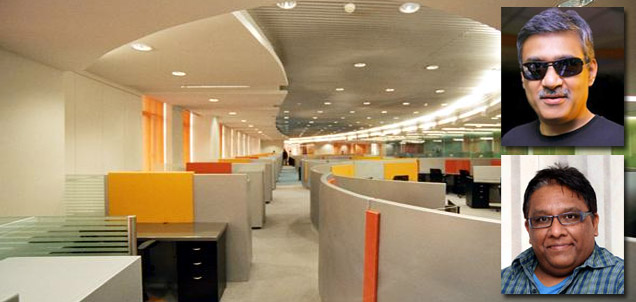
    Photograph of JWT Mumbai courtesy JWT website. Images of Messrs Harris and Pawar from the JWT and Mudra sites respectively

  • The New Big Boss of India’s Biggest Brand


    The search for Ratan Tata’s successor of chairman of the Rs 4.3 lakh crore Tata group has ended with the appointment of Mr Cyrus P Mistry as deputy chairman of Tata Sons. But who’s this 43-year-old Mystery Man?


    Read on for:


    > The Main story on announcement with Mr Ratan Tata’s statement

    > Statement of Mr Cyrus Mistry

    > Profile 1: Avid golfer & foodie, avoids cocktail circuit

    > What Titans Of India Inc Have To Say

    > Profile 2: A reticent man with strategic vision, humility

    > Profile 3: Official profile from the Tata corporate website


    The Main Story


    The mystery over who would succeed Mr Ratan Tata as chairman of the Tata Group ended yesterday as the board of directors of Tata Sons met to appoint Mr Cyrus P Mistry as Deputy Chairman. He will work with Mr Tata over the next year and take over from him when Mr Tata retires in December 2012. This is as per the unanimous recommendation of the selection committee.


    Endorsing the appointment, Mr Tata, Chairman of Tata Sons, said: “The appointment of Mr Cyrus P Mistry as Deputy Chairman of Tata Sons is a good and far-sighted choice.


    “He has been on the board of Tata Sons since August 2006 and I have been impressed with the quality and calibre of his participation, his astute observations and his humility. He is intelligent and qualified to take on the responsibility being offered and I will be committed to working with him over the next year to give him the exposure, the involvement and the operating experience to equip him to undertake the full responsibility of the group on my retirement.”


    Mr Mistry, currently managing director, Shapoorji Pallonji Group, has been a director of Tata Sons since August 2006. He is a graduate of civil engineering from Imperial College, London, and has a master of science in management from the London Business School.


    And this is what Mr Mistry said in his statement:


    “I feel deeply honoured by this appointment. I am aware that an enormous responsibility, with a great legacy, has been entrusted to me. I look forward to Mr Tata’s guidance in the year ahead in meeting the expectations of the group.


    “I take this responsibility very seriously and in keeping with the values and ethics of the Tata group I will undertake to legally disassociate myself from the management of my family businesses to avoid any issue of conflict of interest.”

    But who’s this mystery man?


    Read on:


    Profile 1:

    Avid golfer & foodie, avoids cocktail circuit


    By Reeba Zachariah & Namrata Singh


    The man who will head a group synonymous with Indian industry is an Irish national and shares his birth date (July 4) with the US Independence Day. But in many ways, he resembles the business giant he has been handpicked to succeed. Like Mr Ratan Tata, Mr Cyrus Pallonji Mistry, 43, is described by close friends as soft-spoken , candid and down to earth.


    Again like Mr Tata, Mr Mistry is said to love cars – especially SUVs – and steers clear of the cocktail party circuit. But unlike lifelong bachelor Tata, Mr Mistry is said to be a devoted family man. He is married to Rohiqa, daughter of renowned lawyer Iqbal Chagla, and the couple have two school-going sons. An avid golfer, mr Mistry is known to be a foodie and his favourite holiday destination is Europe. Besides Mumbai , he owns houses in London and Pune.


    According to a Tata group insider, “Mistry is one person who can laugh at himself.” His sense of humour should come in handy in facing the challenges that lie ahead. A person who has shown a preference for the shadows , he will now have to put up with the arclights for years, perhaps decades.


    Tellingly, his Wikipedia profile was created within minutes of the announcement that he had been effectively chosen chairman-in-waiting of Tata Sons. The youngest son of construction baron Mr Pallonji Shapoorji Mistry, Cyrus hails from one of the richest Indian families with a net worth of $7.6 billion. But he will disassociate himself from the family business to avoid conflict of interest.

    Voracious reader with eye for detail


    Mr Cyrus Mistry has been managing director of Shapoorji Pallonji & Company, which is part of the Rs 15,000-crore Shapoorji Pallonji Group (SP Group). An avid golfer and prolific reader, Mistry got the chance to join Tata Sons’ board a year after his father retired as director in 2005. The family is the single largest shareholder in Tata Sons with a stake of 18%. Mistry is also on the board of Tata Elxsi and holds non-executive positions on the boards of several other companies. He is a trustee of the Breach Candy Hospital Trust as well.


    Although he does not have experience in heading a Tata group company , Mr Mistry, a graduate in civil engineering from London’s Imperial College, has been actively involved in the family business. His expertise includes formation of business plans, risk evaluation, business investment strategy and property and infrastructure development.


    Mr Khurshed Daruvala, MD, Sterling & Wilson, in which the SP Group holds 56%, describes Mistry as a “ hands-on leader” who is strategy oriented. “ Ever since Mistry started working with this partnership firm in 2003, the turnover has jumped from Rs 50 crore to Rs 2,000 crore.”


    If this is exemplary, consider what Mistry accomplished after he took charge at loss-making Afcons Infrastructure. SP Group acquired a 53.96% shareholding in Afcons in 2000. In March 2011, Afcons earned a total income of Rs 2,893 crore with a compounded annual growth rate of 21% over the past five years.


    He joined the SP Group in 1991 as a director and became its MD in 1994 in charge of the construction business. His brother, Mr Shapoor Mistry, is actively involved in the real estate and textile business.


    Conservative in his approach, Mr Mistry is said to have an eye for detail. “Once he takes decisions, he sticks with them,” said an insider. He can safely expect to take many crucial decisions in the years to come.


    What Titans Of India Inc Have To Say


    It is a historic and great moment


    -Krishna Kumar, director, Tata Sons


    A young leader means long-term stability for the Tata group


    -A M Naik, CMD, L&T


    There is strong chemistry between Mistry and Ratan Tata. He is very thorough and has good financial insight


    -J J Irani, former director, Tata Sons


    Good sign to have a young chairman -Ajay Piramal, chairman, Piramal group Cyrus symbolizes continuity, yet change


    -Harsh Goenka, chairman, RPG


    He’s mature beyond his years


    -Zia Mody, senior partner, AZB Partners


    Source:The Economic Times

    Copyright © 2011, Bennett, Coleman & Co. Ltd. All Rights Reserved


    And here’s a little more…


    Profile 2:

    Cyrus Mistry:  Tata Sons’ deputy chairman a reticent man with strategic vision, humility


    When senior advocate Mr Iqbal Chagla met Mr Cyrus P Mistry for the first time, he felt there was something special about the man. “He struck me as a young man who will make it big one day,” says Mr Chagla.


    Mr Chagla had good reason to ponder over Mistry’s future prosperity – the younger son of construction tycoon Mr Pallonji Shapoorji Mistry was keen to marry his daughter Rohika.


    On Wednesday, Mr Chagla’s prediction for his son-in-law couldn’t have come true in grander style. In the early evening, Mr Ratan Tata sent out an email to the top five-six executives of all Tata Group companies, informing them that Mr Cyrus P Mistry would succeed him as chairman after December 2012. In his message, the 74-year-old chairman hoped the Tata brass would lend the same support to Mistry as it did to him.


    Not all may choose to do so, but Mr Ratan Tata for his part surely will. Top officials in the group who have worked closely with Mr Mistry say he gets along famously with the Tata Group chairman and is very similar to Tata in nature and attitude.


    Cyrus was Ratan Tata’s First Choice


    They add that Cyrus was the chairman’s first choice right from the time the hunt began for a successor. But Mr Tata was also keen to follow a systematic process of selection, involving shortlisting of candidates – both external and internal.


    So who exactly is Mr Cyrus Mistry, and what makes him the best man to head the sprawling Tata empire? He’s low-profile, reticent and conservative, qualities he has inherited from his father. After graduating in engineering from Imperial College London, Cyrus plunged into the family-owned construction business.


    His father gave him a clear mandate: grow the engineering, procurement and construction activities. Cyrus focused on the Middle East and grew the business in Oman and the region.


    Cyrus’ big break came when the group acquired construction company Afcons Infrastructure Ltd, which undertakes large infrastructure projects in India and abroad.


    The company was acquired at a time India was witnessing a construction boom. As chairman of Afcons, Cyrus oversaw many important projects. The company was involved in the construction of Delhi Metro, and Cyrus often flew to the capital to supervise the work.


    Those who have worked with him say Cyrus possesses a near-perfect blend of hands-on involvement and the ability to give long-term strategic direction. “He has excellent leadership qualities, can think on his feet and combines all this with humility,” says former Unilever honcho Mr Keki Dadiseth, who was at one time believed to be in the reckoning to succeed Mr Tata. Another executive who has worked closely with Cyrus says he has the ability to operate both “as a telescope and a microscope”.


    Among those backing Tata’s choice is Mr Darius Pandole, who remembers Cyrus since their days in the Cathedral & John Connon School in Mumbai. “Cyrus’ is an inspired choice; he will provide long-term stability to the group,” says Mr Pandole, a partner in New Silk Route, a private equity investor. Cyrus is just 43, and even if the retirement age of chairmen in future is brought down to 65, he will still have a good two decades at the helm.


    Yet, there are those who point out that Cyrus has succeeded Tata purely on the strength of his father’s 18.5% holding in Tata Sons, which makes the senior Mistry the single largest shareholder in the holding company of the Tata Group. Others feel Cyrus lacks global exposure and may not be able to tackle the complexities of a diverse business house like the Tatas. But Pandole retorts: “People raised eyebrows when Mr Ratan Tata succeeded JRD. Look at what he’s achieved.”


    Meantime, officials at some of the front line Tata companies are baffled by the sudden announcement. Most have little or no exposure to Cyrus. A senior official in the group said on the condition of anonymity that the Tata Group will now be known more as Shapoorji Pallonji Group. “The Mistrys are known more as sharpshooters, which is in sharp contrast to the Tatas’ trusted brand image,” adds another old hand at a Tata company.


    Source:The Economic Times

    Copyright © 2011, Bennett, Coleman & Co. Ltd. All Rights Reserved


    Profile 3:

    Profile of Mr Cyrus P Mistry from the Tata corporate site:


    “Mr Cyrus P Mistry, 43, joined the board of Shapoorji  Pallonji & Co. as director in 1991 and was appointed managing director of the Shapoorji Pallonji Group in 1994.  He is a graduate of civil engineering from the Imperial College, London (1990) and has an M.Sc. in management from the London Business School (1997).


    Under Mr Mistry’s guidance, Shapoorji Pallonji’s  construction business has grown from a turnover of $20 million  to approximately $1.5 billion. The group’s companies have evolved from pure construction to executing projects under design and build and EPC delivery methodologies, implementing complex projects in the marine, oil and gas, and rail sectors. Under Mr Mistry’s stewardship, the group has registered many firsts in India — construction of the tallest residential towers, the longest rail bridge, the largest dry dock and the largest affordable housing project.  The group’s international construction business now extends to over 10 countries.


    Mr Mistry is responsible for launching the infrastructure development vertical in the Shapoorji  Pallonji Group in 1995 with a 106 MW power project in Tamil Nadu, followed by the development of India’s largest biotech park near Hyderabad in partnership with the Andhra Pradesh government. The infrastructure vertical has also developed two large road projects totalling an investment of USD 550 million.


    The Shapoorji Pallonji Group’s recent foray into agriculture and biofuels, with the leasing of 50,000 hectares in Ethiopia, was also overseen by Mr Mistry.


    Mr Mistry joined the board of Tata Sons in 2006. He has been a director of Tata Power and Tata Elxsi in the past.


    He is also on the board of the Construction Federation of India, the Imperial College Advisory Board, the board of governors of the National Institute of Construction Management and Research (NICMAR), and is a fellow of the Institute of Civil Engineers. ”


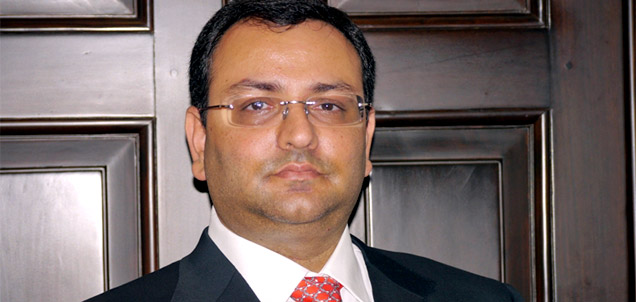
    Photograph: Tata.com

  • Flipkart, Myntra & desi e-tailers launch ad blitzkrieg to up buyer base

    By Samidha Sharma


    A fledgling Indian online retail industry has unleashed big buck mass media advertising in the past six months as they seek to build businesses with a broader urban consumer base in the country. Advertising from e-tailing portals surged 228% on television, 78% in print and 797% on radio compared to the same period last year, said data from TAM Media Research.


    Start-up firms such as Flipkart.com, myntra.com-flush with funds from private equity investors led the way in creating brand buzz going beyond the top metros, which some skeptics argued was reminiscent of the build-up to the dotcom bubble a decade ago. The growth numbers from TAM are based on ad volumes and not absolute spends.


    One industry source said the Bangalore-based online retailer Flipkart has marked Rs 100 crore as its advertising budget- significant for a four-year-old firm still soaking in losses. Flipkart, which sells books and electronics online, is labelled as the poster boy of Indian e-commerce and has invested heavily in building distribution and brand visibility across 50 cities.


    “E-commerce is at a very nascent stage but witnessing a lot of traction with urban audiences. Mass media advertising by e-commerce players will hasten this process and make more people shop online,” said Mr Ravi Vora, VP, marketing, Flipkart.com, backed by marquee investors such as Tiger Global and Accel Partners.


    Travel portals like makemytrip, yatra and cleartrip entered mass media advertising sometime back but the rush of brand-building activity from the e-tailing fraternity worries critics, who caution against the hype surrounding online retailing.


    “It is widely known that advertising does not build a strong online business. Successful online brands like Amazon, Facebook, Twitter and eBay almost never advertised. Great online brands are built through tremendous word of mouth. If you don’t organically have it, no amount of ad spend can get it for you,” said Mr Mahesh Murthy, founder, Pinstorm, and co-founder, Seedfund.


    Mr Rishi Khiani, CEO, Times Internet, which runs timesdeal.com and indiatimes.com, agreed, “The advertising push may drive initial traffic but post that the growth will depend on the word of mouth. Advertising does help in creating a differentiator but brands have to maintain their margins to run the business successfully,” he said.


    Flipkart and others have been able to shore up sales riding on the back of ongoing media spends. “We feel our campaign has been successful and we plan to continue with our marketing activities,” Flipkart’s Vora added. India’s consumer internet story has been one of the hottest themes for US investors, which was reflected when makemytrip listed on Nasdaq last year with $1 billion market cap.


    “The intersection between deepening internet penetration and rising disposable income in India is an exciting sweet spot,” said Mr Brewer S Stone, MD, Pacific Crest, a boutique investment bank involved with makemytrip’s US listing, in a recent interaction.


    But Murthy, an internet industry veteran, cautioned: “This happened the last time around when Rediff, Indya and HomeTrade spent loads of cash. It will happen this time around too-just let the dust settle down in a year’s time. We weren’t prepared for the last bubble.”


    The Indian e-commerce market is expected to cross Rs 46,000 crore in 2011 driven by the travel industry, with Indian Railways accounting for bulk of these transactions. The e-tailing industry is a distant second with 8% share, according to estimates from the Internet and Mobile Association of India.


    Source:The Economic Times

    Copyright © 2011, Bennett, Coleman & Co. Ltd. All Rights Reserved

  • The Anchor: Pops on why advertising is still sexy

    By KV Sridhar (Pops)

    #1 Richer life experience.

    If you are passionate about life and want to live life the fullest, this profession allows you to do that. (I am writing this sitting in a plane to Colombo for a working weekend.)


    #2 Get paid for doing what you like.

    If you are curious about life, mine some insights to tell some stories, you’ll get paid handsomely.


    #3 Want to be an expert in 100 categories?

    Advertising helps you to learn about 100 categories in 10 years, no marketing job can offer that.


    #4 Around the world in no time.

    South of France as a trainee boy? Sounds great? Get your jumbo passport and get on board.


    #5 Do nothing.

    If you are a dreamer or want to relive your memories every day? Just gaze out of your window and narrate few experiences (that’s work for you) and you’ll be the next guru.


    #6 Be a celebrity.

    Imagine, if marketing is the glamorous part of business than advertising is the glamorous part of marketing. Got the logic? You’ll be seen in the papers more than Ratan Tata.


    KV Sridhar (Pops) is the National Creative Director at Leo Burnett.

  • Debrief: Tata Tea: ROFL!

    By Anil Thakraney


    Remember that offensive cad in the Tata Tea ads, the one who’d smugly ask us to ‘Jaago Re’? Well, mercifully he’s been given a break in the new TVC created to celebrate 25 years of the brand. Now the message is ‘Soch Badlo’, and there’s a lady protagonist.


    But the anti-corruption tirade goes on. A cynical man cribs in his living room that corruption will never end in the nation, and that basically India is doomed (my thoughts exactly!). He then turns to his wife and demands a cup of tea. The missus uses the opportunity to teach him a lesson. And she delivers a long lecture about how preparing tea is like changing the state of the nation. A convoluted metaphor about boiling water being the raging nation or some such gibberish.


    I don’t know whether the makers of the ad intended this as a desired response, but I was left laughing out loud. Because the whole anti-corruption crusade of Tata Tea is getting cornier by the ad. And the juxtaposition of tea-making with nation-building is completely hilarious. Plus, in all this pagalpanti, the tea story gets buried somewhere.


    Yes, some soch needs to badlo out here. On the part of Tata Tea managers and their ad agency. They should leave the anti-corruption drive to Anna saheb. And stick to selling us chai.


    Rating: (On a scale of 1 to 5): 2. The marks are only for some good laughs!   

  • Ketchum Sampark goes Digital

    By A Correspondent


    Ketchum Sampark, the Indian Affiliate of global communications network Ketchum Inc, has announced the launch of its digital media business Ketchum Sampark Digital. Aimed at garnering substantial market share in the emerging digital media business, Ketchum Sampark Digital will offer full-service interactive strategy, web design, video production and multimedia development to help companies tell their stories and build engagement with their audiences on digital media (internet and mobile).


    Commenting on the launch of Ketchum Sampark Digital, N S Rajan, Managing Director, Ketchum Sampark said, “The launch of Ketchum Sampark Digital reflects the emerging significance of engaging with consumers through prolific use of digital domains. There has been a distinct shift in usage patterns wherein consumers look beyond email and casual surfing to complete engagement and internet as the media of choice for information. We are initially launching our Digital business with a team of young social media experts and progressively build a bandwidth of skills and digital capabilities including a team of interactive strategists, digital designers and producers.”


    According to Jonathan Kopp, Partner & Global Director, Ketchum Digital, “Globally, Ketchum Digital has created innovative digital media solutions for clients including FedEx, Kodak, ConAgra, Absolut amongst many other industry-leading companies. With the launch of Ketchum Sampark Digital India joins other Ketchum Offices and digital experts around the globe in the Ketchum Global Digital Network bringing digital social media solutions from around the world for our clients everywhere.”


    As part of its foray into the digital media business, Ketchum Sampark is concluding a detailed study of 200 Indian corporates and nearly 150 brands in the Indian marketplace to track their digital footprint as well as user engagements. The study covers Corporates from across 20 different industries including Aviation, BFSI, Consulting, Diversified Large Indian Corporates, Healthcare & Pharmaceutical, Oil & energy, Software Services and FMCG. The Brands covered in the survey are from across 14 categories including Apparel, Automobile, Media & Entertainment, Personal Care and Retail.


    “Our study has tracked engagement of these corporations & brands with their target audiences using social media channels like Facebook, YouTube, Twitter and LinkedIn,” said Ajay Sharma, Managing Partner, Ketchum Sampark.


    Key Findings of Ketchum Sampark Digital’s Indian Social Media Engagement Study 2011


    > Initial findings indicate that while most Indian companies (82 %) have registered a presence on at least one of the four social media channels that were surveyed, the activity is largely focused around consumer communication for their products and services.

    > LinkedIn seems to be the most preferred channel on social media with 72 % of the companies surveyed having a dedicated page on LinkedIn.
    Though Facebook is the largest social media platform in India with over 38 million followers, it lags behind LinkedIn with only 55% of Indian corporates registering a presence on it.

    > Using video and multimedia to create engagement with consumers, investors, potential employees and other audiences is still not an avenue explored by Indian corporates with barely 6% being Very Active on YouTube.

    > More than 50% of corporates despite opening up a channel or registering a page on social media are Inactive. Some Inactive corporates also tend to use the presence on a channel opportunistically during launches and other significant company initiatives.

    > We feel that with the explosion in social media users this will change in 2012.

    > Out of the 150 brands surveyed, 23% did not have any presence on social media platforms while 30% had a presence on only one channel. Only 22% of brands were present on all three social media platforms.

    > Unlike corporates, Facebook is the clear favourite for brands with 75% of these brands registering a presence on it. YouTube and Twitter followed with 42% and 28% respectively.


    79% of brands with a presence on Twitter were Very Active / Active on the platform as compared to 69% on YouTube and 63% on Facebook.