Author: mxm_india

  • The Anchor: 5 changes the publication industry is seeing

    By Adarsh Mishra


    #1 Nowadays circulation operates on an FMCG model. As most of the companies are subscription driven, they are able to track readers and their profiles. The conventional method of circulation has undergone revolutionary changes due to subscription module and publication aspirations to achieve higher numbers in terms of ABC and IRS.


    #2 Circulation, which is considered a cost centre in every organization, is playing a very important role in the present media scenario as media planners are giving more importance to numbers in comparison with class.


    #3 In the present scenario most publications are resorting to invitation pricing which helps them to get a larger base in a shorter time. The classic example can be Delhi where publications slashed their prices in order to get higher numbers.


    #4 In coming days it will be vernacular publications which make more money as against English publications. The reason being people’s inclination towards their own languages and lower operating costs.


    #5 The government should increase the scope of FDI as it will help the publication  industry in India to grow at a faster rate and also it will help small or regional players to compete in the national arena.


    Adarsh Mishra is Vice President, DNA.

  • Google’s India Head Rajan Anandan on ASCI Board

    The Advertising Standards Council of India has appointed Mr Rajan Anandan, Managing Director & India’s Country head of Google as a member of its Board of Directors. Mr Anandan’s induction immediately follows the appointment of ASCI’s new Chairman I Venkat during the last AGM.


    Mr Anandan’s appointment on the Board is strategic to ASCI’s plans to step up its efforts to promote fair advertising practises in the online domain.  With a large percentage of India’s population being very young, digital adoption is expected to increase going forward as more of the population comes of age and there will be a proportionate increase in online revenue spends. Thus, it becomes imperative for ASCI to ensure that advertising on the internet conforms to the current code of conduct.


    Commenting on Mr Rajan Anadan’s induction on ASCI’s Board, Mr I Venkat, Chairman, ASCI said: “The internet is increasingly becoming a significant touch-point for brands to connect with consumers. Thus, it becomes essential that online advertising is aligned to the primary objects of ASCI. Rajan’s appointment on ASCI’s Board will help ASCI generate the necessary consciousness towards fair advertising practises in the Online domain.”


    Mr Anandan said, “The Internet in India has over 100 million users is quickly becoming a scale advertising medium for companies in many industries.  Being on the Board will quintessentially help ASCI and Google to jointly create awareness about fair advertising practises across a large bandwidth of consumer touch-points on the internet.”


    It is estimated that the Indian online advertising revenue will touch Rs 1,500 crore by the end of 2011. With the kind of growths seen in this space, online advertising would possibly be worth around one billion dollars by the end of 2014. Thus, bringing an increasing consciousness on the way brand advertising is done in the online space is critical for ASCI.

  • Bobby Pawar quits Mudra to join JWT as Chief Creative Officer & Managing Partner

    By A Correspondent

    It’s official. Mudra’s chief creative officer has moved. To JWT as chief creative officer and managing partner. Pawar has confirmed the development to MxMIndia.

    Pawar has been the creative force behind the agency’s several wins on the awards circuit over the last two years.

    Information on Bobby Pawar courtesy Mudra.com

    Bobby oversees the Mudra Groups creative product across all the four Agencies. Prior to taking over Mudra’s national creative responsibilities, Bobby had spent 7 years in the US market with BBDO Chicago and O&M New York.

    Bobby cut his teeth at Ogilvy and Mather India. He rose quickly from Senior Copywriter to Creative Director and worked on award winning campaigns for Tata Safari, Tata Sierra, Kelvinator, British Airways, etc.

    He is a two time copywriter of the year (Ad Club of Bombay – 1998, 2000). In 2000, he joined Ogilvy & Mather, New York as a Creative Director. There he worked on brands like Jaguar, American Express and Kodak. He helped pitch for AT&T Wireless and was asked to run the $600 million account when the agency won it.

    He re-launched AT&T Wireless with the much talked about mlife campaign. The launch spot ran on the 2002 Superbowl and ranked in the top three in the USA Today poll. Additionally, it was picked to be in the Museum of Modern Art. Moreover, one of the follow-up spots was spoofed by Jay Leno on his show.

    Bobby moved to BBDO, Chicago in 2004 as Group Creative Director. He worked with Marty Orzio, the CCO, to turn around an agency that wasn’t known for great work. He helped change the culture and the product. Now the shop is considered one of the hottest in the region.

    A stand up comedy buff, Bobby also loves photography and travelling.

  • The Anchor: 5 reasons why broadband internet will grow in India

    1. Better devices
    2. Ease of use
    3. Better connectivity
    4. The pricing at which the broadband in now available – the government of India, BSNL has been doing a lot to get pricing and affordability in play.
    5. People coming onto the web is the effective reason. The fact that more and more services are available on broadband will also result in better broadband services.


    The broadband penetration is bound to grow, there is no two ways about it. Take for instance China, five years back China was around 100 million internet users, four years down, now it is at 450 million internet users. It has an extremely high penetration of mobility but its broadband continued to grow because infrastructure rollout has happened, ease of use is there from a connectivity perspective. Therefore I am opportunistic about the fact that broadband will continue to grow in India.


    Siddhartha Roy is the COO, Consumer Business & Allied Services, Hungama Digital Media Entertainment.

  • Movies Now: Riding high on popular titles

    By Tuhina Anand


    It’s going to be a year since Movies Now from the stable of Times Television Network launched in December last year. Ever since its launch, the channel has managed to upstage its competition, some of which have been in the business for much more than a decade like Star Movies and HBO and the newer players including PIX. What has worked in favour of the channel is its promise of an enhanced viewing experience because of being available on the High Definition (HD) platform, relying on popular titles, getting its distribution correct besides the backing of the Times conglomerate that definitely has helped in marketing the channel.


    Amongst the English channel category, it is the English movie channels that comprise 30 percent of the market share. This is the highest reach in this category.  The English Movie category also has a reach of around 29 percent of the total television viewers. These numbers definitely moves the genre which was earlier seen as niche to be highly influential hence even catching advertisers eye especially those marketing premium products because this is the category where the potential customers are on.


    With launch of Movies Now last year the category underwent a change especially because of the performance of the channel thus putting competition on their toes. The launch of the channel had catapulted the growth of the category from 50 GRPs to 72 GRPs and witnessed growth of 43 per cent. The category reach increased by 20 percent and now reaches out to 5.5mn individuals every week. Besides, Movies Now enjoys the highest viewer time-spent in the category, which is nearly double of other English Movie Channels.


    Talking about the success, Ajay Trigunayat, Channel Head, Movies Now, under whose  leadership, the channel has been charting success shares that his firm directive towards the channel’s Audience Management Plan included Content, Brand & Marketing and that has helped Movies Now break-through the clutter and carve a distinct identity in the mind of its consumers and a firm place in their daily lives, culture and ethos.


    He said, “Movies Now India is witnessing an ever increasing English speaking audience. Also, the target audience is no longer residing only in the metros and is now moving into the Tier 2 and Tier 3 cities. Thereby, we have a category which growing rapidly and demanding far more English content paving way for the new players in the market.”


    The talking point of channels success has been its limited but popular library. Kunal Jamuar, Head of West India and Executive Director, Mumbai at MPG India explains how he sees the channels growth. He said, “It has a limited library but good titles that has ensured first appointment viewing and later stickiness. I think they have consciously kept a limited library thus giving viewers the much more opportunity for stickiness so in that sense they have changed the paradigm for English movies category.”


    “However, I think going ahead they need to address larger demographics which I think is getting ignored like paying attention to various time bands and playing movies accordingly.”


    Rajneesh Chaturvedi of MEC Global, said, “Movies channel is primarily driven by its title where Movies Now has scored well. They have managed their distribution well so in a year’s time they have done well for themselves and the category. Going ahead, they have to keep on adding popular titles which they have been doing currently to get viewers to stick to the channel.”


    INTERVIEW


    ‘Providing the best to the viewer’: Ajay Trigunayat, Channel Head, Movies Now

    Ajay Trigunayat has been instrumental in conceiving & nurturing the launch of Movies Now – Hollywood in HD, the English Movie Channel from the Times Television Network. Prior to Movies Now, he has worked with Media Agency Middle East, Dubai as CEO (2006-07) handling Sales, Event Management & Broadcast, Brand & Marketing for the Arab Youth Football Championship. He has spent 4 years at Zee Telefilms Ltd. and was the driving force behind the re-branding of Zee English, Zee MGM to Zee Café and Zee Studio in 2004 – at the same time re-vamping the content through key strategic partnerships with Disney, Warner, Sony, Fox and Universal.

    Mr Trigunayat has spent a decade in Advertising agencies honing his Brand and marketing skills across Rediffusion Y&R , Lintas and Contract. Here, Mr Trigunayat in conversation with MxM India offers a peek into the working and success of Movies Now.


    Q: How do you see Movies Now poised amongst competition in this category?

    Movies Now has achieved category leadership from the very launch day itself; and is the leader across all channels, across weekdays, across weekends, across day parts and despite 2 key cricket events (World Cup and IPL) the category viewership has grown by a whopping 80%. Our reach has nearly doubled for the category from 36 mn viewers per week to 60 mn + viewers today and Time Spent per viewer has grown from 35 minutes per week to 55 minutes per week!

    We have excellent feedback from our viewers on the our HD picture quality, 5.1 surround sound, selection of titles and our overall look and feel.


    Q: What is the advantage that Movies Now has as compared to the other players in this category?

    Better Movies, Better Picture, Better Sound! Movies Now – Hollywood in HD is a

    complete sensorial treat. It is an exponentially better English Movie watching experience

    in India.


    Q: In terms of future growth for the channel, where do you see it coming from?

    Growth will come due to significantly better viewing pleasure, furnished through significantly better digital distribution; with government mandating CAS across all metros.


    Q: What has been the biggest challenge for the channel since its launch?

    Keeping up the good work and increasing the gap with competition!


    Q: How do you view the current trend of subtitling. Does it help in garnering greater viewership?

    No. Sub-titling does not lead to increase in viewership; but it does provide better comprehension to a large section of viewers who are not familiar with foreign accents.


    Q: In terms of acquiring new titles, what have been your top two priorities?

    Only one priority: provide the best to the viewer!


    Q: There are lot of repeats of a movie, what policy does Movies Now follow on this?

    We let the repeat pattern be decided by the viewer. Thus some movies have few repeats and some movies have many repeats.


    Q: To go beyond metros, what are the few pointers that the channel is following?

    Currently the significant chunk of viewership is delivered from Metros even though we are present across the 1 mn+ universe. We will extend distribution as the viewers across the country take preference to our category


    Q: What should we expect from the channel in times to come?

    Loaded Viewer Engagement with Hollywood in HD.
  • Debrief: Zzzzrfan Khan

    By Anil Thakraney


    Vodafone has decided that people with, let’s just say ‘limited means’, but with a mobile phone in hand must do more on their phones than just talk.


    This makes sense. A whole lot of Indians at the bottom of the telephony pyramid use basic handsets and are averse to experimenting with features. They are happy to use it purely as a speech device. If some of them convert and do more voice-based things, it expands the market. So no issues with the strategy.


    In order to communicate this to the lower end of the consumer spectrum, Vodafone has gone back to the ‘aam aadmi’ actor: Irrfan Khan. A series of TV commercials have been unleashed. I watched two. In one, the actor cribs that people invite him to parties just to get an update on the latest Bollywood gossip. And he says they should use their Vodafone connection for their gossip needs. In the other one he complains that his missus cooks cauliflower all the time. When all she has to do is use Vodafone to learn new recipes.


    Now while I understand that the intent is to keep the communication simple given the target audience, that does not mean the ads have to be dull and witless. The problem is the scripts aren’t funny, and the continuous stand up drone of Khan can get really irritating after a point. And even if you are the sort who smiles at such stuff, you will not do so on the second exposure. Also, for some strange reason, Irrfanji mumbles his way through the ads, as if they woke him from deep slumber. I had to watch the ads many times to even comprehend what the man is saying.

    Bring the Zoozoos back, I say!


    Rating: (On a scale of 1 to 5): 1. Only good for putting you to sleep.   

  • INMA conference starts, packed house!


    By Akash Raha


    The International Newsmedia Marketing Association, better known as INMA,  kicked off its annual South Asia conference in Bengaluru today to a full house. The two-day event is taking place at ITC Gardenia under the theme ‘Roots and Wings: Strengthening Our Core Business and Exploring New Opportunities.’ MxM India spoke to Earl J Wilkinson, Executive Director and CEO, INMA to know about his expectations from the conference. Around 220 delegates from India, Pakistan, Bangladesh and Uganda amongst others are in attendance.


    Mr Wilkinson said, “What I’m looking for from the Bengaluru INMA South Asia Conference is, where are the new pockets of growth in the region? Have newspapers hit a peak with readership? What are the value drivers in advertising for newspapers as competition intensifies? Where does the creativity reside among South Asian newspapers? To what degree are global trends in digital media being adopted by South Asian newspapers? Where does the Indian newspaper story fit in the broader global context of transformation and culture change?”


    This INMA conference will also focus on the unique opportunities ahead for South Asian newspapers in which they seek profitability and would also like to adapt and create more revenue streams in the digital domain. The INMA conference will host top newspapers publishers and marketers in India, Pakistan, Bangladesh and Sri Lanka, and give them the opportunity to share learnings with each other. The sessions are expected to take delegates through a world of ideas and innovations which will give them insights into ways to grow newspaper advertising, circulation and brand across titles and across consumer platforms.


    Mr Wilkinson further added “It’s a very high-level, relevant programme for South Asian newspaper executives. I don’t just want to hear from the speakers. I want to hear from the delegates. Are they curious and pushing for answers and ideas?”


    Mr Tariq Ansari, INMA South Asia president and Managing Director, Mid-Day Multimedia welcomed the delegates and Mr I Venkat, Director, Eenadu, who is also the conference moderator, gave his opening remarks, charting the changes that have been seen in the newspaper publishing scene.


    Image courtesy INMA.org

  • Viacom18 leads in accolades at PromaxBDA Asia

    It was the Big, Big Night for the folks into on-air promotion, branding and advertising for the promo-wallahs (and of course many others). Vying for the much-sought-after Promax Muse and BDA Isis were satellite, cable, broadcast television, radio station and associated new media, their agencies and production houses. The holder of the awards are instantly recongised as the best in Asia.


    Indian companies generally fare well at Promax. And at the 2011 awards held on Tuesday (Nov 22) in Singapore, they dominated. Nearly half the honours in the 48 categories went to Indian entries.


    Viacom18 companies led the tally followed by (in no specific order): Star, MSM, Zee, UTV, Turner, MCCS and the BBC.


    Here’s the tally, sorted by company name.


  • Hard Knocks: Heavy price for a goof-up

    By Anil Thakraney


    In a nation that boasts of hundreds of news channels (with more dying to get into the fray), speed of content is crucial. It’s a cut throat situation out there, and there is tremendous pressure in the news rooms to be first with the story. In this high tension scenario, mistakes can and do happen. And even if heads of news channels build in fool-proof checks and balances in the process, one can never totally eliminate the chance of a slip up.


    Because making mistakes is human, we have all been guilty of it at some point or another. That’s why the defamation suit of Rs 100 crores slapped against Times Now by an aggrieved judge is not just a bit excessive, it’s rather frightening for all of us in the media. The case pertains to the channel erroneously carrying a picture of the judge while reporting on a scam story.


    Now, I have no doubt at all that the judge in question has every reason to be upset. We would all be in similar circumstances, when someone wrongly tarnishes our integrity. But with due respect to the esteemed judge, if the channel has publicly apologised, that should be the end of the matter.


    While the good thing that could come out of this incident is that the media will hopefully be more careful in the future, there is no denying that the rather harsh punitive action against Times Now has alarmed all of us in the media. Many of us would now think a hundred times before running edgy stories, even after filtering them through a battery of lawyers. Who wants to carry the burden of such a stringent defamation action? And when, after having said sorry, the case goes on.


    On my own part, I have reached a state where I am seriously contemplating seeking a PR job. Forget imagining what an amount of Rs 100 crore looks like, the very mention of the figure gives me nightmares.

    Meri to phat gayee, yaar!


    ***


    PS: So, the Bigg Boss cuckoo house has a new inmate, a porn star. Makes no sense to me. The only great thing a porn star can do is to expose, that’s her ticket to fame. And when she can’t be allowed to expose on a family channel, what’s the point in spending so much money on her? They should invite me into the house, and I am available for a fraction of her fee. I shall create trouble in seconds, that’s my ticket to fame! 🙂

  • Subhash Chandra gets Emmy Directorate Award

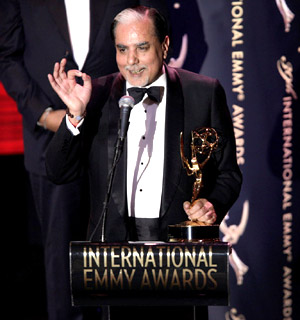
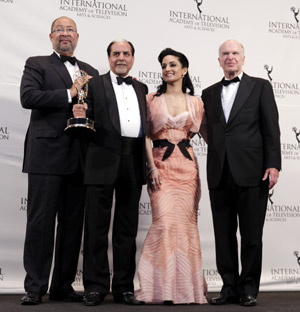
    Zee Group Chairman Subhash Chandra giving his acceptance speech at 39th International Emmy® Awards, held at the New York Hilton in New York City (CREDIT: Chip East / PSG)

    By A Correspondent


    Subhash Chandra, founder of Zee Group, has received the 2011 International Emmy Directorate Award. Mr Chandra made history by becoming the first ever Directorate Award recipient from India. The award was presented at the 39th International Emmy Awards, which took place on Monday, November 21 at the Hilton New York in New York City.


    “Subhash Chandra is a one of a kind visionary – a self-made entrepreneur who made his mark on the Indian television industry by launching the first privately-owned channel in India,” said Bruce Paisner, President & CEO of The International Academy of Television Arts & Sciences. “We happy to present him with our 2011 International Emmy Directorate Award as Zee Entertainment Enterprises prepares to celebrate its 20th anniversary, in 2012.”


    Remarked Mr Chandra, “India is the cynosure of the world today and it’s a great privilege to be the first Indian recipient of this award. It really means a lot to me, Zee Group and the Indian media and entertainment Industry.” He added, “While there have been many representations from India in the areas of technology and retail, this puts India’s media industry on the map and raises the profile of India with regards to its media and content.”


    Zee Group Chairman Subhash Chandra with Richard Parsons, Citigroup chairman and former chairman and CEO of Time Warner (far left), and Emmy Award-winning actress Archie Panjabi (The Good Wife), who both presented him with the 2011 International Emmy® Directorate Award, as well as Bruce Paisner, President & CEO of The International Academy of Television Arts & Sciences (far right) at the 39thInternational Emmy® Awards, held at the New York Hilton in New York City. Marks the first time in history that an Indian received this honor. (CREDIT: Allison Joyce / PSG)

    Richard Parsons, Citigroup chairman and former chairman and CEO of Time Warner, along with Emmy Award-winning actress Archie Panjabi (CBS Network’s critically acclaimed hit drama “The Good Wife”) presented the International Emmy Directorate Award to Mr Chandra during The International Emmy Awards Gala.


    The 39th International Emmy Awards were hosted by Jason Priestley, who was joined on stage by a cast of international celebrity presenters. Actor, director and producer, Mr Priestley was hosting for the second consecutive year. He was joined on stage by a starry cast of presenters including Brazilian actor Vladimir Brichta, Jeff Hephner (Starz’ Boss), Edward Herrmann (Gilmore Girls), Rick Hoffmann (USA Network’s Suits); John Larroquette, Danny Pino (NBC’s Law & Order: Special Victims Unit), Ally Sheedy, Blanca Soto (Univision’s Eva Luna and El Talismán), Jessica Szohr (Gossip Girl); Wendy Williams (host of syndicated talk show The Wendy Williams Show) and Goku and Luffy (characters from Toei Animation’s animated hit Dragon Ball Z and One Piece).


    The International Emmy Awards recognize excellence in television programming produced outside the United States. The awards gala is attended by 1,000 international entertainment decision-makers every year. For a list of nominees, visit http://iemmys.tv/news_item.aspx?id=136.

  • Sabeer ‘Hotmail’ Bhatia’s launches JaxtrSMS. Offers free SMS, NEware

    By A Correspondent

    The man who gave users a free medium to download and access e-mail may soon be causing another such explosion, albeit in the world of mobile phones. Hotmail’s original founder Sabeer Bhatia and Yogesh Patel have announced the launch of JaxtrSMS, a cross-platform, open texting application that would enable users to send SMS to anyone in the world for free.

    What is unique about this new venture is that a mobile user can send a text SMS to any mobile phone in the world without requiring the receiver to have the JaxtrSMS application installed on her phone. This open facet of JaxtrSMS distinguishes it from other free mobile messaging applications where messages can only be sent within a closed network to people who also have the same app installed. JaxtrSMS retains the number of the user and no new number is required while signing up for the JaxtrSMS service.

    Unveiling details at an event in Mumbai, Sabeer Bhatia, CEO & Co-Founder, Jaxtr Inc. and Co-Founder of Hotmail, said, “15 years ago, we gave you Hotmail.com, the world’s first webmail service that freed up e-mail from the confines of the desktop and aided the creation of a global communications network which was completely open and free for users. Today, we present JaxtrSMS which does to SMS what Hotmail did for e-mail. Now, mobile users can leverage our free and open application to send messages to their contacts anywhere across the world without having to pay anything. The fact that our application has been downloaded by users across 197 countries in just a few weeks since our soft launch amply reflects our belief that JaxtrSMS will prove to immensely useful to mobile users across the world.”

    JaxtrSMS can be easily downloaded from www.jaxtrsms.com or from the app store on the handset for free and is compatible with all mobile operating systems including the iPhone, Blackberry, Android and J2ME.

  • HT’s series on medical malpractices

    By Ranjona Banerji


    I have to congratulate the Mumbai edition of the Hindustan Times for its hard-hitting series on medical malpractices – particularly the way doctors take patients for a ride by prescribing any number of fake tests. Almost everyone I know has been a victim of this scam at some time or another and it is shocking the way it has proliferated. Well done to HT – we have so many stories telling us about some celebrity doctor importing some ground-breaking medical practice at some exorbitant price or about the dismal state of government hospitals. Both aspects are undoubtedly true. But it’s also necessary to highlight the problems within the medical community which in keeping with the zeitgeist appears to be greed!


    I must admit to not being a fan of the Mumbai edition of Hindustan Times – being better than what DNA has become is hardly something to be proud of. On a normal day, The Times of India just whitewashes the competition with its total city coverage. But targeting issues which affect citizen and packaging them well is a time-tested and intelligent way of increasing reader interest and HT has done it well here.

    **


    It is quite amusing to compare last night’s television to this morning’s newspapers. So while some channels decided to focus on the Special Investigation Team’s submission that the Ishrat Jahan encounter case was actually murder, others were taken by the BJP’s plan to boycott Union home minister P Chidambaram in the Parliamentary session. Mayawati’s quickfire session to chop Uttar Pradesh into four also got airtime as did Pakistan’s problems with what has been dubbed ‘memogate’.


    The Times of India used the rupee’s downslide compared to the dollar as its lead tying into general economic woes, with Ishrat Jahan as second lead. Hindustan Times did a DNA and gave us everything – Mayawati as lead, then Ishrat, then NDA and Chidambaram with the rupee as a single col. The Indian Express has Anna Hazare and his wax likeness as a lead pic, with Ishrat Jahan as the lead, Mayawati second and the NDA boycott as third.


    The Telegraph, Calcutta, stuck to a local story as lead, went with Pakistan and memo-gate as second lead and Ishrat Jahan as third.

    So what then is “news”. The general news-entertainment channels would usually leave the rupee to the business channels so that could not be “news”. Besides it is almost impossible to have a sensational TV debate on the subject. Ishrat Jahan and Mayawati obviously deserved top billing. Pakistan’s memogate is one more in a list of problems to for most newspapers it was international page news. But Pakistan makes for TV drama, so it makes it there.

    The NDA boycott possibly got stuck in the news spin cycle because the bigger story will be about Parliament was disrupted, not the announcement of the disruption plan.


    **


    Having forced myself to watch NDTV, I was lucky to get a bit of a laugh when during Nidhi Razdan’s evening show, she played a clip of Srinivasan Jain’s interview with Anna Hazare. As is his wont, Hazare held forth on his normal procedure of flogging those who drink alcohol after being warned off three times and then taken to a temple the fourth time (I am guessing there are no Muslims, Christians, Buddhists, Jews, Sikhs and Parsis and anyone else I’ve missed out on in Ralegan Siddhi). Jain, rather than question Hazare on this frankly outrageous practice, proceeded to repeat and expand on it, presumably for us who didn’t understand Hazare the first time around. Razdan was rightly outraged, but her guests – Manish Tiwari, Nirmala Seetharaman, Jyotirmay Sharma and Shoma Chowdhury were even appropriately very amused and could barely hold back their laughter at Hazare’s absurdity.

    **


    By the day, did anyone read Shoma Chowdhury’s defence of all the allegations made against Tehelka? Too much explaining never works in journalism. Brazen defiance works better.  Therefore, a tedious read.

    eom