Author: mxm_india

  • Amitabh Bachchan and the circus and the King of Bad Times!

    By Ranjona Banerji


    What seems to be the imminent collapse of Kingfisher is now looking to dominate the news. Newspapers are full of it – and not just on the business pages – and one can expect TV to follow soon. Ironically there was Vijay Mallya celebrating the “success” of India’s entry into Formula 1 just a few weeks ago; now he is described as “cash strapped”.

    On top of that, we have Air India employees claiming they have not been paid for months, which means that the glory story of Indian’s aviation industry may be heading for some dark days ahead and should also move out of business pages and papers into the mainstream.

    It would be fitting if our umpteen business channels would get their heads out of the stock market and examine a collapse like Kingfisher’s. We spend so much time congratulating ourselves for every teeny achievement by any random Indian anywhere. Surely we can expend a little effort to explain to readers and viewers why things have gone wrong?


    **


    Given the amount of excitement the collapse of the News of the World generated earlier this year, the second questioning of James Murdoch by a group of British MPs should have got some more airtime, surely, from international channels. Especially since firebrand MP Tom Watson likened the young Murdoch to a mafia chief. Indian TV and newspapers both covered the questioning but the BBC remained obsessed with the Eurozone crisis and so on.

    Interestingly it also took a long time for the BBC to acknowledge the riots which broke across the UK this summer. Is there some decision to keep home news quiet and just show prime minister David Cameron making a speech every now and then? Like Doordarshan of the old days?

    **


    Edits in most newspapers focused on the first convictions in the Gujarat riot cases of 2002, pointing out that while this was a rare occurrence which must therefore be lauded, there was a lot to do before peace and harmony could be established in Gujarat. TV channels need to get their heads around some basics of journalism: first report the facts and then get obsessed with reactions. For almost 30 minutes the other day the ticker on Times Now told us that Zakia Jafrey was happy with the verdict without telling us what the verdict was. Jafrey’s response is not the primary news. Time to go back to school? Oh, sorry, I forgot, most young journalists today have come out of some journalism school or the other.

    **


    Am curious to know whether anyone is going to tell us anything about the impending birth of the child of Aishwariya and Abhishek Bachchan. The fight between Amitabh Bachchan and the media is not new – it existed for most of his illustrious career and seemingly made no difference either to his fortunes or indeed to the film media’s. But to have a code of conduct over a celebrity event is surely too precious. Celebrities would not exist if it wasn’t for cooperation with the media. I guess Bachchan senior will send out tweet at the relevant moment and the whole world will know. The circus acts can follow later.

  • The Anchor: 7 points to learn from being in business

    By Chhaya Balachandran Aiyer


    #1 That you are on your own; and you get your pay package based on how well not only you but your entire team works.

    #2 That how much you earn is dependent not only on how hard and how well you work but can fluctuate drastically with how the market, the competition and the client operate. You have no one to complain to, or another job to switch to.

    #3 That while it is not as easy or as fun as ‘being the boss’ appeared  when I was an employee, it has an unbeatable thrill, the sort you  get when you are playing a game and want to achieve higher scores.

    #4 That the challenges are only more exciting and tougher as you move ahead because the goal post just keeps moving forward.

    #5 That the success of any business is completely dependent on the business owner’s vision, drive and focus and this then helps to drive the quality of team members they can retain and attract, and the level of ownership that team members have towards their jobs.

    #6 That every department is critical for the success of an organization, be it admin, HR, production, strategy, etc… every link is critical.

    #7 Nothing can change the fortunes of a company than the ultimate truth   for any business, the acid test, which is customer experience through the product and service it offers. This means know the customer, know the market, continuously improve your offering, delivery and service.

    You simply have to be the best, the most preferred.


    Chhaya Balachandran Aiyer is the Founder-MD of BC Web Wise.

  • The Anchor: 7 reasons to never ignore research analytics. Ever

    By V Balasubramanium


    The word “dynamism” has left a strong impression in the mind as we, like other consumers, have also embraced “dynamism”.  We experience the pace of this accelerating dynamism on a continuous basis. Dynamism in consumer behaviour as a result of a plethora of factors leads to the dynamism in the market. Given this increased pace, any brand – whether small or big, weak or healthy – needs to monitor its performance not only on a day-to-day basis but practically minute by minute. This monitoring and thus implementing quick course correction as required by changing consumer tastes is the biggest catalyst for any brand’s sustenance and growth. Research analytics come into play at this juncture. Without a proper and systematic research analytics strategy, brands, irrespective of size, will find the going tough. Thus the reasons for not ignoring research analytics are mainly connected with the word “dynamism”.

    #1 Consumer needs are evolving. Thanks to the increased exposure of the consumer to the globe through media, or through increased affluence, the attitudinal shift is the main driver to this ever-changing need. The resultant effect is tuning the mind for more brand messages, increased trial, and reduced loyalty.

    #2 The market is getting filled with more and more brands with varied offerings along with evolving needs. This crowding will lead to a greater effort by brands to gain increased consumer connect. Too many brands thus try to get consumer mindspace through various mechanisms.

    #3 Increasing knowledge of brands for the consumer. Consumers in this dynamic society try to get more knowledge of brands and switch decisions without any lag. This leads to expansion of the consideration set basket and reduction of loyalty.

    #4 Media is proliferating. Increased choice of connect points leads to more information being provided to the consumer, thus expanding the consumer’s knowledge base and aspiration levels. This results in increased brand trials.

    #5 Innovative distribution strategies of brands lead to more consumer brand interactions that influence changing brand choices.

    #6 Given all these complexities in markets and consumer behaviour patterns, marketers are increasingly looking for not only marketing RoI estimation but management of effective marketing RoI, the resultant benefit thus in monitoring the bang for the buck behind brands.

    #7 Static is an old word now. All brands are passing through this dynamic phase. To constantly gear to new challenges and create a proactive strategy for the win, brands need to look into present and past trends. Without proper ongoing marketing research analytics, brands of any size will find it difficult to face a new challenge.


    V Balasubramanium is the Director at RainMan Consulting.

  • Prashaant Bhatt to head Fiction at Colors

    By Rishi Vora


    In a recent development at Colors, Mr Prashaant Bhatt has been appointed as the head of fiction programming. He will be responsible for driving the fiction properties on the channel Colors and will take key decisions on new shows and concepts. Mr Bhatt will start his new role on December 1, 2011, reporting to the CEO Mr Raj Nayak.

    Announcing the appointment, Mr Nayak said, “Given Prashaant’s extensive experience in delivering compelling content for multiple successful fiction properties over the years, we are confident that he will take the Colors’ Fiction shows to a new peak. I am proud to have him on the team, and look forward to co-creating new frontiers in fiction programming on the channel.”

    On his new assignment, Mr Bhatt said, “I have tremendous appreciation for Colors’ constant attempts towards providing new and innovative content to viewers. I am looking forward to working with this incredibly talented group of people and to applying my knowledge and experience to fiction programming”.

    Mr Bhatt joins Colors from Balaji Telefilms, where he was the Creative Head for various successful shows. He has over 16 years of experience as a writer and creative director of various successful fiction properties. In the last few years, he has also been involved in conceptualising shows and creatively heading them for various production houses which include not only Balaji Telefilms, but also Rajshri Productions, Cinevistas, Creative Eye, AK Films, UTV and Shreya Creations among others.

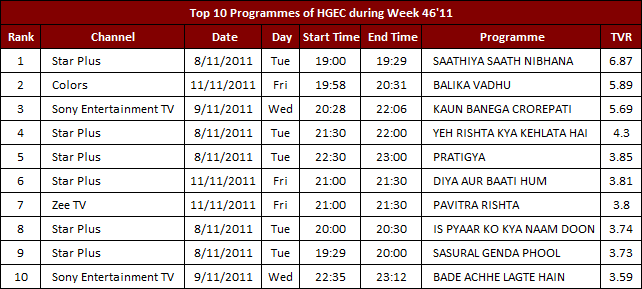
  • TAM data Top 10 programmes on HGEC – Wk 46’11

    Source: TAM Peoplemeter System

    TG: CS 4+ yrs

    Market: Hindi Speaking Market

    Period: Wk 46: Nov 6 to Nov 12, 2011


    About TAM Media Research

    TAM is a joint venture between Nielsen Company & Kantar Media Research. Besides measuring TV Viewership, TAM also monitors Advertising Expenditure of Television, Print & Radio through its division AdEx India. Since 2004, it extended its presence in the PR Measurement & Analysis space for Corporate/Marketing Clients by setting up a separate division Eikona PR Measurement.

    In 2007, the joint venture introduced RAM (Radio Audio Measurement) service to track Radio Listenership for the Indian Radio Broadcast Industry. In year 2009, TAM launched a division, called TAM Sports that specializes in monitoring Sports Sponsorship ROI.

    TAM Media Research’s objective is to fuel media insights that will drive the growth of the Indian Media Industry.

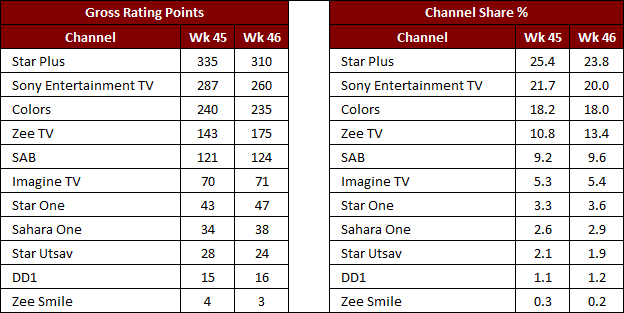
  • GRP Channel shares of HGECs- Wk 46 2011

    Source: TAM Peoplemeter System

    TG: CS 4+ yrs

    Market: HSM

    Period: Wk 45: Oct 30 to Nov 5, 2011

    Period: Wk 46: Nov 6 to Nov 12, 2011


    About TAM Media Research

    TAM is a joint venture between Nielsen Company & Kantar Media Research. Besides measuring TV Viewership, TAM also monitors Advertising Expenditure of Television, Print & Radio through its division AdEx India. Since 2004, it extended its presence in the PR Measurement & Analysis space for Corporate/Marketing Clients by setting up a separate division Eikona PR Measurement.

    In 2007, the joint venture introduced RAM (Radio Audio Measurement) service to track Radio Listenership for the Indian Radio Broadcast Industry. In year 2009, TAM launched a division, called TAM Sports that specializes in monitoring Sports Sponsorship ROI.

    TAM Media Research’s objective is to fuel media insights that will drive the growth of the Indian Media Industry.

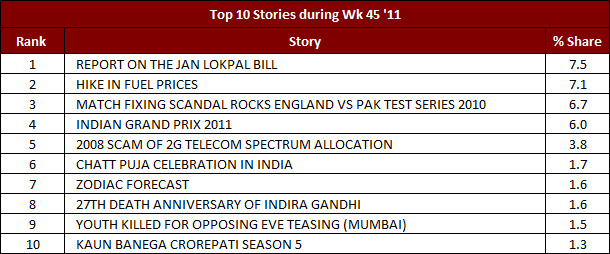
  • NCT Data Wk 45 ’11


    Source: News Content Track – A service of TAM Media Research Pvt. Ltd

    Channels: Aaj Tak, CNN IBN, Headlines Today, IBN 7, India TV, NDTV 24/7, NDTV India, Star News, Times Now & Zee News

    Period: Wk 45 – Oct 30 to Nov 5, 2011

    Note : Analysis is based on the telecast duration


    About TAM Media Research

    TAM is a joint venture between Nielsen Company & Kantar Media Research. Besides measuring TV Viewership, TAM also monitors Advertising Expenditure of Television, Print & Radio through its division AdEx India. Since 2004, it extended its presence in the PR Measurement & Analysis space for Corporate/Marketing Clients by setting up a separate division Eikona PR Measurement.

    In 2007, the joint venture introduced RAM (Radio Audio Measurement) service to track Radio Listenership for the Indian Radio Broadcast Industry. In year 2009, TAM launched a division, called TAM Sports that specializes in monitoring Sports Sponsorship ROI.

    TAM Media Research’s objective is to fuel media insights that will drive the growth of the Indian Media Industry.

  • Mediaah! Extra: Now, Vice Prez Hamid Ansari calls for debate on erosion of editor

    Pradyuman MaheshwariIt had to happen. Everyone has a view on how a newsroom should be run. The aam aadmi (and aurat) has a definite opinion on how newspapers and news channels ought to be run. They also know how Sachin Tendulkar must bat to score that hundredth hundred, but that’s another story.

    Here’s what the Vice President, Government of India, said while inaugurating the Press Council of India’s National Press Day celebrations.

    “Finally, I venture to hope that your debate would also focus on the erosion of the institution of the editor in our media organisations. When media space is treated as real estate or as airline seats for purpose of revenue maximisation, and when media products are sold as jeans or soaps for marketing purposes, editors end up giving way to marketing departments.”

    The Vice President didn’t go into  the controversy over his host Marandey Katju’s recent outbursts, but did talk on paid news. But it would be interesting to note how the big boys in the business (especially @ The Times of India group) have to say to this. Am sure they’ll laugh it off. After all, if the editors (and the tribe of journalists) don’t have a problem, why bother.

    Here’s what the VP said, courtesy the Press Information Bureau’s communiqué:

    “It gives me great pleasure to inaugurate the National Press Day. I congratulate The Press Council of India, its Chairman and Members, on this occasion.

    In over 45 years of its existence, the Council has fulfilled to a significant extent its mandate, as a quasi judicial body, of preserving the freedom of the press and of maintaining and improving the standards of press in India, and adjudicating complaints.

    Ours is an age of great change – social, economic, political and above all technological. Each has impacted on our individual and collective thought processes. Major premises are being revisited and the certitudes of an earlier era called into question. The answers are often disconcerting, in many cases tentative.

    The theme of today’s celebration is Media as an instrument of public accountability. A useful starting point of discussion would be to enquire into the basic premise of being a democracy.

    An essential feature of democracy is constraint on unlimited exercise of power. Democratic practice seeks to bring about accountability of actions of institutions and individuals in an objective, verifiable and transparent manner. While common understanding of constrains on power is limited to exercise of ‘public power’ by state actors, it is important to remember that it also extends to ‘private power’, of non-public authorities, especially when such entities acquire or exercise power traditionally associated with state structures.

    It is a truism that humans are social creatures who formulate rules of interaction aimed at furtherance of harmony and common good and avoidance of anarchy.  Rules and rule-based regulations are thus essential and unavoidable, more so in a democracy that eschews arbitrary exercise of power.

    Another truism is that some form of media has been integral to human civilization since time immemorial. Its principal purpose, to inform, remains unchanged. Technological innovations like the invention of paper and the printing press, radio transmission, TV broadcasting, and the World Wide Web have spawned new media platforms and devices for consumption.

    Today, the convergence between news media, entertainment and telecom has meant that the demarcation between journalism, public relations, advertising and entertainment has been eroded.

    The new trends in technological development and media conglomeration characterized by an emphasis on commercial values and outcomes, pose challenges to traditional public service values in news broadcasting.

    How do they impact the lofty ideal of journalism – of communicating reliable, accurate facts in a meaningful context?

    This aspect is of relevance because the media is the fourth estate in a democracy. It plays a major role in informing the public and thereby shape perceptions and through it the national agenda. Its centrality is enhanced manifold by increased literacy levels and by the technological revolution of the last two decades and its impact on the generation, processing, dissemination and consumption of news.

    Media outlets today assume importance not only for marketing and advertisement but also for the ‘soft power’ aspects of businesses, organisations and even nations. It is a harsh reality that media entrepreneurship is now a necessary condition for a business enterprise, a political party and even individuals seeking to leverage public influence for private gain.

    It would be instructive to study how other democratic systems have dealt with the media revolution and the convergence of communication technologies. Three stable democracies, namely the United Kingdom, the United States and Australia can be studied for best practices.

    In December 2000 the United Kingdom published a White Paper entitled A New Future for Communications in Britain. It suggested conceptual restructuring to bring together the five sectors of telecommunications, television, radio, broadcasting standards and radio spectrum allocations under a single-umbrella communications regulator. In addition, it proposed covering access, choice, content and competition.

    The White Paper proposed a new three-tiered regulation of broadcasting so as to provide a level playing field between the broadcasters, depending on the extent of their public service role. It stressed that all broadcasters be subject to minimum standards, impartiality in news, provision of protection of minors and access of people with disabilities.

    Emanating from this, The Communications Act 2003 established the Office of Communications (OFCOM) as the regulator for all communications industries to further the interests of citizens and consumers. It was tasked with ensuring optimal use of electro-magnetic spectrum, availability of electronic communication services, a wide range of TV and Radio services of high quality, maintaining plurality in broadcasting, applying adequate protection for audiences against offensive or harmful material, and against unfairness or infringement of privacy.

    The British experience of transition from a multi regulator to a single umbrella regulator, accountable to Parliament, and covering telecommunications, broadcast media and wireless spectrum, indicates that turf battles between economic sectors, government departments and individual companies have to be carefully managed in the midst of building a national consensus and enacting legislation.

    The experience of the United States and its Federal Communication Commission in regulating communications by Radio, Television, Wire, Satellite and Cable for over 75 years is also instructive. It promotes competition, innovation and investment in communications, encourages the best use of spectrum and revises media regulations so that new technologies can flourish alongside diversity and localism.

    American law imposes limitations on multiple ownerships and cross-ownership of media establishments across radio, television and print media to prevent emergence of monopolies and to ensure adequacy of independent media voices in the market that could serve public interests, localization of news and bring about diversity.

    In the case of Australia, it is The Australian Communications and Media Authority which is responsible for the regulation of broadcasting, the internet, radio communications and telecommunications sectors. In its role as a broadcast regulator, the ACMA plans the channels that radio and television services use, issues and renews licenses, regulates the content of radio and television services, including digital services, and administers the ownership and control rules for broadcasting services.

    The regulator enforces statutory control rules based on license area and audience reach, limitations on multiple and cross-ownership, limits on foreign control of the mass media, regulations on transfer of media operations and media groups, and determines acceptability or otherwise of media diversity. It seeks to bring about programme diversity, help foster a national cultural identity, bring about fair reporting of news and ensure respect for community standards.

    While media outlets in Australia have the main responsibility for ensuring that the broadcast content reflects community standards, most aspects of such content are governed by codes of practice developed by industry groups. The regulator registers these codes once it is satisfied that the codes contain appropriate community safeguards and are a product of public consultation. National content and children’s programmes on commercial television are regulated by compulsory programme standards determined by the regulator after consultation with the industry and the general public.

    You would notice that the experience and practice of other democracies indicates that media licensing and regulation is seen as a normal and essential activity to help its functioning as the watchdog of public interest. One is reminded of Gandhiji’s dictum that “an uncontrolled pen serves but to destroy”.

    In our country today, media represents a sector of economy that is the envy of others because of the extremely buoyant growth rates witnessed over the last two decades, in an environment characterised by minimal or no regulation. In the absence of any other government regulator, the focus has shifted to self-regulation by the media organisations, individually or collectively.

    Collective self-regulation however has yet to succeed in substantive measure because it is neither universal nor enforceable. Individual self-regulation has also failed due to personal predilection and the prevailing of personal interest over public interest.

    In an address at the Indore Press Club earlier this year, I had mentioned that while economic deregulation has been the dominant trend of the recent past, it is premised on a dynamic market place with a system of independent regulation, especially competition regulation, to prevent cartelisation, abusive behaviour by dominant firms and corporate transactions that derail the competitive processes in the market.

    Two questions arise here. In the first place, who will step in to address the gap when the government, the polity, the market and the industry are unable to provide for full-spectrum systemic regulation that protects consumer welfare and citizen interest?

    Secondly, can the constitutional safeguards on freedom of speech be used to evade regulation of the commercial persona of media corporates and groups? Where does public interest end and private interest begin?

    The experience of other countries shows us the way. The ongoing national debate on the subject should involve all stakeholders leading perhaps to the publication of a White Paper. This should lead to further consultations and evolution of a broad national consensus so that appropriate frameworks can be put in place combining voluntary initiative, executive regulation and legislative action, as appropriate.

    Such an effort can cover issues of multiple-ownership and cross-ownership, content and diversity, and a cogent national communications policy that covers print, radio, television, cable, DTH platforms, video and film industry, internet and mobile telephony, and electro-magnetic spectrum.

    Our democracy is poorer without active media watch groups engaged in objective analyses of the media, discerning prejudices and latent biases, and subjecting the media to a dose of their own medicine. For an industry that has over fifty thousand newspapers and hundreds of television channels, systematic media criticism is non-existent in India. This should be remedied and I hope your deliberations would address this important aspect.

    A related matter pertains to the recent controversy over ‘paid news’. It has been debated extensively in the Press Council and other fora, including Parliament. It is a matter of some satisfaction that the ‘culture of silence’ on the subject is being replaced with an attempt to grapple with this malaise at multiple levels.

    Finally, I venture to hope that your debate would also focus on the erosion of the institution of the editor in our media organisations. When media space is treated as real estate or as airline seats for purpose of revenue maximisation, and when media products are sold as jeans or soaps for marketing purposes, editors end up giving way to marketing departments.

    I would like to conclude by saying that all stakeholders – the government, the media organisations and the industry, civil society, advertisers and sponsors, and the audience and readership of the media – must address the various concerns regarding the profession and work towards securing and defending the public good.

    I thank the Press Council and Justice Katju for inviting me to the National Press Day Celebration. I wish you all success in your deliberations”.


    You’ll read more on this on MxMIndia (and Mediaah!) in the coming weeks.

  • Reliance Retail set to go big with big-box hypermarkets

    By Sagar Malviya & Chaitali Chakravarty


    RIL-owned Reliance Retail is buying real estate in 20 towns and cities to build big-box hypermarkets, moving beyond its earlier model of leased properties and small formats, as the conglomerate turns the spotlight back on retail under the new operations team hired from Walmart China.


    “We want to be a strong Indian retail player. The largest retail company in China is not Walmart or Tesco. It is Sun Art, a strong local company which owns around 200 hypermarkets,” said a senior company executive who added that the company has no plans of inducting an overseas partner even after foreign direct investment is allowed in the multi-brand retail sector.


    The focus on large-format stores of 60,000-80,000 sq ft, nearly the size of two football fields, and building stores on its own land, marks a shift from the company’s earlier strategy. When Reliance Retail had launched in 2006, it had signed up hundreds of properties for small-format stores – supermarkets and convenience stores – on lease. But, due to a combination of factors ranging from high real estate costs to supply chain issues, it had to shut more than 100 stores over the next few years.


    The company under the leadership of two retail veterans from China – Mr Rob Cissell, former chief operating officer of Walmart China, and Shawn Gray, former vice-president in-charge of store operations of the same company – has now for the first time decided to buy real estate and go for big-box formats. Typically, hypermarkets give consumers a choice of buying everything from soap to furniture.


    “We are buying land wherever there is scarcity of ready space, especially for our large-format stores. It will help in the long run as we don’t have to depend on rent inflation and its fluctuations,” Reliance Retail President Mr Bijou Kurein said without commenting on specific land deals.


    Six more hypermarkets by March:

    Reliance Retail has bought land parcels in Mumbai, Aurangabad, Kolhapur, Pune, Mysore and Madurai in the last few months, each measuring 1-1.5 acres, a person involved in the land deals said. The first big-box hypermarket opened at Santa Cruz in Mumbai last month and 10 days later a second one was opened in Pune. The company plans to open six more hypermarkets by March next year.


    The retail company at present runs around half-a-dozen hypermarkets under the Reliance Mart brand. But the company executive said the scale, the range of products, and the consumer experience in the new big-box stores will be totally different from the existing ones.


    “Big-box stores generate volumes and considerably higher realised margins. Reliance’s small-format model was unattractive as it was heavily dependent on fresh fruit and vegetables. It is not possible to manage the entire supply chain from the farm to the stores,” said Mr Harminder Sahni, MD, Wazir Advisors, a retail consultancy


    The Indian retail sector is growing 15-20% annually after a temporary lull of 2008-09 when the global meltdown slowed down growth and demand. Rising incomes, a growing young population and the scope to penetrate deeper into tier 2 and 3 cities are prompting many Indian and foreign players to enter the retail sector. Hypermarkets seem to be the best bet because they offer Western-style shopping experience, a wide variety of products and great deals to the consumer.


    After a slow beginning, Reliance Retail has now emerged as the country’s second-largest retailer after the Future Group with annual revenues of Rs 4,833 crore. Over the past few months, Reliance has accelerated store openings, brought in a management team from Walmart China and launched its first cash and carry store in Ahmedabad in August.


    Source:The Economic Times

    Copyright © 2011, Bennett, Coleman & Co. Ltd. All Rights Reserved

  • Lodestar UM shines @ inaugural FOMA


    By A Correspondent


    The Festival of Media Asia 2011, the first Asian iteration of the acclaimed festival of media creativity and innovation, witnessed the conglomeration of over 600 attendees, over 40 speakers, and more than 50 of the world’s biggest brands. Held at the Marina Bay Sands Expo and Conference Centre, Singapore from November 13-15, 2011, the Festival sparked conversations and provided insights into the media and marketing industry as a whole and the scenario in the Asian region, which is expected to overtake Western Europe as the second-largest advertising market in 2012.

    The Festival culminated in a gala dinner where the inaugural Festival of Media Asia Awards were given out, recognizing the most original and creative campaigns from the region. The awards were given across three top categories and 12 open categories. The Awards drew an overwhelming response – 410 entries from 16 countries, which were cut down to a shortlist of 81 from which the winners of the open categories were selected.

    The top awards at the event were bagged by Ikon Communications, UM and Coca-Cola for Agency of the Year, Network of the Year, and Advertiser of the Year, respectively. From India, it was Lodestar Universal that bagged the only award in the category of Best Entertainment Platform.

    Reacting on the win bagged by his agency, Shashi Sinha, CEO, Lodestar Universal Media said that it was a befitting reply to the spectacular work that the agency had been churning out on a consistent basis. “Being the only agency from India to bag an award is quite an achievement. That is because more often than not, Indian agencies don’t put up a good show where international awards are concerned. So it’s a big recognition for us and I would like to credit the team that worked on producing such an incredible piece of work.”

    The rigorous selection process for the Awards was completed under the guidance of Rahul Welde, Chairman of the Jury, The Festival of Media Asia 2011 and Vice President – Media (Asia, Africa, Middle East, Turkey & Russia), Unilever. On the entries at the awards, Welde said, “There were a number of outstanding cases which just stood out as sure wins, and there were some close calls in a number of categories which stimulated very engaging discussions. The jury was unanimous that the submissions for the inaugural Festival of Media Asia Awards were excellent. It’s great to see this calibre of creativity, execution and effectiveness in our region, and kudos to the brands and agencies who are have turned out some splendid work – quite a few risking and trying something new.”

    Focused on media and marketing in Asia, the session on Day 1 began with a short welcome address from Charlie Crowe, Festival founder and CEO of C Squared. Averred Crowe, “We want to make this an annual event. There is tremendous amount of creativity here, and we’re seeing this explosion of originality all over Asia. There is no better time to tap into it than right now.”

    His speech was followed by a panel discussion which featured representatives from three major Chinese online corporations – Baidu, Youku and Tencent – talking about the digital revolution in China, and their plans to one day challenge giants like Google. Colin Currie, President and Managing Director, adidas Greater China, discussed the challenges involved in connecting with the Chinese consumer, and the way that adidas marketing evolved to take cultural and social sensitivities into consideration.

    The next panel comprising panelists such as D N Prasad of Google – APAC, William Manfredi of Wunderman, Young & Rubicon, Shaun Ruming of McDonald’s Asia-Pacific, Middle East and Africa, and Barry Cupples of Omnicom Media Group, APAC, tackled the shortfall of talent in the media industry in Asia, and explored the reasons for this trend as well as strategies to manage this problem.

    The most appreciated and talked about session was the enthralling keynote by Carolyn Everson, Vice-President, Global Marketing Solutions, Facebook. Everson held the audience captive as she previewed Facebook’s new Timeline feature, talked through the importance of capitalizing on people’s social connection as the basis for marketing, and then presented how Facebook could support brands looking to create connections with their consumers. “Social discovery is the most powerful driver of human behaviour in the world today,” said Everson, “We have always asked our friends for recommendations.”

    Rahul Welde, Vice-President – Media, Unilever Asia, Africa, Middle East, Turkey and Russia, took the conference even further by looking at how marketers would have to change their mindsets and reframe themselves. He offered new and different ways to think, including enhancing interaction and experience, as ways for marketers to address the changing ways that people are relating to media, particularly digital and social media.

    Other notable feature was the Agency CEO tours of media innovation, which took place several times during the event. Leading CEOs took to the stage to showcase and share an innovative or special campaign that had run during the year.


    Awards at a glance:

    The open categories and winners of The Festival of Media Asia 2011 Awards are as follows:

    Best Communications Strategy – Break up for National Australian Bank/ ZenithOptimedia /Australia

    Highly Commended – Mars Play Challenge for Mars / Starcom Melbourne / Australia

    Best Contribution to a Campaign by a Media Owner – 11 Degrees New Media Film Project for Chevrolet Cruz / Youku.com / China

    Highly Commended – Invite Mr Wright for Canon / Discovery Networks Asia Pacific / Singapore

    Best Entertainment Platform – Coke Studio for Coca-Cola / Lodestar UM / India

    Best In-Store Activation – Burst of Freshness for Comfort / Mindshare Vietnam / Vietnam

    Best Targeted Campaign – Whiskas Pledge for Whiskas / Starcom Melbourne / Australia

    Best Use of Content – Johnnie Walker Yulu for Johnnie Walker Black Label / BBH Asia Pacific / Singapore

    Best Use of Digital Landscape – Property Guide iPhone Application for The Commonwealth Bank of Australia / Ikon Communications / Australia

    Highly Commended – Polident Bridges the Generation Gap for Polident / MediaCom China / China

    Best Use of Emerging Technology – Property Guide iPhone Application for The Commonwealth Bank of Australia / Ikon Communications / Australia

    Highly Commended – Woolworths iPhone and Android Application for Woolworths / Tigerspike / Australia

    Creative Use of Media – Interactive TV for Coca-Cola / UM / Hong Kong

    The Effectiveness Award – Australia Kinect for Xbox Kinect / UM / Australia

    The Public Service Award – Harnessing People Power to Let People Know That Speed Kills for The Transport Accident Commission / Naked Communications / Australia

  • 7pm, the New prime time


    By Ritu Midha


    Once upon a time in Hindi GEC, 8 to 10 PM was known as prime time. Then happened Kahin To Hoga and Kaahin Kissii Roz (both on Star Plus), and prime time viewership extended up to 11 pm. The interesting thing here was that while 10 to 10.30 pm slot was viewed across HSM, 10.30 to 11 was largely metro centric. And today, the slot is used for more mature stories like Maryada Lekin Kab Tak.


    Interestingly, channels have now realised that older children and teenagers are not watching that much television any more – and there really is no requirement for shows tailored specifically for them in the 7 to 8 pm slot. Enter Saathiya – and now 7-8 pm has become an integral part of prime time television viewing. Star Plus successfully proved yet once again that Saas Bahu still works – and good scheduling too can be an excellent programming innovation. More on prime time expansion in a minute.


    Another interesting phenomenon one notices these days is that shows are not killed in too much of a hurry – shows that stop being TVR-garners are nudged, and shifted to another time slot preferably in the afternoon – two very recent examples are Na Anaa Iss Desh Lado and Laagi Tujhse Lagan. Elucidates Dinesh Vyas, Business Head, MEC Global, India, “Channels try out possible routes before killing the programme. And as a strategy they try putting programmes between two good performing programmes hoping for viewers to move on to this programme too.”


    While quite a bit of television slots are still sold based on GRPs, and many brands insist on prime time slots – there are a few which are keen to advertise on a specific show. what happens when these shows are moved from one time band to the other. Explains V Narayanan, General Manager , Maxus, Delhi, “This requires a deeper analysis of the new slot where the following parameters are taken into consideration in predicting the ratings which includes, Current viewership of the time slot, Whether the new slot is in prime time or non-prime time slot?, Ratings of competing programmes in the new slot, Promotion plan from the channel in promoting the specific programme slot etc.”


    Adds Mr Vyas, “The media planner analyses that time slot (over at-least 13 weeks) to which it has been shifted, to estimate drop or rise in viewership. Loaded with this data the planner/buying negotiate with the channel for better deal in rates proportionately to the drop percentage.”


    In place of these shows, in their previous time slot arrive new shows- which may or may not capture viewers’ attention – but this is a risk that channels have to take. It is after all about getting the desired eyeballs and audience acceptance.


    Moving back to the extended prime time, the 7 pm slot was made popular by Star’s Sathiya and 7.30 by Sasural Genda Phool on the same channel. However, now shows on Zee and Colors too are working well for their respective channels.


    A quick look at the delivery of this time slot:Star Plus: 

    Rank Date Day Start Time Programme TVR

    1

    25/10/2011 Tue

    19:00

    SAATHIYA SAATH NIBHANA

    4.3

    16

    27/10/2011 Thu

    19:30

    SASURAL GENDA PHOOL

    2.24


    Colors:

    Rank Date Day Start Time Programme TVR

    21

    25/10/2011 Tue

    19:32

    SASURAL SIMAR KA

    2

    87

    27/10/2011 Thu

    18:59

    HAVAN

    0.76

    Zee:

    Rank Date Day Start Time Programme TVR

    27

    24/10/2011 Mon

    19:30

    CHHOTI BAHU

    1.84

    70

    25/10/2011 Tue

    18:59

    EK NAYI CHOTI SI ZINDAGI

    0.89


    Target Group : CS 4 + Yrs ;

    For the week from 23/10/2011 to 29/10/2011

    Source: TAM peoplemeter system


    Havan, has, incidentally, not been able to do as well as anticipated yet. Says Mr Narayanan, “Saathiya is a popular programme and garners loyal viewership amongst the female viewers. Yes, with Havan being promoted aggressively by Colors, Saathiya viewership did drop during the first week of telecast which was expected. “

    While late night slots attracted metro audiences, the 7 pm to 8 pm slot has succeeded in attracting non metro audiences. States Mr Vyas, “I have always believed 7-8pm slots work best in non-metros where the audiences are home by that time.”

    Mr Narayanan, meanwhile elaborates that it is the mid-sized towns where this slot attracts maximum viewership, “ A closer look at Saathiya viewership across 8 weeks ( 2011, Wks: 33-40 & for the top channels only. Tg: All, AA, 15+, C&S.) indicates that 1 million + towns in Gujarat, Punjab/Haryana, UP, Rajasthan, MP procures higher ratings than 0.1-1million towns within each state respectively. As a comparison, the program ratings within the 1Million + towns of the above markets are relatively higher than Delhi & Mumbai ratings. “

    Interestingly the 7 to 8 pm slot is not doing well only in HSM but a similar trends can be observed in South markets as well. Explains Narayanan, “Within the 7-8 pm slot, the rest of AP and the rest of Karnataka performs better than Hyderabad and Bangalore respectively. Specific to TN, Sun TV programmes do well in 0.1-1 million towns than Chennai and 1 million+ towns.”

    Television always has options – programming experimentation, scheduling experimentation, changing the protagonist, the story line etc – and hence has the capability of being a step ahead of the curve. With three and a half hours of prime time – GEC don’t have much to worry – all they need is good characters. The next battle heating up is for the real prime time – 8  to 9 pm with all the channels bringing up new shows there.

  • Birla Sun Life Insurance: Realism works

    Birla Sun Life’s ‘Protection Solutions’ financial plan seems to be targetted at the reckless urban youngsters who don’t plan for their future. And prefer to live for the moment. The TVC tries to strike at this flippant, carefree attitude to life.


    The ad features a young couple walking in the rain, as they look for a cab. The girl cribs a bit, so the hubby reassures her he will soon buy a car, as his promotion is round the corner. Meanwhile she too has some good news to announce but no, it’s not what the excited chap thinks. A baby isn’t on the way yet, but she has got an increment in her salary. As this banter goes on, the man narrowly misses being run over by a speeding car, much to the relief of missus. The message: ‘Kahin aap apne sapno ko kismet par to nahi chhodh rahe?’


    [vimeo]http://vimeo.com/31714764[/vimeo]

    Well, there’s nothing new out here in terms of the strategy. Fear factor and human emotions as a route has been used ad nauseum in the insurance category. However, must say the execution is nicely done. The young couple looks like regular folks you’ll walk past on the streets, and their mannerisms/conversations are very real. Also, they act very naturally. The use of realism should work for the brand… middle class young Indians would empathise with the couple and the situation. A fine example of how good execution can lift an otherwise over-used approach.


    Rating: (On a scale of 1 to 5):  3. But full marks to the ad filmmaker.Â