Author: mxm_india

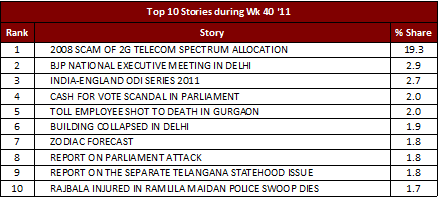
  • NCT Data Wk 40 ’11

    Source: News Content Track – A service of TAM Media Research Pvt. Ltd

    Channels: Aaj Tak, CNN IBN, Headlines Today, IBN 7, India TV, NDTV 24/7, NDTV India, Star News, Times Now & Zee News

    Period: Wk 40 – Sep 25 to Oct 1, 2011

    Note : Analysis is based on the telecast duration

    About TAM Media Research

    TAM is a joint venture between Nielsen Company & Kantar Media Research. Besides measuring TV Viewership, TAM also monitors Advertising Expenditure of Television, Print & Radio through its division AdEx India. Since 2004, it extended its presence in the PR Measurement & Analysis space for Corporate/Marketing Clients by setting up a separate division Eikona PR Measurement.

    In 2007, the joint venture introduced RAM (Radio Audio Measurement) service to track Radio Listenership for the Indian Radio Broadcast Industry. In year 2009, TAM launched a division, called TAM Sports that specializes in monitoring Sports Sponsorship ROI.

    TAM Media Research’s objective is to fuel media insights that will drive the growth of the Indian Media Industry.

  • The Anchor: Sumanto Chattopadhyay on 7 reasons why print cannot die as an advertising medium

    #1 Every time a new medium comes into being, premature obituaries are written for preexisting media. This happened with radio, when television arrived. And with TV, when the internet came along. But I ask you, are radio and television dead?

    #2 In India, newspaper circulation is on the up and up. New newspapers are being launched every day. Almost every page of every paper has an ad or two. So where does the concern arise?

    #3 If paperbacks and magazines died, we might worry that print advertising could be next. But novelists are thriving. The Economist is growing. So me no worry!

    #4 While there are writers, print advertising cannot die. As a writer, I can tell you that the urge to write is too strong to shrivel and give up the ghost.

    #5 The smart phone, tablet and laptop are just not as easy on the eye as the printed page – so to protect our ocular health we will opt for print and print advertising.

    #6 Paper running out could be a serious blow. But with afforestation and recycling we are licking that problem.

    #7 And finally, imagine sitting on the pot with your laptop and clicking on some web banner… Nah. Print rules.


    Sumanto Chattopadhyay is Executive Creative Director, South Asia, Ogilvy & Mather Mumbai.

  • ‘Diplomacy? Not for Mail Today’

    Rahul Thappa, COO, Mail Today in a candid conversation with MxM India’s Akash Raha.

    Q: For a long time you had been in Malaysia, how does it feel to come back to India and join the India Today Group?

    Well, these are two different questions and I will take them separately. Coming back to India… I don’t think I ever had a big departure from India. Perhaps, there a few more cars on the road and lots of development since then, but the people are still familiar and the same. Moreover, I was in India fairly often even when I was working abroad, so coming back wasn’t a shock. As far as the rest of the family is concerned, and it was important decision for them too, they have been doing very good. Whereas joining India Today Group is concerned, I think it has been an excellent experience and a very good opportunity thus far. It is one of the best media houses and also one of the oldest. Usually in media, the oldest have the advantage of having settled down well and not being in a state of flux, like many new media organizations trying to find their DNA. So it’s been good on both accounts.

    Q: What is change of tactic that you are adopting, since you have been on the other side of the business too – Media Planning?

    How I characterize it is, I came from the demand side (for media) which would be the advertiser, advertising agency side of the business. And now, I have come to the supply side. I know how the demand side works. I know the psyche of the demand side and that helps me to understand on our end how our supply is to be sold to the demand side, what changes they may need to facilitate the exchange better etc. The knowledge helps us in building and positioning our product better in their mindset and in the way they conceive our product.  Since, we all have an ad-revenue model it is essential know more about the demand side. If we were a subscription based model, it would, perhaps be not as essential. I think that is what I bring to the table apart from the fact that I have been in senior managerial roles for a while now which helps me shape an organization; you could call us (Mail Today) a start up considering that we have spent merely three and a half years in the industry. I hope my past experience will help shape our team further as we will have exciting times ahead. We bring a strong differentiated product in the market and it’s doing very well. I am not saying it will meet the main stream newspapers head-on, as it was never meant to. It might very well contest against the magazines. It was purposed differently and not to take on the big boys on, and our aim was never so. It might look like such a product, but our content is packaged very differently, unlike other newspapers. Hindustan Times and Times of India are everything for everyone. And anyone who wants to read an English newspaper can pick them up. They are fairly democratic that ways and the entry barrier for those who want to come in is low. They have something for everybody. However, we are not everything for everyone… Our content is curated and our content is for a certain demographic.  And in that demographic itself we have several focal points. SEC as we know it today is not as flat as it is… IRS in the coming years with developed and enhanced methodology will aptly point out the fact where they will have a more living standard measure gauge of SEC’s rather than educational and occupational parameters. So if I were to see SEC as a pyramid, which it rightly is, then we as a product, we cater to the top half of that pyramid. Hence, we will not go deep in the market, because we don’t intend to…We don’t intend to access that audience. By choice we have defined our own playing field and it is, in a way, a niche product. We have lower values in mass product and yet, we are a subscription based product. Since we are a subscription based model in time we will have the leeway or flexibility to depend less on ad revenue and focus more on subscription.

    Q: So what are some of the changes that Mail Today has seen since you joined the group and what are some of the changes that the group is likely to see in future?

    Change in management doesn’t mean change in the way how a company is run. There are only subtle changes where efficiencies are creamed out of each system. A person X will look in efficiencies in one place and a person Y will look at efficiencies at another. That is how they are made and that is how they think. But yes, since I have joined, I have looked for efficiencies in certain places… Given the state of economy currently, everyone is making sure across all boards that all processes are running smoothly and efficiently. But a change in management doesn’t change a way in which a newspaper works… the DNA of our product can’t be changed. As we learn about the market, consumers and demand side of the industry, if any process needs to be changed/improved then so be it.

    Q: Efficiency since the slowdown has become an euphemism for job cuts, is that what you are hinting at?

    No, job cuts happens when one process grows faster, builds up fat and then realizing that that process wasn’t necessary to begin with . But in a media industry all processes are equal and that is not what I am hinting at.

    Q: Mail Today began as a paper for the newer audience – the office goers, to put more literally, the metro commuters. Being a ‘compact’ it is easier to handle and read? Are we right in understanding that this focus still continues?

    No, our compact size had nothing to do with the ease at which it could be handled in tight situation, like the model Mid Day in Mumbai. At least, that was never the overt intention. However, if does mean that a person travelling in a metro finds it easier to read, then so be it. One can observe a trend that successful international newspaper are or have switched to compacts such as Daily Mail, Independent, Guardian… One, it is good for savings in terms of the newsprint cost on the other hand it is also fairly easy to read. Ease of reading, pleasing to the eye, logistical advantages, cost advantages… We think that the newspaper industry can take this (compact) route in the years to come. We have taken a bold decision first and we are proud of that. We have taken the first step towards taking compact forward this format that has been a trend internationally too.  If people say only broadsheet is a serious daily then they are out of date… their size has got nothing to do with the seriousness of content. That’s just stereotyping. One cannot compartmentalize the products content by its size.

    Q: Talking about content… Mail Today was known as the ‘Paper Tiger’.

    Yes that focus still continues and will always continue because that is the belief on which media organizations are built. There is no ‘Madhyam Marg’ to it for us…which is what we call our competitors. They are large and fairly entrenched and they take the ‘Madhyam Marg’, or what we will call, being diplomatic. And we don’t believe in that. We tell a story straight, take the bull by the horns… several idioms come to my mind, but in essence we are very direct. We say what we mean and mean what we say, whatever be the consequences.

    Q: Not too long ago Mail Today used to have their circulation number on the masthead. We see that it is not there anymore… Any specific reasons for this change?

    We can put it back there… that is not a problem. But if it becomes two million and two hundred copies I can’t change it every day. It is a little tedious too and is nothing short of a live ticker. We started it only to tell that we were approaching a milestone and thereafter, that we have crossed it. Printing it every day will not make any difference to anybody’s mindset. Eventually, it will become a blind spot. We are currently at over two lakh copies and when we reach our next big milestone, we will put it up too. But keeping it up there permanently solves no purpose. It was for our detractors who said that we won’t grow. The market is growing and with it we are growing too. The market is not only growing only vertically but also horizontally… and there is enough space for us to grow in it. Everything is being diced up and segmentalized according to age, gender and so many other parameters. So the way media is going to grow is with more choice and there is going to be space for everybody; in fact, journalists will have far more trouble keeping their roots. But getting back to your point, the numbers were just to point out to the fact that we are alive and kicking and growing at a steady rate. In three and half half years, I think the numbers we have got in this cut-throat market is phenomenal.

    Q: Since Mail Today was launched in 2007, it was said that expansion was on the cards. Especially Mumbai and Chandigarh were being talked about. Yet, the industry is still awaiting the expansion. Is it still on or has it been scrapped?

    Hopefully you will hear of it soon, expansion has always on the cards. But expansion just for the sake of expansion, what you would have seen in several publications, is something we won’t like to do. We have seen several premiere media houses which saw splits, mergers, acquisitions expanding and trying to enter into every business, launching in every market that they can think off. And look where they are, look what the recession has done to them… Yes, money has become scarce; funding has become scarce too… There are companies in the market close to 80 and 150 years old and that’s why they are successful. We won’t take that long to be successful as they are, but we will get there. But we won’t ruin our work by trying too hard to get into newer markets. Delhi is our market and we know this market and stabilizing Delhi is of critical importance, which we have done. And very soon you will hear of us launching into major markets in a major way. We don’t want to be insignificant players in several markets. We won’t go into a market just because it’s large and growing… Big newspapers which are meant for all audience types can do that but not us. We are also looking for a certain/specific audience type; be it Bhopal, Cuttack or Port Blair. However, we already have a few marked city, the plans are at place and are being deliberated by the management. And very soon you will hear of our first foray out of Delhi.

    Q: What is your annual revenue from Mail Today, and what is your revenue target for 2011-12 and what is the growth number it has seen?

    Our readership is constantly growing. As far supply side, we are growing on that front too. As far as revenue side, we are growing at high double digits. Our growth over the last year is well into 40 per cent. For us, being a relatively new organization and having faced the slowdown, and yet being in the market with such a substantial growth figure is an even bigger achievement. Otherwise the way we started in 2007, we would have been growing currently at 60-70 per cent. We would love those times to come around but till then we are fairly happy with our growth rate.

    Q: It is being said that the IRS-NRS merger are at hand. Do you think it will solve the measurement problem that the industry faces?

    It won’t solve the measurement problem but it will certainly reduce the confusion. We will have one metric to go by and it will make it easy to everybody to look for improvements. When there are two measurements, it’s like having a pound and metric systems working together. The merger won’t solve the endemic problems immediately that publications may have but it will benefit if everyone focuses on one metric. For example, the simplest thing is when you go to a client or planner or agency you might find one of them focusing on one set of data and another one on the other. You waste a lot of productive time that way, which we can now do away with. Two sets of money which was used in setting up samples can now be used to set up double the samples, hence more robust data.

    Q: What are your digital plans?  We have seen your epaper on the digital space but do you have a plan to do more on the digital space and monetize it with advertising revenue, and perhaps subscription revenue through partial pay walls etc.

    We realize that the digital era is already here, yet, none of the Indian players have been able to do anything substantial on it. But I can’t hide behind and say since it’s not working and we will not go there. Digital has become a way of life, information is dynamic and people want information at any time and at any place. When the demand will increase, so will the entire market and then, people will have many models. For example, if you have a complete pay wall it might not work, yet, if you have a partial pay wall it might just work. Also, you can focus on advertising and give content for free. Ad rates, as we see today differ for a digital pixel and a print pixel, which is not right. It is a peculiarity of mindset and it has to change. In years to come, digital will reign. Yet as I say that, I believe that physical product will co-exist. In 20 -25 years when today’s generation consuming digital grow older and new generation of people consuming arrive, print might see a little fall, yet it will co-exsist and then better product will reign. Mobile, tabs and more futuristic system will come into existence and then the sole factor will be how you reach out to a consumer throughout his day on various mediums. Answering your question, eminently, we have been a little slow on that front (going digital) because we are just a start up and we wanted our editorial to focus on the paper product first and we wanted to keep it growing. The demand side still understands print better and hence it was understandable to keep that going before we jump into anything new. We are already making plans to go digital… But we want to come up with something different… Not something regular and utility base like the other Indian websites we have today. The idea will be to be a Huffington Post equivalent, otherwise, the content and the medium will not be differentiated. For example, god-forbid, if there is a bomb-blast everyone in a matter of 10 minutes will have the news. Hence, time is not a differentiator in that space because everyone has caught up and is as fast. Wealth, is the second dimension (one could be paid, one is not) yet, there is yet to be a successful model in it. Lastly it is skill, which is where one can differentiate. A well curated news and content is important. How does an event affect a person’s life and how you add value to it, which is the skill dimension… Currently at number two, Mail Today, our parent in the UK are competing on time and content. They have most of the news and on time too… You have to see it to believe it, how they put content together, on time and seamlessly where the designing is superb.

    Q: It is interesting how you say Daily Mail is your parent, I was more expecting a term like partner.

    Yeah, they are our parent as far as the website is concerned. And then again, I could say that we have two parents, one is Daily Mail and the other is India Today group, which undoubtedly is a parent. If you see the mast head (of Mail today), one can say that they are similar. We borrow a lot from them. Our DNA in terms of look, feel and the physical self of the paper is from Daily Mail. The way the content is put together is an India Today DNA.

    Q: What is the interaction level of Daily Mail with Mail Today after three years?

    We are very interactive. In content sharing of course we are the equity partners. Apart from that, they provide us the glimpse into the future and whole lot of other learning, as to how to handle multi-national clients. They have been handling the same format for a longer duration of time than us, hence the expertise. Our relationship is a fairly active and very cohesive.

    Q: Do you think that media houses should do something to change the current overdependence on advertisement revenues? Do you think rationalizing cover prices will help? What are the challenges?

    Yes they should. The biggest challenge is, the fear that if prices are hiked circulation will be affected. For example, there are houses where there are 4-5 a paper going in each day and the fear is with a hike in price they might cut down on 1-2 paper. But I don’t really see it as fear, rather it is a affirmation of two things –How valuable your product was in that person’s life if he can do away with it? On the other hand if that person was so price elastic that he couldn’t pay another two rupees for valuable information he or she is buying the first thing in  the morning, it creates serious doubts over the buyability of the reader as a valuable asset to an advertiser. For certain advertisers selling regular day to day stuff it will be bad. But for an advertiser selling a car, it becomes interesting… Let’s say my circulation is one million. If all products become double the price, the people who drop out are for instance 300 thousand. In that case, I would value that 700,000 more than the entire 1 million. Now that 700,000 I have are taking me no matter what the cost, they are actually reading the product and see value in it. The other 300 million weren’t reading me and taking me only because I was cheap.

    My argument to the advertiser would be, as it is earlier only 700 thousand were reading the product. And hence you continue paying me as much as you were, since that’s the exact number I still have. Then, my cost comes down and my revenue stays stable and I am a little more profitable. Some of these costs can be shared with the advertisers like they will want you to, but there are other ways of doing that; by elongating their campaigns, making content for them, doing events etc.,  not by giving them a price off.  The aims should not be to talk to everyone, but to talk to fewer people and be sharper in the communication.   It is time we bite the bullet, it is time we increase our price and it is time we do something rational for ourselves rather than keep digging ourselves deeper in the pit. If two rupees a day can bring down the edifices of large organizations then it is a slap on their face. If the whole network of large newspapers is built on Rs 2 a copy then there is no point discussing their value anyway.  It speaks a lot about what you have built over the past so many years. If you have built content-based credible organizations then the consumers will read you irrespective of a Rs 2-3 price hike. It can’t do away with what I call ‘Elasticity of Doom’. ‘Elasticity of Doom’ will come irrespective of the money – Sorry, you didn’t build a strong enough organization. You can very well increase 50 paise every month for four month. Then people in the industry say that do it all together, how would it make a difference, what is the point of doing it slowly. But like one of my colleagues in Mindshare used to say, you don’t boil a frog by putting it in hot water, it jumps out. You heat it slowly, and sooner or later you can boil the frog and make a nice broth. And all publishers can do it together, 1st of every quarter, across all boards. So that one is not costlier than the other and the parity stays. So it’s possible, you just need will to do it, because the ‘Elasticity of Doom’ eventually is inevitable. The cost of paper has to rise up, it’s not a renewal source, so might as well do it right now. Especially in the paper industry there is no reverse logistic. So till reverse logistics become a part and parcel of life, you will never have cheap recycling and cheap paper. Most of the paper today gets imported and there are tariffs, company disputes etc., due to which prices will always keep rising.

    Q: Talking about lighter subjects, Mail Today comes up with interesting initiatives. What are some of the upcoming marketing initiatives that the paper has planned?

    We have planned a lot of initiatives. But unfortunately we can’t talk much about it as it is a revenue stream for us. Olympics, Delhi centenary year we plan to do a lot on a lot of topics. Delhi has its own problems and being Delhi’s own paper we will try to tackle it in the best way possible. You will see several campaigns in times to come.

    Q: On a broader note, what are the new emerging trends in print media?

    There are wiser people who can talk about trends, but there is one trend that I will talk about which is the rise of tablets. I think it’s at our doorstep right now. While it might seem very quiet… you see cheap tablets of Reliance, Beetel. Samsung too have been known to lower costs drastically. The ipad market, I feel, will grow faster than the penetration of smart phones. There is still very little Indian content on the ipad. Yes the Times of India has an ipad app and a few others too, which is good and evolving, but it is not seamless yet. It is nothing like the foreignpolicy.com apps. We were talking about consuming content at ease in a metro. Consider the iPad which collapses a newspaper to one-eighth its size. You don’t have to open it any more, you can just slide your way through the complete newspaper. There are already about 250 thousand iPads in the country by official or unofficial estimate. Every second member in our industry has an iPad. It’s just a matter of time before the market explodes, and when it does, it will be everywhere without anyone having to curate content for it. That is something we should all keep our eyes on.

    Q: Can we expect Mail Today to come out with an iPad app soon?

    Mail Today would certainly like to do it; but probably as an organization we don’t think we ‘need’ to do it right now. But we have our eyes pinned on it, and will offer a value package to our consumers if and when we think it is the right time.

  • WMC2011: Soni sees bright future for mags

    By Shruti Pushkarna

    After the smashing opening of the 38th FIPP World Magazine Congress with King Khan dancing to “Chammak challo”, Day 2 opened with optimistic assurances from the Minister for Information and Broadcasting, Ms Ambika Soni. Chairman of FIPP and Chairman & Editor-in-Chief, India Today, Mr Aroon Purie invited the I&B minister to grace the opening of the second day with her address.

    A self-confessed “avid magazine reader”, Ms Soni was extremely optimistic in her views on the future of magazines and print media. Addressing the Congress, the Minister stated, “…With 77,000 registered publications, including magazines in different languages, we are one of the major magazine hubs of the world. India represents one of the developing markets for magazines globally, and (are together) expected to contribute about 31 percent of the global advertising expenditure this year, and 67 percent of the growth of this crucial segment of the media.”

    The minister also emphasized the diversified nature of the India market. “We also probably have the greatest possible diversity represented in our magazines in terms of genre and content, not only language. From the glossiest and most sophisticated luxury magazines to those making effective use of the latest digital trends, to the more simply and cheaply produced publications… all co-exist in a highly diversified, highly segmented, highly stratified market.”

    Ms Soni showed that she is not oblivious to the threat that the digital revolution poses to the magazine segment. But she assured the audience that the danger was not as grave as it seemed in, perhaps, the last Congress. She summarized the solution to the problem in three words – innovation, expansion and adaptation. “There will always be room for innovative ideas, in terms of content and format. Adaptation of course to internet age, to tablets, to phones, to developing new revenue models… But there are also significant gains to be made by expansion; this is especially true in developing markets like India.”

    The minister also shared some interesting figures, reiterating the prospects of growth in the magazine segment. “While the print market in India is dominated by newspapers which accounted for 94 percent of all print revenues in 2010, the important point to note is that the overall pie is growing and the magazine segment is estimated to grow at a CAGR of 4.8 percent in the period from 2010 to 2015.”

    And donning the role of a ‘government representative’, she shared with foreign delegates how liberalized government policies are aiding the growth of the print medium: “For the benefit of all the delegates who’ve come from outside, I would like to emphasize that we’ve come a long way, a long way since the basic premise of our print media policy of 1955 which did not allow any kind of foreign publications, either newspapers or periodicals. The policy which was subsequently reviewed in 2002 and then again in 2005 has paved the way for a spurt in the magazine sector. The liberalization of our print media policy has not only attracted foreign direct investment, it has given a growth perspective to the magazine industry in India as well.”

    The minister also assured the AIM members that their “longish wishlist” is being carefully examined and all issues will be addressed soon.

    On a lighter note, she also promised the foreign delegates to “again look at the government’s policy on visas on arrival”.

    Ms Soni left the audience with an interesting question to ponder. She said, “With over 90 million copies in circulation daily, the print industry is among the largest in the world. But the vast untapped potential in this industry is even greater. More than 300 million literate individuals don’t read any publications. These 300 million individuals have rising levels of income and aspirations. Will all these be diverted straight to the internet?” With internet access in India still quite low and broadband access even lower, the minister added, “…Today there is a large window of opportunity for the print media that Indian publishers should therefore capitalize upon.”

  • First on MxMIndia: Tarun Rai is new AIM President, Mitrajit Bhattacharya is VP

    By Akash Raha

    Mr Tarun Rai, CEO of World Wide Media, The Times of India group’s magazine publishing company, has been appointed President of the Association of Indian Magazines. This was announced at the annual general meeting of the apex association of magazines held soon after the proceedings of Day 1 of the World Magazine Congress concluded. Other officebearers are Mr Mitrajit Bhattacharya as Vice-President, Mr Rajmohan as General Secretary and Mr Paresh Nath as Treasurer. Mr Rai and his team will lead the Association of Indian Magazines until 2013.

    Mr Rai takes charge from Mr Pradeep Gupta, Cybermedia group chairman and managing director, who has been holding the position since November 2009. The  officebearers in Mr Gupta’s tenure of 2009-11 were: Mr Rai as Vice-President, Mr Mitrajit Bhattacharya as General Secretary and Mr Nath as Treasurer.

  • The Anchor: Sanjay Tripathy on 7 reasons a marketer chooses an ad agency

    #1 End-to-end expertise and servicing. An advertising agency which provides a bouquet of services and is capable of creating effective 360-degree integrated communications campaigns is important, as classic one-dimensionaldvertising is becoming less relevant in the current environment.

    #2 Team credentials and clients handled. People form the most important part of an advertising agency, and their credentials and experience are a huge factor in deciding to work with them. The advertising agency needs to be evaluated to determine their expertise in handling different business categories, especially their experience of working on your type of business and if they understand the competition in your field. At the same time, it is important that the agency have some experience in other business sectors as it brings in fresh ideas and helps create clutter-breaking communication.

    #3  Size and scale of agency. It is important to ascertain whether the agency is adequately equipped to deal with the corresponding size of the client’s business in terms of creative, operational and technical resources.

    #4 International exposure. The more the agency has interacted with global clients and has experience in creating campaigns globally, the better. It helps bring in more professional working and a lot of fresh ideas.

    #5 Consistency in dealing. The ability of an agency to maintain consistency as well as transparency in dealing with its clients is very vital from a client’s perspective. It enables ease in dealing on a day-to-day basis and helps meet timelines and implement campaign plans more efficiently.

    #6 Strength in research. A strong research wing in an agency helps ensure that the campaign is backed by high sensitivity in terms of socio-cultural understanding and aesthetics while maintaining the brand philosophy. The tools that the agency uses in planning campaigns and analyzing the brand and competitors need to be scientifically prepared.

    #7 Balance between creative and business strategy. A path-breaking creative idea may not always be the best solution for a business problem. An agency which understands the importance of business problem-solving through communication is beneficial in the long run. Also, its ability to align with the long-term strategy of the client is important.


    Sanjay Tripathy is Executive Vice President – Head Marketing and Direct Channels at HDFC Life.

  • Anil Thakraney’s Hard Knocks: The damned misleading adverts

    So, finally the government has woken up on the issue. No less than the Prime Minister’s Office (PMO) has gotten into the act. The plan is to come up with policies that can control the malaise of misleading ads.

    Well, to be honest this should have been done a long time ago. The Indian mediascape is lined with ads that make false/exaggerated promises. Health drinks that will make your child grow tall. A magic lotion that will sprout hair on that bald pate. Cars that give you outstanding mileage on Indian roads (wow!). The dubious list is long.

    Yes, the ideal solution is self-regulation. But it will never work, there are just too many brand managers ready to play mischief for that extra market share point. Therefore unfortunate though it is, we do need some powerful and implementable regulation in force so that consumers don’t get fleeced.

    However, and this is the crux of the problem: More than policies, we need hard punishment delivered to the offenders. Because penalties for misleading ads are very light in India, it becomes tempting to cheat. In the US, consumers can file for huge sums in damages if a brand has lied to them. And they do often get rewarded with the big bucks, and quite swiftly too. This ensures that brand managers think many times before misleading their consumers. In India, harassed grahaks have to do a lot of legwork at consumer courts; and even when the ruling is in their favour, the compensation is a pittance.

    So let’s have the regulation in place by all means. But there needs to be severe penalties spelt out to discourage mischievous marketers.


    ***


    PS: Ads for cars have seen a sudden surge; almost every other commercial is for a gaadi these days. Guess sales are down because of massive hikes in price of petrol and diesel, and there’s a bit of panic in the auto companies. But instead of offering cash discounts and other usual freebies, why don’t they offer schemes like ‘Free 10 litres petrol every month for one year’. That’s actually just Rs 9,000, but it could strike a chord with a junta reeling under murderous fuel price hikes.

  • Just Bates, now

    By Shubhangi Mehta

    WPP agency Bates 141 has dropped the ‘141’ from its name in its third rebranding employ. The agency is planning to adopt new attitude and corporate identity to underline its new agency model. With a new name and agency model, Bates now also has a new logo.

    The new logo features the Bates typeface in contemporary Helvetica and three speech balloons (in original Bates pumpkin, red and blue), replacing the former eye mnemonic.

    Bates has embarked on a new journey to become the changengage* people. Changengage* is the philosophy for the new Bates agency model.

    Changengage underscores a sea of change in the way the agency is structured to deliver better solutions to clients. It is a complete mindset and behavioural change.

    Dheeraj Sinha, Regional Planning Director, Bates, said, “All the previous rebrandings of Bates have happened due to acquisitions and mergers, Bates 141 was also a result of that. This time the rebranding is solely for the new prospective of a new world, the world is changing and so are we. Bates has not just been an advertising agency but we provide digital, rural marketing solutions as well, we will take this a step forward a continue our focus on new engagement-led strategy for the client where digital will definitely play a major role.”


    It may be recalled that the agency logo was refreshed in 2008 and represented Bates and 141 fully integrated as one company with one vision and an integration of their offering.


    The visual identity comprised repeating ‘eyes’ with one set facing the other direction, expressing Bates 141’s Change vision of ‘Change happens when you look at things differently.


    The name 141’s origins lie in the address of the division’s original London HQ, 141 Westbourne Terrace.


    Sonal Dabral, Regional Executive Creative Director and India Chairman, Bates, remarked, “In the new Bates we don’t think ATL and BTL, we think integrated and we believe all our ideas should lead to engagement for brands. We decided to drop 141 from the name Bates as 141 symbolizes our activation arm and therefore doesn’t find a place in our new agency model.The new logo has been designed by the Bates design team internally, mostly by the Kolkata and Mumbai teams. The added colours depict Bates as more vibrant, novel and youthful. The cluster of speech blurbs above the name is symbolic of vibrant conversations and debates we will aim to provoke through our work. The overlapping blurbs are also a subliminal reminder of tag clouds, the language of now and the future.”

    In terms of solutions, a large part of the agency’s revenue currently comes from engagement (eg, OOH, online, interactive, shopper marketing, activation, etc). Bates will continue to strengthen these pockets of expertise by enriching its talent mix with technologists, shopper marketing planners and designers to deliver more sparkling engagement solutions.
    It will also continue to bolster its cluster operating model (Greater China, India and Southeast Asia) which provide the means to leverage pockets of category and discipline expertise across markets/offices.
    Bates is a marketing communications network under the WPP Group.Located in 11 countries in Asia. They work with global and local brands including Accor, Café de Coral, Cheung Kong, Diageo, Disney, Fiat, Finnair, General Mills, HSBC, IDEA, Shanghai General Motors, Singapore Polytechnic, Unilever and Virgin Mobile.

  • All’s well as I&B promises to route content complaints via self-regulators

    By Ritu Midha

    Putting broadcasters’ concerns at rest, the Information and Broadcasting Ministry has said that cases related to the violation of content code would be sent to the News Broadcasting Standards Authority (NBSA).

    Members  of NBA, IBF and BEA met  the Information & Broadcasting Minister Ms Ambika Soni and a few ministry officials in the late afternoon on October 11. According to sources, the meeting ended on a very positive note, with the ministry clarifying that there was no doubt about the broadcast bodies’ self-regulatory capabilities.

    The minister, as per the sources, appreciated the work done by the broadcasters in the area of self regulation, and also stressed on the need of strengthening it further.

    It is now understood that objections, if any, pertaining to the content on any of the private television channels, would be routed to the NBSA, headed by Justice Verma. Action, if any, would be taken post deliberations by NBSA.

    As is known, NBA was not too happy with the proposal for amendment in policy guidelines for uplinking/downlinking of TV channels approved by the Cabinet last Friday. The proposal among other things stated, “Renewal of the permissions of TV channels will be considered for a period of 10 years at a time subject to the condition that the channel should not have been found guilty of violating the terms and conditions of permission including violations of the Programme and Advertisement Code on 5 occasions or more.”

  • Devesh Rai quits Mail Today, turns entrepreneur

    By Akash Raha

    Mr Devesh Rai G is moving on from Mail Today as its head – distribution and marketing. Mr Rai plans to pursue his own entrepreneural interests.

    Mr Rai graduated from Delhi University and went on to do his MBA from IIM Calcutta.

    He has held various positions in marketing, brand and product management in corporate and consulting as well as for five years in advertising agencies. Prior to Mail Today, he was Head, Product Marketing at consulting firm Headstrong. He has also worked with HCL Technologies, Hindustan Times, Rediffusion D&&R and Lowe.

  • WMC 2011: Mag publishers have eye on future


    By Akash Raha

    Future trends, changing media dynamics and measurement issues were discussed during the October 11 session of the 38th FIPP World Magazine Congress. After  addresses by Mr Aroon Purie, Chairman FIPP and Chairman and Editor in Chief, India Today and Ms Ambika Soni, Minister of Information and Broadcasting, a series of interesting and intriguing sessions on various issues followed.

    How tablets are re-inventing the future of magazine media

    The session discussed the various current trends in the tablet publishing. The panelists showed how the audiences are viewing the experience of tablets through their presentations. Ralph Buchi, Head of International Division, Axel Springer, Germany said that the penetration of tablets and smart phones are growing each day. “Tablets are creating new reader base every day. Those who did not read us before are now reading us on tablets. Also, it creates newer audiences in a new age group. People are willing to pay for the content and we are able to garner good advertisements too.” The case study of Axel Springer showed that paid content strategy is paying off as they can boast of significant sales figures of the title with as many as 134,000 digital sales per issue across all our titles.” Mr Buchi pointed out two important reasons for this; increasing willingness to pay for premium content and growing penetration of the devices.

    Neil Morgan, Managing Director, McPheters and Company, UK spoke about imonitors, which was launched in June 2010 to allow publishers and agencies to share the cost of thoroughly monitoring developments of apps. Talking about tablets he went on to say, “Penetration of tablets is expected to triple over the next three years. The number of publication-related apps is expanding rapidly too. Apple still dominates the app marketplace, providing yet another reason for the consumer to prefer the iPad over other tablets; however, Android is growing rapidly to increase competition.” Peo Strindlund. Vice President of Sales – Europe and Asia, Magplus Sweden observed, “Tablet ownership among 35-54 year old is changing drastically. Nearly two-thirds of respondents spend approximately two hours with the device regularly. It is essential to understand this changing behaviour to make profits.”


    Social Media Phenomenon: How magazine brands can benefit

    It’s a truth universally acknowledged that social media can make or break a brand. This session portrayed, through case studies, how magazines can take advantage of social media. “We have to understand that times have changed. The consumer wants relevant content and social media is one such medium to provide that. Today, consumers want everything in real time. The question is that how can media take advantage of that? We have only nine seconds to win the attention of the customer, and if we don’t want to lose that opportunity. Content is king, but content in a context is what is important today,” said a speaker from Meridth, USA. He went on to say, “To be successful in social media we have to adopt an editorial mindset and breed hybrid thinkers. Secondly, keep it fresh and find an innovative angle to the story.”

    Sergio Zalis, Editor in Chief, Contigo Groupo Abril, Brazil, a weekly magazine, said that his group has three major platforms, magazine, internet and events. He said events is one of the most important vehicles in a country famous for its carnival, and spoke about how they have created a community around it. “We create news during carnivals. We have good sponsors that bring us good revenues. We have almost 200 million people in Brazil out of which 80 million people are connected to the internet, 87 percent are connected to social networks. We are a social brand and wanted to interact with our readers. Contigo’s Facebook page had 105,000 followers in only 15 days. Eighteen percent of the traffic that comes to our site comes from social networks.” Svida Alisjahbana, President director and CEO, Femina Group Indonesia said, “In Indonesia, mobile accounts for 62 percent of digital exposure. One of the reasons for that is Blackberry’s penetration in Asia with Blackberry messenger being a craze… Social media has been a powerful medium for us. Our Chief Editor is also Chief Community Officer where she is managing a lot of different type of communities on the social space. Content, Community and Channel is important to us. Content is king, but conversation is the kingdom.” Feng Xincheng, Executive Editor in Chief, News Weekly, China said, “Being a weekly magazine, earlier we communicated with our readers only once a week. But with social media and internet, we refresh our news each day and can communicate whenever we want.”


    Magazine media innovation is a 360° environment

    Mr Juan Senor, UK Director, Innovations, UK spoke in this session about the imaginative ideas being employed not only with the emerging opportunities that digital technology brings but also in the traditional magazine disciplines. “He said that it is time to start charging because ‘free’ can prove to be expensive is very expensive and there is a cost burden… We are moving towards an app based world, but we are not at the tablet world yet. Mobile is still bigger than websites and tablets and will be for some time to come. Digital today is important, yes, but digital alone is not enough. The print has to co-exist with it. The future of paper is a premium future and it will exist for decades.”


    Changing Face of Retail

    Inventory management, efficient print runs and managing the changing retail environment are the key to enhancing profitability. Frederic Chevalier, EVP, Strategy Innovation and Sustainable Development, Lagardere Services, France spoke in length about his company and other success models. Talking about the issues concerning the industry he said, “Declining retail sale or single copy sale poses a major threat to the entire industry, to the publisher, distributor and retailers. Single copy sales are of outmost importance and newsstands are the best places where you can show and showcase your magazine to your audience. The consumer can see, read and browse through your magazine.” He added, “We must collectively adapt our business to the changing world. We must try and make the industry more efficient to reap profits. Also, adopt retail businesses best practices and incorporate newer technologies to make our business profitable.”


    Audience metrics: How to measure multi-platform brand reach

    Advertisers are demanding ever more sophisticated targeting and measurement analytics, particularly of brands operating on several platforms. The point of debate was, what are the trends in audience measurement and what are the criteria advertisers value the most. Ambika Srivastava, Chairperson, Vivaki Media Exchange and ZenithOptimedia, India said, “Brand experience correlates with market share. People positively disposed towards the brand looked at the ads more closely. Without experience, we cannot survive. The brand experience of magazines and the internet is significantly higher than ad share. There has been a lot of action in the automobile sector, for instance, where not only the trade magazines but even general magazines have been preferred for advertising.”


    Emerging markets

    This session discussed through case studies some of the areas where rampant growth can be witnessed. Didier Guerin, CEO, Media Convergence Australia moderated the session and introduced the panelists. Colin Crowell, General Manager, Ringer Vietnam spoke about how the growth opportunity in Vietnam, owing to strong internet penetration, is immense. “We focused on our print product first and thereafter, grew at a steady pace as the print ad revenues kept flowing. The only problem that we faced at the beginning was perhaps to   find the right partner.” Michael von Schlippe, President, Partners Media Group, Kazakhstan spoke about his success story of his magazine in the largest landlocked country lying between Russia and China, and invited the audience to invest in 20 percent (according to government norms of foreign media ownership) of his company. Likewise Chang Eui Lee, CEO, Chosun Magazine, South Korea too narrated his success story and the rapid growth the magazine saw. He stressed on the importance of being ahead of the times and gave the audience and insight to his five-year plan (2012-2016) of increasing the magazine market which includes steps such as improving distribution system, strengthen global competitiveness, support digitization and improve quality of magazine content.

    Paid content and paywalls

    High quality content comes at a price, yet many publishers hesitate to introduce charges on their websites. Mahesh Murthy, Founder and CEO, Pinstorm India was the moderator of this session and gave his invaluable insights on the topic of paywalls. According to Alessandro Cederle, President ANES Italy, CEO Ediemme Gruppo Editoriale, Italy, “Making money with content is an increasingly big challenge for publishers nowadays and hence it is important to define or rather redefine the issue. It’s not about making money but about understanding how content can create value; and if content creates value, then you can automatically make money out of it.” James Tye, CEO, Dennis Publishing, UK said, “It is not possible to put all brands, and we have 30-40 brands, into an iPad-specific app. So when you choose them, choose the one with the most glam potential, choose the one with the highest brand recognition, the most advertising potential, and critically the most assets; so you must have video assets, extra pictures, great content.” He went on to say “All we do as a company is produce good content. I give it to people in the way they want to consume it. So if they want to read it in print, we’ll be there. If they want to read it on the iPad, we’ll be there.”


    The future of international magazine brands in the 360° media world.

    Publishers need to ensure that the consumer experience is a consistent brand wherever they might be in the world, in whichever language they might consume the magazine in and on whatever device they might consume it on. The issue in this session was how publishers are handling the brand across multiple platforms. The session was moderated by Barry Mcllheney, CEO, PPA, UK. Torsten Klein, President, Gruner+Jahr, Germany noted, “We had given content for free on the worldwide web, but we can’t afford to make the same mistake again with tablets. We must put a premium on content from the very beginning and not give it for free.” Roberto Briglia, Chief Content Manager and General Manager of International Activities, Mondadori, Italy said, “The big question still remains how to monetize digital. We have to change the way we sell advertisement and reconceive the way in which we produce content. We must use digital to successfully create new business opportunities. When asked by Mr Mcllheney, whether magazine is at the absolute heart of it, or is it merely one of the platforms, Duncan Edwards, President and CEO, Hearst International, USA said, “Magazines are at the absolute heart of it all and the rest of the mediums are build around it. Magazines as a product will be efficacious for several decades and that is where we will make most of our revenues from. The other mediums will only be alternate sources of revenue.”

    Magazine: The medium of the future

    Despite the drive towards digital media, researches has repeatedly shown that magazine continue to be a relevant and trusted medium and hence, a medium of the future. Susan Kaufman, Editor, People StyleWatch, USA presented a case study citing the success story of StyleWatch. She said, “The success of any brand (magazine) lies in how well does it emotionally relate to its readers… The main reasons for the success of StyleWatch are that we respect and connect with our readers – that’s probably how we managed to sail through the recession as authenticity is one key factor. We are not a regular celeb gossip magazine; our magazine uses celebrities as aspirations and inspirations. Our celebs help validate the trends we cite. We know how to delight and surprise, our magazine is like a present to the reader.”

    Nicholas Coleridge, Managing Director, Conde Nast, UK said, “The first magazine congress I ever attended was 21 years ago, and it had the same theme. This was long before digital was invented. The keynote at that congress was a ‘guru’ from Henley Centre who gave the most apocalyptic speech I had ever heard. Magazines, he said, have no future. But thankfully I got into the business and figured out the optimism in reality.” He pointed out that average issue publication from 1971 to 2011 has been on a constant rise and the statement that magazines have no future is one of the great untruths of our century. He went on to say, “We are bringing out digital versions, apps etc, but we haven’t forgotten that print is foremost. The sheer beauty of the printed page can never be replicated in any other media. Seventy percent people prefer print to digital and this in the age group of 21 to 27 yrs; 81 percent think images look best in print.” Thereafter, MS Min Liao, Editorial Director, Trends Group, China cited the case study of Trends to drive her point that the future of magazine is bright. “Our strategy is brand focus and audience focus. You need to provide something unique to the consumers, as they have greater expectations now.”


    Also Read: http://www.mxmindia.com/2011/10/soni-sees-bright-future-for-mags/

    Photograph: Video grab picture of I&B MInister Ambika Soni with Aroon Purie (to her left) and Tarun Rai.


  • WMC 2011: We have to be innovators as much as publishers: Aroon Purie

    By Shruti Pushkarna


    Addressing delegates at the 38th FIPP World Magazine Congress in New Delhi, Aroon Purie, FIPP

    Chairman and Chairman and Editor-in-Chief, India Today, said much had changed since he first joined FIPP at the Paris World Magazine Congress 2000. He believes, “India has arrived at the world stage and the fact that the World Magazine Congress is being held in Delhi is a reflection of that.” Mr Purie leaves the chairmanship of FIPP at the end of the Congress.


    Compared to 2000, when the Indian media space had not opened up to the world, in 2011, the media space in India is bustling with activity. With 10, 500 newspapers and 58,100 magazines registered in this country, Mr Purie emphasized, “Although newspapers are shutting down in most parts of the world, and most cities have only one newspaper; in a place like Delhi, you can get 16 English newspapers delivered to your doorstep and there are 10 Hindi language newspapers. I don’t think that’s possible anywhere in the world.”


    The demographics in the Indian market, assured Mr Purie, will make any publisher “salivate”. We have 22 official languages which means you have that many more languages to publish in. In that sense, we are like Europe, except Europe has a population of only 739 million and ours is 1.2 billion.”


    India, Purie further added, is a country “straddles many centuries simultaneously”. “That is our

    uniqueness in a way. Not far from here you’re likely to see a bullock cart on the road next to a Bentley, both stuck in the same traffic jam. So it is in the media space. We happily straddle digital as well as traditional media and both are growing rapidly.”


    Citing the latest numbers, Mr Purie added, “Consider that magazine advertising is slated to grow by

    a compound annual growth rate of 13 percent for the next five years. Internet connectivity, although

    now low in terms of penetration, still has 100 million people accessing the net. This is expected to grow to 237 million by 2015. Smartphones now constitute only 5 to 6 percent of the total phones but this is expected to grow to a 25 percent by 2015. India has 31 million Facebook users which makes India the third largest market for Facebook. India is a country rich with promise.”


    But the uniqueness of Indian market does not take away the need to innovate. Mr Purie recalled, “When I took over FIPP two years ago as the Chairman, the mood among publishers was truly dismal. It was like watching terminal cancer patients just biting their time. There is now an aggressive optimism and a growing realization that the new technology is not a cancer but one of those injections that offer rejuvenation.”


    Mr Purie believes that tablets will be both “the saviour and the biggest challenge for magazine publishers”. “For us to succeed we have to know now to design content for eyes, fingers and ears too, and provide an immersive experience to our consumers,” he said.


    Drawing a parallel with this year’s theme, ‘The 360 Opportunity’, Mr Purie reiterated the need to

    integrate the traditional models of content with new technology and new platforms.