Author: mxm_india

  • Zee’s wakeup call for municipality over potholes

    By A Correspondent

    Monsoons are almost through and Mumbai’s roads are already worse than war zones. Even the lord Ganesha came & went through these roads still the conditions are same and even worse. Authorities claim that they have done enough work to fill these potholes but the reality is different. At the start of monsoon Zee 24 Taas started a social campaign Sansanit Kanakhali against the potholes on Mumbai roads. The campaign involved a Facebook application where people can upload the pictures of potholes with their name and brief description of affected area. There was also a slap counter was given where in people could post a slap to the worst picture uploaded, this was like voting the worst patch of Mumbai.  During the campaign period hundreds of pictures were uploaded by users and approximately 10,000 fans joined in the campaign. The responsible persons for worst affected roads were called in the Zee 24 Taas studio and were grilled to answer the viewers’ questions.

    The campaign was well promoted in Print (Times of India, Mid-day, DNA, Loksatta & Maharashtra Times) and on digital media (Facebook, Twitter, LinkedIn etc) as well as through a particularly novel channel, ie the use of street theatre.

    Zee 24 Taas campaign application page on Facebook also had the option of uploading the photos of potholes with area and user’s name, where hundreds of pictures were uploaded from users across Mumbai.

    After a successful completion of this campaign, the BMC launched a tracking system called “Pothole Tracker” on the same lines of Zee 24 Taas campaign “Sansanit Kanakhali”. This tracking system would be linked to the website of BMC wherein people can upload the pictures of potholes. Once the photos are uploaded, SMSes will be sent to the complainants, who will be able to track their complaints till they are closed.

    This is an example of a case where a campaign done by a media channel has struck a chord with the government body.

  • Mindshare strikes gold at the Mirchi Kaan Awards

    By A Correspondent

    Mindshare, the flagship media agency of GroupM won a Gold metal for its exceptional radio campaign for Idea Cellular at the ceremony for the eighth Mirchi Kaan Awards. Held at the Comedy Store in Mumbai on September 28, this year, the awards saw participation from over 20 agencies, receiving more than 220 entries from all over India. The entries were judged across 15 categories.

    Mindshare’s ‘Team ABG’ struck Gold for its work on Idea Cellular in the ‘Best use of Radio in a Campaign ‘ category. Titled Ajab Premki…On-Air Kahaani….in true Bollywood style, Mindshare along with Red FM scripted the story of a lovelorn outsider – Muthuswamy, a young man from Madurai who’s travelled to Mumbai in search of a girl who he’s fallen in love with. Muthu doesn’t know a word of Hindi, Marathi or English and yet, he braves the big city to try and find this girl he’s lost his heart to. Muthuswamy’s story unfolded over a week on Red FM – and all the RJs got the city involved in helping Muthu with the local language.

    Following the success of the campaign in Mumbai, Muthu’s story was also executed across the cities of Pune, Delhi, Ahmedabad, Kolkata, Hyderabad and Bengaluru, where Muthuswamy morphed into the Marathi manoos Godbole (for Delhi) and the Malayali Joby Matthew (in Bangalore).

    Mr R Gowthaman, Leader, Mindshare South Asia, said “I am extremely delighted with this win. It reaffirms my faith in the collaborative work that Mindshare Exchange and Invention teams have been doing with media partners for delivering great communication solutions that build our clients’ business, especially in a difficult medium like Radio.”


    Mr Sashi Shankar, Chief Marketing Officer, Idea Cellular, said “The radio idea and activity put together by Mindshare was able to successfully amplify the campaign and help establish Idea’s theme campaign “Break the Language Barrier”. This demonstrated Mindshare’s ability to work out and deliver creative communication solutions that engage consumers. This also leveraged the power of the medium and helped bring the campaign alive.”

  • FMCGs tread new paths for higher profits

    By Ratna Bhushan


    Consumer product makers such as Heinz India, Perfetti Van Melle and Glaxo SmithKline Consumer are entering product segments that offer higher profitability to offset pressure on margins due to volatile commodity prices.


    Heinz India, known for its ketchup and Complan milk drink, plans to foray into cornflakes. Rival GlaxoSmithkline Consumer Healthcare, maker of Horlicks milk food drink, too may target the breakfast table.


    “With the huge pressure on margins, the attempt is to diversify into areas where profitability can be improved, besides reducing dependence on volatile commodity fluctuations,” says GSK Consumer MD Mr Zubair Ahmed.


    It’s for the same reason that Dabur, maker of Real juice and Chyawanprash, plans to launch car fresheners and aromatic candles under the Odonil brand, and Parachute hair oil maker Marico will foray into body lotions.


    That’s not all. Sugar confectionery maker Perfetti Van Melle is piloting packaged potato chips and salty snacks under its Stop Not brand, and biscuits maker Britannia is giving final touches to a multi-city rollout of its baked snacks brand Time Pass after test-marketing it in Bangalore.


    Everyone wants to hedge risks and reduce reliance on a few mainstay products that depend heavily on certain commodities. Most consumer products companies have taken a hit on their margins due to rising raw material costs over the past 10-12 months. Crude oil prices too went up over 30% in the first six months of the year. Companies have raised prices by 5%-10% and initiated several measures to cut costs to deal with rising costs. While some input costs have started softening, companies say it is too little and that pressure on margins continues.


    Analysts say the firms have no option but to diversify – because they can’t risk increasing prices of their bread-and-butter products beyond a point, particularly in mass-market categories where competition is intense. “Competitive intensity has gone up significantly in the past 12-18 months; companies are looking at ways of getting a foothold in emerging categories,” says Mr Gautam Duggad, research analyst at financial services firm Prabhudas Liladher.


    So companies are adopting a flanking strategy and stepping into more profitable and fast-growing categories even if they are unfamiliar.  “Some of the categories could be small but the idea is to develop and nurture them for 5-10 years so they can add to topline in the long-term,” says Mr Duggad.


    India’s largest retailer Future Group President – Food & FMCG Mr Devendra Chawla expects emerging categories such as beauty, anti-ageing, health, nutrition foods and wellness to attract big investments. Brands are also offering differentiated products with functional benefits because they can be sold at a premium, he adds.


    “Highly penetrated categories like soaps and detergents will also witness margin expansion by upgrading consumers, for example, from plain detergent to machine wash; dish-wash powders and cakes to liquid; and shaving cream to foams and gels,” Mr Chawla says.


    Companies say brand extensions help increase brands’ popularity, shelf space and marketing efficiency.  “Brand extensions not only help increase rate of acceptance and trials by consumers but also maintain efficiencies on advertising and promotion expenditures,” says Dabur India CEO Mr Sunil Duggal.


    GSK Consumer seems the most aggressive. In the past six-eight months, the British firm-synonymous with Horlicks for decades-has added Sensodyne toothpaste and Lucozade sports drink to its portfolio.  Last year, it extended Horlicks to instant noodles called Horlicks Foodles. GSK Consumer’s Ahmed says the move helped increase the brand presence on the shelf.


    Perfetti Van Melle is testing packaged snacks in parts of Punjab, Karnataka and Andhra Pradesh. Unlike confectionery where margins are wafer-thin and price points are restricted largely to Rs 1, 2 and 5, the company would have more leeway to experiment with different price points within snacks.


    Hair oil and edible oil maker Marico will extend its two-decade-old coconut hair oil brand Parachute to body lotion and other skincare products subsequently, riding on the brand’s purity and value-for-money attributes.  Marico’s bottom line depends to a large extent on coconut oil costs, while biscuit maker Britannia’s margins rely heavily on costs of atta and sugar. Heinz, on the other hand, which has also forayed in breakfast mixes, has been dependent on Complan.


    All of them would want to reduce over dependence on a single product or commodity. Analysts, meanwhile, warn that while some category extensions are logical, others may fizzle out. “Companies have to look at avenues of growth but the investments need to be sustained,” says Baring Private Equity Partners’ Head (Investments), FMCG, Mr Keshav Misra. “And not all experiments succeed; some work, some don’t.”


    Of course, there have been several failures in the past. Kellogg’s foray in biscuits had bombed many years ago, and in the late-1990s GSK’s Aquafresh toothpaste and fruit drink called Ribena did not work.


    Source:The Economic Times

    Copyright © 2011, Bennett, Coleman & Co. Ltd. All Rights Reserved

  • M&M start toy store-y with Beanstalk

    By Sagar Malviya & Sarah Jacob


    Utility vehicle maker Mahindra & Mahindra has launched a toy store and driven into a new market that pits it directly against the Mukesh Ambani-led Reliance Retail. The store, Beanstalk, which opened at Brookefields in Bangalore’s IT suburb Whitefield, will target children up to their late teens. “We have been piloting a toy store for the last two weeks in Bangalore,” said Mr K Venkataraman, MD of Mahindra Retail, without sharing further details.


    With its first toy store, Mahindra Retail has forayed into the highly unorganised and fragmented 1,500 crore domestic toy market which is growing at 15%-20% according to industry estimates.


    This is the company’s second venture in the retail sector, after it launched the mother and baby care brand Mom & Me more than two years ago. Mahindra & Mahindra has, however, been distributing toy brands such as Lego, Disney and Mattel, among other products, through group subsidiary Mahindra Intertrade unit.


    For Mahindra Retail, toy retail is likely to be an extension of catering to children, expecting and new mothers across categories such as baby food, strollers, toys and apparel. Its 49 Mom & Me stores are spread across metros and smaller cities such as Amritsar, Aurangabad and Coimbatore. It has also launched Mom’s Lounge, a wellness studio for new and expecting mothers, at two stores.


    Mahindra’s toy store has opened less than a year and a half after Reliance Retail entered the domestic toy market. Reliance Retail, which stitched a franchise agreement with British toy maker Hamleys, opened its first flagship outlet in April 2010. It plans to invest around 125 crore in five years and open 20 Hamleys outlets, two of which are the large-format stores that have opened in Mumbai and Chennai.


    Besides Mera Toy Shop, which has 19 stores across the country, most toy retailers are either regional players such as Sapphire in Karnataka or owner-managed standalone stores.


    A relatively late entrant into the $20-billion organised retail segment in India, Mahindra & Mahindra has focused on specialty formats to benefit from non-crowded retail segments.


    But selling toys is no child’s play.


    “Children are much clued into not just games but also the brands today. And pester power works,” said Mr Sudhir Pai, senior VP & head of Hamleys. With both parents working in many nuclear families, toy retailers stand to benefit. “Parents are unable to spend enough quality time with their children and the guilt factor is prompting buying,” he said, adding that infant and play school categories are growing faster.


    Mr R Jeswant, VP sales & marketing at toy maker Funskool India, said higher purchasing power of young parents, better merchandising of products and awareness of the role of toys in aiding child’s development are boosting growth in the industry. Funskool India, a joint venture between American firm Hasbro and MRF, expects to report a 35% growth in revenue at 100 crore this fiscal.


    “The average selling prices of toys have been moving up as higher-priced toys are being sold in much large numbers. Customers are willing to spend upwards of 20,000 on toys,” Mr Jeswant said. Besides traditional toys, video games are expected to be a high-growth segment.


    The industry is, however, plagued by duplicates.


    “There are probably three dozen versions of Scrabble and two dozen versions of board game Monopoly in the market. But only one each of that is authentic,” said Mr Amit Bagaria, chairman of retail consultancy Asipac Projects.


    The consultancy estimates that toy retail within leisure megastores typically generate sales per sq ft of around 450, a little more than half of what children’s apparel stores do because consumers prefer lower-cost options.


    “The challenge will be for companies to convince consumers to switch from purchasing non-branded counterparts to the branded types,” said Ms Parita Chitakasem, research manager-India at market research firm Euromonitor International.


    Source:The Economic Times

    Copyright © 2011, Bennett, Coleman & Co. Ltd. All Rights Reserved
  • Join the MxMIndia Monday Debate: Are our papers and channels scared of taking on Big Biz?

    The Monday News Debate @MxMIndia

    The news media today is an exciting place – not just because of phenomenal growth but also because of all the questions that this growth throws up. The advent and massive expansion of television and now the explosion of the internet pose new challenges every day to traditional precepts and practices of journalism. The Radia tapes, the Murdoch revelations, the Anna Hazare movement all led to much discussion and even heat within and outside the media.

    Keeping this in mind, MxMIndia announces a new feature – a series of debates (and discussions) on issues which affect, concern or threaten the news media. Some of these will be by invitation but we also invite our readers to participate by suggesting issues that need taking up and contributing to the debates.

    We are starting out with the news media, but will in addition move to areas of marketing, advertising and the media later.

    Here’s how it will go. Each month, we will tackle one issue. So October will be Big Business and the News Media.

    It’s an old problem and one that never seems to go away: how does a media house reconcile between the principles of journalism and the need to make money? In today’s context of paid news and adspace-for-equity deals, is the media frightened to take on big business for fear of losing revenue? Are they not therefore, in the long run, depriving the reader of legitimate news which may well make a difference to their lives? We foresee an exciting discussion in the making. Did someone say slanging match?


    If you have a view on Big Business and the New Media, email us at editor@mxmindia.com with the subject line BBNM. On every Monday in the month of October, we’ll carry your views as well as those of commentators whom we invite to write.


    MxM News Debates will be coordinated by Ranjona Banerji, senior journalist and Contributing Editor, MxMIndia.

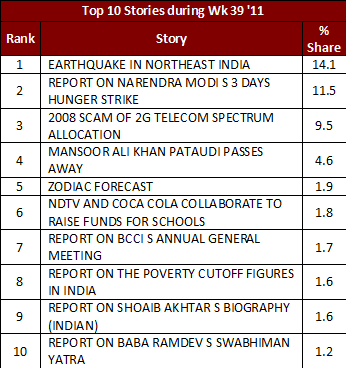
  • NCT Data Wk 39 ’11

    Source: News Content Track – A service of TAM Media Research Pvt. Ltd

    Channels: Aaj Tak, CNN IBN, Headlines Today, IBN 7, India TV, NDTV 24/7, NDTV India, Star News,

    Times Now & Zee News

    Period: Wk 39 – Sep 18 to Sep 24, 2011

    Note : Analysis is based on the telecast duration

    About TAM Media Research

    TAM is a joint venture between Nielsen Company & Kantar Media Research. Besides measuring TV Viewership, TAM also monitors Advertising Expenditure of Television, Print & Radio through its division AdEx India. Since 2004, it extended its presence in the PR Measurement & Analysis space for Corporate/Marketing Clients by setting up a separate division Eikona PR Measurement.

    In 2007, the joint venture introduced RAM (Radio Audio Measurement) service to track Radio Listenership for the Indian Radio Broadcast Industry. In year 2009, TAM launched a division, called TAM Sports that specializes in monitoring Sports Sponsorship ROI.

    TAM Media Research’s objective is to fuel media insights that will drive the growth of the Indian Media Industry.

  • Sircar is back as stand-in I&B secretary

    By A Correspondent

    Mr Jawhar Sircar, Sectretary, Ministry of Culure has been asked to hold additional charge as Secretary, Ministry of Information and Broadcasting. The move was necessitated as Mr Raghu Menon retired as Secretary on September 30. The last time Sircar was asked to do the honours was when Ms Sushma Singh retired as I&B secretary in 2009.

    Mr Sircar’s appointment was announced by way of a circular of the Ministry of Personnel, Public Grievances & Pensions. Here’s what the announcement said: “The competent authority has approved the following additional charge arrangement with effect from 1.10.2011 for a period of three months or until further orders, whichever is earlier”.

    Some info on Mr Sircar, courtesy the Ministry of Culture website: Mr Sircar is a student of Presidency College, Calcutta University and did his Honours in Political Science and obtained two Masters’ Degrees in Sociology and History.


    He has been actively involved with many cultural and academic bodies, like the Asiatic Society, the Victoria Memorial, the Centre for Archaeological Studies and the Kolkata Museum of Modern Art. He has been associated with one of the largest and most successful Book Fairs of the world, that is, the Kolkata Book Fair, since its inception. From the late 1990s, he also took the lead in upgrading the annual Kolkata Film Festival to a remarkable and recognized event of international standards.


    Mr Sircar has been engaged in serious research in social anthropology and was the Director of a field research project that covered 78 sites of ‘popular religion’ in six districts of Western Bengal. The present focus areas of his research are ‘the construction of identities’, the ‘deconstruction of religious phenomena’, folk religion, as also in popular culture and its interface with the semi-classical and classical forms He has published several articles and research papers on history, culture and society. His monograph on “The Construction of the Hindu Identity in Medieval Western Bengal : The Role of Popular Cults”, was well received in India and abroad.


    Photograph: Ministry of Culture, Government of India

  • IT use can bring transparency: Sibal

    By A Correspondent

    “Increased use of information technology will bring about transparency and accountability in the system,” minister for communications and information technology Kapil Sibal has said. Mr Sibal, inaugurating the 8th Assocham International Summit on e-Governance, added that the government would introduce the Electronic Services Delivery Bill in the next session of Parliament. This Bill is aimed at making public services available in only electronic mode in all State and Central government departments over the next five years.

    The scope of human intervention must be reduced with information and telecommunication technologies playing a lead role to curb corruption in public life and ensure good governance across the country, Mr Sibal added.

    He said that though the government is working on a new law to deal with the menace of corruption, only mass adoption of technologies for e-governance and m-governance can improve the quality and speed of public services delivered to citizens in urban and rural areas.

    “Much of the talk of corruption that we have had in the recent past will be dealt with through the initiative of IT. What we need to do is to ensure that the scope of human interface – which is the scope of all corruption – is excluded. IT should play an important role in finding solutions and we are in the process of doing it,” said Mr Sibal.

    By 2014, every gram panchayat in the country will be connected with fibre optic cables and the last mile connectivity will be with wireless broadband. The true empowerment of people is possible when government services are made available at the doorstep of every citizen – be it for tax returns, insurance premiums, banking operations or payment of e-bills, he remarked.

    Mr Dilip Modi, president of Assocham (The Associated Chambers of Commerce and Industry in India), said digital inclusion is the critical pillar of the chamber’s agenda of making inclusive transformation happen.


    “E-governance can bridge the gap between deficits and surpluses in rural and urban India. With six lakh villages in the country, land records need to be digitised. We are quite bullish on the internet’s potential to provide fair transparent governance structures,” said Mr Modi.

    Mr Umang Das, chairman of the Assocham National e-Governance Council, said the concept offers a unique opportunity to move away from piecemeal reforms to an era of institutionalised transparency.

    India has 73 million internet subscribers and the figure is poised to grow to 275 million by 2015, according to Assocham.

  • BIG FM does an item number for Diwali

    By A Correspondent

    It’s Diwali in the air, come October, and 92.7 BIG FM is joining the festivities with its game show, titled “Diwali Ke Item Bomb”.

    The main objective of this show will be to get as many people to win. In this on-air game listeners will be asked an extremely simple question, which if answered correctly will get them a chance to “spin” a roulette wheel on air and win fabulous prizes.

    The Diwali roulette wheel will spin across 30 markets and engage around a crore of consumers over six weeks through on-air and on-ground activities. With the game format designed keeping customer gratification in mind, the campaign is a major platform for brands to leverage.

    The on-ground activities will cover RWAs, schools and colleges where people will get to spin the wheel in person. To make it more exciting there is also a digital element to it, an application that allows people to test their minds, then spin the wheel and win.

    Commenting on the campaign, Mr Soumen Ghosh Choudhury, Business Head, 92.7 BIG FM said, “With our Diwali special property we promise to deliver highly engaging entertainment and more. With a reach across 30 markets and a well tailored offering that is designed to get one hooked and addicted, this property will allow listeners an excellent opportunity to win goodies this Diwali, while advertisers will find an appropriate platform to connect with Diwali revellers across the country.”

  • IRS 2011Q2 | State Watch: Dailies

    By Ritu Midha

    A quick look at data for top 10 dailies in a handful of states brings out a few interesting observations. Do write to us at editor@mxmindia.com with your own observations and insights.

    Bihar: All the newspapers show a positive growth vis-a-vis the previous quarter. Even when compared with the same quarter previous year, all the publications show a good growth except I Next. Interestingly English dailies too have grown – and in case of Times of India, it has maintained the same level as the previous year same quarter.

    Jharkhand: When it comes to its neighbour and a part of Bihar till recently it is quite a different story – six out of top 10 dailies show a negative growth – and it is across Hindi & English dailies.

    UP: Just like Bihar, UP too has shown a growth in all the publications as compared to the previous year with the exception of DLA. Amar Ujala compact is growing the fastest with readership increasing to double in comparison to same quarter previous year.

    Uttaranchal: Uttaranchal too shows growth in all the publications but one, when compared to the previous quarter. Interesting thing however is that Amar Ujala compact that shows the fastest growth figures in UP, here shows a drop of 61%, as compared to same quarter last year.

    MP: If one compares data for Q2, 2011 with Q2, 2010, Nava Bharat (MP) and Raj Express are the only two publications that shows a fall. Another interesting factor here is that The Times of India is the only English publication in the top 10, unlike UP and Bihar where there is almost an equal number of Hindi and English Publications.


    Chattisgarh: In case of Chattisgarh, there are three English dailies in the top 10, however all three show a negative growth when compared to the previous quarter. Though, in case of The Times of India, if compared with Q2, 2010, figures show a 27.3% growth.


    Himachal Pradesh: Six out of top 10 dailies show a negative growth when compared with the same quarter in 2010. Amar Ujala, on the surface, seems to have gained at the cost of Punjab Kesai, while in case of The Hindustan Times, it is at the expense of The Times of India. A deeper analysis, perhaps, can throw more light on it.


    Haryana: In case of Haryana, q2 2010 to Q2 2011, three publications show a downturn, but when it comes to Q1 2011 vs Q2, the downturn is seen in seven publications – all the three English papers in the top 10 show a percentage fall when compared to the previous quarter.


    Punjab: In case of Punjab, only two publications of the top 10 have witnessed positive growth when compared to Q2, 2010 – These are Ajit and Dainik Bhaskar. However, if one compares Q2 2011 with Q1, 2011 even The Times of India and The Tribune show positive growth.


    Maharashtra: In Maharashtra’s top 10 dailies, Times of India and its co-publication Mumbai Mirror are the only two English dailies. Market, as expected, is dominated by Marathi dailies. Deshonatti is the only daily that sees a double digit growth when compared to Q1, 2011 – however, that too shows a 17% fall when compared to Q2, 2010.


    Gujarat: Gujarat too has just one English daily in its top 10 – The Times of India, and it shows good growth in both quarters. Other non Gujarati daily in the top 10 shows a growth of 83.9%, when compared to Q2, 2010.

    To be continued…

  • Premjeet Sodhi’s Nascent Media: Stop over-simplification of media

    While, the core thought of this article about ‘over-simplification’ may apply to the overall domain of marketing, but I am using the setting of media planning to construct the view.

    Lets, first see what is the task or challenge that the media agencies take up in their business.Every advertiser expects the media planning agency to deliver performance for its business metrics. That is to say that – once a media plan is executed the brand manager expects sales to happen.

    Enough has been said about the increasing complexity of the market, the increasingly unpredictable and demanding consumer and the decreasing strength of brands. In such a scenario, the factors that lead to sales success are many. The classical models of marketing have now been replaced by far more dynamic models and media is only one of the many factors that influence sales. Hence, this is not a simple or easy expectation at all.
    Even a little bit of analytics will reveal that media has only got limited leverage to drive sales and this leverage varies for different categories and brands. However, there are other interim metrics leading to sales, such as brand recall, brand perception, brand enquiry, brand interactions, etc for which media can be held accountable for. There are so many marketing models and methods that help understand what a brand needs to deliver in media. None of these methods are simple.Looking at ‘media’ in isolation and expecting it to deliver sales is a naive simplification. 

    Media Planning is an intricate science. It deals with engaging extremely incredulous and volatile consumers to convince them of the merits of one of the score of brands that are available to them and possibly get them to move closer to buying the brand. In short, it deals with the wants and desires of people which can never be a simple subject to address.

    However, somewhere along the way in the past agencies have made advertises believe that this complex task can be broken up into two simple steps – (i) design the message and (ii) deliver the message to the desired consumer segment.

    Here, I will not comment on designing the message since I have already touched upon that in my earlier post titled “Creative is killing Creativity”. Lets look at the inherent simplification that has been cultivated in delivering the message.

    The first simplification was to strip each medium of its “qualitative” values and believe that each vehicle in a medium and across mediums can be represented by the measure of only “quantity”. 

    This made it very easy to measure media and trade media. One was only bothered about the count or reach as we call it. Research agencies made a killing setting up mammoth research projects measuring this lowest common denominator across media. Yes, there was a qualitative aspect but that was left to interpretation and application by the media planners. Now, we have the media planing community largely addicted and servile to these quantitative research databases totally oblivious to the qualitative value of the media they recommend.

    The second simplification was to believe that consumer minds can be affected just by managing the volume of this media measure. 

    The GRP was conceived – which is another simplification of the arithmetic that goes into making a media schedule and this GRP became the volume measure of  voice of the brand. Due to its simplicity, clients took to GRPs easily and it soon became a strong trading currency for media. Today, everything that is done is to create, deliver, manage, buy, sell – this GRP. This GRP comes in various reach and frequency packs and is available across media. This GRP has become the magic wand with which the client and the agency attempt to deliver market shares.

    The simplification is also evident in the remuneration structure that is prevalent in the industry. Everything that is done in communication is measured in terms of the traded value of media bought and the agencies are paid as a percentage of that. Since, actually estimating the real value contributed by media is difficult – so a percentage of spends keeps it simple.

    I guess, the whole media eco-system looks at the issues too simplistically and that is why “value-creation” is reducing day by day and leading to commoditization of media, media schedules, media talent and of media agencies. The advertisers will continue to simplify, but if, the media and advertising domain wants to enhance its value they will have to do away with this over-simplification. After all, Value is in the details.

  • More Garba-Dandiya in Mumbai papers please

    By Ranjona Banerji

    The more I watch TV news (mainly thanks to this blog, my life was far less complicated before this!!!), the more sorry I feel for TV journalists in India. The constant need to fill up air time with drama, pyrotechnics and hysterics must be overwhelmingly frightening. The news in Indian TV world can never just be about events taking place. It has to be worthy of a Cecil B deMille movie with a thundering Charleton Heston, several horses, a few small divine miracles and for the grand finale at the very least, the parting of the Red Sea.
    Monday night and Tuesday morning were full of the death of a National Conference worker in Jammu & Kashmir and the alleged involvement of chief minister Omar Abdullah somehow or the other, the arrest of Gujarat cop Sanjiv Bhatt for turning against the Narendra Modi government and to some extent, the clarification by Montek Singh Ahluwalia on the Planning Commission’s poverty figures.
    **
    Tuesday morning’s newspapers found merit in Bhatt’s arrest and Ahluwalia’s statement but dismissed the J&K fight to a few paras on the nation pages. TV however continues with the story because it has drama and for many of our uber-nationalist TV journalists, J&K has a special fascination. The Indian Express Delhi edition however led with J&K. The Hindu focused on the ongoing Telengana stir which has been downplayed by Mumbai papers at least.
    In fact, the poverty issue has been given full range in our newspapers. The Times of India however has carried two intriguing opinion pieces. Arvind Panagriya, who teaches at Columbia University decided that our high child malnutrition figures are manipulated. And Swaminathan S Anklesaria Aiyer, who normally illuminates economic matters for us lesser mortals, mocked the sudden middle class interest in poverty. Contrastingly, on Sunday, The Hindustan Times carried an excellent piece by Kirit Parikh on our poverty measures. TOI on Tuesday has Parikh going further and discussing the failures of our PDS system.
    **
    Strangely, the anti-Wall Street protests going on all over the United States have not picked up traction in India. One would have thought this would be good grist to the drama mill. Also, given how Indian TV went to town when pop star Michael Jackson died, his murder trial is being largely ignored, in spite of all the dramatic revelations on a daily basis.
    **
    This is a particularly Mumbai-related complaint. The Navratri season is almost at the end and most newspapers have concentrated only on Durga Puja pandals all over the city. Where are all the pictures of garba and dandiya? I hear and see the dancing in real life but cannot find it in my newspapers? What is going on? I understand that the media is chockfull of Bengalis and people from East India, but as a hardened Mumbaikar (please ignore my name and its implications in your mind), I do expect to see Navratri represented in my newspapers.