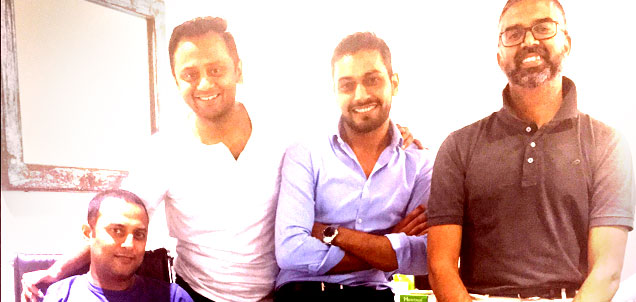
A few years back, not many would have known about Dentsu Creative Impact. But their debut at Goafest 2016 sure got everyone to sit up and take notice. A part of the Dentsu Aegis Network, they won 2 Gold, 3 Silver and 18 Bronze metals across seven categories, which included Radio, Print Craft, Print Single, Direct, Design, Ambient and OOH (Out Of Home advertising). Competing against seasoned industry names, the win did take everyone by surprise. Pradyuman Maheswari speaks to Narayan Devanathan, Group Executive and Strategy Officer, (erstwhile CEO, Dentsu Creative Impact); Amit Wadhwa, President, Dentsu Creative Impact; Kartikeya Srivastava, SVP & Head of Strategic Planning, Dentsu Creative Impact; and Soumitra Karnik, NCD, Dentsu India Group, the men instrumental in making this happen.
23 metals at Goafest, the # 4 creative agency… how it did happen, all of a sudden?
Soumitra Karnik (SK): I think it has been part of the plan. It is not something that has surprised us because we went about it very methodically. In the first few years, we had to stabilise the business side of Dentsu. And then very clearly we defined what the creative product will be eventually. So, even the hiring of the people that we have been doing for the past some time is in line with what we are seeing now.
You all have been around for a while, why did you enter Goafest now and not earlier?
SK: Team structure-wise we were not there very clearly. And when you say Dentsu has been around for a while, we count only the last four years. A lot of people from different agencies came together for a common cause.. There was no single vision or agenda. I think I give credit to Rohit (Ohri), he really brought the people together, from that point, we say, the birth of Dentsu 2.0 started, four years back.
What were the milestones achieved in this journey?
Amit Wadhwa (AW): If you cut to 2012, the basic objective was survival at that point of time.
That was when when Sandeep Goyal moved out?
2011 is when he moved out. Probably it was December, when we came together and obviously that was the year closing also. For all of us it was like, oh, is it a good thing that we have done?
All of you came together despite knowing the fact where Dentsu was….
AW: What we were trying to achieve was something that we could have created history or become history. But we finally did manage to create one. At that time it was a big challenge. Finally, the likeminded stuck together and we managed to pull it off. At that point of time, the basic objective was how do we grow and obviously our business and creative are linked together. The prime importance was we needed to be above floating line, we needed to manage the numbers nicely. We won a lot of businesses in 2012
Kartikeya Srivastava (KS): I was already there in Dentsu and you know everybody came together. To me, it has been a huge turnaround story. The three-four years saw the strengthening the fundamentals and foundation. Having lived in the early 2011 era, it was not even an advertising agency, to be very honest. The key really to our turnaround for me was the instilling of the right culture. It is an organic process and over the three years we have built a strong culture base.
What is the current staff-strength?
110 people at Dentsu Creative Impact (DCI) based out of Gurgaon.
What did you aspire to be eventually?
Narayan Devanathan (ND): Probably not size-wise but focus more on quality.
AW: In terms of numbers, I do not want to go by number of people. But we intend to grow 40% this year. So,we are not stopping on growth in the number front but what we are saying and seeing is that if we are doing well in the creative front, the other bit of growth will automatically come.
Santosh Padhi made a statement at Goafest that, ” Those guys are 2000 people, so many offices. We are 40 people and we got 40 metals and they have got 47″. So, how much does size matter?
SK: It does. I have been part of JWT for a very long time. It is a very strong network, it is a very well-oiled machinery, resources are available. The culture already exists for the past 100-odd years. So, the network support eventually, whether you call it financially or in terms of manpower, it does make a difference.
But in terms of, if metals are the indicators of how good you are, then Taproot has got 40…
All: That is fantastic.
SK: That is the point he was making. If these guys have 2000 people and if 1000 fire, it is still a substantial number.
ND: Eventually it boils down to the focus. Like Amit and Kartik said, last 3-4 years we were about stability. What we like to say is that, this is kind of bungee jumping. If the rope holds, thrill of a lifetime and if it doesn’t, hopefully you won’t feel the pain. But to add to Amit’s point is that, this is a ship that needs turning around and it won’t happen if people are standing on the shore and cheering. It is all hands on deck, power to everybody in the ship. That’s what is happening right now. This is the focus that we are driving towards to push stability. Creative excellence will take us further.
Where does DCI fit into the larger Dentsu portfolio?
ND: Each has an individual identity. Back in 2013, when Taproot became part of the group, we thought of it as a tugboat to pull the ship. But right now, this is more than a tugboat. Creative Impact on its own steam is going to take the Dentsu brand forward. Where we are now, there is enough steam on our own.
What were the surprises like? Was it a “God, these guys exist?”
KS: No, the surprise was that ” Oh god! We never knew these guys would exist”. The fact of the matter is that we were up against biggest agencies in the business. We could pull the rug out of a lot of people’s feet was happening, stood out for DCI.
AW: If you look at what we have been trying to do and what we have been trying to do and what we have done so far, we have managed to surprise. No one expected us to win. We managed to surprise them by winning 80% of the pitches in 2012 itself and managed to hold on to handle one brand of HT, now we handle 4 brands of HT, from 4 brands of Maruti Suzuki to 13 brands of it.
12. Where does DCI stand among other networks and why people should look at you’ll for their brandsand not the others?
ND:. There’s a reason behind it and the reason is that this is the difference in Creative Impact. It continues to be young and the average age is 28. It’s the young being fearless and thinking there’s nothing to lose. Bringing the A game whatever the consequence may be, not being afraid to do the unsafe.
There are agencies which are creatively run and some by suits. What about DCI?
SK: DCI runs creatively.. A simple reason is we all are creative. If one person comes into our thinking sessions, it could be a planning guy cracking an idea, could be an account management guy, it could be anyone. It is a free flowing session. What I say as a creative leader, when we started advertising, none of us said that we want to be an account management guy. We all said we want to be an advertising guy. So, all of us have to be ideas people. The thinking is creatively driven kind of a thing. Ultimately, we all drive towards creating a creative idea.
Is it really that everybody does everything?
AW: I’ll give you an example. We discussed this around 2013.. We had gone into a bit of rhythm, we had managed some numbers, we were stable and we said okay, next what? What should be our positives? What should be our playground? How should we be running the show? All of us are creatively linked. I keep pestering Soumitra with some idea or other, most of them he rejects. So does Kartik. We all have that creative streak. What we decided was that anyone and everyone who comes into the system needs to have that streak. SK: But you’re right that so far it has worked, going forward it might not. Nowadays, people are open. If I were reading the same article you’ll publish, I would be worried that here’s an agency where an account person is meeting the creative person. But it is not as bad as it sounds.
ND: I would be as cynical as you, if I read that. ‘Yaar ek aur agency aagayi, phir wohi baat bol raha hai’. But,two indications. Can’t name the client, as recently as last week, some grey hair and experienced heads were in the room defending this out-of-the-box idea that we had presented to the client. How much logic we put in front of the client , they weren’t buying it. The juniormost writer in the team stood up and said ‘ You know who are you trying to sell this to? You’re trying to sell this to me’. He made an amazing argument and didn’t hesitate to speak up. This is one indication. The other is a ghar wapsi movement. People have switched from our agencies to other agencies and it’s been less than 3 months they said ‘ ‘Acchi jagah nahi hai yeh. Can we come back?’. For us it is a testimony that we’re doing something right.
What is the path ahead?
AW: In terms of numbers we are very clear on how we want to go. But we are selective about what all we are going for. So,what is of prime importance is the set of brands that we have . Usually, what happens is that in the stretch of growing you go on pitching and you start neglecting the existing brands. It’s a conscious decision that we are going to make sure that we deliver on existing brands and obviously grow also. What will talk about us is the work we create.
SK: What could be flattering was that Aggie called up. He was in London that time. He has already set us the next year’s target. He said you guys should be the next Taproot. That’s a clear target, work wise and expectations also in the network,coming from the guy.
Awards are an indicator that you have arrived. How do you think you fare if you were to enter some of your work with Effies?
ND: Honestly, it’s a journey. Part of it is oriented internally to approach so that the data mindset is there. Fortunately or unfortunately, the Effies are the brand put together under case studies rather than work that has been envisioned and has been done. You have a data from an independent firm, that maps the results, which is always not the success seen on ground. Not all of our clients or us are oriented towards working like that.
KS: This is a start. I’ve always felt, professionally, that Effies are a great way to judge, to get recognition. The kind of work that we do today make us a good case.
How are you aligned towards 2017 where Dentsu wants to be the #2 agency network in the country?
SK: I don’t think specifically it would be awards and cut-throat competition and we’ll start doing work only for awards. Have we tasted blood? Yes. Does it add to the expectations of the network? Yes. So, I think we are completely aligned with the vision set in front of us both in terms of business and creative output.
ND: I would like to add what Amit was saying earlier about where next. And I’m coming at it from a not just Creative Impact point of view but specifically, I would like to make it about Creative Impact. One of the things we have going forward, biggest strength is that we are part of the Dentsu Aegis network and therefore the partners that we have within the group driving growth organically, through the networks internally, is the key KRA for all of us. But what Amit has done and this team has done is quietly without talking about it made it work already.
AW: And it’s important what Dentsu Aegis brings to the table, the scope of thinking has widened. We think of an idea and keep the rest for the client to execute. Now we know the intricacies of the other mediums, because we sit together, work together, interact a lot more and the idea is very closely guarded. What we have realised in the last few months is that clients are appreciating that a lot. And, the kind of output we’re getting is far far better. That’s another part of the change that is happening at DCI.
ND: We are lucky to have a creative leader like Soumitra who never starts a meeting by saying TVC banate hain. ‘ Kya idea kya nikalna hain first’ and then it will take form.