Tag: Goafest 2016

  • What’s made Dentsu Creative Impact #4 at Goafest Abby?

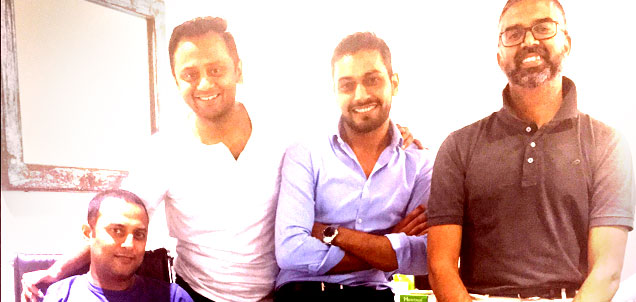
    L to R: Soumitra Karnik, Kartikeya Srivastava, Amit Wadhwa and Narayan Devanathan


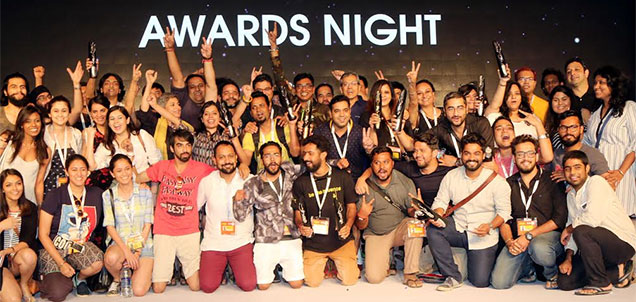
    A few years back, not many would have known about Dentsu Creative Impact. But their debut at Goafest 2016 sure got everyone to sit up and take notice. A part of the Dentsu Aegis Network, they won 2 Gold, 3 Silver and 18 Bronze metals across seven categories, which included Radio, Print Craft, Print Single, Direct, Design, Ambient and OOH (Out Of Home advertising). Competing against seasoned industry names, the win did take everyone by surprise.  Pradyuman Maheswari speaks to Narayan Devanathan, Group Executive and Strategy Officer, (erstwhile CEO, Dentsu Creative Impact); Amit Wadhwa, President, Dentsu Creative Impact; Kartikeya Srivastava, SVP & Head of Strategic Planning, Dentsu Creative Impact; and Soumitra Karnik, NCD, Dentsu India Group, the men instrumental in making this happen.


    23 metals at Goafest, the # 4 creative agency… how it did happen, all of a sudden?

    Soumitra Karnik (SK): I think it has been part of the plan. It is not something that has surprised us because we went about it very methodically. In the first few years, we had to stabilise the business side of Dentsu. And then very clearly we defined what the creative product will be eventually. So, even the hiring of the people that we have been doing for the past some time is in line with what we are seeing now.


    You all have been around for a while, why did you enter Goafest now and not earlier?

    SK: Team structure-wise we were not there very clearly. And when you say Dentsu has been around for a while, we count only the last four years. A lot of people from different agencies came together for a common cause.. There was no single vision or agenda. I think I give credit to Rohit (Ohri), he really brought the people together, from that point, we say, the birth of Dentsu 2.0 started, four years back.


    What were the milestones achieved in this journey?

    Amit Wadhwa (AW):  If you cut to 2012, the basic objective was survival at that point of time.


    That was when when Sandeep Goyal moved out?

    2011 is when he moved out. Probably it was December, when we came together and obviously that was the year closing also. For all of us it was like, oh, is it a good thing that we have done?


    All of you came together despite knowing the fact where Dentsu was….

    AW: What we were trying to achieve was something that we could have created history or become history. But we finally did manage to create one. At that time it was a big challenge. Finally, the likeminded stuck together and we managed to pull it off. At that point of time, the basic objective was how do we grow and obviously our business and creative are linked together. The prime importance was we needed to be above floating line, we needed to manage the numbers nicely. We won a lot of businesses in 2012


    Kartikeya Srivastava (KS): I was already there in Dentsu and you know everybody came together. To me, it has been a huge turnaround story. The three-four years saw the strengthening the fundamentals and foundation. Having lived in the early 2011 era, it was not even an advertising agency, to be very honest. The key really to our turnaround for me was the instilling of the right culture. It is an organic process and over the three years we have built a strong culture base.


    What is the current staff-strength?

    110 people at Dentsu Creative Impact (DCI) based out of Gurgaon.


    What did you aspire to be eventually?

    Narayan Devanathan (ND): Probably not size-wise but focus more on quality.


    AW: In terms of numbers, I do not want to go by number of people. But we intend to grow 40% this year. So,we are not stopping on growth in the number front but what we are saying and seeing is that if we are doing well in the creative front, the other bit of growth will automatically come.


    Santosh Padhi made a statement at Goafest that, ” Those guys are 2000 people, so many offices. We are 40 people and we got 40 metals and they have got 47″. So, how much does size matter?

    SK: It does. I have been part of JWT for a very long time. It is a very strong network, it is a very well-oiled machinery, resources are available. The culture already exists for the past 100-odd years. So, the network support eventually, whether you call it financially or in terms of manpower, it does make a difference.


    But in terms of, if metals are the indicators of how good you are, then Taproot has got 40…

    All: That is fantastic.


    SK: That is the point he was making. If these guys have 2000 people and if 1000 fire, it is still a substantial number.


    ND: Eventually it boils down to the focus. Like Amit and Kartik said, last 3-4 years we were about stability. What we like to say is that, this is kind of bungee jumping. If the rope holds, thrill of a lifetime and if it doesn’t, hopefully you won’t feel the pain. But to add to Amit’s point is that, this is a ship that needs turning around and it won’t happen if people are standing on the shore and cheering. It is all hands on deck, power to everybody in the ship. That’s what is happening right now. This is the focus that we are driving towards to push stability. Creative excellence will take us further.


    Where does DCI fit into the larger Dentsu portfolio?

    ND: Each has an individual identity. Back in 2013, when Taproot became part of the group, we thought of it as a tugboat to pull the ship. But right now, this is more than a tugboat. Creative Impact on its own steam is going to take the Dentsu brand forward. Where we are now, there is enough steam on our own.


    What were the surprises like? Was it a “God, these guys exist?”

    KS: No, the surprise was that ” Oh god! We never knew these guys would exist”. The fact of the matter is that we were up against biggest agencies in the business. We could pull the rug out of a lot of people’s feet was happening, stood out for DCI.


    AW: If you look at what we have been trying to do and what we have been trying to do and what we have done so far, we have managed to surprise. No one expected us to win. We managed to surprise them by winning 80% of the pitches in 2012 itself and managed to hold on to handle one brand of HT, now we handle 4 brands of HT, from 4 brands of Maruti Suzuki to 13 brands of it.


    12. Where does DCI stand among other networks and why people should look at you’ll for their brandsand not the others?

    ND:. There’s a reason behind it and the reason is that this is the difference in Creative Impact. It continues to be young and the average age is 28. It’s the young being fearless and thinking there’s nothing to lose. Bringing the A game whatever the consequence may be, not being afraid to do the unsafe.


    There are agencies which are creatively run and some by suits. What about DCI?

    SK: DCI runs creatively.. A simple reason is we all are creative. If one person comes into our thinking sessions, it could be a planning guy cracking an idea, could be an account management guy, it could be anyone. It is a free flowing session. What I say as a creative leader, when we started advertising, none of us said that we want to be an account management guy. We all said we want to be an advertising guy. So, all of us have to be ideas people. The thinking is creatively driven kind of a thing. Ultimately, we all drive towards creating a creative idea.


    Is it really that everybody does everything?

    AW: I’ll give you an example. We discussed this around 2013.. We had gone into a bit of rhythm, we had managed some numbers, we were stable and we said okay, next what? What should be our positives? What should be our playground? How should we be running the show? All of us are creatively linked. I keep pestering Soumitra with some idea or other, most of them he rejects. So does Kartik. We all have that creative streak. What we decided was that anyone and everyone who comes into the system needs to have that streak. SK: But you’re right that so far it has worked, going forward it might not. Nowadays, people are open. If I were reading the same article you’ll publish, I would be worried that here’s an agency where an account person is meeting the creative person. But it is not as bad as it sounds.


    ND: I would be as cynical as you, if I read that. ‘Yaar ek aur agency aagayi, phir wohi baat bol raha hai’. But,two indications. Can’t name the client, as recently as last week, some grey hair and experienced heads were in the room defending this out-of-the-box idea that we had presented to the client. How much logic we put in front of the client , they weren’t buying it. The juniormost writer in the team stood up and said ‘ You know who are you trying to sell this to? You’re trying to sell this to me’. He made an amazing argument and didn’t hesitate to speak up. This is one indication. The other is a ghar wapsi movement. People have switched from our agencies to other agencies and it’s been less than 3 months they said ‘  ‘Acchi jagah nahi hai yeh. Can we come back?’. For us it is a testimony that we’re doing something right.


    What is the path ahead?

    AW: In terms of numbers we are very clear on how we want to go. But we are selective about what all we are going for. So,what is of prime importance is the set of brands that we have . Usually, what happens is that in the stretch of growing you go on pitching and you start neglecting the existing brands. It’s a conscious decision that we are going to make sure that we deliver on existing brands  and obviously grow also. What will talk about us is the work we create.


    SK: What could be flattering was that Aggie called up. He was in London that time. He has already set us the next year’s target. He said you guys should be the next Taproot. That’s a clear target, work wise and expectations also in the network,coming from the guy.


    Awards are an indicator that you have arrived. How do you think you fare if you were to enter some of your work with Effies?

    ND: Honestly, it’s a journey. Part of it is oriented internally to approach so that the data mindset is there. Fortunately or unfortunately, the Effies are the brand put together under case studies rather than work that has been envisioned and has been done. You have a data from an independent firm, that maps the results, which is always not the success seen on ground. Not all of our clients or us are oriented towards working like that.


    KS: This is a start. I’ve always felt, professionally, that Effies are a great way to judge, to get recognition. The kind of work that we do today make us a good case.


    How are you aligned towards 2017 where Dentsu wants to be the #2 agency network in the country?

    SK: I don’t think specifically it would be awards and cut-throat competition and we’ll start doing work only for awards. Have we tasted blood? Yes. Does it add to the expectations of the network? Yes. So, I think we are completely aligned with the vision set in front of us both in terms of business and creative output.


    ND: I would like to add what Amit was saying earlier about where next. And I’m coming at it from a not just Creative Impact point of view but specifically, I would like to make it about Creative Impact. One of the things we have going forward, biggest strength is that we are part of the Dentsu Aegis network and therefore the partners that we have within the group driving growth organically, through the networks internally, is the key KRA for all of us. But what Amit has done and this team has done is quietly without talking about it made it work already.


    AW: And it’s important what Dentsu Aegis brings to the table, the scope of thinking has widened. We think of an idea and keep the rest for the client to execute. Now we know the intricacies of the other mediums, because we sit together, work together, interact a lot more and the idea is very closely guarded. What we have realised in the last few months is that clients are appreciating that a lot. And, the kind of output we’re getting is far far better. That’s another part of the change that is happening at DCI.


    ND: We are lucky to have a creative leader like Soumitra who never starts a meeting by saying TVC banate hain. ‘ Kya idea kya nikalna hain first’ and then it will take form.
     

  • Goafest Young Abby winners donate award monies to NGO

    By A Correspondent


    The winners of Goafest 2016 Young Abby Awards – Bodhisatwa Dasgupta & Nitesh Sah – have asked the Abby Awards Governing Council to cancel their trip to the Cannes Advertising Festival that they won and donate the money to an NGO that woks in elimination of gender violence.


    Bodhisatwa and Nitesh, both currently employed at JWT, had won the coveted Gold medal of the newly launched Young Abby Awards at the recently concluded Goafest 2016. The duo had won the metals and much accolade for their campaign against gender violence and were scheduled to undertake a fully funded trip to the Cannes Advertising Festival in mid-June this year.


    Honoring the request of the inspiring young achievers, The Abby Awards Governing Council has decided to contribute a sum of Rs 8 lakh (the monetary equivalent of the trip cost) to reputed NGOs doing significant work in the field of gender violence and sensitisation.


    Talking about their intent behind this noble initiative the young guns Bodhisatwa Dasgupta and Nitesh Sah said: “It all started with the brief, really. The task was to do an ad campaign that lessened the number of incidents of gender violence in India. Now I have huge respect for advertising. Advertising can do many great things. But lessen the incidents of gender violence on-ground – Not so much to the last mile. We knew what we had to do. We though if you’re really serious about gender violence, don’t send us to Cannes (as was promised to the winners).  Instead, donate the money you would spend on a lavish trip to an NGO that works closely with rehabilitating victims. We’re glad our entry won and happier still that the Goafest team agreed to donate the money, as was humbly requested” .


    Speaking about the encouraging move by the duo, Nakul Chopra – Chairman of Goafest Organizing Committee said “Such thoughtful steps by the young showcase their greatness and acts as a great motivation for all around. It is uplifting and humbling to see the two super achievers from the advertising fraternity take such an inspiring stance. We are happy to able to contribute in their cause and hope that more and more youngsters continue to be moved and inspired by their contribution.”


    Added Ramesh Narayan – Chairman of the Awards Governing Council of Goafest 2016 said “The advertising fraternity prides in its power and potential to be agents of change in society.  These two young guns Bodhi and Nitesh and their highly honorable initiative is an inspiration for all of us to walk the talk. I have always been honored to be a part of this industry but today I’m honored that I work among such talented and compassionate individuals.”


    The winning campaigns by Bodhisatwa Dasgupta and Nitesh Sah – Question, Kidding, Old Fashioned is centered around the evils of gender violence and the need to eliminate it.  The duo endeavored to make a real difference with their campaign and their move towards giving up their winning prize trip is another step towards bringing change and awareness on the issue of gender violence in India.


  • 4 noteworthy trends from the Creative Abby 2016


    By Ajay Chandwani


    The Goafest Creative Abbys this year saw a few macro trends judging by the participation and results.


    The most important highlight was the enthusiastic participation by over 300 companies sending in over 4600 entries. The Abby Award which is in its 49th year has now truly come of age. It has evolved into a communication award with ad agencies and marketing companies sharing the platform with organisations from Digital, Direct, Design, PR, Film Production, Promotion, Branded Content, Broadcaster and Publisher domains.


    1. Digital Dominates with the five-minute video

    This year, the digital vertical overtook every other vertical in entries firmly establishing the growing importance of this medium of today.


    One of the highlights of digital companies entering this year is the popularityof online videos which has now become as large as a category. The birth of the five-minute HD film made for the internet is definitely the trend of the year. Many companies are seeing the advantages of creating mood, atmosphere and attitude in long format digital films with both clients and film producers relishing the possibilities opened up by the luxury of extra time.


    2. Craft Rules!

    Craft in Print, Design, Out-of-Home and Film continues to push the envelope and seems to have been raised to a new high even though gold-winning ideas may have become scarce. Photography, illustration and use of copy made more impact than great ideas per se.


    Going by last year’s Indian performance in International festivals like Cannes One Show and D&AD it was apparent that Craft  in Print and Design is slowing gaining momentum as an Indian strength even as we continue to struggle to produce gold winning ideas in film and mainstream verticals.


    3. Blurring of Sub-categories

    A trend visible was the blurring of some of sub-categories caused by work which is rooted in the digital space. For instance, work entered in Direct which is based on use of Digital Marketing will also find its way in other verticals like Digital or Promotion and Activation as the case may be.


    4. Birth of two ‘Nice’ Categories

    It was heartwarming to see the first lot of entries in the debutant categories of Gender Sensitive Abby and Young Abby. Even though entries were not too many being the first year, the quality of work entered was good and it kept the juries engrossed in discussion.


    The Glass Lion last year and the Gender Sensitive Abby this year are among the nicest things to have happened to two of the most iconic awards shows atleast in terms of Indian participation. More and more creative folks are now sensitive to communication that connects with the audience at a deeper level.


    As we look back on the cheering crowds at Goafest, it’s good to remind ourselves the need to keep looking harder for the elusive big ideas even as kudos must go out to all those metal winners who made it worthwhile to celebrate creativity!


    Ajay Chandwani is Director, Percept Ltd and a Member of the Awards Governing Council of the Goafest Abbys and of the Managing Committee of the Advertising Club


  • JWT India, Mindshare top Abby 2016 tally


    By A Correspondent


    “It’s a hat-trick and we are proud of it,” said Senthil Kumar, Chief Creative Officer, JWT South Asia when he learnt that his agency had bagged the maximum number of metals. Santosh Padhi, Co-founder and Chief Creative Officer at Taproot Dentsu, was elated by his team’s showing. Though a not-so-distant first runner-up, Paddy, as Padhi is known in the industry, accepted the kudos and then said: “We are a small organisation with just 40 people and have won 40 awards. Imagine if we had a 2,000-member staff.” For Prasanth Kumar, CEO, Mindshare South Asia, a rich haul of 17 metals at the Media Abby is a continuation of the agency’s winning ways after last year’s Emvies Awards.


    Although the knowledge sessions are big draws in every edition of Goafest, the buzz-creator is always the Abby Awards. This year has been the best ever for the Abby in terms of the number of entries. There were 4,460 entries sent in by 299 organisations for the Creative and Media Abby Awards. In 2015, this number was 3,475. But while the number of Silver metals in the Creative categories have increased from 107 last year to 134 this year, and 180 Bronzes last year to 245 this year, there has been a sharp fall in the number of Gold Abbys given out. There were 71 Gold Metals given out last year and in 2016, the number is just 38. Also, last year, there was one Grand Prix winner, but this year there have been none.


    So are we saying that in a country of a billion-plus people where we pride ourselves on creative output and storytelling skills, the standards of creative work have fallen? Ajay Chandwani, a member of the Awards Governing Council, said it’s possibly not correct to say that. But added that the jury was indeed tough on what should be winning awards. “Grand Prix indicates a significant change in paradigm in a category,” he said.


    A new award was instituted this year which can loosely be defined as falling between a Gold and a Grand Prix. It’s called the Best in Medium or Category, and the Ambuja Cements ad, starring WWE star Khali and created by Publicis Communication, bagged the award. There was only one Best in Category award given away this year.


    Two new categories were introduced this year, one in keeping with the growing awareness that ads need to be gender-sensitive, and the other was called the Young Abby where the winners received an all-expenses paid trip to the Cannes Lions.


    Interestingly, and even though all the agencies entered the awards separately, Goafest 2017 saw the emergence of Dentsu Aegis Network as a serious contender on the awards circuit with 6 Golds, 32 Silvers and 45 Bronze metals aggregating a total of 83 metals.


    On Day 2 of the Abby Awards, Piyush Pandey, Ogilvy India Executive Chairman and Creative Director and Times of India group Managing Director Vineet Jain were felicitated.


  • Gyaan Unlimited at Goafest

    By Labonita Ghosh


    When you see members of your team pack floral shirts and shorts as they head to Goa, it’s hard to believe they have anything other than partying on their minds. But Goafest — organised by the Advertising Agencies Association of India (AAAI) and The Advertising Club, which forms the backdrop to the ad world’s best-known creative awards, the Abby – is able to strike a great balance. There is a lot of out-of-office bonhomie and boisterousness (and more than a reasonable amount of liquids flowing), but the days are filled with interactions with industry movers and shakers, sessions by thought leaders from around the globe and an invaluable swapping of insights and tips.


    Goafest 2016, in its eleventh year, upped the bar quite a bit. With some 2,400 delegates and 4,460 entries for the Creative and Media Abby, the 2016 edition was the biggest Goafest yet. Two new categories were also introduced, to keep pace with the rapidly-changing times: The Young Abby and an award for gender sensitivity. A more digitally-enabled Goafest greeted delegates who could download the app and post their questions for various speakers on it.


    Ambi M G Parameshwaran, President, Advertising Agencies Association of India said: “The last three days saw some of the brightest minds from the world of media, marketing and advertising congregating to make Goafest 2016 an exciting experience for all. Undoubtedly this was the biggest Goafest and the most well balanced — over 15 seminar sessions, three award shows, two sundowner parties and three after parties — all done in one venue, both indoors and outdoors.”


    According to Raj Nayak, President of The Advertising Cub: “As organisers, we tried to create a unique and wholesome experience for all the delegates attending the event to ensure that everyone had an interesting takeaway when they leave from Goa at the end of the festival.”


    Indeed, the organisers had a stellar line-up of speakers from the ad and marketing world, and the tedium of industry-specific sessions was broken by talks by writer-columnist Shobhaa De, former Army man and founding-CEO of the security agency Natgrid Raghu Raman, and young writer Varun Agarwal, and an interaction former cricketer Arjuna Ranatunga and journalist Rajdeep Sardesai.


    The session that really packed them in — and had everyone in splits – was a freewheeling tete-a-tete between adman-filmmaker R Balki and director-producer Karan Johar, where they chatted about marketing, the Oscars and Bollywood, of course. As for the seminars, they were divided into three industry-specific themes. Day 1 was about forging better client-agency partnerships, which was followed by better marketing of brands on the second day, while the last day was about using data and technology to leverage creativity.


    Chandramouli Venkatesan, Managing Director of Mondelez India (the makers of Cadbury) opened the first day with the instantly-engaging idea that client-agency partnerships need to be like that of Jai and Veeru, the protagonists from the film Sholay. “It should be a study in contrasts. A client and an agency, who are two different entities, coming together to create magic,” he said. “Not two entities who think in a similar manner.” But no matter how different, they must have a shared purpose and passion, and a friendship that allows each to challenge the other to do better. Samar Singh Sheikhawat, Senior Vice President, Marketing, at United Breweries had a slightly different take when he said that agencies first need to get to know the business (almost as well as the client) if they are to offer any worthwhile solutions. Sheikhawat says he facilitates brewery visits for agency execs he works with, just as he had to – early on in his career – spend time in the offices of advertising stalwarts like Roda Mehta, to understand the agency side of things. Oliver Maletz, head of connections planning, media and international communication at Volkswagen, in his session, outlined that agencies need to be true business partners to clients, along with being innovators (though not just for the sake of innovating) and aim to deliver meaningful value to a meaningful number of people.


    The second day, which was about better marketing your brand, had Benny Thomas, strategy head at Crispin Porter + Bogusky, talk about gauging a ‘return on creativity’ instead of the rather more prosaic(but financially-necessary) RoI. One way to ensure that a client accepts a brilliant idea, is to bombard it with hundreds of others. “If you give clients 200 ideas, they are bound to pick one,” Thomas said, giving the example of a campaign-turned-social initiative called Small Business Saturdays, that was spearheaded by his agency and has now become a local trade promotional in the US. Tara Marsh, global head of content at Wunderman, dealt with how neither clients nor agencies give enough importance to the behavioral aspects of consumers that make them choose one brand over another. “Your content needs to be something that users will choose to spend time with,” she added. Prakash Sangam, CEO of the RedBus and writer-filmmaker Varun Agarwal provided the ‘inspiration quotient’ for the day. Sangam, who has successfully run a bus-booking portal, talked about how the bus industry (like so many others) has been transformed by technology. Now, passengers can download apps to not only book tickets and select seats, RedBus has enabled various kinds of information conveniences to travellers.


    In today’s world, much more of both data and technology is available, but advertisers and marketers are not using it enough, feels Carter Murray, Worldwide CEO of FCB. “Most marketers use data for only six per cent of their decisions,” Murray said. “Data is waiting for its [Martin] Scorsese – where marketers use data to make the creative product better, not just to drive change.” Jean Lin, Global CEO of Isobar, in her talk, outlined seven breakout things that indicate a changing landscape (e-commerce, borderless buying, programmatic videos etc) and said the future of brands is clearly brand commerce. “[Marketers] need to bring the brand inspiration closer to the point of transaction,” she said adding that ideas that reimagine that last mile are the ones that are likely to survive in an ever-changing world. While Fergus O’Hare, Director of Facebook Creative Shop, APAC, took the idea of providing creativity with a crucible of technology by giving examples of how Facebook as a platform could be used to deliver personalised marketing at scale through mobile, Alasdair Lennox, Executive Creative Director, EMEA, Fitch discussed how ‘advertising’ as a word will die out, and be replaced by the concepts of ‘experience’ and ‘conversations’.


    That’s not all. Goafest also give participants a chance to view lots and lots of great advertising and hear behind-the-scenes stories about some of the most successful initiatives in the world – often from people who have been in the trenches themselves. While YouTube makes it possible to watch every ad ever aired, you’d never know about Nivea’s remarkable sunburn campaigns, or Kraft’s marketing of its healthier mac-and-cheese option without changing its packaging, or even learn how Paypal caught people’s attention by putting their faces on dollars, if it weren’t for the seminars. You would’ve heard of Burger King’s Subservient Chicken or seen Cadbury’s eyeballs-grabbing Gorilla beating a drum, but to know about the incisive decisions that shaped these seemingly-inane promos, is something else. Closer home, if you’ve ever wondered why messy chocolate-eating has become adorable on TV, you had to hear it from the people who made the Dairy Milk ads. And the thumping success of cutting-edge campaigns like Domino’s Anyware (ordering pizzas with a tweet) and Disneyland’s MagicBand (a bracelet that is park ticket, hotel key and credit card rolled into one) was brought to life by the global speakers’ analysing the social impact these have had. Indeed, Netflix’s ads have sparked a sociological phenomenon of ‘TV adultery’ (watching ahead to the next episode of a show without your spouse) in the US. This year’s Goafest had all of that. Indeed.


    In arrangement with MxMIndia.com


  • Winnning ways for Mindshare


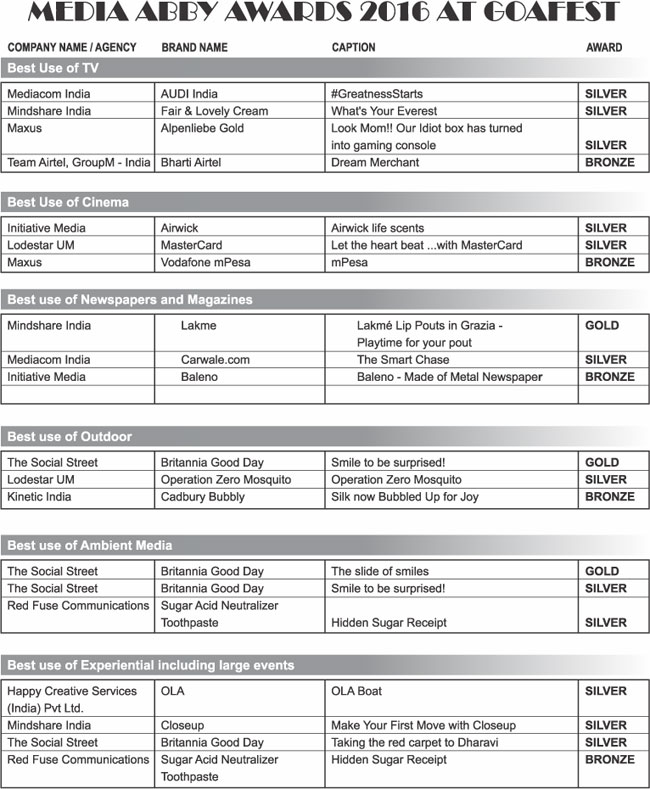
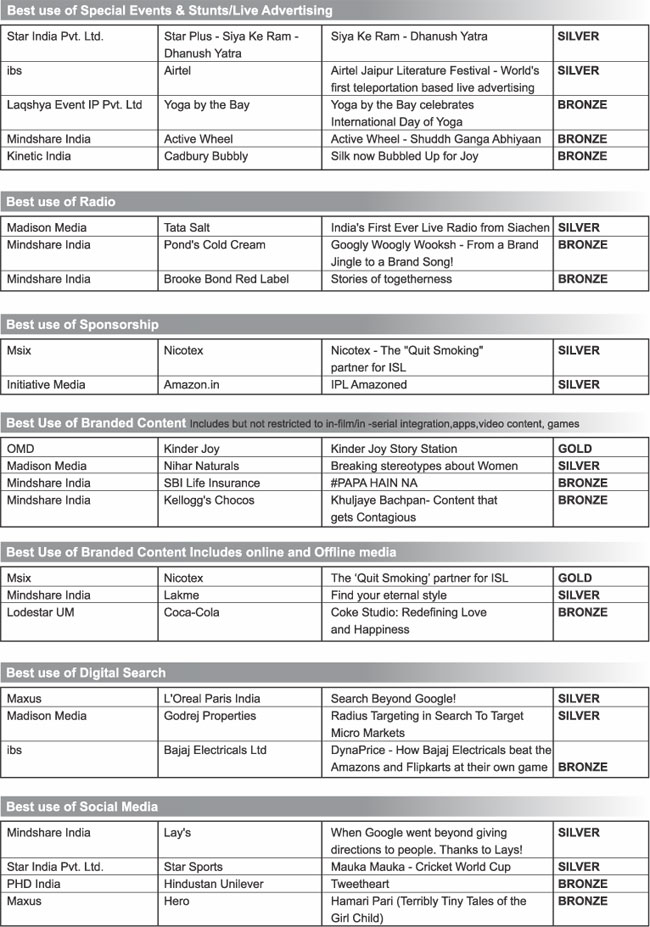
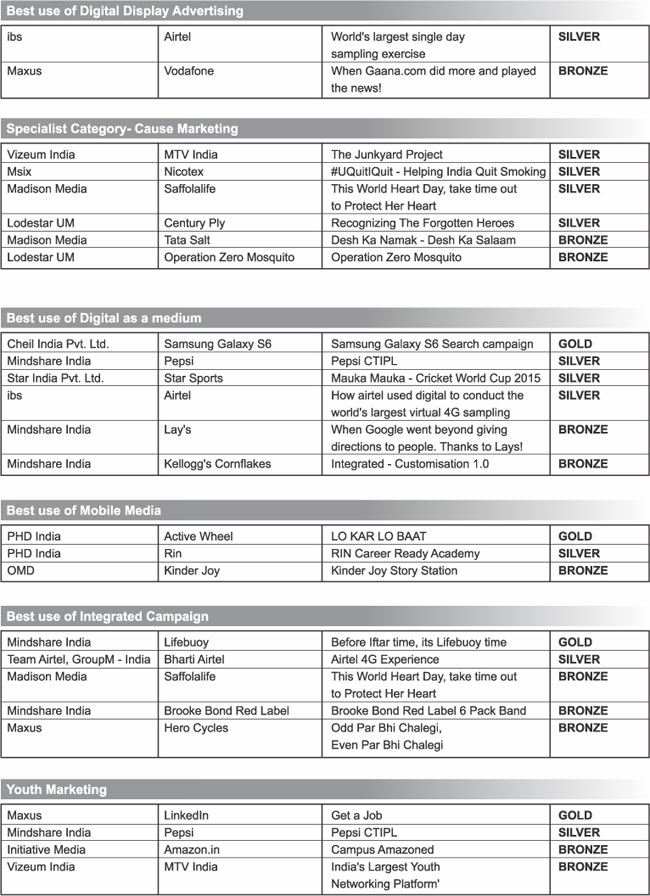
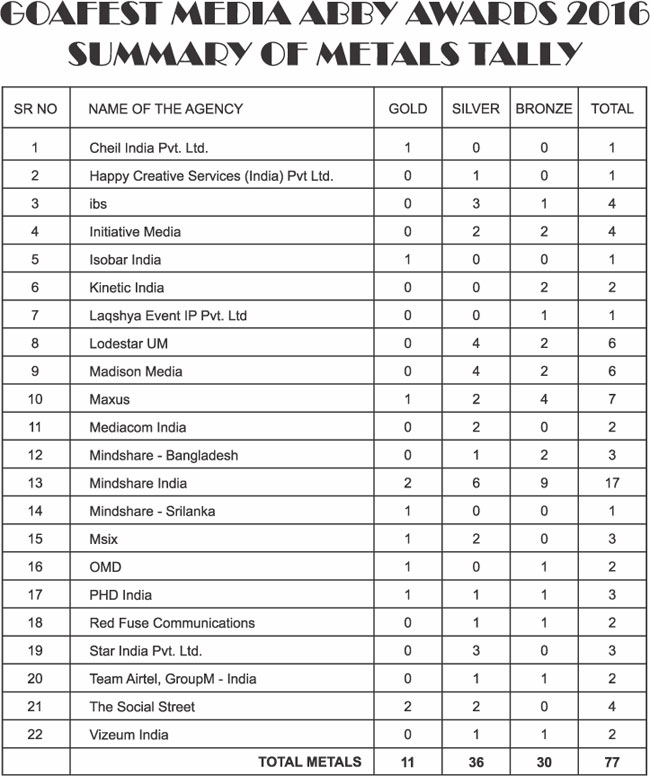
    Media agency major topped the metals tally at the Media Abby awards held on Day 1 of Goafest 2016. Mindshare was awarded two Golds, six Silvers and nine Bronze metals. The first runner-up was sibling Maxus with seven metals (one Gold, two Silvers and four Bronzes).


    The parameters we were looking for was work that is fresh and unique, said Pratap Bose, Jury Chair of the Media Awards, adding that the jury did not find any of the shortlisted entries making the cut for a Grand Prix, the highest level of the awards.


    Lodestar UM and Madison Media secured six metals each with four Silvers and two Bronze awards. New entrant The Social Street won two golds and two silvers.


    There were a total of 76 agencies which participated in the Media Abby, sending in 1015 entries this year. The number of jury members was 86 and a total of 77 metals were awarded (11 Golds, 36 Silvers and 30 Bronzes).


    For Prasanth Kumar, CEO, Mindshare South Asia, it is a continuation of the agency’s winning ways after the agency coming out tops at last year’s Emvies Awards of the Advertising Club. “Yes, we ended 2015 with 176 awards and this year has also been equally spectacular,” he said, adding that the emphasis is on providing innovative solution to clients to break the clutter and fragmentation.


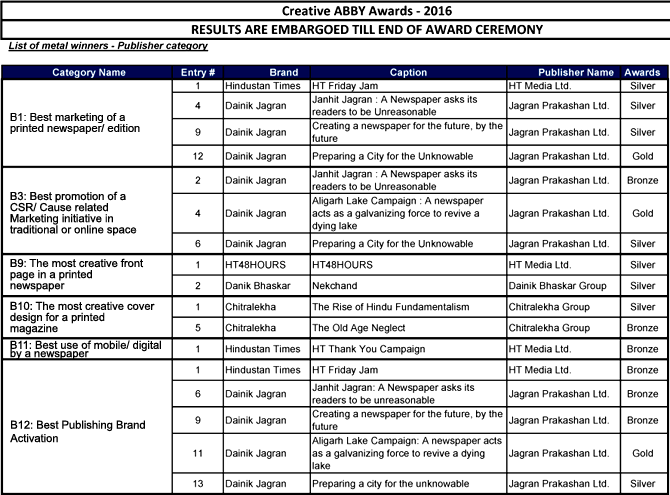
    Along with the Media Abby, the Publisher Abby awards were also presented. Dainik Jagran newspaper was presented 10 of the 17 awards.


  • Go, Goa, Goafest!

    By A Correspondent


    The three-day Goafest 2016 convention is scheduled to start in Goa today. Clearly, the biggest annual event of the advertising, marketing and media fraternity in the country, the day typically comprises knowledge sessions while the evening sees the Abby Awards being presented for creative excellence, followed by time to network and celebrate.


    On Day 1 this year (today, April 7), the Media and Publisher Abbys will be presented and on Day 2 and 3, the Creative Abby winners across various categories will be awarded.


    Among speakers a mix of Indian and international captains have been invited in this year’s edition of Goafest. Carter Murray, Global CEO of FCB, Jean Lin, Global CEO at Isobar, Fergus O’Hare, Director of Facebook Creative Shop – APAC, Benny Thomas, Strategy head, Crispin Porter and Bogusky  and former Sri Lanka captain and minister Arjuna Ranatunga amongst others are the key international speakers. Chandramouli Venkatesan, MD, Mondelez India, writer Shobhaa De and Raghu Raman, Group President, Reliance Industries are among the key Indian spearkers. A highlight of the event will be a conversation between film-makers Karan Johar and R Balki who is also Chairman of the Mullen Lowe Lintas group.


    When asked how this year’s Goafest will be different from the last, organising committee chairman Nakul Chopra said: “We’ve learnt that the delegates like to hear from people from varied fields and we are trying as hard as we can to bring them the variety that they seek and I hope this Goafest will not disappoint.”


    On the Abby Awards which is the highlight of Goafest, Awards Governing Council chairman Ramesh Narayan said: “For the first time, the entire entry process except for three or four categories was online and that ensured the entire scoring process was also online. We’ve also taken on board all the views of the entire creative community.”


    According to information received, the number of entries received this year was 3244 for the Creative Abby and 1015 for the Media Abby. The corresponding number last year was 2801 for Creative and 674 for the Media.


    On comparisons with other events held in India, especially Kyoorius Awrds which is done in sync with UK-based industry body D&AD, Narayan said: “Most people love an award. If it’s an Abby award all the more because it’s the largest award in the whole of India. I would love to say that the Abby is incomparable. However, I’ll just say that the entire process is easily among the best in the world.”


    Chopra meanwhile is bullish about Goafest 2016 that kicks off today. “It’s a great platform, it’s a great award show, it’s the most respected event of this kind in India and we are seeing the enthusiasm to take part in it increasing manifold year after year… so I am very bullish.”


  • Goafest announces key speaker line-up

    By A Correspondent


    Upping the ante on engagement this year, Goafest has announced an experienced array of speakers from across the world of film, media, marketing and business. These include leaders and innovators like Benny Thomas -Strategy head, Crispin Porter and Bogusky, Carter Murray – Global CEO – FCB, Ace Director, Producer, Screenwriter, Actor and Television Personality Karan Johar and leading filmmaker and advertising guru R Balki. Adding to the enthralling line-up will be an engaging session with veteran journalist Rajdeep Sardesai in conversation with Honourable Deshamanya Arjuna Ranatunga, Minister of Ports and Shipping & Former Sri Lankan Cricket Captain.


    Key speaker line up:

    Benny Thomas -Strategy head, Crispin Porter + Bogusky,

    At CP+B, Benny leads strategy, planning and a team of strategists for businesses including PayPal, Braintree, NBA2K and Charles Schwab


    Karan Johar – Director

    Film Director, Producer, Screenwriter, Actor and Television Personality


    R. Balki – Director

    Film director, Screen writer, Producer and Chairman of Mullen Lowe Lintas group


    Prakash Sangam – CEO, Red Bus

    Prakash Sangam is the CEO of redBus, which is the world’s largest bus ticketing service that is ‘Made in India’. Prakash is engaged in growing the market leadership of redBus in the Indian market, expanding redBus to other countries globally and extending the business into adjacent travel segments of Hotels and Holidays.


    Tara Marsh – Global Content Head, Wunderman

    As global content lead, Tara Marsh ensures that Wunderman’s clients have an agile partner capable of providing strategy and resources – anywhere in the world. Tara brings valuable experience to bear navigating through complex technologies as well as identifying the right talent.


    Carter Murray – Global CEO – FCB

    A passionate champion of great creative and a consummate brand steward, Worldwide CEO Carter Murray took the helm of FCB in September 2013.Based in New York, he oversees 151 offices in 90 countries globally.


    Jean Lin – Global CEO – Isobar

    Jean Lin started her digital journey by establishing digital agency wwwins Consulting in 1999 it then became Isobar’s first Greater China offices in 2004 and was the driving force behind Isobar’s expansion in the Asia Pacific region. Jean was appointed a member of Global Executive Team at Dentsu Aegis Network, Isobar’s parent company.


    Raghu Raman -EX Army Man

    Raghu Raman is the President Risk, Security & New Ventures at RIL. He is the former founding CEO of National Intelligence Grid (NATGRID), GoI. In his earlier avatars, he has led Mahindra First Choice, Mahindra Special Services Group and Mahindra-British Aerospace joint venture as the CEO.


    Alasdair Lennox Creative Head – Fitch

    Executive Creative Director for EMEA in 2014, Alasdair directs the creative output for FITCH’s studios in the region. Alasdair joined FITCH as a junior environmental designer in the late nineties. He evolved a broad spectrum of design skills and a well-worn passport. He can bring a brand’s unique personality to life across all points in the customer journey and solves complex commercial and strategic challenges for international clients including Adidas, Vodafone, Diageo, UBS and Apple.


    Fergus O’ Hare Head of APAC Facebook Creative Shop

    Fergus O’Hare is the lead Creative Strategist for Asia Pacific of Facebook Creative Shop. He is tasked with creating and building ideas that transform how the world’s largest and most innovative marketers use Facebook to drive business growth.


    Stay tuned for more on the speaker’s line-up at Goafest 2016.

    This year’s exemplary speaker’s line-up at Goafest is set provide an enriching experience by emerging as a great melting pot of ideas and vision.  Presented by the Advertising Club and AAAI the Goafest ABBYs 2016 will once again see the entire advertising and marketing community join the celebrations in Goa from 7th April, 2016 to 9th April 2016 at   The Grand Hyatt, Bambolim, North Goa.


  • Ramesh Narayan to helm Abby Awards Governing Council for Goafest 2016

    By A Correspondent


    The Advertising Club and Advertising Agencies Association of India has announced the Awards Governing Council for Goafest 2016. Ad veteran and industry leader Ramesh Narayan, founder at Canco Advertising Pvt. Ltd. has been appointed theChairman of the AGC. The other members elected to the Council are:


    Chairman (CEO, Publicis South Asia & Vice President) of Goafest Organizing Committee – Nakul Chopra; President Advertising Agencies Association of India (AAA’s of I) & Advisor, FCB Ulka Advertising – Ambi M G Parameshwaran; Chairman and CEO at Dentsu Aegis Network – Ashish Bhasin; President, Sony Pictures Networks – Rohit Gupta; CEO at Group M, South Asia – CVL Srinivas; CEO at Mediabrands – Shashi Sinha; CEO at Percept H Pvt. Ltd. – Ajay Chandwani; National Head, Sales, English Cluster at Viacom18 – Namrata Tata; Chief Executive Officer at Contract Advertising – Rana Barua; Founding Partner and Chairman at The Social Street – Pratap Bose.


    Announcing the appointment, Raj Nayak, President of The Advertising Club said, “We are pleased to announce that Ramesh Narayan will be the Chairman of the Awards Governing Council of the Goafest. He brings his unique experience as one of the very few people who has been President of the Advertising Club and the Advertising Agencies Association of India (AAAI) to this post. He has also been Chairman of the Abby Awards Committee twice, and was the first Indian to judge the Effie Awards finals in New York. Ramesh is the only person to have been conferred the Lifetime Achievement Award by the AAAI and been inducted into the International Advertising Association’s Hall of Fame.” 


    Welcoming the announcement Ambi M G Parameshwaran – President, Advertising Agencies Association of India (AAA’s of I) said “Ad Club is a wonderful institution. I am delighted to hear about Ramesh Narayan’s appointment. With his unparalled understanding of India’s advertising scenario, and his years of valuable experience, Ramesh is sure to bring in a whole new perspective which will definitely drive the council to greater heights of success.”


    Nakul Chopra- Chairman of Goafest Organizing Committee, showed his excitement about the new appointment as well. “I’ve known Ramesh as a visionary leader who embraces change and is open to new ideas. I’m sure his appointment means an interesting phase for the Council is on the anvil.”