By Ranjona Banerji
 I wish I could say the current situation with government assault on Newsclick was a definitive moment in the story of Indian journalism, that we had reached so low that the only way was up, that a turning point had come.
The sad reality is that there are no lows too low, as long as the larger section of the Indian media remains in thrall of and/or subservient to the Narendra Modi government and the BJP.
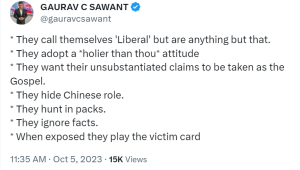 Gaurav Sawant is a familiar face on Indian television and is managing editor of India Today. This is what he posted on X, formerly Twitter, on October 5: “They call themselves ‘liberal’ but are anything but that. They adopt a *holier than thou* attitude. They want their unsubstantiated claims to be taken as the Gospel. They hide Chinese role. They hunt in packs. They ignore facts. When exposed they play the victim card”. (screenshot attached)
Sawant is a powerful person in the media and here he makes it clear that media solidarity is out of the question. He sides with the abuser. Why abuser, you may ask. Because. The Delhi Police picked up independent journalists and contributors associated with Newsclick, held them for hours without allowing them legal representation, questioned them about whether they had covered the Delhi riots and the farmers’ protests, seized their electronic devices.
The police then arrested the editor-in-chief Prabir Purkayastha and administrative officer Amit Chakraborty under the UAPA, an act for terrorists. They refused to give a copy of the FIR to the arrested.
https://indianexpress.com/article/india/hand-fir-copy-to-newsclick-court-tells-cops-10-journalists-questioned-8970471/
Print and digital media have condemned the police action and the arrests.
https://thewire.in/media/another-blow-for-press-freedom-under-modi-govt-say-newspapers-on-newsclick-raids-arrests
Practically every media organisation has issued a strong statement, calling out the police action for its illegal and brazenly pro-BJP actions. Now even coverage, let alone criticism, of the Government’s actions during the Covid19 pandemic are being presented by the police and pro-Modi outfits as anti-national and therefore equal to acts of terrorism.
So, media solidarity? Definitely not.
The Editors Guild, the Network for Women in Media (India), The Press Club of India, the Mumbai Press Club, Digipub News India Foundation, to name just a few, have issued separate statements. Several media organisations have also collectively written a letter to the Chief Justice of India pointing out the dangers to the police action and the use of UAPA against journalists and media houses. Several journalists have issued independent statements condemning the police action. Protests have been held by journalists across India.
Conspicuous in their absence? The most powerful media figures of all: Those in TV.
The big names in TV have remained since 2014 firmly on the side of authoritarianism and in favour of government action against the media. Through the pandemic, as thousands of labourers walk thousands of kilometres to reach home in the hot summer; TV cameras were nowhere to be seen. Thousands gasped for oxygen and died from the virus; TV cameras were nowhere to be seen. Thousands were buried by rivers in shallow beds; TV cameras were nowhere to be seen. Thousands lay piled in morgues; TV cameras were nowhere to be seen.
The term “anti-national” can be interpreted in any number of ways. There is a special place for these members of the media who use their power and platforms to create communal violence and hatred everyday but cannot do even a moment’s journalism.
The allegations against Newsclick remain amorphous. News outlets are allowed foreign investment. It is not a crime to cover protests against government action, even if (especially if?) the government does not like it. People have a right to know why they have been arrested. To question authority is not a crime.
As of now that is. But the more the mainstream television media refuses to join the battle for democracy and the more it supports an authoritarian regime, the closer we get to North Korea.
Ranjona Banerji is a senior journalist and commentator. She writes on MxMIndia on Tuesdays and Fridays. Her views here are personal.