Tag: WPP

  • $66bn in ad sponsorship this year


    By A Correspondent


    Advertisers are expected to spend a combined $66bn on sponsorship this year, though fewer than one in five are confident that they can actually measure the business value return of the sponsorships they undertake.

    These and other key findings are included in the latest monthly Global Ad Trends report focusing on sponsorship compiled by WARC, the international authority on advertising and media effectiveness.

    Sponsorship growth is trending ahead of most paid media, and $66bn is expected to be invested this year – mostly on sports properties

    Brand spend on sponsorship – inclusive of rights but excluding activation – is expected to rise 4.9% to reach $65.8bn worldwide this year. Sponsorship is growing faster than all paid media channels excluding internet formats.

    North America makes up the greatest share of spend (36.8%, or $24.2bn), followed by Europe (26.7% or $17.6bn), Asia-Pacific (25.2% or $16.6bn), Latin America (7.0% or $4.6bn), and then the Middle East & Africa (4.3% or $2.8bn).

    Most of this money is going to sports properties. Among these are the FIFA World Cup in Russia, which is thought to have attracted $1.7bn worth of deals. At a time of fragmentation, sport offers large, engaged, multiscreen audiences: by volume of data, the 2018 FIFA World Cup was the most-streamed sporting event in history. TV is still king for live sporting events, with World Cup matches reaching 44% of the global population via television.

    Sponsorships are principally used to drive brand metrics and reach

    Generating brand awareness is the most important objective for sponsorship campaigns. This mirrors separate WARC research in this year’s WARC 100 that found 61% of successful campaigns counted brand awareness as a core objective. This suggests sponsorship plays the same role as mass-reach media, fitting into the ‘upper-funnel’ of a marketing plan (generating awareness and consideration).

    Sponsors rely on intermediate metrics; true ROI remains a challenge

    Only 19% of sponsorship professionals are confident that they can actually measure the business value return of the sponsorships they undertake. Further, only 37% of practitioners have a standardised process for measuring sponsorship.

    The top two named tools used for evaluation are digital and social media metrics. However, the Association of National Advertisers (ANA) states that social media metrics often provide a “distracting noise” due to their weak relationship to sales.

    Social Media and live events power sponsorship activation

    Social is considered the number one activation channel for sponsorships by 83% of marketers. However, the prevailing sentiment is that authentic engagement of sponsorship, through digital and social activation, remains a challenge.

    Possibly by way of remedy, the share of marketers activating sponsorships through experiential live events has risen to two-thirds (65%) over the last year.

    Summing up, James McDonald, Data Editor, WARC, says: “As brands continue to jostle for a finite amount of consumer attention, the changing way in which media is consumed has led to the fragmentation of audiences. Yet sports generate an engaged, mass audience which sponsors can reach, before amplifying their campaigns via social media and experiential events.

    “Sponsorships facilitate the upper part of the sales funnel – driving brand awareness and consideration – in much the same way as TV. This can present challenges, however, such as the knowledge gap between brand impact and sales impact.”

    Global media analysis: A round-up of sponsorship

    ·  4.9% forecast rise in sponsorship spend this year, outpacing the majority of paid media

    ·  19% of practitioners who say they can confidently measure the ROI of their sponsorship campaigns

    ·  39% of Russia World Cup sponsorship deals originating in Asia

    ·  44% reach of global population for both the FIFA World Cup and Olympic Games

    ·  73% of advertisers stating that brand awareness is the most important objective for sponsorship campaigns

    ·  83% of marketers who use social media to amplify sponsorship campaigns


    Other new key media intelligence on WARC Data

    ·  Advertisers to spend over $20bn on consumer data this year

    ·  Blockchain adoption is low, though over half of advertisers intend to use in future

    ·  Word-of-mouth most popular way to discover new video content

    ·  Over a third of UK adults have access to a connected TV


  • Mark Read assumes charge as WPP CEO


    By A Correspondent


    Very proud to be given the chance to lead @WPP with our fantastic people and clients. Time to update my twitter profile!

    • Mark Read, hours after the announcement of his appointment to the corner office at WPP. On Twitter (@readmark).


    For some weeks now, the name of Mark Read as the new CEO of WPP has been doing the rounds. It was imperative for WPP to have someone who is familiar with the set-up and has considerable equity with its long-standing clients.


    Read has held multiple leadership positions across the company, including nine years as an Executive Director of WPP plc. For 12 years, as Head of Strategy and then CEO of WPP Digital, he was responsible for the company’s digital development, including the move into technology through the acquisition of 24/7 Real Media, the creation of digital network Possible and the launch of Stream, WPP’s celebrated “unconference”.

    In 2015, he was appointed Global CEO of Wunderman, where he transformed the network into one of the world’s leading customer-focused digital agencies. Wunderman, as we know, is among WPP’s largest businesses, with more than 10,000 people in 200 offices across 70 countries and clients including Microsoft, Dell, Shell, BT and Adidas.

    In April 2018 he was named joint Chief Operating Officer of WPP, with responsibility for clients, operating companies and people.

    Earlier in his career, Mark co-founded and developed internet start-up WebRewards. He also specialised in the media and marketing industries as a principal at consultancy Booz Allen & Hamilton, having started his career at the WPP parent company working on corporate development.

    Mark has an MBA from INSEAD and an Economics degree from Trinity College, Cambridge University, and was a Henry Fellow at Harvard University. He is the Chairman of the Natural History Museum Digital Council. Wired magazine ranked him as one of the Top 25 Digital Influencers in Europe in 2014 and he was named The Drum’s Digital Individual of the Year in 2015 and 2017. He lives in London with his wife and two children.

    According to the New York Times, Jon Williams, a former Grey CEO, told Reuters: “For any leader coming into any business the most important thing is to have respect. Because of Mark’s operational delivery and because he’s got a personal relationship with a lot of the business leaders, he’s got that respect. He can hit the ground running.”

    Around noon India time on September 3, WPP made official the appointment of Mark Read as Chief Executive Officer and his appointment to the Board of WPP as an Executive Director with immediate effect.


    Said Roberto Quarta, Chairman of WPP: “The Board carried out a rigorous selection process, assessing internal and external candidates. That process, alongside Mark’s wise and effective stewardship of the business in the last few months, left us with no doubt that he is the right leader for this company, and we are delighted to announce the Board’s unanimous decision to appoint him as Chief Executive Officer of WPP,” adding:  “Recognised for his leadership throughout the industry, he has an intimate understanding of the business, he enjoys very strong internal support, and he has earned the respect and endorsement of our clients with his constant focus on their needs. He has played a central role in many of WPP’s most successful investments and initiatives, and he has deep experience at board and operational level. Most recently, Mark led the transformation of Wunderman into one of the world’s top digital agencies, and he understands the importance of culture in creating successful organisations. In short, he is in every way a 21st -century CEO.  WPP is a world leader in communications services. The priority for the Board and the task ahead for Mark and the new management team is to build on this position of strength, while pursuing a clear vision for change and value creation.”


    Added Read: “WPP is a great company with exceptional people and strong relationships with clients who place a high value on our work. Few organisations have our global reach – 130,000 people delivering results for clients in 112 different countries. Fewer still have our powerful combination of creativity and expertise in technology and data. “Our industry is going through a period of structural change, not structural decline, and if we embrace that change we can look ahead to an exciting and successful future. Our mission now is to release the full potential that exists within the company for the benefit of our clients, to accelerate our transformation and simplify our offering, and to position WPP for stronger growth. To achieve that we need to foster a culture that attracts the best and brightest: inclusive, respectful, collaborative, diverse. What makes our company special is its people, and I am very proud to have been given the chance to build a new WPP with them.”

    Meanwhile, Quarta has resumed his role as Non-Executive Chairman on the appointment of Mark Read as Chief Executive Officer. Andrew Scott will continue in his role as Chief Operating Officer of WPP on a permanent basis as a key member of the senior management team.


    Read will be paid in accordance with the Compensation Policy approved by share owners on June 7, 2017, as set out in the 2016 Annual Report.

    • Annual Salary of £975,000 (that’s Rs 8,93,03,662.50… Rs 8.93 crore)
    • Annual Bonus of up to 250% of salary with mandatory deferral of at least 40% of bonus into

    shares deferred for a two-year period.

    • LTIP award of 350% of salary. Performance will be measured over a five-year period using

    measures in line with the WPP Compensation Policy.

    • A cash allowance of 20% of salary, less employers’ national insurance, in lieu of pension.
    • A benefits allowance of £35,000 per annum to cover health, risk and other benefits.

    His contract of employment contains restrictive covenants including an industry non-compete, a non-deal with clients and a non-poach and non-employ of key WPP individuals.

  • Will Rediff resurrect itself post WPP, Dentsu exit?

    By A Correspondent


    Before you say we are being too harsh, because you resurrect only those who are dead, well, you know we don’t mean that. But, yes, the agency has been pretty down in the dumps, and as one insider told us, that few in the younger set of CMOs takes the agency too seriously.


    And this for an agency that has done some stellar work. Created Brand Airtel for instance. Has done some awesome work for various clients, over the years.


    Rediff’s rise and rise also saw its downfall. Perhaps a wrong choice of captains, perhaps a tough jv with WPP with the then CEO Martin Sorrell making life tough for Rediff co-founder and bossman Arun Nanda by reportedly pulling out key clients. In the recent past, the agency’s cash registers were ringing thanks to the prized contract with the Tatas to handle the group’s PR activities. But it lost that business too earlier this year.


    So as MxM reported on May 22 (http://www.mxmindia.com/2018/05/is-arun-nanda-buying-wpp-stake-in-rediffusion/), Rediffusion has exited the WPP-owned Y&R and Dentsu partnerships and has chosen to go independent again. Our sources tell us the money paid to WPP was peanuts (less than Rs 5 crore) and both left the room with a Phew!.


    Nanda is happy to go independent all over again, and WPP country manager CVL Srinivas delighted that he can bring in Y&R solo to Indian shores.


    Rediff founders Arun Nanda and Ajit Balakrishan have bought back the 40% shares held in their company by Y&R (26.7%) and Dentsu (13.3%).


    In a joint statement, Nanda and Balakrishnan said: “Forty-five years back, we started Rediffusion with the vision of creating a passionate and bold agency that would take ownership of its clients and their work; with the promise of creating dynamic, fearless and category-busting work. As communication is undergoing a revolution in this hyper-connected and technology-oriented world, it’s time Rediffusion rode this new wave with a new freedom, zeal and passion. We believe we will be able to deploy a variety of digital tools and creative styles more swiftly, if Rediffusion is on its own.“


    The communications group will now comprise Rediffusion, Rediffusion Direct, Everest Brand Solutions, Rediffusion Healthcare Communications and Rediff.com.


    In a release, WPP said its companies Sudler, Wunderman and Y&R, which operated as joint venture agencies with Rediffusion, will be developed as wholly-owned agencies, with WPP selling its stakes in the current Rediffusion joint ventures. There will be no change to Wunderman’s existing India businesses.


    Said Srinivas: “India is a key growth region for us and we have a well-defined road map and vision for what we would like to achieve here. WPP is home to some of the best marketing talent in this country and our plan is to steer our agencies to stay ahead of the curve – in terms of both market and client needs, by providing the best-in-class offerings.”


    Rediffusion’s recent wins include SBI, Tata 150 years mandate, Liebherr & Tata Trusts. The agency also continues to handle Tata Sons, Tata Motors, Parle, TVS Tyres, Taj, L&T Realty, Godfrey Philips, Eveready, HPCL, Audi, GSK, Danone, Sun Pharma, to name a few.


    The agency has had a change of guard in the recent past. As reported by MxMIndia (http://www.mxmindia.com/2018/06/rahul-jauhari-navonil-chatterjee-to-take-charge-at-rediffusion-yr-everest-as-dhunji-wadia-to-retire-in-august/ ), Rahul Jauhari and Navonil Chatterjee have taken charge as Joint Presidents. Dhunji Wadia who was to retire as President of the group this month, left last month, in an exit that was reportedly not very amicable.


    Lastly, will Y&R enter India? We aren’t a hundred percent sure yet, but don’t be surprised if it does in a hurry. For now, the list of its Asia offices doesn’t include India: https://www.yr.com/locations#asia. But we are told it will be back soon.


    As for Rediff, Nanda and Balakrishnan will need to be doing loads of interesting work and get many more clients to stay in the reckoning.


  • Rahul Jauhari & Navonil Chatterjee to take charge at Rediffusion Y&R (& Everest) as Dhunji Wadia to retire in August

    Dhunji Wadia

    By A Correspondent

    There is going to be a change of guard at Rediffusion Y&R as Dhunji Wadia will retire from the agency network in August 2018. Rahul Jauhari and Navonil Chatterjee will take charge as Joint Presidents at the Rediffusion Y&R group. Wadia had joined the group in 2010 first helming Everest and then in late 2014 as President of the Rediffusion Y&R group. While there is no official communication on this, the succession has been announced internally via mail. Jauhari is currently Chief Creative Officer, Chatterjee is Chief Strategy Officer.

    Rahul Jauhari
    Navonil Chatterjee

    Although, the agency bagged the coveted State Bank of India account recently, there have been mixed reports on how the agency is doing in terms of business, thanks to an indifferent advertising services scenario in the country as well as a longstanding dispute with WPP group. But now with the exit of Sir Martin Sorrell from WPP, as reported by MxMIndia earlier, there have been talks of Rediff Y&R buying out the 40 per cent stake of WPP and Dentsu. In the past Rediffusion has lost some prized accounts like Airtel and Colgate.


    With over three decades of experience in the business, Wadia has been associated with major national and international brands like Parle, Tata, Unilever, Nike, Levi Strauss, Diamond Trading Co, Kellogg, Aditya Birla Group, Sony Entertainment Television – Max and SAB, Kotak amongst others. Both Jauhari and Chatterjee joined Rediff in mid-2015.

  • Mathman Sorrell quits WPP equation


    By Prabhakar Mundkur


    When Martin Sorrell made a hostile bid for J Walter Thompson (JWT) in 1987, nobody could believe that an ad agency could be the victim of a takeover.  Largely because agencies were held together by loyal clients who could object to new owners if they thought them inappropriate.  JWT at the time was doing badly in financial terms with gross margins of less than 5%, which were perhaps the most embarrassing agency margins in New York.


    Sorrel at the time was confronting a company several times WPP’s size.  Besides while he had been finance chief of Saatchi and Saatchi, a job he quit in 1984, Sorrell had no previous experience of running a firm as large as JWT.  To his credit, the financial turnaround at JWT was quick and methodical.  But we saw some of our favourite people leave the agency, particularly the planners and other intellectuals.  But Sorrell felt that the thinning of the management ranks would do JWT good, and perhaps it did.  In many ways though, it also destroyed the soul of the company as the ‘thinking’ agency.   Who would have thought that this was the beginning of the takeover spree by Sorrell.  Ogilvy was next, although it was rumoured that he may have paid too much for Ogilvy and that it would be his downfall.


    Compared to the $566 million that Sorrell paid for JWT in 1987, Ogilvy was acquired at $864 million in 1989.  Although perhaps a little smaller than JWT, Ogilvy was the agency with a better creative reputation thanks to David Ogilvy, its founder.  With two of the best ad agencies under his belt there was no stopping Sorrell.


    While he was responsible for making the advertising industry more profitable, he might have destroyed the spirit of the industry forever.  The entry of bean counters into the advertising business was not well received those days.  David Ogilvy called him an “odious little shit” who had “never written an advertisement in his life.”  But to Sorrell’s credit, he learnt about the advertising business quite quickly.  When I heard him speak in the ’90s, it was difficult to imagine that Sorrell was a finance man.  He seemed to have grasped the essentials of the advertising business, and was making good sense to clients.


    But internally people at his agencies found him autocratic and dominating.  He took all the decisions leaving none for others.  Not always pleasant, I remember once before presenting to him he told me “your neck is next on the chopping block”.  If this was British humour, I may have missed it.  It certainly wasn’t a pleasant way to start your presentation.


    In his 31 years since he first pitched for JWT, Sorrell has of course transformed the advertising business.  More WPP revenue comes from media, research and data than from the traditional ad agency business something that he was proud of and referred to as the transformation of Madison Avenue from “madmen to mathmen”.  Something that might be real but which has also taken the romance out of the advertising profession.  But to his credit who would have thought that the British could have led an assault on Madison Avenue.  He was not a likeable guy but one has to salute his achievements.


    With Sorrell leaving, speculation must be rife on who will take over.  In my mind the biggest question is whether the successor be a mathman or a madman.  That might make all the difference to how this industry goes into the future.


    Sorrell leaving might be a good lesson for Indian CEOs.  The mighty should step down before they have to.

  • Mindshare, MediaCom Mumbai in Gunn’s World Top 10 for media excellence


    Gunn Report, the global index of excellence in advertising, has released the results of the 2018 Gunn Media 100, a global ranking of the world’s most awarded and applauded campaigns and companies based on their performance in media competitions around the world.

    Gunn Report, now part of WARC, tracks the winners’ lists of close to 30 of the most important global, regional and national media awards shows to compile Gunn Media 100 – a list of the 100 best campaigns for creativity and innovation in media, along with the best-performing agencies, networks, holding companies, brands, advertisers and countries.

    The highest-ranked campaign in the Gunn Media 100 is McDonald’s ‘Capacity Based McDelivery’ by OMD Singapore. To maintain competitive advantages, McDonald’s promoted its delivery service McDelivery in Singapore in partnership with Google. By integrating McDonald’s first-party data with Google’s hyper-local targeting, they maximised media cost efficiency and managed consumer expectations of delivery time through tailored messages, mapping real-time restaurant data against paid search spends via a live API.

    Said Stephen Li, CEO of OMD APAC: “To have our work for McDonald’s recognised as best of the best globally, is testament to our unwavering commitment and relentless focus on helping our clients’ leading brands continue to cut-through with data-driven creativity. This recognition motivates us to continue our drive in helping brands make better decisions, faster. The ‘Capacity Based McDelivery’ campaign is the perfect example of this in practice, leveraging real-time data to generate fresh growth for a market-leading brand in a highly competitive category. I could not be more proud of this achievement, and all the other great work coming out of OMD Singapore. It only inspires us to continue raising the bar even further still for our clients.”

    In second place is ‘Hungerithm’ by MediaCom Melbourne / Clemenger BBDO, which saw confectionary brand Snickers partner with 7-Eleven stores in Australia to drive sales and increase category share. Snickers says the internet gets angry when it’s hungry. The brand launched ‘Hungerithm’, an algorithm that analysed 14,000 social posts a day and adjusted the price of the chocolate bar accordingly.The angrier the Internet got, the cheaper Snickers became.

    Ranked third is ‘Reword’ for Headspace by Leo Burnett Melbourne / Starcom Melbourne. The Australian youth mental health foundation, successfully tackled cyber bullying by putting in place a social media rewording tool that analyses what users type and uses a red line to strike through abusive phrases.

    Three themes have emerged from the world’s top campaigns for media excellence:

    :: Data is driving fresh media thinking. The top campaign is built around smart use of data. This is a recurring theme in the rankings, as brands look to harness multiple data sources to deliver competitive advantage.

    :: An event-led strategy helps brands stand out. As brands struggle to be heard in a fragmented media landscape, there is a growing focus on ‘events’ such as Super Bowl, US Presidential debates, and Olympics, that can draw a crowd and interest from the press.

    :: Partnerships are central to youth-focused media strategy. Partnerships with organisations or individuals that bring their own reach are now a key element of media strategy, particularly for brands targeting younger demographics.


    MediaCom London claims first place in the Gunn Media 100 agency rankings with four campaigns ranked in the top 100: ‘Best Day Of My Life’ for Shell (#6), ‘Singing Our Way To The Top Of The Box Office’ for Universal Pictures’ Sing (#22), ‘Missing Type’ for NHS Blood & Transplant (#30) and ‘Dark To Light’ for Gucci Guilty (#77=).

    PHD New York is in second place also with four campaigns in the top 100. Their highest ranked campaign (#13) is ‘The Debate Headache’ for GlaxoSmithKline’s Excedrin. Mindshare Mumbai is ranked third with three campaigns making the cut.

    MediaCom is the top-ranked network with eight agencies from around the world – Auckland, Bogota, Dusseldorf, London, Mumbai, Melbourne, Mexico City, New York – contributing to the network’s poll position. PHD Worldwide is in second place and OMD Worldwide, third.

    For the first time Gunn Media 100 has included a ranking of holding companies. WPP tops the leader board, with three of its networks – MediaCom, Mindshare Worldwide and Wavemaker – ranked in the top 10. Omnicom Group and Interpublic Group follow.

    Stephen Allan, Worldwide CEO and Chairman of MediaCom, said: “This is an outstanding achievement, of which I am extremely proud. Every single person throughout the MediaCom network has contributed to our success and has truly embraced our philosophy of Systems Thinking to great effect.

    “I am, of course, delighted that MediaCom UK has also been recognised within the Gunn Media 100 as the top individual agency, which is incredibly well deserved. But none of this would have been possible without our fantastic clients, agency partners and media owners who have collaborated with us to create globally-celebrated campaigns. We are proud to have contributed towards WPP’s achievement of being named the top Holding Company within the same report.”

    CEO of WPP, said: “WPP’s core purpose is to deliver growth for our clients so we are delighted to receive this recognition of our effectiveness in doing so. And congratulations to MediaCom who, as network and agency of the year, have helped us achieve a hat-trick of awards.”

    Nike takes first position as the top brand with four campaigns featured in the top 100, all from the US. McDonald’s is in second place, followed by Snickers and Dove.

    Unilever tops the Advertiser’s ranking by a significant margin. Procter & Gamble is in second place. Both advertisers have six brands featured in the top 100 campaigns. Mars takes third place with five campaigns in the top 100.

    The US dominates the rankings with 30 campaigns in the top 100, 12 of which feature in the top 20. UK is second with 11 campaigns. Australia and India follow. In total, 24 countries are represented.

    The most highly ranked campaigns and companies in Gunn Media 100 are:

    The world’s top 10 campaigns for media excellence

    Rank Campaign title Brand Agency Points
    1

    Capacity Based McDelivery

    McDonald’s OMD Singapore 136.1
    2 Hungerithm Snickers

    MediaCom Melbourne / Clemenger BBDO Melbourne

    131.2


    3 Reword Headspace  Leo Burnett Melbourne / Starcom Melbourne 129.1


    4 Bachelor Of Shaving Gillette MediaCom Mumbai 122.5
    5 Bradshaw Stain Tide Saatchi & Saatchi New York / Hearts & Science New York 106.1


    6 Best Day Of My Life Shell MediaCom London 105.4
    7= Sport Chek – The Fastest Olympic Campaign! Sport Chek Touché PHD! Montreal


    101.3


    7= Bully Ads Canadian Safe School Network Touché PHD! Toronto


    101.3


    9 Yasmin’s Sex-Ed Revolution Yasmin PHD Shanghai 96.7
    10 Like My Addiction Addict’Aide BETC Paris 87.2


    The world’s top 10 best agencies for media excellence

    Rank Agency Location Points
    1 MediaCom London, UK 317.2
    2 PHD New York, USA 249
    3 Mindshare Mumbai, India 235
    4 PHD Shanghai, China 211.4
    5 Mindshare Shanghai, China 197.4
    6 Clemenger BBDO Melbourne, Australia 184
    7 MediaCom Mumbai, India 174.9
    8 Mediaplus Munich, Germany 171.4
    9 Touché PHD! Montreal, Canada 171.3
    10 Starcom Chicago, USA 169.4


    The world’s top 10 agency networks for media excellence

    Rank Agency Network Holding Company Points
    1 MediaCom WPP 1360.6
    2 PHD Worldwide Omnicom Group 1199.5
    3 OMD Worldwide Omnicom Group 1140.8
    4 Mindshare Worldwide WPP 890.2
    5 Starcom PublicisGroupe 761.1
    6 Universal McCann Interpublic Group 731.1
    7 BBDO Worldwide Omnicom Group 546
    8 Wavemaker WPP 526.8
    9 Dentsu Aegis Network Dentsu 482.2
    10 McCann Worldgroup Interpublic Group 447.1


    The world’s top 10 holding companies for media excellence

    Rank Holding Company Points
    1 WPP 3565.4
    2 Omnicom Group 3326.7
    3 Interpublic Group 2131.7
    4 PublicisGroupe 1597.3
    5 Dentsu 540.1
    6 Havas 442
    7 MDC Partners 88.6
    8 Hakuhodo DY Holdings 65.1
    9 Publicis Group 41.4
    10 Accenture 17.1


    The world’s top 10 brands for media excellence

    Rank Brand Sector Points
    1 Nike Clothing & Accessories 297.5
    2 McDonald’s Retail 263.7
    3 Snickers Food 227.9
    4 Dove Toiletries & Cosmetics 204.5
    5 Netflix Media & Publishing 194.5
    6 Shell Business & Industrial 180.8
    7 Samsung Technology & Electronics 136.1
    8 Headspace Non-profit, public sector & education 129.1
    9 Gillette Toiletries & Cosmetics 122.5
    10 US Army Non-profit, public sector & education 107.3


    The world’s top 10 advertisers for media excellence

    Rank Advertiser Points
    1 Unilever 942.7
    2 Procter & Gamble 517.6
    3 Mars 392.8
    4 Nike 283.3
    5 McDonald’s 263.7
    6 PepsiCo 251.4
    7 Anheuser-Busch InBev 217.1
    8 Nestlé 195.7
    9 Netflix 194.5
    10 Royal Dutch Shell 186.5


    The world’s top 10 countries for media excellence

    Rank Country Points
    1 USA 2841.9
    2 UK 1427.5
    3 Australia 871.6
    4 India 854.8
    5 United Arab Emirates 748
    6 Canada 684.1
    7 China 656.8
    8 Singapore 363.2
    9 Brazil 345.3
    10 Germany 337


    Commenting on the results of Gunn Media 100, Emma Wilkie, managing director of Gunn Report, said: “Hot on the heels of the recently published Gunn 100 ranking for creative excellence and the WARC 100 index for effectiveness, the newly launched Gunn Media 100 benchmarks media creativity and innovation as well as highlighting media trends based on an independent global analysis.


    “We’re seeing that the smart use of data, event-led strategies and partnerships that provide new consumer reach are the main themes currently driving the media industry forward offering new and exciting opportunities in the market place.”


    The full Gunn Media 100 rankings – including the world’s top 100 campaigns for media excellence, top 50 agencies, networks, brands, advertisers, countries and top holding companies as well as commentaries, the work and credits – are available by subscription on www.warc.com/gunnreport.



  • Are WPP results a sign of troubled times for the industry?


    By Prabhakar Mundkur


    WPP shares plunged 13 per cent on the London Stock Exchange because 2017 proved to be the worst year since 2009 showing a drop in net sales of 0.9 per cent.


    There seemed no single big reason why the largest communication group was showing weak results.  However, the industry has been under pressure with 84 per cent of the digital investment going to the digital duopoly: Google and Facebook. In addition, large global firms like Unilever had cut spends, while others like P&G were trying to cut out the middle man on media by going directly to the digital publishers.  Mark Pritchard of P&G told the press: ‘If entrepreneurs can buy digital media, why can’t the brand team on Tide, Dawn and Crest be entrepreneurs and do the same?” This might be a backlash of transparency issues that clients are having with agencies and also the suspicion that agencies are pushing more media money into digital because they are earning larger commissions there compared to traditional media.


    Internally, WPP was more than aware that they still function like a few large silos from media, advertising, data and research that don’t talk to each other.  This was reflected in Sir Martin’s statement to the press that they would move away from individual companies to a “to a cohesive global team dedicated to the core purpose of driving growth for clients.”


    While communication conglomerates like Publicis, WPP, Omnicom and Dentu went on an acquisition spree to offer a bouquet of services to clients, true integration amongst these disciplines has continued to be a challenge.


    In addition, the traditional agency model is antiquated, and the traditional agency has failed to come up with something new that can keep up with the times.


    Durex springs a new airy surprise

    Reckitt Benckiser is not the most creative client in the world, in fact most of their advertising is downright boring, but Durex seems to always break the mould.  Last year, Durex had surprised us with the Durex Jeans teaser campaign which had led everyone to believe that they could expect a new brand of jeans from Durex only to be presented with a DurexJeans a new condom.


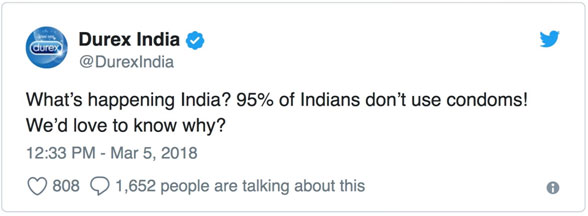
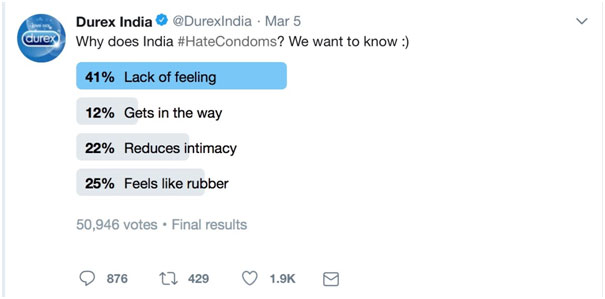
    Earlier this month, Durex went on to ask people on social media their main reasons for not wearing condoms and then presented the results of their research on twitter.


    Durex then went on to launch its new Condom Durex Air.  As its final tweet said: ‘Finally here’s our solution for all condom haters out there.  Presenting to you Durex Air, a condom so thin like it’s not even there. Reach a new level of intimacy and #LoveDurexAir.


    Do we need to thank Nike and Apple for introducing Air into our vocabulary to represent product variants which are thinner and lighter?  Somehow, I never thought a condom might also ride on the Air bandwagon.


    An exam in progressive parenting

    Exam time stress for both Indian parents and children is well known.  So much is the attention given to it that even our Prime Minister addressed students recently on how to cope with exam stress through “Pariksha par charcha” speech which was broadcast to all CBSC schools.  The Prime Minister even published a book called Exam Warriors.


    Bournvita did an interesting twist on exam time with their Exam Sale promo.


    A stall at a local mall had children selling their guitars, cameras and paint brushes for free.  They explained that they were being given away for free because their parents wanted them to focus on their exams. Passersby were surprised and this got an adverse reaction from them about marks and trying for a 90% grade being so important that students had to give up their hobbies.


    The message came through quite clearly that marks is not all that good parents must be looking for when evaluating their children.


    East India Comedy depicts the truth on advertising

    East India Comedy’s recent salvo might be less of a parody and more reflective of how the general content in advertising is depicted.  The video launched on Youtube said:“Introducing a new product to help women match up to all the expectations that society places on them. Ab aapbhi ban saktihain ‘adarshnari’!


    It suggests that women are being pressurised into buying products to become what society wants them to be.


    Maybe there is some truth in that!

  • RIP, Ranjan Kapur (1942-2018)


    By A Correspondent


    Ranjan Kapur, WPP India Chairman, former Ogilvy India CEO, a mentor to many young entrerpreneurs and one of the Indian advertising industry’s leading lights, passed away in Mumbai on Saturday. He died due to a heart attack. He was 75.

    Born in Lahore in pre-Partition India in 1942, Kapur had did an MA in English from St Stephen’s College, Delhi in 1964.

    He joined Citibank, but the lure of the creative business got him to Ogilvy in the ‘60s. He moved to head Ogilvy India in 1994, and he helped catapult the agency to the top. He is credited to have spotted the talent in now Ogilvy India chairman Piyush Pandey and make him creative head.

    The cremation will  be held on Sunday, January 28 at 11.30am at the Worli Crematorium, Dr E Moses Road, Near Hotel Four Seasons.


  • Can IT consulting majors gobble up communication giants?


    By Prabhakar Mundkur


    Prabhakar Mundkur

    Steve Jobs is once known to have said, “We do no market research. We don’t hire consultants”.


    So obviously Steve Jobs didn’t have much faith in either but for some time now marketing trade magazines have been publishing articles on what might be described as a face off between the consultancy firms and the communication groups like WPP and Publicis.


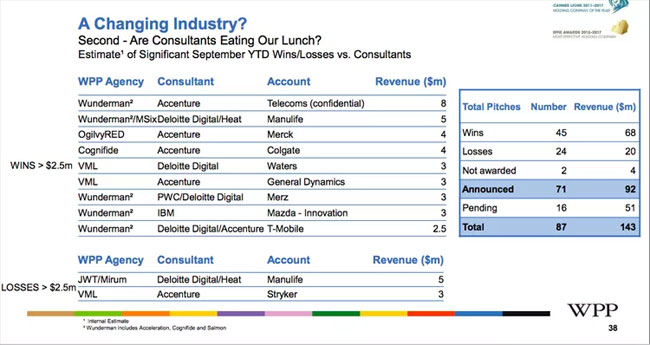
    The latest salvo came from WPP’s third quarter earnings report where WPP dismissed the threat from management consultants as “overhyped”. Analysts may tend to have agreed.


    And yet just last month, Jerome Bodin, an analyst at Natixis shocked the communication group community by saying that WPP and Publicis were potential take over targets. He seemed to suggest that consultancy or IT services companies like Accenture or Capegemini could be shopping.


    Bodin said that WPP and Publicis were potential take over targets and that Accenture could be a possible buyer. “Amid strong pressure on advertising agencies’ business models, a consolidation deal is a credible scenario,” Jerome Bodin, an analyst at Natixis, wrote in his research report. Bodin said a merger was one possibility, but more likely were acquisitions by a consultancy or IT services company like Accenture or Capgemini. Brian Whipple an ex-ad agency executive from Accenture Interactive said, “We don’t believe brands are built from advertising anymore. “They are built from an amalgamation of customer experiences, so that is what we are focused on.” That statement unveiled the possible threat on the horizon for communication groups. Cognizants buy out of Zone Digital in the UK just two weeks ago perhaps was a good example of what Bodin might have been alluding to.


    In their third quarter earnings report this year WPP accused AdAge of carrying “wildly inaccurate” estimates of the consultancies’ digital marketing revenue in comparison with the industry’s agencies or holding companies. (Earlier Ad Age had reported that four consultancies have already cracked Ad Age’s ranking of the 10 largest agency companies in the world.)

    “Where the consultancies may have made some inroads is their focus not so much on the digital area, but more importantly on client concerns about cost,” WPP said.

    So WPP seems to have gone to great lengths to justify that the consultants were indeed no threat to WPP. They seem to have won more pitches and the more important ones in terms of size.


    Do services of the communication group and the consultancies really overlap?

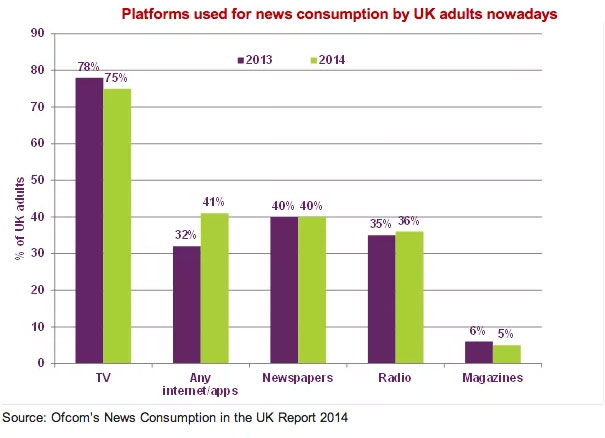
    If one looks at it objectively there is no real overlap. Communication groups have mostly focussed on communication and creativity and the consultancies have been focussing on business expertise and advice to clients. This has often been alluded to as the consultancies being more left brained and the communication groups being more right brained. Why then this furore over the consultancy and the communication group face off? One of the reasons perhaps that there is some degree of overlap is the new field of ‘digital’ that has attracted both the consultancy and the communication groups, which considered it a natural extension of their earlier services since main media like TV and print have been slowly down and giving in to digital media, that is in some countries taking over a lion’s share of the market. For example, when it comes to news, digital media because of the penetration of phones and tablets and computers has been catching up with TV and newspapers in developed countries like the UK and others.

    Ofcom’s report in 2014 for the UK first showed a trend that would soon catch up in other countries as well.


    Andy Main, Chief Executive of Deloitte Digital which is entering India says ” We are transformation partners for our clients, while an advertising agency is a communication partner offering only creative solutions and talking only to marketers. Through our work, we try to impact the business of a company by bringing a change in its balance sheet quickly. I don’t think a television ad has ever transformed a business. We can work with the brand’s chief executives, supply chain, sales, finance and even human resource managers.


    Deloitte Digital brings capabilities like digital technology, experience design and linkage to back office systems. We can manage the company’s data leveraging new-age technologies like artificial learning and cognitive technology apart from connecting with the brand’s consumers through advertising”.


    So there is no doubt that the consultancy groups are taking the high ground with clients by claiming to be transformation partners for clients. Once upon a time, agencies also claimed to be transformation and business partners for clients, but it might be something the communication group has forgotten along the way. After all who would deny that Bill Bernbach transformed the Volkswagen business in the United States with the launch of the VW Beetle. Or deny that Ogilvy transformed the business for Rolls Royce and many others?


    Unfortunately that may no longer be true. Declining margins in the advertising business, have forced agencies to do just that much and no more. They have also enveloped themselves into the comfortable cocoon of ‘creativity’, thereby limiting their transformational abilities.


    Sometime ago Sir Martin Sorrell posed a rather rhetorical question when he said that consultancies can’t buy culture. He added that one is a science and the other is an art. I agree with that. But communication groups have not been happy with art and all the recent additions to their portfolios have been in the area of science. In fact, WPP boasts that less than a fifth of their revenues come from mainline advertising. The rest is data, media, research and digital which probably falls under ‘science’. So it is justified perhaps that the time has come for the consultancies to chase art as well.


    On the question of buying culture, my piano teacher used to say that it is easy to buy culture. She once pointed out that the easiest way to buy culture for the nouveau riche was to buy a piano and study classical music!


    Veteran adperson Prabhakar Mundkur now blogs at prabhakarmundkur.com. This comment first appeared here


  • Mindshare appoints Sudipto Roy as MD, Team Unilever for AAR

    By A Correspondent


    Sudipto Roy

    Mindshare has appointed Sudipto Roy Managing Director, Team Unilever for AAR (APAC, Africa, Middle East, Turkey, and Russia). Roy’s mandate is with immediate effect and will bring the collective power of WPP to Unilever and help create a horizontal offering for one of the agency’s most important global accounts, notes a communique.


    Roy first started at Mindshare heading strategy for the Mindshare Unilever team in Mumbai in 2007. He relocated to Singapore in 2011 to lead the Unilever relationship out of the Singapore hub and went on to play a wider role as Chief Client Officer for Mindshare APAC in 2014. He later joined Tenth Avenue (WPP’s connected experiences company) as CEO of developing markets in 2015. Roy will be based out of Singapore and will wear two hats in his new role. In his first role, he will assume leadership of the Mindshare central and market teams in AAR and his other role will see him proactively work with various WPP agencies to create offerings across digital, data, research, consulting services, content, shopper, and e-commerce.


    Said Roy: “I am very excited to be back with WPP at such an interesting point in the development of this industry. We are perfectly poised to build on the advances of the last few years and create the next iteration of the marketing services model powered by data, technology, content & commerce. What we do now sets the tone for the next decade.”


    Commenting on the appointment, Peter Dart, Global Team Unilever Lead at WPP, said: “Roy joins us at a time when we are beginning a signifcant business transformation task as we bring many of our units together to create a more impactful service for one of our largest global clients. His deep knowledge of our markets, our network, and of the Unilever marketing teams will serve as a great enabler to drive this change.”


    Added Himanshu Shekhar, Chief Executive Officer, Mindshare South East Asia: “It is great to have Roy back into the extended Mindshare & WPP family. He is a unique talent whose product and business orientation helps us create impact at speed. We look forward to exciting innings from him.”


  • HDFC Bank stays #1 in BrandZ India study


    By A Correspondent


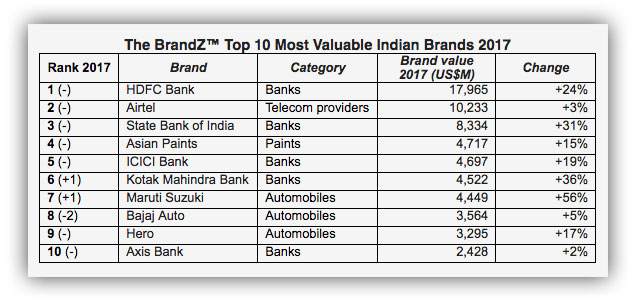
    India’s most valuable brands have increased their brand value by 21% to US$109.3 billion in the last year, according to the BrandZ Top 50 Most Valuable Indian Brands 2017 announced on Wednesday by WPP and Kantar Millward Brown. This compares with a 2% decline in 2016, and is well ahead of the 8% value increase of the BrandZ Top 100 Most Valuable Global Brands 2017.


    HDFC Bank (24%) is India’s most valuable brand for the fourth year running, almost doubling its brand value since the ranking started in 2014 from $9.4bn to $18.0bn. It has a strong purpose – to improve lives by bringing world class financial services to all sections of India – and demonstrates it through increased access to banking in rural areas, an expanded digital presence and leveraging the latest technology to simplify its offering for customers. BrandZ data shows that consumers perceive the bank as increasingly innovative.


    The BrandZ ranking and report highlights the success that many Indian companies have had in 2017 with managing their most important intangible asset: their brand. For many that has been driven by a rapid response to rising consumer optimism, and evolving to meet people’s needs as their financial circumstances, preferences and expectations change.


    Said David Roth, CEO EMEA and Asia, The Store WPP: “Indian consumers seek authenticity and value for money, and the meaning of those things is being constantly redefined. As consumers become wealthier, they look beyond price to factors like extra features, innovation and a personalised experience. As reflected in this year’s ranking the most agile Indian brands have recognised the complexity in the market, and achieved just the right balance between aspirational and affordable.”


    The automobile category, which also includes tyres, lubricants and motor fuels, grew 23% in value. Brands responded to the changing market with new models that combined smart pricing and functionality with style and power. Royal Enfield, Maruti Suzuki and TVS were among the Top 10 overall fastest risers. Royal Enfield (no.40, 59%) engaged with biker groups on social media, and marketed a range of accessories. Maruti Suzuki (no.7, 56%) extended the brand beyond its traditional appeal to the value segment of the market, while introducing new showrooms called NEXA to reach premium customers.


    According to a communique, the India Top 50 have faced successive disruptions in the last year, some global, some created by fast-growing competitors and others strategically imposed by the government – including demonetisation.


    The FMCG category, which includes alcohol, food and dairy, personal care and soft drinks, was significantly affected by these challenges but still managed to grow 6% in total value. Some brands achieved impressive value increases by accurately understanding and responding to Indian sensibilities. Noodle brand Maggi (no.32; 66%), the overall second-fastest riser, aligned itself with the trend for nostalgia. This helped it bounce back after a difficult couple of years; its rapid regrowth demonstrating how a strong brand can help a company weather a crisis and recover faster, although it is still some way below its peak brand value of $1.1bn in 2014. Health food brand Saffola (no.36; 24%), meanwhile, introduced oats in new localised flavours and expanded its range of oils into a new super premium sub-segment.


    The financial services category increased its value by 26%. The fastest rising banks were Punjab National Bank (no.39; 43%), which is highly customer-focused and more agile than some of its competitors, and Kotak Mahindra Bank (no.6; 36%), which has innovated in areas including digital banking. Both of these brands still have significant catching up to do, however, if they are to reach the top of the leader board.


    Other trends highlighted in this year’s BrandZ Top 50 Most Valuable Indian Brands include:

    :: There are seven newcomers to the ranking. Telecom provider Jio ranks at no.11 only months after its launch, having disrupted its category with free-data promotions. The others are newly listed retailer D-Mart (no.24), appliance brand Whirlpool (no.45), insurance brand Bajaj Allianz (no.49), Canara Bank (no.50) and entertainment brands Sun Direct (no.27) and Dish TV (no.47)


    :: The long-term growth curve of the Top 50 is positive, with the total brand value of the ranking up 57% since the study was first carried out in 2014, when it amounted to $69.6bn


    :: India experienced a resurgence in national pride, while also embracing globalization. This manifested in a desire for products and brands that best reflect Indian heritage, sensibilities and tastes, which benefited local brands and put pressure on multinationals to follow suit. Colgate (no 28; 2%) launched a toothpaste with Ayurvedic properties to meet this demand


    :: The top riser is insurance brand ICICI Prudential (no.35; 89%). It benefited from the ‘halo effect’ of other brands’ successful responses to rising consumer affluence, which led to an increase in sales of assets such as cars that need insurance protection


    Said Vishikh Talwar, Managing Director, Kantar Millward Brown, South Asia: “There are now ‘multiple Indias’. Consumers continue to love the brands they’ve loved for generations, while equally embracing the brands of the future. Brands must be completely in rhythm with the pulse of the market. Those that can accurately interpret Indian sensibilities, while ensuring smart pricing, are likely to be most successful. This is easier for local brands, but people will relate just as positively to a global brand if it uses insight to understand and meet their needs, and communicate in a way that builds trust.”


    According to a communique, for the first time, this year’s BrandZ Top 50 Most Valuable Indian Brands 2017 study incorporates new research from Y&R’s BAV Group into what it takes to build powerful nation brands. According to the 2017 Best Countries report, India stands out for its history, cultural influence, distinction and reputation for entrepreneurship; especially among the world’s business decision-makers. Because there is a strong relationship between how people perceive a country and how they view the brands associated with it, India’s reputation has a significant impact on the global power of its brands.


  • Indrani Sen: Will Ekam provide the missing links in digital measurement?

    By Indrani Sen


    Digital media measurement has been breeding a sense of dissatisfaction among global marketers.  Recently, Procter & Gamble chief brand officer Marc Pritchard, was quoted in media that he was tired of waiting for digital platforms to get their measurement act together http://www.thedrum.com/opinion/2017/03/28/why-marketers-should-follow-coca-cola-and-pgs-lead-overhyped-digital. Pritchard complained about the inadequate viewability data from Facebook, Snapchat, Google, and others who are reaping the benefits of the advertising spends in digital media by all leading brands. The article also referred to Marcos de Quinto, Coca-Cola’s global chief marketing officer, who a few months back criticized his company’s history of digital spending, and stated that TV advertising is still the best investment for brands.


    Jeri Smith, chief executive of Communicus, wrote in the above article “So far, only de Quinto has opened up his brand’s books to show evidence of effectiveness. Stating that “TV still offers the best ROI across media channels,” he revealed that Coca-Cola has reaped a return on TV investment of $2.13 for every dollar spent. Their return on digital? Only $1.26 per dollar spent.”


    In August 2016, Sir Martin Sorrel had cited the example of Procter & Gamble planning to cut investment in digital ad spends while predicting that the digital ad spend to slow over the next few years https://www.marketingweek.com/2016/08/24/sir-martin-sorrell-brands-are-starting-to-question-if-they-have-over-invested-in-digital/. All these comments make one wonder if digital media is really overhyped and why the digital industry is unable to get the their measurement act together.


    Digital media haveplenty of measurable metrics and other analytical data available in real-time, but a comprehensive measurement of these data across different digital platforms is lacking. The metrics are generally categorised into three groups, according to the flow of any digital marketing campaign from traffic generation to conversion to revenue. Overall site traffic, traffic sources, click through rate, cost per click are typically the traffic metrics which progresses to conversion metrics like conversion rate, cost per lead, average page views per visit, average cost per page view, average time on site, bounce rate, rate of return visitors, etc., followed by calculations of return on investment and cost to acquire a customer. With all these metrics being flaunted by the digital media and organizations like comScoreproviding measurement for cross platform audiences in digital media, why are the global advertisers complaining about the lack of measurement?


    Last year, when BARC announced their plan for measuring digital viewership and going beyond audience measurement of broadcast media, it also claimed that BARC will be the first to provide a TV+ Digital viewership measurement service across the globe. The press release issued data “BARC India to Solve the Digital Puzzle with its “EKAM” range of products” announces certain unique offerings in digital measurement. Ekam range of products needs to be studied in greater details through interactions with representatives of BARC to understand their full implications. We will have to wait for another 18-20 months for the reports to roll out before we can sample the results and proclaim it as “EkamevaAdvitiyam” of digital measurement.


    The irony is that better tools and techniques of measurement of digital media may not be able to improve on the ROI as the consumer becomes more and more elusive. In the digital age, we are getting bombarded by consumer-led demassification of media which is shrinking the value of the advertising budget. The return on media investment is bound to fall in future with proliferation of media types and vehicles in spite of best efforts through programmatic media planning and buying.


    Indrani Sen is an advertising and media services veteran and now an academic. The views expressed here are her own