Tag: WPP

  • GroupM makes ESP standalone agency brand, Mumbai to be ESP Properties hub

    By A Correspondent


    Media agency major GroupM has announced the expanding of its sports and entertainment offering under a new global agency brand, ESP.


    ESP will be made up of two separate businesses: ESP Properties and ESP Brands. Both businesses will be part of WPP’s media investment management company GroupM, but remain independent of its media-buying operations.


    According to a communiqué, ESP Properties will be GroupM’s first company dedicated to serving rightsholders from the worlds of sports and entertainment, including federations, leagues, events, teams, publishers and venues. “It will offer a thorough assessment of their commercial programs, and advise how to grow the revenue they generate through a full range of services across data, digital and content development. It will also offer global partnership sales on behalf of rightsholders, both to existing WPP brand clients and beyond.”


    ESP Properties will be formed through new hires, the integration of existing GroupM business units including leading sponsorship agency IEG, and the acquisition of data-driven sports marketing agency Two Circles. It will collaborate with specialists from the WPP network to deliver a full range of marketing services. It will also work with GroupM Entertainment on new programming concepts and, where mutually beneficial, provide direct finance for new projects.


    ESP Properties will launch with over 150 staff in hubs across New York, Chicago, London, Singapore and Mumbai, plus additional teams in Los Angeles, Sao Paulo and Dubai amongst others. It launches with a roster of globally recognised clients including the All Blacks, Cleveland Cavaliers, Valencia CF, England and Wales Cricket Board, Pele, and City Football Group.


    Said Sir Martin Sorrell, CEO of WPP, in a statement: “There is significant and growing demand on the part of clients to invest more in content and sports but few in our industry have had a serious response to this. Our new ESP Properties will bring creative power and commercial insight to rightsholders for the first time, providing unmatched opportunities to better tailor their offerings to the needs of today’s brand sponsors. ESP will also work hand in hand with our recent investment in Bruin Sports to provide our clients with access to many high-value media and sponsorship opportunities.”


    GroupM is also expanding its support for brands to plan, negotiate and activate sports and entertainment partnerships by growing the specialist teams in its individual media agencies. These specialist teams will be underpinned in key regions by the second business within ESP, ESP Brands. ESP Brands will be an evolution of the former partnerships consultancy GroupM ESP.


    Dominic Proctor, Chairman of ESP and President of GroupM Global, added: “The global launch of ESP Properties brings leading commercial and creative capabilities to some of the world’s most celebrated names across sports and entertainment. Sport is a driving force in media and we want to serve the market better by assisting rightsholders in optimizing their properties and creating more winning partnerships with leading brands. At the same time we will ensure we work more efficiently on behalf of brands by providing even more resources for the specialist sports and entertainment practices that are embedded in our GroupM agencies, underpinned by a central team in key regions, ESP Brands.”


    The new ESP Properties will be led by John Kristick, Global CEO of GroupM ESP since 2011. Kristick is a senior sports marketing executive with nearly two decades of international experience, including being appointed Managing Director for the USA Bid Committee to host the 2022 FIFA World Cup, and previously working for more than ten years in Europe serving as an Executive Director for Infront Sports & Media from its inception. The business will be led regionally by Jonathan Hill (EMEA), Laren Ukman (North America) and JinWei Toh (APAC). ESP Brands will be managed regionally in North America by Bryce Townsend and through the individual GroupM agencies in other regions.


    John Kristick, CEO of ESP Properties, said:  “ESP Properties’ offering is truly unique in meeting the changing needs of the world’s leading federations, events, leagues, teams and other rightsholders. We have brought together a range of experts from across GroupM, such as IEG with over three decades of experience in sponsorship consulting, and our new partners Two Circles who have been leading the way in data-driven sports marketing. By combining this strategic expertise with unmatched understanding of how to navigate potential brand partnerships, we can uncover new revenue opportunities for rightsholders worldwide.”


    The launch is part of WPP’s commitment to content, demonstrated by its investments in MediaPro, VICE, Indigenous Media, FullScreen, MRC, and, most recently, Bruin Sports Capital.


    Said George Pyne, founder of Bruin Sports Capital:  “ESP Properties provides rightsholders around the world with a very powerful combination of strategic services and sales expertise. The ability to access the group’s unmatched global resources and corporate client base will be very helpful as we create value for the relevant businesses Bruin operates. We also anticipate collaborating with ESP Properties to jointly deploy capital and create new businesses as opportunities arise.”


  • BARC is ready, but IBF?


    By A Correspondent


    Update @ 1.49pm: The fears have been allayed. BARC’s future-ready TV audience measurement data will be released today

    The coconuts were ready to be broken. A new sun was rising today. Data analysts made it to their offices early. There was indeed much anticipation. We almost didn’t sleep. Okay, that last bit was an exaggeration. We did catch some winks. But you know why all this tamasha:  the first data from Broadcast Audience Research Council (BARC) was scheduled to be released today.


    Till late last evening though, the BARC big bosses were grappling with a new problem, and this didn’t concern set-top boxes, the technology, etc etc. Some members of the Indian Broadcasting Federation, the apex body of broadcasters, wanted the release of data to be delayed. They reportedly wanted some more stability.


    When we teased whether it was BARC’s IRS moment, given all the madness that happened (and is still playing out) with the print readership study IRS, we were told it wasn’t that bad. These were just reservations. Niggling problems. And no it wasn’t raised by a network whose sporting activity is getting many numbers. In fact all the GECwallahs are pretty happy with the way BARC is going about its task. It’s the smaller channels, specifically some news channels who are upset. There is a conference call scheduled at 12.45pm today to deliberate on the issue.


    Meanwhile, TAM, which was until recently subscribed by most broadcasters, still exists, but key stakeholders – television channels, media agencies and advertisers – and have in fact released data comparing household versus individuals. It may be noted that BARC is currently only due to publish household viewership data.


    Partho Dasgupta

    The diversity in cultural and media consumption in the country makes the work of the Broadcast Audience Research Council (BARC) India the most challenging service governed by a single joint industry body for the entire country, said BARC CEO Partho Dasgupta on the eve of the release of data. With the number of TV-viewing households likely to go up from 20,000 to 50,000 in four years, the process will become even more complex, he added.


    Over 300 channels having ordered for the watermarking technology, and with over 272 channels already live, BARC India’s stakeholders – broadcasters, media agencies and advertisers  have, got together some of the top vendors from across the globe offering technology and solutions.  BARC India, has invested 76% of its budget on technology, it is learnt.


    According to Dasgupta, around 3000 professionals have been trained with the BARC India Media Workstation (BMW). NCCS, or the new SEC system, will be the norm to follow for accurate classification and data analytics. The pre-launch and post-launch audit processes were conducted by Ernst and Young’s  Florida team.


    Meanwhile, TAM, a joint venture of Nielsen and WPP-owned Kantar Media, is considering an urban-centric audience measurement service. There have also been rumours that BARC could well either buy over TAM’s TV audience measurement facility or turn its sole subscriber. When asked what TAM and he plan to do after BARC data is released, CEO LV Krishnan, who has helmed TAM since 2000, told MxMIndia in an interview yesterday: “On May 1, I’ll still be in business and there is never an end-of-the-road for anything. There will be a new kind of a craft that we will create…”


    So what happens to BARC now? We’ll know for sure by 1.30pm what course the conversation takes. Hmmmm.


  • With Bengaluru as a hub, WPP to form global analytics firm ‘Gain Theory’

    By Pritha Dasgupta


    WPP, the world’s largest advertising company, is merging two of its existing companies to float a new global analytics company called Gain Theory with three key hubs in New York, London and Bengaluru.


    It will help marketers analyse the maze of big data at a much quicker pace and help them incorporate and use the information in their business plan. The company will bring together data, analytics, technology solutions and consumer-insight capabilities to help marketers simplify the sheer volume of data they are currently receiving. It combines WPP’s expertise in media, marketing, data and technology to create a consultancy that will help brands make smarter, faster, predictive business decisions.


    “Gain Theory is the coming together of a select set of entities driving marketing RoI (return on investment) analytics and practices within the WPP group and will be a separate P&L (profit and loss). Acquisitions and partnerships as appropriate will be part of our road map.


    The new entity will focus on marketing analytics and help clients navigate the big data-driven consumer engagement and maximise RoI from these activates”, said Sunder Muthuraman, CEO, Gain Theory APAC.


    In India, Hindustan Unilever is by far the biggest client of Gain Theory. “We believe that when it comes to innovation in analytics and analytical technology, India, particularly Bengaluru, will lead the way. Meritus — one of the founding members of Gain Theory — is headquartered in Bengaluru and has a rich heritage in innovation, which is a strength that will be leveraged under Gain Theory,” said Muthuraman.


    While, globally, Gain Theory is led by Jason Harrison as the chief executive officer, Sunder Muthuraman will be the India lead and the CEO of APAC. The global operations will also include Manjiry Tamhane as the chief operating Officer and CEO, EMEA.


    “There’s no denying that technology today offers us more access to data than ever before, but in doing so it can also create paralysis for companies that need to act quickly,” said Harrison.


    The company is starting off with 200 employees worldwide that include professionals like data scientists, statistical experts, big data technology experts and various domain experts in the field of marketing, media and consumer engagement. It will soon expand to Latin America and China.


    Gain Theory will work with both existing and non-WPP clients. It will also draw expertise from other WPP companies like GroupM, KBM and Kantar.


    Source:The Economic Times

    Copyright © 2015, Bennett, Coleman & Co. Ltd. All Rights Reserved

    Licensed to republish


  • Exclusive! BARC in talks to buy TAM?


    By A Correspondent


    Entertainment television is all about twists and turn in the fictional serials. Cricket, as you would’ve heard several times over, is a game of glorious uncertainties. So why then should there be surprise over the possibility of BARC buying up TAM.

    Okay, let’s cut the tease. Broadcast Audience Research Council (BARC) has indeed been in discussions to buy the television audience measurement business of TAM, the firm jointly owned by WPP’s Kantar Media Research and Nielsen. And, yes, it’s March 12 today, not April 1.

    According to reasonably reliable sources, there have been a detailed dialogue between the joint industry body-managed BARC and TAM owners Kantar and Nielsen. The talks haven’t concluded yet and the mid-point formula that was suggested by a WPP representative has been reportedly rejected by BARC bosses.

    Both BARC and TAM were unavailable for comment, but from what one learns, BARC was seriously considering the buy.

    So why gobble up TAM when the audience research measurement activity of the measurement body was under question? Well, even as doubts were being raised, there is no denying that broadcasters, advertisers and media agency use TAM as the currency for their buying decisions. Also, as industry analyst told us, TAM comes with a ready 12,000-odd panel, established processes and teams and archival data.

    And from TAM’s point of view, why sell out to BARC? Given that all stakeholders have contributed to the BARC kitty, it’s evident that sooner or later all TAM subscribers will exit the system or want to renegotiate. Given this, it’s best to sell the existing well-oiled measurement machinery to BARC which would find it of use, said the analyst we spoke to earlier.

    TAM has already made it known to subscribers (and the media) that it will continue operations even as there is a significant number (in billings at least) of subscribers who have said they would like to unsubscribe. If TAM continues to exist, there will be several comparisons made with the new measurement system, and those subscribers who may be rated poorly by the BARC system vis-a-vis TAM may quote the latter. This could even lead to advertisers questioning the BARC data and hence cause a confusion in the marketplace.

    As reported on MxMIndia earlier, the ghost of the Indian Readership Survey has raised anxiety levels in the industry. For, MRUC and RSCI, the bodies running IRS are jointly run and owned by various stakeholders in the industry. And despite it being an industry association, print players are up in arms against the new IRS.

    BARC, meanwhile, is said to be only in the discussion with the television audience measurement business of TAM. Other divisions such as the Strategy or S Group which offers advisory service on measurement, AdEx India, RAM for radio audience measurement, Eikona for measurement of earned media and PR activity and TAM Sports, which offers special analysis of sports ROI will not be part of the deal if it goes through.

    So where do things stand now? At the time of writing, the talks have been suspended. But as the date approaches for the launch of the system, and the stakes for both BARC and TAM grow higher, the deal could well be inked. Like on television, be ready for the climax.


  • Sudipto Roy to drive WPP’s ‘tenthavenue’ as CEO, Emerging Markets

    By A Correspondent


    Sudipto Roy

    The WPP-owned global communications company Tenthavenue has announced the appointment of Sudipto Roy as CEO Emerging Markets, covering Asia, Africa, Middle East and Turkey.


    Established in 2011, Tenthavenue (spelt by the company with the t lowercased) helps build products and services that enable advertisers to create connected brand experiences. As parent to WPP’s ‘Connected Consumer’ agencies, the Tenthavenue agency family consists of market leaders and rising stars in their respective fields, including Kinetic, Aviator, Joule, Spafax, Candyspace, Forward and TMARC.


    Mr Roy will lead Tenthavenue across China, South East Asia, Hong Kong, South Africa and drive the network’s expansion into new markets, including Turkey, Middle East and Japan.


    Mr Roy has held leadership roles within Mindshare across India, APAC and Africa.  Said Rupert Day, founder and CEO of Tenthavenue: “This appointment comes at a time when we are refocusing our vision for the future. We have had a fantastic start over the last four years, and we want to remain nimble, agile and focused for the next five. In recruiting Roy, we are continuing the energy and direction Tenthavenue requires to keep growing, and to keep building winning propositions.”


    Said Mr Roy: “Tenthavenue is poised to create a highly differentiated marketing services model for the future. The company has an inherent strength in out of home experiences, on-the-go experiences and mobility. That’s the perfect combination for a new age services model as consumers spend less time in front of the TV and desktop and become mobile.”


    Mr Roy will be based out of Singapore and will begin his new tenure in mid-April.


  • Sanchit Sanga promoted to Head of Digital Services, APAC at Mindshare

    By A Correspondent


    Sanchit Sanga

    Mindshare APAC, the global media agency network part of WPP has appointed Sanchit Sanga to the role of Head of Digital Services for Asia Pacific to be based in Singapore.


    Sanchit takes on the role after two years as Digital leader for South Asia & South East Asia. In his new role as Head of Digital APAC, Sanchit will focus on the continued development and delivery of Mindshare’s digital services to marketers, working closely with the regional in-market digital leads and global teams.


    Mindshare continues to focus on expanding their digital services from digital performance product integration, to working with GroupM partners like Vocanic to offer innovative Social solutions, to building an in-house Mobile Marketing practice – partnering with innovative start ups like Footmarks. As part of the drive to continually raise the quality of the digital product, Mindshare has increasingly focused on aspects such as precise audience targeting and multi-screen planning, working with partners like Crayon Data, Xaxis and the Mindshare Trading hubs.


    Ashutosh Srivastava, Chairman, Asia Pacific & CEO, Global Growth Markets, Mindshare Worldwide, commented on the appointment: “We are privileged to have highly talented people like Sanchit in the Mindshare family. Over the years, Sanchit has developed trusted relationships with our clients, which continually assists us to lead the industry in digital thinking. It is an exciting time to be in our business, where our understanding of media, technology and effective data usage is becoming more and more central to brand success.”


  • Interactive TV releases Cinema Audit & Monitoring report

    By A Correspondent


    Interactive Television, a unit of WPP, in collaboration with IPSOS-MEDIA CT released the CAM report August 2014 (Detailed trends and tracker for the movie Singham Returns). CAM report by Interactive Television is an initiative seeking to capture and present the trends and developments in the Indian Cinema advertising industry. The report documents important specifics of the month of August including presence of each category and brands in cinema, brand recall, placement and distribution strategy of each brand and traces the developments in the Indian cinema advertising.


    CAM report August 2014 captures that Food and Beverage continues to be the top category present in almost all the screens in cinema advertising in the last one year & has emerged as a biggest spender on this medium followed by Beauty & Personal Care and Apparel.


    Ajay Mehta, CEO- Interactive Television Pvt. Ltd says, “CAM completed 12 rounds of audit with ‘Singham Returns’. With this month’s CAM report, 298 brands were active on cinema out of which 55 are new brand entrants. On an average, 120 new brands are associating with cinema every month and looking at it as a useful medium to advertise. In the coming months, we are expecting to see rise in number of brands advertising on cinema because of big releases like Happy New Year, PeeKay expected to generate higher footfalls.”


    Key highlights of the report include cinema is India’s greatest passion and has been enchanting audiences for almost a century now. The core objective of CAM report is ‘to understand the potential of cinema as a medium of advertising, track how is it moving over time.’ The Report examined advertising investments in Indian multiplexes or theatres and offers a comprehensive overview of where the money is flowing in cinema advertising. Chocon continues to be the top advertised brand on screen with presence in 3/4th of the screens and the ads are being played in all premier slots. The brand continues to be most recalled brand followed by 7up. Also the difference between the top brand recalled and the others is quite high.


    The report also highlights that 55 new brands were screened, out of which Parle Marie & Tropicana were present on more than 100 screens. Parle Marie with highest slots balanced their ads for ‘Before Movie’ and ‘During Interval’ equally.


    CAM reporting is done on a monthly basis and monitoring is done with big releases in that particular month.


  • JWT likely to win global ad contract from Tatas

    By Pritha Mitra Dasgupta


    WPP-owned J Walter Thompson is likely to win a global advertising contract from the Tata Group, the first time that the conglomerate will embark on a corporate brand initiative as part of Chairman Cyrus Mistry’s push to make its worldwide presence felt more strongly.


    The two sides are yet to sign on the dotted line but a verbal commitment has been extended to the agency, according to well-placed insiders. A formal announcement is likely this week. Sources estimate the size of the business at just under Rs 200 crore. The group hasn’t engaged in any brand activity except during centenary celebrations a few years ago.


    During the celebrations, an award winning, football-themed film on the group’s values was made by Arun Nanda-led Rediffusion Y&R. “The new management under the leadership of Cyrus Mistry feels the need to position Tata as a force on the global platform,” said a top Tata Sons executive explaining the rationale behind the campaign.


    Mr Mistry, who took over as chairman of holding company Tata Sons in 2012 from Ratan Tata, will be looking to strengthen the group’s presence in global markets as an increasing share of its business comes from overseas. “More than half of the (group) companies’ revenues are… from the international markets,” said the person cited above.


    “And while people are aware of the individual companies, they don’t know that these companies actually belong to Tata Sons. And thus the company feels that this is the right time to launch a global campaign.”


    As reported in May, pitches kicked off in the first week of April. with five agencies participating – JWT, TBWA, Y&R, McCann World-Group and FCB Ulka.


    Of these, the first three made it to the final round of presentations that took place in May. The brief was simple, according to the CEO of one of the agencies that participated: “What should the Tatas do to be globally visible?”


    The group wants people to look beyond Tata Consultancy Services and Tata Motors unit Jaguar Land Rover, he suggested. “I think the idea is to build salience for the brand Tata so that people see more than just TCS and JLR. It is something that they are trying to fix.”


    A JWT executive said winning the deal was more about prestige than anything else. “More than the size of the business it is an extremely prestigious account because no other Indian company has gone global this way,” the person said. He said the pitch was led by Colvyn Harris, CEO of JWT South Asia, and the team had members from the agency’s New York and London offices. Harris declined to comment.


    A Tata Sons spokesperson said, “We have not appointed any agency so far, and will make an announcement at the appropriate time.” It wasn’t clear whether Tata wants one advertising campaign that will run across markets or if it will have separate country-wise campaigns with one overarching theme and tagline since the positioning of the group’s units vary across geographies. For instance, the group is the largest employer in the manufacturing sector in the UK, which is very different from its positioning in the US or even China. A top executive at another agency that participated in the pitch said, “They don’t have a plan yet. They have also not finalised the media plan as well and therefore don’t know if it will be an above-the-line (aimed at a wide audience) or below-the-line campaign (more sharply focused). And therefore they have not yet finalised a media agency.”


    However, executives aware of the plans say the media business will be integrated with one of the WPP agencies, a strategy that works well for both JWT and Tata if the two go ahead with the initiative.


    Source:The Economic Times

    Copyright © 2014, Bennett, Coleman & Co. Ltd. All Rights Reserved

    Licensed to republish


  • HDFC Bank is India’s Most Valuable Brand


    By A Correspondent


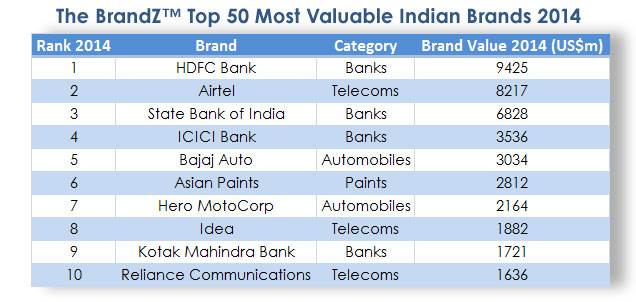
    The combined Brand Value of all the brands in the inaugural BrandZ Top 50 Most Valuable Indian Brands ranking is almost $70bn BrandZ. HDFC Bank is India’s most valuable brand with a value of $9.4bn. Carried out by marketing and brand consultancy Millward Brown in conjunction with WPP, the valuation is the only one in India that takes into account consumers’ opinion of brands to calculate the contribution that product brands make to business success.


    The BrandZâ„¢ India study shows that India’s unrestricted ‘right to play’ for businesses has nurtured great diversity amongst brands in the ranking. The Top 50 come from 13 different categories. Seventeen are multinational corporations (MNCs), 26 are private Indian brands and seven are state-owned brands. This indicates that India is an open, fertile market for building valuable brands, irrespective of age, origin, structure, category, ownership or even price range.


    HDFC Bank, the No 1 brand, has a network in more than 2,100 cities. It is popular with its 28 million customers for launching mobile apps designed to make banking easier, and running literacy, education and skills training programmes in rural areas. The No 2 brand, Airtel, is the fourth largest mobile operator in the world with nearly 300 million customers, while India’s largest commercial bank, State Bank of India, is at No 3 in the ranking.


    Services businesses (Banking, Telecoms and Insurance), which are the nerve centre of today’s Indian economy, are prominent in the ranking. Seven of the Top 10 brands, and 30% of the Top 50 brands, come from the service sector. Financial services stand out, with the 12 banks and insurers in the ranking holding the largest proportion (37%) of total Brand Value. Analysis shows these brands have built value by successfully achieving scale – both in geographical reach and the diversity of their offerings. Telecoms, Personal Care, and the Food and Dairy sectors also feature strongly in the Top 50. The data shows that these brands – along with the other FMCG brands in the ranking – excel at connecting with Indian consumers.


    The average Brand Contribution (a measure of the impact brand alone has on value) of the Top 5 brands is far higher than the overall average of the Top 50, illustrating the positive impact that building a strong brand has on the financial valuation of the brand. These brands create powerful connections by being meaningful to consumers, and differentiating themselves from others.


    Key findings highlighted in the BrandZ Top 50 Most Valuable Indian Brands include:

    :: Being meaningful and different builds value – India’s most valuable brands are highly relevant to consumers and differentiate themselves through service, new offerings and brand experiences. One such example is personal care brand Colgate (No 28) – even after 70 years in India the brand has successfully remained relevant and continues to differentiate itself from the competition.


    :: India has evolved into a brand powerhouse – India’s Top 50 most valuable brands have as much Brand Power (consumers’ predisposition to choose that brand over another) as the global Top 50, and are ahead of the other emerging economies.


    :: Private sector players and multinational corporations dominate – together these contribute around 85% of total brand value. They have succeeded by nurturing a strong relationship with Indian consumers.


    :: Megabrands lead the game – like other fast growing economies, India is dominated by a handful of big brands or companies that own stables of brands: the Top 5 account for 45% of the ranking’s total value. Their tremendous scale and ability to cater to a wide spectrum of the population has translated into financial gains.


    :: ‘Balanced brands’ is the mantra – brands that are able to build both strong connections with consumers and business scale that leads to the creation of financial value are contenders for entering or rising up the BrandZ ranking. Three out of the Top 5 Indian brands demonstrate this balance.


    :: Consumer technology is ‘the category waiting to happen’ – there are currently no homegrown consumer technology brands in the Top 50, but this category is on the verge of emergence. The presence of Indians working in the sector globally is high, and consumer-facing technology brands founded by young entrepreneurs have already started to gain ground.


    :: ‘Indianizing’ products and services is important – the many successful international brands in the ranking have taken the time to understand Indian needs and tastes and adapt to them. Noodles, food seasoning, soup and sauce brand Maggi (No.18), personal care brand Colgate (No.28) and beverage brand Horlicks (No.20) are masters at this – and are thought of as Indian brands by most consumers as a result.


    :: Old and new sit side by side – living with one foot in the ancient world and one in the modern makes consumers equally receptive to heritage brands (Bajaj Auto, No.5, established 1945) and new brands (Airtel, No. 2, established 1995). More than a quarter of the Top 50 brands were created after the economic liberalization in 1991 while Dabur, No.22, was established 130 years ago.


    Said Prasun Basu, Millward Brown’s Managing Director – South Asia: The stronger the relationship a brand can build with consumers in its category, and the more it can leverage that to build scale, the more sustainable and profitable it becomes. All of the Top 50 brands are reputable, successful engines of growth for the future of India. Any global manufacturer that makes the effort to understand the diversity of the Indian consumer’s needs, tastes and aspirations, and which can build a proposition that is both meaningful and appropriately differentiated, will succeed in building a strong brand.”


    Added David Roth, CEO of The Store, WPP: “With the second highest number of social networking users in the world, and the third highest number of users of mobile devices, developing an e-commerce strategy that focuses on social and mobile platforms is essential for brands in this region.”


    Said CVL Srinivas, CEO GroupM – South Asia, “We are already seeing the impact of the purchasing power of the internet and mobile users in India, with the exponential growth of e-commerce companies in the space of travel, e-tailing, ticketing and many main line brands increasing their brand building budgets to digital media in multiples.”


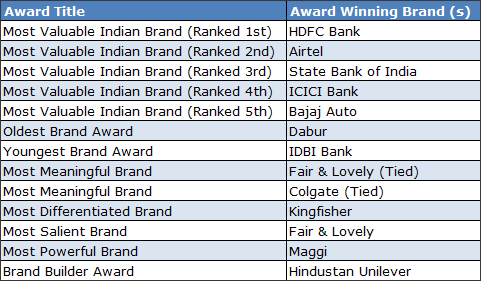
    In addition to the rankings, special awards were also presented to brands among the Top 50 under the following categories.


    Millward Brown BrandZ India Awards 2014

    A copy of the BrandZ™ Top 50 Most Valuable Indian Brands 2014 report can be downloaded at www.brandz.com


  • Behavioural science lab Moribus will help clients use research findings to sell their products

    By Pritha Mitra Dasgupta


    Maxus, advertising and PR firm WPP’s media agency, wants to study your behaviour and help clients use that insight to sell their products.


    Last week, Maxus launched Moribus, a behavioural science lab in India which will be part of its consumer insights division, Insights. Moribus will be the first of its kind lab by a media agency in Asia-Pacific and will use disciplines of behavioural science, behavioural economics, sociology, psychology and so on to solve real life business problems, said Maxus MD Kartik Sharma. Moribus has inked an exclusive deal with Mumbai University’s Centre for Computational & Social Sciences to carry out customised research projects for marketers. While the unit was officially launched a week ago, Maxus had floated two behavioural study projects about two-and-half years ago, Sharma said.


    “Moribus is a Latin name for behaviour and the fundamental thing about marketing is changing behaviour or making people do something which they were not doing earlier,” he said. “It is only for India for now and as we go along we may extend it to a few more markets in Asia.”


    While Mr Sharma declined to comment on the investments made by Maxus on setting up the lab, sources with knowledge of the matter said it has invested Rs 2-3 crore to flag it off.


    While traditional research is good, it sometimes doesn’t unearth some of the insights that marketers are looking for, Mr Sharma said. “People, when asked a question, will react in a certain way, and when you observe them they react in another way. So this kind of technique will also help us understand some of the insights.” Findings of these behavioural studies will be complimentary to the existing marketing plans of clients, and will not replace anything.


    One of the two projects it has carried out was for an impulse category product – usually, things like chocolates, perfumes, music, luxury clothing – and it was called ‘The Ego Depletion Experiment’. “The objective of the study was to understand consumer decision-making when people are under stress,” said Mr Sharma. In behavioural research, the word “economics” has a certain amount of pay off, he said. “Markeunters of impulse products would significantly increase their chances of making a sale by being present in ego-depletion moments.”


    For example, it could be their presence outside the classroom in colleges via counters or giving special offers during exam time.” Besides the economic payoff, this experiment doesn’t need a very large sample size. “Because when you study behaviour in a particular way, even with 30-40 people one can get very good insights. You don’t need to run a 30,000-40,000 panel, therefore it is also more cost effective to the client,” said Mr Sharma.


    Source:The Economic Times

    Copyright © 2014, Bennett, Coleman & Co. Ltd. All Rights Reserved

    Licensed to republish


  • WPP’s Sir Martin Sorrell outlines 10-point keynote at IAA World Congress

    By a correspondent


    With some of the powerful and influential names like Jim Elms, Global CEO, Initiative; Andrew Ward, Vice President Marketing, Etihad Airways; Ben Hughes, Deputy Chief Executive, Financial Times; Doug Pearce, CEO,OMG China; MykimChikli, CEO Zenith Optimedia China; Tim Andree,Executive Chairman, Dentsu Aegis Network etc gathered at the 43rd IAA World Congress in Beijing China, WPP’s Sir Martin Sorrell took the opportunity to present to the gathering his key-note address, which was more a ‘ten-point list’ on issues concerning the ad industry.


    The points included: 

    – Shift to East, South and East – meaning a potential shift in power in the world. The USA is still the center, but undeniably power is beginning to move. With a focus still on “BRICS and the next eleven”. WPPsees a G2 world in the future.


    – Overcapacity and shortage of human capital – in key industries such as automotive there is massive capacity, but changing lifestyles, and aging populations.
    – Rise and rise of the web – 12 years ago WPP’s web business was close to zero and now it is 30 per cent.


    – Growth of retail power – and the changing relationship now between retailers and consumers as populations move to urban areas, with busy two earning families using the e-commerce more and more.


    – Importance of internal communications – data – people talk about “data” and we are now applying more technology to data and its role in our organization’s communications.


    – Global and local structures – WPP sees the rise of Africa -which represents significant opportunities with a dramatic shift in power taking place.


    – Relative power of finance and procurement – the balance of marketing functions and finance is now very much out of balance, and this needs to be addressed- in all parts of the world. Not just the western economies.


    – Growth of government – WPP has government clients in almost every country.They are more significant players than ever. In some parts of the world, such as China, there is also an element of “Government run capitalism”.


    – The acceptance of social responsibility – the issue and attention towards sustain ability is considerable now. And for companies to “do good” is still”good” for business.


    – Industry consolidation – this was a big news day with the announcement that the Publicis Groupe and Omnicom Group merger is not proceeding.


  • WPP may buy Temple at over Rs 200 cr

    By Pritha Mitra Dasgupta


    WPP, the world’s largest advertising company, is set to buy Bengaluru-based creative agency Temple Advertising, according to people close to the development in the two agencies. They said the deal, which could be valued at over Rs 200 crore, could be signed as early as April 15.


    “WPP is currently engaged in 18 to 20 different acquisitions across the Asia-Pacific region and Temple Advertising is definitely one of them,” said a senior WPP executive. “Temple will be merged with Bates CHI & Partners in a bid to pull the agency out of the slump.”


    Martin Sorrell

    Martin Sorrell, founder and CEO at WPP, refused comment on the proposed acquisition, saying, “We don’t comment on conjectures.” Emails to Varagur Srikanth, Manmohan Anchan and Vidur Vohra, all directors at Temple Advertising, did not elicit any response till late on Sunday.


    Temple Advertising was launched by Srikanth, a former employee of Ogilvy & Mather, in 2003 with a single account, Scullers. The agency, which now has over Rs 10 crore of billings, works for some of the best-known brands in India and abroad including Wipro, Reliance Trends, TVS, Indigo Nation, Manchester United and Scullers.


    “If final talks go through on April 15 or 16, the entire process of merger and integration with Bates will be over by July,” said a person with the knowledge of the deal. Following the merger with Bates, the current directors of Temple will spearhead the merged entity.


    “The integration will be primarily at the creative department level,” said the person quoted above. This person also disclosed that Sagar Mahabaleshwarkar, national creative director at Bates, is looking to move on. Mahabaleshwarkar refused to speak on the matter.


    A mail to David Mayo, CEO at Bates CHI & Partners Asia, also did not receive an reply. Several WPP India agency heads said that Mayo has been running Bates India from Singapore ever since Sanjay Thapar, group CEO at Bates CHI & Partners, quit the agency earlier this year.


    “Bates is in a rather laggard state right now. It doesn’t have a proper management, talent, clients and no significant work has come out of the agency in the recent past,” said one of the agency heads at WPP India. Following the merger, both agencies are expected to go through a name change to reflect the new ownership.


    Source:The Economic Times

    Copyright © 2014, Bennett, Coleman & Co. Ltd. All Rights Reserved

    Licensed to republish