Tag: Vodafone

  • MxM Mondays: Why do marketers not spend enough on digital media?


    By Ananya Saha and Robin Thomas


    According to the latest IAMAI-IMRB report on Digital Advertising, as of March 2012, the total advertising spends, including classifieds, was valued at Rs2,850 crore. It is expected that by FY2013 the digital advertisement spends will be Rs4,391 crore.


    Search advertising constitutes about 20 per cent of the total online advertising spend or about Rs570 crore. Display advertisement, which has many components, forms a sizeable portion of advertising spends. Advertisements on portals and vortals form 13 per cent of the overall pie (Rs369 Crores). Advertisements on Social Media, Email and Videos over the Internet form 3 per cent (Rs94 Crores), 5 per cent (Rs144 Crores) and 2 per cent (Rs59 Crores) respectively. Mobile ads form nearly 4 per cent (Rs90 Crores). A major proportion – around 53 per cent of the overall digital advertising spends – are classifieds listings (Rs1,496 Crores).


    These numbers seem impressive, but there has been some concern that marketers are not spending enough on Digital Media. The theme for this week’s MxM Mondays is ‘Why do marketers still not spend enough on digital?’ While marketing spends may be shifting to the digital media globally, in India, television and print still rule. Is it because digital still doesn’t reach the masses, and homemakers, in particular? Or is that the bucks (hence commissions) are still big in TVCs? MxM spoke to some players in the industry to find out:

     

    Ambika Sharma

    Ambika Sharma, MD and CEO, Pulp Strategy

    The shift to digital media is not happening as fast as the industry would like it to be. However, we are witnessing an increase in aptitude and attitude with regards to usage of digital media. Marketers are not using the media aggressively as they prefer to wait-and-watch. Even then, they are aggressive on ‘search marketing’, but not other aspects of digital media.


    There is hardly any youth brand which is currently not on digital platform. Education is one prominent category that has been using digital media. The cents for digital, however, remain restricted. But as the impact of digital media grows, the impact of mobile advertising has seen a decrease as most people now do not prefer to click on banner ads on mobile screens. Some studies show that in the past one-and-a-half-year, the user has been ignoring banner ads.


    The digital spends depend on ROI, search and impressions, which needs robust backend engine. E-commerce websites have been the heavy users of digital advertising to create impressions. But there is little or no response mechanism on impressions and the visibility is highly fragmented. The numbers, like there is TAM for television, are not available for digital media. If a marketer advertisers on three digital platforms, every platform gives their own numbers. So, there is no comprehensive measurable strategy.


    Going forward, digital media will grow, but it will be a long while before it catches up with other media vehicles. Lotof factors such as measurability, reach, people not preferring to buy online are affecting the growth.

     

    Gyan Gupta

    Gyan Gupta, CEO, I Media Corp Limited (IMCL), Dainik Bhaskar

    In the US, the online spend is 29 per cent of the total advertising pie; in UK, it is 26 per cent. Now if you see the figures in India, it is not even 5 per cent. The trend shows that there will be 50 per cent increase.


    But I will not say that marketers in India are spending enough yet. The typical spender (who spends on television) is yet not on-board. Till the main spenders come on-board, the growth will be limited. FMCG’s have a deep share of the pocket, and it is necessary that they spend on digital media. Auto companies, e-commerce companies, financial companies have been heavy spenders on this medium.


    What are the marketers spending on, and how they spend also becomes important. What needs to be analysed is if the cost of acquisition is happening, if the leads are getting generated, how much a brand is spending on digital activation vis-a-vis on brand promotion. Trending is happening. This year will actually showcase the brands spending on digital media.

     

    Harneet Singh Rajpal

    Harneet Singh Rajpal, Vice President-Marketing, Domino’s Pizza India

    The use of digital media is picking up in India. For any marketer present in India, the digital media is beginning to become a part of their media plan. It is on radar for everyone, especially in the categories where youth is the target.


    For Domino’s, digital media has been important ever since we began our online ordering platform. Currently, it helps us drive traction. Hence, our media spends for digital medium have increased over the last two years. For us the return-on-investment is visible for every buck we spend on this media, since it results from direct conversion from inventory to revenue generation.


    We now spend close to 4-5 per cent of our total advertising budget on digital marketing, from almost nothing in the last two years. We work with leading publishers in the domain to create applications for Google search, Facebook and social media. I must say that on Facebook, we have the largest number of fans in the food category, and also followers on Twitter.


    Social Media management needs time and investment. It is important that the brand keeps the target in mind when planning the digital activations. Going forward, marketers will have to evaluate the prospects digital media brings. Of course, that depends on category to category. Digital media is still limited because of its reach, whereas traditional media garners higher reach. Also, the confidence about using the media is not too high among the marketers since there are no hard numbers to prove its success. The penetration of internet and the efficacy of the media will be tested over time.


    Jonathan Bill, Senior Vice President and Business Development, Vodafone India

    Digital Advertising is a growing medium in India. It will be everything we are hoping it to be and that too quicker than we think, so I think the business is starting to get in a healthy shape. The advertisers are starting to embrace digital more openly and they should do so, because India has the third largest internet population on the planet.


    On TV and Print bagging bigger ad share, I think that is a legacy issue among advertisers, but I do get a sense that it is fast changing. In the West, however, TV and Print advertising have declined in favour of online advertising. Print, therefore, has very less revenue share from advertisers as compared to online advertising and now online is beginning to even threaten television as a medium.


    I think we just need to continue on the path we are going. The quality of sales and, to a certain extent, the market needs to be made. The West took nearly two or three years to be made as far as the start of digital advertising market is concerned and in India we are only about a year ready. So, I am very bullish on digital advertising in India, particularly on mobile on three to five years timeline.


    Narayanan SP

    Narayanan SP, Senior Vice President, and Head VAS Mobile Commerce and Long Distance, Idea Cellular

    Compared to the global benchmark, certainly advertisers in India are not spending as much money on digital or mobile, but this is something which will change over a period of time. Marketers are experimenting to see if it makes sense for them to connect digitally for certain set of products/features and whether digital is the right medium to communicate or engage their brands. Thus, lot of experiments are happening.


    On the internet front, we are already seeing a significant traction which may not be as big as the international market because of the low internet penetration in India. So if you are looking at a certain type of product wherein the target audience are already digitally connected, then it makes immense sense to go digital. Digital, I believe, will evolve as more and more customer profiling is done and advertisers are able to target their customers precisely. When advertisers are able to measure the ROI (Return on Investment), then we definitely believe that a lot more investment will come into digital.


    The fact that TV and Print still bag more advertising share will definitely change over a period of time in terms of mobile being one of the vibrant channels. This does not mean print and television advertising disappear but, you will see an increase in spends on digital advertising and mobile advertising in particular over a period of time. This is because mobile is able to give the advertiser not only a more precise profile of the customer which makes it a lot easier for the advertiser to reach out to its consumers effectively, but it also allows the advertiser to interact with customers and measure the results of their campaigns effectively.


    Mobile industry, for instance, has a wealth of data in terms of customer usage, but there has not been much mining of the data which can be heavily leveraged by the advertisers. However over a period of time, you will see a lot more advertisers leveraging this data.

     

    Rakesh Rao

    Rakesh Rao, National Sales Head, Zapak Digital Entertainment

    The digital media has been growing exponentially. The year-on-year growth of this media vehicle is close to Rs2,800 crore, and is supposed to reach close to Rs4,000 crore in a year. So to say that it is not a preferred media would not be the right statement. Of course, it is not a dramatic growth, but given the growth of internet and smart phones, digital media is becoming a part of our daily life. The marketers are also following the trend.


    The ROI, when compared to TV and radio, is much more measurable. Cost per lead and cost per click measure actual conversions. This is the only interactive platform too, while rest of the media only give reach.


    Education, travel, finance are becoming the biggest spenders on digital because of conversion aspect. E-commerce, and categories like travel that look at selling inventory believe in digital media.


    The challenges that this media is encountering is getting TV-centric brands such as FMCG onboard because of reach. It is a given that while TV is cost-effective when it comes to reach, digital media will catch up in some years. About 60 per cent of these brands are on digital, but 40 per cent need coaxing. There is no hindrance apart from the fact that broadband numbers need to grow. Digital media is here to stay and grow.

     

    Sandip Tarkas

    Sandip Tarkas, President (Customer Strategy) and CEO, Future Media and T24

    As far as Future Media is concerned, our advertising spends on digital have been increasing year-on-year. Despite a lot of digital activities done by marketers specifically on social media, it does not reflect in spends. The problem with digital is not a lack of a credible or universal measurement system, but the fact that it is too measurable as people try to measure every little thing. Although there are so many metrics which evaluate the digital medium, I don’t think it is a lack of measurability at all, as in digital we are clearly able to measure our CPM’s (Cost per Thousands) and so on. Digital is something we use for more engagement rather than reach because it does not offer reach.


    We look at advertising based on two things – reach and cost efficiency. And then you look at everything else – whether the medium is interactive and so on. So, it is primarily about reach and cost efficiency. Digital media spend in India is a reflective of India’s internet penetration, whereas in a lot of markets digital penetration is very high. In those markets both print and television advertising have declined and digital advertising has been growing.


    In India too, digital is growing much faster than the traditional media, and the growth of the media certainly shows the growing importance of digital. The current size of the digital advertising pie is reflective of the kind of inroads it has made in the country.


    On digital being a 360-degree medium in itself and the role of online video and social media advertising, the biggest gain happening in digital at present is the fact that it is changing quite rapidly. Since the late 90s when we first started using digital advertising until now, the role of the medium has changed quite drastically.


    Digital today not only offers more opportunities for engaging the consumers, but the vehicles used in digital have also been changing with time. For instance, in the early days television ads would continue for quite a lot of time, but today with more options, even the television channels have begun to announce that the programme will be back in say a minute or two. So as consumers have more choices, the way the medium gets utilized also changes. Digital, I believe, be it in any form – video, social, mobile – if it is not going to be interactive, it will not be very successful.


    For anybody targeting the youth, digital is an inescapable medium. I believe the biggest change in digital advertising will take place through mobile, particularly mobile VAS and the data cost. Growth spurt in digital advertising will also come through the increase in smart phone usage and the lowering of data cost will revolutionize digital advertising.


    This is because India has a very high tele-density and today mobile phones have reached the lower-most strata. I believe digital advertising in India will explode once mobile advertising comes of age but, right now it is still in its infancy.


    Eventually digital advertising will impact television and print ads as marketers will have to allocate their budgets for digital advertising, once it comes of age. It may probably hit print advertising first and then television but for that to happen there is still some time.

     

    Sanjay Tripathi

    Sanjay Tripathy, Executive Vice President – Head Marketing and Direct Channels at HDFC Life

    There is still limited spend on digital due to lack of knowledge about the medium and utilizing it effectively as a part of marketing plan; reach/penetration of the medium; and its ability to create impact in the short term. Digital still reaches about 10 per cent of the Indian population and there hasn’t been much of a development in building infrastructure to support the growth of internet. TV continues to be the mass medium which gets the maximum eyeballs and reach.


    While the ROI variables will drive spends to digital, marketing needs a serious mind shift to look at the additional advantages which digital brings along –  a medium which allows two-way dialogue  and measurability to the last mile.


    Thirty per cent of our budgets are dedicated to digital this year – a big move from the fact that we spent a negligible amount last year. As BFSI marketing and advertising becomes more ROI focused, digital media will play an important role. Digital budgets will have a healthy growth each year and will also account for a significant part of the marketing budget.


    While marketing spends may be shifting to the digital media globally, in India, television and print still rule. This is because reach plays an important role. Penetration of Internet in India is still low compared to international markets. The consumption of non-traditional online media is still low and 360 degree integrated communication planning in India has not evolved to have online as an integral part of marketing plans. Also, online medium do not works in sync with other media.


    While there has been a tremendous amount of growth in the usage of internet among SEC A, SEC B audience, internet is yet to gain as big an audience in tier 2 or tier 3 cities. TV continues to be the mass medium due to lack of digital infrastructure. It is the reach and channel affinity which mainly drives the spending and this is where a traditional channel like TV gets one up over digital. There is also a problem of lack of content on digital. Either the content has not been customized to cater to the audience or often the language becomes a hindrance in consuming the content.


    But digital media will make a huge impact. Level of engagement, interactivity and ROI afforded by the medium means it has big role to play. For brands which don’t engage their users online will tend to lose their relevance. As reach increases, the importance and level of competition will also increase –  YouTube already affords a higher reach compared to most of the TV channels and is increasingly becoming an important part of the traditional media mix.


    Digital offers tremendous potential for business – whether it’s about spreading awareness or generating business even in the face of a slowdown. In fact, as people tighten up their purse strings, they will want to do more research before they arrive at a purchase making decision and internet remains the primary medium of product research.


    I see the spends going up because the whole media pie has been asymmetric- if you look at the reach-frequency formula and compare it to TV, print, radio and then digital. There are more people spending time on digital in comparison to other traditional media touchpoints. I see the digital percentage increasing in the overall pie.


    Youtube and pre-roll videos have become a mainstay when it comes to hosting TVCs on digital and these unique ad formats are as effective in reaching out to audience as a TVC. For print QR codes help bridge the gap between offline and online world.

     

    Saugata Bagchi

    Saugata Bagchi, Senior VP, Tribal DDB India

    The primary challenge is the need of cracking an ROI metric, which is acceptable by advertisers across the board.  The media spends are happening, but is it delivering enough clickthrough rate goes unanswered. Digital media cannot ensure high reach like television, but with 12 per cent penetration among various categories it can definitely give high frequency. Currently, only 25-30 per cent of population is online; hence, the spending on this medium will remain lower than other mediums.


    The point of advantage is that there is a big influx of youth, and they are ready to spend. While the marketers would want to catch the youth online, they (marketers) get no justification in form of numbers to spend much on media. Hence, they prefer doing mall activation to spending on digital platform. The agency and publishing community need to be more forthcoming to speak to the marketers, and in their language.


    Digital media is currently registering 15-18 per cent year-on-year growth, but it is important to note the gap between digital and television media.


    Since the offices of MxMIndia are closed on Monday, August 20, there will be no MxM Mondays next week. We will announce the theme for the next edition on Tuesday, August 21.



  • Google, HT Media, Vodafone bag ‘Best Companies to Work for’ accolade

    By A Correspondent


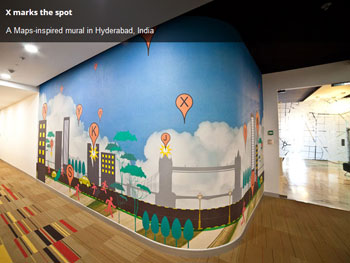
    A Google Maps-inspire Mural in the Hyderabad office. Photograph courtesy: Google.com

    It may not be the best of times to release a report like ‘The Best Companies to Work for’, given the low morale on the economy front and crunch in job opportunities prevailing in the marketplace. But there are companies that prefer to stand aloof from the depressing lot and would like to be counted as being amongst the best places to work for.


    The Economic Times in partnership withGreat PlaceTo Work have released ‘India’s Best Companies to Work for 2012′. The study throws up a diverse line-up of companies as favourites to work for.  Emerging the number one employer is Google India followed by Intel and NTPC at third. Further, five out of the top 10 companies are multinationals, pointing at the role played by global HR practices in stimulating employee satisfaction across workplaces in India.


    The study has been divided into the Top 50 and Top 25 best workplaces. When analysed further, only two out of the Top 25 Best Workplaces are companies which are new to the list of Best Workplaces, the rest having featured in the list in previous years. However, similar consistency is not seen in the Top 50 list in which there are 14 companies which have never featured in the list in India before.


    As for the standings, Gurgaon-based Makemytrip occupies the fourth spot, a drop from last year’s third rank. Amongst the media companies, HT Media Ltd is the only player to figure in the Top 25 list and is ranked 16th.


    Reacting to the win, Rajiv Verma, CEO, HT Media Limited, said: “This recognition is a testament to the strength and integrity of HT Media’s corporate culture. A few years ago, when we crafted a set of long-term goals for our company, we embraced the vision of being an ’employer of choice’. The recognition that we received from the study is a compelling sign that we have been moving in the right direction.”


    Other nominees include Cactus Communications that has been placed at number 20, Cleartrip Travel that is placed at 29th spot, Music Broadcast (operates radio channel Radio City) at number 41, Viacom18 placed at number 48 and Vodafone at number 49.


    In the category of Best in Class, Outdoor Advertising Professionals India Pvt. Ltd. achieves the top spot under Advertising & Marketing; Vodafone India Ltd. is number 2 under Telecommunications; Godrej Consumer Products Ltd., Procter & Gamble, Mars International India Pvt Ltd. and Mother Dairy Fruit & Vegetable Pvt. Ltd. are selected under FMCG; and Google India under IT.


    Some prominent companies that came up trumps across 22 sectors include: Vodafone India in Best Company in Large Organisations (more than 10,000 employees); Makemytrip, Cactus Communications & Cleartrip Travel Services under Professional Services, and HT Media Ltd and Viacom18 Media under Media.


    The study

    TheGreat Placeto Work® framework is based on over 27 years of research of the best workplaces across the globe from employees’ point of view. Some key trends spotted include: overall employee perception of their workplace culture has not changed significantly from 2011 – this is true for all companies, the Top 50, and Top 25 best workplaces in the Study. Thus, while individual companies may have done well or poorly in building trust with their employees, the workplace culture in India Inc., as perceived by their people, remains the same.


    Positive perceptions about their workplace culture continues to be high for senior management category compared to supervisory staff, with 7 per cent less supervisory staff giving positive feedback about their workplace culture. The study further reveals that 75 per cent of employees are below 35 years of age. While they are the majority in most organisations, their views about the workplace culture are significantly less positive than employees over 45 years in age. Only 20 per cent of employees, on an average, have worked in the same organisation for more than five years. There is a slow but gradual improvement in employee perception as one stays longer in an organisation, the study notes.


    As in the previous years, the Top 50 best workplaces are concentrated in Mumbai, NCR and Bangalore, but also have representation from Chennai, Pune, Hyderabad and Ahmedabad. 35 of the Top 50 have more than 1,000 employees, with 14 out of 50 having more than 5,000 employees. Only 7 of the Top 50 Best Workplaces saw employee increases of more than 30 per cent in the previous year, and 6 actually reduced their workforce.


    Also, the percentage of women continued to be low with only 5 of the Top 50 employing more than 40 per cent women employees. Women constitute less than 10 per cent of employees in seven of the top 50. Only three of the Top 50 have more than 30 per cent of their senior management as women. While 15 out of Top 50 best workplaces have employee attrition of over 20 per cent, however, in all major industries, attrition for the Top 50, on an average, is less by one-third to two-third of the industry average.


  • Ranjona Banerji: I also hate the chip chip!

    By Ranjona Banerji


    I’m taking off from next week and staying with the advertising industry since it is also “news” as some Indian media organisations have told us for years. Also, you cannot escape advertising if you watch the news or read newspapers and magazine. After careful consideration and consultation with others, it is clear that Priyanka Chopra’s “chip chip” ad for Garnier remains the most annoying on television. It comes on so often and with such clever cross-channel planning that you are forced to watch it unless you jump up and run every five minutes. By this time, the sun, the dog, the grass have all started looking extremely embarrassed at being made party to the ill-matched song and dance routine.


    But close to this one are those with annoying children like the rude boy in the McCain’s ad. I don’t see why he deserves to be treated with various kinds of fried potatoes. He should stay in his room downloading food while his family has fun without him. Next is the little girl in the Cadbury’s ad who is smiled on indulgently/ protected for not wanting to share her chocolate. (I am far more generous. If anyone gives me a chocolate product made by Cadbury’s I promptly give it away.)


    Today’s newspapers say that table manners are becoming a thing of the past. The advertising industry has long known this which is why it is particularly fond of promoting messy eating. People who eat Cadbury chocolates not only give each other long and profound looks while discussing vegetables they don’t want to eat, they also manage to get half the bar of the chocolate they’re eating all over their faces. This is an Indian rule I think and also applies to eating ice-cream. To save money, these ads should be joint ventures with washing machine/washing powder companies and maybe even whatever Garnier is selling in that “chip chip” ad.


    Then there are irritating mothers – based on the general feeling that the advertising industry specialises in mothers you want to murder. The Kellogg’s mother, who does something as amazingly innovative (sarcasm emoticon please) as putting almonds on top of a bowl of cornflakes, wins the current round of MYWM. If Kellogg’s only sold their variety of cornflakes with almonds in it in India, she wouldn’t have to be quite so smugly clever.


    An award has to be given to both Rahul Bose and Mahesh Bhupathi for agreeing to tell us that their mouths are full of germs. This is courage extraordinary. Also, for the ungrammatical manner in which they both say: “and much less germs”. Since both speak very good English the rest of the time, one assumes (or hopes) that Colgate paid them a lot of money.


    Vodafone’s attempt to make old men cuddly and lovable after Tata Docomo’s portrayal of them as curmudgeonly and crotchety should win an anti-ageism award at one of the next 1,000 award ceremonies the advertising industry seems to organise. At which, the best actress award has to go to Anushka Sharma for not only being convincing in selling cameras, internet services, scooters and so on but also for beating Amitabh Bachchan, Katrina Kaif, Priyanka Chopra and all the rest of the stalwarts for successful grabbing of TV time.


    Currently, there are several ads for a film called Cocktail starring, I think, Saif Ali Khan and Deepika Padukone. I saw a film called Cocktail once. It had Tom Cruise in it. Any relation?


  • Vodafone, Pepsi & Kingfisher most recalled brands in IPL 5: Ormax

    From the MxM Infodesk


    The top recalled brands during IPL 5 are Vodafone, Pepsi, Kingfisher, Volkswagen and Hero, according to the findings released by Ormax Media’s Cricket Advertising Recall & Effectiveness research – Day After Cricket (DAC),


    The last week of IPL 5 however saw Pepsi lead the recall charts, touching a score of 44% on Unaided Recall, the highest achieved by any brand this season.


    Volkswagen and Kingfisher were the only brands which feature among the Top 10 brands in terms of both Unaided Recall and Ad Likeability.


    The Top 3 most liked ads were: Gems – Raho Umarless, Sprite – Raasta Clear Hai and Mazaa – Har Mausam Aam. Interestingly, none of these three campaigns featured a celebrity.


    The most recalled innovation sponsorship asscoation recalled was Karbonn Kamaal Catch. DLF Maximum Sixes and Vodafone Star Of The Match are a distant no. 2 & 3.


    IPL 5 Top 10 Brands Recalled

    Rank

    Brand

    1

    Vodafone

    2

    Pepsi

    3

    Kingfisher

    4

    Volkswagen

    5

    Hero

    6

    Coca-Cola

    7

    DLF

    8

    Idea

    9

    Nokia

    10

    Tata Docomo


    IPL 5 Top 10 Most Liked Campaigns

    Rank

    Brand

    1

    Gems

    2

    Sprite

    3

    Mazaa

    4

    Volkswagen

    5

    Cadbury’s Dairy Milk

    6

    Yatra.com

    7

    Kingfisher

    8

    Mountain Dew

    9

    Lays

    10

    Slice


    Day After Cricket is a consumer based day-after recall study, conducted among IPL viewers across six cities: Mumbai, Delhi, Bangalore, Hyderabad, Chennai and Kolkata. The TG for the study was Males 15-40 years and Females 15-34 years old.


  • Can Facebook, the marketer’s online best friend ever become its ace salesman?

    By Delshad Irani & Ravi Balakrishnan


    In 2009, Facebook terminated the ‘Whopper Sacrifice’, Burger King’s social experiment cum marketing activation. Created by Crispin Porter Bogusky, the campaign’s premise was the more ties you sever the closer you get to your BK Whopper. The application as it turned out was a whopping success.


    Within a week 200,000 ‘friends’ were virtually burned out of existence from various lists. Facebook couldn’t handle the loss of those hard-earned friendships. Burger King, on the other hand, proved the point it set out to make – Americans sure do love their burgers. That same year, Swedish furniture giant Ikea spent practically nothing to create a campaign to promote its newest store.


    The agency Forsman & Bodenfors created a new Facebook account for the manager at the store in the city of Malmo and posted catalogue pictures of furnished rooms.


    Users could win furniture and other items in the photos if they beat their friends to the punch. All they needed to do was tag the pieces with their names first. Needless to say the prospect of first-to-tag-wins drove Facebookians crazy. The campaign was hassle-free, cheap and effective, just like the Scandinavian furniture it was advertising.


    Fast-forward to a few weeks ago. General Motors, the world’s fourth-largest advertiser and spender of $3.9 billion globally on advertising in 2010, haunted by questions related to effectiveness and ROI, pulled out its pretty penny, all $10 million of it, from Facebook’s paid-ad kitty just days before the social network’s stock went public.


    In addition to that sum, the automaker spends a reported $30 million on content creation for social media. These examples make Baccarat-crystal clear what we know already – you don’t have to pay big to make an impact via social media.


    In India, most marketers love talking about the worth of a campaign by the number of fans, or likes received on the most recent post. But even they are starting to ask a tricky question: what’s the real worth of their campaigns on Facebook? Worth more than a burger, eh?


    The site itself has been trying to tell advertisers that no longer will mere presence and innovative social media campaigns cut it. If they want scale, they’ll have to shell out the hard cash for offerings like “sponsored stories”, not to be confused with “sponsored ads”.


    For instance, products like Reach Generator guarantee that posts by a brand stand to be seen by 75 per cent of its fans every month or an estimated 50 per cent every week. Non users of the tool will have to settle for an average of only 16 per cent of fans viewing posts on a weekly basis. Not everyone’s buying though, believing that compelling content will win any day of the week.


    Anuradha Aggarwal, senior VP, brand communication and insights, Vodafone India said: “Since having high engagement scores is our goal, we focus on creating content on our Facebook page rather than on advertising. We focus on creating posts and apps to enable our 3.2 million fans to create conversations and experiences around the brand.”


    PepsiCo’s approach is to use a combination of both, posts/promotions on brand pages and display advertising. One of the cola maker’s prominent campaigns on the site was ‘Meet Messi in Miami’ where fans had to complete a series of tasks to win a chance to meet The Atomic Flea.


    During the 2011 ICC Cricket World Cup, Pepsi launched an online progamme as part of the ‘Change the Game’ campaign where fans could win a dream trip across the country for all India matches. The latter initiative was listed as one of the 19 best campaigns in the world by Facebook on their success stories blog, the only Indian effort to feature on the page.


    According to Homi Battiwalla, category director – colas, hydration and mango based beverages, PepsiCo India, it is too early to give a conclusive opinion on new advertising properties like sponsored stories and other offers. So the bottom line when it comes to the marketing on the social network is the game hasn’t quite changed. “The primary focus remains on organic content as we believe it results in better consumer connect,” said Mr Battiwalla.


    For automakers like Mahindra & Mahindra, Facebook is good for what it was born to do in the first place. Well, that and to spy on “old acquaintances”. According to Vivek Nayer, senior VP, marketing, automotive division, Mahindra & Mahindra: “Rather than looking at Facebook for advertising reach, we’ve leveraged it for what the platform is inherently good at; building communities. Today at 5 million, we are the largest automotive community on Facebook in India”


    In the case of Unilever, the company moved from almost accidentally stumbling on the power of the site – after noting a lot of action on its first Cornetto Luv Reels page long after the promotion was over – to it being a key pillar to the launch of Fruttare, its new range for the summer. Sapan Sharma, general manager – ice creams, Hindustan Unilever, said: “There’s an advertiser login where you get all the details. In the first 10 days of launch, 1.2 lakh fans signed up and there were 1.2 to 1.5 lakh conversations.”


    Arch-rival P&G is not lagging either. According to a company spokesperson: “In just less than two months, we have over 690,000 fans for our Thank You, Mom campaign. This makes it the largest, most engaged-with Thank You, Mom community globally.” For the launch of Olay’s premium skin care range, Olay Regenerist, a Facebook waiting list was created, with both fashion journalists and consumers signing up for an exclusive trial on the site; in less than three weeks, over 11,400 people had registered.


    But as the eight-year-old Facebook enters a new league as a listed company, it needs to, and rather urgently, scale its revenues to sync with its audience. Minute, often ineffective, right-rail ads aren’t exactly a juicy bone to dangle in front of existing and potential advertisers; thus the introduction of premium ads and better placement.


    According to Siddhart Rao, CEO of digital agency Webchutney, the sweet spot between organic and paid promotion is the one that will yield maximum benefit to brands looking to extract value from social media marketing platforms like Facebook. “One cannot work without the other,” he said.


    S Yesudas, managing director – Indian subcontinent, Vizeum, said: “I do not think all marketers know what to expect from the medium. The hurry to be on to the bandwagon gets them there. The fact that Facebook offers free advertising inventory for brands to test the medium gets overlooked. In my opinion, the medium can be successfully used to build relationships with the consumers.


    Targeting can be done based on profile information, relationship status, interest or based on certain words in profiles or status messages. But the truth is the brand communication will always compete with the updates, videos, etc from friends.”


    Indeed, it’s complicated; the relationship between advertisers and Facebook. Especially when one moves from the fluffy world of engagement to hard sales. Many retailers in the West like JC Penney, Gamestop and Gap pulled the shutters on their stores on Facebook this February.


    Chhaya Balachandran Aiyer – founder – MD, BC Web Wise said: “Ironically Wade

    Gerten, the founder of 8thBridge – the flower store that was responsible for the coinage of the term F-commerce as it was the first to open shop on Facebook for 1,800 Flowers – has admitted that sales never really materialised for their first or other F-outlets, adding that F-commerce deserved an F. Given the fact that F-commerce (Facebook commerce) has failed in the west for retailers, it appears that Facebook would be an engagement vehicle. Peer recommendation and product ratings are not integrated. Should it launch a brand intelligence tool which can be used by consumers – which exposes peer comments and recommendations that can be accessed by the FB community – then the ball game will change.”


    Venkat Mallik – president, Tribal DDB & Rapp India says Facebook’s ability to deliver sales impact has been a bit of a mixed bag: “There need to be more strong case studies demonstrating the sales or brand impact from the use of Facebook led engagement.”


    However while Facebook may not itself be a platform to sell it can impact sales according to some of its satisfied customers. Unilever’s Mr Sharma for instance believes there’s a definite co-relation between high levels of engagement and products sold.


    According to Carlton D’Silva, chief creative officer, Hungama Digital Media, “Opinions of family and friends matter when making purchase decisions decisions and Facebook activity will provide a lot of data to consumers, which can be leveraged in places where they make these decisions, causing a significant, if not direct impact on purchase behaviour.”


    “GM is slashing its advertising budgets by $ 2 billion, of this only $10 million or 0.5 per cent was on Facebook. They have also announced they won’t advertise on Super Bowl, either. Further, what should be noted is that GM has 8 million fans already. I am sure that they are going to continue with the engagement plans for acquired fans. It would be foolish to assume anything beyond, or assume Facebook has failed for GM, it would be just that advertising further is currently not the best bet in its media plan,” said Ms Aiyer


    The users of Facebook both on the agency and the marketer side each have their wishlist ready.


    “The analytics are available at a lag of 7 to 15 days; I’m sure it can come earlier. I’m sure there will be a time when we can talk to people from a specific city or market,” said Mr Sharma


    “They are hugely data rich. If in some way they get to using some of the data millions of people put in their hands on a minute to minute basis, sky will be the limit for them.This will surely come in with resistance from the users, unless they persuade them. They have to walk this path very carefully,” added Mr Yesudas.


    Most brands have a clear agenda from marketing spends on social media platforms like Facebook – greater outreach among target audiences through personalised interaction and engagement, leading to higher impact on conversions and sales.


    “It’s a perfectly reasonable expectation from a social communication platform with 900 million members,” said Mr Rao of Webchutney, “but whether brands invest enough thought, time, resources and action to engage audiences meaningfully is another question.” And one helluva question it is. Because for every whopper of a Scandinavian success story, there are at least a dozen marketing campaigns that have fallen flat on their face. So, ask not what you can do on Facebook but what Facebook can do for you.


    Source: The Economic Times
    Copyright © 2012, Bennett, Coleman & Co. Ltd. All Rights Reserved

  • AdEx 2011-12: Print grows 14%, TV 11%, Radio 0%


    By A Correspondent


    This is perhaps the shortest Big Story you’ve read in the eight-month existence of MxMIndia. But then more than words, it’s numbers that have got to do to the talking.


    MxMIndia requested TAM Media Research which painstakingly computes data for ad volumes for the television, print and radio sectors. The growth figures are indicative of how these are doing: print isn’t down and out yet with 14%, TV is growing but it’s not as dramatic as we thought it would and Radio hasn’t degrown. In fact we must urge radio practitioners to interpret the 0% in a positive way because there were enough naysayers willing to rubbish the potential of the business.


    Note: the analysis is based on ad , that is duration in seconds/CCMs and excludes promos.


  • APPIES 2012: 100 best marketing campaigns to be presented LIVE

    By A Correspondent


    Fierce competition is expected at APPIES 2012 where 100 of the top marketing campaigns from 16 countries in Asia Pacific will vie for 10 Gold Medals. An annual two-day festival of the best marketing ideas, APPIES brings together the brightest minds in the industry from across 16 countries to celebrate excellence, network and exchange knowledge. Now in its third year, APPIES 2012 brings the audience up close and personal with some of the most compelling campaigns through its unique live presentation format.


    APPIES 2012 enables brand marketers/campaign creators to demonstrate their stellar ‘Show, Share and Sell’ skills, thanks to the unique ‘4-6-10’ format. Each presentation will begin with a 4-minute showreel video summarising the entire campaign, followed by a live 6-minute exposition of the campaign’s key highlights by the brand’s marketers/ campaign creators. Then comes the interactive 10-minute session where each campaign will be cross-examined by the judges and audience members.


    Building on last year’s list of campaigns by companies and brands such as P&G, Nestle, Pepsi, McDonald’s, Fonterra, Singapore Tourism Board, Bacardi, Adidas and Vodafone, APPIES 2012 will continue to showcase the best campaigns from various industries that span across highly-diverse markets in Asia Pacific region.


    The 100 selected marketing campaigns will cover a broad range of six product/service categories that include Consumer Durables, Consumer Services, Food & Beverage, Non-Food FMCG, Business Services and Government, Cultural, Social & Environmental campaigns.


    APPIES 2012 will also host special keynote sessions and panel discussions on The Future of Industry. Marit Kievit, Global Brand Director (Lux) at Unilever and Chris ter Steege, Director (Digital Integration), Integrated Marketing & Communications at Philips Asia Pacific have been announced as keynote speakers at APPIES 2012. With advisory and assessor panels comprising top marketers in the region, APPIES 2012 is designed to offer excellent networking and knowledge sharing opportunities for industry professionals.


    Marit Kievit is the Global Brand Director for Lux (Unilever). The multi-cultural team led by Marit has developed breakthrough and award-winning integrated campaigns. She was also a permanent member of Axe’s global brand team, setting the global innovation agenda for one of Unilever’s most successful brands. Most recently Marit joined the global leadership team for Lux as a global brand director, based out of Singapore.


    Chris Ter Steege is a communication professional with an obsession for innovation and creativity in marketing, brand communication, digital and social media, and leading the creation of impactful experiences through integrated communication strategies and tactics. With 10 years experience, Global to Local, B2B and B2C, at Philips, Chris now leads regional cross-sector digital programs in Asia Pacific, co-leads the region brand campaign, works with sector marketers to deliver award-winning campaigns, and manages the digital team in one of the most diverse and fastest growing regions in the world.


    Leanne Cutts is Vice President, Marketing for Kraft Foods Asia Pacific Region, based in Singapore. She is responsible for driving the growth of the gum, candy, and powdered beverages categories as well as leading consumer insights & analytics and driving marketing excellence in the region.


    The Institute of Advertising Singapore (IAS) was founded in 1990 with the aim to position Singapore as an internationally recognised “centre of excellence” with world class advertising professionals, international best practices and industry leading creative output. The IAS has several highly successful business platforms for the advertising and marketing communities to meet, collaborate and raise the standards of the industry as well as encourage continuous education. The IAS has also organised the Singapore International Advertising Congress since 1998.


  • Harish Bijoor: What’s in a Name?

    By Harish Bijoor


    So STAR News is ABP News. STAR Ananda is ABP Ananda. And STAR Majha is ABP Majha.


    Here’s a brand name change once again, and the question is out in debate again: What’s in a name?


    What’s in a name? Plenty! Shakespeare-dada was wrong!


    For a start, the name is a brand. The brand is a name. And the name is a very important starting point in the voyage of discovery of a brand.


    Let me start with my definition of a brand. It is a simple one. I define the brand with the consumer simplicity it deserves. “The brand is a thought”! A thought that lives in people’s minds. A thought that thrives in the soft-space of the human mind.


    By this definition, everything that lives as a thought in your mind is a brand. Shantabai, the multi-tasking maid is one, Osama Bin Laden, the late terrorist is one and so is the young Akhilesh Yadav. Each of these brands possibly rub shoulders with other brands such as an Amul and Bata and Tata in your head. The brand is a thought. Nothing more. Nothing less.


    What does a name transition mean to companies and brands? Plenty really. Plenty in the initial six months for sure. The first 180 days of a brand name change are the most crucial and critical days. It is in these frenetic days of frenetic brand activity that a name change can be made successful or not. No wonder then that you see a flurry of advertising activity that goes in to establish a new name solidly in the mind of the consumer.


    There are brands that have done it well. Vodafone is a veteran of many changes. An Orange became a Hutch seamlessly, just as a Hutch became a Vodafone seamlessly. Every change was accompanied by a high decibel campaign that had transition elements of one collapsing seamlessly into another. The first 180-days are therefore the most critical. You can make a brand name transition happen or collapse. Both are possibilities. The period after just does not matter. This is really the Golden six months of a brand name transition.


    UTI Bank did it seamlessly as well, with a transition into an Axis Bank so seamlessly that today UTI is a non-important part of its total brand equity and recall altogether. That is the power of a powerful brand-name transition plan.


    In the case of this current transition from STAR to ABP, there are indeed two big brand names. One is a region-centric one (ABP) and the other (Star) is a world-brand for sure. Moving from one to the other will require some degree of panache and scientific brand action.


    There are really two sets of dynamics in this transition. One is a B2B dimension. Out here, MCCS is the back-end brand. It is the company that runs the show. It is the company that is the backbone. Employees, clients who advertise, distributors and vendors are all key participants here. These key actors are the easiest to communicate to. These key actors will buy into this name change without a whimper.


    The second set of dynamics is that of the viewer. This is B2C space. This is where there is bound to be ruffled feathers and ruffled sentiment. This is where there is bound to be confusion and lack of clarity. This is really the end that needs to be handled well and seamlessly through a process of cogent communication.


    STAR News is a thought. The thought of a channel can be a potent one. It starts with the name at hand, and goes on to attach to itself a host of other meta-tags that bring to mind the memory of a channel that is an intrinsic part of compelling and credible viewing experience.


    The brand to that extent is plenty. It is a name. A slogan. A symbol. A colour. A character. A personality. A charisma. An image. A reliability. An emotion. A passion. A perception. And lots more. ABP needs to handle each of these. With kid gloves, speed and scientific brand action.


    The author is a brand-expert and CEO, Harish Bijoor Consults Inc.

    Twitter.com @harishbijoor


  • Vodafone pushes to access net via phone

    By A Correspondent


    Looking at growth opportunity in using internet on phones, Vodafone is pushing for this aggressively. Data shows that a sizable proportion of internet enabled phone owners do not use internet or have very low minutes of usage. To tackle this issue, Vodafone has come out with a campaign to drive usage and penetration of internet among Vodafone customers by simplifying usage experience and showing the fun possibilities of internet.


    Created by O&M, the campaign proposition is of “internet is fun” to be substantiated by products that make internet fun to use on Vodafone network.


    The brief given to the agency for the campaign is based on the core idea that internet and the mobile phone are ubiquitous in today’s world. The message communicated is to ensure that consumers get easier access to the internet and experience it in a simple and fun manner, on their Vodafone mobile phones. In short – The Internet is fun on Vodafone.


    “This also meant creating services, products and offerings that substantiate our proposition, which you will see unveiled over the IPL. We will be staring the campaign with an execution on the Opera Mini browser available on Vodafone that facilitates faster internet browsing as an added caveat – this campaign was for the IPL. Hence the creative execution needed to be different and have scale to break clutter and standout during IPL 5,” stated an official communique from Vodafone.


    “To deliver the ‘internet is fun on Vodafone’ promise we brought alive the Vodafone internet world in the form of huge, larger than life real games in a setting reminiscent of the Tele Matches. These games are set in a timeless space, with real people playing ridiculous games and generally getting together to have a fun time. And that provided the best metaphor for our proposition.”


    “each offering explains how Vodafone makes the mobile internet experience more fun and was brought to life with its own unique and absolutely fun game played between two teams. To bring out authenticity in the execution, the TVCs are set in a small village nearPragueinCzechoslovakiaand all the props are real and have been constructed for the films. And because the drama is happening in Czech, and english commentator explains the proceedings to the audience,” stated the communique.


    This is an 8 week long campaign. The campaign started with 3 teaser films on April 4 followed by the first TVC which aired on April 8. This is part of the 8 TVC’s on different products from Vodafone that make the internet experience on Vodafone fun. The campaign will be supported with a high decibel 360 media plan using TV, Radio, Print, Outdoor, on Ground and a digital and online plan.


  • Border War Face Off gets one million downloads on Nokia

    By A Correspondent


    Border War Face-off, an arcade game made on patriotic lines by Jump Games (a part of Reliance Entertainment Digital and a leading developer and distributor of mobile games) was released in October 2011 across all leading operators like Vodafone, Docomo, Reliance, Idea, and others.


    The game is to save Mother India from enemies’ invasion by playing a courageous soldier defending our borders from an enemy invasion. This game is Jump’s own IP and is extremely popular among the youth gamers. The figures have been good from the very beginning but in mid-February Jump decided to ad wrap this game and put it up on Nokia OVS stores and by mid-March the game had over one million downloads.


    Since then Jump’s social website pages have been flooded with user requests to add innovations to the game. After the over whelming success of Border War Face Off and persistent user request Jump has now come up with the sequel called Border War-LOC.


    Border War Line of Control is the modern day rendition of an arcade classic. The gamer, as an Indian soldier, will have to protect the Indian borders with a new age weapon, Super Cannon.


    The various features of the game are:

    • A classic arcade game with very vivid and crystal clear graphics
    • A huge diversity in the type of enemies
    • Easy to use controls


    Speaking about this particular launch of the game, Chaitanya Prabhu, Business Head India, Jump Games said: “The game ideation started around august last year. We wanted to create games which are suitable for Indian audience and tap the Indian mentality, sensitivity and lifestyle. The game Border war, as the name suggests is based on patriotic lines with some great visual graphics. Jump has always believed in the motto of Think Global – Play Local. Now seeing the over whelming response of Border War -Face Off we have made a sequel to the same called Border War -LOC. It has a very engaging game play and we are expecting a similar or better response for the same.”


    The game, priced at Rs 50, will be available on all leading operators like Vodafone, BSNL, Idea, Docomo.


    Jump Games is a leading International developer and publisher of mobile games, apps and content. It is an integral part of Reliance Entertainment (Digital Business). Jump’s foray and expertise lies into the media and entertainment space.


    Jump’s experience and expertise in creating innovative and cutting-edge gaming content reflects in its client roster, which sports some of the best brands from across the world – Codemasters, GLU, Playboy Hands On / Connect 2 Media, Honest Entertainment (Fido Dido), Coca-Cola, Cartoon Network, and Konami to name a few.


    The company develops content across leading wireless platforms and its catalogue includes leading titles like Ben 10: Battle of the Omnitrix, Bloons, Putt-Putt Golf 3D, ICC World Cup, Ashes Cricket.


    Distributed across the US, Europe, South Africa, Australia, the Middle East, and Asia, Jump’s content can be accessed through 80 leading networks across 40 countries as well as global AppStores.

  • Ad Strat: The friendship pug

    Rajiv Rao, NCD, Ogilvy &Mather


    1. Name of the Campaign: Vodafone Network


    2. The Brief: In the initial phase of market development Vodafone had communicated ‘Where ever you go, our network follows’ using the Pug. The campaign made our brand synonymous to an omnipresent network and gave it the stature of a constant companion.


    As the market evolved, in the next phase, we needed to build a strong consumer perception on not only the network presence, but also of Vodafone’s network quality.


    [youtube width=”400″ height=”200″]http://www.youtube.com/watch?v=jNU1yCpIGGU[/youtube]

    3. Researchinsights:  Research helped us identify that the key parameters in the perception of a good quality network are – connectivity, voice clarity and call continuity( no call drops).


    4. The thought process behind the creative: The network qualifiers being slightly technical in nature, we needed a story to bring them to life. The stories we chose used metaphors of friendship in all 3 ads. Each TVC showed our Pug, who signifies our network, being the enabler in forming and growing this friendship.


    5. Media vehicles chosen: TV, Outdoor, Print, Radio, Digital


    6. Does the treatment do justice to the brief? Yes, we made sweet stories, the Vodafone way, to tell a very tangible network promise. Our metaphors were simple to understand, distinct and left an impact yet emotional to touch hearts.


    7. What is the differentiating factor about the ad? In a market where the network promise has mostly been a show what you mean exercise, we have taken the lesser travelled emotional route to communicate the same promise. We have precious moments of interactions between 2 friends coming closer with our Pug (network) as the enabler.


    8. Market and client feedback:

    200,000 plus views on YouTube in 1 month

    Early indicators, from a business perspective, look positive. Results are still expected.


  • Anil Thakraney: Voda must commission study on campaign

    By Anil Thakraney


    There is a controversy raging in the virtual world over the new Vodafone pug campaign. The one where the doggie plays cupid between two kids who look to be in their early teens. The problem is this: Some people find them too young to be flirting, and feel that this sort of a campaign would send the wrong signal toIndia’s kids.


    I did allude to this when I reviewed the campaign some weeks back, and I recall wondering if the two are indeed a bit too young to be glad-eyeing each other. But I left it at that and passed no value judgments. And that’s because I am not really sure of the propriety (or the impropriety) of the situation. While it is true that young ones in urban India often start dating early in their lives (and this used to be the case even when I went to school, so it’s nothing new), I am not entirely sure what happens in small towns and villages.


    However, some ad experts seem to think that the campaign is indeed a terrible influence on young minds, and veteran ad man Alyque Padamsee’s comments have gone viral in the social media. He seems to think that ads like these can lead to social problems like eve-teasing and sexual harassment when the lads grow up!


    Quite obviously this is an over the top reaction. My own view is that kids would most probably view this as harmless fun, and not as a license to either misbehave with members of the opposite sex or to get into bed at the age of 12. And I also believe that kids usually get influenced by adult behaviour, as it’s the grown ups who tend to be their role models.


    Still, it might be a good idea if Vodafone commissioned a study amongst the young teens, in urban and ruralIndia, to understand the influence of this campaign on young minds. And if it’s a harmless one, then great! And if it is found to be pernicious, they could pull the campaign. Either way the marketer will be appreciated for taking a pro-active step.


    [youtube width=”400″ height=”200″]http://www.youtube.com/watch?v=pSLOnR1s74o[/youtube]

    However, they must act quickly. Before, egged on by comments of worthies like Alyque, some dudes with too much free time on hand file in bitter PILs. And cause the early death of a campaign which to my mind seems to be quite cute, and doesn’t really threaten the moral fabric of the great Indian society.


    * * *


    PS: Wonderful use of emotion. The happywallah emotion. Keep a hanky ready, it’s sure to leave a little moisture in the eyes. Especially if you are a parent.