Tag: TRAI

  • MediaSENse by Indrani Sen: To cap it all

    By Indrani Sen


    During the last month, the News Broadcasters Association (NBA) and others sought adjournment of the court case challenging the advertising cap of 12 minutes per hour twice in the Delhi High Court. The hearing scheduled on September 8 was first adjourned to September 23 on the ground that lawyers were on strike, which again got adjourned to November 27 on the ground that the matter was under discussion with the Information and Broadcasting Ministry (I&B). The earlier order by Supreme Court that the Telecom Regulatory Authority of India (TRAI) will not take any legal action against any channel violating the norms will stay put till the Delhi High Court case is heard and resolved. As per the reports published by the TRAI on a quarterly basis, very few channels are adhering to the limits set by TRAI.

    Based on consumer complaints, TRAI has been trying to regulate the quantity of commercials on TV channels since 2012. When the regulation on Ad Cap was announced in 2013, ( http://www.thehindu.com/   August 18, 2013).  Manish Tewari, I&B Minister in the UPA government said in an interview “TRAI should introspect and reconsider its current stance till carriage fees don’t mitigate further and subscriber revenue doesn’t stabilize for the sake of the healthy growth of the industry.”  Subsequently, Prakash Javadekar, the first I&B Minister in the BJP Government  indicated to media that the government was considering an amendment that free-to-air (FTA) channels should be exempt from the restriction of the 12 minutes ad-cap, while for pay channels the existing limit of 12 minutes per hour of advertisements would continue. (http://www.livemint.com/ October 8, 2014). After Arun Jaitley took over as I&B Minister, he made a statement that there should be no ad cap in the print or electronic media, but did not give any such instruction to the Ministry. (http://www.indiantelevision.com/ )

    While the I&B Ministry and TRAI are mulling over the issue, it would be informative to do a quick look around the world and survey the norms related to ‘TV Ad Caps’ practised in developed countries. In Europe, the Audiovisual Media Services (AVMS) sets the regulatory framework setting a limit for all channels of 12 minutes on the amount of advertising shown in one hour.  The similar rules which apply in the UK, are set out in the Code on the Scheduling and Amount of Advertising (COSTA) prepared by Ofcom, Independent regulator and competition authority for the UK communications industries. With our colonial hangover, we seem to have adopted the regulation prevailing in UK.

    The Australian model is very interesting. The Australian Communication and Media Authority (ACMA) categorises the time bands into two slots and stipulates that on the main channels, commercial television licensees may schedule

    1) Average 13 minutes per hour of non-programme matter between 6pm and midnight; and

    2) Average 15 minutes per hour on non-programme matter at other times.

    However, the maximum that can be scheduled in any given hour is:

    1) 15 minutes from 6pm to midnight – with no more than 14 minutes scheduled in any four of those hours; and

    2) 16 Minutes at other times.

    The definition of non-programme matter includes paid advertising but excludes short programme promotions and pop-up programme promotions in the middle of programmes. Additional allowance is given during election periods to accommodate the broadcast of ‘political matter’. Since 2014, the leading channels have been lobbying with the government for raising the bar to 20 minutes of non-programme matter every hour. The pros and cons of the same are still being debated.

    Canada had the stipulation of ad cap of 12 minutes per hour based on individual licence agreements till 2007. In May, 2007, CTRC (Canadian Radio-television and Telecommunications Commission) announced a phased relaxation of the rule bringing the free to air conventional TV channels more closely in line with their counterparts in US. So, from 2009, there is no cap on the quantity of commercials per hour on the free to air Canadian channels while the specialty pay channels are still subject to the ad cap of 12 minutes per hour.

    American TV hour-long programmes typically run for 42 to 43 minutes, leaving 17 to 18 minutes per hour for commercials. Federal Communications Commission (FCC) has a special regulation for controlling loud commercials, but has not introduced any cap on the quantity of time used for the commercials per hour. In 2014, a new study from Nielsen, the ratings measurement firm of US, showed that the number of commercials had grown steadily over 2009 to 2013. In 2009, the broadcast networks averaged 13 minutes and 25 seconds of commercial time per hour which grew to 14 minutes and 15 seconds in 2013. The growth was more significant on cable television. A typical American home had 189 channels to choose from yet only watched 17.5 on a regular basis. That figure was the same in 2009, when the average home received 129 channels. According to Nielsen, use of shorter commercials became more common (http://www.latimes.com/entertainment   May 16, 2014). Recently, I read online that Viacom is planning to find out if they can get more value for TV commercials by running fewer them on the network. (http://variety.com/2015/tv/news/viacom-primetime-tv-advertising-cuts-1201598646/  September 21, 2015).

    Ad clutter has been a major hindrance for TV viewing over many years. To cap it all, now an exodus of consumers from TV to streaming video, mobile devices, etc. have started across the world. On TV, appointment viewing has been changing to scattered delayed viewing. Our TV channels, who are fighting against the TRAI regulation on ad cap for protecting their revenue, should remember that their ratings followed by revenue may be better protected with less time devoted to ad breaks.

    The  I&B Ministry and TRAI should consider the scope of adopting the Australian model with variable options across different time bands including additional allowance during Central and State elections. As we have almost 50 percent of our licensed channels in the news genre, the news and non-news can also be put in two different buckets apart from the FTA and Pay channels. In my view, we need to come out of the practice of holding UK as the role model and look around for better alternatives while framing our media rules and regulations.

    Indrani Sen is a veteran media agency and marketing services professional. She is currently an Independent Consultant and Adjunct Faculty, Media Management at Symbiosis Institute of Media & Communication, Pune. This column MediaSENse will appear fortnightly. The views expressed here are her own.


     

  • Unfair or Fair Play? Reach & ratings drive channels to ask for multiple pushpoints on EPG

    By A Correspondent


    What do you do when you are launching an all-new channel or just wish to ramp up the reach of your existing network?


    Spend top dollars on distribution, of course.


    While quality content is important, the key factor in the popularity of a channel and ensuring good ratings for a channel is distribution (and hence availability).


    In the good old days, there was carriage fee. Pay the cable operators in sackfuls, and you are sure of your channel being carried in the prime band or alongside the leading channels.


    But with digitisation and EPGs getting on to our screens, the game has changed. While carriage fees have reduced, the EPG has made things a little complex. Yes,  you can always ask for good placement, but that’s not a sureshot way to rope in viewers. With the stakes very high, the innovative brains that we have in the Indian media and entertainment sector have dreamed up a new strategy. Ensure that your channel figures in the EPG more than once.


    Aur dikhao, aur dikhao!


    So, if you are an English news channel , while you’ll find your name amongst the news channels of that language, you can also get yourself among the GECs. Next to a Star Plus, Colors and Zee. How does this happen? Dollops of dosh, of course.


    Is it the right thing to do? No, it isn’t. Are the industry associations doing anything about it? No, they aren’t. Will the TRAI do something about? Most likely it will.


    The move has sent shockwaves in the industry, but the last mile cable companies are delighted that it’s one more source of revenues from reach-hungry channels as other channels are reportedly mulling a similar move. Said the head of one distribution firm on anonymity: “Yes, I have already been approached by some channels, and I have had to put my foot down in saying that we can’t corrupt the system.” Any more, we may add.


    There’s no stopping an all-new channel or a channel that is relaunching or attempting a fresh promotion strategy to have its name figure a dozen times in the EPG.


    A 10-plus-year-old channel attempted this recently on its relaunch, following the footsteps of another channel which had done this, albeit in a small way a few years back. The channel that did this earlier has reportedly done it again to counter its recently-recharged competition. MxMIndia has in its possession a list of headends where multiple pushpoints have been provided on the EPG. Needless to say, these are in zones that have maximum viewership for certain genres.


    An industry analyst we spoke to said the move is reprehensible and must be nipped in the bud asap. “While viewership and not reach is the variable that eventually matters, the proliferation is unhealthy and must be stopped.”


    A channel marketing executive however said there is no need for the TRAI or the industry bodies to step in. “Do you stop the promotion of a soap which is displayed in multiple locations at a supermarket? This is a legitimate marketing practice and it’s not that channels are breaking the law to do it.”


    Next is what? A channel-block on your EPGs?


  • Centre approves conduct of FM Phase-Ill auctions and migration of Private FM Radio licenses

    By A Correspondent


    The Union Cabinet chaired by the Prime Minister, Shri Narendra Modi, gave its approval for conduct of FM Phase-Ill auctions and migration (renewal) of Private FM Radio licenses from Phase-II to Phase-Ill in 69 existing cities for 135 channels. This will be on an ascending e-auction basis. Approval was also given to migration (renewal) of private FM Radio licenses from Phase-II to Phase-Ill on payment of migration fee according to TRAI recommendations.


    As of now, with the implementation of two phases of private FM Radio, namely Phase I (1999-2000) and Phase II (2005-06), there are 243 private FM channels in operation in 86 cities of the country, spanning 26 States and 3 Union Territories.


    The auction process will add an estimated revenue of over Rs. 550 crore to the National Exchequer on successful auctions of all proposed channels. Besides, it will beget the amount realized through the migration process which is dependent on the TRAI recommended formula, where migration fee is linked with the discovery of market prices through the FM Radio Phase III auction.


    Roll out of the first batch of FM Radio Phase III auction will provide more channels to listeners with richer content in 69 existing cities.


  • Tarun Katial: What the new government (and MIB) must do for Radio


    By Tarun Katial


    1. Foreign Direct Investment (FDI) in Radio Broadcast Sector

    Key Issues:

    :: The current FDI limit in the radio broadcast sector is restricted to 26%.


    :: In respect of television broadcasting sector, the FDI limits are as below:


    Non-news content – FDI is permitted up to 100%; and

    News & current affairs content – FDI has been restricted to 26%.


    TRAI Recommendation:

    :: TRAI on August 22, 2013 recommended that FDI limit for radio sector should be enhanced to 49%.


    Requests:

    :: There should be parity in the FDI limits for the television and radio broadcast industry.


    :: For FM radio broadcasters airing news & current affairs, the FDI limit should be increased to 49%.


    :: For all other FM radio broadcasters airing non-news content, the FDI limit should be increased to 100%.


    2. Deferred payment mechanism for Non refundable One time Entry Fee (NOTEF) and Migration Fee

    Key Issues:

    :: Based on current guidelines the migration fee payable by existing players to migrate to new regime and NOTEF by successful Phase 3 bidders has to be paid upfront and in full.


    :: It is estimated that the FM radio broadcasting sector will require additional capital investment of Rs. 3,000 crores or more for meeting the outgo on account of migration fees, Phase 3 auction license fees and capex for the creation of infrastructure.


    :: This additional capital investment of Rs. 3,000 Crores amounts to 200% of the annual revenue of the radio industry.


    :: The telecom industry which is much larger than the Radio Industry and which has an annual turnover of Rs. 3,00,000 Crores has already been allowed a deferred payment mechanism for the recent spectrum auction in 1800MHZ and 900 MHZ Bands. It is pertinent to note here that the total spectrum fee in the auctions was Rs. 61,000 Crores, which when compared to the annual turnover of Rs. 3,00,000 Crores,  amounted to only 20% of their annual revenue.


    Request:

    :: On the lines of the recent spectrum auction polices for Telecom, we request a deferred payment mechanism for the migration fee and NOTEF as under:

    Upfront – 25%

    Moratorium – 2 years

    Balance payment – Annually over the license period


    3. Migration of Phase 2  to Phase 3 regime

    Key Issue:

    :: With licences of Phase 2 expiring from March 2015, the migration to Phase 3 is the critical concern of the Radio industry.


    TRAI Recommendation:

    :: TRAI on February 20, 2014 recommended that the policy of migration of existing operators to Phase 3.


    Request:

    :: We request that the Government accept TRAI’s recommendations and announce the migration policy at the earliest.


    4. Channel Spacing

    Key Issues:

    :: Limited number of FM channels available in various cities and high license price makes it difficult to shift the focus away from mainstream film music. Consequently there is lack of content plurality thereby affecting radio listenership.


    :: The additional capacity could provide a platform for special focus genres, regional/folk content, dedicated channels for sports and news, etc.


    TRAI Recommendation:

    :: TRAI on April 19, 2012 recommended that it is technically feasible to reduce the channel spacing to 400 KHz from the current 800 KHz and thereby, double the number frequencies in A/A+ and B category cities.


    Requests:

    :: TRAI’s recommendation of reducing channel spacing from 800 KHz to 400 KHz should be accepted.


    :: The government should announce immediately the proposed number of additional frequencies that can be auctioned in A/A+ and B category cities and the associated time frame for their auctions.


    :: This will enable industry players and incumbents to take informed decisions during Phase 3 bidding.


    5. Reserve price for cities undergoing auction for the first time in Phase 3

    Key Issues:

    :: In Phase 3, 228 cities (707 frequencies) out of a total of 294 cities will be undergoing auction for the first time. The Ministry has proposed the following methodology to calculate reserve price for cities undergoing auctions for the first time as under:

    >> Highest bid price received during FM Phase 2 for that category of cities in that region.

    >> In case the benchmark from Phase 2 for a particular region is not available, then the lowest of the highest bid received in other regions for that category of cities may be taken as the reserve price


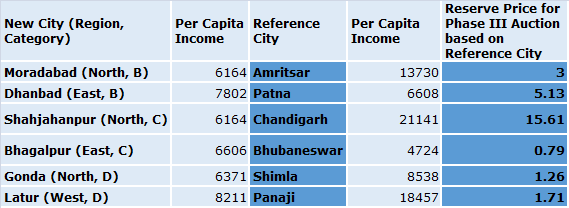
    The table shows the reserve price in some of the cities based on the rules provided in Phase 3 guidelines:

    Ministry of Information and Broadcasting; Census 2011


    :: In view of the table above, it is unreasonable to expect, that the price set for Chandigarh, a C category city in North region and the city which received the highest bid of Rs. 15.61 Crores during Phase 2 auctions with per capita income of Rs. 21,141, is a fair reserve price for Shahjahanpur with per capita income of only Rs. 6,164.


    :: Similarly, the reserve prices for most other fresh cities look unreasonable. For instance, Moradabad a B category city in North region with a per capita income of Rs. 6,164 cannot be compared with Amritsar, which received the highest bid of Rs. 3 Crores and which has a per capita income of Rs. 21,141.


    TRAI Recommendation:

    :: TRAI on February 20, 2014 recommended that the methodology for determining the reserve price for fresh cities in Phase 3 should be reconsidered.


    Request:

    :: In case of cities going for auction for the first time, the reserve price should be ‘Average bid across all regions in the country for the same category of city’. This will eliminate any outliers and e-auction will allow fair price discovery of each city.


    6. Expedite Empanelment with DAVP (Directorate of Advertising & Visual Publicity) of some radio stations

    Key Issues:

    :: The revision of DAVP rates for FM has been pending since last 3 years


    :: Empanelment of radio station of some radio broadcasters, which is pending since 2008.


    Requests:

    :: DAVP rates/policy be revised appropriately based on the growth of FM listenership across India


    :: Expedite empanelment of radio station of some radio broadcasters to ensure fair allocation of funds by DAVP.


  • One Minute View: TRAI misplaced views on media ownership


    The Telecom Regulatory Authority of India has done some great work as a regulator.  While the cellular phone would have turned ubiquitous even if the TRAI hadn’t existed, one must recognise the superlative work put in by the TRAI ever since it was set up in 1997.


     

    However, in our mind, in the case of the broadcast sector, not all of the work is in order and in sync with business realities and progressive thinking.


    Digitization happened (not everywhere, but it’s in progress), but the 10+2 ad cap is still not implemented. There is some stuff on cross-media ownership, but most of it is a grey area. The fact of the matter is that the governments of the day do not have the spine to take on the news media. They use TRAI regulations to police news vehicles, but finally nothing happens.


    The TRAI has spent a fair bit of time and effort on the issue of ownership of the news media as well as on paid content. But to say that there should be a restriction on corporate ownership of the news media is bizarre. Let there be restrictions on the concessions given to the media or the favours in the form of DAVP ads. Don’t give media concessions on land if the turnover exceeds an x amount or if there is evidence (circumstantial included) to know that the owners have deep pockets and don’t need a concession, let them be run as any other business.


    Also, if you find a news entity involved in paid content, penalise it. Suspend the licence for a few days, if necessary. Knock off concessions like postal certificate and accreditation to staff. But let’s not say that corporates or political parties can’t enter the media. Most of the big media companies have a corporate or political past. This includes The Times of India (Dalmias and then Sahu Jains) and the Hindustan Times (Birla). Even regional media biggies like Dainik Jagran and Dainik Bhaskar have interests other than the media. There are very media companies which were started by career media professionals or entrepreneurs and have now grown into big entities. Ditto with politicians. Mahatma Gandhi started Indian Opinion, Lokmanya Tilak had Kesari… the list is endless here too. There are also many examples of publications which have some political connections but are fairly professionally run. We must also not overlook case of newspaper companies diversifying into other businesses thanks to the profits or the clout. Now does the TRAI have it in it to take on the mighty newswallahs?


    The Recommendations can be read at:

    http://trai.gov.in/WriteReadData/Recommendation/Documents /Recommendations %20on%20Media%20Ownership.pdf


    Read the Press Release issued on the Recommendations :

    TRAI releases Recommendation on “Issues relating to Media Ownership”

    The Telecom Regulatory Authority has today released the Recommendations on the Issues relating to Media Ownership. The recommendations cover – a comprehensive definition for control; cross-media ownership; vertical integration; and internal plurality.


    The key recommendations are:

    1. A comprehensive definition of ‘control’, in line with earlier recommendations proposed.


    Cross-Media Ownership


    2. The News and Current Affairs genre is of utmost importance and direct relevance to the plurality and diversity of viewpoints and, hence, should be considered as the relevant genre in the product market for  formulation cross-media ownership rules.


    3. Television and print should be considered as the relevant segments in the product market. For print, only daily newspapers, including business channels are allowed to air news generated on their own and become significant in the relevant market, a review of the cross-media ownership rules should be undertaken.


    4. The relevant geographic market should be defined in terms of the language and the State(s) in which that language is spoken in majority.


    5. A combination of reach and volume of consumption metrics should be used for computing market shares for the television segment. For the print segment, using only the reach metric is sufficient.


    6. For calculating market shares, in the relevant market for the television segment, the GRP of channel should be compared with the sum of the GRP ratings of all the channels in the relevant market and the market share of an entity would be the sum of the market shares of all the channels controlled by it.


    7. Similarly, in the relevant market for the print segment, the market share of a newspaper would be the circulation of all newspapers in the relevant market, and the market share of an entity would the sum of the circulation of all the newspapers controlled by it.


    8. The Herfindahl Hirschman Index (HHI) be adopted to measure concentration in a media segment in a relevant market.


    9. A rule based on HHI be implemented, i.e., if the television as well as newspaper markets are concentrated ((HHI> 1800 in each), then, an entity contributing more than 1000 to the HHI of the television market, cannot contributing more than 1000 towards HHI in the newspaper market as well, and vice-versa. If it does so, it will have to dilute its control in one of the two segments. This rule applied only if the HHI thresholds are violated consecutively for two years.


    10. The cross-media ownership rules be reviewed three years after the announcement of the rules by the licensor and once every three years thereafter. The existing entities in the media sector which are in breach of the rules, should be given a maximum period of one year to comply with the rules.


    11. Mergers and Acquisitions (M&A) in the media sector will be permitted only to the extent that the rule based on HHI is not breached.


    12. Detailed reporting requirements, which are to be made on an annual basis to the licensor and the regulator, worked out.


    Vertical Integration amongst Media Entities


    13. Reiterates its recommendations on vertical integration amongst broadcasters and DPOs as contained in its “Recommendations on Issues related to New DTH Licenses” dated July 23, 2014 and recommends early notification and implementation of the same.


    Issues affecting Internal Plurality


    14. Given that about six years have elapsed without any concrete action being taken by the Government, strongly recommends that its Recommendations of 12 November 2008 and 28 December 2012 may be implemented forthwith. These Recommendations inter alia specified:


    (a) the entities (political bodies, religious bodies, urban, local, panchayati raj, and other publicly funded bodies, and Central and State Government ministries, departments, companies, undertakings, joint ventures, and government-funded entities and affiliates) to be barred from entry into broadcasting and TV channel distribution sectors;


    (b) that in case permission to any such organisations have already been granted an appropriate exit route is to be provided;


    (c) that the arm’s length relationship between Prasar Bharati and the Government be further strengthened and that such measures should ensure function independence and autonomy of Prasar Bharati; and


    (d) that pending enactment of any new legislation on broadcasting, specified disqualification for the entities in (a) above form entering into broadcasting and / or TV channel distribution activities should be implemented through executive decision by incorporating the disqualifications into Rules, Regulation and Guidelines as necessary.


    15. Even surrogates of the entities listed above should be barred from entry into broadcasting and TV channel distribution sectors.


    16. Given the inherent conflict of interest arising from practices such as “private treaties”, such practices be immediately proscribed through order of the PCU or through statutory regulations. This would cover all form of treaties including (i) advertising in exchange from the equity of the company advertised; (ii) advertising in exchange for favourable coverage/ publicity; (iii) exclusive advertising right in exchange for favourable coverage.


    17. “Advertorials”, or for that matter any content which is paid for, a clear disclaimer should be mandated, to be printed in bold letters, stating that the succeeding content has been paid for. Placing such a disclaimer in fine print will not suffice. Action on advertrials and other material which is paid for may be taken immediately.


    18. On “paid new”, in addition to the above, it is imperative that liability reposes in both parties to the transaction if it is tried to be passed off as news.


    19. On ground of the inherent conflict of interest, ownership restrictions on corporates entering the media should be seriously considered by the Government and the regulator. This may entail restricting the amount of equity holding/ loans by a corporate in a media company, viz., to comply with provisions relating to control.


    20. Editorial independence must be ensured through a regulatory framework.


    21. With respect to the “media regulator”, the Authority recommends that:

    (a) Government should not regulate the medi;

    (b) There should be a single regulatory authority for TV and print mediums;

    (c) The regulatory body should consist of eminent persons from different walks of life, including the media. It should be manned predominantly by eminent non-media persons;

    (d) The appointments to the regulatory body should be done through a just, fair, transparent and impartial process;

    (e) The “media regulator” shall inter alia entertain complaints on “paid news”; “private treaties”; issues related to editorial independence; etx, investigate the complaints and shall have the power to impose and enforce an appropriate regime of penalties.


    22. The above recommendations, once implemented, will address the immediate objective of curbing unhealthy media practices. The Authority notes that there would still exist the need for a comprehensive evaluation of the legislative and legal framework in order to establish a robust institutional mechanism for the long term. The Authority, therefore, recommends that a Commission, perhaps headed by a retired Supreme Court Judge, be set up to comprehensively examine the various issues relation to the media, including the role and performance of various existing institutions, and the way forward. More than 5 years have elapsed since the Authority released its ‘Recommendations on Media Ownership’ on 25 February 2099. The situation has became graver. Clear time-lines may, therefore, be indicated to the Commission so appointed.


  • TRAI gets into the act on FM Phase III, issues ‘recommendations’

    By A Correspondent


    The Telecom Regulatory Authority of India (TRAI) has issued its recommendations on ‘Migration of FM Radio Broadcasters from Phase II to Phase III’.


    Phase I of FM Radio broadcasting was launched in 1999 and under which 21 private FM radio channels became operational. Phase II of FM Radio broadcasting was launched in July 2005 and 221 more channels were added. As of now, total 242 channels (21 migrated from Phase I and 221 from Phase II) are operational. In Phase III, an additional 839 channels across 294 cities would be made available for auction.


    The salient features of the recommendations are:

    I. TRAI reiterates early implementation of its recommendations on minimum channel spacing of 400 KHz for FM Radio broadcast issued on April 19, 2012, which will in effect increase the number FM channels in each city for auction.


    II. The period of permission to operate the existing FM channels on migration from Phase II to Phase III will be fifteen (15) years. The Phase II permission period was ten (10) years.


    III. Cutoff date for migration is to be decided by MIB after the completion of auction process for Phase III of FM Radio. However, the cutoff date for migration should not be later than March 31, 2015.


    IV. For calculating the migration fees, the cities have been categorized into 3 Groups X, Y & Z. This classification is based on the numbers of FM channels available in each city for the Phase III auction. Group X consists of 17 cities where no channels are available for auction in Phase III. Group Y consists of 26 cities where channels available for auction are 1/3rd or less of the total channels in that city. Finally, Group Z includes 42 cities where more than 1/3rd of the total channels in that city are available for auction.


    V. Regarding how to calculate the migration fee, the recommendations vary for the three groups.


    (i) For Group X, since no auction is possible for the cities herein, the migration fee is proposed to be derived from the percentage increase in the Phase III auction prices obtained in Group Z cities. It is recommended that the migration fee for the operators in the 17 cities in Group X should be higher of –

    • Phase II average bid of the city multiplied by a factor of 1.5; or
    • Phase II highest bid of the city increased by the average increase in auction prices in Group Z cities (vis-à-vis their reserve prices) in the same category in Phase III.


    (ii)   Group Y cities are those where auction will be held, but for a few channels. Since this is deemed to be a scarce market situation, the recommendation is that the migration fee for the existing channel operators should be higher of-

    • Phase II average bid of the Y city multiplied by a factor of 1.5; or
    • Phase II highest bid of the city increased by the average increase in auction prices in Group Z cities (vis-à-vis their reserve prices) in the same category in Phase III.


    …but, the lower of

    • The above; and
    • Actual Phase III auction price obtained in the city.


    (iii) Group Z cities, have sufficient FM frequencies available for auction and as such the actual auction price obtained in Phase III will be the migration fee.


    VI. In all of these cases, the residual value of the Phase II permission, calculated on a pro rata basis, is to be deducted from the Phase III migration fee.


    VII. The methodology to be adopted for determining the reserve price for fresh cities in Phase III should be reconsidered as the current methodology might jeopardise the auction.


    VIII. The cities in each group are:

    (i) Group X – Kolkata, Indore, Baroda, Bhopal, Jabalpur, Coimbatore, Visakhapatnam, Ranchi, Raipur, Gwalior, Jalandhar, Trivandrum, Kannur, Trichur, Gangtok, Panaji and Shimla.

    (ii) Group Y – Mumbai, Delhi, Chennai, Ahmedabad, Surat, Pune, Nagpur, Jaipur, Bangalore, Jamshedpur, Rajkot, Amritsar, Varanasi, Kochi, Madurai, Bhubaneswar, Siliguri, Guwahati, Jodhpur, Patiala, Udaipur, Kota, Puducherry, Mangalore, Hissar and  Karnal.

    (iii) Group Z – Lucknow, Kanpur, Hyderabad, Asansol, Patna, Agra, Allahabad, Vijayawada, Rourkela, Muzaffarpur, Kolhapur, Nasik, Aurangabad, Sholapur, Sangli, Ahmednagar, Jalagaon, Dhule, Bilaspur, Akola, Nanded, Chandigarh, Ajmer, Bareilly, Jammu, Srinagar, Bikaner, Aligarh, Gorakhpur,  Jhansi, Kozhikode, Tiruchi, Tirupati, Mysore, Tuticorin, Tirunelveli, Gulbarga, Rajahmundry, Warangal, Shillong,  Agartala and Itanagar.


    The Ministry of Information and Broadcasting (MIB) had sent a reference dated April 9, 2013, to the Authority, seeking recommendations of TRAI on Migration of FM Radio Broadcasters from Phase II to Phase III. The clarifications sought by TRAI were provided by the MIB by November 22, 2013.


    The TRAI issued a consultation paper on ‘Migration of FM Radio Broadcasters from Phase II to Phase III’ on December 3, 2013 seeking comments from the stakeholders. Open House Discussion was held at New Delhi on January 3, 2013. Taking into account the comments received during the consultation process and analysis of the issues, the Authority has finalised its recommendations.


    The full text of recommendations is available on TRAI’s website www.trai.gov.in.


  • What form of Regulation in India?


    Observer Research Foundation, a New Delhi-based think tank, held a seminar last week on Perspectives in Media Regulation: Lessons from the UK, with featured speakers from the Reuters Institute for the Study of Journalism, London. The question, as always, is, can we effectively regulate media in India? Indeed, should the media be regulated? By whom?


    By Chintamani Rao


    The on-going debate on media regulation is in many ways the stuff of the coffee house debates of the sixties, in which jhola-carrying intellectuals diagnosed the ills of the world and prescribed remedies, while the rest carried on running the world in their own ham-handed way.


    The best indication of this, at last week’s seminar, was perhaps in the presence – or otherwise – of a member of the broadcast regulatory body, TRAI. The hosts indicated their seriousness by having Dr Vijaylakshmi Gupta give the keynote address, obviously to set the Indian context before we heard about the UK. Dr Gupta indicated hers by reading out prepared platitudinous speech and then leaving immediately.


    And so the coffee house debate carries on….


    In a discussion on regulation on another occasion I wondered why the media have a say in whether they wish to be regulated: were the banking, or insurance, or telecoms or airline companies asked if they do? The Chairman of the News Broadcasting Standards Authority answered that was because the media is special, not like any ordinary business, and has a role of national importance. Unlike banks and insurance and…?


    If you break the broad regulation issue into its component parts, it comes down to two distinct aspects: ownership and content. Issues of ownership include both, the who? question- who should own the media; and the what? question – what they should be allowed to own, i.e., cross-media ownership.


    The ownership question has no real answers. The discussion at another seminar a few weeks ago was perhaps typical. A senior journalist who had recently had a fairly public falling-out with his corporate employers, was critical of non-media corporates owning media companies. He was also not in favour of media conglomerates; owner-editors; journalist-owners; and of government or political parties owning media. I said I couldn’t disagree with what he had said, and asked who then, in his opinion, should own the media. No answer.


    The point is not to find fault with this speaker. It is, rather, that this is an unresolvable issue, in which every answer raises fresh questions.  What is necessary is not to limit who may and who may not own, but transparency about who does. It calls, as with most things in India, not necessarily for new regulations but first for implementing existing regulations.


    The other aspect of the ownership question is cross-media holding: born of the concern that media conglomerates, through cross-media domination, can drivepublic opinion. That’s a theoretically sound concern, but in practice doubtful at two levels. First, it is questionable whether in the pluralistic environment that is India even the largest media conglomerate can actually drive public opinion.


    Second, what is the efficacy of such regulation? Even in the highly regulated and media-rich United States the media business is oligopolistic. And yet, going back to the first question, it is doubtful if any of the six dominant houses is in a position to actually drive public opinion.


    The real issue in cross-holding is, to my mind, not when a single company owns properties across print, TV, radio and the internet, but when a broadcasting network owns distribution channels. For a content owner to be in a position to control what gets to the viewer, and so be able to choke the pipeline for its competition, is a serious travesty of consumer rights. In India every major broadcasting network owns distribution platforms, the two biggest networks have collaborated in a joint ventureto distribute content, and there is no law to protect the consumer. That is a serious issue for the regulatory authorities to address.


    The real, vexed question is of content regulation. Can we? Indeed, should we? Self-regulation or statutory? And, all the while,a government that has been trying for five years to regulate audience measurement wants you to believe that it is committed to self-regulation in content! It is the same government that in its previous term tried to create a broadcast regulator who would be not a constitutional authority but be hired and fired by the government. The proposed structure also required each broadcaster to have on its rolls a Content Auditor who would screen content and tell the Editor what to drop or modify and – incredibly – inform the broadcast regulator if the Editor didn’t comply.


    The UK currently has no regulation of print media. The response of the press to the Leveson enquiry and the consequent government proposal is to resist any regulatory mechanism, which is to be expected. But it must be said, in fairness, that the News of the World scandal, though huge, was a ‘rarest of the rare’ case that was effectively exposed and dealt with swiftly, which is a great deal more than we can expect. Whether one NOTW should lead to from no regulation to statutory regulation is debatable.


    In the US, too, there is no regulatory mechanism – self- or government. It depends entirely on good practice. The Editor is responsible, and owners typically take a back seat on editorial decisions. Would an editor carry content prejudicial to the owner’s interests? Probably not, but in a robust media environment you can’t stop the rest of the world from seeing you.


    In India broadcasters, in particular, have made moves to self-regulation by setting up the News Broadcasting Standards Authority (NBSA) and, for entertainment content, the Broadcast Content Complaints Council, both under the aegis of the broadcast industry bodies. A necessary limitation of such self-regulation is that it is limited to the members of these bodies. In the case of news, that means 53 channels of 23 NBA member broadcasters. The other 150 known news broadcasters in the country are beyond the pale.


    The effectiveness of self-regulation is often questioned because, even if you don’t doubt their intent, self-regulatory bodies do not have the statutory authority to penalise offenders. Members themselves often don’t accept the rulings of the regulators they have created. Indeed, the first time the NBSA indicted a broadcaster the peeved member quit the NBA in protest.


    Dr David Levy of the Reuters Institute had an interesting take on the matter. Effectiveness of self-regulation, he said, is a function first of culture: far more than of legal guarantees.In other words, some of us are made that way, and some just aren’t. The implication that we are incapable of self-regulation may raise some hackles but let’s face it, that’s fundamentally true.


    The very idea of statutory regulation, on the other hand, is anathema. Those of us of a certain age have actually lived through it in its extreme form, nearly 40 years ago, and can’t begin to contemplate what it might be like in this multimedia age.


    So where does that leave us, between the devil and the deep sea?


    Giving statutory penal authority to self-regulatory bodies has its own set of issues.The only viable answer seems to be co-regulation. I see a system in which a self-regulatory body such as the NBSA conveys a verdict and recommends a penalty to a statutorily authorised one, such as perhaps the TRAI. If the statutory body does not agree with the recommendation, it must respond to the recommending body through a laid-down process, and the two come to an agreement.


    That media owners protest against any and all forms of regulation is not surprising: who wants to be regulated? Every time content is mentioned in the same breath as regulation, even a limit on advertising time, they get all excited about Article 19, freedom of speech, democracy, et al. While no one doubts the sanctity of our constitutional freedoms, there can be no such thing as unfettered freedom. The trouble is, the press think everyone should be accountable and subject to criticism and control – the legislature, the executive and the judiciary; indeed, both Church and State – except themselves.


    There is no perfect solution. The best solution is one that protects consumer interest, and that necessarily means some measure of control while enabling and protecting media freedom.


    Chintamani Rao is an independent marketing and media consultant. A former news broadcaster, he served on the boards of both the IBF and the NBA, and was involved in the creation of the NBSA.


  • Ready for a ratings-dark year?

    By Shailesh Kapoor


    The threat, and I use the word carefully, that we may end up being in the middle of a fairly long ratings-dark period in 2014, is now a real one. Kantar has taken the Indian government to court over the cabinet guidelines for TV ratings agencies. The guidelines have a shareholding pattern clause that would make TAM (in which Kantar, a WPP company, has a 50% stake) an ‘illegal’ ratings provider less than a month from now.

     

    I wrote two weeks ago on why I’m no fan of TRAI or I&B ministry interfering in the broadcasting ecosystem on the topic of ratings. But now that they have, if Kantar’s case is dismissed, we may have a situation unlike anything seen before – a running, sprawling industry will have no viewership measurement. In effect, it will have no currency to sell in.


    This is chaos of a magnitude far higher than what happened in 2012, where ratings were held back for nine weeks, but were still being recorded, and hence, eventually released. Here, we are staring at a no-measurement situation, not just a no-reporting one!


    We are in that part of the year when a lot of annual deals are signed. Typically, data from April 2013 till date can be used to arrive at cost benchmarks for these deals. The real challenge will be post-evaluation of actual deliveries. There could be nothing to evaluate at all.


    But the big element of chaos will come via specials and new launches. Sporting events like the IPL, the T20 World Cup and the FIFA World Cup are scheduled between March and July this year. We are also likely to have a General Election without measurement. How’s that as an idea to call a ceasefire in the news channels war? I’m not even getting into the innumerable fiction and non-fiction show launches that happen every month across 100+ channels.


    How will the broadcasters respond if this reality of no-ratings dawns upon them? I’d like to assume that most would want to keep a close eye on their performance through alternative methods, with the understanding that no magic is going to happen overnight when the BARC ratings start later this year.


    Putting monitoring mechanisms is not very difficult. Tracking day-after recall is a good indicator of directional movement of consumption of any channel or show. Many broadcasters used it effectively even during the nine-week ratings hiatus in 2012. For example, Madhubala’s recall doubled from 5% to 10% over that period. The rating averaged 2.5 TVR before the blackout, and 4.3 TVR in the week after the blackout. Hence, an accurate sense of significant positive movement was captured during the blackout.


    So, I believe the content and marketing teams can still survive this period, albeit with a dash of trepidation. The real issue is on the buying side. Media planning solutions are more complex than just programme and channel sampling measurement. And a currency research can be replaced only by a currency research. This is where I fear all hell may break loose. Though, it may also mean that we have the classical buyer-seller market, where negotiation skills and enterprise become the deciding factors.


    I’m still hoping a solution is worked out, either in the court or outside court. I&B has been making some fairly strong comments on why they needed to do what they did, without having to wait any longer. The question they should also ask is: At what cost?


    Whatever happens, be assured that there will never be a dull moment over the next 12 months. Fasten your seatbelts!


    TV Trails is a weekly column written by Shailesh Kapoor, founder and CEO of media insights firm Ormax Media. He spent nine years in the television industry before turning entrepreneur. The views expressed here are his own. He can be reached at his Twitter handle @shaileshkapoor


  • We can’t be without a measurement system: Hemant Bakshi, ISA Chair & ED, HUL


    What appeared to be a quiet start of the year emerged as an action-packed one as the ghost of the TV measurement scare emerged yet again with the Union Cabinet approving guidelines on television audience measurement issued by the TRAI.  Hemant Bakshi, Executive Director – Home & Personal Care of Hindustan Unilever (HUL) and Chairman, Indian Society of Advertisers (ISA) spoke with Shobhana Nair on how no measurement system is no good for the ecosystem, and the television sector in particular. The ISA, it may be remembered, had opposed the stand of several broadcasters who had unsubscribed from TAM last year. Excerpts from an interview with Mr Bakshi


    The danger of no measurement system hangs on the industry again though the reason is different this time around. How have you thought of handling it as the ISA Chairman?

    Firstly, it has just been announced and we need to get clarification on exactly how it is going to be amended. We are trying to figure that out right now. Meanwhile, ISA’s position on this remains the same that we do need a robust measurement system and I think the guidelines will help us get that. In the short term, we can’t be without a measurement system because ratings are the currency with which we buy television and the absence of the currency will affect the industry. We want to avoid that scenario at any cost.


    Have you discussed the situation with other members of ISA and what is a possible solution that has come out?

    I think we will come to conclusions but, as I said, right now we need to understand the details of the guidelines on how things will pan out, etc. And we are working on it.


    What are your thoughts on the guidelines by TRAI for TV Rating Agencies? Do you think it is a good attempt to create a manipulation-free environment?

    I haven’t seen the guidelines fully, so I don’t want to comment on it.


    BARC has many months before it becomes operational, what is on your agenda to speed up things there?

    BARC has already been working quite well and the progress has been outstanding. We need to keep in mind that to create something of this nature takes time and can’t be done overnight. Having said that, the work on BARC is at a good pace.


    After everyone came to an agreement last year on the need for a television audience measurement, we still have many  sections in the industry against TAM…

    I think we should look ahead and not look back. Going forward, the three bodies (IBF, ISA & AAAI) are working together through BARC to create a ratings system which will be acceptable to everyone. I think we should put all our energies in that.


  • What next for TAM?


    By Pradyuman Maheshwari [updated]


    Is it a cul de sac for TAM? Was the cabinet approval for the TRAI guidelines the final nail on TAM’s 15-year-plus existence?


    Created by a decision of the Joint Industry Body way back in 1998 with stakeholders Indian Society of Advertisers (ISA), Indian Broadcasting Foundation (IBF) and the Advertising Agencies Association of India (AAAI) agreeing to back the body. For a while, there was an alternative in the form of aMap, but that fizzled out thanks to a lack of patronage.


    Had aMap existed today, one wouldn’t be sure of its future because it always quoted a consortium of unnamed investors as its primary owner.


    Policy Guidelines for Television Rating Agencies in India


    The Union Cabinet today approved the proposal of the Ministry of Information and Broadcasting for bringing out a comprehensive regulatory framework in the form of guidelines for Television Rating Agencies in India. These guidelines cover detailed procedures for registration of rating agencies, eligibility norms, terms and conditions of registration, cross-holdings, methodology for audience measurement, a complaint redressal mechanism, sale and use of ratings, audit, disclosure, reporting requirements and action on non-compliance of guidelines etc. The proposal is based on recommendations made by the Telecom Regulatory Authority of India (TRAI) on “Guidelines for Television Rating Agencies” dated 11th September, 2013.


    Based on the recommendations of TRAI, comprehensive policy guidelines for television rating agencies have been formulated.


    Salient features of these guidelines are as follows:

    • All rating agencies including the existing rating agencies shall obtain registration from the Ministry of Information and Broadcasting.


    • Detailed registration procedure, eligibility norms, terms and conditions, cross-holding norms, period of registration, security conditions and other obligations have been delineated.


    • No single company / legal entity either directly or through its associates or interconnect undertakings shall have substantial equity holding that is, 10 percent or more of paid up equity in both rating agencies and broadcasters/advertisers/advertising agencies.


    • Ratings ought to be technology neutral and shall capture data across multiple viewing platforms viz. cable TV, Direct-to- Home (DTH), Terrestrial TV etc.


    • Panel homes for audience measurement shall be drawn from the pool of households selected through an establishment survey. A minimum panel size of 20,000 to be implemented within six months of the guidelines coming into force. Thereafter the panel size shall be increased by 10,000 every year until it reaches the figure of 50,000.


    • Secrecy and privacy of the panel homes must be maintained. 25 percent of panel homes shall be rotated every year.


    • The rating agency shall submit the detailed methodology to the Government and also publish it on its website.


    • The rating agency shall set up an effective complaint redressal system with a toll free number.


    • The rating agency shall set up an internal audit mechanism to get its entire methodology/processes audited internally on quarterly basis and through an independent auditor annually. All audit reports to be put on the website of the rating agency. Government and TRAI reserve the right to audit the systems /procedures/mechanisms of the rating agency.


    • Non-compliance of guidelines on cross-holding, methodology, secrecy, privacy, audit, public disclosure and reporting requirements shall lead to forfeiture of two bank guarantees worth Rs. one crore furnished by the company in the first instance, and, in the second instance shall lead to cancellation of registration. For violation of other provisions of the guidelines, the action shall be forfeiture of bank guarantee of Rs. 25 lakh for the first instance of non-compliance, forfeiture of bank guarantee of Rs.75 lakh for the second instance of non compliance and for the third instance, cancellation of registration.


    • 30 days time would be given to the existing rating agency to comply with the guidelines.


    • The guidelines would come into effect immediately from the date of notification.


    The Guidelines for Television Rating Agencies in India are designed to address aberrations in the existing television rating system. These guidelines are aimed at making television ratings transparent, credible and accountable. The agencies operating in this field have to comply with directions relating to public disclosure, third party audit of their mechanisms and transparency in the methodologies adopted. This would help make rating agencies accountable to stakeholders such as the Government, broadcasters, advertisers, advertising agencies and above all the people.


    Background:

    Television Rating Points (TRPs) have been a much debated issue in India since the present system of TRPs is riddled with several maladies such as small sample size which is not representative, lack of transparency, lack of reliability and credibility of data etc. Shortcomings in the present rating system have been highlighted by key stakeholders that include individuals, consumer groups, government, broadcasters, advertisers, and advertising agencies etc. Members of Standing Committee on Information Technology had also expressed concern over the shortcomings.


    In 2008, the Ministry of Information & Broadcasting (MIB) had sought recommendations of TRAI on various issues relating to TRPs and policy guidelines to be adopted for rating agencies. TRAI, in its recommendations in August 2008, had amongst other things recommended the approach of self-regulation through the establishment of an industry-led body, that is the Broadcast Audience Research Council (BARC).


    The Ministry had constituted a Committee under the Chairmanship of Dr. Amit Mitra, the then Secretary General FICCI, in 2010 to review the existing TRP system In India. The committee also recommended that self-regulation of TRPs by the industry was the best way forward.


    Since, the BARC could not operationalise the TRP generating mechanism, the Ministry of Information & Broadcasting sought recommendations of TRAI in September 2013 on comprehensive guidelines/accreditation mechanism for television rating agencies in India to ensure fair competition, better standards and quality of services by television rating agencies. TRAI recommendations on Guideline for Television Rating Agencies were received in September 2013. While supporting self-regulation of television ratings through an industry-led body like BARC, TRAI recommended that television rating agencies shall be regulated through a framework in the form of guidelines to be notified by MIB. It also recommended that all rating agencies, including the existing rating agency, shall require registration with MIB in accordance with the terms and conditions prescribed under the guidelines.


    Source: Press Information Bureau website – pib.nic.in


    The problem with the TRAI guidelines for TAM is its ownership – TAM is a 50-50 jv between Nielsen and Kantar Media Research. The third point on the cabinet approved TRAI guidelines is very clear on the ownership issue. “No single company / legal entity either directly or through its associates or interconnect undertakings shall have substantial equity holding that is, 10 percent or more of paid up equity in both rating agencies and broadcasters/advertisers/advertising agencies,” it says.


    With Kantar being owned by WPP which in turns owns Group M, Ogilvy, JWT and a host of advertising and marketing services firms in India, there’s little that TAM can do.


    Perhaps not. For, as they say in India, for every law, there’s a mother-in-law, brother-in-law, and son-in-law. So Kantar can retain a 9.9 percent stake and the rest of the 40.1% can be bought by one or multiple entities, who can then have some longwinded alliance or consulting arrangement with one of the many WPP group entities.


    For instance, MxMIndia could own the 40.1 percent stake and then MxM can retain Ogilvy, or JWT or whatever for creative services. Or the 40.1 percent stake could be owned by a Trust… TAM could seek inspiration from the ownership of other similar moves made in the past.


    What’s happened though is unfortunate. By giving the government a handle to police it, the broadcast ecosystem has had it. The development also shows that the broadcasters may seem more powerful but can’t keep off the government from interfering in its affairs. It may be remembered that until last year, the print readership study was undertaken by Hansa, which is owned by the RK Swamy BBDO and Hansa group. This group also has interests in advertising and runs a media agency, but no one raised a question on the issue of ownership. Or even if people did, it wasn’t public and certainly didn’t call for a government intervention.


    Logically, the government ought to have no business to police the TV measurement business. An intervention should be necessary only if there’s a fraud and then the law enforcers – the courts and the cops can get into the picture.


    It will be interesting to see if an agency like Group M – which is owned by WPP – decides to say that it will have its own system of measuring TV audiences. It’s unlikely that it will do it as Hindustan Unilever, one of its main clients, is a key member of the ISA and a senior HUL executive is a member of the BARC technical committee for the new audience measurement system. Also, an HUL may not want to take on the government for its own business reasons.


    The clock may be ticking for TAM, but the next step in this drama is the notification of the guidelines. TAM could of course take the government to Court. In the event that the notification happens and TAM doesn’t take the government to court, it will need to do something about its ownership. And increase boxes from 9450 to 20,000 etc etc.


    There’s of course another all-important factor. From the reports we receive at MxMIndia, BARC has kind-of decided on awarding the critical tech contract to Mediametrie, the French industry body and a couple of other vendors. The deal may not have been signed, but it’s just a matter of tam, er, time. Nielsen had also made a fresh pitch at a lower cost, but the informal industry view was to think long-term and give the contract to Mediametrie.


    In that event, it may well be a cul de sac for the way TAM is today. Perhaps, like in the Hindi movies, it will need to be reborn as something else. Or wait for divine intervention.

    In the meantime, we hear of a pressure building within the industry of how the notification could impact broadcasting. The earliest the BARC-approved measurement system will come up is the second quarter of 2014. It will take a quarter or two for it to find stability and earn the confidence of the fraternity. Advertisers and broadcasters (and media agencies) can ill-afford a period of no measurement.

    That perhaps would do more harm to the industry than any other move to shore up the media ecosystem.


  • TRAI express concern over ‘tardy’ digitization in Chennai

    By A Correspondent


    The Telecom Regulatory Authority of India convened a meeting of broadcasters, multi system operators (MSOs) and Cable Operator Associations of Chennai to review the progress of implementation of Digital Addressable Cable TV Systems (DAS) in the Chennai Metropolitan Area.


    The deadline for implementation of DAS in the metro cities of Delhi, Mumbai, Kolkata and Chennai was 1st November 2012. While DAS has been successfully implemented in the metro cities of Delhi, Mumbai and Kolkata, the same is not the case in Chennai, a TRAI communiqué notes. It has been reported that TV channels are still being transmitted/ retransmitted in analogue mode/ unencrypted mode in the Chennai Metropolitan Area, by some of the Multi-System Operators/ Cable Operators. The Analogue transmission has to be stopped and complete addressable digitization is to be implemented. The subscriber Management System of the MOSs must have complete details of the subscribers including their choice of chennals/ serv ice opted by them. Unless this is done the full benefit of digitization cannot be extended to all the stakeholders including the subscribers.


    The TRAI has directed all the stakeholders to take immediate action for effective implementation of DAS of face consequences.


  • News, music channels to petition High Court on 10+2

    By A Correspondent


    With the Telecom Disputes Settlement Appellate Tribunal (TDSAT) dismissing the pleas of broadcasters against the TRAI ruling on the 10+2 minutes ad cap given the Supreme Court ruling that it (the TDSAT) cannot hear cases challenging TRAI regulations, the News Broadcaster Association and music channels are reported to getting set to approach the High Court on the issue.


    Although an NBA member we spoke with wouldn’t come on record, the decision on approaching the High Court had been taken immediately after the Supreme Court decision as the TDSAT decision of dismissal was imminent.


    However, given that the TRAI’s 10+2 regulation is in force, there is an urgency to file petitions in the High Court. News and music channels believe that the ad curtailment regulation will drive them out of business, and while they are in broad agreement of bringing down the ad duration, they believe 10+2 minutes is unachievable.