Tag: TRAI

  • [60 Days to D-Day] Digitization in 4 metros will not happen by July 1: JS Kohli

    Late Monday night, Telecom Regulatory Authority of India (TRAI) announced the new tariff structure for digital cable TV services. Under the new rules, all cable operators will have to mandatorily offer a Basic Service Tier (BST) to viewers which would consist of 100 free to air channels, including 18 mandatory Doordarshan channels, as well as the Lok Sabha channel. The tariff order states that apart from the mandatory channels in the BST, cable operators and Multi System Operators (MSOs) will have to provide customers a minimum of five channels of different genres.


    The authority also stated that MSOs will have to increase their channel carrying capacity. TRAI stated: “The Authority has mandated MSOs to carry a minimum of 500 channels from January 1, 2013. However, keeping in view that smaller MSOs having less than 25,000 subscribers may need some additional time for building capacity, they have been given time up to April 1, 2013.” The TRAI has prescribed that every MSO should have a minimum capacity to carry 200 channels by July 1.


    TRAI has also established new guidelines for revenue sharing between Multi System Operators (MSOs) and Local Cable Operators (LCOs).


    MxMIndia’s Shruti Pushkarna spoke to Mr Jagjit Singh Kohli, a veteran of the cable industry and CEO of cable distribution firm Digicable, on his reading of the latest order issued by TRAI and if he thinks the sunset date of June 30 is still achievable.


    What’s your first response to the Tariff Order?

    Well, the order is on expected lines, no big surprises there. Given the circumstances, I am happy with it, in the sense that we know the regulatory has been operating under tremendous pressure from various stakeholders, so given that situation, I am actually happy with the order.


    TRAI has observed that the Order will help profitability of channels. But carriage fee exists. Do you think the bottom line will be impacted for both broadcasters and the cable trade?

    The channel capacity is increasing to 500 channels, so automatically the pressure on carriage will reduce. So, although the carriage fee remains but the channel capacity itself is increasing so much that the price per channel will come down.


    Given the status as of today, do you see the implementation happening in the four metros before July 1?

    Now, that I don’t think will happen. We will need a postponement of at least three to four months. The tariff order has just come; there are so many other issues such as DAS licenses being not issued till date. To meet the deadline the industry needs to deploy atleast 150,000 boxes every day, only then will we be able to meet that deadline, and that’s impossible.


    What about the availability of set-top boxes?

    Even that is an issue. But even if set top boxes were to be made available, it would be very difficult to meet the deadline.


    Do you think the government is doing enough to promote the switch to digitization and explain the benefits to consumers?

    Yes, you can’t blame them on this. They have been quite aggressive on the timelines and in their campaigns.


    Are there any areas of worry in the run-up to digitization (given that we have just 60 days to go)?

    The only area of worry is that we will need some more time to meet the deadline, otherwise everything is fine.


    Photograph: Fotocorp


  • Govt can plug revenue leakage by banning carriage fees, says broadcasting industry

    By A Correspondent


    Industry sources have said that banning carriage fees in the new digitisation of cable distribution regime w.e.f July 1 is necessary to ensure that government can plug the huge revenue leakage upwards of Rs10,000 crore annually due to cable companies levying huge carriage fees and grossly under-declaring their subscriber base.


    Moreover, ensuring a “must carry” clause for all TV channels and putting an end to their regulatory pricing wherein TRAI mandates the price that viewers pay for every channel, are also critical to revive the sick TV broadcasting industry, which continues to reel under the triple burden of usurious carriage fees, regulated tariffs for their channels as well as getting a fraction of their due subscriber revenues.


    At present, over nine-tenths of TV channels are in the red and are unable to invest in quality programming, while many smaller/niche channels with big-ticket pedigrees – Imagine TV being the latest – have had to shut down.


    Another fallout of these distorted industry practices has been that potential new export avenues have closed, because India is not able to export television formats and finished content – while other industries like software, music and animation (which do not suffer such a usurious regulatory/industry scenario) have been big-ticket forex earners for over a decade.


    Industry sources said that TV channels collectively paid at least Rs3,500 crore last fiscal to cable companies and distributors as carriage and placement fees, of which news channels alone paid at least Rs1,500 crore. These carriage fees turned many profitable TV channels immediately into the red, thus denying the government a large income tax earning opportunity upwards of Rs1,000 crore per year.


    According to another industry estimate, given the estimated subscription revenues of all MSOs/LCOs in the country, the government has lost about Rs5,950 crore over the five-year period from 2006 to 2011 in service tax alone by reason of under-declaration while the evasion of income tax is about Rs17,413 crore over the five-year period 2006 to 2011; and loss of entertainment tax by states is in addition to that amount.


    Additionally, TRAI had, itself mentioned in a March 2010 paper that “there is evidence of tax evasion in the cable industry…the last publicly available CBEC report of 2005-06 shows only Rs75 crore of service tax being collected from the industry on a base of 68 million subscribers paying an average of Rs165 per month, the estimated service tax collection from analog cable should be in the range of Rs1,400 crore per annum”.


    Another estimate – from HSBC for 2011 – says that the government lost around Rs1,380 crore last year in entertainment and service taxes alone due to cable companies under-declaring their subscriber base by as much as four-fifths. This estimate assumed the potential revenue to government at Rs1,725.90 crore given a Rs165 ARPU for 67 million analog pay TV households and entertainment tax at Rs20 per household along with 12 per cent service tax.


    But because only 20 per cent or 13 million households are disclosed, the actual revenues collated were estimated to be only Rs 345 crore even as TV channels lost out on the bulk of their subscriber fees. These practices have ensured that India now has a cash-rich last mile; India already has the third-largest TV distribution industry in the world where viewers can and are willing to pay for content – borne out by the fact that pay TV penetration is as much as 80 per cent in India, which is amongst the highest in the world.


    On the contrary, TV channels, who actually create the content, get less than a fifth of what viewers actually pay the cable companies. However, broadcasters say that the only opportunity to correct these distortions and ensure that TV channels do not continue to close due to extraneous factors, lies in the digitisation of cable distribution, for which the government is currently putting together relevant rules.


    Under this, it will be mandatory for all viewers to get a digital set-top box and for operators to distribute channels in a digital and addressable format. This will give viewers a wider choice of channels with better viewing quality. In fact, digitisation is now being seen as the game changer for the entire Indian TV industry as it will also significantly benefit distributors the multisystem operators – (MSOs) and local cable operators (LCOs) – whose paying base will improve even further.


    In this regard, Dr Prannoy Roy, chairman, NDTV told ET, that “digitisation of cable distribution is a major step towards making India’s media achieve truly global quality”. However, Rajat Sharma, chairman, India TV, pointed out that digitisation will be “meaningless unless all channels are made available to the consumer and he is given the power to make a choice”.


    He told ET that this can be done “only if it is mandatory for the cable operators to carry all channels and ensure that set-top boxes have the capability to carry more than 500 channels” and added that the government must curb any effort to create an artificial scarcity at the head end or in the box in carrying the channels.


    Pointing to the other issue of price controls on TV channels, Uday Shankar, president, Indian Broadcasting Federation, told ET: “IBF has always believed that channel pricing should be kept under regulatory forbearance and market forces should be allowed to discover channel valuations. Internationally, apart from countries like China or Taiwan, there are no instances of government regulating the pricing of channels. Freedom in pricing is essential for channels to offer best in class, quality programming. In the absence of this freedom, broadcasters are compelled to somehow match spiraling input costs with regulated prices thereby running the risk of compromising quality”.


    He added that there is enough competition in every genre to “remove any fears of exorbitant pricing”, given that the consumer has a choice between multiple DTH platforms and cable operators and “as a result of that, we have seen that the ARPUs have been flat to down”.


    Source: The Economic Times
    Copyright © 2012, Bennett, Coleman & Co. Ltd. All Rights Reserved


  • TRAI-ing time for TV with ad curbs


    By Rishi Vora


    The Indian television scene as we know it is set for a sea change, and not in a good way for everyone. While viewers may heave a sigh of relief, advertisers and agencies are already counting the declining shekels as the authorities’ latest move is likely to cause a major setback to the Rs 21,000 crore television industry.


    Keeping in mind consumer grievances about too many ads, too little content, the Telecom Regulatory Authority of India (TRAI) has proposed to limit ad duration on pay television channels and also a few other suggestions on sporting events and news coverage.


    The story of Indian TV’s growth is also the story of increased advertising – which is good for brands, broadcasters and media agencies. The consumer, however, tends to feel inundated with advertisements especially at prime time and during the most popular shows.


    Not that there are no existing norms, but with the recent proposal, TRAI has stepped up the pressure for a better viewer experience.


    The Proposal

    • No free-to-air channel shall carry advertisements that exceed 12 minutes. For pay channels, the limit shall be six minutes. Furthermore, the prescribed limits shall be enforced on a clock-hour basis as against being averaged for 24 hours.

    Also it is proposed that the 12-minutes of advertisement are not to be aired in more than four sessions in one hour which means continuous ad-free broadcast for at least 12 minutes.

    • No more than three ad breaks during a movie, with a minimum 30 minutes between ad breaks will be permitted.
    • During live sporting events, advertisements can only be carried during interruptions in the sporting action. TRAI has also put up a proposal to ban on part-screen & drop-down advertising, which means only full-screen ads are permitted.
    • TRAI has proposed that audio level of the advertisement should not be higher than the audio level of the programme.
    • News and current affairs channels shall not run more than two scrolls at the bottom of the screen carrying non-commercial content. These scrolls should not occupy over 10 per cent of the screen space.


    The general sense among key stakeholders of the industry is that it’s a drastic move to slice ad duration to such an extent – almost half of the current norm – for pay channels. It’s going to be tough for the pay channels as anyway they lose out on substantial monies on account of leakages in the subscription model. Added to this are other worries such as increase in ad rates, inventory issues which may crop up, impact on quality content etc.

    MxM India finds out what key stakeholders have to say.


    Mr Sunil Lulla, CEO, Times Global Broadcasting Co. Pvt Ltd said, “The industry standard today is 10 minutes plus 2. Most of us are around that on an average hour basis but given the pressure and high cost of this business, very often the industry has had to go beyond the earlier stipulation and I think this should be left to the forces of the industry to regulate, like we’ve done for content.”


    He further added, “Regulation must be industry-created and cannot be ministry or government-thrusted. We believe that self-regulation has worked for content; we believe that self-regulation will work for advertising and many other aspects, and that’s the best way to develop this industry.”


    According to Mr Ajay Kakar, Chief Marketing Officer – Financial Services, Aditya Birla Group, these guidelines, though framed keeping viewer experience in mind, are more likely to impact the industry negatively as they may lead to increase in ad rates. He explains that the lower ad revenue would put pressure on broadcasters to reduce costs, which will subsequently impact the quality of content. Mr Kakar feels that these guidelines if accepted by the industry could lead to a paradigm shift for broadcasters and advertisers.


    Mr Ashish Pherwani, Senior Manager, Media and Entertainment – Ernst & Young has a similar view. He says that 70-80 per cent of a pay TV channel’s revenue comes from advertising and if the current regime of 12 minutes per hour is to become six minutes per hour, rates are ‘unlikely’ to double to make up for the revenue dip, so cost of content will go down and therefore shows like Bigg Boss and KBC won’t be viable.


    “The TRAI note stresses that digitisation will get more subscription revenues for broadcasters but that’s not going to happen soon. It’s going to take some years! Given that most GECs and sports channels’ inventory is 100 per cent and sold out currently, ad rates will go through the roof if inventory is halved. Advertisers will reduce TV spends and go to other media or less expensive TV channels. Hence, overall a negative impact on the TV industry.”


    Mr Jehil Thakkar, Partner and head of Media and Entertainment, KPMG noted that the guidelines have been in existence, but it is the market that determines the volume. He further added that it is in the broadcasters’ interests that they keep a limit on advertising, noting that they are well aware of the perils of excessive advertising as consumers tend to move between channels to avoid long commercial breaks.


    Mr T Gangadhar, Managing Director – MEC India is all for a good viewer experience. “I’m not a big fan of regulations, but there needs to be a way to protect the consumer’s interest,” he maintains. “Pay channels are making money through subscription. But yes, that is not much, as a lot of that is lost in leakages that are so prevalent in the broadcast industry.”


    He further added, “Typically, in many countries, subscription and ad sales go hand in hand – so what they’re trying to achieve is that if you’re a pay channel, quite clearly you have a revenue model in subscription and therefore while you are entitled to advertising revenue as well, it can’t come at the expense of spoiling the viewer experience especially when the viewer is paying for that particular channel.”


    Mr Neelkamal Sharma, COO – Buying Madison Group advised, “I woul suggest that it should be done in two stages, maybe from 12 minutes to 10 and then to 8 minutes. The move to have a limit is good and is in the overall long-term interest of the TV industry, since it will reduce viewer irritation. But a decision like this should be taken in consultation with industry bodies like IBF, ISA and AAAI.”


    It will be interesting to see if these guidelines are passed as the industry clearly is not on the same page as the TRAI. Broadcasters and advertisers are expected to send their suggestions to the TRAI before March 27.


    Watch this space for updates, views and more analysis.


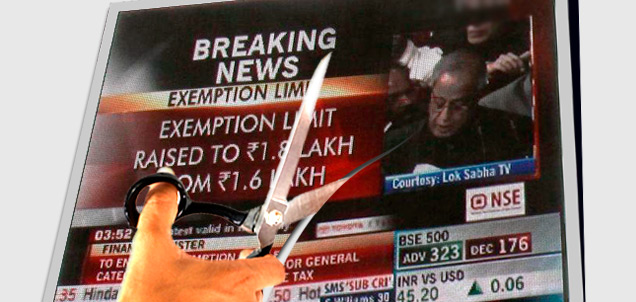
    Imaging: Rafiq, File photograph of Budget on a television set: Fotocorp

  • 100 Days to D-Day…but where are the Set-Top Boxes?

    By Shruti Pushkarna


    Only 100 days to go for Digitization Day and the ground reality does not look too promising at this point. There is a mammoth requirement of set top boxes, Digital Addressable System (DAS) licences have not yet been issued to operators and several other issues remain unresolved as of now.


    To get a clearer picture of the ground reality from the cable operators’ end, MxM India spoke to Roop Sharma, President, Cable Operators Federation of India. Speaking of the ground level scenario, Ms Sharma said, “No DAS licences have been issued to the operators still. Until and unless the operator has the license, he can’t get a bank loan and unless the operator has the license, he will not want to order equipment which is worth no less than 1 crore. And more importantly there is no consumer demand for digital. This is only government’s demand because they want to curry favour to the broadcaster. There isn’t any incentive from the government either. They are only forcing a technology on consumers by mandating it.”


    But more than anything, the biggest problem as pointed out by Ms Sharma is the sheer unavailability of Set Top Boxes (STBs) in the market. She told MxM India, “You need a Set Top Box to go digital and where are the STBs? First there was talk of importing them from China but that will also take atleast four to five months. Now there are some vendors in India but for that too, the chip has to be imported from outside. There is a requirement of 30 lakh STBs for Delhi alone and this is counting only one TV per household. Also, where is the manpower to deploy all these STBs?”


    Another industry source told MxM India, “As per the declared number, there is a requirement of 10 to 12 million STBs but my experience says that the actual total count will be no less than 20 to 22 million, because they have only counted 1 TV per household. The boxes are just not there.”


    Ms Sharma feels that the government is pressurizing the smallest guy in the entire value chain, which is the cable operator. Talking of other unresolved issues, she said, “Even if the cable operator gets the STBs and gets the license, the government has not assured that every operator who gets the license will get the content. How can the operator make such a huge investment when there is no assurance of content? The government is only pressurizing the smallest guy in the value chain, they can’t pressurize the broadcaster, not even the MSO.”


    MxM India also spoke to Mr Neeraj Sanan, EVP- Marketing and Distribution, MCCS to learn of the state of readiness of channels and industry as a whole. Mr Sanan said, “In principle, the entire fraternity of MSOs, LCOs and DTH friends are united in supporting the lead taken by TRAI. In my view, Delhi and Mumbai are slightly ahead of Kolkata in digitization. Being a country where examinations to appraisals to income tax, everything happens at the last minute I see two things:  a huge last minute rush (that too provided TRAI holds it grounds) which will put operational pressure in implementation. I still hope that, in the larger interest of the community, that we see the sunrise of Digitization. Already we have taken a lead in creating consumer pull through tickers which have been running on MCCS’ three channels for a month now and if all players in the value chain do the same I am sure we can see a successful June 30 sunrise.”


    But as per another industry source June 30th seems quite unachievable, “There is a lot of resistance from LCOs and cable operators’ end. Their business is fragmented, that’s how they make their revenues, and digitization will put a stop to that. And moreover, none of the MSOs are really prepared because this requires a capital investment of 30 to 35 crore and they don’t have that kind of funding. The sheer size and the volume of the business is so large that you cannot do it even by December 31st. One thing is certain, it will create unforeseen situation on ground.”


    Ms Sharma feels that the deadline might seem possible only if STBs are made available. Listing out all issues that need to be addressed before June 30th, she said, “First and foremost, tariff needs to be in place. DAS licenses have to be issued. Interconnection agreements have to be in place. Revenue share has to be specified. STBs have to be made available in the market. And there have to be fiscal incentives given to the operators. Also, we need to have many consumer awareness programmes. All these problems have to be addressed if the deadline has to be achieved by the notified date.”


    She also added that the TRAI had only done one open house recently in Delhi but since the June 30th deadline applies to all the four metros, TRAI should have done an open house in each of these cities.


    What’s your view on Digitization? Do you think the four metros can meet the deadline? Email us at shrutip@mxmindia.com and editor@mxmindia.com.


  • MxMIndia Comment: Let market forces decide ad duration

    By Pradyuman Maheshwari


    There is no denying that the Telecom Regulatory Authority of India (TRAI) has done some splendid work in the world of telecom. It’s also done its homework well on the recommendations for digitized delivery of broadcast signals. The sunset dates (especially for the four metros) are very ambitious, but TRAI is determined to cleanse the system, and this could well help do that.


    However, there are some areas where TRAI has failed, and come up with outlandish recommendations. For instance, its advisory that only All India Radio news feeds be used on FM private radios. It’s bizarre. When all and sundry players are allowed to air news on television – via satellite and cable, why not have news on radio? I believe that radiowallahs are also to blame for this delay and somewhere the fact that most of them are also in television and print is impacting pushing this agenda.


    Then there’s the issue of cross-ownership. I am aware of the problems that owning various media has, but just following what was implemented in developed nations eons ago is not right. Also, strategic tie-ups between media groups can happen to ensure that they further their collective agenda. An example being of Star and Zee getting together to set up distribution arm MediaPro.


    The newest in TRAI’s proposals which has now asked stakeholders to present views is on the duration and display of ads on channels. Surely we knew that the TRAI was working on it, but the timing was interesting. It’s happening at the end of a tough fiscal, but more importantly, the industry bodies have matured in their outlook and are taking necessary steps to get their acts together (like they did on self-regulation). So why not ask the IBF and NBA to get together and deliberate?


    [youtube width=”350″ height=”200″]http://www.youtube.com/watch?v=8QGcFHfF6kE[/youtube]

    But the issue here is different, should the government really get into the act of regulating ad durations and displays? Let market forces decide (see video alongside where Sunil Lulla, Times TV Network CEO and VP, IBF and NBA board member, advocates the same to my colleague Shruti Pushkarna on the sidelines of the CASBAA convention yesterday). We have already had several instances when broadcasters have dropped ads to up viewership and ratings. Ad breaks on films have been tweaked much to achieve this. I am sure all sports channels know that they can’t play around with the amount of screenspace ads take because it impacts the viewer experiences. News channels go without a break for hours whenever they are pursuing a huge story.


    More than regulations, market forces will help decide all of this. The government must have as much, say, in the matter of ad duration as it has in, say, a Hindustan Lever’s pricing of Dove soap. Tracking the policies in other countries makes for good reading, but is not necessarily a good idea. Broadcasters have appointed top marketing and research talent to think through this. Let them do their jobs… they know what’s good for their channels and their viewers.


    The problem is that the Indian public doesn’t like to pay for content. They wouldn’t mind paying a few hundred rupees per head on going to the cinema for the movies, but will hesitate to pay even 1/10th that for a month’s subscription of a pay movie channel. Broadcasters are largely to blame for this, but that doesn’t mean that they need to pay so heavily for their mistakes.


    The damage is not done yet. I am certain that all stakeholders will damn the proposals and ensure that these regressive policies don’t come in to being.


    MxMIndia opposes them, and recommends a liberal broadcast regime. Let market forces rule.


  • TRAI invites views on ads policy for broadcasters

    By A Correspondent


    It was bound to happen, only its timing – soon after the not-very-exciting Budget and the uncertainties thrown up by digitization staring in its face – could’ve been unfriendlier. On Day 3 of FICCI-Frames, Big brother Telecom Regulatory Authority of India (TRAI) released a consultation paper titled “Issues Related to Advertisements in TV Channels”.


    First some background, in TRAI’s words: “The advertisement revenue has been a substantial portion of the overall television industry revenues. Perhaps, this has led to the tendency of pushing more and more advertisements in the television programmes in both pay and FTA channels. The increasing duration and distracting formats of advertisements has, however, adversely affected the consumers’ viewing experience. This has been reflected in numerous consumer complaints and opinions being expressed at various fora.”


    The TRAI is hence reviewing the existing regulations on duration of ads and how they should be presented given complaints that these are not being followed. Here goes:


    1. The limits for the duration of the advertisements shall be regulated on a clock hour basis i.e. the prescribed limits shall be enforced on clock hour basis.

    2. No FTA channel shall carry advertisements exceeding 12 minutes in a clock hour. For pay channels, this limit shall be 6 minutes.

    3. The 12 minutes of advertisements will not be in more than 4 sessions in one hour. In other words, there will be continuous airing of the TV show for at least 12 minutes each. Not more than three advertisement breaks shall be allowed during telecast of a movie with the minimum gap of 30 minutes between consecutive advertisement breaks.

    4. In case of sporting events being telecast live, the advertisements shall only be carried during the interruptions in the sporting action i.e. half time in football or hockey match, lunch/ drinks break in cricket matches, game/set change in case of lawn tennis and so on.

    5. There shall only be full screen advertisements. Part screen advertisements will not be permitted. Drop down advertisements will also not be permitted.

    6. In so far as News and Current Affairs channels are concerned, they are allowed to run not more than two scrolls at the bottom of the screen and occupying not more than 10 per cent of the screen space for carrying non-commercial scrolls, tickers etc.

    7. The audio level of the advertisements shall not be higher than the audio level of the programme.


    The text of the Consultation Paper is available on TRAI’s website (http://www.trai.gov.in/WriteReadData/trai/upload/ConsultationPapers/289/ cp_aproved_Authority.pdf). Written comments on the issues raised in the Paper are invited from the stakeholders by March 27, 2012, and counter-comments by April 2.


  • TRAI issues consultation paper on digital cable

    By A Correspondent


    The Telecom Regulatory Authority of India (TRAI) on Thursday released a consultation paper on “Issues related to Implementation of Digital Addressable Cable TV Systems”.


    The analog cable TV service, which caters to around 94 million households, has been a roadblock in exploiting the full potential of the sector. Keeping this in mind and in consultation with all the stakeholders, the Telecom Regulatory Authority of India had recommended to the government complete digitization with addressability of the Cable TV services, in a phased manner in August, 2010.


    After the Parliament passed the Bill to amend the Cable TV Act paving the way for the digitization programme, in order facilitate transformation to digital cable system, TRAI identified certain key issues that need to be determined. These issues pertain to:

    • Composition and Tariff of Basic Service Tier (BST)
    • Retail Tariff
    • Prepaid billing
    • Interconnection issues
    • Revenue share between MSOs and LCOs
    • Quality of Service Standards
    • Redressal of Consumer Complaints


    Some of the key issues raised by TRAI in the consultation paper concern:

    • The minimum number of free-to-air (FTA) channels that a cable operator should offer in the basic-service-tier (BST). TRAI has also demanded for the genre-wise (entertainment, information, education etc) mix of channels in a BST?
    • If the retail tariff is to be determined by TRAI or left to the market forces? If it is to be determined by TRAI, how should it be determined?
    • The subscription revenue share between the MSO and LCO and if it is to be prescribed by TRAI what should be the revenue share.
    • Whether an ad-free channel is viable in the context of Indian television market?
    • The responsibility for ensuring the standards of quality of service provided to the consumers with respect to connection, disconnection, transfer, shifting, handling of complaints relating to no signal, set top box, billing etc. and redressal of consumer grievances.
    • The impact on the wholesale channel rates after the sunset date i.e 31st Dec 2014, when the non-addressable systems would cease to exist.


    The full text of the Consultation Paper is available on TRAI’s website (www.trai.gov.in). TRAI has invited written comments on the issues raised in this consultation paper from the stakeholders by 16th January, 2012, and counter-comments on the comments by 23rd January, 2012.


    The comments and counter-comments may be sent to Mr Wasi Ahmad, Advisor (B&CS) at: advbcs@trai.gov.in or traicable@yahoo.co.in.