Tag: TikTok

  • TikTok fears point to larger problem: Poor media literacy in the social media age

    TikTok fears point to larger problem: Poor media literacy in the social media age

    By Nir Eisikovits


    The U.S. government moved closer to banning the video social media app TikTok after the House of Representatives attached the measure to an emergency spending bill on Apr. 17, 2024. The House voted on each of the four components of the bill, and the one affecting TikTok passed 360-58 on Apr. 20, 2024. The packaging is likely to improve the bill’s chances in the Senate, and President Joe Biden has indicated that he will sign the bill if it reaches his desk.

    The bill would force ByteDance, the Chinese company that owns TikTok, to either sell its American holdings to a U.S. company or face a ban in the country. The company has said it will fight any effort to force a sale.

    The proposed legislation was motivated by a set of national security concerns. For one, ByteDance can be required to assist the Chinese Communist Party in gathering intelligence, according to the Chinese National Intelligence Law. In other words, the data TikTok collects can, in theory, be used by the Chinese government.

    Furthermore, TikTok’s popularity in the United States, and the fact that many young people get their news from the platform – one-third of Americans under the age of 30 – turns it into a potent instrument for Chinese political influence.

    Indeed, the U.S. Office of the Director of National Intelligence recently claimed that TikTok accounts run by a Chinese propaganda arm of the government targeted candidates from both political parties during the U.S. midterm election cycle in 2022, and the Chinese Communist Party might attempt to influence the U.S. elections in 2024 in order to sideline critics of China and magnify U.S. social divisions.

    To these worries, proponents of the legislation have appended two more arguments: It’s only right to curtail TikTok because China bans most U.S.-based social media networks from operating there, and there would be nothing new in such a ban, since the U.S. already restricts the foreign ownership of important media networks.

    Some of these arguments are stronger than others.

    China doesn’t need TikTok to collect data about Americans. The Chinese government can buy all the data it wants from data brokers because the U.S. has no federal data privacy laws to speak of. The fact that China, a country that Americans criticise for its authoritarian practices, bans social media platforms is hardly a reason for the U.S. to do the same.

    The debate about banning TikTok tends to miss the larger picture of social media literacy.

    I believe the cumulative force of these claims is substantial and the legislation, on balance, is plausible. But banning the app is also a red herring.

    In the past few years, my colleagues and I at UMass Boston’s Applied Ethics Center have been studying the impact of AI systems on how people understand themselves. Here’s why I think the recent move against TikTok misses the larger point: Americans’ sources of information have declined in quality and the problem goes beyond any one social media platform.

    The deeper problem

    Perhaps the most compelling argument for banning TikTok is that the app’s ubiquity and the fact that so many young Americans get their news from it turns it into an effective tool for political influence. But the proposed solution of switching to American ownership of the app ignores an even more fundamental threat.

    The deeper problem is not that the Chinese government can easily manipulate content on the app. It is, rather, that people think it is OK to get their news from social media in the first place. In other words, the real national security vulnerability is that people have acquiesced to informing themselves through social media.

    Social media is not made to inform people. It is designed to capture consumer attention for the sake of advertisers. With slight variations, that’s the business model of all platforms. That’s why a lot of the content people encounter on social media is violent, divisive and disturbing. Controversial posts that generate strong feelings literally capture users’ notice, hold their gaze for longer, and provide advertisers with improved opportunities to monetise engagement.

    There’s an important difference between actively consuming serious, well-vetted information and being manipulated to spend as much time as possible on a platform. The former is the lifeblood of democratic citizenship because being a citizen who participates in political decision-making requires having reliable information on the issues of the day. The latter amounts to letting your attention get hijacked for someone else’s financial gain.

    If TikTok is banned, many of its users are likely to migrate to Instagram and YouTube. This would benefit Meta and Google, their parent companies, but it wouldn’t benefit national security. People would still be exposed to as much junk news as before, and experience shows that these social media platforms could be vulnerable to manipulation as well. After all, the Russians primarily used Facebook and Twitter to meddle in the 2016 election.

    Media literacy is especially critical in the age of social media.

    Media and technology literacy

    That Americans have settled on getting their information from outlets that are uninterested in informing them undermines the very requirement of serious political participation, namely educated decision-making. This problem is not going to be solved by restricting access to foreign apps.

    Research suggests that it will only be alleviated by inculcating media and technology literacy habits from an early age. This involves teaching young people how social media companies make money, how algorithms shape what they see on their phones, and how different types of content affect them psychologically.

    My colleagues and I have just launched a pilot programme to boost digital media literacy with the Boston Mayor’s Youth Council. We are talking to Boston’s youth leaders about how the technologies they use everyday undermine their privacy, about the role of algorithms in shaping everything from their taste in music to their political sympathies, and about how generative AI is going to influence their ability to think and write clearly and even who they count as friends.

    We are planning to present them with evidence about the adverse effects of excessive social media use on their mental health. We are going to talk to them about taking time away from their phones and developing a healthy skepticism towards what they see on social media.

    Protecting people’s capacity for critical thinking is a challenge that calls for bipartisan attention. Some of these measures to boost media and technology literacy might not be popular among tech users and tech companies. But I believe they are necessary for raising thoughtful citizens rather than passive social media consumers who have surrendered their attention to commercial and political actors who do not have their interests at heart.


    This article was updated to indicate that the U.S. House passed the TikTok measure on Apr. 20, 2024.The Conversation Nir Eisikovits, Professor of Philosophy and Director, Applied Ethics Center, UMass Boston. This article is republished from The Conversation under a Creative Commons license. Read the original article

  • The Morphing of Social Media & the Putative Rise of Conversation Marketing

    The Morphing of Social Media & the Putative Rise of Conversation Marketing

    Ashoke AgarrwalAt the dawn of the internet era and, a bit later, of the social media era, many sociologists believed they would lead to a more informed and enlightened world. The events at Tahrir Square, the subsequent Arab Spring, and later the Maidan revolt in Kyiv seemed, for a period, to support this contention. Marketing gurus posited the dawning of the age of interactive and one-to-one marketing, much like the bazaar of yore but on a global, post-modern scale.


    But then the medium took over the message.

    Marshall McLuhan, in his 1964 book, ‘Understanding Media: The Extensions of Man’, coined the phrase, “The medium is the message”, which went on to become a pop phrase that was widely quoted, right or wrongly, in a wide variety of contexts.

    Marshall’s theory posits that the form of the medium embeds itself in the message, creating a symbiotic relationship by which the medium influences how the message is perceived. A corollary of Marshall’s theory was that a dominant medium would influence societal norms, politics and personal identities.

    By 1964, TV was the dominant medium in the US and most of the developed world. In its days, TV as a medium was supposed to build a sense of collective experience and this community. Instead, it promoted a culture of consumerism and passive consumption. Advertising, of course, gorged on this medium that was so much in synergy with its objectives.

    Sidney Lumet’s 1976 movie ‘Network’ is a trenchant yet entertaining critique of the Age of TV and its social impact.

    When the age of social media dawned with Facebook and Twitter, the initial hope was that the medium would redefine interaction and create a participatory culture. Instead, it became another gatekeeper medium controlled by shadowy algorithms that created echo chambers promoting tribalism across many dimensions while delivering audiences to advertisers. The fact that it could provide a more narrowly targeted audience to advertisers than could TV resulted not in a more informed consumer but in an increased ability of brands to insinuate into the social and consumption profile of the consumer. Also, more brands could get into the act as social media lowered the threshold level at which advertising budgets were effective.

    Going by the ultimate societal effect of the TV and social media eras, another corollary to McLuhan’s theory can be posited: that the societal impact of a dominant medium settles into the lowest common denominator in human nature!

    With the rise of TikTok, social media is morphing, creating and strengthening a new medium.

    Initially, social media sites like Facebook showed chronological updates from users’ friends and contacts. As the volume of posts grew, the networks employed algorithms to prioritise posts that had proved popular among the user’s friends.

    TikTok changed that. As a recent article in The Economist notes, “TikTok decided that, rather than guessing what people liked based on their “social graph” – that is, what their family and friends liked – it would use their “interest graph”, which it inferred from the videos they and people like them lingered on. And rather than show content created by people they followed, it would serve up anything it thought they might like.”

    TikTok’s growing popularity forced every other big platform to follow suit – Reels on Facebook and Instagram, Watch on Pinterest, Spotlight on Snapchat, and Shorts on YouTube.

    The result is that social media is morphing away from an interactive medium into a video-first, highly curated engagement platform. In that sense, social media is on its way to becoming a TV-like medium. Thus, marketers and advertisers are beginning to adopt a grammar akin to their TV campaigns for their social media campaigns.

    While social media platforms become places for passive consumption, users move their conversations and arguments off the open networks and into closed private groups like WhatsApp and Telegram, with implications for the business of political campaigns and the news media. Political parties like the BJP have made WhatsApp groups a key pillar of their campaign strategy. As social media platforms have moved away from highlighting news stories in their feeds, news media are increasingly trying to create channels on instant messaging platforms like WhatsApp and Telegram.

    Currently, in India, the tendency is to use it as a mass promotional channel, sending messages to an undifferentiated mass of “mobile” numbers.

    Marketers need to recognise that the platform offers two unique opportunities:
    1) it allows for a convenient one-on-one interactive platform and
    2) it allows a brand to create, communicate and enthuse a “fan group”.

    WhatsApp marketing can become the communication edge of a whole-of-marketing Big Data and data analytics-driven approach. I call this Conversation Marketing. Data collected from retail outlets, e-commerce platforms, loyalty cards, and first-party data can enrich conversations with consumers and groups. Conversation Marketing allows marketers to open a genuinely interactive, one-to-one channel with consumers. Whether this turns out to be a chimaera as from the early days of social media depends on how both the owners of the messaging platforms as they move to monetise them as well as the campaign strategies of brands.

  • Introducing Data Stories by Kunal Sinha: So how Effective are Influencers?


    By Kunal Sinha


    Kunal SinhaWith Orhan Awatramani aka Orry taking over IG feeds during the past few weeks, announcing ‘I’m a liver’ and snagging a Black Friday endorsement deal from CRED (who else?), the question of influencer effectiveness begs to be answered.

     

    When Hubspot posed the question, 80% of marketers said that influencer marketing is effective; in fact, 89% say it works as well as, if not better than other marketing channels. They believe that it yields the highest ROI, along with blogging and social commerce.


    In its early days, the detractors against influencer marketing were many. With brands having little control over influencers’ output, some marketers believed that partnering with creators could result in damage to the relationship they have with their consumers if their endorsements are inappropriate or less than transparent.


    Recent experience with influencers suggests that sentiment to have changed. In a study by Kantar, some 59% of marketers said they invested in influencer content in 2022, and close to 60% of marketers globally said they are going to increase spend on influencers in 2023. Already, 23% of marketers globally are spending over 40% of their marketing budgets on influencers; and this year, they would end up spending $16.4 billion dollars on influencer marketing.


    Here in Indonesia, Dr Richard Lee, a doctor who promotes and sells skincare, is followed by 5.1 million folks on TikTok, 1.7 million on Instagram, and has 4.69 million subscribers to his YouTube channel, all reasonably large followings. He made $800,000 in less than three hours selling his skincare products in a live shopping stream on Shopee in August. A follow-up livestream shopping event in September raked in $500,000 in just one-and-a-half hours. Dr Lee’s conversion of his followers into shoppers suggests that the lines between influencer marketing and social commerce are getting blurred.


    Research published in Harvard Business Review analysed more than 5,800 influencer marketing posts on the popular Chinese social media platform Weibo.


    Posts in that dataset were written by 2,412 influencers for 861 brands across 29 product categories, at costs ranging from $200 to almost $100,000 per post. The study found that on average, a 1% increase in influencer marketing spend led to an increase in engagement of 0.46%, suggesting that the strategy can in fact yield positive ROI.


    The jury seems to be out when it comes to the impact of influencers on novelty. Kantar’s analysis of 30 different influencer campaigns in beauty, fintech, sports and retail revealed that compared to market averages in their database of almost 9,000 global ads, influencer creative executions are in the top third for delivering new information and being credible.


    Conversely, the study published in HBR found that ROI for influencer posts announcing new products was 30.5% lower than for equivalent posts that were not about new product launches.


    Having said that, there are some clear directions towards which factors and variables make an influencer campaign perform better.


    Number of followers: Influencers who have a large following not only deliver greater reach, but are also seen as more credible. They are able to generate higher engagement rates than brands would achieve by spending the same budget on partnering with a less-popular influencer. Posts from influencers whose follower bases are larger than average achieved 9.2% greater ROI.


    Posting frequency: Influencers who do not post often are not seen as up-to-date sources of information. They are also unable to establish presence on followers’ feeds to build trust and intimacy. On average, marketers can increase the ROI of their influencer marketing efforts by 53.8% simply by selecting influencers who engage in an optimal level of posting activity – five posts per week.


    Content originality: Influencers posting more original content tend to stand out. Their content attracts more attention, and they appear more knowledgeable and authentic. Brands that leverage such influencers typically achieved higher engagement rates for a given marketing spend. Specifically, influencer posts that were original content achieved 15.5% greater ROI than those that were not (such as re-shares).


    Links to the brand: Consistent with prior research on content marketing, the HBR study finds that posts that include links to a brand’s social media account or external webpages perform significantly better. Including links to a brand’s website or social media in an influencer post achieves 11.4% higher ROI.


    Putting these principles into practice for TikTok Indonesia

    In its quest for growth in Indonesia, TikTok was hampered by the perception that its content was mostly about dance and music.


    Increasing the user base by 50% required out-of-the-box thinking. Our strategy at M&C Saatchi was to make folks realize that there’s more to TikTok than met the eye. We would show them diverse content they weren’t aware of.


    How did we do that? By deploying Najwa Shihab, an extremely popular, intellectual persona to introduce the high quality of TikTok’s content. While she was extremely popular on Instagram, nobody expected her on TikTok. We were convinced that her positive, inspiring imagery that would galvanize users. And it did.


    Najwa’s first-ever TikTok video post achieved 51.2 million views in 5 days. She gathered 1 million followers within a week.


    The #serunyaditiktok campaign reached an astounding 8 billion views on TikTok; motivating 3960 creators to come on-board. The content racked up 1.8 billion views in a week. An online media event featuring Najwa was covered by 128 outlets, generating 5 billion impressions.


    As against the target of 33 million new users, TikTok gained almost 55 million users, who spent 67% more time on the platform. TikTok moved from #9 to #3 in the top social media app rankings in Indonesia.


    Why is influencer marketing effective?

    In its essence, what influencers do is create desire by assigning a value to the objects they promote. That value of those objects isn’t objective, it is subjective. That subjective value is based on our relationship with others: it is mimetic. We assign value to things, and thus desire them, based on what other people want. Mimetic desire means that our own choices are usually according to the desire of others.

    Influencers serve as models of desire. They are people who we look towards for guidance about what to want, usually unconsciously, as they transfigure objects before our eyes.

    Now, go figure, which of your hidden desires Orry has been able to transfix!


    References:

    Hubspot: What Will Influencer Marketing Look Like in 2024? https://blog.hubspot.com/marketing/how-to-work-with-influencers

    Leung, Zhang, et al, Does Influencer Marketing Really Pay Off, Harvard Business Review, November 2022

    Bubani, Gonca, Under the influence? How influencer marketing grew up, World Advertising Research Centre, 2022

    https://www.statista.com/statistics/268641/share-of-marketing-budgets-spent-on-digital-worldwide/


    Kunal Sinha is Group Chief Strategy Officer at M&C Saatchi Indonesia, and author of several books including The Future of India’s Rural Markets and Raw – Pervasive Creativity in Asia. He will write for MxMIndia every other Monday. His views here are personal.


  • Not just Creators, Non-Playable Characters are raking it in…

    TikTok


    By Edith Jennifer Hill


    The one constant the internet offers us is a continual rotation of trends. Months ago, the trend was people exhibiting “main character energy”. People were imagining themselves as main characters in their own life show: they were the ones who knew everyone’s name in the coffee shop, they were having the whirlwind romance, they were only accepting the best.

    Now, the trends have moved on, and people are NPCs.

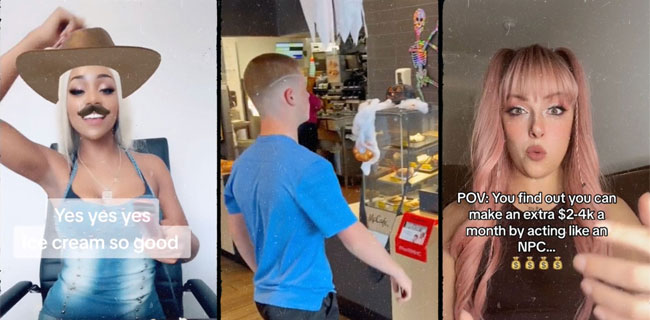
    Non-playable characters, or NPCs, are taking TikTok by storm. NPCs originate in video games. They are the background characters, the ones with repetitive movements and sayings, and no storylines. The main, playable, character can interact with them but only in limited ways. They are tools in someone else’s story.

    People pretending to be NPCs on TikTok are not new. Creator @loczniki, Nicki Loczek, has been acting like a video game character on her TikTok page for two years. Her videos regularly get millions of views.

    NPC content rapidly gained popularity in recent months when creators like @pinkydollreal have been live streaming as NPCs. NPC creators perform scripted lines and reactions to purchased “gifts” from their fans that then appear on screen as emojis.

    Giving diamonds, coins and other gifts to creators has a very low cost to fans. However, when creators accumulate large audiences, the profits can add up significantly, especially when the streams can go for hours. Creator @glam_with_dee tried out the trend and shared that she made $99 in a two-and-a-half-hour stream.

    Some people are calling the NPC trend a fetish – more often that not it is beautiful women performing actions and sounds on command for an audience. Others, however, disavow this sentiment, stating that people always claim women making money from the absurd is a fetish, when it is often far from the truth.

    People watch NPCs on TikTok for a variety of reasons. Nicki Loczek’s popularity came from her funny videos pretending to be a video game character in public. Many streamers also dress up in elaborate cosplay costumes, feeding into the gaming and fantasy aesthetic.

    Others, myself included, watch for the absurdity. It is uncanny watching people be NPCs.


    Commodifying the self

    People online have been commodifying themselves since social media platforms introduced creator fund programs and brands recognised the income potential of content creators. For years, creators have been participating in brand deals for anything from health products to home decor, with some going as far as deals for free cosmetic surgery.

    One of the key principles of being successful online is a consistent personal brand. Traditionally, when we think about people becoming successful online, we attribute this to authenticity.

    Audiences want consistent posts, a clear authorial voice, and a person and brand where they know what they’re getting. While NPCs cannot technically be “authentic” as they are characters rather than people, they still fulfil these attributes on TikTok. They do what we think they will do. Their reactions are expected, if not delivered at the specific times we ask for them.

    NPC live streamers have planned reactions to the “gifts” they receive while they stream. Bigger gifts usually have bigger reactions. Christine Tran, a PhD candidate from the University of Toronto, states: “NPC streamers are just the latest genre of creators who divide their bodies into marketplaces of intimacy.”

    The NPC trend fits in with other forms of online commodification. Pretending to be an NPC on TikTok live is not too far removed from popular YouTubers maintaining an “online persona” for the purposes of creating a marketable, brand-friendly channel.


    Monetisation online

    TikTok is one of many social media platforms where users create and sell a personal brand for money. Tobias Raun, an assistant professor in communications, states: “YouTube as a platform plays a crucial role by persistently encouraging users to compete for attention and status and rewarding them economically for promoting themselves.”

    TikTok pays its users far less than YouTube does. While the real numbers differ depending on video length and the creator themselves, TikTok is known to pay $0.03 per 1,000 views, compared to multiple dollars on YouTube. The most money to be made on TikTok, outside of brand deals, is through live streams.

    The creator fund on TikTok is limited to creators with over 10,000 followers who have amassed a minimum of 100,000 views in the last month. It is also available in limited countries. Australia is not included.

    Alternatively, any creator with over 1,000 followers can live stream and can cash out in-app “gifts” for real money. This system is available to far more people.

    The NPC trend has shown us how the self-branding online we are more familiar with, people being so authentically themselves, can be surpassed by people playing a character. The rise in live videos on TikTok is linked to the platform’s monetisation policies. If content creators want to make money from their content, they either need an incredibly large following or must find brand deals or do live streams.

    I couldn’t call myself an autoethnographic researcher without trying to go live myself. I did.

    TikTok is a strange, strange place. I went live for 15 minutes while writing some of this article, and 320 people watched me. I talked to some of them. Someone said I typed too hard. Someone else asked me to sing Black Sabbath.

    I closed my TikTok app with a new-found appreciation (and a little bit of fear) of how hard it must be to maintain a character for hours during a live stream.

    Someone did say they liked the sound of my typing. If I found a way to do my marking on an ASMR live stream, you would find me on TikTok tomorrow.The Conversation


    Edith Jennifer Hill is Associate Lecturer with Flinders University. This article is republished from The Conversation under a Creative Commons license. Read the original article.


  • Why are young people abandoning news websites?


    By Nic Newman


    The crisis in journalism caused by the traditional news media’s struggles to cope with the digital revolution has been well documented over many years. But news organisations now face a much more fundamental change driven by generations who have grown up with and rely almost entirely on various digital media.

    Data published in this year’s Reuters Institute Digital News Report shows an acceleration in the structural shifts towards more digital, mobile and media environments. This is where news content is delivered via social media and now, increasingly video-led platforms such as TikTok, rather than via what to a new generation of media consumers look like the more formal and stuffy traditional of “legacy” media, including newspapers and television.

    Not only is consumption of traditional television news and print formats continuing to decline at a relentless rate, but online websites are also struggling to engage news users, despite the tumultuous times in which we live.

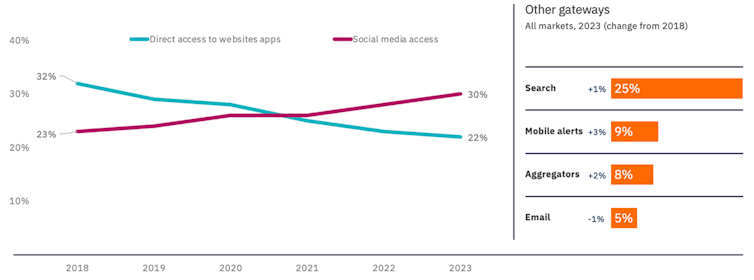
    One benchmark of this shift is a question we ask about key gateways that people use to access news. Using average data across all 46 countries surveyed in our annual report, we found that more people choose social media each year, mostly at the expense of direct access via a traditional news website or app. Access via search and other aggregators has also increased slightly over time.


    Use of news websites/apps versus social media to access news:

    Graph showing direct news website/app use decline and social news increasing.
    Which of these was the main way in which you came across news in the last week? Base: All who used a news gateway in the last week in each market-year ≈ 2000. Note: Number of markets grew from 36 in 2018 to 46 from 2021 onwards. Markets listed in online methodology.
    Reuters Institute for the Study of Journalism, Oxford University, Author provided


    These are averages, and it is important to point out that direct connection remains strong in some markets – mainly in northern Europe, where there is keen interest in news and relatively high trust. But elsewhere – especially in parts of Asia, Latin America, and Africa – social media or other aggregators are by far the most important gateways, leaving news brands much more dependent on third-party platforms for traffic.

    Generational differences are also a big part of the story. In almost every country we find that younger users are less likely to go directly to a news site or app and more likely to use social media or other intermediaries.

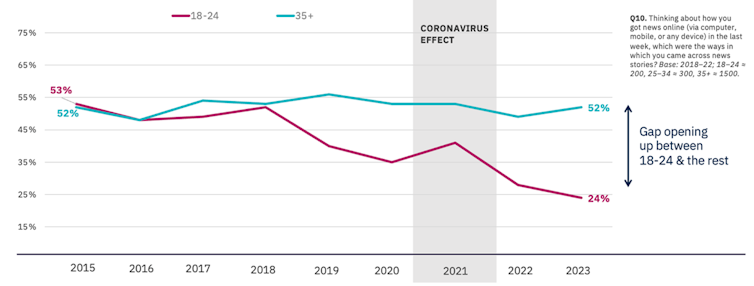
    The following chart for the UK shows that over-35s (blue line) have hardly changed their direct preferences over time, but that the 18–24 group (pink line) has become significantly less likely to use a news website or app.

    This is just one indication of how the generation that has grown up in the age of social and messaging apps is displaying very different behaviours as they come into adulthood.


    Percentage of people using a news website or app:

    Graph showing declining use of news websites and apps among 18-24 age group from 53% in 2015 to 24% in 2023 while 35+ group stayed around 52% (see previous two paragraphs).
    Thinking about how you got news online (via computer, mobile, or any device) in the last week, which were the ways in which you came across news stories? Base: 2018–22; 18–24 ≈ 200, 25–34 ≈ 300, 35+ ≈ 1500. Reuters Institute for the Study of Journalism, Oxford University, Author provided


    Dependence on social media may be growing, but it is not necessarily the same old networks. Across all age groups, Facebook is becoming much less important as a source of news – and by implication as a driver of traffic to news websites. Just 28% say they accessed news via Facebook in 2023 compared with 42% in 2016, based on data from 12 countries we have been tracking since 2014.

    This decline is partly driven by Facebook pulling back from news and partly by the way that video-based networks such as YouTube and TikTok are capturing much of the attention of younger users.

    Twitter usage is also reportedly declining following the chaotic set of changes introduced by Elon Musk, even if our survey shows relatively stable weekly reach overall.

    New platforms

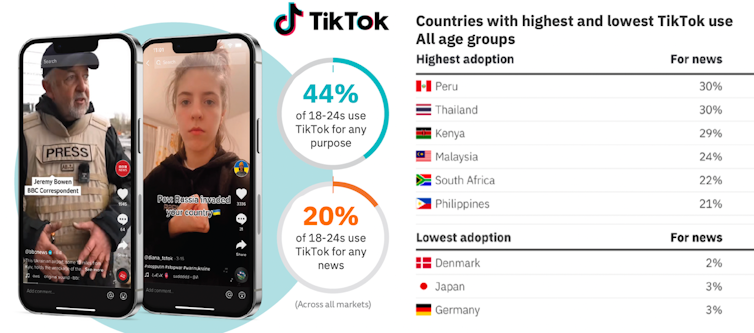
    TikTok is the fastest growing social network in our survey, used by 44% of 18–24 year-olds for any purpose and by 20% for news (up five percentage points compared with last year). Our survey results also show that the Chinese-owned app is most heavily used in parts of Asia, Latin America and Africa.

    Graph showing which platforms and websites people have used to access news.
    Which, if any, of the following have you used for news in the last week? Base: Total sample in each market ≈ 2000. Note: TikTok has been banned in India and does not operate in Hong Kong.
    Reuters Institute for the Study of Journalism, Oxford University, Author provided


    The report also provides evidence that users of TikTok, Instagram and Snapchat tend to pay more attention to celebrities and social media influencers than they do to journalists or media companies when it comes to news topics. This marks a sharp contrast with “legacy” – or more established – social networks such as Facebook and Twitter, where news organisations still attract most attention and lead conversations.

    Although news organisations have been experimenting with TikTok accounts, many are struggling to adapt to the more informal tone where creativity is the key to attracting an audience.

    These shifts are additionally challenging for publishers because they often require expensive bespoke content to be created and there are few ways to monetise short form videos, with limited linking opportunities back to websites or apps.


    Younger people less likely to read online

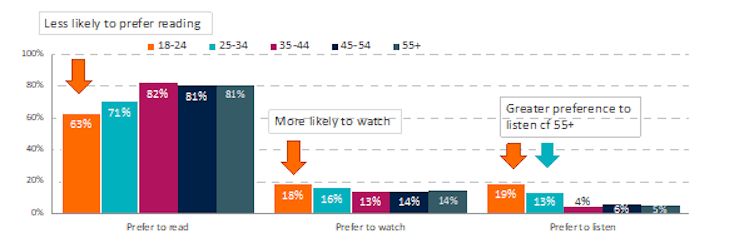
    These platform shifts are part of a wider move away from reading and towards watching or listening to news content online. While all age groups say they still prefer to read news online because of the speed and control if offers, younger groups are more likely to express preferences for watching or listening to news content, as the chart below shows. And this translates into greater consumption of short-form videos and podcasts by this group, according to our data.


    News consumption preferences by age and media:

    Graph showing young people are less likely to read and more likely to watch or listen to news.
    In thinking about your online habits around news and current affairs, which of the following statements applies best to you? Please select one. Base UK= 1740 (excl. DKs)
    Reuters Institute for the Study of Journalism, Oxford University, Author provided


    Our research over more than a decade has captured the way that all age groups have adopted digital media, alongside more familiar formats such as TV and print. But now we are seeing the emergence of a generation of social natives that are not bound by traditional definitions of news.

    As our previous research has shown, younger groups expect news to be engaging, participatory and to be available on their terms – in the networks and platforms where they spend their time. Trust is not a given, it needs to be earned – as much by journalists as by any other creator of content.

    For all the difficulties this entails – around trust, attention and business models – this is the media environment that the public is increasingly choosing for themselves. It is one where journalists and news media will need to carve out their place if they want to maintain their relevance and connection with the wider public.The Conversation


    Nic Newman is Senior Research Associate, Reuters Institute for the Study of Journalism, University of Oxford. This article is republished from The Conversation under a Creative Commons license. Read the original article.


  • Is 13 too young to have an Instagram account?


    By Catherine Page Jeffery


    The surgeon general is the “nation’s doctor” in the United States. They are tasked with giving Americans the “best scientific information” about their health.

    Late last month, the current US surgeon general, Vivek Murthy, warned 13 is too young to join social media. He said it poses a risk to young people’s “self-worth and their relationships”, adding:

    I, personally, based on the data I’ve seen, believe that 13 is too early […] the skewed and often distorted environment of social media often does a disservice to many of those children.


    Is 13 too young? What should parents think about when it comes to their kids and social media accounts?


    Why are we talking about 13?

    Major social media platforms, including Twitter, Instagram, Facebook and TikTok, require users to be at least 13. This includes those in Australia and New Zealand.

    This minimum age requirement stems from 1998 US legislation which banned the collection of children’s personal data without parental consent.

    For many parents, schools and cybersafety experts, this minimum age has become something of a benchmark. Many assume it comes with the implicit assurance social media platforms are appropriate and safe for children once they turn 13. Conversely, they also assume they are unsafe for children under 13.

    But this is not necessarily the case.


    What does the evidence say?

    Social media platforms do present some risks for young people. These include online bullying and harassment, exposure to misinformation and inappropriate content, grooming, privacy breaches and excessive use.

    Stories documenting the potentially harmful effects of social media are rarely out of the news. Studies claim links between social media and poor mental health and low self-esteem.

    These findings are concerning, and there is no doubt social media may negatively affect some young people’s wellbeing. However, it is not a straightforward question.

    While these studies might find a correlation or link between excessive social media use and poor self-esteem, for example, they rarely point to direct causation. Young people already experiencing low self-esteem and depression may use social media significantly more than others.


    So why don’t we just increase the age?

    Murthy acknowledges it is difficult to keep kids off their devices and social media. But he suggests parents band together, and say you know, as a group, we’re not going to allow our kids to use social media until 16 or 17 or 18.

    But any increase in the age – whether formal or informal – will not necessarily keep children safer online. Children can easily falsify their ages (many already do). And young people are good at finding creative and secretive ways of doing what they want regardless.


    Why can’t parents just say no?

    It is often suggested – by cyber safety experts – that parents just say no. This message has been reinforced by celebrity commentators such as British actress Kate Winslet, who recently told the BBC:

    My children don’t have social media and haven’t had social media.

    While these approaches may work with younger kids, older children are unlikely to simply comply. Blanket bans and restrictions not only lead to family conflict, but are also more likely to lead to children using social media without parental consent or knowledge.

    This is a problem because parents play an important role in helping children navigate online spaces, including the sometimes fraught nature of peer relationships on social media.

    If a child has a social media account without parental permission, they are much less likely to seek out their parents for help if they have a problem online, for fear of getting into trouble or having their device taken away.


    Children also have a right to be online

    Discussion about risks also tends to ignore the potential benefits of being online.

    Social media is incredibly important for many young people. It keeps them connected with friends and extended family, provides a platform for creativity and self-expression, and enables civic participation and activism.

    Social media also provides access to like-minded individuals and communities who may provide solidarity and support, especially for marginalised teens.

    Children, particularly teenagers, also have a right to participate in online spaces, including use of social media.

    The United Nations’ Committee on the Rights of the Child notes children have the right to “meaningful access to digital technologies” as a way of realising the full range of their civil, political, cultural, economic and social rights.


    So, when should my child get a TikTok account?

    There is no one-size-fits-all approach here. Children vary tremendously in terms of their maturity, skills, life experience and judgement.

    On top of this, online risk is not equally distributed, as children who are more vulnerable offline are more vulnerable online. For example, children with mental health problems, learning difficulties, a disability or who have problems at home are more likely to experience high-risk situations online.

    In deciding whether your child is ready for a social media account, parents might consider:

    Is my child especially vulnerable to online harms?
    Does my child have the required maturity and resilience to manage potentially negative online social interactions?

    Does my child listen to advice and follow rules?
    Is my child aware of the risks, and do they have strategies for managing them?
    Will my child come to me with any problems they encounter online?

    Parents might also consider their children’s offline lives, as these often carry over into online spaces. This includes what their friendships are like, their propensity for taking risks, and their ability to consider the consequences of their actions.


    Start talking early

    The best thing that parents can do is initiate conversations about social media and the internet early and often.

    Many issues that play out on social media are extensions of young people’s existing peer relationships. Parents can talk to their children about their friends and peers, show an interest in their child’s online activities, and openly discuss their child’s rights and responsibilities online.

    Some parents may wish to set reasonable expectations and rules about appropriate use of social media. Documenting these expectations through a “family technology agreement” that is negotiated democratically as a family, rather than through top-down rules, is more likely to succeed.


    Catherine Page Jeffery is Lecturer in media and communications, University of Sydney. This article is republished from The Conversation under a Creative Commons license. Read the original article.


  • LinkedIn @ 20: Transforming the business networking giant


    By Theo Tzanidis


    When someone says social media, you probably don’t immediately think of LinkedIn. But there’s no denying that the business networking site has gone the distance: it is now 20 years since it was founded in Silicon Valley.


    It was the brainchild of Reid Hoffman, a US entrepreneur who worked on an early social media platform for Apple before launching one of his own in 1997. SocialNet was a dating and professional connections site, but folded two years later after failing to find a big enough userbase in those early days of the web.

    LinkedIn founder Reid Hoffman talking at a conferece
    LinkedIn founder Reid Hoffman. Photograph credit: Marco Verch, CC BY-SA


    Hoffman went on to become a senior manager at PayPal, and made a substantial amount of money when it was bought by eBay in 2002. This helped him to co-found LinkedIn on December 28 2002 with a team of former SocialNet colleagues, becoming its first chief executive and later executive chairman.


    This was a period when everyone was realising the importance of individual interconnection and peer-to-peer interactions. LinkedIn launched in May 2003, just ahead of Myspace and Facebook. But where they and others like Friendster went after the consumer market, Hoffman’s venture was always focused on business.


    How it grew

    LinkedIn was originally set up as a place where users could share their CVs and establish a network of people who could recommend them. It took a while for the service to find its feet via innovations like allowing users to upload their contacts books (2004), as well as jobs listings (2005) and public profiles (2006).

    LinkedIn went international in the late 2000s, opening an office first in the UK in 2008 and introducing Spanish and French language versions the same year. Jeff Weiner, formerly of Yahoo, took over as chief executive the following year as the company morphed into a proper business.

    It made money from premium features that enable users to do things like messaging outside their network, send promotional emails and access analytics. It also sells advertising space and packages to help recruiters attract talent.

    It floated on the stock market in 2011 with a valuation of US$9 billion. This helped to finance an acquisition spree that has gradually bolted new features onto the platform, such as posting articles (2015) and videos (2017).

    The company was acquired by Microsoft in 2016 for US$26 billion (£21 billion). With Hoffman joining the Seattle giant’s board the following year and Weiner still LinkedIn’s chief executive today, Microsoft has taken a relatively hands-off approach to ownership.


    Pandemic benefits

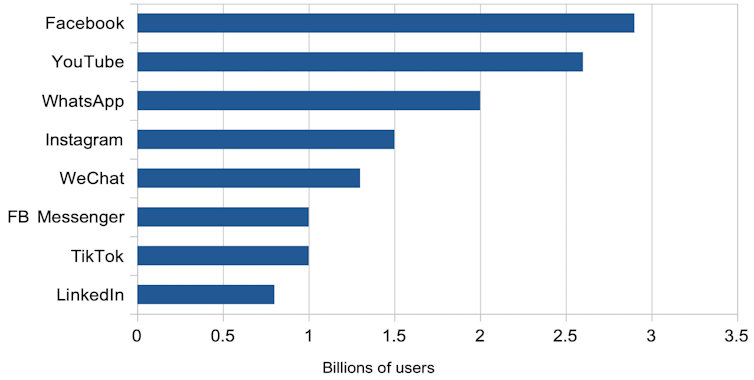
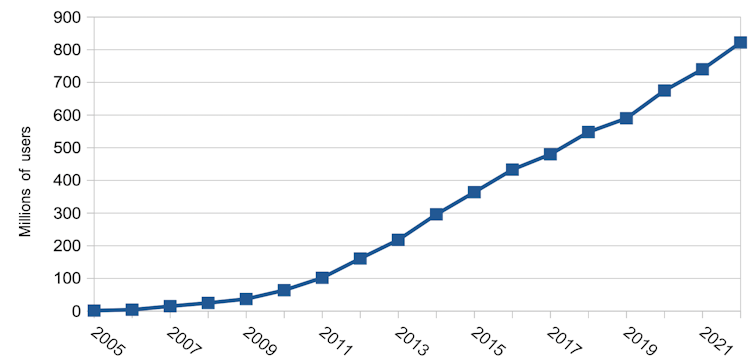
    Today LinkedIn is arguably the seventh largest social network after Facebook/Messenger, YouTube, WhatsApp, Instagram, Twitter and Tik Tok. In 2021 it had nearly 824 million users across 200 countries and territories, of which 6% (49 million) are premium subscribers, paying a minimum of US$29.99 a month.

    Not only does LinkedIn’s business focus attract an upmarket userbase, they are also youthful. The majority (59%) is made up of 25-34s, followed by 18-24s (20%) and 35-54s (18%). It generated revenues of over $10 billion in 2021.


    World’s biggest social networks

    Bar graph showing the largest social networks by user numbers
    All the data is monthly active users from January 2022, except LinkedIn, which just gives user numbers. Statista


    LinkedIn had a “good” pandemic, with conversations on the platform rising 43% and content-sharing almost 30%. It benefited from a shift in how people networked, related to findings from numerous studies that it’s the “weak links” in our professional networks who are the most important for gleaning critical information that leads us into jobs we genuinely desire.


    At a time when the usual barriers of time and space were less relevant and Zoom calls were ubiquitous, it became the perfect moment for reconnecting with these occasional contacts. Especially with so many people questioning their work situations, LinkedIn was the ideal place to see their posts and reach out to them.


    This meant that LinkedIn played a key role in the great resignation, particularly since like the platform, this movement was dominated by millennials. Users posting about changing or quitting jobs would attract large numbers of likes and comments, inspiring others to do likewise. The fact that so many people were connected on LinkedIn multiplied the effects, making it both the main catalyst and the main solution for employers.


    LinkedIn user growth over time

    Line graph showing growth in LinkedIn user numbers over time
    Various sources


    Meet the ‘work-fluencer’

    LinkedIn’s role as a lightning rod for work issues is also likely to determine how it develops, as a new category of social media influencer emerges – the “work-fluencer”. Companies are increasingly finding that employees’ LinkedIn profiles and postings can express the brand better than corporate accounts, allowing them to develop the corporate business network much more quickly and naturallyand naturally.

    When this is done well, employee posts are usually much more authentic than corporate PR. Rather than just curating articles on professional milestones and triumphs, people have become more open and honest about day-to-day work life.

    Over 13 million LinkedIn members have their profile set to “creator mode” to obtain higher exposure for their postings. Many use the hashtag #careertiktok to publish things like their wages and day-in-the-life vlogs about their professions, achieving over 1.5 billion views.

    This new “online watercooler” represents a change in the amount of information people reveal about their work on the internet. Workers are raising formerly taboo concerns like pay transparency, discrimination and professional undermining. Some professionals like lawyers, entrepreneurs and HR experts, have leveraged their posts into new content-marketing businesses and other profitable side hustles.

    Twenty years after LinkedIn was founded, this could enable the platform to enjoy the kind of trust and community growth that other social media networks would envy. Certainly it has challenges – fake accounts are an issue, for example. And LinkedIn inevitably attracts a lot of spam, which is probably one reason it doesn’t achieve the same amount of daily interactions as other social media.

    On the other hand, it benefits from not having a single direct competitor of scale. The nearest big ones would be Facebook Groups or Reddit, but LinkedIn’s purely corporate focus is always likely to be a plus against such players. At a time when traditional platforms like Facebook and Twitter are experiencing difficulties, LinkedIn has a real opportunity to continue succeeding as the one dedicated platform of its size.


    Theo Tzanidis is Senior Lecturer in Digital Marketing, University of the West of Scotland. This article is republished from The Conversation under a Creative Commons license. Read the original article.


  • Boom in Long & Short Videos


    By Our Staff


    India’s online video market has seen explosive growth both in terms of users and usage. The video user base has scaled to more than 350 million people growing over 24% over 2018-20, twice as fast as markets such as China and Indonesia. Despite this rapid boom, there exists massive headroom for growth – online video user penetration in India is nearly 60% of Internet users, compared with more than 90% in China, notes a report from Bain & Co. The report covers both the Short Form Video as well as the Long Form Video (including OTT / Streaming) market, and provides in-depth insight into the users, platforms and creators of online videos.


    Online video consumption has exploded over the last few years, with a surge in both users and usage bolstered by prolonged stay-at-home periods, especially during the pandemic. India’s online video user base has scaled to more than 350 million people, growing 24% over 2018 to 2020, nearly twice as fast as markets such as China and Indonesia.


    Usage per active user has also grown dramatically-the daily time spent per active user on online videos has simultaneously grown by 60% to 70% over 2018-20. Majority of time spent on smartphones is on entertainment, primarily watching videos. These are among the findings of a report titled “Online Videos in India- The Long and Short of It”, released by Bain & Company.


    Said Arpan Sheth, partner and global leader of Bain & Company’s Vector Solutions Group: “India has a large digital community, with about 640 million Internet users and 550 million smartphone users which is rapidly growing and spending more time online. Smartphone users spend about 4.8 hours on their devices daily, of which a staggering one hour on average is spent consuming videos. Despite this rapid boom, there exists massive headroom for growth—online video user penetration in India is nearly 60% of Internet users, compared with more than 90% in China.”


    Digital video entertainment consists of short-form videos (SFV) which are between 15 seconds and two minutes, and long-form videos (LFV), which are more than 2 minutes long. Within SFV and LFV segments, content can be further segregated based on who is creating it (user generated vs. professional) and how it is delivered (pre-recorded vs. livestreaming). The lines across these segments are increasingly blurring, as platforms expand their offerings to capture a greater share of consumer time in catering to broader consumer needs and occasions to enhance stickiness. For example, Instagram now has Reels, IGTV, and IG Live.


    YouTube has recently introduced YouTube Shorts in India. In India, the SFV market has taken off over the past two years, growing 3.5 times in user base and 12 times in total time spent by all users on SFV platforms. More than 200 million Indians watched SFVs at least once in 2020, with daily active users spending up to 45 minutes a day on these platforms. However, India’s short video user base has historically been largely men from Tier 2 and smaller towns, but this is evolving quickly, with the medium gaining traction in metros and amongst women. China paved the path for the SFV-market globally, over the past decade. India lags China by three to four years in terms of user penetration as well as usage.


    However, rapidly growing access with cheap and ubiquitous data, easy-to-use platforms, and a high proportion of vernacular content will aid short video scale-up in India. By 2025, three in four Internet users, or 600 million to 650 million Indians, will consume short-form videos, with active users spending upto 55 to 60 minutes per day.


    Added Shyam Unnikrishnan, partner and a leader in Bain & Company’s Consumer Products, Retail, Strategy and Digital practices in India: “The SFV ecosystem which essentially comprises of users, creators and advertisers are key to driving economics for the platform. Brands are increasingly using short video platforms to reach their target customers. New monetisation models, such as video commerce, livestreaming, and in-app purchases, will become increasingly commonplace in the coming years. Players need to invest in developing an advanced, tech-enabled platform to link users, creators, and advertisers and deliver a seamless experience to all.”


    TikTok became the first scale SFV platform in India, with more than 200 million users and 20 million content creators posting at least one video a month. This robust base of creators is key to attracting users. India has more than 50 million users who have created and posted at least one short video. Content creators are active on multiple platforms and are increasingly monetising their follower base through brand collaborations and commerce. All this is giving rise to a robust creator economy—an enabling ecosystem of players helping creators with content creation, monetisation, financing, and business management.


    The Indian SFV market is now occupied by a mix of specialist SFV apps (e.g., Moj, Josh, MX TakaTak, Roposo, Zili) and global social media/video giants (e.g., Instagram Reels, Facebook Reels, YouTube Shorts). Amongst the specialist short video platforms, five platforms-the previously mentioned Moj, MX TakaTak, Josh, Roposo, and Zili-have more than a 100 million downloads each.


    The market, while at scale, is still nascent. Major players are only a little more than a year old. The market could evolve to follow one of the divergent paths of the two mature SFV markets: China and the US. The China short video market is led by specialist platforms, while in the US, social-media-led platforms (led by Instagram Reels) and specialist short video platforms (led by TikTok) co-exist.


    Said Sriwatsan Krishnan, partner and a leader in Bain & Company’s Private Equity and Alternative Investor practice in India: “Market leaders will have to focus on three areas to develop a large, engaged community of users and creators. First and foremost, they will have to make substantial investments in technology to deliver a hyper-personalised experience to users, optimise user interface (through faster app and video load time, etc.), and expand access via vernacular interfaces. Winners will simultaneously focus on creator enablement and lock-in on one side, and creation of scalable monetisation engines on the other. Successful players will need access to large amounts of capital to achieve these goals and deliver on their potential.”


    India’s short-form video (SFV) market offers tremendous potential. Successful players will focus on three areas including tech-enabled hyperpersonalisation, creator enablement and lock-in, and monetisation as they onboard the next wave of users and drive engagement which will require access to large amounts of capital.


    According to Bain & Company, the five major trends that will shape the future of the SFV market in India are;


    Content curation and social-led engagement: Leading players will invest in a robust recommendation algorithm and a superior user interface and user experience to deliver a winning experience.


    Monetisation: Digital advertising will be the first frontier, but platforms will increasingly experiment with alternate commerce and micro-transactions. – Innovations to onboard the next wave of users: SFV platforms are already available in more than 15 languages in India, but a continued explosion of vernacular options is evident.


    Emergence of a robust creator ecosystem: A robust creator economy will emerge. This enabling ecosystem will help creators with content creation tools, training, brand affiliations, financing, and business management.


    – Niche platforms within larger SFV ecosystems: Platform players will emerge, housing a suite of apps which cater to distinct user and content niches. Long-form videos(LFVs) on the other hand, have substantial scale—viewed by 350 million to 400 million users, almost twice as penetrated as SFV. The format has seen substantial growth, with users and usage increasing nearly 1.5 times from 2018 to 2020. Active users today spend more than 2.5 hours per day on long-form content. Covid-19 lockdowns and stay-at-home advisories during the pandemic further propelled these numbers. LFV is poised to grow to 600 million to 650 million users in India by 2025. This growth will be driven by a steady increase in the Internet user base; access to cheaper, faster data; the introduction of more affordable plans, including the advent of freemium models; and a proliferation of content. A strong push on regional and vernacular content will accelerate this even further-85% of content viewed is non-English, and 30% is in languages other than English or Hindi. The LFV market is significantly more mature and crowded than the SFV market. More than 50 LFV platforms (also referred to as ‘over-the-top’ [OTT] platforms) exist in India.


    This crowded landscape includes four broad archetypes of players vying for consumer time including global giants (YouTube, Netflix, Amazon Prime Video, Disney+ Hotstar), platforms by television broadcasters (SonyLIV, ZEE5), specialist Indian platforms (MX Player, Eros Now), and aggregators (JioTV). Content drives differentiation, and it is possible for multiple platforms to co-exist in steady state, as seen in developed markets. Players have opted for different monetisation models that reflect the platform’s core consumer in the income pyramid such as subscription video on demand (SVOD), freemium, ads video on demand (AVOD), and transactional video on demand (TVOD).


    Six trends will shape the LFV space going forward:-


    • Content explosion: Platforms will look to build deeper libraries with increasing original and regional content.

    • Value chain integration: Backward integration by over-the-top (OTT) platforms into content production and forward integration by production houses may become more commonplace

    • Hyper-personalisation: Content curation will become even more sophisticated. Approximately 70% of YouTube watch time globally is already driven by recommendations.

    • Increased monetisation: Platforms will amplify focus on monetisation as the industry matures.

    • Gamification/social engagement: Players will explore social-led engagement to keep users hooked.

    • Content moderation: Platforms will look to invest in content protection tools to prevent piracy and moderate content to comply with regulations.


  • TikTok tops Ad Equity charts again, globally


    By Our Staff


    Kantar, the data, insights and consulting company, has released Media Reactions 2021, the second edition of its global ad equity ranking of media channels and media brands.


    Ad equity refers to the attitude’s consumers have towards the advertising experience within specific platforms and ad formats.  Despite the prominence of digital platforms in daily life, consumers continue to be more positive about offline ad platforms such as cinema, sponsored events, magazine ads and point of sale (POS). The popularity of podcast adverts has risen. Positioned at #11 in the overall Ad Equity ranking, they have overtaken influencer content as the preferred digital ad medium. Podcast ads are perceived as both better quality and more relevant compared to 2020, but also more repetitive, unsurprising given the increase in ad spend on the platform.


    Consumer Global ad equity ranking – all media channels Consumer Global ad equity ranking – online media channels
    1) Cinema ads (-) 1) Podcast ads (+1)
    2) Sponsored events (-) 2) Influencer content (-1)
    3) Magazine ads (-) 3) Ecommerce ads (new!)
    4) POS ads (new!) 4) Ads on TV streaming services (-1)
    5) Newspaper ads (-) 5) Social media story ads (-)


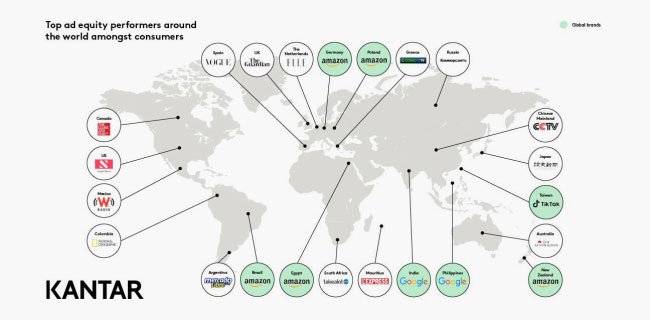
    Across branded digital platforms, TikTok remains top of the global Ad Equity rankings. Although only ranked as the #1 overall platform in one market – Taiwan, TikTok is the leading global digital platform in the important US market and is first or second ranked of the global digital platforms in 9 of the 22 markets where it was measured. The inclusion of commerce platforms in this year’s ranking illustrates their increasing importance across the digital advertising landscape. Amazon ranks second globally among consumers, topping the list in 4 markets. Together with regional ecommerce giant Mercado Libre, which leads in Argentina, Amazon’s success showcases why ecommerce has entered the online media channel ad equity rankings in third place.


    Global ad equity for media brands: 2021 Top 5 ranking among consumers

    1) TikTok (-)
    2) Amazon (new!)
    3) Instagram (-1)
    4) Google (-)
    5) Twitter (-)


    Global vs Local: Media Reactions highlights the importance, and challenge, of market-specific media strategies. In 16 of the 23 markets surveyed the #1 ranked media brand was a local media brand or a localised version of global media brands. Ten of these 16 are news and magazine brands. This local success, together with differing attitudes to the ads on global digital media brands, makes balancing the benefits of scale of global media platforms with the promise of greater relevance from local media gems ever more important. (see image above)


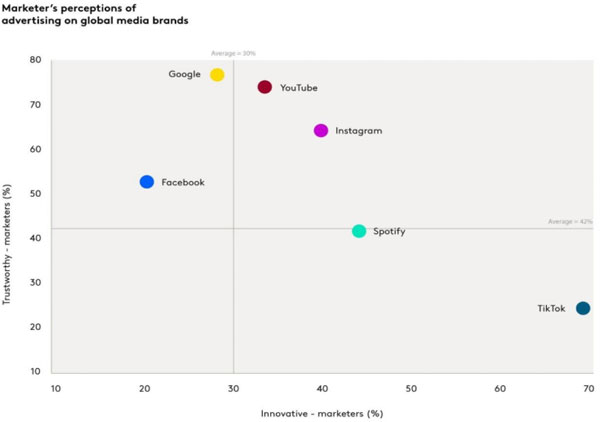
    The Innovator’s Dilemma: Media Reactions also highlights the challenge for brands in keeping their media mix reflective of the latest consumer media preferences as well as reflective of their own values and brand positioning. Marketers favour channels and platforms they believe provide both trustworthy and innovative advertising environments. Among the global brands, Instagram best manages this balancing act. YouTube, Google and Facebook are trusted platforms but are considered slightly less innovative.


    TikTok is not yet trusted by marketers as much as the more established platforms, but it has made enormous improvements in the past year. It remains comfortably the most innovative place for ads, and trust has doubled, so many more marketers are now positive about placing ads on the platform.


    Ad Spend Outlook: Media Reactions marketers’ survey provides insights into probable media growth areas for 2022. The vast majority of global marketers plan to increase spend on their favoured ad formats: online video, influencer content and social media ads. Many will reduce spend on print ads.  YouTube, Instagram and TikTok are the platforms set to benefit most.


    Discussing the findings Duncan Southgate, Global Brand Director, Media, Insights Division at Kantar, said: “The ad industry has been encouraged by the rapid recovery in 2021, as advertising has been used as one of the levers to fuel recovery in the wider economy. As we emerge into a new media landscape, brands need to understand which consumer and marketer attitudes have changed, and which have stayed the same. Which media brands have retained their appeal, and which have grown stronger? While the pandemic accelerated the growth of digital in every aspect of life, we have seen a robustness in consumers’ preference for offline advertising, and some strong local news brands in particular. Marketers need to ensure their strategies respect those preferences alongside the benefits of scale delivered by global digital platforms. TikTok has done an impressive job retaining its differentiated advertising proposition with consumers – even as its user base has almost doubled over the past year. We have also seen the re-emergence of retail as a critical ad platform, both online and physically. Advertising strategies that seamlessly align with omnichannel retail strategies provide a great opportunity for marketers to deliver more popular campaigns.”


    Added Sandeep Ranade, Head of Media- South Asia, Insights Division at Kantar: “Moving into 2022, we will see consumers adopting more and more digital channels and it will impact advertiser’s appetite for digital connection opportunities. Consumers do not differentiate between the way media is bought and hence it will no longer be offline vs online but a balance of reach vs receptivity and global vs local media partners to bridge the gap between what consumers prefer vs what advertisers perceive consumers prefer. We have also seen that Indian consumers generally have more pronounced views on advertising compared to the global audience”


    The full report can be found at www.kantar.com/campaigns/media-reactions.


  • TikTok’s Nikhil Gandhi joins MX Media as COO

    By Our Staff


    MX Media has announced the joining of Nikhil Gandhi joins as Chief Operating Officer. Based out of Mumbai and Singapore for this role at MX, Gandhi will be responsible for taking the platforms to their next phase of growth by expanding its geographical reach, enhancing data driven innovation, growing the scope and scale of revenue streams, and building maximum impact for all stakeholders – be it consumers, advertisers, or internal teams across verticals.


    Elaborating on the same, Karan Bedi, CEO of MX Media said “Nikhil brings decades of experience in both traditional and emerging media platforms, and will be a huge asset in taking MX to the next level of rocket fueled growth. We look forward to working closely with him.”


    Speaking about this new role, Gandhi added: “MX Player is by far the leader in the video entertainment space. I’m super excited to join the MX team and look forward to the next phase of our growth.”


  • To Copy or Not to Copy. That’s the Question


    By Bhuvi Gupta


    Bhuvi GuptaHave you ever used any of the short video apps that sprung up after the ban on Tik Tok?
     

    At first look, you couldn’t differentiate between the apps. They have similar if not outright identical user interfaces. The differences only start peeping in when the ‘satisfaction’ achieved after some scrolling doesn’t quite match up to what was achieved with TikTok due to their much-praised algorithm.


    While the apps did receive some flak for not investing into development, innovation, and design despite having the resources to, the logic, which I believed trumped, was user familiarity that accelerated migration.


    TakaTak is designed to be mistook for TikTok


    Feature Replication has become a common practice for digital products. Snapchat’s success with stories was very quickly replicated across all platforms as was TikTok’s short videos. Substack and Clubhouse are the the latest digital groundbreakers whose formats are being replicated by tech giants or already have been launched (Twitter’s Spaces)


    So should brands copy? Or innovate? I think the right answer is to copy, but  innovatively like Apple. Apple has never launched a product category. What it has done and brilliantly, is to innovate on user experience and design on what already existed. This is true for its vast product line, be it the personal computer, the iPod or even their latest success, Airpods.  This is the holy grail of imitation.


    Why Copy? The answer is Network Effects


    All social media networks have largely been governed by Metcalfe’s Law, which states that the value of a network is 2x that of the total users using it. Metcalfe’s Law governed the success of the telephones and explains the dominance and success of all digital social networks today. By replicating popular features into their pre-existing interfaces, digital networks try to make best use of their critical mass, which helps to stem migration to other platforms.  Also, great for creators which to take advantage of monetization and different audiences often come to the legacy imitator social network.


    The Art of Imitation


    Beware though; blind replication without paying attention to brand and objective will lead to deterioration and debacle. Something, which is happening with LinkedIn. LinkedIn has tried replicating Facebook’s newsfeed and Snapchat’s Stories but both have been done without much thought and adequate content moderation filters. As a result, LinkedIn has moved away from its primary objective of a robust professional network to somehow straddle a reality that is now part social. Stories on LinkedIn are another such misfire. Stories, which by their format, are fun and frivolous, do not fit with the brand ethos of a professional network that LinkedIn is.


    This is in contrast to Instagram, which copied Stories from Snap but modified them to suit their audience rather than replicate all features of Snap. As a result, Stories has now become a useful addition to Instagram, and more successful than the original.


    Apple, which understands its brand positioning and accordingly creates products in pre-existing categories, is also able to get away with charging a sizeable premium for copycat products.


    Copying today is essential for survival for social media networks. One is already seeing the mass migration of people from Facebook to other social networks. If it was not for products such as Groups and Messenger, the platform would have been long dead. Hence, all the Snapchat-inspired features and now a Substack copycat product have ensured that Facebook has not gone the Orkut way.  Hence, it is safe to say that the copycats in the digital world are here to stay. They will live long but prosper only if they copy smart!


  • Google is Most Valuable Media Brand


    By Our Staff

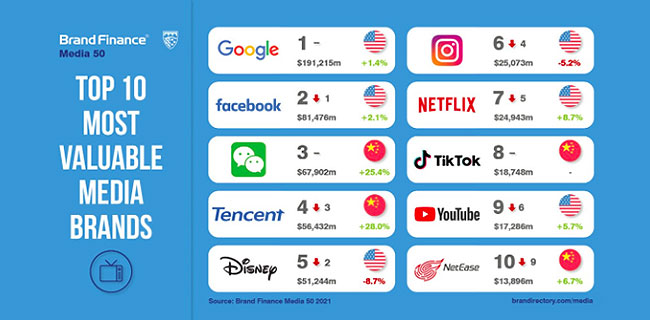
    Search engines included in Brand Finance’s annual ranking of world’s most valuable media brands for first time, with Google claiming top spot – brand value nearly US$200 billion. TikTok breaks right into top 10 most valuable media brands after its first brand valuation. Social media and gaming brands among fastest-growing in ranking, with Chinese newcomers Bilibili and Huya improving most – at 106% and 74% respectively. TV networks and film studios suffer in wake of pandemic – CBS fastest-falling brand in ranking, losing half of brand value over last year. WeChat named strongest media brand with elite AAA+ rating, while Facebook struggles to overcome reputational issues.

    View the full Brand Finance Media 50 2021 report here

    For the first time, search engines are included in Brand Finance’s annual ranking of the world’s most valuable and strongest media brands, with Google claiming the top spot, following a 1% increase in brand value to US$191.2 billion.

    Technology has become an integral part of all businesses, so Brand Finance has reclassified brands into the industries they are revolutionising. As a search engine, most of Google’s revenue is derived from advertising, leading to its inclusion as a media brand and the extension of the Brand Finance Media ranking to include 50 brands this year.

    Google also owns the majority of internet advertisement infrastructure – controlling about 90% of search ads, managing the main ad exchange and server, running popular browser Chrome, and dominating smart devices with its Android operating system. Moreover, it manages widespread data centres, as well as a large portion of the cloud, which is where most of the ad dynamics occur. In addition to capitalising on ad spend, Google has since expanded into a variety of fields such as hardware, entering the smartphone industry by releasing the Pixel, its first handset.

    The addition of search engine brands to the Brand Finance Media 50 2021 ranking follows expansions in previous years including streaming platforms, gaming brands, and social media as they continue to grow and carve out their own place in the media market, shifting the balance away from the networks, film studios, and publishers before them. Five further search engines feature in the extended ranking this year, with Yahoo! placing second highest after Google in 13th position with a brand value of US$9.4 billion.

    Said Richard Haigh, Managing Director, Brand Finance: “Significantly better at innovating than its rivals, Google changed the marketplace of search engines, spearheading the digital media revolution in a way that distinguishes the brand above all others. No better indicator of this is the fact that the name Google has become a verb – ‘I’ll Google it’ is quite arguably one of the most widely used phrases of the 21st century.”

    TikTok (known in China as Douyin) enters the Brand Finance Media 50 2021 ranking for the first time with a brand value of US$18.7 billion, launching into the top 10 most valuable media brands in 8th position.

    Another Chinese video sharing platform Bilibili has gained more in brand value than any other brand in the Brand Finance Media 50 2021 ranking, with an impressive 106% increase to US$1.9 billion. Despite being known for its cache of video content, Bilibili draws a large portion of its sales from smartphone games, which accounted for 40% of its revenues in 2020 versus over 70% in 2018, indicating an attempt to diversify its revenue stream. In the first quarter of last year alone, Bilibili reached 172 million Monthly Active Users (MAUs), placing it in the same class as video services operated by Tencent (up 28% to US$56.4 billion).

    Video game publisher Huya is the ranking’s second fastest-growing brand with an impressive 74% increase in brand value to US$1.6 billion. The brand celebrated an uptick in MAUs at the end of last year – reaching a total of 178.5 million people – as well as a boost to advertising revenues, primarily driven by its expanding and diversifying advertiser base.

    Other gaming platforms that performed well this year include South Korean NCSoft (up 68% to US$2.2 billion) and Kakao (up 49% to US$1.8 billion), as well as Activision Blizzard (up 20% to US$6.3 billion) and Electronic Arts (up 14% to US$4.4 billion).

    COVID-19 has exacerbated the widening gap between traditional media brands, with TV networks and film studios facing an uphill battle against online competitors. This is best exemplified by CBS being the fastest-falling brand in this year’s ranking, with a 49% decrease in brand value to US$5.9 billion, following a dramatic drop in advertising revenue and a disastrous merger with Viacom. However, CBS is not alone in its struggles, with NBC (down 44% to US$8.4 billion), 20th Television (down 25% to US$6.1 billion), and Universal (down 21% to US$11.6 billion) all seeing considerable declines in brand value as film and television production was halted.

    Comparatively, Netflix enjoyed a spike in usage, causing its brand value to increase by 9% to US$24.9 billion. Netflix has been a pioneering force in changing consumers’ viewing habits, taking over traditional television by providing a more appealing, flexible option in line with the modern fast-paced lifestyle. With 37 million new users by the end of 2020, Netflix’s success has driven improved revenue forecasts and brand equity scores. Despite this, the streaming platform’s growth was not as substantial as in previous years due to challenges posed by competitors such as Disney (down 9% to US$51.2 billion) and HBO (down 3% to US$4.0 billion), which recently started offering streaming services in a bid to remain competitive.

    Riding the airwaves of media revolution to offer more personalised, online consumer experiences, Spotify enjoyed an impressive 39% boost in brand value to US$5.6 billion. The music streaming platform has seen a significant increase in new users over the past year after expanding operations into 13 new markets. Spotify is now primed for further success as it continues to develop its capabilities, signing exclusive podcast contracts with Archie Comics and Joe Rogan, and acquiring Megaphone from Graham Holdings to improve its own podcast technology.

    Added Richard Haigh, Managing Director, Brand Finance: “Podcasts are one of the primary motivators for listeners to upgrade to paid subscriptions on music streaming platforms, with the global podcast industry expected to grow by nearly 30% over the next five years. With these forecasts, and rivals already showing market intent, Spotify’s reign as the leading music streaming brand will be difficult to maintain.”

    WeChat is the world’s strongest media brand with a Brand Strength Index (BSI) score of 95.4 out of 100. One of the world’s most popular social media apps, WeChat is also the strongest brand globally, according to the Brand Finance Global 500 2021 report, and one of only two brands in the media ranking to have been awarded the elite AAA+ brand strength rating, the other being Disney with a BSI score of 89.7 out of 100.


    Alongside revenue forecasts, brand strength is a crucial driver of brand value, and as WeChat’s brand strength grew, its brand value also enjoyed a rapid boost, increasing by 25% to US$67.9 billion. One of China’s home-grown tech successes with very strong equity, WeChat enjoyed high scores in reputation and consideration among Chinese consumers – according to Brand Finance’s original market research – successfully implementing a broad and all-encompassing proposition that offers services from messaging and banking, to taxi services and online shopping, becoming essential to many users’ daily lives.

    Said Richard Haigh, Managing Director, Brand Finance: “A beacon of innovation, WeChat has shown the value of constantly striving for technical development, particularly in the face of adversity. Though the company has done exceptionally well this year, lower levels of enthusiasm among younger adults in China may be a warning flag. It will be essential for WeChat to keep up its momentum to achieve similar successes in the year ahead.”

    In stark contrast, social networking site Facebook trails behind WeChat by almost 20 BSI points, scoring 77.0 out of 100. With 2.8 billion active monthly users, Facebook remains the most popular social media platform in the world. Despite recording a marginal increase in brand value and placing second overall in this year’s ranking, Facebook has battled widespread scrutiny over privacy issues and suffered significant reputational damage in the wake of several political and social scandals, ultimately damaging its brand strength.

    With an even lower BSI score of 72.5 out of 100, Twitter’s brand strength is similarly dented by issues with consumer trust and reputation. In the past year, the platform faced intense scrutiny over its handling of Donald Trump’s account, sparking raucous debate surrounding freedom of speech and accusations against the former US President for allegedly using the platform to incite violence and spread fake news.