Tag: Tanmay Mohanty

  • Publicis Media picks up PepsiCo India mandate

    By Our Staff


    Publicis Groupe India has won FMCG major, PepsiCo India’s media mandate. The account was bagged post a multi-agency pitch process.


    With this development, PepsiCo India has consolidated its media, creative and digital business with Publicis Groupe.


    Commenting on this development George Kovoor, Senior Vice-President, PepsiCo India, said, “Publicis Media was selected after a very thorough and competitive pitch process.  Their expertise in areas such as media, data, digital, analytics, content, commerce, and ability to orchestrate and leverage diverse capabilities for seamless brand experiences led to them to be our partner of choice. We are confident that this new partnership, and their technological excellence will help us reach our consumers in an engaging and impactful manner.”


    Added Tanmay Mohanty, CEO, Media Services, Publicis Groupe India: “We are proud and elated at having been chosen as PepsiCo India’s media agency partner. Through data driven decision-making, new insights and ideas on the category, our teams were able to demonstrate how PepsiCo India could grow its portfolio brands further and leverage the power of integrated communications. PepsiCo India has iconic brands, and we look forward to bringing in media excellence and innovation for them and generating the right business outcomes.”


    Said Anupriya Acharya, CEO, Publicis Groupe South Asia: “Publicis Groupe looks forward to working with PepsiCo India, channelising our full spectrum of media, creative and digital capabilities and driving stronger consumer connects and powerful communications for its brands. We look forward to harnessing and mobilising the best talent, resources, proprietary tools and capabilities from across the Groupe and helping PepsiCo India accelerate and devise consumer strategy.”


  • Zenith honoured with Honor mandate

    By A Correspondent


    Pardon the forced play on words in the headline but perhaps that was the only way to differentiate ourselves from the 20-other publications that you’ve read the same news.


    So here’s the juice: Zenith has won the media mandate of smartphone brand Honor. This includes the mainline media and digital duties of the brand. The business was won after a tightly contested multi-agency pitch.


    Speaking of the appointment, Winston Li, CMO, Honor India said: “It was a comprehensive pitch process and among other agencies, we were impressed with Zenith’s approach to drive business results. As a TechChic brand, we were looking for innovative ideas and fresh thinking that matches our style of working, brand and product proposition. We look forward to work with them.”


    Tanmay Mohanty

    Added Tanmay Mohanty, CEO of Zenith India and Head of Global Partnerships for Publicis Media India: “We are tremendously delighted at the win. Zenith will look to leverage its strong ROI+ proposition and expertise in digital marketing to building market leadership for Honor. Our focus on the full consumer journey and a single view across touchpoints will unlock new opportunities for the brand.”


  • Publicis Media bags Hero MotoCorp mandate

    By A Correspondent


    Two-wheeler major Hero MotoCorp has appointed Publicis Media as its media agency for both traditional and digital media duties.


    Publicis Media has created a bespoke platform – ‘Team Hero MotoCorp’ (Team HMC) – that will be in charge of the account and will harness talent from across the organization, both for the mainline and new-age mediums.


    Said Gurinder Singh Sandhu, Head of Marketing, Hero MotoCorp: “Publicis Media was selected after a very thorough and competitive pitch process with strong presentations from several agencies. We are excited about this new partnership and the potential of ‘Team HMC’ in helping us drive even stronger consumer connect and grow brand impact.”


    Added Tanmay Mohanty, CEO of Zenith India and the executive sponsor on Team HMC: “Hero MotoCorp is one of the most prestigious accounts in terms of both scale and complexity. We are excited to partner Hero MotoCorp in their marketing journey where data and tech will complement the strong strategy, planning, buying and content verticals to further strengthen the Integrated Marketing play. ‘Team HMC’ will mobilise the most apt talent and capabilities from across Publicis Media globally, for this partnership. We look forward to delivering strong business outcomes for them and unlocking new consumer connections across social, digital and traditional mediums.”


  • Nestlé partners with media entities to create inspiring brand narratives

    By A Correspondent


    Nestlé is partnering with India’s top media companies to produce inventive and creative brand solutions, through a first-of-its-kind initiative called Media Hive. Some of the big-league media and entertainment firms that participated in the Media Hive included Times Of India, Star, Zee, Viacom18, The Hindu, Big FM, Radio City and Arre.


    The focus was on immersive solutions that put media as the centre-piece of communications. This landmark initiative was the collaborative effort of Zenith & Nestlé.


    As many as 19 briefs came from Nestlé brands such as KitKat, Maggi, Munch, Polo, Nescafe, Milkmaid, Ceregro, Milky Bar etc to 42 media partners. Around, 354 ideas were generated in total. The Nestlé brand teams, after careful consideration shortlisted 72 ideas which were presented at the Media Hive event in New Delhi.


    Media Hive included the top leadership of Nestlé and Publicis Media. The inaugural address was by Suresh Narayanan, Chairman and Managing Director of Nestlé.


    Said Rashi Goel, Director Communications at Nestlé: “Nestlé was looking for inspiring media narratives for its brands that go far beyond the 30-seconder. Through Media Hive, we have paved the way for a new era of moving, compelling and evocative brand experiences which captivate and involve consumers. The powerful ideas generated in the Media Hive, will bring alive our brands in subtle yet, engaging ways. This is an entirely new approach to energising our brand stories and we thank Zenith for this very successful partnership.”


    Added Tanmay Mohanty, Group CEO at Zenith India & Head Of Global Partnerships at Publicis Media India: “Attention is a scarce resource today. In this context, there is a real need for enriching, long-lasting media experiences. Efforts that appeal to people’s emotional sensibilities. Media Hive brought many such striking, impactful ideas to the fore where brands can be introduced in non-intrusive ways. Though Media Hive, we are also to trying to evolve and grow the larger eco-system.”


  • TV dominates media consumption in India: Zenith


    By A Correspondent


    People around the world will spend an average of 800 hours using the mobile internet this year – that’s equivalent to 33 days without sleep or pause, according to Zenith’s Media Consumption Forecasts, published today. By 2021 the total will rise to 930 hours, or 39 full days.


    This is the fifth edition of the Media Consumption Forecasts, which surveys changing patterns of media consumption since 2011, and forecasts how the amount of time people allocate to different media will change between 2019 and 2021. Across the 57 countries that were surveyed, people will spend a collective 3.8 trillion hours using the mobile internet this year, rising to 4.5 trillion hours in 2021.

    Since the first edition was published in 2015, the average amount of time people around the world spend accessing the mobile internet has risen from 80 to 130 minutes a day, at an average rate of 13% a year, spurred on by the availability of affordable smartphones, faster connections, better screens and app innovation. Growth is slowing, though, now that most people in the developed world who want a mobile device have one, and ownership is becoming common in developing markets. We forecast an average of 8% annual growth in time spent on mobile internet devices between 2018 and 2021. We expect mobile internet use to account for 31% of global media consumption in 2021, up from 27% this year.


    Television remains the most popular global medium

    Television remains the biggest medium globally, attracting 167 minutes of viewing each day in 2019. Television viewing is predicted to fall slowly to 165 minutes a day in 2021. Television will remain the world’s favourite medium throughout our forecasts, accounting for 33% of all media consumption in 2021, down from 35% in 2019.


    Mobile internet has eaten into the amount of time people spend with some – but not all – rival media. Between 2014 and 2019, the average amount of time spent reading newspapers has fallen from 17 minutes a day to 11, while time spent reading magazines has fallen from 8 to 4, and time spent watching television has fallen from 171 to 167. Desktop internet use has also fallen, from 47 minutes a day to 40. However, consumers’ appetite for radio and cinema has remained robust, with radio listening rising from 53 minutes to 55, and time spent at the cinema rising from 1.8 minutes to 3.0 minutes a day on average, driven by a boom in cinema attendance in China.


    Note that in this report, time spent with newspapers and magazines only includes time with the printed editions of these publications, while time spent with television and radio only includes time with traditionally broadcast channels and stations. Time spent with online platforms owned by publishers or broadcasters is counted as internet consumption.


    Total media consumption rises to eight hours a day

    The mobile internet has expanded the amount of time people spend consuming media: consumers will spend an average of 479 minutes a day with media this year, up from 420 minutes in 2013. By 2021 we expect the average consumer to spend 495 minutes a day consuming media.


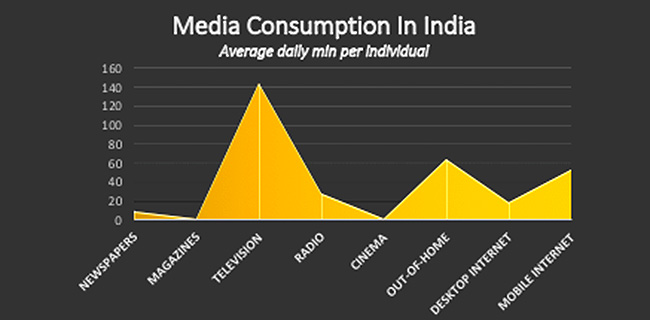
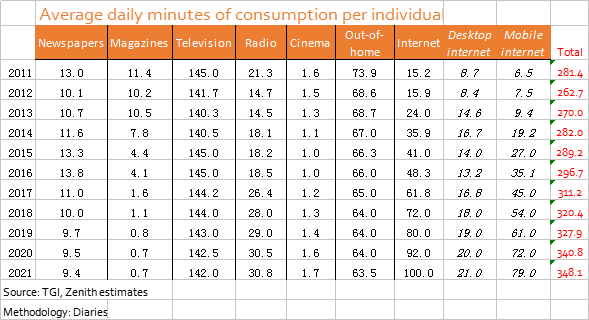
    In India, consumers will spend an average of 320 minutes a day with media this year, up from 270 minutes in 2013. By 2021, Zenith estimates that the average consumer will spend 348 minutes a day consuming media. Television remains the dominant medium — consumers on an average spend 144 minutes daily on television, up from 140 minutes in 2013.


    “Mobile internet technology has expanded both the amount of time people spend with media, and what counts as media,” said Jonathan Barnard, Head of Forecasting at Zenith. “Media now means comparing prices on the high street, sharing jokes with friends and booking your next holiday, opening up new opportunities for brands to connect with consumers.”


    “To take advantage of this abundance of media, brands need to communicate with consumers in the environments that best matches their values, and at the times when consumers are ready to move along the path to purchase,” said Matt James, Zenith’s Global Brand President. “This requires investing in talent and technology to unlock the value of data and create personal brand experiences.”


    Mirroring global patterns, time spent on mobile internet shows remarkable growth in India as well. Media consumption on mobile internet has gone up from 9.4 minutes daily in 2013 to 54 minutes this year and is expected to reach 79 minutes by 2021.


    Tanmay Mohanty

    Tanmay Mohanty, CEO of Zenith India & Head of Global Partnerships (India) said, “While television remains the dominant medium, internet consumption led by mobile shows the fastest growth. There is nothing more personal to the consumer than the handset and for many in India, the first taste of media consumption comes from the small screen. Mobile consumption is only expected to go upwards with falling data prices, increased mobile penetration in tier 2 & 3markets, availability of low-cost handsets, entry of 5G networks and explosion in vernacular content formats.  Marketers who adequately invest in mobile technology and mobile-first strategies will reap the rewards.”


  • Publicis Media aligns Convonix & Resultrix under Performics. Tanmay Mohanty to take on additional role

    By A Correspondent


    Pallav Jain
    Sarfaraz Khimani

    Publicis Media India today announced the alignment of Convonix and Resultrix under the Performics brand. This, notes a communique, firmly establishes Performics as the largest performance marketing offering in the country by far and is in line with Publicis Media’s market-leading presence and ambitions in the areas of digital marketing, data, tech and analytics.


    Pallav Jain and Sarfaraz Khimani will serve as Co-CEOs of Performics India and will report into the Publicis Media India CEO Anupriya Acharya.


    Tanmay Mohanty

    Meanwhile, Publicis Media has also announced a new Head of Global Partnerships role for India. Tanmay Mohanty will take over this new role in addition to his current role of Zenith India Group CEO. In this role, Mohanty will bring in a “more strategic and holistic approach to global partnerships in India and ensure greater Groupe and client connectivity with partners such as Google, Facebook, Adobe and Microsoft amongst others”.


    Anupriya Acharya

    Said Anupriya Acharya, Publicis Media India CEO: “We stand at an important growth juncture and it is imperative that we put accelerated focus on next-frontier areas in marketing communications like machine learning, artificial intelligence, consulting, automation and the like.  The current changes reflect our endeavor to create a compelling offering with an effective structure that supports evolving client needs. Pallav and Sarfaraz have driven spectacular growth for Convonix from an entrepreneurial start-up to a scaled organisation, across India and in multiple market mandates including US, UK and Asia-Pacific and bring in expertise on innovative solutions around talent acquisition and talent management at scale. It makes them the ideal choice for leading Performics India. Tanmay Mohanty is a proven leader with a successful track-record of accomplishment of leading in the digital first space and then bringing that thinking to the larger integrated media space. He has brought in value and substance to every client conversation across Zenith and Resultrix. I am sure with his strong product focus and client need-gap understanding, he will shape our global partnerships in India well.”


  • Achche Din…! Zenith forecasts 15% AdEx growth in 2019


    By A Correspondent [to be updated by 9.30am]

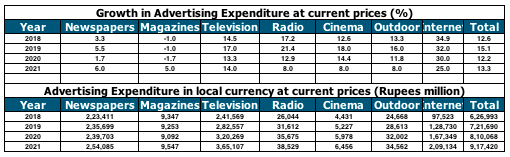
    Media agency network Zenith forecasts that adspends for India in year 2018 will close at Rs 62,699 crore. And the total AdEx for India will see an increase of 15% and climb up to Rs 72,169 crore in 2019.

    India remains one of the fastest growing economies, with strong GDP growth of over 7%, led by reforms in sectors such as retail, infrastructure, manufacturing and services, notes a Zenith communique, adding: “Given that a significant part of the population is below 30 years of age, there is likely to be continued consumption-led growth with less reliance on export-led momentum.  This should give a boost to businesses across the board, ad investments and government initiatives.”


    Furthermore, the release adds: “However, 2018 has also seen the depreciation of the rupee and oil price volatility. The overall expectation is that oil prices will stabilise, giving Indian consumers more disposable income. Indian consumer confidence continues to remain relatively high. “

    According to Tanmay Mohanty, Group CEO at Zenith, many parts of India were experiencing digital transformation, led by mobile. This will accelerate categories such as banking, financial services, healthcare, entertainment and sports, travel and lifestyle. “2019 is the year of the Indian General Elections. These and the State Elections will boost marketing spends.  Additionally, the Cricket World Cup and the Indian Premier League will drive growth.” Mohanty said.

    “Digital will continue to accelerate both in reach and consumption.  Television – linear and catch-up will be on an upward curve. The expectation for radio is that it will digitise aggressively in response to streaming services while both cinema and out of home (OOH) will innovate and increase reach-led investments. Print will thrive on regionalisation.” Mohanty added.

    According to a similar report released last year (Dec 4, 2017), total AdEx for India was estimated to climb up to Rs 58,422 crore, growing  at 8.4% in 2018, led by television. This estimated has been bettered by the figure of Rs 62,699 crore as quoted earlier for adspends in 2018.

    Meanwhile, online video and paid search are driving the growth in global adspend, as advertisers focus on personalised and targeted communications, according to Zenith’s Advertising Expenditure Forecasts, published today (December 3).

    This is what the rest of the summary, as provided to the media, notes:

    With advertisers now able to use these channels to target with pinpoint accuracy and serve personalised messages, they are increasing both the efficiency and effectiveness of campaigns. Between 2018 and 2021, online video advertising will grow at an average of 18% a year, twice as fast as other forms of internet display advertising and well ahead of any other channel.

    Paid search is not growing as quickly in percentage terms – it will grow at an average of 7% a year over this period – but in dollar terms will contribute even more to global growth than online video. The application of AI techniques, better location targeting, integration with commerce and the rise of ‘in the moment’ search are all making search more effective for advertisers. We forecast that between 2018 and 2021, online video advertising will grow by US$20bn, while paid search will grow by US$22bn. Between them these two channels will account for 60% of the extra ad dollars added to the market over this time.

    Online video and television are more important to brand-building than ever

    Advertisers commonly use online video together with traditional television, combining television’s broad reach and immersive experience with online video’s ability to target and optimise frequency. Taken together, these two media are becoming more important to advertisers’ brand-building campaigns. Their combined share of adspend in ‘display’ media (i.e. all media except paid search and classified advertising) has risen from 46.2% in 2012 to 48.4% this year. By 2021 we expect television and video to have a combined 48.8% share of global ‘display’ – a higher share than television ever achieved on its own. Taken together, television and online video are working harder for advertisers than ever before.

    Global e-commerce advertising starts to accelerate

    E-commerce advertising – advertising that sits alongside and within search results and product listings on e-commerce sites – is well established in China, but is only just starting to get going globally. Zenith believes it has the potential to transform the way brands convert customers online, and add about US$100bn of new money into the global advertising market.

    E-commerce advertising has risen from 0.8% of all adspend in China in 2009 to an estimated 18.2% this year, driven by investment by companies like Alibaba in turning e-commerce into advertising revenue. Until recently, e-commerce platforms outside China have largely focused on direct sales to consumers at the expense of advertising, but that is now changing. Amazon generated nearly US$5bn in advertising revenue in 2017 as a whole, and in Q3 2018 its ad revenues grew by 122% year on year. Other shopping platforms are following suit by investing in their own advertising activities.

    Globally, e-commerce advertising is about as advanced as it was in China at the end of the last decade. Amazon accounted for 0.8% of global adspend in 2017, the same proportion that Chinese e-commerce occupied in 2009. If e-commerce follows a similar path globally to the one it followed in China, it could account for 18% of global adspend by 2027. That’s equivalent to over US$100bn in today’s ad market, representing a huge revenue opportunity for the platforms, and a whole new way for brands to reach customers at the point of purchase. This money typically comes from brands’ commercial teams rather than their marketing teams, from budgets set aside for negotiating with retailers. It is therefore new money to advertising, and should expand the market without cannibalising money spent elsewhere.

    Steady growth in global adspend to continue

    We estimate that global advertising expenditure will grow 4.5% by the end of this year, boosted by the Winter Olympics, FIFA World Cup and US mid-term elections. Growth will then remain steady and positive for the rest of our forecast period to 2021, at 4.0% in 2019, 4.2% in 2020 and 4.1% in 2021.

    Central & Eastern Europe will be the fastest-growing region, with average growth of 6.3% a year between 2018 and 2021, driven by continued strength in Russia, which is growing at 6.8% a year and accounts for 39% of the regional total. Asia Pacific is next, growing at an average of 4.9% a year, or 5.7% a year excluding Japan. India is the stand-out growth market here, growing at 13.5% a year from US$9.7bn in 2018 to US$14.2bn in 2021, when it will become the world’s eighth largest advertising market, entering the top ten for the first time. India has huge potential for further growth, with advertising taking up just 0.3% of GDP, less than half the Asia Pacific average of 0.7%

    Young advertising markets like India are playing an ever-more-important role in driving global growth in adspend. ‘Mature’ markets – by which we mean North America, Western Europe and Japan – account for 62% of global adspend this year, down from 75% ten years ago. ‘Rising’ markets – by which we mean all markets apart from the ‘Mature’ ones – will contribute 54% of the growth in global adspend between 2018 and 2021, increasing their share of global expenditure from 38% to 40%.

    “E-commerce advertising is poised to transform the advertising market in much the same way that paid search did in the last decade,” said Jonathan Barnard, Zenith’s Head of Forecasting and Director of Global Intelligence. “It could bring US$100bn in new money into the market over the next ten years.”

    “Brands are transforming their businesses to take advantages of the new digital opportunities available to them,” said Vittorio Bonori, Zenith’s Global Brand President. “Better segmentation and targeting, personalised creative and direct transactional relationship with consumers are combining to drive brand growth.”


  • Zenith refreshes top deck. Jai Lala is COO, Gurnani is Chief Client Officer

    By A Correspondent


    Media agency network Zenith India has announced new appointments at senior levels. Jai Lala has joined for the newly created position of Chief Operating Officer (COO) at Zenith and will oversee operations, structure and expansion in addition to the scaling up of specialised, future-facing offerings for the agency. Focus will be on areas where Zenith is already market-leading such as Data, Dynamic Content, Tech, Analytics, Performance and Programmatic.


    In addition, Zenith has elevated its Managing Partner and Head, West & South Ajit Gurnani to the newly created role of Chief Client Officer. He has already had a great role in firming up client relationships for Zenith and will continue to interface with key clients, bringing in new and critical perspective on businesses and enhancing Zenith’s overall strategic product and delivery.


    Lala has over two decades of experience across across Media Planning, Buying, Research & Sales. He is has worked in organizations such as UTV, ESPN Star Sports and was last with Medicom as Chief Strategy and Growth Officer. He has serviced clients across the country such as Unilever, PepsiCo, GSK, ICICI, Castrol, Lenovo, USL, Coke, Marico and many more in various capacities. Jai is also a visiting faculty at ISB & MICA.


    Elaborating on the appointments, Tanmay Mohanty, Group CEO of Zenith India said, “Zenith stands at an important growth juncture; we have witnessed an absolutely spectacular year so far in terms of new business wins and performance on  key client businesses. In our endeavour to build further on our ROI+ offering, delivering transformational growth to our clients, we are announcing two big appointments at senior levels. Jai Lala needs no introduction and has over 20 years’ experience in media planning and buying. He will aid me in client deliveries,  keeping up the scale and momentum of operations,  integration of  existing talent and new hires and the  expansion in overall footprint for Zenith. Ajit on the other hand has been with us for over three years and  brings in huge expertise and value to every client conversation. He has transformed the way we deliver to clients and will shape our client relationships further. Both these appointments will help Zenith put out passionate, exciting and compelling work.”


  • Zenith bags media mandate of Welspun India

    By A Correspondent


    Zenith has bagged the media duties of Welspun India’s domestic business. The business was won following a rigorous multi-agency pitch. The mandate includes media investment and strategic partnership across print, television and radio.


    Tanmay Mohanty

    Said Tanmay Mohanty, Group CEO, Zenith India: “Welspun Group is one of India’s fastest growing conglomerates and we are pleased to be chosen as the strategic partner for the domestic business of Welspun India.  Zenith brings in powerful, integrated communications at scale and we look forward to harnessing our rich capabilities in tech, data, content and analytics for them. We were able to demonstrate a strong understanding of Welspun’s consumers and how we can exceed their business objectives. Zenith looks forward to making a real difference to the Welspun brand, and will cement and support their expansion plans.”


    Commenting on the association, Manjari Upadhye, CEO, Welspun India – Domestic Business added: “Welspun India focuses on offering thoughtful living to its consumers. With the domestic brand Spaces, Welspun India is promoting thoughtfulness through home décor. Zenith specialises in transformative, effective and data-driven communications which will be integral to our strategy of building a robust domestic offering through Spaces.”


  • Zenith wins Spykar

    By A Correspondent


    Zenith has won the media duties of India’s leading Jeanswear brand Spykar. The business was won as part of a competitive multi-agency pitch. Said Tanmay Mohanty, Group CEO, Zenith India: “We couldn’t be more thrilled to partner with Spykar which is India’s own home-grown contemporary jeanswear brand and needs no introduction.   Our ROI-focused approach will drive maximum business growth for Spykar, on the back of strong tech, analytics, content and consumer- centric insights. This win is testament to our scale and ability to bring in astute media strategies for powerful, integrated brand campaigns.”


    Added Sanjay Vakharia, CEO, Spykar:  “Spykar has been India’s leading denim brand for 25 years. Great product coupled with widespread distribution has given us exemplary growth. In the last 3 years, our revenues have doubled. This has encouraged us to pursue aggressive growth plans and we were looking for a partner who can help  us in achieving our goals. We have selected Zenith after a comprehensive pitch process. They have dived deeply into our business and impressed us with their vision and proficiency in delivering effective, data-driven, personalised plans.  Lifestyle clothing is a dynamic, high-growth business and we are sure that Zenith’s strategic insights  will unlock new opportunities for us. Their culture of innovation is akin to our own and we look forward to working with them.”


  • Zenith wins media mandate of HDFC Life

    By A Correspondent


    Zenith has been selected as the agency of record (AOR) for HDFC Life. This is for the entire traditional media mandate. The digital duties already lay with the agency’s Performics.Resultrix division.


    Said Tanmay Mohanty, Group CEO, Zenith India:“This win is a matter of great pride for us and an extension of our existing, very fruitful digital relationship with HDFC Life. Our teams were able to demonstrate an effective ROI-focused, data-driven approach to media. Zenith’s strong suite of tools, proprietary research and analytics will unlock new consumer connections for HDFC Life and will deliver on seamless, integrated communications.”


    Added Pankaj Gupta, Chief Marketing Officer & Executive Vice President, Strategic Alliances, Bancassurance & Specialty Sales, HDFC Life: “We are happy to associate with Zenith and believe that it would be an exciting partnership, since Zenith’s view on the brand mirrors that of ours. Zenith exhibited fresh thinking and insights on the life insurance category during the pitch. Hope that through its forward-thinking and disruptive approach, Zenith would help us stay ahead of the curve in a dynamic media environment; thereby, deepening our market presence and highlighting our customer-centric value proposition.”


  • Mobile internet to reach 28% of media use in 2020: Zenith

    By  A Correspondent


    The spread of mobile devices and rapid mobile data networks has transformed global media consumption in recent years. As much as 24% of all media consumption across the world will be mobile this year, up from just 5% in 2011, according to Zenith’s Media Consumption Forecasts 2018, published today (May 30). “By 2020 we expect this proportion to reach 28% as the mobile internet takes share from almost all other media. The rise of mobile is also forcing brands to transform the way they plan their communications across media, focusing less on channels and more on consumer mind-set as the distinctions between channels are eroded,” the report adds.


    This is the fourth annual edition of the Media Consumption Forecasts, which surveys changing patterns of media consumption since 2011, and forecasts how the amount of time people allocate to different media will change between 2018 and 2020, in 63 countries across the world.


    The rise of mobile

    Mobile internet use has eroded the consumption of almost all other media. Newspapers and magazines have lost the most. Zenith estimates that between 2011 and 2018 time spent reading them has fallen by 45% for newspapers and 56% for magazines. However, this refers only to time spent reading printed publications. Time spent reading newspapers and magazines online is included in the internet total, and for many publications the time they have gained online more than makes up for the time they have lost from print.


    Television channels and radio stations have gained audiences online but they have faced stiff competition from native digital platforms such as YouTube and Spotify.


    From channel to mind-set

    The rise of mobile has blurred the boundaries between different channels: it can be used for entertainment, news, information, research, socialising and communication. For brands it can play the role of building awareness, creating direct responses, allowing one-to-one communication, or generating earned content, depending on how the consumer is using the device, and in particular their mind-set while using it.


    A consumer who is actively searching for specific information is in a very different mind-set from one who is sharing holiday photos with friends, or leaning back and enjoying a video. Brands need to understand the signals a consumer’s activity provides about their mind-set, and therefore what forms of communication are appropriate.


    Focusing on mindset also dissolves the distinction between traditional and digital media: it’s more important that a consumer is reading news, than whether they are doing so using a printed newspaper or newspaper websites. People who are watching video content on television sets, laptops or smartphones have much in common, though people watching long-form entertainment can have quite different mind-sets from people scrolling short-form content on social media. Brands need to decide the role each platform plays in their communications strategies,however the consumer happens to access it.


    Media consumption continues to grow

    The rapid expansion of mobile internet use has increased the amount of time the average individual spends consuming media, by giving people access to essentially unlimited content almost everywhere, and at any time of the day. “We estimate that the average person will spend 479 minutes a day consuming media this year, 12% more than in 2011. We forecast the total to reach 492 minutes a day in 2020,”  the report adds.


    Time spent at the cinema actually increased 3% between 2011 and 2018 as cinema owners have invested in more screens and a better experience for visitors, while studios have marketed their films more effectively at international audiences.On average, though, people spend much less time at the cinema than they do with any other medium – just 1.7 minutes a day in 2018. We expect this to rise to 1.9 minutes in 2020.


    “Under traditional definitions, all other media are losing out to the mobile internet,” said Jonathan Barnard, Zenith’s Head of Forecasting and Director of Global Intelligence. “But the truth is that the distinctions between media are becoming less important, and mobile technology offers publishers and brands more opportunities to reach consumers than ever.”


    Added Tanmay Mohanty, Group CEO, Zenith India: “The mobile medium continues to accelerate in India and across the world, blurring lines on channels and delivering sharp ROI for brands. The mobile handset is powerful, personal and immersive and India holds steadfast as one of the top smartphone markets. The media consumption forecast reveals that brands have huge opportunities that they can leverage across mediums and the mobile phone is in many ways, a facilitator. Smart targeting is possible through artificial intelligence (AI), data and ad technology, mapping the consumer effectively across media touch-points. Brands can benefit from visible, tangible returns, once they understand the consumer mind-set and journey and their place in it.”