Tag: TAM AdEx

  • GEC AdEx in 2020: Commercial ads: 55% share, Promos 45%


    By Our Staff

    TAM AdEx has released the second of its reports on 2020 for television advertising. This time it focuses on advertising on general entertainment channels.

    Here are some highlights

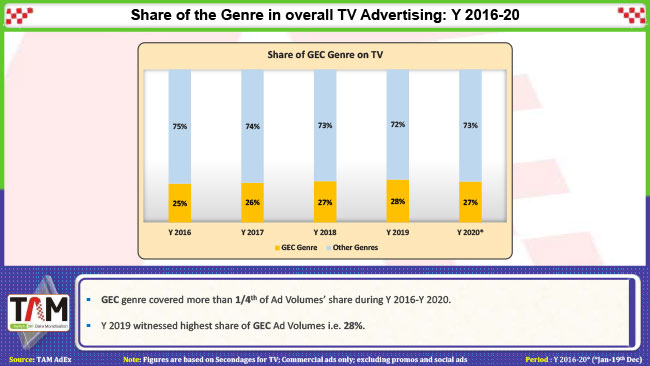
    GEC genre covered more than 1/4th of Ad Volumes’ share during Y 2016-20.

    True Shield Hand Sanitizer was the top brand during Apr’20 to Jun’20 & Aug’20 in GEC Genre.

    Toilet Soaps leads among the Top 10 categories of GEC Genre with 9% ad volume share in Y 2020.

    Ecom-Media/Entertainment/Social Media saw highest increase in ad secondages during Y 2020 compared to Y 2019 in GEC Genre.

    In GEC genre, HUL topped among the GEC advertisers followed by Reckitt Benckiser on 2nd position during Y 2020.

    6 out of Top 10 brands on GECs were from HUL and 3 were from Reckitt Benckiser.

    1.3K+ advertisers & 2.7K+ brands exclusively advertised during Y 2020 on GECs compared to Y 2019.

    Primetime is the most preferred time-band on GEC genre followed by Afternoon and Morning time-bands.

    20-40 second ad commercials were most preferred for advertising on GECs during both Y 2019-20.

    Commercial advertising added 55% share of Ad Volumes on GECs whereas Promos had 45% share in Y 2020.

    Highlights of the report are Advertising Trend during Lockdown versus Unlockdown, Covid Prevention categories, Celebrity Endorsement, Social Ads by Govt. etc.

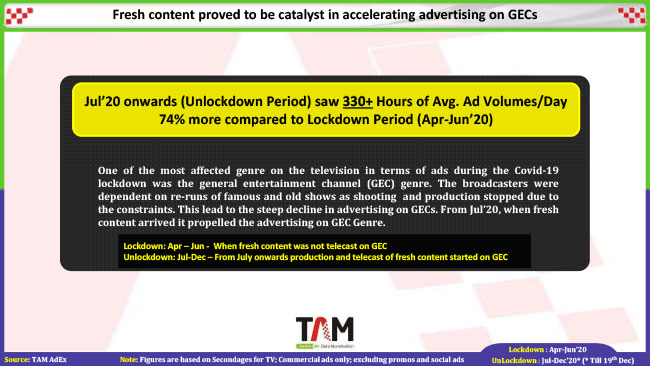
    According to the report, advertising volumes in 2020 saw a marginal rise versus what it was the previous year (2019). Average ad volumes in the all-important fourth quarter of the year rose 39% over the average ad volumes in the first three quarters of the year. There was 90% growth in Average Ad Volumes/Day witnessed during Post Lockdown period.

    FMCG players ruled the list of Top 10 advertisers with HUL leading the list. Four of the Top 10 brands advertised were from Hindustan Unilever and three were from RB. Personal Care/Personal Hygiene sector had 20% share of Ad Volumes followed by F&B with 18% share.

    Please click on this link for the report:

    TAM AdEx – Mirroring Y 2020 for GEC Genre


  • Ad volumes register marginal y-o-y rise in 2020: TAM AdEx report


    By  A Correspondent


    TAM AdEx has released the first of its report on 2020 for television advertising.

    Highlights of the report are Advertising Trend during Lockdown versus Unlockdown, Covid Prevention categories, Celebrity Endorsement, Social Ads by Govt. etc.

    According to the report, advertising volumes in 2020 saw a marginal rise versus what it was the previous year (2019). Average ad volumes in the all-important fourth quarter of the year rose 39% over the average ad volumes in the first three quarters of the year. There was 90% growth in Average Ad Volumes/Day witnessed during Post Lockdown period.

    FMCG players ruled the list of Top 10 advertisers with HUL leading the list. Four of the Top 10 brands advertised were from Hindustan Unilever and three were from RB. Personal Care/Personal Hygiene sector had 20% share of Ad Volumes followed by F&B with 18% share.


    Please click on this link for the report: TAM AdEx-Mirroring Y 2020 for Television Advertising


  • Is Legacy Media Recovering in the Unlocking?


    By Indrani Sen


    During the last two or three weeks, we saw many reports on how the AdEx has improved in June 2020 ensuring us that not only digital, but TV and print are also on the path of recovery after Covid-19. TAM AdEx for June has shown that TV advertising volumes increased by 74 per cent per day in June compared to April, when adspends declined sharply due to decline in demand during the nationwide lockdown. TV ad volumes saw 46% growth in June compared to May.


    Print, which suffered a bigger hit in terms of revenue due to distribution problems during lockdown, has recorded a higher increase of 325% in average ad volume per day in June 2020 when compared to April 2020. Most of the business newspapers and industry websites reported on the recovery of digital and TV media. None of the articles highlighted the comparison between the first quarter and the second quarter of 2020 which could have given a better idea about the recovery of ad volumes in digital and TV media.


    I saw only one article in details on Print AdEx on the recovery of Print AdEx which also did not have any such comparison (https://www.financialexpress.com/brandwagon/print-advertising-on-the-road-to-recovery-as-average-ad-volumes-per-day-rose-325-in-june-2020-tam-adex/2032701/). This trend of lack of reporting on print clearly indicates that the medium has lost its position to digital not just in terms of share of the advertising pie, but also in the share of mind map of the audience, the advertisers and agencies.


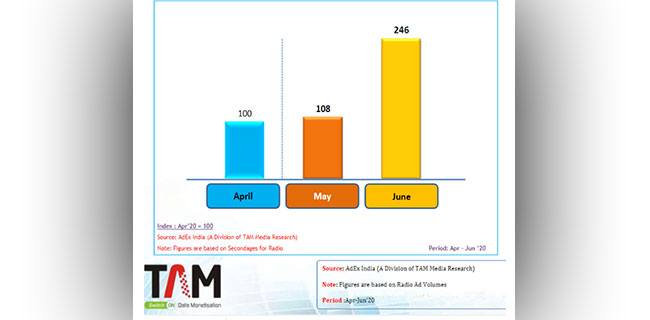
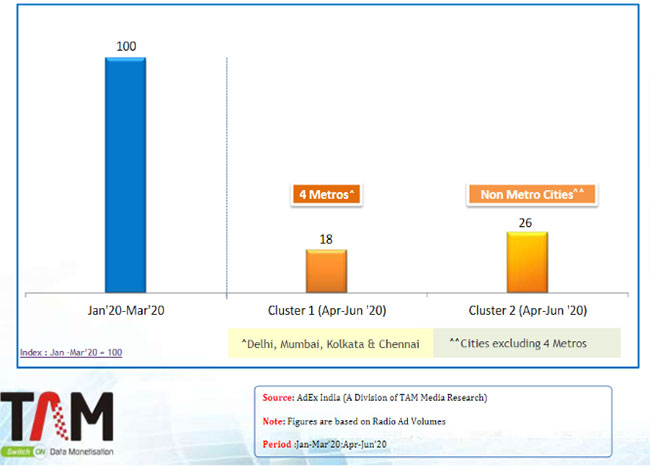
    The Advertising Report on Radio – April-June 2020 published by TAM shows that average ad volume per day increased by more than two-fold in June compared to April and May. However, a comparison with the first quarter of the year (Jan-March) shows that the ad volumes in radio are still much below the pre-Covid-19 phase. It is interesting to note that FM Radio ad volumes in Non-metro cities have recovered better than metro cities.


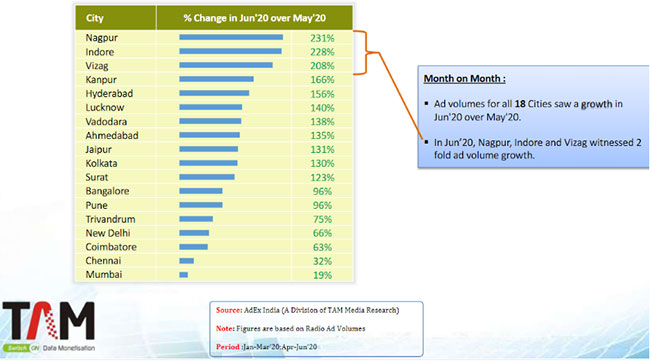
    The ad volumes of radio advertising in all 18 cities grew in June 2020 over May 2020. The chat below shows that the eight non-metro cities, Nagpur, Indore, Vizag, Kanpur, Hyderabad, Lucknow, Vadodara and Ahmedabad have shown much better growth in June 2020 compared the four metro cities. Kanpur, Indore and Vizag led the chart with each accounting for two-fold growth in ad volumes. Among the four metro cities, Kolkata has shown the highest percentage change in June 2020 over May 2020 with Mumbai showing the least percentage change. The listenership of FM radio increased during the period of lockdown and has retained the level, but advertisers across different cities are investing in the medium in different way.


    The report has detail analysis of radio advertising by categories, advertisers and brands as well as city wise analysis of the performance of radio AdEx. It also presents comparative analysis of TV and radio and digital and radio advertising during Jan-June 2020. The Top 10 common categories, advertisers and brands between TV and radio shows that during the first six months of 2020, Top 10 common categories, advertisers and brands added 33%, 14% and 4% on TV while they added 10%, 7% and 4% on radio.  Similarly, the Top 10 common categories, advertisers and brands between digital and radio shows that during the first six months of 2020, Top 10 common categories, advertisers and brands added 47%, 18% and 12% on digital while they added 19%, 2% and 1% on radio. The role of radio in the media mix needs to be reassessed by advertisers and agencies for the growth and survival of the FM radio industry during this period of unlocking and subsequent return to normalcy.


  • Will OTT consumption trends last beyond the Lockdown?


    By Indrani Sen


    Starting March 25, Covid-19 imposed four phases of a lockdown over 68 days in India. We have seen many changes in our Media & Entertainment industry during this period. The rise of consumption of video streaming or OTT platforms is a major one among the various changes. As we enter the Phase 5 of lockdown with gradual unlocking of restrictions, the questions which are foremost among the various sectors of the M&E industry ‘will the gain made during the Lockdown last/ can the loss made during the Lockdown be reversed?’


    How long does it actually take to form a new habit? Maxwell Maltz, a plastic surgeon published his thoughts on behaviour changes in an audio book called Psycho-Cybernetics which was not only a blockbuster hit, but also influenced thinkers like Zig Ziglar, Brian Tracy, Tony Robbins etc. Maltz’s submission “it takes minimum 21 days to form a new habit” was shortened to “it takes 21 days to form a new habit” and the ‘21 days’ myth was born.


    There have been other scientific studies on the subject and a study by Phillippa Lally published in European Journal of Social Psychology found that on average, it takes minimum 66 days before a new behaviour becomes a habitual one. Though we have had 68 days’ of lockdown, the consumption of OTT platforms did not increase at one stroke at the beginning of Lockdown, but has increased gradually over this period. Still, it would be fair to assume that a large percentage of the viewers contributing to increased OTT consumption is on the verge of forming a new habit which is likely to last as we slowly emerge from the lockdown.


    From only nine in 2012, today the number of OTT platforms in India now stands at 35. The technique of personalisation of content for individual viewers has been helping them to increase their subscriber base which in turn has started attracting distribution of recent movies and other interesting contents. According to TAM AdEx data, the OTT platforms have been advertising aggressively during the Lockdown period on national and regional TV channels across different genres. Most of the platforms have been rewarded with growth of paid viewers and rise in viewing time.


    Apart from the above increases, what other trends we can expect to emerge in OTT viewing in India? As the consumption of OTT platforms increase both vertically and horizontally, the bandwidth required for delivery would continue to remain as an issue. The Cellular Operators’ Association of India has already asked OTT platforms to limit the quality and quantity of video to reduce the strain on the cellular network infrastructure.


    The shift of OTT viewing from small screen to large screen would be a trend to watch out for. As we would be living under the cloud of COVID 19 till an effective vaccine is discovered and is available globally at an affordable price, we will be accepting ‘new normal’ in various wakes of life including spending more time at home with family. The urge to view content together as well as the limitations of the broadband internet may lead to a shift of OTT viewing from the small screen of the mobile to the large screen of TV, a fact which was highlighted in the recent KPMG study.


    Another trend to watch out for would be a shift in prime time viewing of OTT platforms due to WFH and early return from work to home due to night curfew.  A recent article in Financial Times stated: “According to a recent survey by mobile marketing platform InMobi, 46% viewers are watching more content online. Another consumer survey conducted by Hammerkopf has found that OTT consumption primetime has moved to 7 pm onwards, as opposed to 10 pm-12 am before.” (https://www.financialexpress.com/brandwagon/how-is-coronavirus-impacting-the-streaming-platforms-with-an-increasing-appetite-of-viewers/1919916/).


    Various websites have recently carried articles on the ad spend on OTT platforms based on the TAM AdEx report of January to April 2020 showing that ad insertions doubled from 16000 in March to 33000  in April on this medium. An article on www.warc.com made an excellent analysis of the same ( https://www.warc.com/newsandopinion/news/adspend-on-ott-platforms-double-as-advertiser-mix-shifts-in-india/43633) pointing out that while some  categories/advertisers/ brands withdrew their advertising from OTT platforms, many new categories/ advertisers/ brands started advertising in their place. The churning of traditional to new advertisers would be the third trend that we can expect to see in near future on OTT platforms.


    Could there be a negative impact on the Lockdown on OTT business? If there is a further spike in Coronavirus cases after unlocking and the Government is forced to impose Lockdown again, then the economy may take a grievous down turn due to prolonged Lockdown resulting in a severe cash crunch and loss of employment. In such a situation, there may be de-growth in subscription of the video streaming platforms along with de-growth across M&E industry.


    The OTT platforms have restructured the content creation and distribution in the entertainment industry and it appears that the Lockdown would be acting as catalyst to accelerate the growth of this sector and the current consumption trends would last beyond the Lockdown period.


  • Radio rules in Pre-Election Frenzy


    As per data from TAM AdEx, radio grew in the run-up to the elections. The analysis below will be conducted on a weekly basis by TAM AdEx and brought to you by MxMIndia
    March_Cumulative Weekly Tracker for General Election 2019_1


  • Print AdEx: The writing is clear on the wall


    By Indrani Sen


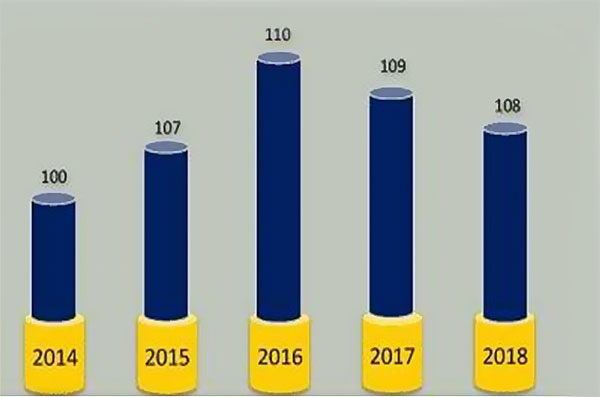
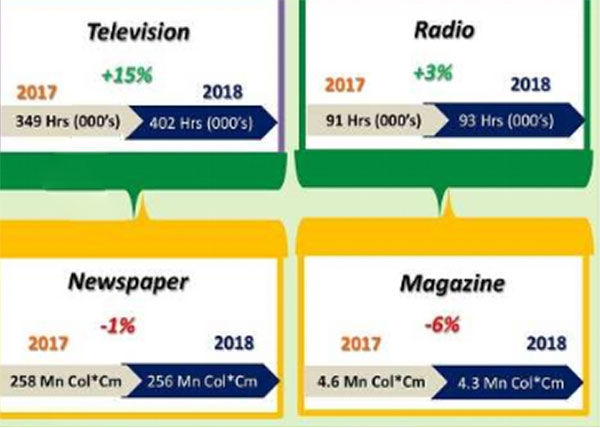
    According to a report published in Brand Equity on February 27 based on TAM AdEx data based mainly on display ads, print advertising volumes are up by 8% from 2014 to 2018, though after 2016 there has been a decrease in print advertising volumes in the next two consecutive years. (https://brandequity.economictimes.indiatimes.com/slide-shows/print-advertising-volumes-up-8-between-2014-2018-tam-adex/68172547).


    Source: TAM AdEx/ ET Brand Equity


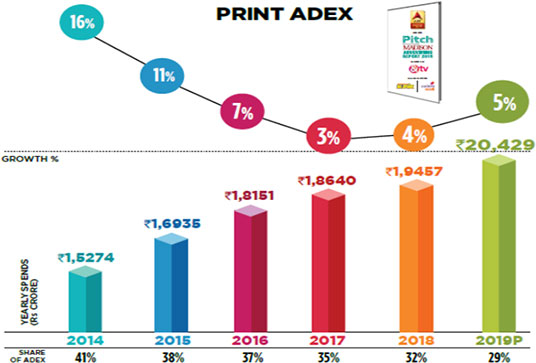
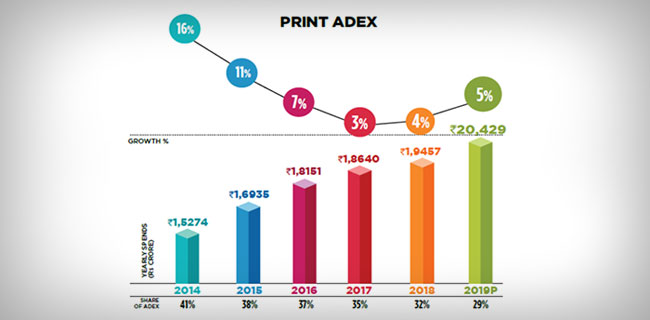
    If we compare this growth in volume with the growth in value as reported In PMAR 2019, we find that though there has been a growth in the print advertising Value by 27% from 2014 to 2018, the share of print Advertising in the total advertising pie has been decreasing steadily.


    Source: PMAR 2019


    As shown by PMAR 2019, from 2014 to 2018, the share of print advertising in the overall advertising pie reduced from 41% to 32%, a 9% drop in 5 years. In another five years, the share of print advertising in rupee value may come down to below 20% in India. The writing is clear on the wall as reflected in the diminishing/ stagnant growth rate of print advertising value.

    If we compare the above two charts, then we find that in terms of value, print advertising has grown by 27% from 2014 to 2018 as against only 8% increase in volume. Over the next five years, there may be still a growth in value of print advertising, but in terms of volume it may show a diminishing trend as reflected in the TAM AdEx comparative analysis of ad volumes across media in 2017 and 2018 where we find that magazines have lost 6% of ad volume from 2017 to 2018.


    Source: TAM AdEx/ ET Brand Equity


    So, print media needs to work out a strategy for survival which lies on one hand in promoting and monetising their online editions and on the other hand in innovative ways to tie up with other media which are still showing growth in both volume and value.

    In another recent article, Vanita Keswani, CEO of Madison Media Sigma, suggested that “Print ads will be more effective if they complement digital campaigns and entice readers to interact with brands online” (https://brandequity.economictimes.indiatimes.com/news/business-of-brands/what-print-media-needs-to-do-to-win-back-advertisers-faith/67959125). This solution however requires active support from the creative and media agencies which may not work out across categories and brands. It may be worthwhile for the newspapers to look at categories like Two-Wheelers, Cars & Jeeps and Services which are the leading contributors to the Print AdEx volume and experiment with strategic integrations.


  • AdEx on all media drops much in Nov 2017 (vis-a-vis Oct)


    By A Correspondent


    Every week, MxMIndia in partnership with TAM AdEx brings you a scan of advertising expenditure across print, television and radio in various categories. And on a monthly basis, we bring you a view on how the adspends have been for a calendar month vis-à-vis the previous calendar month.


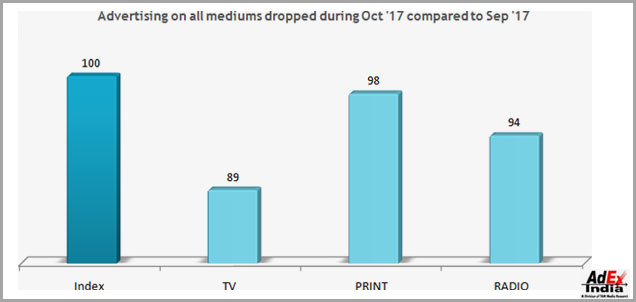
    October this year was particularly bad for television, though not as bad for print. But, in November, after the frenzy of the festive season, the drop is significant for print too.


    The data we bring you above and below is hence of particular interest:


  • TAM AdEx for Festive Season 2017


    In a special arrangement with MxMIndia, the platform trusted by discerning advertising, media and marketing professionals, ​TAM AdEx, a division of TAM India,  provides weekly scans of spends across television, print and radio.


    We’ve read a few weeks back how AdEx for Television in particular was down in October 2017 vis-a-vis September 2017. Ask television folks and they will tell you dhanda has been down in October 2017, despite it being The Diwali Month.


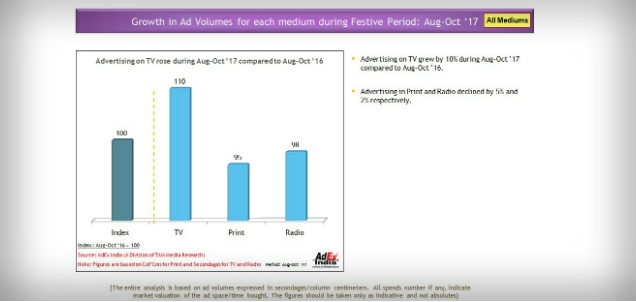
    But now we have numbers that vis-a-vis the festive season of last year, this year saw more ‘achche din’ for the all-important TVwallahs. Print and Radio are down a bit.


    Why read all this, just jump to the slides below and consume the numbers.


    Read on and Enrich yourself.


  • AdEx on all media drops in Oct 2017 (vis-à-vis Sep)

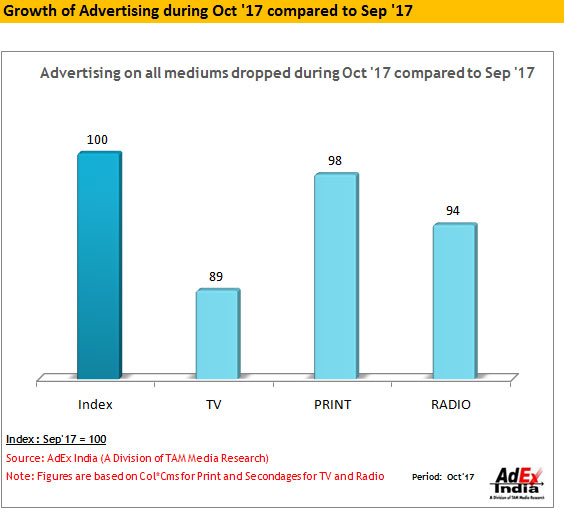
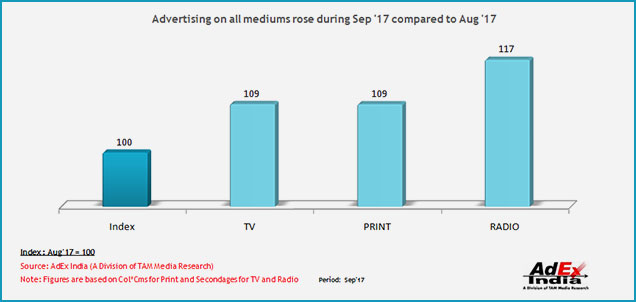
    Index : Sep’17 = 100
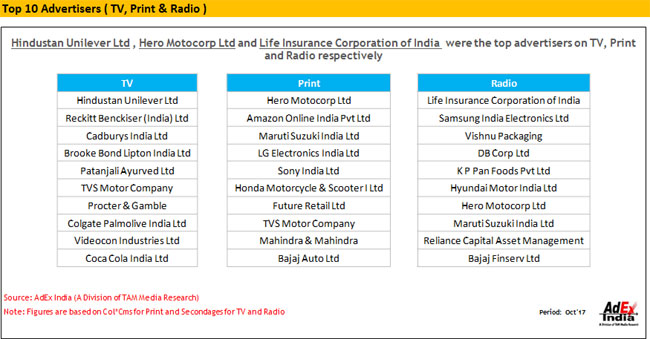
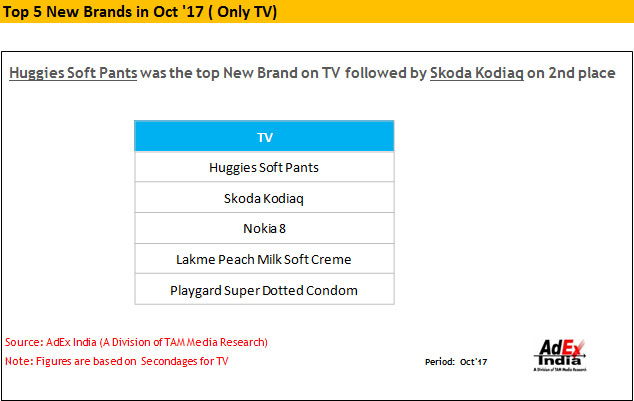
    Source: AdEx India (A Division of TAM Media Research)
    Note: Figures are based on Col*Cms for Print and Secondages for TV and Radio
    Period: Oct’17


    By A Correspondent


    Every week, MxMIndia in partnership with TAM AdEx brings you a scan of advertising expenditure across print, television and radio in various categories. And on a monthly basis, we bring you a view on how the adspends have been for a calendar month vis-à-vis the previous calendar month.


    October this year was all-important given that Diwali was on Oct 19, and before that we saw the frenzy towards shopping and sales.


    The data we bring you below is hence of particular interest:

  • A wee bit of a rise in Sept 2017 AdEx


    The world knows this. In a special arrangement with MxMIndia, the platform trusted by discerning advertising, media and marketing professionals, ​TAM AdEx, a division of TAM India, has been providing weekly scans of spends across television, print and radio.


    Here we bring you the all-important early indicators of how festive spending has been in September 2017.


    Read on and Enrich yourself.