
Tag: T20

  • Joy e-bike is Title Sponsor of Ireland T20 tor

    By Our Staff


    Wardwizard Innovations & Mobility Ltd., manufacturers of electric vehicles under the brand ‘Joy e-bike’, has announced its association as ‘Title Sponsor’ with the India Tour of Ireland 2023 by the men’s cricket team. With this, Joy e-bike shall display its recently launched ‘Made in India’ product ‘Mihos’, an electric two-wheeler at Malahide Cricket Club Ground in Dublin.


    Speaking on the partnership, Tarun Sharma, President, Marketing and Branding, Wardwizard Innovations & Mobility Ltd., said: “In the vibrant tapestry of India’s cultural identity, cricket stands as a unifying thread that weaves together the diverse spirit of our nation. In India, cricket is more than a sport, it’s a symphony of passion, teamwork, and perseverance that reverberates across every corner of our country. It mirrors the energy and dynamism of India, a land where traditions blend harmoniously with progress. At Joy e-bike, we stride forward with a vision of weaving sustainability into the very fabric of mobility and are propelling India towards a sustainable and electrifying future. Our commitment to providing innovative & eco-friendly products mirrors the cricketing ethos of adaptability and evolution over time. Our product range aims to create moments of joy and inspiration for our consumers. This collaboration of Joy e-bike cup is a testament to our belief in the power of unity, progress, and the unwavering spirit that defines India and in our pioneering EV solutions.”


  • What’s common to advertising & cricket


    By Ashoke Agarrwal


    Ashoke AgarrwalI am a student of both cricket and advertising.


    The cricketing season in India starts in the post-monsoon months and nears its end in the dog days of April with the IPL. As the different hues of cricket play out this year, the parallels between cricket and advertising strike me.


    Cricket is the only sport with three widely played versions – Tests, One-dayers (ODIs) and the T20s. The shorter versions – the ODIs and the T20s – are later versions of the game whose oldest form is the five-day Tests.


    Let’s think of advertising agencies as the players, their client brands as the team they play for, and the advertising campaigns the agency and the brand management create as the type of cricket match.


    Test matches are games of deep strategy akin to a game of chess—the results of a Test take days to unfold. A Test match might end without a winner, but with every Test, a player’s reputation is either enhanced or diminished.


    An advertising campaign akin to a Test match focuses on creating a long-term positioning and equity for the brand. Therefore, the campaign’s planning horizon is over the long term, measured in years. Like in cricket, in the “Mad Men” era of advertising – stretching from the 50s to the 80s – Test-type campaigns were the norm. In the Test match era of advertising, the client’s management considered their advertising agencies as brand custodians and partners and paid them as such. As a result, advertising agencies could afford to hire intellectual and creative talent that could deliver long-term results, setting up a virtuous cycle.


    In the late eighties, Wall Street replaced Madison Avenue as the valued partner of companies in the US. The phenomenon soon spread across the world. As a result, the planning horizon shrunk from years to the next quarter. And the era of the ODI began in advertising.


    Client management tasked agencies with creating ODI-type campaigns to deliver sales and results reflected in the next quarter’s financials. As a result, agencies took on the role of a vendor who supplied services to specifications set by the clients. As a result, agency compensation changed to reflect the new realities, and agency talent pools shallowed.


    With the digital age coming, the era of T20 in advertising dawned. Performance marketing became the new mantra, and the planning horizon shrank further from the quarter to the click of a like, share or buy button. Agencies became clickbait suppliers, and desk jockeys’ armies paid like wage earners while the platform behemoths like Facebook and Google ate everybody else’s lunch.


    Like in cricket, all three forms of advertising – Tests, ODI and T20 – continue to co-exist with Test and, lately, ODIs yielding market share to T20s.


    Like top-rung cricket players like Virat Kohli and Ben Stokes, who are superb at all three forms of cricket, a few super agencies play, and the brands they handle continue to create all three types of campaigns. But the preponderance of agencies and brands, driven by market realities, are becoming predominantly T20 players.


    The super agencies cross-pollinate the skills and capabilities practising all three forms of advertising. Test teams, like the current English team, win Tests playing “Baz Ball”, bringing the aggression of T20 to the Test arena. Super agencies can bring speed and accountability to long-term brand-building campaigns—or strategic nous to the daily toil of performance marketing.


    Over the next decade, AI is going to change many businesses. How will it change advertising? Will AI engines take over the quotidian tasks of the ODI and T20 kind of advertising? Will the business of advertising go back to being the fine art of positioning, building and nurturing brands over periods of years and decades? Will such agencies attract, once again, a new generation of brilliant strategic and creative minds?


    While we ponder advertising in the age of AI, let me give you a taste of why the much-ballyhooed generative AI technology is unlikely to replace true creativity in advertising in the near future. I asked Chat GPT to provide me with a 50-word mini-essay on “Why Advertising is like Cricket”. Here is the response.


    Advertising and Cricket both require strategy, patience, and a keen eye for opportunities. In cricket, a team must carefully plan their moves, adjust to changing conditions, and seize moments of weakness in their opponents. Similarly, in advertising, a brand must develop a clear strategy, adapt to changing consumer behaviors, and capitalize on emerging trends. Both cricket and advertising also rely on effective communication and teamwork to achieve their objectives. Finally, just as cricket has its own set of rules and regulations, advertising also operates within a set of guidelines and best practices to ensure fair play and positive outcomes for all involved.”


    Isn’t it as bland as can be? I suspect it would be the same answer if I replaced “Cricket” with any other team sport or “Advertising” with any other business service. Try it for yourselves. This proforma response is because the core of the current state-of-the-art generative AI bases its response on probability curves trained on static data without any actual capability to explore the context and synthesize creativity.


  • CoinDCX unites crypto and cricket

    By Our Staff


    CoinDCX, the cryptocurrency exchange, has signed on as title sponsor for the upcoming T20 series between India and Sri Lanka. It will be the first ever crypto brand to come onboard as a global cricket sponsor.

    Said Ramalingam Subramaniam, Head of Brand & Communication, CoinDCX: “The CoinDCX team is very excited to be the Official Sponsor of Team Sri Lanka for the upcoming Sri Lanka vs India T20I series. With its vision to make crypto easily accessible to Indians, CoinDCX has been a pioneering player in the crypto space in India. The sponsorship of Team Sri Lanka is a significant push by CoinDCX towards creating awareness and educating retail investors around the country about new age assets. In addition, targeting young cricket fans in India will help position our brand strategically to grow further”.


  • Virat continues alliance with Audi

    By Our Staff


    Virat Kohli continues his association with Audi India. Virat has been associated as a friend of Audi India since 2015 but has been driving an Audi since 2012 when he first bought his car.
     

    Said Kohli: “Whether it’s behind the steering wheel or on the pitch with a bat in the hand, performance, consistency and technique are what define perfection. I have been an Audi fan even before I was formally associated with the brand. Audi cars reflect elegance and sportiness, which resonate perfectly with my personality. I am extremely delighted to continue my association with Audi India and be a part of the brand family. It is safe to say that my relationship with Audi India is more of a test match than just a T20.”


    Commenting on the occasion, Balbir Singh Dhillon, Head of Audi India, said, “Audi India has been associated with Indian cricketers for many years. We are extremely happy to continue our association with Virat Kohli as he perfectly embodies the progressive premium image of brand Audi. He has been a part of the Audi India family for more than half a decade and is clearly a great fit for the brand, as both exemplify brilliant innovation in their performance. With this continued association, we look forward to an even more exciting journey going forward.”


  • Leagues Over Legacy: The Future of Cricket


    By Shailesh Kapoor


    Shailesh KapoorIt’s been a bizarre cricket week. A Test match that didn’t last even two full days. The shortest Test match ever since World War II. Test cricket needs exciting games like tone at Gabba. It needs higher batting run rates to attract more audience. It needs innovations like pink-ball, day-night Tests. But a Test that gets done in about 10 hours is no advertisement for a format that’s meant to last four days, if not five. After that spectacular Australia series, this one runs the risk of becoming a tad farcical, though India’s qualification to the World Test Championship finals will mask that conversation fairly quickly.
    The much-hyped Narendra Modi Stadium was inaugurated less than two days ago. Its first-ever Test may have seen India on the right side of the result, but it hasn’t flattered the cricketing media. The venue, however, has its hands full. There’s another Test and then five T20s, all at the same stadium.

    Which brings me to the itinerary of this England tour. When the T20 format was first introduced about 15 years ago, a solitary match on a tour was all it merited. Over time, that one match became two matches, but Tests and ODIs remained the primary competitive formats for nation vs. nation cricket.

    But times have changed. IPL is a huge hit, finding new benchmarks of success with each passing season. Attention spans have dropped anyway. A three-hour format is well-suited to the times, and highly inclusive compared to the other two formats.

    But this co-existence of cricketing formats also reflects upon the crossroads cricket administrators, including ICC, find themselves at. It seems they want to keep all three formats alive, and nurture them with nearly-equal priority. For a sport that’s primarily restricted to a dozen nation, a strategy that doesn’t make a conscious choice cannot be a growth strategy.

    In my opinion, ICC and its national affiliates are trying to avoid the unavoidable. They are only buying time by keeping all three formats alive. Of the three, the Test format is fairly secure. It’s the niche, connoisseur-endorsed format that can doesn’t need to make much money, as long as it can broadly earn for itself. But it’s the 50-overs format that could have been retired a while ago. It’s an in-between thing that achieves nothing in particular, except keeping a legacy going.

    From a broadcast perspective, one would expect the leagues to get stronger with each passing year. Australia’s Big Bash League (BBL) can do well with some Indian players, as its quality of play and telecast makes it one of the most watchable cricket tournaments across the world. The match timings are not India-friendly, but weekends double-headers can take care of that, if India (read BCCI) decides to play a more active role in BBL, say from a talent pool perspective.

    Other leagues, like those from Pakistan, Bangladesh, West Indies, England and Sri Lanka, are in initials stages of building some traction among the T20 audience base. But it’s almost certain that this is the direction the viewership will move to, over the next decade.

    All that is still a thing of the future, though. The next season of IPL is fast approaching, and one can sense that a blockbuster is in the offing again. So, brace yourself for the most popular cricketing gala, even as a rather bizarre International series plays out before it.


  • My11Circle comes on board as title sponsor of LPL

    By A Correspondent


    In a major boost to the inaugural edition of the Lanka Premier League (LPL), My11Circle, one of the leading fantasy sports platforms in India, has come on board as title sponsor of the T20 tournament in a multi-crore deal. With this new association, the T20 tournament will now be called My11Circle Lanka Premier League. Former Indian cricket team captain Mr. Sourav Ganguly is the brand ambassador of My11Circle.


    Talking about the association, Avik Das Kanungo, Director – Brand and Marketing Strategy, Games24x7, said: “Our fantasy sports platform, My11Circle is already a popular destination for fantasy cricket in India, commonly referred to as the platform where you ‘Play with Champions’. As part of Games24x7’s continuous efforts to extend awesome game playing experiences to more cricket enthusiasts, we are delighted to partner with Lanka Premier League (LPL). We firmly believe that My11Circle LPL has the potential to become one of the world’s greatest sports properties. Our primary objective is to reach out to more cricket fans across regions and borders and communicate our unique ‘Play with Champions’ proposition to them through this partnership.”


    LPL COO Mr. Sanjay Raina added: “We at IPG are committed to building a world-class league with LPL. With our association with My11Circle — the first fantasy sports platform that allows a player to make a team and play directly with legendary cricketers, we will be able to take the league to millions of fans both on and off the platform. We are delighted to welcome My11Circle as title sponsor of Lanka Premier League.”


    The My11Circle LPL is scheduled to kick off from November 26 till December 16, 2020 in Hambantota. Five franchisee teams, named after Colombo, Kandy, Galle, Dambulla and Jaffna, will compete in 23 matches over a 15-day period for the title.


  • MyTeam11 launches campaign IPL

    By A Correspondent


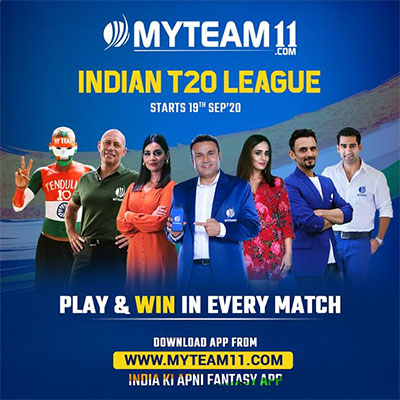
    Fantasy sports platform MyTeam11 unveiled its campaign named ‘India Ki Apni Fantasy App’ around the Indian T20 season.
     

    The campaign will run through IPL season featuring MyTeam11’s Brand Ambassador Virender Sehwag along with Danny Morrison, Jatin Sapru, Sanjana Ganeshan, Mayanti Langer, Suhail Chandhok and Sachin Tendulkar’s famed fan Sudhir.


    Speaking about the campaign, Manvendra Singh Rathore, CMO, MyTeam11 said, “This has been a difficult year for all of us and the Indian T-20 season brings a new lease of life for the cricket fans in the country. It is a time when the country wants to build its own brands which can serve the people and with “India ki Apni Fantasy App” campaign we want to stress on that very factor. We are leaving no stones unturned to ensure the best possible and immersive user experience on our application.”


  • Mobile Premier League signs on as RCB sponsor

    By A Correspondent


    Mobile Premier League (MPL), the esports and mobile gaming platform, today announced its sponsorship of the Royal Challengers Bangalore ahead of the upcoming T20 season. Interestingly, IPL has Dream11 as its title sponsor.


    Speaking of the partnership, Sanjeev Churiwala, Chairman, Royal Challengers Bangalore said: “We are delighted to have Mobile Premier League as one of our partners. RCB’s biggest strength lies in the love and support the team gets from their fans and it would be exciting to open avenues for them to engage with the team and we share this ethos with MPL of being committed to our fans to bring continuous at-home cricket experiences for them.”


    Added Abhishek Madhavan, VP, Growth and Marketing, MPL: “This is a great opportunity for us at MPL to associate with the Royal Challengers Bangalore. RCB is one of the strongest teams in the IPL led by Virat Kohli, our Brand Ambassador, and is also one of the most recognised brands in the country with a huge fan following. RCB’s philosophy of #PlayBold is shared by us and Virat as well, and we hope to become a household name in India with our IPL associations.” MPL has also signed on as principal sponsors of Kolkata Knight Riders.


  • Cricket World Cup So Far: Still Waiting to Launch?


    By Shailesh Kapoor


    It’s three weeks since the ICC Cricket World Cup started in England. 22 days and 26 matches later, the excitement is still waiting to build up. A multitude of factors have ensured that this probably the least exciting Cricket World Cup in a long time, from a cricketing perspective.
     

    From a marketing and media perspective though, there are no such concerns. India matches have rated very well, and the India-Pakistan ratings, which will come in next week, are likely to hit the roof anyway. Brands have piggybacked on the once-in-four-years tournament well, and the match timings are highly conducive to India, making the Cricket World Cup a highly lucrative media event.


    But all of the above is an India story, and an off-field story too. On field, the tournament has struggled. Four of the 26 matches have been rained off so far. Thankfully, the rains have relented over the last one week, preventing this World Cup from becoming a farce purely on grounds of poor weather.


    But even as the rains relent, cricket fans wait for exciting games. Only 3-4 games have reached a point where the winner is not evident with 10 overs to go in the second innings. It seems only five teams have really turned up, prepared to play hard. Four of these – Australia, England, India and New Zealand – are near certain to be the four semi-finalists, while the fifth – Bangladesh – has put up better fights than more seasoned teams like South Africa, Pakistan, Sri Lanka and West Indies.


    It’s a format tailormade to enable tight scenarios on the points table, where one can be waiting till the last few games to know the final composition of the semi-finalists. It happens in IPL every year, and happened in the 1992 World Cup too, when this format was last used. Pakistan, the eventual winners, had to win virtually everything in the second half of the league stage to qualify. And they did!


    But so far, chances of any such drama happening in the last one week look very remote. It seems that the next two weeks will only decide who plays whom among the four near-certain semi-finalists. And that is sure to rob the World Cup further of excitement.


    Now, a lot of this is not in ICC’s control. You cannot worry about South Africa looking sub-par and not being able to win more often, for example. But much as ICC can’t control it, there is enough and more for them to reflect upon. Attendances at the Asia matches have been very good, with Indians and Bangladeshis in particular packing the stadia. But this sub-continental colour that cricket is acquiring surely cannot be healthy. I was in the UK for the first 10 days of the World Cup, and there was no buzz or talk about the tournament at all. The local newspapers dedicated 2-3 full pages to football, vis-à-vis half a page to an England game in the Cricket World Cup. You could drive around the city of London for 2-3 hours and stare pointedly at every hoarding, and yet, not know that there’s a big cricket event going on here.


    Cricket has faced the globalization challenge for years now. While Afghanistan and Bangladesh have come in stronger over the last few years, there hasn’t been much progress in the rest of the world. 50% of the teams in the World Cup are from the sub-continent. Surely, this cannot be a right step in the direction of globalization. Something for ICC to worry about deeply.


    It’s perhaps also an issue with the 50-over format itself. Eight hours of viewing is not a premise on which you can grow a sport in today’s age. Perhaps T20 needs to take the centerstage after all, and Test cricket can be the variant for the connoisseurs. ODIs seem to have a questionable future at this point of time. But these are difficult calls, and the playing nations will be understandably reluctant.


    We may still see a late surge by one of the weaker teams, and this World Cup could suddenly light up. And eventually, in the last one week, it will be about what India’s final outcome is. That’s the beauty of sport and the passion it evokes.


  • Max Life Insurance gets RCB players to promote product offering

    By A Correspondent


    Max Life Insurance has unveiled its latest ad campaign announcing its official life insurance partnership with Royal Challengers Bangalore. Featuring three members of Team RCB, the new campaign attempts to remind all to remain shielded with a comprehensive life insurance cover.


    Speaking on the launch of the campaign, Aalok Bhan, Director and Chief Marketing Officer, Max Life Insurance remarked: “Like cricket, our lives too are full of unforeseen challenges. While cricketers are practical enough to realize the importance of a protective gear to safeguard themselves on the field, more often than not, they forget to prepare for protection off the field. Through our association as the official life insurance partners to Royal Challengers Bangalore, we aim to protect India’s finest players against the risks they face off the ground, by enabling greater financial security in their personal lives. Like any successful cricketing team has a Plan B should anything go wrong in the game, at Max Life Insurance, we believe that life insurance provides the protection of a robust Plan B, should anything go awry in life’s plans. This protection is what will give our customers the confidence to go ahead and play the game of life Front-Foot-Forward!”


    Added Sonal Dabral, Chief Creative Officer South and South East Asia and Vice Chairman India at Ogilvy: “This T20 season is all about great partnerships. Max Life Insurance’s partnership with RCB is one such winning partnership highlighting the significance of risks and financial security by drawing parallels between life and cricket- both equally daunting, uncertain and full of unexpected challenges. The campaign capitalises on this very thought and goes on to establish that to truly emerge a winner in the game of life, it is imperative to gear up well by calculating risks – not just physical but also financial.”


  • MyTeam11’s new ad film targets upcoming World Cup Cricket

    By A Correspondent


    Fantasy sports website MyTeam11, announced a collaboration with 25 television channels across the music, news, sports and knowledge sharing genres among others, in a nationwide campaign targeting the upcoming T20 and World Cup cricket season.


    Commenting on the move, Vinit Godara, CEO and Co-founder, MyTeam11 said: “We are planning to become the leading brand in the world of fantasy sports, and the upcoming cricket season involving T20 leagues and the ICC cricket world cup seems to be the right fit for our plans. With this collaboration we want to reach out to people in every nook-and-corner of the country and encourage them to use their talent, skills & knowledge of the game to earn while enjoying their favourite sport.”


  • Shailesh Kapoor: T20 Cricket: India’s ‘Second Sport’?


    By Shailesh Kapoor


    This Republic Day, India beat Australia in the first T20 International of the ongoing series. Earlier the same day, the Indian women beat the Aussies too, in a record run chase. Thus started a long season of T20 cricket for the Indian viewers; a season that will go all the way till May end, when the IPL concludes.


    India finishes three T20s in Australia, then plays another three with Sri Lanka, followed by the T20 World Cup in India in March, and the IPL in April-May immediately after. More than 80 T20 matches will be aired this period, not counting the women’s T20 World Cup, which is also scheduled for March.


    For those whose initiation into the sport of cricket was through Tests and ODIs, this may come across as a crazy cricket schedule, almost an off-putting one. But for a wide section of sub-25 audience, this is the cricket they enjoy seeing the most – the three-hour entertainment show, over the eight-hour or five-day drag.


    I may have made this point in this column a couple of years ago, but it’s worth saying again that the sport a person (and by extension, a country) grows up to love is the sport he (or she) grows up to watch (and possibly play) when he’s a teenager. Typically, 12-17 years is the age band when the mind is most impressionable regarding the sporting taste of a typical urban Indian.


    Times are changing, though. For many in the 12-17 age group, the “entertainment” that sports provided has been replaced by social options, loosely grouped under the generic category of activities (including the virtual ones) called “hanging out”. Hence, the challenge to engage them will continue to get tougher by the year.


    In the pursuit to find the ‘second sport’ in India after cricket, broadcasters and sports marketers have launched every possible sporting league. Some of these leagues have done genuinely well, while others are merely projected media successes, despite low viewership and financial losses to most stakeholders. A dozen leagues later, India has not got any closer to finding that second sport.


    But even as that effort continues, the sport of cricket is virtually getting split into two. Cricket 1 is the old cricket – Tests & ODIs – attracting a small section of 25+ male audience (40+ for Tests) and increasingly becoming a niche proposition, unless there’s a big event like the World Cup once in four years.


    Cricket 2 is T20, be it nation vs. nation or leagues (IPL primarily, for now, for the Indian audiences). Cricket 2 is entertainment first and sports later. It’s more gender-inclusive for that reason. It targets 15-30 as its core constituency, though the national team playing T20 would tend to get Cricket 1 audiences into it too.


    Year-on-year, the proportion of Cricket 2 audiences will grow, as the 15-30 year olds get older. A decade from now, Cricket 2 will address a much wider 15-40 audience, and be perhaps the only cricket that gets ratings.


    To that extent, India seems to have found its second sport (or the new first sport, more appropriately). Call it Cricket 2, Call it T20, it’s a new sport alright. And its strength will be on display, all the way till end May this year.