Tag: T20

  • India out, advertisers still in!


    By Ananya Saha and Robin Thomas


    India might not have made it to the semi-finals of the T20 Cricket World Cup, but the advertisers and sponsors of the event are still cheering. ESPN Star had sold inventories to about 34 advertisers and, according to industry estimates, the advertising revenues that the channel made for the T20 World Cup are already in the range of Rs 250 crore. Are they complaining?

     

    Mahesh Ranka

    Mahesh Ranka, Founder & CEO, Indus Sports and Sponsorship, feels that India’s performance would hit the advertisers. He said, “The ad deliveries in the World Cup will be lower given that India did not make it through. However, the advertisers and sponsors would have taken the factor of India not making it through before they signed up. The bigger issue is for ESPN Star, whose inventory might be affected.”


    It is no news that advertisers and agencies always plan with such contingencies, of India not winning or getting out of a tournament, in mind. And especially in the case of T20, India was going to play either five matches or seven. With just three games left, from a sheer quantity perspective, it does not seem a big loss to advertisers.

     

    Anwesh Bose

    Anwesh Bose, Senior Vice President, DDB MudraMax Media, said, “Advertisers and sponsors have got their value already. Cricket is a non-cancellable property, so nobody is going to withdraw the money they have put in. For the T20 World Cup, sponsors buy the inventory for the entire tournament.” He added, “The broadcaster, in this case ESPN Star, holds back about 10 percent of inventory of finals and semi-finals, which they sell at a very high premium. Now that India did not go, they might not be able to command the premium for the inventory.”


    With India losing, ESPN Star has definitely lost an opportunity that they would have capitalised on if India had made it through.



    Vivek Srivastava

    Vivek Srivastava, Joint MD, Innocean Worldwide, said, “If you are a brand that looks at tactical use of such opportunities then you might sound like prophets of doom at this eventuality. However, most strategically driven brands today have long-term sports marketing properties and a long-term perspective on leveraging them. They look at a long-term engagement via a mega sport like cricket. Our client Hyundai has a long-term vision about integrating the brand and engaging with India’s passion for cricket as well as other cricket-playing nations via a five-year official partner status with the ICC. While India missing out on a semi-final berth hurts the emotions, it is business as usual.”


    Agreeing with Mr Srivastava is Hiren Pandit, Managing Partner-Special Projects at Group M who opined, “Advertisers have got more mileage and viewership during the T20 matches, and India’s exit will be slightly disappointing for them. Most of the advertisers in cricket are long-term advertisers, all the deals have been done earlier. India’s early exit may have been a missed opportunity but it does not mean that advertisers will not continue to sponsor the sport. Viewership will be impacted by India’s exit but there will still be some viewership.”


    The industry believes that the viewership will only see a minor blip, if at all. According to Satish Menon, CEO, Sports 18, while advertisers may be slightly disappointed with the loss, it is not going to stop them from advertising or investing in cricket in the near future.


    Mr Menon asserted, “When (Team India) does not do well it does reflect on the viewership and so on. As far as the viewership is concerned there will be a marginal dip, not a huge one because cricket is a universal game and a lot of the cricket fans or viewers also follow other matches equally. So I don’t think India’s exit will have any major impact on viewership and especially because it is the T20 World Cup.”

     

    Sudha Natrajan

    “When India is not there in a tournament, there is between 25 percent and about 35 percent drop in the viewership as compared to when India is playing. This is the sort of trend you see in the earlier games. If the games are interesting, the viewership could even climb, despite India’s exit from the tournament. The problem however is the buzz and the interest level that the country has when India is playing as compared to when they are not playing. So more than the TVR, it is the overall interest that you see diminishing,” concluded Sudha Natrajan, founder, TMC Corporation.


    Given that it is the festive season in India, the advertisers might not mind a few losses.


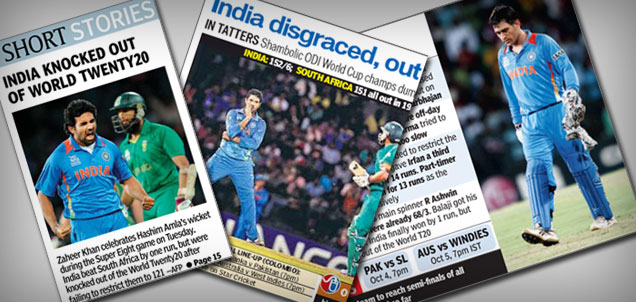
    Clippings above (LtoR) from DNA, Hindustan Times and The Times of India

     

  • Shailesh Kapoor: Enter ‘short-form’ T20-style entertainment

    By Shailesh Kapoor


    India played Afghanistan last Wednesday in the T20 World Cup. It wasn’t billed as a high-profile game. There was little hype surrounding a game that was merely a formality, before we play the biggies. It was a weekday match, and wasn’t a very high scoring game either. Yet, the viewership of the India-Afghanistan game was at the level of the Top 10 programmes on television. If that’s some indication, we know what’s likely to come for the Super 8 matches vs. Australia, Pakistan and South Africa. They should easily be the top programmes of the week. The India-Pak game may even end up being the highest rated programme of 2012 on Indian television.


    There has been much talk about cricket fatigue over the last few years. So much so that the talk about cricket fatigue has fatigued itself out by now. Most such talk, however, tends to be shallow, starting and ending with the million-dollar question: Is there too much cricket?


    Of course there is too much cricket. You don’t need to look at ratings for that. A look at the ICC future tours and programmes calendar for the Indian team will give you the answer. But to assume that too much cricket translates into cricket fatigue is simplistic, even erroneous.


    The real change that has happened over the last five years is not that the volume of cricket has increased, but that a new format has been introduced in the mix – T20. As a result, Test cricket and ODIs stand exposed in terms of their entertainment value. T20 has made them seem like yawn-fests. Why?


    In India, core sports audiences belong to the 13-30 years age group. A large part of this segment is consumption-led, distracted, hard-to-please and perpetually wanting to move on with things.


    With this changing mindset comes the concept of ‘short-form entertainment’. Everything has to be shorter than it was before, to please this audience. Films that are longer than two hours begin to drag, unless they are extremely well made. Serials that continue more than two years are frowned upon. Channels that have long ad breaks are dismissed as being fuddy-duddy. Interstitials and gags that stretch beyond a minute acquire overtones of being indulgent and boring.


    There is so much to do and so little time. Most of this “so much to do” may be ‘trivial’ stuff, like social networking, but try telling a 20-year-old that. What! You called social networking trivial?


    Short-form entertainment is soon going to play an even bigger role in our television viewing landscape. It is not about 10 seconds or three hours. It is about: What can be achieved in a certain time, should take only that much time.


    1. If a promo can communicate a message in 15 seconds, why cut a 30 second spot?

    2. If a movie can tell its story well in 100 minutes, why take 130 minutes to do the same?

    3. Why do I have to watch the entire news if all I want are the headlines?

    4. You can give me engaging break content, like trivia and gags, but remember, it is break content and I didn’t come to your channel to watch a break. So keep it as short as possible.

    5. Why do I have to watch the entire Test match when all I want to see are the boundaries and the wickets?

    6. I’m not going to watch eight hours of cricket when I am now aware of a three-hour version that’s more entertaining.


    Get on with it, is what television professionals are being constantly told by the viewers. Today, this may be a sub-30-years mindset. But in the family context, it can be extremely infectious. We see it happening all the time with GEC serials. The dragging perceptions for serials first come from the daughter, and about 3-4 months later, viral their way to the mother or the mother-in-law.


    Increasingly, short-form entertainment will be the key to television success, across genres. It’s a dynamic and evolving concept, and the broadcasters who can keep pace with the consumer mindset on it, with bear a distinct advantage over others. This is true across genres, but even more so for sports.


    When India plays Pakistan in the semi finals of the 50-over Cricket World Cup, even a 24-hour game can classify as ‘short-form entertainment’. But most ODI cricket is not India-Pak in big events. It is cricket lacking any real sense of purpose or competition. That’s when watching Sehwag (now Kohli) bat is more exciting than the result of the match itself. That’s the short form that works.


    As a teenager, Mike Tyson’s boxing bouts used to interest me a lot. I wondered how so much sponsor money could be put on something that lasts merely 30-seconds. Today, I know the answer of course. It’s not about the time; it’s only about entertainment, entertainment, entertainment.


    Shailesh Kapoor is founder and CEO of media & entertainment research and consulting firm Ormax Media. He spent nine years in the television industry before turning entrepreneur. He can be reached at his Twitter handle @shaileshkapoor


  • Debrief: Pepsi: Not the game, change the ad!

    By Anil Thakraney


    It must take enormous talent to botch up something like this. The creators of the new ad for Pepsi had all the power tools at their disposal: A funky, irreverent brand. Top Indian cricket heroes. The most happening Bollywood star. And a cool idea – Change the game- which packs in potential for super commercials. And yet, it’s all gone terribly wrong.


    In the TVC, designed to promote Pepsi’s association with the current T20 World Cup, the team bus has broken down on the road. Leading to crowds, noise and traffic mess. Ranbir Kapoor arrives out of nowhere, and advises Dhoni and his boys on strategies to use for the tournament. When Dhoni questions Kapoor’s ‘tameez’, the latter explains that T20 lacks tameez.


    [youtube width=”400″ height=”220″]http://www.youtube.com/watch?v=Y8YeNX6l5ek[/youtube]

    An extremely poor ad, I have a laundry list of problems. Boring interpretation of ‘Change the game’. Witless, uninteresting dialogues. Forced irreverence, which falls totally flat. Worse, Ranbir Kapoor looks like he has no idea what’s going on out here. And the cricketers leave you with a feeling they want this shoot done with very quickly, and their bills settled before the first ball is bowled.


    Truth be told, lack of tameez as a thought ties in well with T20 cricket. (That it promotes rowdy behaviour inside the stadia is another story, of course). But a tired, stupid commercial has killed even that little germ of an idea.


    Rating: (On a scale of 1-5): 0. Disaster with a capital D.


  • Radio stations (except AIR & BIG FM) can’t commercially exploit T20 World Cup: ICC

    By A Correspondent


    Radio stations and brands planning to commercially exploit the T20 World Cup that starts in Sri Lanka next week (Sept 18-Oct 7) need to beware.


    According to an official communication sent by the International Cricket Council (ICC) to the Association of Radio Operators for India, the exclusive rights holders for radio/audio stream services across all mediums, including the internet in India are BIG FM and All India Radio (AIR).


    The biggest rider is that “member agencies (of Association of Radio Operators) may not undertake any unlicensed commercial exploitation or selective commercialization of ICC Proprietary Content through third party sponsorship and presentation of the same”.


    A point in the statement reads, “Other than International Management Group (IMG) and its licensees, BIG FM and AIR, no entity operating or making available radio/audio stream services is entitled to use ICC Names, ICC Marks and ICC Proprietary Content, claim official association or commercially associate in any other way, either expressly or impliedly, including through marketing promotions, contests, advertising, score updates or other commercial activity (including by monetizing any of the ICC Proprietary Content), with the ICC or the ICC World Twenty20 Sri Lanka 2012.’


    It further states, ‘Should your member agencies fail to adhere to the above, the ICC will engage with them to bring to their attention the permissible parameters of activity and work with them to resolve the matter. However, should such activities persist, your member agencies will be deemed to have knowingly breached the exclusive rights granted by the ICC to IMG and its licensees, BIG FM and AIR, and the ICC will have no other option but to initiate further action, including legal recourse.’


    Lauding the initiative, Tarun Katial, CEO, Reliance Broadcast Network said, “In an extremely encouraging move, ICC has decided to come down on anyone misusing content to offer packages to advertisers. As radio partners, we look forward to offer consumers the best possible entertainment package with exclusive and highly engaging content, while offering marketers an approved and ethical platform by which they can reach out to their audiences.”


    Strict action against channels which do not adhere to the stipulations laid down by the governing body will be taken this year.


    A source close to the development said that the ICC diktat doesn’t mind score updates interspersed in the programming, but radio stations can’t get these get sponsored.


  • Why IPLs are no fun without this man


    By Biswadeep Ghosh


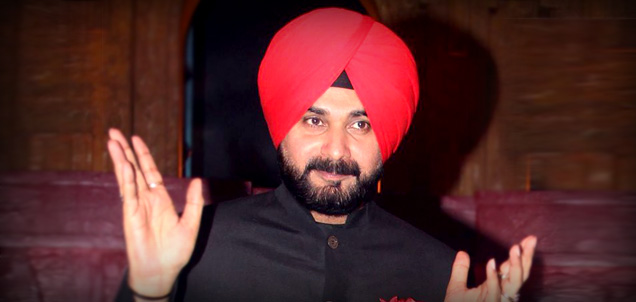
    Think of the Indian Premier League. Forget your favourite cricketers for a while. One, two, three, four… now that you have managed to push the players into the backyard of your mind, who is that one person whose association with the tournament is a fact you just cannot ignore? Rest assured, they aren’t Shibani Dandekar and Archana Vijaya, the two young ladies who do the rounds within the venues, asking unintelligent questions to intelligent cricketers when not busy matching their knowledge of the game with equally informed (or uninformed) celebrities. Despite the presence of so much glamour – which includes one Shah Rukh Khan – the man who is managing to colonise the maximum amount of attention is Navjot Singh Sidhu.


    After having been a successful international cricketer for sixteen long years in which he metamorphosed from being a maha-boring batsman to watch – particularly in today’s T20 terms – to someone who could step out and send the ball flying for miles while dealing with the spinners in particular, Sidhu’s second innings as a commentator has been comparably notice-worthy. He has irritated purists with his style of commentating, which is based on a unique formula. He talks very little cricket, and talks too much. As if that is not enough, he showers similes, metaphors, shayaris and proverbs on the viewers, hijacking the time of his colleagues who can do nothing apart from watching him with a partly amused, partly stunned look.


    When Sidhu joined the IPL5 commentary team as part of the Sony Max show Extraaa Innings, he had reportedly said that the show beats ‘Vidya Balan in terms of entertainment quotient’, the reference being to the actress’s affirmation that a film is about ‘entertainment’ in The Dirty Picture. Balan’s character Silk had used the word ‘entertainment’ three times, and Sidhu had promised five times more than that.


    Somewhat confusing, no doubt about that, since exactly how much entertainment did Silk promise by uttering the word three times? Sidhu may not know that, but he will have an answer to this query for sure. He has an answer for everything.


    What kind of rubbish does he talk? How much can he talk? How can he remember so many shayaris, proverbs and god knows what else? How does he misinterpret half the things he knows with so much confidence? As time has flown since the day he became a commentator many turbans ago – he started his career when India toured Sri Lanka in 2001 – what is amply obvious is that he has added a lot of new material to his arsenal, stuff he uses the way only he can.


    In the studio of Extraaa Innings, Sidhu, who says ‘gurrru’ whenever presented with an opportunity, came up with an outstanding statement the other day: outstanding since not even George Bush could have given rise to so much unintentional humour. Sachin Tendulkar, he said, is a genius, just as Adolf Hitler and Benito Mussolini were. Hence, the Master Blaster is meant to be admired. Sourav Ganguly, on the contrary, is a man of character. So, he is meant to be trusted.


    Presenting, some possible conclusions drawn from what Sidhu said:

    *Tendulkar is characterless, and hence, not supposed to be trusted.

    *Ganguly is not a genius and, therefore, should not be admired.

    *Tendulkar’s genius has parallels in Hitler and Mussolini.

    *A man of character cannot be a genius, and vice-versa.

    *Hitler and Mussolini are meant to be admired.


    Poor Harsha Bhogle, who sits right next to the man. Having been reminded of his hair transplant by Sidhu – for the consumption of the entire world, by the garrulous Sardar, who else? – he keeps staring at our protagonist, doing hee-hee-hee, distinctly clumsy and uneasy, acutely aware, one is sure, that he has been condemned to become one part of the ‘Jai and Veeru’ pair in the present edition of Extraaa Innings.


    That Harsha and Sidhu have become Jai and Veeru – the legendary characters played by Dharmendra and Amitabh Bachchan in the curry Western Sholay – tells us two things. Firstly, Extraaa Innings is not meant for the cricket connoisseur: which is fine, since neither is T20. Secondly, a character like Sidhu can only make its TRPs shoot heavenward, many watching the show seek the sort of humour that he has come to epitomize.


    That Sidhu’s prattle is not a 24-hour-reality in our lives is what works for the man. In a serious moment, when a batsman has failed to negotiate delivery after delivery, he has been known to irritate the hell out of a listener by comparing the batsman to a ‘one-legged man in a bum-kicking competition’. (He is not doing that in this edition of IPL, having been confined to the studios, but he has made many such comparisons in the past). But the thing is, the ‘idea’ of Sidhu has become an addiction with the passage of time. As his loyal fans will tell you, it is not an addiction which is subversive, like heroin, but a habit which makes one smile even when one gets completely exasperated.


    As a person talking cricket, Sidhu, having been a top-level cricketer himself, makes a lot more sense than, say, Mandira Bedi, who possibly believed that the leg stump was tied to a batsman’s leg when she had started out. Unlike serious commentators, however, nobody hears him for his reflections on the game. Sidhu’s USP is the ‘out-of-placeness’ of his thoughts, a carefully manicured image he has developed by insisting that the Indian team ‘without Sachin is like giving a kiss without a squeeze.’


    As someone who seesaws between being a purist and a lover of baseball cricket’s entertainment – the former, when I watch test matches and the latter, when T20 hits the mart – I am among many who lose it when he starts burying voices around him, and cracking meandering jokes in the middle of a serious discussion. But, my anger subsides when Sidhu says what he thinks is funny and introspective by combining humour with deep thought. He is at his best when devotedly absurd: an entertainer who puts up a whole-hearted performance. He is what every T20 player on the cricket field ought to be. Now, is that a Sidhuism?


    Born in Patna but based in Pune, independent writer-journalist Biswadeep Ghosh enjoys writing on films, literature and music. But, yes, cricket is his passion, and he (even) follows matches featuring Canada and Namibia whenever he can.


    Photograph: Fotocorp