Tag: Star Plus

  • Star Plus reign continues as LC1 data makes debut

    By A Correspondent


    The ratings numbers from TAM Media including LC1 markets are out.


    Here is the data for Week 5 of 2013 for Hindi GECs. Figures in brackets include Week 4 and Week 1-3 Average.


    Star Plus 281(233) (258)

    Zee TV 214 (245) (214)

    Colors  210 (195) (219)

    Sony 159 (186) (174)

    SAB  134 (145) (145)

    Life OK 121 (114) (115)

    Star Utsav  52(53) (53)

    Sahara One 24 (25) (26)


    Please note that TAM Media Research does not share weekly ratings data with the news media, as it would early last year. While the data above has been sourced from a reasonably reliable source, we would urge readers to verify these.


  • RBNL and Star to usher in 2013 with 3rd ‘BIG Star Entertainment Awards’

    By A Correspondent


    It’s the season of awards and Reliance Broadcast Network Ltd in association with Star India have announces the third edition of the ‘BIG Star Entertainment Awards’.


    The Awards will feature 31 categories, winners for which will be selected through online and SMS votes sent in by 92.7 BIG FM listeners and Star Plus viewers. The awards night is scheduled for December 16, though the show, which clocked in 6.8 TVRs on Dec 31, 2011, is scheduled to be on air on December 31, 2012.


    Tarun Katial
    Nikhil Madhok

    Speaking on the announcement, Tarun Katial, CEO, Reliance Broadcast Network Limited said, “The unique format of BIG Star Entertainment Awards has clicked with audiences as an exceptional usher in to their New Year!”


    Said Nikhil Madhok, Senior VP Marketing, Star Plus, “New Year’s eve is a special night that all families like to spend together. Star Plus is back with the 3rd season of BIG Star Entertainment Awards which promises to be a great opportunity for families to bond and bring in the New Year.”


  • Mediaah Report Card on Ambika Soni: 7/10

    By Pradyuman Maheshwari


    Although I would hold her responsible for the mess that we have in digitization, Ambika Soni was among the better I&B Ministers we have had in the last decade.


    In my report card, I would give her a 7 on 10.


    In fact had it not been for digitization and the lack of gamechanging vision, she’s could’ve scored higher.


    Remember she took over from Anand Sharma and earlier Priyaranjan Dasmunshi who had made life tough for industry practitioners.  Ms Soni’s tenure came as a breath of fresh air. Reportedly, the advisory she received from her predecessors was that she shouldn’t go easy on media biggies, but she would’ve none of that.


    Everyone has a view on the content dished out on television and in the print media. Parliamentarians, legislators and politicians of all hues, consumer and advocacy groups, corporate, citizens, et al would engage with her to act on their demands. For instance, Balika Vadhu in Colors was found by some to be glorifying child marriage or Sach Ka Saamna and Bigg Boss were found to be unfit for family viewing. Ms Soni heard the complaints and kept the complainants at bay. The general entertainment channels must thank the former minister to ward off a variety of pressures.


    I think just letting various players do their job with a nudge here and there was an achievement. Ms Soni also ensured that entertainment and news broadcasters work out an effective self-regulatory mechanism. This had had its share of hiccups in the past, but in her tenure it happened.


    Ambika soni

    But though her progressive outlook ensured that the industry benefitted, various factors pull her down in this appraisal. In fact, according to one magazine study a few years back, she was judged to be a non-performer.


    Let’s look at the areas where Ms Soni failed:


    1. Doordarshan. The pubcaster had turned 50 in 2009 and there was an opportunity to make it a more professional BBC-like body. Didn’t happen.

    2. Radio. News on FM radio is not allowed due to some silly Home Ministry objections even as there are several cable channels in every nook and corner of the country.

    3. Paid news. If paid news is being discussed much it’s thanks to the Election Commission and a section of the fraternity. The minister had an opportunity to cleanse the system, but she didn’t want to upset the holy cows in the business

    4. Tougher on measures: Had she adopted a sterner stand and asked the industry to act faster, we wouldn’t have seen an NDTV taking TAM to court as BARC would’ve been set up and offered the necessary guidelines.

    5. Digitization. Agreed it’s a bold measure and it’s in her tenure that it gained momentum and was being executed. But the fact that it didn’t was all thanks to the way her ministry went about the task. Even as there are just two days to go, 100 per cent digitization will take another two or three months to happen in the four metros.


    Could this embarrassment have been avoided? Yes, of course.


    I am also shocked at how and why she quit less than a week before what was decidedly the biggest thing in Media and Entertainment in the last decade. Bigger than DTH and other policy initiatives. Yes, it’s a good idea that a senior political leader goes back to help the party in the run-up to the elections, but why do it when the Sunset Date is just a week after?


    Why did the Prime Minister allow her to do so? Why did the UPA chairperson allow it?


    This, I guess, is the reality check for all of us in the media. The powers that be don’t really care.


    As for Madame Soni’s score in my report card. 7/10. And a red line for being irresponsible and leaving the ministry a week before her biggest project was being executed.


    Pradyuman Maheshwari is Editor-in-Chief, MxMIndia. The views expressed here are his own. Inbox him at pradyumanm@mxmindia.com or use the messageboard below


  • Week #39: Star Plus ahead as T20 hits HGECs

    By A Correspondent


    The GRPs of Week #39, according to TAM, show Star Plus leading in the Hindi General Entertainment category. Star Plus scores 268, inching ahead steadily from last week’s 252 GRPs. The second channel in the category is Colors that remains steady at 233 GRP. Zee TV follows with 217 GRP.


    In Week #38, Zee TV registered GRP of 235 and was ahead of Colors by two GRPs. The gap has now widened in favour of Colors. Sony, which registered 232 points the last week, has fallen to fourth position with 202 GRPs. It had registered 232 GRPs in the past week.


    SAB registered 122, Sahara One 34, and Star Utsav 31 GRPs. The last week’s GRPs that the three channels registered were: 122, 29, 34 respectively.


    The ratings for the India matches in the week were as follows.

    vs Eng: DD National – 1.7, ESPN – 0.3 and Star Cricket – 4.5.

    vs Aus: DD National – 1.4, ESPN – 0.3 and Star Cricket – 3.8


    Please note that the information has not been supplied and verified by TAM Media. However our source is reasonably reliable.


  • Star Plus involves viewers in marketing innovation

    By A Correspondent


    Continuing its innovation of involving viewers in its soap stars’ lives, Star Plus has now called for congratulatory messages for Ek Hazaaron Mein Meri Behna Hai couple Maanvi and Viraat, as they prepare to get married.


    Viewers across India are invited to send the couple their best wishes, and the best messages selected by Maanvi get a chance to be a part of the wedding. The channel has chalked out a 13-city on-ground activity plan during which wedding floats will travel around collecting wishes for the couple.


    More details about the float schedule are at www.starplus.in and on Star Plus’ Facebook page.


  • Star Plus leads in Hindi GECs. Colors is #2 and Zee #3

    By A Correspondent


    Star Plus has maintained its lead as the top Hindi GEC in Week 35 in the weekly ratings made available to MxMIndia from an industry source. Star Plus scored 264 (265), whereas Colors secured 245 (258) and Zee was at 227 (237). Sony was a distant fourth at 210 (211). Sab and Life OK were tied at 132 (126 and 125 respectively). A highlight of the week was Balika Vadhu’s special episode on Thursday which generated 6.4 TVRs, the highest on HGECs in the week.


    Please note that the information has not supplied and verified by TAM Media. However our source is reasonably reliable. The figures in brackets indicate ratings of the previous week.


  • Star channels launch on IPTV Swiss Operator – Sunrise

    By A Correspondent


    Sunrise TV, the largest telecommunications company in Switzerland has announced the launch of the Indian entertainment pack including the premium flagship channels from the Star Network – Star Plus, Star Gold and Vijay TV.


    With this launch on July 19, Sunrise TV subscribers can now watch Tamil & Hindi entertainment & Bollywood channel with English subtitles that provide an innovative mix of drama, events, lifestyle shows, celebrity chat shows, religious & cookery shows, music & dance reality series and Bollywood blockbusters.


    Yeshpal Sharma, Vice President Star UK & Europe said: “We are pleased with our partnership with Sunrise TV for the launch of Star channels in Switzerland. This reflects our commitment to bring the best of Asian television entertainment to our viewers in Europe and we look forward to a continued relationship with Sunrise.”


  • Hindi channels say ‘Vanakkam’ & ‘Namaskaaram’ to Southern hits


    By Meghna Sharma


    What is common between Ghajini, Wanted and Bhool Bhulaiya, apart from the fact that they were all blockbusters and starred A-listed actors? The fact that they were all remakes of popular South Indian films.


    Lately, Bollywood has been experimenting with a lot of films made down south. And since, the small screen is a reflection of what happens on the big screen, even the channels – movie as well as GECs – are cashing in.


    There has been a spate of south Indian dubbed films being shown on the television. According to the recent data, there isn’t much difference between the ratings for Hindi and dubbed films on TV. On an average, both get a 0.3TVR (HSM CS15+ on channels like Colors, Star Plus, Sony Max, UTV Movies, Star Gold in Jan -June) as compared to prime time where Hindi movies score better.


    So, it is logical to wonder, why the sudden acceptance of South Indian dubbed films on national channels? Is it a Rajnikanth effect or there is more than what meets the eye…


    Formula or freshness?

    Manisha Sharma, weekend programming head, Colors feels that the acceptance started gradually over four-five years ago with experimentation by all three stakeholders – Bollywood, broadcaster and viewer.


    Anilkumar Sathiraju

    “The viewer was getting hungry for content and the increased frequency with which Hindi blockbuster movies were being repeated ensured that he was willing to experiment with dubbed movies. The other thing that worked for the dubbed movies was the fact that the production quality of south Indian movies has gone up tremendously in the last decade. Also, the movies which were initial successes were the ones which had stars who, at some point, had crossed over into Hindi like Rajnikanth and Nagarjuna,” she added.


    According to media planner Anilkumar Sathiraju, associate VP and head South, Mudra Max, the fresh content and faces are working in favour of the dubbed movies on channels. “Movies down south, especially Telugu films, have a certain mantra – say six over-the-top fight scenes, two behind-the bushes romantic songs – which isn’t very common in Bollywood movies of late. So, people don’t mind watching something ‘different’.”


    Mohan Gopinath

    However, there are movie channels like Zee Cinema, which have been showing South Indian dubbed films for a long time, which feel that the trend has caught on other channels recently. “To be frank, these movies have always rated on Zee Cinema, so the appetite has always been there. Other channels have picked the trend up in the past few years and now the viewer gets South films, dubbed in Hindi, all across. Now with South Indian films being remade into Hindi films, the appetite for dubbed films has increased,” says Mohan Gopinath, business head, Zee Cinema.


    Manasi Sapre

    Also with broadcasters taking precautions to maintain the real essence of the film while dubbing, not much is lost in translation. So, viewers find it easy to relate to the films.


    Manasi Sapre, director programming and acquisitions, Movie channels UTV, said: “Though, dubbing is a challenging job, we make sure that the essence of the film isn’t lost in the process. Therefore, it varies – sometimes they are sourced dubbed and sometimes we do it.”


    Vijay Subramaniam

    “Till a decade or so ago, most regional movies were shown with subtitles which didn’t attract the viewer as much it does today, since they are dubbed. So, not only masala movies but also artistic films are able to find their way into one’s living room,” said Vijay Subramaniam, deputy GM, Madison Media.


    Apart from the content and viewer’s acceptance, Anamika Mehta, COO, LodestarUM feels that it’s the explosion of media which is behind this: “What happened with the song Kolaveri di is the finest example one can give today. Boundaries are shrinking and more and more people are coming to know about the film culture down South.”


    Cost cutting

    Vajir Singh

    Vajir Singh, editor, Box Office India accepts that freshness in content and crossover of actors – famous like Rajnikanth or lesser-known ones like Siddharth – does play a role, but feels that it is the cost of acquisition that plays a bigger part here: “If a channel can purchase entertainment at cheaper rates, then why shouldn’t it? South Indian films in comedy and action genre have always done well as they provide pure entertainment to viewers and eyeballs to the channel.”


    He’s not the only one to voice such a sentiment. Even media planners feel that cheaper acquisition rates are a main reason why suddenly these movies are being shown on television so frequently. “It is far cheaper to acquire little older or newer South Indian movies than latest Hindi movies which are showcased as premieres on the weekends by channels. So, it helps them to build a bigger library,” said Ms Mehta.


    “Broadcasters, over years, have been struggling with increased cost of acquisition, limited hits and increased competition. As compared to about a decade ago when a Bollywood star would have 2-3 releases a year, today stars prefer to do one movie at a time. Also, in a good business year the number of blockbuster movies will not cross 10. This, coupled with the fact that there are new channels getting launched in both Hindi GE and Hindi movie space, ensured that broadcasters was struggling for content and more willing to experiment with south Indian dubs,” explained Ms Sharma.


    The new experimentation seems to be working for Bollywood and it is working for the channels and viewers too. No one seems to mind it!


    Pictures courtesy: maxtelevision.com, Imaging: Rafiq


  • Colors jumps to No 2, thanks to JDJ

    By A Correspondent


    Reality shows are the flavour of the season; and the latest entry to the bandwagon is Colors’ Jhalak Dikhla Ja.  The celebrity dance show in its fifth season premiered on July 16 on Colors and thanks to the show, the channel saw its highest growth this week. Colors has jumped to No. 2 again.


    According to the latest data for week 24, Star Plus is on number 1 position with 268 GRPs this week (last week 269). Zee TV has slipped to No. 3 with 212 GRPs (last week 203). Sony Entertainment Television went below the 200 mark, at No. 4, the channel has recorded 187 GRPs (last week 201).


    DID Little Masters on Zee has been doing well for the channel, but saw a drop in TVR ratings (2.8)  as Jhalak Dikhla Ja  got a 3.13 TVR. Both are dance shows, but whereas one deals with children, the other has celebrities like Madhuri Dixit and Karan Johar to its credit.


    So what worked for the show as well as the channel? Dinesh Rathore, vice president, India- West, MediaVest Worldwide, feels that though celebrities do arouse curiosity and makes them switch to a particular channel, there is no dearth of celebrities on television today as most reality shows feature them. “I think the show has done well on its opening weekend because of the initial curiosity. It would be difficult to say if it will continue to do so for the channel. We’ll just have to wait and watch.”


    Monaz Todywalla, general manager, Madison Media, said: “From the content point of view, the show is well packaged and promoted. Hence, it was bound to get such ratings on the opening weekend. However, the channel cannot rest on the shows shoulders alone. If it wants to remain on the slot or even reach the numero uno position, it will have to do a lot more, especially content wise.”


    Meanwhile, Zee TV’s DID Li’L Masters which earned a launch rating of 5.8 is adding a Bollywood flavour to its show on the coming Sunday with a tribute to the iconic dancing stars of Indian cinema.


    Surely what we have seen is a mere ‘jhalak’ of the two warring dance shows.


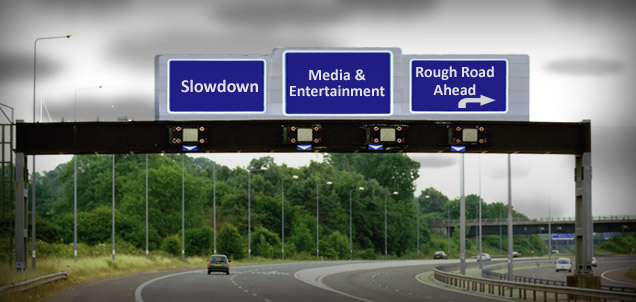
  • Rough roads ahead for M&E, but not everyone’s complaining


    By Johnson Napier with Tuhina Anand, Shruti Pushkarna, Meghna Sharma and Shubhangi Mehta


    Not many in the business arena would want to relive the harsh moments of 2008-09, which saw the economy at its most downward. While the phase did see a few corporate entities engage in a growth spree of daredevilry proportions, most brands were put to the ultimate test of surviving the slowdown odds or risk folding up business. The phase was, as most experts would agree, the toughest that had hit the Indian shores in a long time. And that there wouldn’t be anything harsher than that in a long time to come.


    But then that phase was a thing of the past and if one has to assess the current scenario, there is a sentiment of adversity that’s staging a strong comeback yet again. Given the spate of hurdles facing the economy like rising inflation, hike in petroleum prices, falling value of rupee and global uncertainty, the question doing the rounds is whether the current economic crisis is putting as much strain on the industry as it did in 2008-09? And, importantly, will the gloom see the growth numbers nosedive to lower levels than what was originally anticipated for 2012-13?


    To recap the growth numbers that was predicted for the media industry for 2012, Mindshare’s annual report – ‘This Year, Next Year: Indian Media Forecasts’ – had projected net revenue for 2012 at Rs37,397 crore, slated to grow at 12 per cent over 2011. This was somewhat close to the kind of growth that was witnessed in 2011, which stood at 12.8 per cent. But with the current crisis refusing to die down and with the sector already moving at a slow pace since January this year, the growth figures may see a marginal fall or remain stagnant.


    Sectoral evaluation

    Providing his outlook, Sujay Ghosh, Senior Vice President, DDBMudra South said that there is indeed a slowdown being felt across sectors. “There is a slowdown across several sectors like retail, apparel, real estate to name a few. As it happens with every slowdown, consumer spending gets concentrated on essentials and indulgences get affected. So, footfalls have shrunk and “like to like” buying has also come down. And with the petrol price hike, things will worsen further.”

     

    Divya Gupta

    Sharing a similar sentiment, Divya Gupta, CEO, Dentsu India said that there is a slowdown being witnessed in certain sectors, but then there are others that are doing business as usual.


    When analysed further across sectors, the buzzword that’s doing the rounds is “caution”. Expressing such a trend in the domain of television, Ravikumar Gilganchi, VP, Sales, Kasthuri TV shared that in the last two months there has been an increased demand from the advertisers on returns and they have become very rigid on spending: “The dip would be around 15-20 per cent. However, I would like to believe that this is a short-term scenario and by June things would bounce back to normal.” His reason being that since it’s just the start of the financial year many would still be getting their budgets approved and hence, June is when the action would begin.

     

    Sujay Ghosh

    He further shared: “For the first rung channels, there is not much choice for advertisers and they will go with whatever price is being quoted with not much negotiation as they would want that channel to be part of their media plan. They would start negotiating hard with second rung channels where there are many options available.”


    And it’s not just broadcasters who are feeling the heat. Production houses that play an integral part in the broadcast business too are seeing a rough patch. Hemal Thakkar, Director, Playtime Creations, whose show ‘Ruk Jana Nahi’ airs on Star Plus said, “This time economic slowdown has brought inflation with it which is the biggest cause of concern. This has led to a spike in manufacturing cost of product and budget limitation puts everyone in a spot. Interest costs too have shot up in last two years and so it triples the burden of execution in limited budget.”

     

    Hemal Thakkar

    But Rahul Kumar Tewary from Swastik Productions Pvt Ltd  whose show Navya airs on Star Plus thinks there is also an opportunity in all this: “The economic downturn has affected the industry as can be seen with the shutdown of channels like Imagine, but it hasn’t made any impact on the major players. The TV industry is on track for major growth as per the industry reports.” According to him, there are unlimited opportunities in the media space as it is a growing industry.


    Another sector that may see a saturated growth pattern is print, which is the second favourite with the brands after television. Alok Sanwal, Project Head & Editor, Inext, expressed concern as he said, “Largely, there is a note of caution for each one of us and this phenomenon is something that a lot of ad agencies had predicted from the beginning of the year for us. If we look at the larger advertising scenario, it was not good even last year. As of now things have been fine for most publications, including us. I feel each one of us have to be sceptical of how things would shape up in the second and third quarter of 2012-13.”

     

    Rahul Kumar

    As for the larger players, Sanwal feels that there is a word of caution there and the trend is utilitarian, by which he means, it is extremely sales driven: “So to that level, I think, it is a challenge for them. At the end, revenues may continue to grow but the larger challenge would be how to control expenses or optimise investments.”


    R Rajmohan, publisher, Open said: “What we are seeing now is worrisome but the print industry has been witnessing a slump from January this year onwards. The range varies across newspapers and magazines and in some cases it is much more than 20 per cent drop in revenues. The market sentiments have not been positive for a long time and this has led to people curtailing their ad spends on a large scale.” As for the brands, he feels they are playing the game of caution. “They will only spend where they see a genuine need. As for the genre, I feel the lifestyle magazines would continue to do well while the others may not do so well. But the scenario may change with the onset of the festival season. Till then it is wait and watch.”


    But there are those who believe that the scenario is not as bad for the sector and that it is on track for recording modest growth. Krishna Prasad, Editor, Outlook said: “I don’t know if the sentiment is as gloomy as it looks. If you look at the papers and magazines, there are so many sectors that are still promoting ads in them. The media, per se, has been witnessing tremendous action with so many new channels being launched and so many acquisitions and takeovers being the order of the day. So from a macro view, the economic gloom is not really taking a toll on our industry. But that does not mean all our problems are over, far from that. Oil prices are shooting through the roof, the value of rupee is falling further and all these factors will make our growth a challenge. We will have to see how things pan out in a couple of months from now.”


    He added: “Brands are being careful with their spends. Even big brands are treading cautiously and are not going overboard, unless required. We will have to wait and see what the forthcoming months will unfold for the print industry.”


    Agreeing with him, Mr Ghosh said that there are indeed pressures being felt by the clients as well: “There are client pressures in terms of numbers and therefore the client expects us to value add…in terms of strategic thinking on how to get more share of wallet. So our involvement with the client has gone up significantly. Similarly, the clients are concentrating on trying to get more out of their spends from everywhere.”


    He further stated: “I think the spends will remain constant or probably fall a little but nothing drastic will happen. Because the clients have been through it earlier and are experienced enough in not going overboard with expenses…especially with hiring, inventories and so on. So they won’t have to cut down much on marketing spends or any other spends for that matter.”


    Need for self-introspection

    KV Sridhar

    Always the one to be bridging the gap between the client and the consumer, the advertising agencies too are approaching the gloom with a note of caution. Providing his outlook, KV Sridhar, NCD, Leo Burnett, said: “If the industry is affected, the agency is affected and all this is caused by our internal issues more than the external issues. There are three pointers to this. First, advertisers do cost cutting and there are agencies available that are ready to work at lesser prices, this in turn affects the complete industry. Second, there are inefficient government policies, where the government is neither affected nor concerned about the sky-scraping inflation. And third, it’s the fact that we are all a part of a global family as an advertising fraternity. Keeping all this in mind we can still expect a double digit growth, the issue being that growth is also not enough for us, we are always aiming for more.”

     

    Agnello Dias

    Agnello Dias of Taproot India spoke on behalf of small and independent agencies when he said: “Ours is a small and independent agency, and hence personally, I do not think that agencies like us get affected by slowdown. It’s actually the bigger agencies having clients who play a part in the rise and fall of the economy of the country who get affected by the slowdown.”


    Representing the industry as president of AAAI and also the Executive Director – India Operations of Draftfcb Ulka Group, Nagesh Alai too feels that the current slowdown is affecting the advertising industry: “The advertising industry, to a considerable extent, is linked to the fortunes of the country’s economy/GDP. The recalibration of GDP growth to under 7 per cent, the high inflation, the high interest rates, falling FDI inflows and share portfolio pullouts, the plunging rupee, lowered credit rating, policy paralysis at the government et al have significantly heightened concerns in the business world and that is reflected in poor business confidence.” According to him, while a few sectors like FMCG seem a bit more confident, most other sectors are seeing a softening and are seeing revenue and profit pressures.


    Suggesting the possible solution that agencies could adapt, he said: “Overall, it’s going to be quite a challenging 2012. Most agencies will be affected and may have to relook at their numbers. Having said that, it is better to accept the situation as a business cycle and weather it with prudence and caution. It’s certainly not gloom and doom. My sense is that this time around, it is entirely up to us to rescue the situation and the sooner we do it, the better it will be for everybody. I only hope that the incumbent government gets out of paralysis and inaction and takes some positive steps in the interest of our economy and its people, if they are hoping to win at the 2014 general elections.”


    Though a relatively small domain, Out of Home too is seeing the effects of the slowdown. Sunder Hemrajani, MD, Times OOH highlighted the trend as he said: “After the last slowdown which happened in 2008-09, when the industry actually declined, subsequently the industry had two good years, 2010-11 and virtually 2011-12. The last year, 2011-12 started well for the industry, in the first half from April to September, the (Out of Home) industry saw good double digit growth rates. The slowdown started in November and carried on right upto March and April this year. So overall, you had a situation where the industry grew at about 8 per cent but first half was significantly better than the second half.”


    According to Mr Hemrajani, what has happened is the whole environment, and this is true not just of OOH but all media segments, has become very uncertain. “As a result of that uncertainty you find that people are holding on, clients are not making long term commitments. Earlier one used to get an annual deal or a six months deal, but now they have become three months and one month…so the level of commitment is becoming more short-term rather than long-term. Secondly, the pricing…it’s becoming difficult to increase prices and in some segments the prices have declined as well.”


    But the situation is not as bad for Rajan Mehta, Founder and CEO, LiveMedia. He said, “Contrary to the current economic situation, our business is growing quarter on quarter. Possibly because it’s new and hasn’t hit saturation as yet and also because it is very well targeted and hence cost effective. We are seeing that marketers for whom we were not a priority medium earlier are beginning to consider us as their media budgets have been reduced. They say ‘necessity is the mother of invention’ and therefore it is in these hard times that when advertisers are being challenged to get a bang for their buck that they are discovering and adopting mediums like LiveMedia.”


    Adding his thoughts, Haresh Nayak, MD, Posterscope Group India said, “From trade point of view we are seeing trends as close to 2008 and clearly non occupancy has gone up resulting in loss of business. This coinciding with monsoon which is supposed to be the lean period for OOH has brought down business and according to our estimates the non-occupancy has gone to 50 per cent. Though we implemented 18 campaigns last month, we are seeing a trend of quick availability and ease in implementing large campaigns due to slowdown.”


    With the rupee showing slow signs of recovery and with petroleum prices expected to be hiked further in the coming months, the M&E industry will have to look at alternative strategies to see itself emerge stronger from the economic broil. It may help that the mediums of digital, radio and so on are putting up a strong show, especially digital that is scheduled to grow in excess of 30 per cent. Radio, too, could make merry with the stage set for phase 3 rollout, providing them alternate streams for revenue generation. For now, players are opting to tread on the cautious route and one will have to wait a couple of quarters before the fate of the sector could be ascertained.



  • TAM releases mid-week TVRs for SMJ

    By A Correspondent


    Since Sunday last, when Aamir Khan made his debut on the small screen with Satyamev Jayate, there has been much discussion on the show and how it has established a new dimension to  entertainment television. Albeit only on Sunday mornings.


    While the all-India ratings will be out only next Wednesday, those for six metros was released this morning. According to TAM Media, in the All4+ category, the show’s prime telecast got a rating on 4.27 in the six metros for all nine channels. In the C&S4+, overall viewership TVR of the prime telecast was 4.08. In the three Hindi-speaking metros (Mumbai, Delhi and Kolkata), the show got a TVR of 3.79 on Star Plus itself. In the 6 metros (all4+), DD National scored a TVR of 0.43.


    Pratap Bose, COO, DDB Mudra was disappointed by the ratings. “To be frank, I was expecting a higher rating, so I’m surprised at a 3.79 TVR in the three metros. According to me, the show should have gotten at least a rating of 6 across sections. However, I’m optimistic and hope that as the show progresses, it will be able to do well.”


    On the other hand, Ashwini Kamat, GM, MediaCom feels that the ratings are okay since it’s mid-week rating only. “I’m sure the ratings which will come out on the coming Wednesday would be much higher. It would be closer to 4.5 TVR for the three metros.”


    Echoing the view that one must wait for the All-India ratings is Sundeep Nagpal, Director, Stratagem Media. “Given the canvas of the issues raised and the multi-channel simulcast across the country, the six-city numbers are probably not the best way to judge the popularity of the programme,” he said.


  • MxM Exclusive: Satyamev Jayate impacts govt. Women & Child Dev Minister Krishna Tirath promises action, commends Aamir

    By Karuna Madan


    Union Minister of State (Independent Charge) for  Women and Child Development Krishna Tirath has appreciated Star Plus’s multi-channel Satyamev Jayate describing it as a commendable effort.


    “Satyamev Jayate is a commendable effort by Aamir Khan and it deserves appreciation. We have taken note of the issue of female foeticide raised in the first episode,” Ms Tirath told MxMIndia in an exclusive chat.


    “The ministry is very serious about the whole issue of female foeticide and infanticide, and I can promise that suitable action will be taken against the culprits who indulge in such malpractices,” the minister stated, adding: “we will rectify any lacuna in the laws to check the menace in the country. There are a number of legislations already to curb this practice. But any lacuna, if found, will be rectified.”


    The Minister said that such practices can be stopped through mass awareness campaigns.


    “We can stop the cases of female foeticide by educating the masses and we are taking necessary steps in that direction. The government is already working on better policies in collaboration with other public and private institutions,” she averred.


    Raising concerns over declining sex ratio in the country, Ms Tirath called for greater public participation and awareness to prevent the issues related with girl child and women.


    Foeticide is punishable under Section 315 of Indian Penal Code (IPC), with imprisonment of either description for a term which may extend to ten years, or with fine, or with both.


    “The high number of incidences of female foeticide are due to the deep rooted traditional preference for a son. We are aware of this and have adopted a multi-pronged strategy which includes legislative measures, advocacy, awareness generation and programmes for socio-economic empowerment of women,” Ms Tirath said.


    Under the Pre-Conception and Pre-Natal Diagnostic Technique (Prohibition of Sex Selection) Act, 1994, sex selective abortions have been made punishable.  The Ministry of Health and Family Welfare is responsible for administration of this Act and its implementation is the responsibility of the State Governments/Union Territory Administrations.


    MxMIndia newsdesk adds: Ms Krishna Tirath would’ve made for an ideal guest on the Star Plus show. An MP from New Delhi and a resident of Karol Bagh in the capital, Ms Tirath, 57, is a mother of three daughters, as per Lok Sabha records. She’s been in active politics for a few decades, having been member of the Delhi legislative assembly for four terms starting 1985.  She’s  much into sports having participated at Inter-Univ and national level volleyball and athletics. Given her personal and professional credentials, there’s more reason than one, why she should be championing what Aamir Khan did on SMJ’s Episode #1.


    Editor’s Note: Although interviewing ministers is not part of MxMIndia’s regular activity, given the huge effect that Satyamev Jayate has had – especially in many sections of our intelligentsia, we thought it would be a good idea to commission a seasoned political journalist to interview the Women and Child Development minister and check if the show has had any effect at all on the government. It evidently has. Since the eventual objective of SMJ is to cleanse Indian society and stir the public and the Establishment into action, more than ratings (some of which will be out tomorrow), we believe it’s vital to check the impact on the government and the public.


    Karuna Madan (@KarunaMadan) is a senior journalist based in New Delhi


    Photograph: Fotocorp