Tag: Shashi Sinha

  • April 4-6: Goafest 2013 dates announced

    By A Correspondent


    While the ad frat is looking at 2013 with the hope that it will usher in good tidings for business, the AAAI and Ad Club found an apt opportunity to get them excited by announcing the dates and launch details of Goafest 2013.


    Nakul Chopra

    Scheduled to be held on April 5 and 6 at the Zuri White Sands in Goa, the theme for the 8th edition of the festival is ‘Just what you unexpected’. The organizing committee, led by Nakul Chopra, who has been appointed chairman this year, did not disclose other details of the event, including the speakers that have been approached or any further information about the awards.


    A three-member committee that included outgoing Goafest chairman Arvind Sharma, awards committee chairman Shashi Sinha and Nakul Chopra informed a select gathering of mediapersons that the aim this year was to come up with an even more evolved and bigger Goafest compared to 2012. For the record, the 2012 festival saw about 228 organisations entering the festival, received about 4253 entries, gave away a total of 332 awards to eligible winners and saw more than 179 agencies walk away with wins.


    Shashi Sinha

    “For Goafest 2013, our focus will be to strengthen the excellent new initiatives that were launched last year,” said Nakul Chopra. Mr Chopra further added, “Last year we opened Goafest to all nations in South Asia and we also brought strong client participation through the Marketing Wizards initiative – our endeavour this year is to further expand and grow these initiatives, apart from of course celebrating creativity and excellence.”


    “Goafest is the festival for all in South Asia who are involved in creating ideas”, added Arvind Sharma, President of the Advertising Agencies Association of India (AAAI). “Be it other countries in this region, the marketing fraternity or other allied professionals who participate in creating ideas – we want them all to equally own and participate in Goafest. We are taking a virtual conference/road show to neighbouring South Asian countries to increase awareness for Goafest and invite active participation.”


    Arvind Sharma

    Last year Goafest saw the introduction of Marketing Wizards, an initiative whereby young client delegates could not only avail of the special under-30 delegate fees, but were also provided free accommodation – over 70 delegates from client organizations availed of this offer. This year Goafest is targeting about 150 young delegates. In addition, Goafest will continue to have strong participation from senior clients in the knowledge seminars, as was the case in 2012. “Clients are our equal partners in creating ideas. We naturally strive to have their equal participation in Goafest both as speakers and delegates – this year we aim to attract participation from over 75 client organizations and hopefully over 250 people,” added Mr Chopra.


    For the 6th consecutive year AAAI and The Advertising Club will come together to deliver India’s premier awards that celebrate creativity. “We have a well oiled and extremely robust process now in place for the awards – we will take on board improvements from our past learnings and continue to follow the stringent and now well accepted norms for the Abbys in 2013,” said Mr Sinha.


    The Abbys will continue to be open to all who want to participate, and membership of AAAI or The Advertising Club is not required. “Last year we had over 225 organizations that sent entries – this year we hope to cross 250,” said Mr Sinha.


    Continuing with changes that were introduced in 2012, there will be a Grand Prix for all nine verticals including Film, Print, Radio, Out of Home, Ambient, Design, Interactive Digital, Direct and Integrated. There will be a Grand Prix for Media as well.


    Media Awards will be held on April 5, together with Digital, Design and Direct. All other Creative awards will be held on April 6.


    The Industry Conclave will be held as per tradition on the day before Goafest, April 4. This year the conclave will focus only speakers from client organizations to bring perspective to the industry.


  • It’s Ogilvy all the way at Effie 2012

    Click on the image for larger view


    By Ritu Midha


    As an event, one couldn’t have thought of a better way to spend a Tuesday evening than sampling the soothing breeze and top-notch refreshments at the Turf Club, Mumbai. Of course, the event was the Effie 2012, so the focus was necessarily on the awards.


    Piyush Pandey

    Perhaps unsurprisingly, the show was stolen by Ogilvy and Mather, who came ahead by miles, with the Man of the Moment being its executive chairman and creative director, South Asia Piyush Pandey once again. Ogilvy and Mather, with 280 points (more than 400 percent over its closest rival) was declared Effie Agency of the Year. When it came to clients, the competition was stiffer, although both Cadbury India Ltd (Effie Client of the Year) and No 2, Star India Pvt Ltd, are O&M clients.


    An emotionally charged Piyush Pandey said, “It is all by God’s grace. The credit completely goes to our team and culture. New blood joins with its own creative thinking and seamlessly blends with the existing creative thought process.” On being a repeat winner, he said, “It feels ecstatic to be winning again and again. To tell you the truth – the joy and thrill of winning increases every year.”


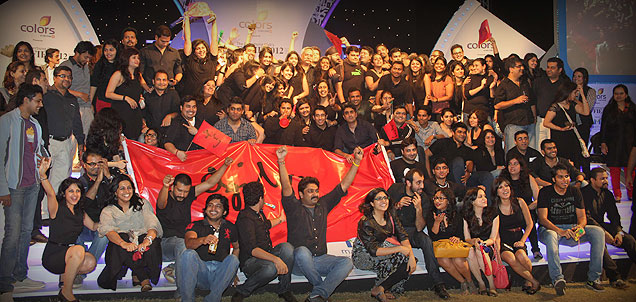
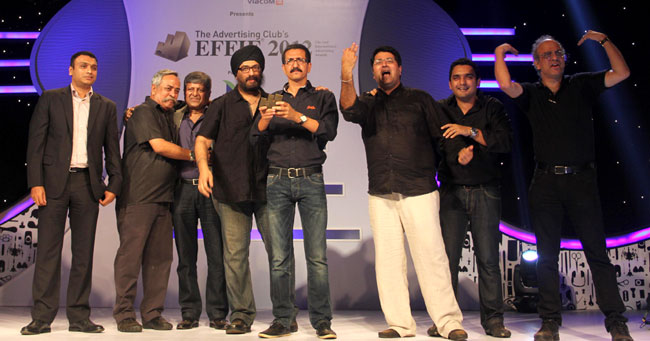
    The victorious Ogilvy team with Shashi Sinha (hugging Piyush Pandey) and Rajesh Iyer, Marketing Head of Colors (extreme left)


    Shashi Sinha
    Shashi Sinha

    The Effies themselves were enhanced in stature this year, both in participation and jury process. Advertising Club President Shashi Sinha stated, “It is special for two reasons: it is the first Effie under the aegis of the Ad Club post it becoming the Ad Club of India.” Also, he said, “This year the entire judging process has been conducted online – and the credit goes to Bipin Pandit and his team for managing it smoothly, considering that there were more than 100 jury members this year.”


    This year, the number of entries increased to 357. And while last year 29 agencies had participated – this year the number reached 50. Another feather in the Effie cap is that 50 percent of the jury members represented clients – best placed to judge the effectiveness of a campaign.


    Ajay Kakar

    Emphasizing the way the Effie is growing, Chairperson of the Organising Committee Ajay Kakar said, “This year, judging moved beyond Mumbai, and was extended to Delhi. We have also introduced two new categories – Direct Marketing and Ongoing Campaign.” He added, “It is a matter of pride that it is not a small set of agencies winning an Effie tonight; 13 agencies have contributed to the winning entries.”


    Ravi Rao

    Another point worth mentioning is the fact of a media agency winning two Effie trophies this year. Mindshare took away two bronzes – and considers it just the right beginning. Mindshare’s Leader, South Asia Ravi Rao told MxMIndia, “We bagged three bronzes, two for Axe Shower Gel and one for HSBC. I am really glad that we made it to the Effies. We will strive harder next time around.”


  • Final countdown for Effies 2012


    By Ananya Saha


    Effies 2012 is drawing to to a close with the second round of judging held in Gurgaon (NCR). The last leg of second round is scheduled for November 29 in Mumbai. The 12th edition of Effie has shortlisted 128 entries from 20 agencies. The 2012 edition boasts of two new categories: Direct Marketing and Ongoing Campaign apart from sharpened categories of David vs Goliath and Integrated Category.


    Ajay Kakar

    Ajay Kakar, Chairperson – EFFIE Committee and the Vice President of The Advertising Club said, “This year we have surprised ourselves. We received 357 entries from 50 agencies, up from 300 entries last year. We have introduced Round 2 in Delhi. Last year, we only had Round 1 in Delhi.”  Effies boasts of being known to measure effectiveness, from the viewpoint of the client and agency. “And 120 judges from who’s who from media, marketing and advertising will be judging with a bit more than 50% of judges being clients.” The judges and Effies Committee is also kicked about online judging, “It not only saves paper but also helps the judges to take their time,” Mr Kakar said.


    N Rajaram

    The judges were also upbeat about Delhi hosting second round of the judging process. N Rajaram, CMO, Airtel Center said, “The second round of Effies held in Delhi effectively recognizes that fact that clients based out of Delhi has increased significantly. It is a good step in the right direction.” Anil Dua, Sr VP – Sales and Marketing said, “This edition of Effies has been unique since it is IT-enabled. It brings out the efficiency as a judge, and helps us to judge efficiently.” Bipin Pandit, Chief Operating Officer, The Advertising Club, called Effies the coveted affair.


    Shashi Sinha
    Shashi Sinha

    Though shy to talk for Delhi since he belongs to the Board of Effies, Shashi Sinha, President, The Advertising Club, noted that the participation in Effies had increased significantly in the past five years with lot of marketing and senior advertising professionals becoming part of this year’s edition. Bindu Sethi, chief strategy officer, India, JWT, said, “There is a good mix of representation from from Delhi and Mumbai. The quality of entries has also got better. It is fun judging such campaigns on effectiveness.” She also remarked about how the paperless judging made it easier for the judges to refer back to the case studies to make an informed decision


    Satbir Singh

    Satbir Singh, Managing Partner and Chief Creative Officer of Havas Worldwide India, is judging Effies for the very first time. He said, “The Effies are purely and single-mindedly conducted to measure effectiveness of the campaigns. As a judge we have to be mindful of the strategy, the execution, the background and the effectiveness of the final campaign while judging.”


    Mr Kakar summed up, “Effie remains the only award that awards the effectiveness.”


    For the record, the Round 1 of judging was held in Mumbai on November 20 and 21, and in Delhi on November 24. The last leg of the judging process will happen in Mumbai on November 29.


  • Are suit-led agencies creatures of the past? And why AAAI must reinvent Goafest…


    Just a day after the vicinity was in grief over the Shiv Sena chief’s death, at Central Mumbai’s tony nightspot Blue Frog, friends and well-wishers of senior journalist Anant Rangaswami came in to witness (and celebrate) the release of the book ‘The Elephants in the Room – The Future of Advertising in India, 2016’. It was a simple event – emcee Karthik Iyer of Bengaluru-based Happy Creative Services made us chuckle with his wisecracks, Anant’s kids Rohan and Anya presented the first copy to his former boss and mentor Arun Arora (Chairman, Edvance and formerly President and ED, Bennett Coleman & Co Ltd) and finally a few words from Anant Rangaswami. For the rest of the evening, there were good spirits and food for company. The book surely asks some tough questions, and then puts recent history of the business in perspective. Our sub-140-character review: Unputdownable. If you’re in the biz of advertising, download now!

    To get a flavour of the book, we present two passages – one on suit-led agencies and the other on Goafest and why it must reinvent. Enjoy.


    The Elephants in the Room

    By Anant Rangaswami


    The very reason that suits ran most of the agencies in India till the late 1990s was due to a simple fact: the creatives didn’t care about, and didn’t know much about, managing a business and managing money. As a result, however talented and however critical to the business a creative was, he or she reported to a suit. It suited both well, during that time, till clients latched on to who, in the agency system, was the magician – and the answer was, ‘the creative’.


    [Creatives who aspire to head agencies must learn that, however painful it may be, they will have to gain more than a rudimentary understanding of accounts, of finance, of administration, of taxation. Currently, a number of agencies have suits as CEOs ONLY because the creatives fail at what are hygiene skill sets for managers].


    Ranjan Kapur perhaps saw this trend coming before anyone else. While he was clearly the head of Ogilvy in India, he saw the opportunity in leveraging the growing reputation and charisma of Piyush Pandey. During Kapur’s years, we saw the face and image of the agency change. While JWT (then HTA) had built a redoubtable reputation for their planning, by the late 1990s, Ogilvy was transformed into the most creative agency in the country as far as popular perception was concerned. Not just Ogilvy – it was Piyush Pandey who had become the God of Advertising Things.


    While Kapur pushed himself, cleverly, more and more into the shadows and pushed Pandey more into the sunlight, his contemporaries at the two largest competitors of the time, Prem Mehta at Lintas and Mike Khanna (and later Colvyn Harris) at HTA (to become JWT later), failed to notice what Kapur was up to – and why he was up to whatever they were up to. Mehta held on till he sold his stake in Lintas to Lowe; the status quo remains at JWT, and Ogilvy has, without a doubt, occupied the number one creative agency spot in India.


    Kapur, I would argue, saw the future and bet on it. It could not have been easy, at that time, to buck the trend and allow and encourage a creative to become the face of the agency. In hindsight, some of the most memorable advertising work in the past two decades have been on brands handled by Ogilvy – Cadbury, Fevicol, all the avatars of what is now Vodafone, and so on. All these resulted in glory for Pandey and a small amount of reflected glory for Kapur.


    But that was a small price to pay – the success of the agency, as far as Kapur’s boss Sir Martin Sorrell was concerned, was due to Kapur.


    Today, Lowe is run, whether you like it or not, by Balki. JWT is still run by a suit.


    It’s important, for many reasons, for the agency to be run by a creative. The foremost is that when it is apparent that a creative runs the agency, and is not just the head of the creative department, it sends a signal that the ‘environment’ will be more creative-friendly. It makes it easier to recruit and retain creative talent for the creative-led agency than for the suit-led one.


    It’s not that the only solution is to insist that a creative heads the agency. It could be in the form of the Piyush-Rane partnership (which was defined by Kapur’s formula), where the creative is the face of the agency. In Rane’s case, he has defined his job as one that will ensure that the environment allows Piyush and his team to focus on the creative product, while he looks after the mundane essential tasks such as finance, accounting and general administration.


    But make no mistake about it – the suit-led and the suit-as-the-face agency is a creature of the past. For a moment, let me get back to Salt, which is a new agency headed by a suit, Mahesh Chauhan. Why is Salt doing well, defeating my entire premise? Because, while Chauhan calls himself and sees himself as a suit, his clients and his creative colleagues see him as a creative. Chew on that.


    Take a look around you – at all the agencies headed by suits – and at all the agencies headed by creatives. Look at who is winning. Look at who is struggling.


    It’s not a surprise. As Sir Hegarty said, I’ll repeat, “How can we not have a creative person at the top of a creative business?”


    It’s time for the suits to actively push their creative heads forward and actively recede into the backgrounds. The creatives must be the faces of the agencies – otherwise the creatives will begin leaving.


    So will the businesses, as many have sadly learned.


    It’s not going to be easy, but it has to be dealt with, sooner rather than later. I told you, it’s an elephant in the room.


    A few days ago, my brother, JP Rangaswami, wrote in his blog: “Business is personal. It’s about relationships. It has always been so. Until we tried to forget it and concentrated on making money, not shoes. [As Peter Drucker said, people make shoes, not money]. Then, for a short while, business became not-personal.”


    In India, the entire advertising industry is about relationships. It’s personal. And, to paraphrase Drucker, in this business, you create communication, not money.


    ****


    The AAAI, in the current form, has become an elephant – a white elephant. Unless they change, there is no reason for them to exist.


    Which brings me to another elephant. The AAAI has given birth to it and, by some accident and aided and abetted by some office bearers (almost all heads of large creative and media agencies who convince their friends in media houses to sponsor it) it is still alive. The elephant is called Goafest.


    Speak to any event manager and tell him you want to do a major event in Goa in April – and he’ll tell you that you’re nuts. It is, verifiably, the hottest month of the year in Goa, with the average temperature being around 33 degrees C (high) and 27 degrees C (low). I’ve checked historic data to save you the time.


    Yet, from the time that Goafest was created, it’s been held in the first fortnight of April. Never earlier, never later.


    If you live in Mumbai, you’re tempted, every month, to run away to Goa and get away from the pressures of living in the megapolis. Every month except April – because not only is it hot, it doesn’t rain. March is alright, because it is cooler. May is alright, because it begins raining. April is a bummer, because it’s hot and humid.


    Yet Goafest is held every goddamned year in April.


    Why? Why? Why? When I first thought of the question, I was reminded of a lecture I attended when The Times of India, my then employer, sent me to a course at IIM Ahmedabad. The lecture was on the Toyota system, where ‘Seven whys’ would help Toyota employees on the assembly line arrive at the root cause of problems.


    Hazel Rogers from Australia makes the 7 Whys easy to understand.


    “The 7 whys is a technique that I believe was developed as part of the Toyota factory quality push, back in the mists of time. It’s since been taken from the manufacturing paradigm and used in IT quality theories. It’s a great method for getting to the root cause or at least one of the root causes of any problem. So it’s a great tool to use with EFT!


    What is it? Start with a problem. Keep asking “why?”, until you’ve gotten to where you can’t go any further, or you’ve found some interesting “hidden” thinking! You don’t HAVE to ask why 7 times precisely.


    For example:

    I’m procrastinating…


    Q Why do I procrastinate?

    Because I’m stuck on using the tools I have here (on the computer)


    Q Why am I stuck, when there people available to help me?

    Because I haven’t asked for help


    Q Why haven’t I asked for help?

    Because they will think I’m stupid, I should be able to figure it out.”


    I’m not going to the 7th question, as much as I didn’t need to when trying to figure out the answer to why Goafest is held in April.


    It’s held in April because the planning is appalling, so there’s little time to raise the money to afford Goa hotels in months with better weather.


    To give you an idea of what can be done with better planning, you need to look no further than another event held annually in Goa, Kyoorius Designyatra. Their 2012 edition was held in September; they’ve already announced that their 2013 edition will be held in August.


    As I write this, I’m certain that speakers are being spoken to, that hotel room prices are being negotiated and sponsors being contacted.


    Compare this with Goafest. Going by the history of Goafest that I can claim to be associated with (which is from the 2008 edition), it’ll be sometime in January 2013 before the AAAI management committee discusses the April 2013 event. Once they meet, and they decide on possible dates, they need to talk to The Advertising Club, the owners of the Abbys, the awards which are held at Goafest. Once The Advertising Club agrees, they will begin the process of contacting possible speakers – for whom, unlike Designyatra, they have no budget for. (They do pay for airfares when requested and for the accommodation within India). Ideally, they look for speakers who are happy to come to India at their cost – and that shrinks the pool of prospective speakers dramatically.


    It doesn’t help that speakers get notice of less than two months from the day the request is made.


    So this, then, is the product that is Goafest:

    1. On the Thursday, a meaningless Conclave ( I use the capital C to emphasise how AAAI views it), where the entry is by invitation only to CXOs and to the handful of marketers who are bullied into attending by their agency partners


    2. On Friday, the event is open to the public, and the bar is open as well. Kids loll around drinking and flirting (as I would if I was their age), while speakers like Dan Wieden, Sir Martin Sorrell, Sir John Hegarty, to name a few, are besieged by trade media for interviews in the burning April Goa sun.


    3. Speaker sessions start by around 4. Most of the kids are too drunk to attend; some have success with their flirting. It’s difficult to fill the seminar hall. All kinds of devices have been attempted, including a chance to win an iPod if you attend. So Scott Goodson of StrawberryFrog has an audience of less than 300, of the 3000 who are attending the fest.


    4. Friday evening sees the Media Abbys. Those from the creative agencies don’t care and they’re off to Martin’s for a piss up. The youngsters from the creative agencies continue to flirt. The media agencies win and lose, and there’s a piss up as soon as the bars open (inexplicably, they close during the awards presentation ceremony).


    5. Saturday morning sees most of the media agency executives leave. The bar is open, those who remain do the same as described in points 2 and 3 above.


    6. Saturday evening sees the Creative Abbys (during the presentation of which the bar is still closed).


    7. Losers bitch about the judging (admittedly, it was the least in 2012) but head for the bars once they’re opened.


    8. Some of the lucky delegates have sex with partners they’ve met for the first time in Goa.


    9. International visitors tell Indian trade media that they’re very happy with how their Indian offices are doing, even if their Indian offices are doing terribly.


    10. Sunday morning, all fall down.


    This is absolute rubbish. What the AAAI demonstrates, first by scheduling the event in April, and then by the content they create, is an absolute contempt for the intelligence of the average advertising professional in India. They have the temerity and the arrogance to call it the “Cannes of India”, much in the same spirit that Maharashtra’s chief ministers compare Mumbai to Shanghai.


    Unless the AAAI reinvents Goafest, it’s a downhill ride from here.


    The AAAI needs to re-focus on the premise of Goafest. To begin with, they’re trapped, by the very name of the festival, to hold the event in Goa. Goa has become, over the years, a very expensive destination – except if you live in Mumbai or Pune. To someone from Kolkata , Singapore and Bangkok are cheaper. At short notice, even in April, it could cost you a small fortune to fly to or from Goa at short notice. Ask Lodestar’s Shashi Sinha, who had to make a last minute change a few years ago and ended up spending Rs.18000 on a one-way ticket from Goa to Delhi on the Sunday after Goafest.


    Forcing the event to stay at Goa makes the festival exclusive and not inclusive. It is slowly becoming an annual ritual for the industry from Mumbai to take a few days off. We see a few hundred each from Delhi and Bangalore; from the rest of India, the number will be in the low double digits. Perhaps 10-15 from Kolkata, and another 10-15 from Chennai.


    It’s time to become truly inclusive, and start moving the festival around the country. That’s why Goafest traps you. For God’s sake, if the entire advertising industry cannot come up with a new name for an advertising festival, it’s a little sad.


    (In the short term, you can be sure that next year’s attendance will take a beating, thanks to the sluggish market and the pressure on margins).


    Learn from Designyatra that content is King, not the entertainment. I’ve attended two editions of Designyatra in Goa and one in Mumbai – and all three have had superlative content. Content that keeps you riveted to your seats and taking notes. Speakers you want to walk up to and hug once they’ve finished. Conference halls that are packed to the rafters.


    And there’s no free alcohol, no parasailing, no tattoos. Designyatra is serious business – and the delegates seem to profit from it – there are more attending every year. There are no major costs in event management, as all the sessions are held in hotel banquet halls. Sponsors are happy to support the event, because they’ve seen, over the years, the quality of the delegates and the level of involvement.


    The old adage goes, if it ain’t broke, don’t fix it. On the other hand, if it is broke, fix it. Goafest is broke. Fix it.


    Extracted with permission of the author Anant Rangaswami

    from The Elephants in The Room – The Future of Advertising, 2016.

    Pages 152, self-published.

    The book is also available as a free download from Firstpost.com.

    More information and interactions at facebook.com/theelephantsintheroom


  • Shashi Sinha to be CEO, IPG Mediabrands. Lynn de Souza to turn ‘social entrepreneur’

    By A Correspondent


    Shashi Sinha

    It’s a decision that was seen coming ever since IPG Mediabrands formally entered India in March this year. The idea was to set up a more federal (and if we may add, Group M-like) structure with one CEO and a singular objective of growing marketshare, salience and the business.


    IPG Mediabrands was set up with two co-chairs in Shashi Sinha and Lynn de Souza. With more than 17 per cent marketshare, the group comprises: three media agencies – Lodestar UM, Initiative and the all-new BPN, Reprise, a jv with Interactive Avenues, Magna Intelligence and the outdoor business. Going forward, IPG Mediabrands Analytics will also be set up and the outdoor activity will see renewed vigour.


    Lynn de Souza

    Magna Intelligence was launched to further improve the group’s buying capabilities and IPG Mediabrands also brought its unique consumer panels to the market. With more than 16000 contacts in India alone, the consumer panels fuel proprietary tools such as Matrix.


    To lead this exciting journey, a new role of CEO of IPG Mediabrands India has been created with Mr Sinha playing that role. Initiative, BPN, Reprise and the outdoor company will all now report to him, in addition Lodestar UM, which he leads currently.


    According to a communiqué, this represents the commitment IPG Mediabrands has made to the Indian market, and also recognizes that Mr Sinha, an IPG veteran of over 20 years, has contributed greatly to that growth. He has rapidly expanded and developed Lodestar UM over the past six years, led the way for the foundation of many new offerings in the market, and has remained actively engaged in various industry forums. Currently, Mr Sinha is also the President of The Advertising Club.


    IPG veteran, Lynn de Souza, Chairman and CEO of Lintas Media Group and an active participant in the non-profit space for several years, has expressed her desire to become a social entrepreneur, the communique adds. “She will announce the launch of a pioneering new initiative for the development sector in early 2013,” it notes.


    MxMIndia learns that Ms de Souza has already proceeded on leave and will be back only on November 25 to work till the end of the month., and will be leaving IPG Mediabrands at the end of November. Mr Sinha has taken charge as CEO, with the various heads reporting into him from yesterday.


    Although there has been a buzz for a few weeks, even some of the top brass in the group agencies got a confirmation of the developments only on Monday. Mr Sinha was at his alma mater, the Indian Institute of Management in Bengaluru. He was only the 12th awardee of the ‘Distinguished Alumni Award’.


    Much reason to cheer for Shashi Sinha.


  • Bipin Pandit is now COO of Ad Club

    By A Correspondent


    Bipin Pandit

    The Advertising Club, at its managing committee meeting following the AGM, unanimously decided to promote Bipin R Pandit as the chief operating officer of the club.


    The club follows the ritual of holding a managing committee meeting immediately after the AGM every year, which was done this year too. Post handling the items on the structured agenda the committee under the presidentship of Shashi Sinha unanimously decided to promote Bipin R Pandit as the Chief Operating Officer of the Ad Club.


    Mr Pandit had joined the Ad Club in 1998 and during his tenure he has been successively promoted from executive secretary to manager, general manager, and now Chief Operating Officer.


    Mr Pandit said, “I am thankful to the entire managing committee and our president Shashi Sinha in particular for the promotion. They are not only supportive of the ideas and suggestions that I give, they encourage me to implement them. I have always loved doing new things or to do existing things in a new way. I love challenges and with this elevation there will be many in store.


    “We are not a club that does only awards, it has given a great deal back to the industry – from sending students to Cannes, Spikes etc, to holding case study presentations, organizing evening meetings with international speakers, and holding educational workshops.”


  • Anil Thakraney: Delhi ad guys less cynical than Mumbai frat

    By Anil Thakraney


    When I met Shashi Sinha for an interview in February this year, we discussed the Bombay Ad Club’s activities. Sinha was very clear about expanding into Delhi. And I immediately knew it was a good idea, though I didn’t say that to him. This is because during an interview, the interviewer does not offer any opinions; at least that’s my mantra. Though the esteemed Shri Arnab Goswami shall not agree, but I digress.


    Well, I am happy to hear that the Advertising Club Bombay will now be called The Advertising Club. And Delhi/NCR is their next stop. This should ideally have happened a decade ago. The Delhi ad market has been booming for a long time now, they boast of many very large local and multinat clients. And the Ad Club Delhi isn’t really a happening body. So a clear opportunity exists for the Bombay club guys.


    There’s another reason why I find Delhi a more exciting market, and I say this from personal experience of having worked there. The Delhi ad guys, much like the rest of the Dilliwallahs, are an excitable, exuberant sort, they are lot less cynical compared to the Mumbai ad frat. And they will participate in the Club’s events with gusto. (Provided, of course, the newly named Club delivers cool events.) In the Mumbai ad world, apart from participation in award competitions, I have noticed very little enthusiasm on industry events. Maybe they have gotten tired of seminars, or maybe in Mumbai they just don’t care anymore. Perhaps this also explains the Bombay Ad Club’s hugely decreased activity.


    And I will give you another insight on why they’ll find Delhi more responsive to events. This may sound very pedestrian, but it’s a fact of life. Commute in Delhi is lot more easy and joyful compared to Mumbai. This will also play a key role in crowd support in the capital. Just the thought of additional evening commute in a messy, decaying, perpetually traffucked Mumbai is a huge downer.


    Mumbaikars would rather go home than listen to an ad guru. Survival, not knowledge, is the priority out here.


    ***


    PS: Outstanding Nike commercial and it must have cost peanuts to produce. The power of the ad is in the words, they are superbly scripted. Reminds me of the good old days when press ads in India used to contain glittering prose. Before the TV boom, before the cow belt guys took control of the desi ad world.


    [youtube width=”400″ height=”220″]http://www.youtube.com/watch?v=2JnYcuRW_qo[/youtube]


  • Chalo Dilli, as Ad Club drops Bombay


    By Tuhina Anand


    As the Advertising Club Bombay gears up to don a new avatar, the crucial question is: will it help the industry? And will the industry accept the new inclusiveness? Ad Club Bombay has been looking at expanding its footprint and in its bid had last year held some of its judging for Effies in Delhi. Shashi Sinha, the President of the renamed The Advertising Club (till yesterday The Advertising Club Bombay) has been vociferous in the Ad Club’s demand to have a more inclusive approach, especially including the Delhi NCR advertising fraternity.


    Shashi Sinha

    In fact, their priority has been to bring Delhi under their ambit and not other cities like Bengaluru, Chennai, Kochi or Kolkata. One of the reasons for setting their eyes on Delhi is that the capital is a key market for the adfrat, considering that most of the agencies have offices there and some even their head offices. The other reason for extending their footprint could be the functioning of the Delhi Advertising Club (DAC).


    It is no secret that many in the ad fraternity in Delhi NCR prefer to stay from DAC activities. Its awards, one of the key events for any Ad Club, are not a patch in comparison to the Abby by Ad Club Bombay. When MxMIndia called the DAC office in Delhi, President RC Tanwar seemed miffed and said, “I am the President of Delhi Ad Club and we have given no right to anyone to decide on how DAC should function. I think people from Mumbai should realize that DAC is much more active than their counterparts. We don’t just have awards but other events too. What is Ad Club Bombay about – Goafest?” He categorically said, “We will never partner with Ad Club Bombay; they can have their own plans and we are not interested to be part of those.” However, though Mr Tanwar said he would reply to MxMIndia’s questions, he did not do so.


    While there have been issues in the past like the awards leaks in Goafest, the awards process has been cleansed in the last two years. One cannot also overlook the fact that Ad Club Bombay (now The Advertising Club) is a formidable force and includes some of the big names from the industry. Its Managing Committee has enviable names on board and there is no ignoring that.


    Prathap Suthan

    It may be recalled that a few years ago Prathap Suthan had floated The Delhi Alternative (Alt Delhi) a platform that gave an opportunity to fraternity from Delhi to come together. The initiative is still going strong. Mr Suthan on the current development said, “On Ad Club Bombay becoming The Advertising Club, my take is very simple. It is a good thing. It is the right thing. Just that this should have been done ages ago. It just underlines the fact that Delhi is actually growing into a market that has already or will soon become larger than Mumbai. It is almost that they suddenly don’t want to miss the boat. Unfortunately rebranding isn’t going to change geography. And I personally think intercity rivalry is healthy, positive and must be sustained.”


    He added, “Alt Del isn’t an idea that was ever set up to challenge the Bombay Ad Club or the Delhi Ad Club. It was and is still a growing forum away from the industry to promote the coming together of communication professionals, much larger than just advertising. Plus the fact that it is also alive on FB with members from across India. It was led by a leadership of senior people from different facets of communication, and set up for individuals to interact, learn, network and enrich their advertising quotient. We wanted to supplement learning through workshops, meetings and exhibitions. There has been zero support from any agency, corporate, media house etc and it has been running only on the collective steam and money of our leadership. Until now we have had a few workshops, great participation, excellent quality, and wonderful feedback. Now that winter is here in Delhi, Alt Del is planning to make the best use of it.”


    Rahul Kishore

    The Delhi and Mumbai competition that Mr Suthan has mentioned seems to be playing on the fraternity’s mind. Rahul Kishore, Senior VP – Priority Projects, Mogae Media, commented, “The move seems to be a sensible one as there are Ad Clubs that are present all over the country. I see no reason why it should be referred to as Ad Club Bombay only. However, I’d like to add here that most advertising agencies today operate out of Gurgaon.”


    Sathyamurthy Namakkal, President, DDB MudraMax, Media, said, “I think we are reading too much into the whole situation. Delhi is an important market with lots of advertisers being based out of the city so it is a gesture to have more representation in the Ad Club than it to give it more weight than required.”


    Sathyamurthy Namakkal

    As for some of the Ad Clubs around India, The Advertising Club Bangalore has been pretty active. It holds its yearly awards fest called Big Bang. It also conducts lot of sporting events that have been popular at the advertising festivals. Among its events is one called Melting Pot that encourages participation from creative teams to come up with a public service campaign.


    Talking about an issue that Ad Club Bangalore faces, Arvind Kumar, Executive Director of the Ad Club said, “For the awards we get entries from small and medium agencies but there is reluctance on the part of bigger agencies to participate, citing that their companies’ `unwritten’ policy bars them from entering any Indian awards. This is a major dampener as the participation from bigger agencies would certainly help in raising the quality of entries. It would also help the creative people from those agencies get wider recognition.


    The Advertising Club Cochin has been fairly robust considering that it has 400-500 members. Sandeep Nayar, President of Ad Club Cochin, said, “We have at least one event planned for each month that includes creative competitions, sports events and workshops among others.” The Ad Club is 15-16 years old and its biggest property is the Pepper Awards – the awards night for the creative fraternity from Kerala. Mr Nayar in fact seemed open to any collaboration with other Ad Clubs across the country that would give them a wider platform to showcase works from down South.


    In the end, it’s not about which city is better. The move by the Ad Club Bombay can only help the fraternity, in Delhi NCR in particular. A move that helps the industry has to be taken in the right spirit.


  • Abby to drop Bbay as Shashi Sinha to get 2nd term as Prez

    By Tuhina Anand


    After its Annual General Meeting (AGM) it is learnt that the Ad Club Bombay will be formally named The Advertising Club. The change is in keeping with Ad Club’s effort to be inclusive and larger representation to the industry. In this direction, the first step is to include members from Delhi in its Managing Committee (Man Com) and also hold its Effies judging in the capital too. The judging in Delhi happened last year too and plans are now to strengthen its presence e there.



     

    Shashi Sinha

    Also it is learnt that the new Man Com has been decided and will be formally announced post the meeting today. Shashi Sinha, CEO, Lodestar Universal India will continue as its President and this will be his second term. Ajay Kakar, CMO – Financial Services, Aditya Birla Group will be the Vice President. Pratap Bose, COO, DDB Mudra Group will be the Secretary and Sujoy Ghosh will be the Joint Secretary. Madhukar Sabnavis of Ogilvy will be the Treasurer.


    Talking about the development, Mr Sinha said, “The purpose is give a larger footprint to Ad Club Bombay . Since we have had requests to include Delhi under our aegis, we have taken a step in that direction. Also Delhi and Mumbai represent the large chunk of our fraternity thus it makes sense to bring them together and provide a consolidated platform to the industry.”


    The other members of the Man Com will include- Punitha Arumugam of Google, Ajay Chandwani (Percept), Sajan Raj Kurup (Creative Land Asia), Samir Satpathy (Marico), Sanjeev Bhargava (JWT), Ajay Trigunayat (Times TV) and N Rajaram (Airtel).


  • Video: Good effort to evangelize print: Vikram Sakhuja, Shashi Sinha & Josy Paul. Sequel planned: Rajan Bhalla

    By Robin Thomas


    On the sidelines of the HT Media event to unveil the book – ‘The Magic of Print’, MxMIndia caught up with some industry players for their views on the evolution of print advertising, the road ahead for the medium and of course their reactions to ‘The Magic of Print’ and whether such initiatives really help the industry?


    1. Vikram Sakhuja, Global CEO, Maxus

    [youtube width=”400″ height=”220″]http://www.youtube.com/watch?v=gleSCF4K05A[/youtube]

    Your reactions on the book – ‘The Magic of Print’…?

    It’s a great book, it’s a beautiful production, it’s got some very good tips. There are some twelve tips to re-create the magic of print and an absolutely mind blowing compilation of ads. I think Rajan Bhalla has done a brilliant job.


    Does the industry need more such initiatives?

    Yes, absolutely. The good thing about these kind of initiatives that it makes you stop back and think, reflect and when you are tuning with some great minds and if something comes out of it, is always nice.


    2. Shashi Sinha, CEO, Lodestar UM

    [youtube width=”400″ height=”220″]http://www.youtube.com/watch?v=9vILEEM6PeQ[/youtube]

    Your  reactions to the book (‘The Magic of Print’)…?

    It’s a lovely book, and it’s got a combination of some great ads, and there are some simple tips. Copywriting is one area which is very difficult for a beginner in advertising to enter into and the ones that have managed to enter into this field can also learn quite a lot from this book.


    On whether the industry needs more such endeavours?

    There are so many business schools, but no one teaches you the craft of advertising. So I believe this is a great endeavour and for a publisher in-house to do this initiative and to inculcate the spirit, I think it’s a great opportunity.


    Does the industry need more innovation for better growth?

    I won’t be worried if innovations happen or not because ultimately if there are a lot many ads on print, innovation will automatically happen. Innovation is something you do for the long term, so I won’t be worried if innovation happens or not. The fact is that advertising in print will continue to grow and as television rates go up, automatically people will come back to print. Whether it takes two years or five years, I won’t be able to predict, but, this will happen.


    A word of advice for print media…?

    Keep providing great content, contents which are engaging and the rest will follow.


    3. Josy Paul, Chairman and National Creative Director, BBDO India


    [youtube width=”400″ height=”220″]http://www.youtube.com/watch?v=h83bzcVtlck[/youtube]

    Your reactions on the book – ‘The Magic of Print’…?

    It’s a good book, well printed, it’s got some nice images and makes me want to spend more time with it and share it with my team and may be even have some discussions on which of those are fantastic work.


    And does the industry need more such endeavours?

    I think more discussions are good because a discussion makes you think about the medium a little more. Basically it is about focusing on the medium and what makes the medium a little more interesting and exciting. So I think that conversations are good, always.


    Does the print industry need more innovations for better growth?

    I am not sure about the word innovation in print because as a reader if I find people coming in the way of my news, I do get irritated. I believe true innovation is when within the context of the page and with respect to the page you can still create magic and still have a point of view that will make people think again or get excited or share things or put it up on their board, then that’s great. However this whole thing of irritation to the reader is not innovation, in fact is suddenly makes the news a nuisance.


    Where do you see creativity in Print media, five years from now?

    Creativity can never die, it’s forever. I expect newer things to happen, more beautiful things, and younger people will bring in more filters to print and we will see beautiful things that we never thought about. So one cannot really predict, creativity in fact evolves.


    What about print as a medium five years from now?

    I think print will take a new avatar. We all know that education is a big necessity in this Country and newspapers will become an integral part of education and it will start finding new audiences and I think it will further penetrate into the different strata of the society. So, newspapers or print media is like a river that will grow very deep and I don’t think it will just die like that.


    4. Rajan Bhalla, Head, Corporate Marketing and Magazines, HT Media

    [youtube width=”400″ height=”220″]http://www.youtube.com/watch?v=1P8utJgX-EA[/youtube]

    On the idea behind initiating- ‘The Magic of Print’?

    Well, I think the magic of Print is our contribution, our effort to help everybody in the industry associated with print advertising to understand how to create the magic in print advertising. I think it is absolutely clear that print is an absolutely great media vehicle from the point of view of showcasing brands and above all lending a lot of credibility to the message. It is time that we all started looking at how great print advertising can be created and this is our effort in that direction.


    On the process that went behind creating this initiative?

    It was a tedious process that lasted us almost a year. We first identified the content of what we wanted to present in the book. Once we had the content right, we then started scanning for the best examples we could find across the globe to fit into that category. We were not so concerned about picking brands from India, we just looked at global advertising as a market place and we looked at just the best in class advertising that was created under every single theme that you will see.


    How have the advertisers responded to the book?

    The book has just launched, so I am very positive that both the media fraternity as well as the creative fraternity is going to view this as a great initiative, which is also going to help clear a lot of thinking that they put into creating great advertising that works for them. So, it is just the beginning and we would like to probably move on this path as we go forward, year on year.


    So, will there be a sequel to this book – ‘The Magic of Print’?

    Absolutely yes; so we would be looking at various genres in which we can actually help impact the print industry, impact print advertising and help our advertisers in different ways. So you can look forward to another such initiative one year from now.


  • INMA 2012: ‘Print must engage audiences effectively’

    By Shruti Pushkarna


    Day 1 of the sixth annual South Asia INMA conference opened with a host of promising sessions which addressed key issues facing the industry.


    Ashish Pherwani
    [youtube width=”400″ height=”225″]http://www.youtube.com/watch?v=WfREkdmTRuc[/youtube]

    The session ‘Winning the Ad Growth Challenge: Is it a Plausible Model’ was moderated by Ashish Pherwani, Partner- Advisory Services, Ernst & Young India and the other panelists included Bharat Bambawale, Director, Global Brand Bharti Airtel Ltd; Mayank Pareek, COO (Marketing & Sales), Maruti Suzuki India Ltd; and Shashi Sinha, CEO, LodestarMedia.


    The moderator, Mr Pherwani opened the discussion on the ad growth challenge by listing out four factors that he felt were impacting ad growth: inherent competition, technology change, slow economic growth and growth of television. Citing a recent research, Mr Pherwani said that there were clear indications that consumers are spending more time on digital media at the expense of traditional media.


    He also listed out some questions for the print industry to address, the broad one being, how to stay relevant and grow revenues. Among the other questions he raised were: New ways advertisers can use print, how to enhance effectiveness of print for advertisers, what makes advertisers continue on print when times are tough and finally how can print companies explore new media.


    Mayank Pareek
    [youtube width=”400″ height=”225″]http://www.youtube.com/watch?v=PYJJnTGb12U[/youtube]

    Mr Pareek said that the demography is changing because the way people seek news is changing. He said that Maruti had redefined their strategy to invest in print, looking at the changing trends in consumption: “We’ve gone from 67 per cent to 23 per cent in our spends on advertising in print in the last five years.” He said that it is important that companies continuously adopt to the changing demographic needs. He added that even though digital spends are low today, digital is growing and changing rapidly. So for print to remain relevant, there is need to develop engaging content as the other media are offering. However, Mr Pareek agreed that print will continue to play a role in the future as well.


    While the other panelists agreed with Mr Pareek that print will continue to be the part of a media plan for an agency or an advertiser, they also shared his concern on the need for print to adapt to changing consumption patterns.


    Mr Bambawale of Airtel said: “We are using much less print. There is one strong global trend which holds true forIndiaas well, young eyeballs are moving away from the printed word to the video. So for print medium to engage this audience is a great challenge. The conversation should change from ‘how can we put an ad out there’ to ‘how can we engage’. In a newspaper, content is all about facts and events but in engagement, content is about making things interesting. The answer lies in creating content that has high degree of engagement even around topics of news or current issues.”


    Mr Sinha said that the strength of print lies in the fact that it brings a lot of credibility: “Print still stands for credibility, I am not so sure if digital has that. We’ve embraced digital because of the youth. For certain brands which go through an erosion of trust, print is the best place to be in.”


    He added that not growing fast enough is the problem of measurement: “The current measurement metrics are limited to cost and reach. There is no way to measure engagement or performance. Unless we start showing these to the advertiser, things won’t change. There is a need to introduce new metrics of measurement.”


    Mr Bambawale echoed Mr Sinha’s view on measurement being limited to cost and reach as far as newspapers are concerned: “If you change the matrices by which you present the title to an advertiser, it’d be a more fruitful conversation perhaps.”


    The discussion concluded with two key takeaways, Print needs to find new ways of engaging its audience to stay relevant in a changing era. And second, there is a need perhaps to look at other matrices of measurement for print, a way of measuring effectiveness of an innovation.


  • Being on Cannes jury is no mean task


    By Tuhina Anand


    Being on the jury of Cannes Lions means serious business – being shut in a room for endless hours and going through thousands of entries to make a case for the piece you like. Undeniably, despite the work involved, the experience of being a jury at Cannes is a learning experience in many ways.


    Ryan Menezes

    As Ryan Menezes who was invited to be on the Cyber Lions jury in 2011 puts: “I thought, cool, after winning India’s first ever gold lion in 1996, I now get to judge the most cutting edge category of all. I was looking forward to a week of sun, sand and schmoozing. Yeah, right! It was cyber boot camp from start to finish.”


    Giving a peek into the work, Mr Menezes explained that first there’s a preliminary voting to determine the shortlist, which takes place online. This is even before you set foot in Cannes. He added: “Once you’re there, barely recovered from the seven course welcome dinner, you plunge into this seemingly bottomless pit of entries where you see some of the world’s best work, and some of the world’s best case studies for mediocre work. You quickly learn to check out the work first and skim through the somewhat exaggerated case studies, but with around 500 entries to be judged over 6 days, you’re looking at around 9 hours a day of sitting in front of a computer, with headphones. By the end of the day, you’re too drained to do anything more than crawl back to your fantastic Hollywood themed suite at the Palais Stephanie and pass out.”


    But wait, there are good parts too: “You get to hobnob with some of the best minds in the world, you get a peek into what’s going to happen in the future in the digital category in India, as we are light years behind. You learn stuff that can help you win pitches when you return (I have used this to great effect in two successful pitches this year) and you learn that craft is not dead, it has been resurrected and is alive and kicking serious butt in cyberspace. You get VIP entrances to the gala functions, reserved seats at the award ceremony, invites to the hottest parties, but you’re too dead so you take off to Paris or Amsterdam or Monte Carlo for some peace and quiet. And to sum up, what made the experience really worthwhile was the flawless orchestration of everything by the organizers from start to finish. And, of course, the jury members were fair – there was no lobbying, no camps and no crab mentality. Just a desire to give great work it’s due. And that’s what makes Cannes, well, Cannes.”


    Amer Jaleel

    Amer Jaleel, NCD, LoweLintas who was invited to judge the Press Lions in 2011 agreed with Mr Menezes. It was his first experience of judging at any festival and after his experience he feels that coming out with great creative work is difficult but judging so many good works is even more difficult: “While people come and congratulate you on being on the jury and then take off to enjoy the French Riviera, you have to get back to some serious work looking at endless entries. However, besides seeing the best works, what I enjoyed was interacting with the mindset behind those works.”


    “The debating that goes behind each piece of work and when you knock your head against somebody else’s work is the enjoyable part of being on the jury. The questioning, the conviction behind the works helps in validating your beliefs, assurance and creative thinking. It also gives you a peek into human behaviour as you see few pushing for some works with vested interest,” Mr Jaleel added.


    Shashi Sinha

    Shashi Sinha, CEO, Lodestar UM, who judged media Lions in 2008 feels that the experience at Cannes was of superior quality: “The screening process is intense and it’s time consuming. What I remember is that one got to see an amalgamation of digital and activation at Cannes which one is now beginning to see in India. This was four years back!”


    Being actively involved in the organizing of advertising industry awards in India, Mr Sinha pointed that a large jury at Cannes for each category works in favour of minimizing the biases. He also points that the entire process being digitized adds to making it a tighter procedure of judging.


    Priti Nair

    For the experience of being on the jury, Priti Nair of Curry-Nation who had judged the print category said: “It was a fascinating experience. First and foremost you feel enormously good and they make you feel enormously important as a judge! I was judging print and there were some 7000 entries. You get to meet and interact and have lunch with people whose names you have only read and whose work you have truly admired. What strikes is the smoothness with which the whole thing moves. It is thought through to the last detail in terms of how do you divide, how you score and how you make sure it does not feel unfair. Apart from this, you actually get to see work that you would never ever see anywhere. It is work sent from all over the world.”


    These could be lessons that Indian awards committee could also emulate here.


    While everyone praises the well-oiled jury process, the chance to see works from across the world and even interact with great minds in advertising, some are also of the view that being on such a platform makes you realize the drawbacks in Indian advertising and people practicing advertising itself.


    KV Sridhar

    KV Sridhar aka Pops, who was on 2010 Press Lions jury, pointed that the Cannes jury is different from any other international fest as there is representation from different countries. If there are 22 jury members they will be from 22 different countries. He said:, “There would be silent Japanese who will make an apt observation and there will be vocal Indians or South American jury. However, the Indian jury becomes a lone member as representation from South Asia is not so strong. So they fail to gang up and explain the nuances of advertising coming from their part of the world as compared to those from Latin American countries who do make a case of work coming from their part of the world.”


    He added: “I have seen is that jury members from other countries are well versed with works not just coming from their agency but also from their country. So they really put a strong case for their works. It’s like putting their country first and then the network. One is not saying that be blindly patriotic but one must stand and fight for a good piece of work from their country and explain the various cultural nuances which will help the jury in better understanding of the work. Also, the jury should share their inputs with the industry so that for the next time one is prepared well when sending entries for festivals like Cannes. There should be a platform created to share their learnings.”


    Pops categorically said that one should be familiar with the works coming from their own country: “Fight for the creative you like, it doesn’t matter which country it belongs to. Double tick if you like a work, as in Cannes if you blink you will miss the entries!  Ensure that the works you like makes to the next level and that will only happen if you fight for that work and lastly be honest to yourself.”


    Ravi Kiran

    Ravi Kiran, who judged the media Lions in 2010, makes a valid point when he says that while Cannes is for celebrating work, there should be focus on learning too. While few make it to Cannes, there should be means to make the entries available to people who work behind these entries, but are not at Cannes. He also noted that when it came to countries, jury came with a certain mindset, like in the case of India one would always look at scale, given its vast population. So anything on a small scale in certain categories where it applies would not impress juries for Indian works: “While we have heard that how you package the work matters at Cannes, I did feel that many entries coming from our country lacked substance. Packaging is important, but you can’t bluff the jury with poor substance in the garb of good packaging. Also there were many videos that went with the entries and I particularly felt that one should ensure that these videos are not too long, as no jury has the patience when going through 70-80 entries. In fact, the videos should be similar to 30 second ads that we make.”