Tag: Shashi Sinha

  • Special to MxM: Shashi Sinha on Day 2

    By Shashi Sinha


    The good thing about the last day at Goafest was the quality and number of gold and silver metals that were given out this year. A number of members came on the jury this year and there were much more metals that were handed out this year compared to last year.


    As for the sessions, the big one for me was the one by John Philip Jones, which was media-based and I really found it interesting. It must have been a complex thing for the students and youngsters gathered at the venue, as it was based on investments and so on, but it was a good one for those in upper hierarchy. It was all about how one can spend clients’ money smartly; in fact I am going to do a detailed presentation for my team later on.


    While that was about sessions, the event had its share of fun too. Rain dance was an occasion that was enjoyed to the fullest by the young adlanders. It was good to see so many youngsters revelling together. Unfortunately for me, again I was stuck up with a press conference and had to give it a skip. But that said, I think the Creative Abbys were the highlight of the evening. Compared to Media, Creative Abbys had more Grand Prix on offer and were bagged by deserving candidates, including Ogilvy and Creativeland Asia.


    As the president of AAAI and we were discussing that if we had ten thousand to spend, how would we spend them. So while the focus till now was to get the event going, the plan going forward would be to plan three years’ ahead and see what can be planned for the future. But having said that, the event will continue to remain big and will continue to stay as relevant going forward.


    So it will not be only about 2013, but about the next 3-5 years because right now we have attained the critical mass and the focus would be to maintain the success levels going forward.


    Click here to view all Goafest 2012 stories


  • Special to MxM: Day 1 Comment by Shashi Sinha

    By Shashi Sinha


    Continuing with its drive to provide excellence – whether through speakers or evolution of fresh ideas, Friday began on an equally good note. I was very impressed to see so many participants at various sessions where marketers like Jonathan of Coca-Cola, Lucas Watson of YouTube presented their sessions. The hall was full and it was nice to see youngsters coming in and spending time to listen to the speakers. Unfortunately I couldn’t attend a few sessions as I was busy with the media announcing the awards.


    The awards night was equally interesting, especially for the creative awards for three categories – direct, digital and design — were presented. Also the big awards were for Media Awards and we had a Grand Prix for the first time. I am extremely delighted that our fraternity is getting recognized. The entries were of very good quality and I was there, judging and watching it. So I can say that the Grand Prix has a great winner and it has also won multiple Golds across categories. I think it’s a superb and a world class entry.


    Interactive is a new category and we opened up from 8 sub categories to 17 and that’s a big high. The other big high for me was the Sri Lankan agency Grant McCann winning against Indian agencies. So though we have created a separate category for best of South Asia, they are winning against Indian agencies and I think that’s a great thing.


    Also, I think digital as a category was very interesting but some entries were very average and if you see the winners you will realise that you will realise that the media agencies are winning in creatives and creative agencies are winning in media; also there are digital specialists winning in a big way. So this whole thing of democratization that we have been talking about is happening. As we fine-tune the digital category, you’ll see it in the results – you’ll see it becoming more democratized.


    On the awards, I am very delighted as we are giving almost 300+ metals out of which 100 were given last evening and 200+ will be given today. You will notice a host of agencies winning and this is what gives us pride. We already had informed about 167 agencies from India participating at the awards and we expect a huge success today as well.


    From the speakers’ point of view, everybody is looking forward to John Philip Jones. I am delighted that he has accepted our invitation as he is considered a guru for media people in terms of investments. There will be a host of other good speakers there too like Hemant Bakshi of HUL. Also, the night will culminate with the Creative Abby where some real big winners will be announced. I am especially happy for Integrated as a category as it is a hard category and has some very good entries.


    Shashi Sinha is CEO, Lodestar UM. He is also President of the Advertising Club Bombay and Chairperson of the Goafest Awards Governing Council.


    Click here to view all Goafest 2012 stories


  • Special to MxM | Daily Commentary by Shashi Sinha

    By Shashi Sinha


    The Conclave got off to a rousing start yesterday. The sessions this year were in a different format from last time, where we had a few international speakers. What’s working is the international case studies that were being presented by several international leaders. There is a common theme running this year where it is not about digital, it is not about activations but about larger ideas which can be made popular and which people can use as a part of their journey. They don’t necessarily have to embrace the content, but they can embrace an idea and they can exploit it as per their wishes. So there is a consistency in the way in which the sessions have been rolled out.


    One of the moving sessions was by Tim Love of Omnicom, who expressed how ideas multiply when you connect with them in different ways. So, while there was a common theme this year at the Conclave, each one was different and had their own theories to present. Personally, this format works better than the format we had last year, where we had presenters coming and discussing internal issues like recession and so on, which were good to an extent but there is a newness that is needed every year and that was what has been achieved at the Conclave this year.


    This enables a level of conceptual thinking that is needed behind every idea. So, all in all, it was a good day to start with as there were not too many sessions and there were less but effective presentations.


    The Conclave saw some big international marketers from Coca Cola and Intel discuss the way ahead for the industry, but the sessions on Saturday will see some key and large marketers from India shedding light on mantras and ideas for a better tomorrow. I think from an organiser’s point of view, not only getting them to interact but also present their point of view is what will make it a different experience for the delegates this year.


    As for the awards that would begin from today, we are proud to have received tremendous amount of participation from agencies, but I think still that the scale could have been bigger. That is what we will attempt to do next year. This year there was a delay in the forms being dispersed and so on, so it requires evangelisation and we need to sell the idea and concepts well. But it is a very good beginning; you will see the results on Saturday.


    Net-net, I think, this year we have managed to get some high quality marketers to come and share their mantras. Second, the whole theme around the power of ideas has been simplified and has been presented in an enlightening way to the delegates. A lot of people were saying it is all about digital; but that is not the case. It is about an idea and how you magnify an idea. Third, and last, everyone keeps talking about co-creation of ideas but it is not about that – it is about how consumers embrace ideas. Delegates can look forward to more empowering sessions in the two days, especially the young turks from the industry.


    Shashi Sinha is CEO, Lodestar UM. He is also President of the Advertising Club Bombay and Chairperson of the Goafest Awards Governing Council.


    Click here to view all Goafest 2012 stories


  • Anil Thakraney: Cag awards: Need to be revived

    By Anil Thakraney


    Interesting story on Cag awards in mxmindia. Here’s the link in case you missed it:

    http://www.mxmindia.com/2012/04/why-cag-has-stopped-awarding-seniors/


    To be quite honest, till I read this particular article, I wasn’t even aware that Cag awards still exist. They’ve become so low profile and unhappening in recent years, I imagined they had shut shop some years ago. In fact, I often used to wonder what went wrong.


    Once upon a time, Cag awards were the most respected and the most wanted in the ad world. Creatives used to value them hugely. Unlike the Abbies which were perceived to be commercial in nature, and therefore lacked the value of Cag awards.


    The difference between the two was essentially what happens with film awards. Those in the popular categories and those awarded by the critics. The latter is more valued by the film frat. According to the story in mxmindia, what led to the de-valuing of Cag awards is that scam ads slipped in, and the scamsters robbed the awards of the credibility they possessed. A pity, really. Because in my books, Cag had the opportunity to be that ONE awards competition which most ad people would continue to covet and which would truly reflect their skills.


    Surely the entry of scamsters could have been controlled. It’s not so difficult to do.

    All you need is a copy of the media plan and a letter from the client. To kill the whole idea because of that makes little sense to me. Also, GoaFest charges heavy fees per entry. And therefore its revenues are dependent on the ad frat. This makes the organizers powerless.


    In my interview with Shashi Sinha, he mentioned that given a choice he’d invite clients to the jury team, but the creative directors won’t allow it. What Sinha didn’t say openly is that the real control lies with the creative directors so there’s nothing he can do. They pay for the festival, right?


    Cag could have been that organization where there are no entries. Or the entries aren’t paid for. Like the film awards. Where the jury members select the winners on their own. And this allows the organizers to run the show in their way, on their terms. Minus all the scams and controversies that have been known to dog GoaFest.


    And Cag could so easily have found sponsors who desire to be associated with a clean, respected ship.


    In fact, I believe this can still be done. It needs just one entity/organization to revive the awards and make them the most valued in the Indian ad world.


    * * *


    [youtube width=”400″ height=”200″]http://www.youtube.com/watch?v=Qxjz_P3yjwM[/youtube]

    PS: Brilliant commercial from Land Rover. What a refreshing way to advertise a powerful SUV. Says so much about the brand without having to pack the ad with the usual, tired, vehicle-in-action shots.


  • 9 Days to Go-Goafest | Shashi Sinha on the judging process

    Shashi Sinha, President of Ad Club Bombay and Chairman of Awards Governing Council has played a critical role in the cleaning up of awards at the Goafest which has come under a scanner post the incident of self voting and leaking of award results. Having started the process last year to bring credibility to the awards, Sinha is now upbeat on crossing the first hurdle and promises that this year the work showcased at the Fest will be high quality. Here’s Sinha throwing some light on the judging process.


    Yesterday evening, as I stepped out from the Direct jury discussions, I must admit that I felt overwhelmed by the quality of conversation this year. We have been encouraging the jury to engage in long discussion as that is the only way to understand the nuances involved in the work. More the discussion, more the clarity in judging the works.


    In fact, this year we have increased the number of jury in each category from 6 to 8 in the last year to 10 to 12 this year, thus having a better representation of people. We have fine-tuned the judging process and added more categories. We have also increased the number of Grand Prix that will cover all the 9 verticals (10 if you consider Print and Print Craft separately) where again role of conversation will play a critical role in finding ‘the work’. We have also moved to secret voting thus allowing the jury to make their choice without worrying about upsetting anyone from the fraternity which was the case when voting happened by show of hands.


    We had tackled these issues last year, but I would say that last year at the Fest the focus was to get the process right and clean up the issues that had marred the awards. We were focusing on bringing transparency to the entire judging process and make it tight and fair. The AGC and KPMG are now familiar with how things ran last year hence there is more comfort with the procedure and protocol.


    Now with process in place we are working towards improving the quality of work being showcased. I must admit that we have achieved this seeing the quality of discussion we have been having, I feel proud to be part of the industry.


    We have also been giving a week’s break after the R1 of judging just so that there is a gap and judging happens with a fresh perspective, without any preconceived notions. Also, while shortlists were announced earlier, we are not doing this now, so that even for judges as they walk in for R2 there is an element of surprise to see the shortlist, paving way for fresh conversation. As earlier, where all the shortlists were showcased at Goa, now we will only showcase the finalists, resulting in a better quality of display as the works would have gone two filtering process.


    In fact, we are finished with the R1 in all categories this year and almost in the last leg of judging with 3 categories left. Today, we will judge the interactive which I am looking forward to. It is an upcoming category and I am sure it would be fun being a part of it. This year, we have also had entries from South Asian countries and even though the number is not much but it is good beginning that will give the fest a larger footprint.


    We have also split the award to two days as that was a feedback we got from people. So the 3Ds- Direct, Digital and Design will be given on the night of April 20, the rest will be given on April 21.


    In my mind, the judging process may have become complicated and is time consuming but the changes have happened for good. Goafest is here to stay and each year we have bettered it, like this year we have an impressive list of international speakers, given the fact it’s been a rough year for the industry. We have also managed the location issue as the Zuri White Sands is a better location as opposed to the beach. I think we have got the formula right for the Fest now. Just keeping my fingers crossed.


    Click here to view all Goafest 2012 stories


  • Awards have no relevance to advtertising: Balki


    By Anil Thakraney


    It’s always fun meeting the big boss of Lowe Lintas. Since we have worked together before and since Balki is always forthright and politically incorrect, one is assured of an exciting but meaningful exchange. Here is he, speaking his mind on various issues. Movies, advertising, the challenges facing the industry, the kind of people he’d like to hire, and yes, about his continuing allergy to advertising awards.


    You have to respect the man for the wonderful work he’s been doing on both, the small and the large screen. And more so for being that rare individual in the ad world who has the balls to stand up for something he believes in.


    Still around in advertising? Shouldn’t you be busy making big films with Big B?

    I am making a movie a day, it’s the same thing. An idea is an idea whether it’s three hours or thirty seconds. The day I stop tripping on getting the high when one gets an idea, that’s the day I will stop. In fact, I haven’t done a film in the last two years, I have been caught up with Lowe Lintas. I do have an idea for a film which I will work on towards the end of this year.


    And it will back to Bachchan, I suppose.

    Not back to, WITH Bachchan. I haven’t gone away from him.


    What’s with the Bachchan fetish?

    When you work with the ultimate guy it becomes difficult to work with somebody else. He’s phenomenal. Such hunger and greed for performing at the age of 70… it’s truly inspirational. I can keep on making films with him for the rest of my life.


    Are you a fan of Abhishek Bachchan too? His career isn’t going anywhere.

    Actually I found his performance in ‘Paa’ the best. It was the most difficult role. I think his problem is more the choice of films rather than the quality of his acting. He’s got his niche, he’s very good at certain things. He’s also a good friend.


    So that’s why you keep using him in the IDEA commercials, often when he’s not even needed.

    He’s a better friend of IDEA than he’s of mine. I didn’t choose him, IDEA chose Abhishek.


    What are the learnings from movies you’ve taken to advertising?

    The biggest thing that happens when you come back from cinema to advertising is that you are even more impatient. Because cinema takes so much time to execute, you want to make the ads even faster. That’s the reason I like making ads. You make them fast and you move on. There’s an idea a day, and that’s an addiction which is difficult to escape.


    Your wife’s directing ‘English Vinglish’. Are you the producer? And what’s it about?

    Rakesh Jhunjhunwala has co-produced it with me, along with another investor. It’s about the insecurities of a middle class woman who doesn’t know English in today’s context. It’s about how she overcomes the fear of English. It’s a very relevant issue to a lot of people in this country. In India, it’s money, fame and (knowledge of) English which determine the class and quality of a person.


    Let’s cut to Lowe. Are you still as hands-on as ever?

    I am. There’s so much of work, yaar. Today, Arun (Iyer) and Amer (Jaleel) have taken on a hell of a lot, they handle 50 percent of the business. My travel has come down but my ideation hasn’t. So yes, I am still involved in major things, I know what’s happening. This is not a profession where internal structures and motivations of the agency can dictate solutions for a client. The client comes to an agency for a solution and we have to get it, by hook or by crook. Gone are the days when creative directors would sit on a revolving chair and give motivational advice to people on how to crack things.


    Piyush Pandey said to me the reason he isn’t making movies is because he’s not bored of advertising.

    It’s about the number of things you can do, it has nothing to do with being bored of advertising. So maybe some people are capable of doing a lot more and some people are not.


    Significant changes you’ve observed in the ad world in recent times.

    It’s the same, in so far as it’s still a problem/solution business. What I find is that the clients today are hungrier for more interesting solutions. I find that clients don’t want to waste an idea. And because of the complexities of the marketing issues, the problem articulation is no longer simple. You can no longer say this is small, this is big or that is cheap. It’s about understanding the complexities and simplifying them. And I find that fewer and fewer people are able to do this. Therefore far more is expected of a creative person today than it ever was. The creative person is now seen as the solutions provider. Planning is now playing a big role in the articulation of the problem. Planners are now working more for the clients than for the agency. This shift is something I don’t quite agree with, but it’s happening. This situation requires more discipline, rigour and understanding from a creative person than ever before.


    And I guess this impacts your hiring policies.

    It impacts that hugely. The three Cannes Gold winners don’t make sense any more. Today a lot of senior creative people have to grow within the current system. So you hire junior people who are clever and intelligent and then groom them into the system of understanding problems. It’s very dangerous hiring very senior people from the outside. We went through a phase in advertising where we said we are losing our respect as an industry. That’s changed. Today the clients respect the advertising agency for providing solutions.


    Both, Prasoon Joshi and Piyush Pandey told me that the industry is losing talent. There seems to be too much pressure from clients, they no longer pamper creative people. And opportunities have opened up for agency personnel in other industries.

    I don’t agree with this. I actually think there’s never been a better time to be in advertising. You are no longer respected for your whacky ideas, being a maverick won’t get you any special respect. The problem isn’t that the industry is losing talent, the problem is it’s not attracting talent. It’s damn difficult to find talent to address today’s problems. In fact, today there are a lot of people in marketing who want to join advertising. Where we are not attracting the right talent is at the junior level. We as an industry haven’t been able to articulate what is the kind of people we want.


    As an old-world creative director, do you find yourself struggling with the new media?

    No. Clients want you do virals in the new media, but it’s still film. The video will never die, though the medium for broadcasting it may have changed. The production methodologies may also have changed. But the idea is the key to it all.


    You are not even on Twitter and Facebook. How will you ever understand the digital world?

    The reason I am not on it is that I don’t want the world to know what the fuck I am doing. That’s a personal choice, it has nothing to do with the new media. In fact, today if I am on Facebook, I am a fuddy duddy cock.


    The problem, Balki, is that all you uncles are obsessed with the TV commercial.

    I approach a problem very simply. There is a solution, and there is an idea. And if the solution demands a certain kind of medium, you use that. Nobody knew how to make films before or how to make a digital programme. So it’s all about expression. And you go into that particular medium and do it. I didn’t know how to shoot a film earlier, so I went to the experts to do it for me. I don’t watch television at all, but that doesn’t mean I am fuddy duddy on television.


    Small shops are springing up. People like Aggie are doing very well. Does that worry you?

    It’s always been happening. What do you think Mohammed Khan and Ravi Gupta did? If Ogilvy and JWT don’t worry me, then why should they? They are all competition. In fact, the more the merrier, it means more people are doing better ads, and that’s fantastic for the ad industry.


    Why are so many creative directors branching out on their own?

    In some cases they believe their talent is far superior to what a large agency can harness. The other reason is there are only so many people who can grow to a point in an agency. So it could be the frustration of not being able to grow beyond a point. They have to start their own thing to be what they want to be. The third thing of course is money. Some people want to be richer than what they are.


    Words of wisdom for young creative people.

    I think if you like sport, you should come to advertising. There is a hurdle to be crossed every day, there is a goal to be scored, there is a wicket to be taken, there are problems that come your way. It is like a game. The moment you start taking it too seriously, it’s very difficult to function in this business. A lot of things don’t make sense out here.


    Shashi Sinha tells me he’s cleaned up the GoaFest judging process. All the scams have been dealt with. But you still won’t take part.

    I believe the advertising industry needs credible awards. But how do you judge advertising? You say, ‘Haha, this is so funny! Oh, what a technique in this one!’ And based on that you award some ads. And two months later the agency loses the business. So obviously it doesn’t work. What the fuck are we doing in advertising? We are supposed to solve a problem interestingly. You are supposed to state the problem and the judges are supposed to ask if that ad could have solved that problem. I judged at Cannes once, and I refused to judge after that. I’ll give you an example of what happens: Those Coke print ads, where someone is sleeping under the shadow of Coca Cola bottles, has been hailed as the greatest piece of creativity. And then you have those great TVCs of Coke with Aamir Khan, which the nation loved, but which they (the Cannes jury) didn’t understand! This kind of judging has no relevance to what the purpose of advertising is. Basically the award show is a game and you play it. So it’s not about cleaning it up, I don’t value what you award.


    And you also have a problem with your peers doing the judging.

    Some of them I respect and some I don’t.


    So what sort of jury will satisfy you?

    Having some respected marketers on the jury would help. And some very good advertising people. Right now they ask anybody who’s free to come and judge, and that’s not the way to do it. You can’t choose people just because you want representation from various agencies. Thing is, before I give you a piece of work to be evaluated, before I give you the right to say if I am good or bad, I need to be assured you are a person who’s capable of telling me that. We need to first judge the judges.


    What disappoints you about the ad world?

    What pains me is the amount we try to market the barometers which decide who’s good and who’s bad in the Indian industry. The Gunn report, the Asian awards, etc, they tom-tom the barometers rather than the advertising itself. And all this has absolutely no relevance to what we do here. It’s time we found a barometer or an evaluation process that tells India which is a good agency. A method through which clients can credibly choose agencies beyond just the surveys and the awards. And this lack of a proper barometer has led to personality driven agencies. This propels a lot of false media management. PR for advertising people happens because of this.


    Why don’t YOU work on that barometer?

    Piyush Pandey and I have had many whiskies discussing this, but we only walk away promising that we should drink some more, and that’s about it. (Laughs.)


    Click here to view all Goafest 2012 stories


  • Anil Thakraney: Full service agencies must return

    By Anil Thakraney


    In my interview with Lodestar’s Shashi Sinha, we discussed how the advent of media buying global conglomerates has killed the media planner. Here’s a link to the interview, in case you missed it: http://www.mxmindia.com/2012/03/the-media-planner-has-become-a-zombie-shashi-sinha/


    What gives me heart is that Shashi believes integration is the best way to work, and that he will re-start that structure in Interface. Good luck to him. That discussion also brought back memories of my days in advertising. When the client servicing, the creative team and the media planner would work under one roof and operate as one unit. And how that bonding facilitated many opportunities to conceptualize and execute cool media innovations for clients. Having quit the ad world a long time ago, I personally cannot even imagine working in an ad agency where there’s no media planner I can discuss ideas with. And nag her into making my crazy creatives come to life in the media. I shall go to the extreme and say that I consider the cutting off of the media function to be like an amputation, the loss of a limb.


    In fact, so connected were we with the media planners back in my days as a young account exec at O&M (then called OBM), I vividly recall that one evening when the then fiery media chief, Rhoda Mehta, threw me out of her department, accusing me of spending too much time with the girls in the media. Yes, in those days the media department was packed with members of the fairer sex, and I must also confess it wasn’t just work that attracted many of us lads to that pretty department. So, Rhoda wasn’t exactly over-reacting, heheh.


    On a serious note, it’s obvious that one of the reasons the industry produces such few media innovations is the break-down of the full service ad agency. A way has to be found to reverse things, and bring people back under a single roof. I am not sure how that can happen in these days of independent media buying outfits, and, therefore, we must all keenly observe how Shashi goes about things at Interface.


    Like it happens in Karan Johar’s weepy flicks, the broken family must re-unite for the greater good.


    * * *


    PS: Blast from the past! One cannot even imagine that a marketer would run such an advert in these times of militant feminism. The brand would get skewered on the streets. And what if this ad appeared on March 8, International Women’s Day?


    The brand manager won’t live to tell his version of the story, haha.


  • The media planner has become a zombie: Shashi Sinha


    Shashi Sinha has done a lifetime in the business of advertising and media. It’s been an interesting journey for an engineer who went from selling booze to crunching complicated numbers. The CEO of Lodestar UM shares his views on many important issues, including media research, the demise of the full service agency, key challenges facing media buyers in today’s market and how he managed to restore some credibility in the creative awards. The 54-year-old, who’s usually soft-spoken and politically correct, candidly speaks his mind on this occasion. Media buyers and creative directors must pay close attention. He makes some very valid points.


    By Anil Thakraney


    You work for two companies?

    I work for the Draft FCB group where I handle Lodestar. And recently I have taken charge of a creative agency called Interface. But my primary responsibility is Lodestar.


    Whom do you report to?

    I have dual reporting. I report to the Draft FCB Global CEO, Laurence Boschetto. On the Universal McCann side, I report to a gentleman called Jim Hytner who’s based in London.


    Dual reporting is always a tricky thing…

    It is tricky. Since they are sister companies you have to keep both masters happy. One of my strengths is getting along with people and ensuring that their objectives are met. I have been doing this for five years now. As long as the combined operation is successful, things are okay.


    Cut to the past. What attracted you to advertising, when you were a sales manager with the UB group?

    I actually came into advertising for the wrong reasons. I grew reasonably fast in the UB group at a young age and I was in sales there. But I wanted to migrate to marketing and that would have been an effort. Then a friend said to me I should work in advertising as I would get to work on many brands at one shot. And so I joined the ad world in 1986 and stayed on.


    And you started out as an account planner in Ulka. How did media happen?

    In those days planning was an unknown concept. Bal Mundkur used to run the agency at the time, and he thought planning was an airy fairy function, that it had lost steam. He asked me to do some ‘real work’. So I started doing odd jobs like running the financial advertising cell, selling sponsored prorgammes, etc. Later I shifted to client servicing. Along the way my interest in media grew. When the FCB guys decided to make India the regional hub, Anil Kapoor said the time had come for me to fully move to the media function.


    Share an interesting memory of Bal Mundkur.

    He had balls. Today our revenues and profits are huge and yet I would not take a decision which Bal took in the late eighties. The servicing team handling a large multinational client was very unhappy, they said they were being treated like shit. Bal wrote a six-page hand-written letter to the client explaining why the agency would like to part ways with them. When he told me about it, I was horrified. I asked him to instead change the team on the account. But Bal said, “No, it is a matter of pride.” (After some prodding Shashi reveals the name of the client. It was Glaxo.)


    You are involved in many activities, you run the GoaFest awards, now you are heading the Ad Club as well.  You have excess time on hand?

    (Laughs.) I have enjoyed it for the last three years but it’s getting to me now. I believe when you take something on you must give it your best. I took on GoaFest last year because it was in a mess. So one had to get some credibility back, I had a point to prove.


    I guess next year you would not want to do it.

    I will definitely not run the awards next year.


    Why has the Bombay Ad Club gone dead in the last few years? I recall they used to hold many events in the past.

    You are right, it has ended up becoming an awards-only body. The regular interactions have reduced. The agenda for the future is to make it broad-based. The Delhi market has become very big and it’s a starved market. So we can collaborate and do things. As soon as GoaFest is over you will see a lot of action happening in the Ad Club.


    Do you miss the days of the full service ad agency?

    I do. In fact, I’ll let you in on a secret. I want to go back to the integration system with Interface, and the response I have got so far is very good. I genuinely believe that full service is the final solution. The best ideas come when you are sitting around the table.


    Shashi, after all these years of happily running a media buying agency you are suddenly talking of integration.

    One has been playing to a role. One is building the media agency, building one’s clients. But the best quality works happens in a full service agency.


    And the media buying market has become like a sabzi mandi. How much fun can that be for someone who comes from the old school?

    This is the unfortunate downside of globalization, global clients and global processes. Truth is that internationally advertising is not a hot profession any more, it comes way down the totem pole. Though in India it still has a pedigree, there’s some respect left. Ten years later it may not be there.


    One super media innovation you are most proud of having effected.

    It’s always teamwork so it’s embarrassing to say I did it. We have enabled many, but the one I am most proud of was for Nerolac Paints about five years ago. We took up a Mumbai local and deposited the shades onto the train. Nerolac deposited their paint on the outside of the train and made a shade card out of it. It was a wonderful idea.


    How many years do you give the print medium in this country?

    I can’t say about Bombay, Delhi and Bangalore, but as a country, print will be here for a very long time. The smaller towns are under-leveraged. Secondly, even if there’s internet access, there’s no power supply in these places. So how much can one use the computer, how much can one read on the mobile? If the time spent in Bombay on a newspaper is 15 minutes, for a town in UP it would be forty minutes. The entire family reads it.


    Key challenges the buyer faces in a highly fragmented media market.

    Everyone chases the rate game and how to buy it cheap. To me that’s stupid. For most of the organized media there are metrics in place to measure the media efficiencies. So in media terms how many consumers we’ve reached is all bull. The big challenge is to find whether that’s working for my brand or not. That, no one is able to answer.


    That’s the media planner’s job. And the industry has killed the planner.

    Correct. The problem is that the media business has become all about volumes, the business has become transactional. The planner today has become a zombie, a computer programmer.


    How can the industry improve media research in this nation? There are too many question marks on television audience measurement and print readership studies.

    Someone has to put money on the table, it’s as simple as that. The solutions are all known, I know very bright and talented people in research, what needs to be fixed is known. The problem is: No one is wiling to invest. Today, if television measurement costs Rs 20 crores, what if Rs 100 crores was spent on it? Or, for readership surveys, which cost Rs 4 cores today, what will happen if they had Rs 15 crores? So it’s nothing but lack of funds. Neither the newspapers nor the media agencies nor the clients want to put down that kind of money. And that’s the only problem.


    GoaFest will be a sub-continental event this year?

    This being a tough year, we’ll have to see how to bring Pakistan and Bangladesh in. We have to see how many of them will come, it’s early days yet so I don’t know the answers. We are also trying to get the clients in.


    On the awards, how did you lick the problems of self voting and media leaks?

    On the problem of self-voting, it was very simple, it didn’t need a very bright mind. We stopped the practice of raising hands during the judging, and they had to vote on a piece of paper. So if a judge voted for his own agency’s work, we would block that score.


    You must be very disappointed with the creative directors who were indulging in this.

    Yes, 110 percent. In the Effies, the majority of the judges are the clients. And they are not as desperate to win as the creative directors. Which is why the creative directors take short cuts. And as long as you allow short cuts to happen, people will get even more emboldened. As far as the issue of the leaks goes, we solved it from the media end, because it’s very difficult to nab the person who was doing it. I reached out to various people in the media and got a commitment from their senior leadership that they won’t do it. Also, the switch to secret voting format helped.


    And yet, Lowe refuses to take part. Which means you still haven’t been able to crack the core credibility issues.

    Balki has taken a position and his problems are beyond the purview of someone running the awards. I am just a process coordinator. If he says he does not like his peers judging his work, that he doesn’t respect them, I can’t do anything about it. I can only clean up the processes. But forget Balki, there are other people who have their own agendas for not entering the awards, they fire over the awards committee’s shoulders. Privately they’d say to me they don’t have a good enough body of work so they won’t take part. But their public posture would be very different.


    Can’t you change the composition of the jury? Does it have to consist of creative directors?

    I would definitely like to bring the clients on the jury. Perhaps 50 percent of the panel. But I have been told by creative directors that ‘these are our awards’. You must understand that one is running an industry association and there will be many voices. And so it’s like a democracy; I may have a point of view but there are nine other people voting.


    One rival media buying agency head you admire.

    Jasmin Sohrabji (Managing Director, OMD India). She is far younger than I am but I respect her for building something from the start. She’s built the company from scratch in the last five years, and she’s done a terrific job.


    What are the future goals you’ve set for yourself?

    I think there’s a huge opportunity in the content space. And one would like to do something that’s related to advertising. It could be digital or television content. We have taken some baby steps in that direction but haven’t been able to ignite it. In fact, I have told our global parents they should offer quasi-entrepreneurial opportunities to the team members. In the sense that people within the company are given pilot projects to run, in which they have some stake.


    One big life regret.

    It’s not a regret but sometimes I wonder if after completing my IIT I made the right decision to stay on in India. I had the opportunity to get a scholarship to do my MBA abroad, and I could have stayed on there.


    Why? Don’t like working in India?

    Nothing like that. But the scale of operations abroad is dramatically different. The quality of life is good out here, but one is a big fish in a small pond.


    Click here to view all Goafest 2012 stories


  • Industry veterans remember Ulka founder Bal Mundkur

    By a Correspondent


    Draftfcb Ulka Group held a prayer meeting in memory of the late Bal Mundkur, veteran adman and founder of what is today Draftfcb Ulka. The prayer meet was held on Thursday, January 19, 2012 at Yashwantrao Chavan Pratisthan in Nariman Point, Mumbai.


    Piyush Pandey, Executive Chairman and Creative Director, South Asia Ogilvy & Mather India; Alyque Padamsee, theatre personality and ad film-maker; Gerson da Cunha, stage and film actor, social worker and author; and theatre veteran Dolly Thakore were some of the notable personalities from the advertising and media fraternity, other than the leadership team from Draftfcb Ulka who attended the prayer meeting.


    Shashi Sinha, CEO, Lodestar UM remembered the late Mr Mundkur as a man who was always a leader, and never a follower. A man who was very generous, always ready to help those who needed help, and a man who did not work for money alone but, also for a lot of noble causes which he did not give up even after his retirement. Mr Sinha pointed out that Mr Mundkur had left his cushy job to start his own agency, and that he named the agency – Ulka – at his mother’s suggestion.


    A two-minute silent prayer was observed in memory of Mr Mundkur which was again followed by close friends, associates, former colleagues etc. sharing their thoughts and memories of the late advertising veteran.


    Mr da Cunha highlighted the recently released ‘Ad Katha’, a special volume tracking the history of Indian advertising, as one of Mr Mundkur’s huge achievements. Mr da Cunha was also quick to point out that a lot of people not just owed Mr Mundkur the brands he created for them, but many owed him their career as well. Mr Mundkur has created great professionals, he said, while dedicating the 300-page ‘Ad Katha’ to the memory of Mr Mundkur.


    Mr Alyque Padamsee was also among those who spoke about Mr Mundkur at the prayer meet, saying he remembered Mr Mundkur as a man of rumbustious character. A man who had big ideas and was determined to see each one through. Mr Padamsee also added that his inspiration comes from Mr Mundkur, who was always ready to defend someone – ie, if you believe in something then stand up and fight for it.


    Mr Mundkur passed away in Goa on January 7, 2012 due to heart failure. Mr Mundkur had founded Ulka in 1961, ten years after he joined the world of advertising. In a span of another ten years, Ulka had become the fourth largest agency in the country, and by far the largest independent Indian start-up.


  • Bal Mundkur: Tributes by Shashi Sinha & Bunty Peerbhoy

    By Tuhina Anand


    Shashi Sinha, CEO, Lodestar UM

    Bal Mundkur did what he believed in and did that pretty well. He was passionate about advertising per se and was not among those who would look at action from far but get personally involved with work that he took charge of. I had the opportunity to work with him for 5-6 years and I can recall that ion those days advertising was really different ball game yet even then he would be pushing boundaries and not hesitate in taking chance. He would lead from the front and give his ideas to better creativity. He got into advertising pretty late but when he got into it he followed it from his heart.


    Bunty Peerbhoy

    I have known Bal very closely. I remember an interaction with him which he had with my father one day at Habour Bar in Taj where he was sitting alone. My father introduced me to him and he asked him how much I was being paid by my father. As a trainee, my father replied that I was being paid Rs 90. He made an offer to me to join him where he would pay me Rs 500. My father was stunned but Bal was unfazed. He said, “You are underpaying a smart young man, I am offering him what he deserves’. That was my first interaction. Though there is an aside to this story and that is when my father introduced me to Bal, I was sheepish because those days I used to play cards with Ulka people and Bal would drop in at times so in that sense we had met before but it was an introduction which I definitely didn’t want my father to know of.


    I have spent time with him and known him both professionally and personally. He has also been a speaker at the memorial lecture that we conduct every year in memory of my father called the Ayaz Peerbhoy Memorial Lecture. He was a lovable incorrigible person who always challenged the convention. He never shied away from being blunt. At time when agencies were doing speculative campaign he came out strongly saying that while people in advertising may talk against it but when it came to doing one for a prospective client they would not shy away from doing it. He stressed on the fact that one should not say things that they don’t mean. He always spoke his mind. He was certainly among one the colorful men of our business whose language too was equally colorful…but that was Bal.


  • Video Report: The new rules of engagement


    By Shruti Pushkarna

    [youtube width=”350″ height=”200″]http://www.youtube.com/watch?v=iQBVjzNGF9I[/youtube]

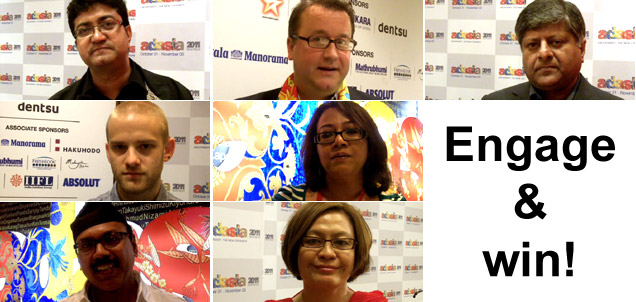
    Amid discussions at one of the biggest marketing, media and advertising meets, or AdAsia as we call it, one common thread to many a conversations was the changing reality of advertising from the consumer’s perspective. Several members of the fraternity expressed concern over the pressing need to ‘engage consumers’ in a fast changing world. MxM India caught up with a few to find out what really are the new rules of engagement.

    Keeping up with new technology and being able to deliver a digitally enhanced experience to the consumer is a growing area of focus but the underlying idea echoes the same old principle, ‘reaching out’ to the consumer.

    Prasoon Joshi, Chairman & CEO McCann Worldgroup India, Executive Creative Director of the Asia Pacific region and Chairperson, McCann Global Creative council said, “There are no new rules…it’s just that there is a new reality out there. You have to be able to understand the lives of consumers…I think if you are connected with your market, then rules or whatever you call them, will come naturally to you.”

    Furthering Mr Joshi’s view, Kelly Clark, CEO, Maxus Worldwide said that the new rules of engagement are the old rules of engagement and we have to start out by understanding customers’ relationships with brands.

    Shashi Sinha, CEO, Lodestar UM said that engagement has to come from a sum total of different activities, but foremost you need to know what the customer really likes and will participate in. Josy Paul, Chairman and CCO, BBDO India made an interesting point, saying that understanding the new rules of engagement starts from knowing that advertising might not be the only solution. Emphasizing on a collaborative model between advertisers, regional partners, PR partners and activation partners, Mr Paul said, “…it’s really about shedding your sense of the past and forgetting whatever you knew before but using your experience to assimilate and synthesize the new world.”

    Three rules of engagement recommended by Contagious Communications Consultant, Will Sansom are transparency, experience and meeting an unmet need. He said, “…First and foremost be honest…second rule is use emerging technology…and third is about identifying an unmet need and then meeting it.”

    Kitty Lun Chan, Chairman/CEO, Lowe China said that we live in exciting times where internet has revolutionized everything, and in this ‘socially-networked’ world, everyday new forms and new approaches of engagement are being created.

    Keeping it to the basics, Basabdatta Choudhary, CEO, Platinum Media underlined “relevance” as one of the constant rules of engagement in these changing times.

  • With animals, what you see is what you get. With human beings, it’s more complicated


    Make no mistake about this: Lynn de Souza has a soft, warm, chilled out, happy exterior. But inside that resides a steely, tough, hard-edged professional. And she needed all that internal strength to survive and thrive in an industry notoriously dominated by what she calls the ‘Old Boys Club’. Lynn and I go a long way back, and this made our conversation frank, fun and, yes, highly argumentative. And we discussed many issues ranging from the dubious media research, the future of various media, her role in promoting gender equality, her formula for cleaning up the otherwise scandalous Goafest. And why she, er, chooses dogs over men.  


    By Anil Thakraney


    What’s your exact job portfolio at Lintas?


    I look after Lintas Media Group, and our subsidiaries Karishma Initiative, Aaren Initiative and Lin TV. LMG and Karishma are media agencies, Aaren Initiative is the largest OOH agency and Lin TV produces and distributes branded content. I am responsible for their overall financial and reputation, health, corporate governance, etc.


    Who do you report into?


    Michael Wall, the global CEO of Lowe Worldwide.


    Would you not like a global role now, having been there and done that in India?


    Have I been there and done that in India? I don’t think so. India’s potential story is not even the tip of the iceberg, and I haven’t even travelled the whole tip yet! I would love to have a global role that is based out of India, because this is where it’s all happening. I am fiercely proud of India and all things Indian and it’s our time to show the globe a thing or two. We don’t need to be sitting in Manhattan or London to do that, in fact, that could be counterproductive.


    Would it be correct to say you’ve reached the top of the Indian media peak?


    More like the bottom of the ocean, which has the most beautiful creatures and colours in the world. There are so many challenges ahead, so much to learn and so much to do. Our lives as consumers of media are being transformed so rapidly it’s really hard to keep pace, and this rate of change is even faster in an emerging market like ours. What we thought we knew yesterday is no longer relevant today, and what we think we know today will not be relevant tomorrow. The only people who can be on top of all of this are those who want to keep learning and keep evolving and keep travelling. There is no place for those who think they have arrived.


    What’s your goal for the next 10 years? What else would you like to achieve?


    Goals are for footballers and 20-year-olds. I don’t have any. I am just happy to be alive, to have a wonderful family, to work with some awesome people, to have a few good friends, and to do my little bit for my four legged friends. I take each day at a time, that’s all, and just try to do the best I can for that day, honestly. When I was young, I did have plans and was ambitious, too ambitious. My values have changed. It’s important to be good at what you do, but it’s also important not to be so good that you become bad for everything else around you.


    Key challenges ahead for the media buyers.


    Look beyond the colour of money to the colour of advertising and media content, and the kaleidoscope of consumer insights. Get away from the keyboard and play some real piano now and then. Visit places they have never been to, in reality, and not only on 3G. Meet and talk to people from all cultures including, especially including, our villages in the length and breadth of our country. Data will never be a substitute for reality and as long as we hold on to it for dear life, we will continue to reduce the value of the media, and the consumers they deliver, to the lowest common denominator – a CPRP.


    Are our creative people ready for the new media? And the clients?


    I think the younger ones are. I have been meeting a lot of independent digital agencies recently, and it’s always great fun to meet their founders – usually young creatives and techies who have left traditional agencies and employers to write their own dreams and ‘apps’! You would also be surprised how many clients are now taking to what you call ‘new’ media like fish to water. There are lot of questions and uncertainties and domain knowledge issues of course, but there is no dearth of desire to learn, because user technology has become so easy and enjoyable that once they use the digital spaces for themselves, they want to start using them for their brands.


    Was media unbundling a good thing? You pioneered it.


    It was the best thing to happen to the media function. Till then, media planners were languishing in the backrooms with their big red NRSs and estimates, always at the tail end of a presentation and often sent home without even presenting. Making the function profit seeking in its own right attracted the right kind of front-room talent, investment in tools and databases and the ability to then cope with a magnifying media world. Which industry has seen such an explosion of new offerings in such a short time – 600 TV channels, 70,000 print titles, 350 radio stations, and countless websites, all in 15 years or less? Unbundling has allowed us to specialize enough to cope with this growth, possibly even enable this growth.


    Predict the future of the print media in India. Newspapers are shutting down all over the world.


    You need to separate form from content. Newspapers abroad have digital versions that have a much larger following than the newsprint version. I read the NY Times every day because the reading experience is so enriching, it doesn’t matter that I don’t live in that city. As long as people have eyes, they will read, and as long as they read, there will be something delivering the news to them in a written form… in newsprint or cyberspace, or Kindles, how does it matter? About India, do you know that the highest read newspaper in the world is a Hindi daily? Regional language papers have trebled in readership in the last ten years. Tier two and three cities, where literacy is still not even 70% and growing, register the highest growth.


    And what about television?


    TV will be fully digitized very shortly and this means that the convergence of content across digital broadcast, web and telephony platforms is almost here. My agency is already producing content for television, re-purposed for mobile, and developing web apps to go along. As are many others. Consumers follow and lead content, so to track them and predict their behavior will be very important, our measurement systems will need to keep pace and adopt new technologies to capture, retrieve and analyze data.


    There are too many complaints about media research in India. What can be done to change things?


    There’s an overload of data in some aspects. We have different data sources for different media. And there’s no one single source available. That’s why many of the media agencies invest in their own studies. We have our own, for example. What worries me is that nobody’s looking at the future. So that we have future-ready research which is truly centered around the consumer. I told the IRS people that they need to think ahead. They have a 10-year-old way of collecting data and that has to change.


    Also TV viewership measurement.


    That’s why you can’t recommend media only on that basis. Which is why a lot of us have our own proprietary research which picks up a whole lot of other aspects. You cannot rely only on these data sources.


    That’s no solution. We need few but reliable research studies which the whole industry can follow.


    It’s not necessary for everything to be done at the industry level. You do things at an industry level when you want a currency. When you want a common parked research where both the buyer and the seller access it, so it becomes a currency. But if you want to do things that are genuinely good for the brand, you develop a whole lot of other proprietary studies, which many of us do.


    Lynn, frankly I am disappointed with you. You’ve spent a lifetime in the media industry, you’ve done it all, you’ve made your money. Isn’t it time for you to think of the industry and take on the challenge of reforming media research so that everyone benefits?


    If I did that, I wouldn’t say it to you. If I had any ambitions that I want to change something, I would quietly go about doing it my way. Three years ago, I didn’t want that there should be two research agencies, the IRS and the NRS. I was sitting on both the committees and I found both doing the same things, both saying the same things, so I said why can’t they be together. So quietly, at both meetings, I would suggest let’s have only one study. It took three years of doing this before the RSCI got formed. They’ve elected me as the first Chairman and we had our first meeting only last week. I am hoping we will change the readership agenda of this nation. Print is still the largest medium in India, and if the RSCI works out, we will make a big change. But I won’t thump my chest and say ‘Hum yeh kar rahe hain, hum woh kar rahe hain!’ (Laughs.)


    Not enough. You should take on media research full-time, and become the Queen B who made a huge difference.


    (Long pause.) I promise to give it a serious thought just to please you. (Laughs loudly.) But I will not commit to anything you wish me to commit to!


    You’ve cleaned up Goafest. There were no scandals this year. How did you do it?


    I am a great delegator. And I give a lot of respect to people I delegate to. So we had Shashi (Sinha) completely given the role of running the awards. I gave Sundar the role of running the conclave. I looked after the organizing and the venue. The most important thing I did for Goafest was to create an impression of being clean. I looked for a very clean looking place, I changed the venue itself. So it looked fresher, cleaner, greener. That had a very subtle effect. Then, I roped in the ASCI and the IAA with the responsibility agenda on the first one and the sustainability agenda on the second one. That gave the impression we are doing something good for the industry, and not just pampering creative egos.


    How did you handle the problem of self-voting?


    Shashi led that and he did a fantastic job. People were not allowed to self-vote. One or two individuals who were supposedly high on self-voting in the past were not included as judges this time.

    But Lintas still won’t take part in the awards…


    We do not have any confidence in the awards given by our peers. I was given a job to do, to chair Goafest. I was forced to do it, and I did it to the best of my ability. But that’s different. You know, I served at the Cannes media jury in 2009 and it was a fantastic experience. It was professionally run, it was technically advanced. I have served on the Indian juries as well, and it was nonsense, though am sure this time around they did a better job. I have seen the behaviour of our peers, the kind of lobbying and planning that goes on. As an agency we are not into chest-thumping. But when our agency wins awards because our clients have won, I value those because the consumers voted us.


    But now that you’ve cleaned up the place, will Balki take part next year?


    That you have to ask him. But it has to do with the value you place behind awards. Not everyone thinks awards are the best thing in life.


    Looks like you’ve fallen in line with Balki’s ideology.


    (Laughs.) On the contrary he may be falling in my line! We have our own independent reasons.


    What’s this about women’s rights you’ve been promoting?


    Internationally, diversity and inclusion is a big agenda. As a part of that agenda, two years back, IPG asked me to set up and lead the women’s leadership network. Initially I refused. I didn’t think there should be segregation of any kind. Later I studied the subject in detail, and I realized there’s a very powerful economic reason why you have to support women. There are three ‘Ws’ that will transform this century: Web, Weather and Women. And the power that women are exerting on this century is enormous. It’s said if women were empowered at Wall Street in 2009. things wouldn’t have been the way they were. In India we have 29 women heading banks and financial institutions. So there is an approach that women bring to the table that improves the productivity of a team. So it’s important to keep and retain women. At IPG, 30% of our staff are women, and when you come to the top, it’s just 11%.


    How do we change this inequality?


    We need hardcore practices in place. We can have a hiring quota set aside for women. I believe last month Hindustan Lever hired only women. We need to make everybody conscious we are not doing anything special for women. We have to make men and women understand that when you work together, you do well. For example, Coca Cola has something called the ‘Power of 3’. They believe that in any big team, the minute you have three women in the team, the group becomes far more productive. And if you have just one woman in the team, she gets eaten up.


    But Lynn, women falling out along the way is a social problem. Babies have to be looked after. How will you change that?


    You try and keep them engaged in the work orce. Some of the things we’ve done include giving them the option to work from home when they are pregnant. By giving them a desktop mirroring system at home. That’s literally like working in the office. There are lots of such ways in which you can keep women productive even if they have babies.


    Personally, I am quite cynical about this whole thing. You can’t change deeprooted beliefs and attitudes so simplistically.


    Anil, you are basically cynical about everything! Anil ‘bloody cynical’ Thakraney! (Laughs.)


    Why are all ad agencies headed by men?


    In the creative agencies there is a very strong old boy’s club. It’s very difficult for women to break through into that club. And if they don’t play by those rules, they will not break into it. Read my blog on this (link).

    Exactly why were the 3As of I guys giving you stress? Why didn’t they want you in?


    (Long pause.) Because I am clean.


    You found corrupt activities going on?


    (A longer pause this time.) No comment.


    One rival media chief you admire.


    Sam Balsara. He’s awesome. A hardcore desi boy with so much energy, he does so much.


    The best boss you’ve had.


    Ravi Gupta. And Steve Gatfield.


    One thing you learnt to do from Roda Mehta?


    Two things. Precision and integrity.


    One thing you learnt NOT to do from Roda.


    (Thinks.) Over-precision. Beyond a point you have to just let it go, you don’t need perfection.


    Roda didn’t just do the media job, she built the media planning and buying industry in India. None of you guys have been able to do that. She was a game changer.


    It’s not needed. You don’t need a crusader in today’s world. You need inventors and innovators. In today’s world we need enablers. Twenty years ago it was different, it was the licence era, there were strictures and rules. Today there’s far more freedom. No one wants a crusader. Everyone wants an enabler.


    Would it be correct to say you love dogs more than men?


    (Laughs.) Why only dogs, any animal. With animals, what you see is what you get. With human beings it’s more complicated.


    Is that the reason you are still single?


    No, it has nothing to do with that. I didn’t find anyone as intellectually stimulating as… my dog! (Laughs.) Are you happy to hear that?


    Have you watched Balki’s two films?


    I haven’t watched ‘Cheeni Kum’ yet. And Balki hasn’t forgiven me for that. But he sent me the ‘Paa’ DVD, and I really liked it. I didn’t watch the last five minutes of the film though. Because I wanted to make my own ending. I wanted the character to live. So I made him into a dog. (Laughs.)