Tag: Shailesh Kapoor

  • Shailesh Kapoor: Same Day. Same Slot. Three Launches. It Happens Only In India!

    By Shailesh Kapoor


    It has been an action-packed week for Hindi GECs. Three shows launched in the same slot on the same day, earlier this week. Monday, August 18, 2014 saw the action unfolding at 8.30pm, with the simultaneous launch of KBC on Sony, Nisha Aur Uske Cousins on Star Plus and Udaan on Colors. Zee TV had launched a new show in the same slot (Jamai Raja) two weeks ago.


    We have had instances of a channel launching upto six new shows on the same day. But three big channels launching new properties on the same day in the same slot has to be a first in the nearly 25 years history of Hindi GECs. In a category where new launches have increasingly struggled to open well, this has to be counted as a very odd happening.


    The equivalent of this would be three big movies releasing on the same Friday. Or three cola brands launching a new campaign in the same week. Can you remember either of that happening ever? Probably not. Which brings me to the point of this piece: Are we an under-coordinated industry?


    Anyone who knows the way information flows in the Indian television industry would tell you that it needs no spy work to find out launch dates of new shows. The information is available everywhere, at the junior-most levels in channels and production houses. In any case, coming-soon promos for these shows have been running for weeks. That would be enough time to find things out.


    Yet, when I see channels taking each other head-on, it indicates a certain insular approach towards the business environment. As it is, getting sampling on new shows is a tough task. If three new launches happen at the same time the same night, all are bound to feel the pinch, though some more than others. Building from a low base of viewership is possible, but lower the base, the more challenging is the build-up task.


    There’s a lot of FPC planning that’s going on in GECs all the time. But it’s taking a more tactical form in recent years. Launching head-on against another well-promoted show is a strategic blunder, especially when an extra week would not make any discernable difference whatsoever.


    But one can imagine why it’s happening. To understand this, let’s look at the probable outcome next Thursday, when the ratings are out. At least two, if not all three, shows may open below expectations, because of the fragmentation of new viewers in a highly unpredictable slot. However, show openings are marketing and communication KRAs, I understand. And that’s a department that’s likely to have the least say in the decision to launch head-on. In the end, all you can do to resolve this anomaly is a corridor discussion that borders on pontification.


    52 weeks a year, six channels and at least eight daily fiction slots in a day gives us total of 2,496 possible launch day-slot options. The number of fiction launches in a year are only about 50. What are the chances even two, let alone three, fall on the same day-slot combination? It’s a version of the classical ‘Birthday Problem’ (visit the Wiki to know more). The answer would be very low, less than 1% for two shows and close to 0% for three shows.


    Yet, it happened. Only in India!


    TV Trails is a weekly column written by Shailesh Kapoor, founder and CEO of media insights firm Ormax Media. He spent nine years in the television industry before turning entrepreneur. The views expressed here are his own. He can be reached at his Twitter handle @shaileshkapoor


  • Shailesh Kapoor: Informed Gut: The Evolution We Need

    By Shailesh Kapoor


    In channels with original content (which accounts for 70% of all channels on-air), launch periods of new shows can be full of nervous energy. You can sense the vibe around the office. You see busy people all around you. Episodes have to be delivered, marketing campaigns are being planned and executed, media plans are being firmed up, cast members are on city tours and the PR team is in high-action mode, episodic promos are being planned for the post-launch week, etc. Urgency is the operating word.


    An average launch would witness this cycle for about three weeks. With about 10-12 launches a year, a channel is in “launch mode” for about 35 weeks every year. That’s more than two-thirds of calendar time, and about 80% of actual working hours time, given that the other 17 weeks would tend to be slightly relaxed.


    At the root of deciding whether this 80% share of annual effort delivers or not is, of course, the choice of content itself. Production, branding and communication are important, but marketing axioms tell us that no marketing or execution, however brilliant, can save a bad or an irrelevant product. Hence, spending time, effort and money on trying to make poorly selected content work is like hiring the best pilot to fly a faulty plane and hoping it won’t crash.


    Content selection, then, is the all-important starting point around which the 80% effort (and indeed 80% results) pivots. Prudent selection of themes and ideas, when backed by good execution, can deliver magic. But reckless and thoughtless selection of content is bound to create failures.


    Having observed various channel cultures closely over the last six years, my estimate of the proportion of total time and effort that actually goes into content selection would be a generous 15%. Money-wise, it would be less than 3% (Here, I talk about money spent on content selection decision process, not on the content itself).


    A rational mind would struggle to justify this dysfunctional scenario. It’s like the 80:20 rule with a twist, whereby what has 80% impact of your business gets less than 20% of your resources, while what has only 20% impact on your business gets 80% resources. Why should this be happening?


    The umbrella reason comes down to the much-misunderstood notion of “gut-feel”. There is a general sense (and even broad agreement) in the industry that gut-feel should prevail while selecting content. And applying gut feel takes neither time, nor effort or money. Gut-feel is about key people having the ability to take the right decisions, based on their experience and understanding of the category and its consumers.


    There is an evident problem with this argument. It is well known that 70% of all new content fails to deliver. So that’s the report card on gut-feel at an industry level. Some of the biggest blunders in our television history have been commissioned by the same creative directors and channel heads who were responsible for some of the biggest success stories. That says a thing or two about the ability of gut-feel to consistently deliver.


    That’s where the notion of “informed gut” comes in. Discounting gut, especially in a creative business, is neither recommended nor realistic. But gut, when combined with good evidence, can create an environment where content selection thrives on solid principles that combine creative instincts and business (consumer insights and financial) truths.


    Channels tend to sometimes take one of the two extremes – either go only by gut, or when failure rates peak, set a process where gut is given no credence and the entire selection process is driven by business truths alone.


    Ideally, gut itself should be seen a part of the business truth. Creative heads with an open mind and a penchant for business deliverables should be able to espouse the idea of informed gut, given its inclusive nature and its essential win-win premise.


    Informed gut can be spoken about, even understood. But to make it a principle of running a channel business in India is a tough challenge today. Hope the times to come show us some evolution in this direction.


    TV Trails is a weekly column written by Shailesh Kapoor, founder and CEO of media insights firm Ormax Media. He spent nine years in the television industry before turning entrepreneur. The views expressed here are his own. He can be reached at his Twitter handle @shaileshkapoor


  • Shailesh Kapoor: Too Much Oxytocin on TV? Try Adrenaline

    By Shailesh Kapoor


    If you have been watching Star Plus’ Mahabharat, you would know that the worthy show is nearing a worthy conclusion soon. The story is currently in the latter half of the epic Kurukshetra war, though the mindgames off the battlefield are equally, if not more, intriguing.


    The sudden and decisive jump in Mahabharat’s ratings over the last two weeks has been heartening to see. From averaging 3.1 TVR in Week 25-28, the show jumped to 4.4 TVR in Week 29, and has held onto that number in Week 30 too. This is the period when the battle has gathered steam, and stalwarts like Abhimanyu, Bhishma and Drona have been killed, but not before providing high drama and excitement.


    Conventional television wisdom may suggest that war scenes are not the most TV-friendly content, especially in the Indian context, where GEC viewing is still largely family-led. I’m not sure if Indian parents would want their children to see Bheem drinking Dushasana’s blood. Wars are essentially violent, and that female audiences have low thresholds for violence is a universally proven fact, both via research and science.


    Yet, war is working. Not just in Mahabharat, but recent war sequences in Jodha Akbar and Maharana Pratap too have managed to pull in new audiences, and engage the existing audiences better. There could be several reasons for this, but the one I find particularly strong resonance in is: Adrenaline.


    Several years ago, I heard a channel programming head remark: “Television is all about hormones”. The line has stayed with me ever since. It has eternal relevance, because it is based on how we, the human beings, are made.


    Some recent work made me read up more on various hormones and their functions. I was seeking correlation with their impact on television and film content. Essentially, almost all the explanation came down to three hormones – oxytocin (the love hormone), endorphins (stress-reducing or the happy hormone) and adrenaline.


    More than 90% of successful television and film content can be explained using one (or a combination) of these three hormones. Oxytocin gets its due when we speak of romance, chemistry and falling in love. Its impact extends to love that may not be “romantic” in nature, like a warm hug given by a mother to her child.


    Endorphins reduce stress, and the comedy genre is known to activate the release of this set of hormones. Indian audiences have even coined a phrase for it, something that everyone who works with us is familiar with: Mind Fresh.


    But adrenaline has been generally ignored. Being more “outdoorsy” in nature, this hormone tends to link closely to male content preferences, than those of female audiences in India. But increasingly, its impact is being observed in our work. This impact was strong enough for us to include the impact of adrenaline as a separate parameter in our content testing tool Ormax True Value earlier this year.


    If you have been following the Commonwealth Games closely, you would have noticed that weightlifters are given a sniff of adrenaline by their coaches just before they step forward to make their lift. A battle scene, if executed well, can provide a milder form of that rush to the audience at home. (I have never sniffed that adrenaline, so not quite sure of the comparison. Wonder why it is even legal for lifters to do that!)


    Indian content makers and analysts have ignored adrenaline for a while now, probably because execution capabilities to deliver the rush were missing in this marketplace. But that may be changing fast.


    It’s time the ‘josh’ hormone got its due!


    TV Trails is a weekly column written by Shailesh Kapoor, founder and CEO of media insights firm Ormax Media. He spent nine years in the television industry before turning entrepreneur. The views expressed here are his own. He can be reached at his Twitter handle @shaileshkapoor


  • Shailesh Kapoor: Pro Kabaddi: A Giant Leap for a Dying Sport?

    By Shailesh Kapoor


    When I first learnt that Star Sports are investing in Kabaddi, I rubbed my eyes in disbelief. A wrestling league, or even a boxing league, would seem like a good idea, given the talk value around these sports in recent years, especially in the wake of India’s creditable performance at the global stage, including the 2012 London Olympics. But Kabaddi?


    India has monopolized the sport at the Asian Games, winning all seven golds since its introduction in the event in 1990. But the primarily sub-continental sport has not found many takers outside South Asia. Awareness of the sport is very low amongst young audiences, many of who confuse it with the traditional Indian (dying) sport of Kho Kho.


    Star’s decision to invest in Kabaddi, then, can be labeled as ‘high-risk’, a decision that would have to rely on exceptional execution to even find a critical audience in its first season. To their credit, having taken the decision, they have gone all guns blazing, with some good advertising and high media visibility. The simulcast on Star Sports and Star Gold will also help in widening the reach in the first year.


    But you can’t “buy” relevance and appeal for a media property. It needs to be intrinsic to the content. Hence, it was with great curiosity that I tuned into the first four games.


    My skepticism about the league has reduced considerably, say from 9/10 to 5/10, having watched the first two days of action. The last I watched Kabaddi was probably back in mid-90s. What I saw this time was strikingly different and several notches higher in entertainment than the sport I had imagined Kabaddi to be. Here’s why:


    1. Shifting from mud to mat makes the sport visually cleaner and colorful. It is far more appetizing for TV than the ‘brown sport’ I remember from the 90s.


    2. The rules have been changed to make the sport fast-moving and contemporary. There is less scope for time-wasting and the speed of action is higher than most other contact sports.


    3. Hindi and English commentary are both available. The quality of commentary is very acceptable, and there’s a lot of focus on explaining the rules in the early games, while maintaining the energy of the event.


    4. The celebrity quotient is present in good value. If it is only a function of the opening matches being in Mumbai, we will know soon. But if it sustains, the celebs would generate a lot of chatter around the league, a critical aspect in the first year.


    It’s difficult to say if these steps will be enough to make the league work. But they at least give it a chance. I believe there’s definite entertainment on offer in the league, but the ratings would tell us over the next few weeks if the young audiences across India connect with this form of entertainment.


    Even a moderately successful first year should encourage the organizers and Star to come back stronger in the second year. Other sporting leagues, including the much-hyped hockey league, have struggled to sustain themselves after a season or two. Star Sports Pro Kabaddi will hope to buck that trend.


    TV Trails is a weekly column written by Shailesh Kapoor, founder and CEO of media insights firm Ormax Media. He spent nine years in the television industry before turning entrepreneur. The views expressed here are his own. He can be reached at his Twitter handle @shaileshkapoor


  • Shailesh Kapoor: Yo Yo Honey Singh: TV’s Latest Superstar

    By Shailesh Kapoor


    Last week’s TV ratings released yesterday, saw Colors take the No 3 spot again. A quick look at the programme performance revealed that a key contributor to their small but significant growth was the Comedy Nights With Kapil episode telecast on July 6. That episode rated a cool 63% more than the average performance of the show over the last month. So who featured in this magic episode that broke all rules of momentum? Salman Khan? Shahrukh Khan?


    The answer is: Yo Yo Honey Singh.


    Yes, the singer-composer-performer, famous for his innovative (some may call them cheesy) rap numbers, and infamous for misogynistic lyrics from his past, is now a television star too. When you have 63% impact on TV ratings, you are a real mass star, someone who has the ability to influence audiences across markets and age groups.


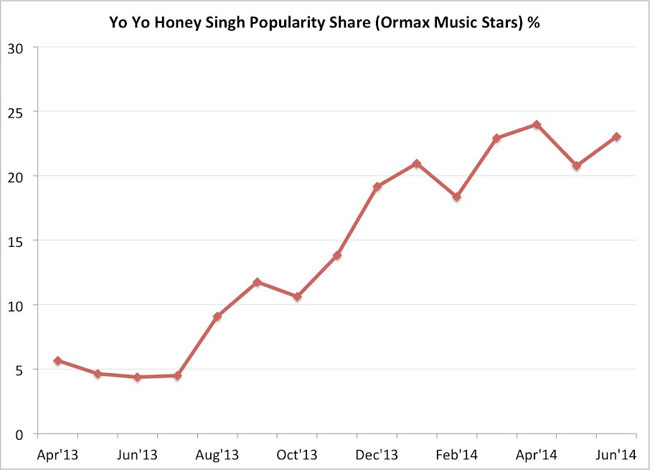
    Yo Yo Honey Singh’s popularity has grown dramatically over the last year, since the launch of Lungi Dance (Chennai Express) in end July 2013. The chart below, based on Ormax Music Stars, a popularity rating of singers, composers and lyricists, shows how his popularity share has grown from 4% before Lungi Dance to 23% today.


    The Comedy Nights episode in question (watch here) gives an insight into why the man is so popular. There is a natural ‘rockstar’ attitude he exudes, and when combined with his ability to use contemporary language in his lyrics, it makes for a heady combination.


    Often questioned about the use of ‘risqué’ lyrics in his songs, especially those involving liquor and ‘objectification’ of women, Honey Singh has been very forthcoming in his answers, be in Anupama Chopra’s show earlier this year or the Comedy Nights episode linked above. He maintains a consistent line of argument, suggesting that his lyrics are potentially no less controversial than some of the classic melodies of the past, but for their use of modern lingo making them come across as such.


    Criticism, especially from the media and the elite, has rarely affected mass stars. With his ever-growing popularity among kids, teenagers and youth, and a widening net extending to markets outside North India, Yo Yo Honey Singh probably considers the criticism an integral part of his image, and not necessarily a negative part.


    A quick visit to his Facebook page gives us a validation of his popularity. 22 million fans is no mean feat. But the mention of “business agents & contacts” on the masthead tells you that he’s still coming to terms with his stardom. Imagine Ranbir Kapoor or Alia Bhatt putting their agent details on the social media?


    But this element of ‘tackinesus’ may have worked in Honey Singh’s favor, finding him fans in the masses, even as most young stars, ranging from singers (Arijit Singh) and actors (Siddharth Malhotra) continue to be driven by the bigger cities.


    Star Plus is launching Raw Star with Honey Singh soon. Given their overall dominance, the channel’s non-fiction record in recent years has bordered on being embarrassing. But they now have solid ammunition at their disposal: The TV star who can give 63% jump in ratings of a long-running show. Ironically then, the Comedy Nights ratings would have probably led to more celebrations at Star than at Colors.


    I hope our media gives Yo Yo Honey Singh more coverage. Else, we may be missing out on some very insightful stories around the making of a superstar.


    TV Trails is a weekly column written by Shailesh Kapoor, founder and CEO of media insights firm Ormax Media. He spent nine years in the television industry before turning entrepreneur. The views expressed here are his own. He can be reached at his Twitter handle @shaileshkapoor


  • Shailesh Kapoor: Bade Achhe Lagte Thhe: A Goodbye

    By Shailesh Kapoor


    Circa May 2011. In a stressful television primetime, where most hit shows were either about “smart” women trying to adjust in a challenging household, or about social issues dominant in small-town and rural India, came Ekta Kapoor’s Bade Achhe Lagte Hain (BALH). Last night, three years and more than 600 episodes later, the show bid goodbye to its audiences.


    BALH’s premise, of late marriage between a couple as different as chalk and cheese, was only mildly unique. But as episodes unfolded, it was the treatment of the subject that captivated millions across India. The show provided a mix of ingredients that made for an irresistible offering: Imaginative lead casting, a well-etched out ensemble, assured performances, crackling chemistry between the leads, lavish yet tasteful production and a lightness of treatment that was striking in the middle of countless other shows that were beinghandled with a heavy hand.


    The results were instant. The show jumped to being one of the top shows on television within weeks of its launch, with blockbuster performance in the metropolitan markets. Audiences who had actively sworn off primetime Hindi fiction went back to it, and Ram-Priya, or RaYa as they are called on social media, were the talk of the town.


    In my book, BALH remains the most influential TV launch in the last decade, along with Balika Vadhu. (Co-incidentally, the title ‘Bade Achhe Lagte Hain’ is derived from a song from the film ‘Balika Badhu’!) Its impact on primetime television was evident in the way the proportion of ‘mind fresh’ (read light-hearted) content increased across channels. Happy moments and fun side-characters were incorporated even in serious subjects, to deliver to what was commonly referred to the industry in 2011-12 as ‘BALH audiences’.


    The show also did well for the careers of many of its cast, especially Ram Kapoor. He started getting important roles in films, though his latest and most significant outing (Humshakals) was an embarrassment on all counts. Sakshi Tanwar (Priya) has been the most prominent brand endorser from the television industry over the last three years. Sumona, who played Ram’s sister, bagged the prestigious role of ‘Kapil ki biwi’ in Comedy Nights With Kapil.


    Like many other successful shows, BALH overstayed its welcome. The first generation leap it took, in mid-2012, was the start of the descent, though the introduction of a new child character (Pihu) postponed the inevitable for a few weeks. But eventually, the show lost its audience, as it began to lose the very lightness of touch it initially won the audience’s hearts for. The farewell, hence, was only a foregone conclusion.The show ends to make way for Amitabh Bachchan’s Yudh.


    Yet, in its golden period that lasted about a year, BALH gave us many memorable moments, including a delightful honeymoon schedule in Australia. It also gave us the first real kiss on primetime television in India, an event that took the social media by storm, even as the audiences struggled to come to terms with the shock of seeing a lip-lock in the primetime.


    I can’t say I will miss Bade Achhe Lagte Hain, because that will need going back to 2012. But I hope we see more of its ilk – shows that can shape the future of primetime television in India for the better.


    Bade Achhe Lagte Thhe!


    TV Trails is a weekly column written by Shailesh Kapoor, founder and CEO of media insights firm Ormax Media. He spent nine years in the television industry before turning entrepreneur. The views expressed here are his own. He can be reached at his Twitter handle @shaileshkapoor


  • Shailesh Kapoor: OOH Media: Television Marketing’s Favourite Indulgence

    By Shailesh Kapoor


    Two decades of satellite television in India have seen many changes, including some watershed ones. But the more things change, the more they remain the same. Sometimes, there can be greater insight hidden in what has remained the same, than what has changed. For the television business, it is their love for the outdoor media that has stood like a rock for two decades now.


    This love started as a natural fallout of the reverence the television industry had for Bollywood in the early ’90s. Anything films would do for promotions was seen as cool and even effective. Never mind if measures existed or not, or if the target audience of the TV show in question had any connection with theatre audience profile or not. That being the context, “how many hoardings” was a very important question.


    In one of my early assignments in 2000, I was in charge of launching a new weekly fiction series. Working with frugal marketing spends, we decided to stay away from the outdoor media. Little did we know what was in store for us. About two weeks before the launch, the producers decided to hold back episode deliveries because they felt their show was not being promoted well. “We don’t see any banners”.


    An executive producer in the week before a show launch can be a bundle of raw nerves and hence a mess to deal with. “They are saying we don’t see any banners”. After decoding the terminology in my head (banners, hoardings, billboards, posters… all used interchangeably in India, I now know) I replied: “If they could see any, it won’t be short of a miracle. I don’t have a budget to take any outdoor on this launch.”


    A day later though, I was at the producer’s office, showing them outdoor creative, and taking them through the Mumbai outdoor plan, which included about five hoardings, out of which at least two were in Juhu, within a couple of miles from the producer’s home-cum-office. I had been sanctioned an additional budget the previous evening to make this happen.


    Conversations around buying strategic outdoor sites that senior management encounters on the way from or to their home are not uncommon. “It will be very visible to the MD when he goes for his morning walk,” I was once told.


    Several channels invest in an outdoor plan to create buzz amongst the trade – the advertisers and the media planners. Perhaps that principle was valid in the ’90s. But today, non-digital media being used for trade marketing in the media industry can only be seen as a wasteful expense.


    Regarding the impact of outdoor on consumer awareness or sampling of a new launch, the less said the better. We have conclusive large-sample evidence to prove that general outdoor media contributes (make that NOTHING) in a film’s marketing plan. But point-of-sales OOH, i.e., advertising in the theatre, is highly effective. For television though, ‘point-of-sale’ is at home. The closest outdoor media to it is the mode of transport that brings a person home – the local trains, the metros, the local buses, etc. Even for them, effectiveness is limited, given that many launches target an audience that hardly steps out of home. In smaller towns (<1 lac population), the medium delivers better results as 3-4 sites can cover a sizeable proportion of the city at a fairly low cost.


    But the Mumbai story is one of indulgence and prestige, than one of intelligence and prudence. Upto 10-15% of marketing budgets of some launches are spent on just the Mumbai outdoor budget. There is no measurement of the impact. But by extension of that argument, there is no measurement of the wastage either. Little knowledge can be a dangerous thing, right?


    This is a classic case of the “If I see my own campaign a lot, I feel my campaign is very visible” syndrome. The syndrome has stayed with the industry for two decades. Bollywood has nurtured it for more than five decades, though they are now questioning it more than ever before.


    Hope television follows suit!


    TV Trails is a weekly column written by Shailesh Kapoor, founder and CEO of media insights firm Ormax Media. He spent nine years in the television industry before turning entrepreneur. The views expressed here are his own. He can be reached at his Twitter handle @shaileshkapoor


  • Content testing tool Ormax Xpressive launched

    By a correspondent


    Ormax Media has announced the launch of Ormax Xpressive, an automated facial coding based content testing tool. The product is powered by Europe-based RealEyes, a global thought leader in facial coding services.


    Ormax Xpressive can be used by media companies, such as TV channels, film studios, content producers and media agencies, to test video content ranging from 10 seconds to one hour in duration. Ormax Media have already tested 11 videos using the tool, even before its formal launch slated for this week.


    Speaking about Ormax Xpressive, Shailesh Kapoor, CEO – Ormax Media, said: “Facial coding based testing captures the consumers’ actual behavioural response to the content being tested, instead of relying on them answering a set of questions. The product is based on the premise that for any content to work, it needs to emotionally engage with its target audience. Decoding facial expressions into emotions enables us to measure which specific emotions were triggered off by the content, at a second-by-second level. We are extremely proud to bring this technology to India, in association with RealEyes.”


    Alex Slater, Commercial Director, RealEyes, added: “Every day we’re bombarded with thousands of marketing messages. But to achieve any sort of cut-through, you’ve got to move people.  If 80% of behaviour is determined by the subconscious, why is it that 90% of research seeks to mine the conscious, rational brain? The face doesn’t lie. Facial movements are spontaneous and subconscious.  This type of emotional intelligence is richer and more pure, and it makes little demand on the audience during the test.”


    The emotions tracked by the product include happiness, surprise, confusion, sadness, disgust and scare. Data can be analysed by age, gender, markets, SECs and other relevant consumer variables. The only equipment required to participate in a test is a webcam-enabled computer. The test can be conducted at the respondent’s home or at a central location.

  • Shailesh Kapoor: In A Politely Incorrect Industry, Can You Call A Spade A Spade?

    By Shailesh Kapoor


    Those who attend movie trial shows would relate to the predicament I’m about to share. Have you seen a movie at a trial, sat tortuously through it wondering what they were thinking when they were making it, and thenfaced with with the question you would pay anything to avoid: “How did you like it?”


    Seasoned industry folk have mastered the art of responding to such questions. They would tend to say all the good things first, and then point out the big issue as an appendage: “But I just felt that if you spend some time explaining the story, the film would work better.”


    This infectious living-in-a-bubble-at-launch-time disease has fast passed onto the television industry as well. Whenever a new show goes on air, I try and sample it for a couple of episodes, purely out of a disciplined habit inculcated over more than a decade. Seventy-eighty percent such experiences are excruciatingly boring. Mediocre writing and direction is rampant, and there’s only that odd show that stands out as being smartly made.


    Whenever I liked something new, I used to make it a point to call or message my friends at the relevant channel about how it made me feel. Silence meant ‘not liked’, not ‘haven’t watched yet’.


    But of late, this formula has stopped working. Imagine that you get a message from a channel friend, who has put his heart and soul into a new project, at 8.45pm, only 15 minutes before the new project goes on air for the first time ever. His message is brimming with excitement, requesting you to watch and give your feedback, because “it really matters”.


    This scenario forces me to reply at 9.30 or 10pm, whatever the end time is. And my option to reply with my true thoughts (which could be “your team has killed the spirit of the concept you tested with us” or “sack the director now! NOW!”) can be limiting at times.


    Hence, out of no choice, and actually with a baggage of guilt, I started behaving like the filmi guy at the trial, who would slip in the big negative as an inconsequential by-the-way. But the more I thought of this behaviour, I found it dishonest on every count, both to the client and to myself.


    What’s the big issue about criticism, especially when it comes with a constructive solution-oriented approach? Can Indians stop being less touchy and more objective about their work? Can they not get that just because they have produced or marketed something, it need not blow everybody’s mind?


    We have all been on the other side at some point or the other. Listening to appreciation about our labor of love can be a high, while criticism, especially when coming from trusted parties, can deflate you. But the ratings or the box office will deflate you anyway within a week. A bubble is never a stable place to live in.So, at some point of time in the recent past, I decided to shed the fear and the inhibition, and decide to say it like it is.


    I would urge others in the business to consider liberating themselves of the responsibility of being polite and dishonest, within and outside the organization. You will discover how it can empower you from within. Not to speak of the respect you are likely to win over time!


    TV Trails is a weekly column written by Shailesh Kapoor, founder and CEO of media insights firm Ormax Media. He spent nine years in the television industry before turning entrepreneur. The views expressed here are his own. He can be reached at his Twitter handle @shaileshkapoor


  • The Past, Present & Future of Ormax Media


    Behind every channel and reality/fiction show’s success is a lot of hard work by its programming and business teams. And over the last few years by a  Mumbai-headquartered research firm called Ormax Media. It’s small in size, but big in ideas. Almost every television channel will vouch for that and in recent times other media companies too. But the maximum growth has been with films where the processes are getting structured and scientific. As Ormax Media completes six years in the business, Pradyuman Maheshwari spent an hour-odd with co-founder and CEO Shailesh Kapoor in his office last week and asked him for insights on the firm’s journey and plans for the future. Excerpts from the interview:


    Six years seem to have just flown by. As you look back, how’s the journey been?

    I think the most interesting part of the journey originates from the idea that while we are a media insights firm, we set ourselves up to be more like a media company than a research company. We are very proud of the fact that we don’t follow some of the processes and practices that typical research companies follow either in the way they approach their proposals, they way they do fieldwork or the way they write presentations and reports. We have always taken a very media expertise-driven approach instead on processes and people. It’s really worked well over time. Increasingly, when we meet our clients today, they see us less and less as a research company, but instead see us as people who understand their business well and also have a contact with the consumer. But ‘understanding the business well’ part is critical to Ormax Media’s existence.


    The fact that you were already part of the industry must’ve helped much in the early days?

    Yes, in the first year, a lot of business happened through personal contacts, both Vispy Doctor’s and mine. But that can only take you to a certain level and thereon you have to create equity and grow. I think we did something very well in 2009 and 2010, which is giving us rich dividends now. Which was that rather than just scouting for bespoke business, we focused on creating a lot of standardized products that could cater to common industry needs. Today, we have about 24 such products. Our top-end products keep us very stable in terms of our business growth.


    For example, Ormax True Value is a product we use to test television shows for GECs, kids, youth and other categories. Many channels were testing shows using qualitative research, but there was no standardized product for show testing that would give a forecast of the viewership and actually get into the diagnostics of what will work and wouldn’t, and have a very strong predictive sense to it. So once we have a product like that, which no other research company is offering, there is a natural advantage we build. If you need to test a show and you see a good product and that is the only product available in the market, you would tend to use that. And once you’ve used that once or twice and you like what you’re getting as an output and you get the confidence that this is accurate, you start using it more and more. We have used this product-led model to secure a lot of business over time.


    Content testing is a tricky business, right? Television software is very tough to forecast viewers. So, aren’t you forever treading on very tricky terrain?

    Yes, it is tricky. But I believe that forecasting any business parameter, be it box-office or viewership, has a very ‘put your money where your mouth is’ kind-of feel to it. There are times when we get it wrong too, but if we don’t take the risk, our impact on the channel’s or film company’s business is considerably reduced.


    When we were not in the forecasting business, our access was more to the marketing and research departments. Now that we are forecasting across industries, we deal a lot more with CEOs, CFOs, GMs, Business Heads and CXOs. I think that’s a very encouraging shift for us from commanding a certain market positioning. Today, 70 percent of our meetings have a boardroom impact. The number was less than 40 percent till two years ago.


    Of course, there is a lot of back-end work that goes into creating the right forecast models and generating accurate forecasts over time. A lot of data has to be collected and analysed. It’s like the black box or the secret sauce.


    Can you share some examples where you’ve made some specific comment and that possibly transformed the show for a channel?

    There’s very little I can share with names, as most such work is commissioned. But to give a general idea, there was a show we tested around three years ago. We tested it three times over a period of six months. It first tested average. There was an issue with the casting of the female lead and some issue with the narrative treatment too. But the basic idea tested well. The channel backed the idea and re-tested another pilot with a different female lead and director. By the third testing, the show had scored exceptionally well. It continues to be a successful show even today.


    Is it right to say then that Ormax has clearly moved from being essentially a research firm to now advising CXOs?

    I think that’s an accurate description of our recent journey. We’ve always had some consulting assignments, even when we started in 2008. But at that time, 90 percent of our work was still conventional research. Today, we are increasingly getting projects that are ‘mixed’ in nature, where we are playing the role of a consultant, doing some primary research, relying on some secondary data already in our system, or in the client’s system. So, we have liberated ourselves of the distinction between research and consulting, or between various types of researches for that matter. All that matters is the impact on the client’s business.


    When you speak to CXOs directly, doesn’t it create resistance with the research guys?

    There may be certain instances of that. But our Bollywood experience really taught us a lot regarding this area. Film people are driven strongly by box-office. Whether it is the studio head or the director or the marketing head, everyone understands the language of box office numbers. Even the creative people like directors and actors have a very strong orientation towards their film being a hit.


    Dealing with the film industry, we realized that the moment you can talk business language, people just open up to you and are far more willing to have discussions that they won’t have with a research company. We have applied this insight to TV, radio and other areas of our work. If we can tell you that this is the way you can increase your GRPs or TVR or whatever the currency is, then everyone would want to be in the room listening to us.


    When you have CEOs, CFOs and programming heads pouring their heart out to the problem they have, how do you manage with the confidentiality? Is that an issue?

    It’s an often-asked question, but it’s never been an issue so far in six years. Confidentiality is at the heart of our business. It is one of the core values we espouse as an organisation. Since 2009 itself, we started spending on data collection so that we build insights that are owned by Ormax, and hence, can be freely shared across clients. But the life of the data we collect on a client project ends with the project. That’s a clear distinction we make.


    We are bound by Non-Disclosure Agreements across clients. But more importantly, confidentiality, and the maturity needed for that, runs in our bloodstream as an organisation.


    Tell me a little about your structure, team size etc.

    We decided in 2009-10 that we won’t look at how the research industry is structured and replicate that. We intuitively structured ourselves as a service company instead, like say a good ad agency. We have three departments under which the 35-member team is structured.


    Keerat Grewal heads the Account Management team, which is responsible for business development, client servicing and relationship building. Amit Bhatia is a part of her team and in-charge of our Delhi business. He also handles new priority products strategy for the entire company as an additional responsibility.


    The Insights team is structured by domain. Anurag Bakhshi heads television insights, Gautam Jain leads film insights and Namrata Sukumar is responsible for print, radio and branded entertainment. Their teams include product managers and researchers.


    The Operations team, headed by Khushroo Dumasia, is responsible for quality execution of projects. We have a state-of-the-art CATI (Computer Assisted Telephonic Interview) setup in Surat, from where a lot of our products run. It’s arguably the best CATI research facility in India, in terms of technology, processes and best practices.


    What will the breakup of various domains in terms of their contribution to your business?

    TV would currently be about 60%, films about 20% and the rest put together will be the remaining 20%. All three domains are growing, and the growth in films has been the fastest – over 100% for the last two years.


    I remember you also doing work on radio. Give me an example of the work you do there.

    We have a long-standing relationship with Radio City. Also, one of our very popular products is Ormax Heartbeats. It’s a weekly music charts product, which radio stations, music channels, music labels and film studios use to decide which songs to play and promote more than others. We also have an annual RJ Track we conduct in about 10 cities across India.


    Are you looking at news channels?

    Definitely. We have a product called Ormax Brand Matrix (OBM), which is a viewership maximization tool. OBM is being used widely across genres, ranging from news to infotainment to movie channels, and of course, GECs.


    A lot of research companies offer ‘brand track’ products. The problem with brand tracks is that they are good-to-know, but not actionable. They give you a lot of data, but don’t help you convert it into specific plans to increase viewership.


    OBM is a complete 360-degree turn on the old idea of a brand track. It gives a brand track a complete viewership orientation. That’s where our domain expertise comes in handy.


    What about the kids’ genre?

    A lot of very interesting work has happened in the kids space in the last five years. Ormax True Value is used across channels to test new kids shows. Ormax Small Wonders, our kids tracking study, is now into its tenth edition. It captures media and entertainment habits and preferences of kids every six months.


    There is a lot of very satisfying bespoke work happening in kids’ genre, whereby the focus is on understanding trends and need gaps. We are very proud of our association with kid’s channels in India.


    As you said, your films business has increased considerably over the years. Are they relying more on consumer insights or have you established your expertise or both?

    I think it’s a bit of both. We’ve been very committed to growing our films business. We launched Ormax Cinematix, our flagship product in the films space, in 2010. Today, nine studios are subscribing into it for box office forecast of unreleased films and marketing inputs to improve their opening box office. But in the first year, we have only one client. We knew that film tracking and box office forecast is a big deal internationally. Our internal discussion was that we need to back our belief. Till 2012, we won’t question whether this product will work for us. We started seeing big results in 2012, and then there was no looking back.


    Our other films product is Ormax Moviescope, where we pre-test the actual film weeks or months before its release with real audiences, and give content inputs and lifetime box office potential estimate of the film. We have now tested about 40 films across studios. Word of mouth really spreads in the film industry, which is how we have grown so rapidly in this sector. TV is a little more insular.


    You’ve, in a sense, reached a stage of super-stardom in your business. There’s no direct competition, no specialized research firm doing this. So what next?

    There are two clear areas we want to focus on in our seventh year. We still believe that our journey from being seen as researchers to being seen as media super-specialists has still not finished. We’re probably 50-60% there. We want to be in a state that six months from now, we can say that we will not take work that does not do justice to our boardroom positioning. That day, we would have completed the transition. It should happen by early 2015 if all goes well.


    The second area we are focusing on is technology. We firmly believe that to remain relevant, we need to embrace the latest technology available to us, than sticking to traditional research methods. I understand we’re still not an Internet country as far as GECs or mass content is concerned. But that doesn’t mean we can’t bring in technology in another form.


    One of our recent collaborations has been with a UK-based company called RealEyes. They provide automated facial coding services. Suppose you have a video, like a promo or a trailer even a half-hour episode, you can get the viewer to sit in front of a computer and watch the content, and the webcam will record their facial expressions. In the backend, the software will analyse the emotions. When did the audiences feel happy, sad, confused, scared, etc.? It’s actually not “research”. You aren’t asking any questions. It’s behavioural data. It can be quite spooky to know that normal viewing of content can be converted into emotional response.


    We have created an India-specific product called Ormax Xpressive based on the RealEyes technology. We have already finished seven projects, even though the formal launch of the product is slated next week. The results are very encouraging. The sharpness of response we have got is something conventional research will never get close to.


    It’s like you can have your ECG and see how the heartbeat reacts when Arnab Goswami speaks.

    It’s like you just realized you don’t need an ECG! The technology is entirely via the webcam. No gadgetry is required, yet the results can be very interesting. We tested the first 2 States trailer as a pilot, when we were building the India product. The moment Amrita Singh would come on screen, the engagement with the promo will show a huge spike. This happened thrice in the trailer. It was clear that the trailer is working far more for its cultural stereotyping-led comedy, and less for its youthfulness. Claimed responses rarely give such clarity of thought.


    We’ve already started building India benchmarks. Also, you may see a graph for a promo and say this is the scene where it went up and this is the scene where it went down. But you need the expertise of the category to understand what exactly led to the rise or the fall. In a promo test, we realized that close-ups are working much better than long shots. And that became a larger point. We are now wondering if it is true in general for all promos? So, we want to and can marry technology with our understanding of content. That’s the advantage we have.


    There’s a belief that the best channels or the top shows across the world are all based on gut feel. Shows like Satymaev Jayate and Bigg Boss etc are on air more because of gut feel than research (or at least as much of both). What’s your view on this (and does basing content strategy on gut impact an insight advisory firm like Ormax)?

    My answer to this question often surprises people. Ironically, though we’re in the insights business, where we should negating gut, we’ve been quite open to the idea that gut is very important. We try and promote the whole idea of ‘informed gut’. We say, you should look at all evidence, whether it comes from the consumer, it comes from ratings, internal discussions, gut, anywhere.


    The research industry is globally moving towards evidence-based consulting, where you look at all the evidence available to you, including gut, and then you take an informed decision. We don’t enter a meeting where we’ve done some research and we say this is what it is and this has to be done. I think we put various perspectives on the table. Once the choices are sharply articulated, good business leaders find it easy to make choices. Even if they go with their gut, it will be an informed decision.


    Also, our role is to increase the probability of success. There’s no guarantee, but if out of ten shows you launched last year, three worked, if you work with us, five will work! So if we can push that ratio, we are relevant.


    You’ve been a business head of a channel yourself. Do you sometimes feel you should be sitting on the other side and actually running a channel?

    The answer is a definitive no. Just the amount of diversity of work Ormax offers, and I think I speak for many others who work here, is enviable. In the morning, if I have a GEC meeting, in the afternoon I’m working on a kids’ project, and then meeting a film studio head in the evening. Next morning, it’s probably a radio research, followed an editorial meeting at a news channel. This variety in work can create vast knowledge and always a sense of freshness. The ability to learn and grow is decided by every person working at Ormax, not by the market. I’m not sure how many media organisations can promise this.


    Would you be open for an acquisition or such a thing? There are others in the business that are looking at value-added television research.

    I think while you should never say never, at this stage, that’s definitely not a thought in the mind. Instead, there’s the thought of going public in next 2-3 years, say around 2016. There are a lot of ideas in incubation, which may require funding at some stage. We believe we have only scaled a small peak so far. There’s a lot more to achieve. But the acquisition route is not a thought on either Vispy’s or my mind.



  • Shailesh Kapoor: FIFA World Cup: Patriotism With A Twist

    By Shailesh Kapoor


    The Football World Cup kicked off last night in Brazil. The month-long tournament is the only sporting event besides the Olympics that truly unites sports fans across the world. All other sports have their catchment areas, but soccer is the world’s favorite sport by a safe distance.


    All that being said, the craze for the FIFA World Cup in India amuses me every four years. Yes, football is the second most popular sport in India after cricket. Both television ratings and consumer research show that besides WWE-style wrestling entertainment, no other sport has the potential to challenge football’s number two position over the next decade in India.


    So my amusement is not so much about the following or viewership of the World Cup. That is logical and even expected. My amusement is about following of specific teams.


    Every four years, we see news footage and newspaper stories about fans of certain teams, often the ‘third-world’ teams such as Brazil and Argentina, gathering at public places in India to watch World Cup games. These “fans” can give local fans of the respective nations a run for their money. They wear the team colours, know their team inside out and some even carry the nation’s flag on them.


    How does an Indian, who has virtually no interest in nation-vs-nation football for four years, become an ardent fan of a soccer-playing national team? There is no rational explanation to this bizarre phenomenon. But we are not the most rational country in the world, are we?


    I have two hypotheses. The first one says that the choice to support a team is to spice up the viewing of the World Cup. So you first take the decision “I must watch the Football World Cup”. The reasons for that could range from entertainment to social expectations. You then wonder: “Now that I’m watching the World Cup, I must decide whom I am supporting”. Making a favorite team choice is critical because it would create higher engagement with the tournament, and also create volatile water cooler conversations at office.


    The second hypothesis is about the choice of the team itself. Most Indians tend to go for Brazil traditionally, for the strong third-world or brown-skin connect, I believe. Argentina has been a strong second favorite. The post-colonial effect ensures most European teams are ignored, though the ones that are not-so-British (such as Spain) have found some traction over time.


    These choices having been made, the real amusement lies in the journey over the month of the World Cup. From being a forced fan to a natural fan can be some transition. But we Indians can make that transition within days, even hours. From “I choose to support Brazil” to “I love Brazil” to “Brazil BrazilBrazil” is a quick turnaround.


    And if your chosen team indeed loses, you can behave as if the world has come crashing down. Though I suspect the hurt would last far shorter than that of India losing the final of a Cricket World Cup, a la 2003.


    So, be prepared for bleary-eyed colleagues in your office for the next one month, behave like they were born and brought up in Argentina (or Brazil), and that Maradona (or Pele) is the biggest influence on their lives. And if you spot some foreign-looking flags on the streets, just remind yourself that you are still in India!


    TV Trails is a weekly column written by Shailesh Kapoor, founder and CEO of media insights firm Ormax Media. He spent nine years in the television industry before turning entrepreneur. The views expressed here are his own. He can be reached at his Twitter handle @shaileshkapoor


  • Shailesh Kapoor: Male Characters Set To Rule Hindi GECs?

    By Shailesh Kapoor


    It’s been a category dominated by female viewers and female fiction characters. Hindi General Entertainment Channels (GECs) have behaved more like Hindi Female Entertainment Channels for more than a decade now.


    The stronghold of the women on the remote continues. But the other type of female dominance – that of female fiction characters – has been challenged. As per the latest Ormax Characters India Loves report (May 2014), for the first time since we started tracking character popularity in 2009, the top 10 fiction characters list has more male characters than female characters!


    Three years ago, this would have been unthinkable. The contribution of male characters has traditionally been a token one, rarely crossing two out of ten. In the last two years, three out of ten seemed more gettable, but the female dominance remained. Last month, the balance finally tilted, with five male characters in the Top 10 and ten in the Top 20. And remember, we are talking only of fiction characters. The top 5 non-fiction ‘characters’ are all men in the same period of tracking.


    What has led to this turnaround and what could be its possible implications? A significant part of the answer lies in the list of popular characters. The five male characters who made it to the top 10 list in May are Jethalal (Taarak Mehta), Maharana Pratap, Akbar (Jodha Akbar), Krishna (Mahabharat) and Inspector Daya (CID). The list offers a good mix of history, mythology, comedy and action-thriller genres.


    Contrast this to the female characters in the top 10: Jodha (Jodha Akbar), Sandhya (Diya Aur Baati Hum), Ishita (Yeh Hai Mohabbatein), Anandi (Balika Vadhu) and Gopi (Saath Nibhaana Saathiya). Lack of genre variety is striking. Most of these characters, and others in the top 20 list, are women on a journey, facing challenges on the way. It’s a template that was created starting with Tulsi in 2000, and then redefined with Anandi in 2008. Over years, this template has been exploited to create hundreds of daily serials and characters.


    The idea of a woman’s struggle-heavy journey and her eventual victory is a powerful one for female audiences, and shall remain so in the years to come. The problem is, of course, in the same-ness of execution. It’s as if the idea is so powerful that nobody seems to care about the quality of its depiction anymore.


    The only female characters in the Top 30 who do not fit this template is Daya (Taarak Mehta) and Dadi Sa (Balika Vadhu). Everyone else is on a ‘journey’, all the time. And while the destinations may be different, the routes are strikingly similar.


    Beginning to feel disenchanted by content that is highly relevant but unimaginative, female audiences have increasingly started preferring male characters. Mahadev’s dreamboat looks, Akbar’s attitude and Krishna’s life lessons are the new cool.


    GECs would do well to act on both fronts. For one, they should capitalize on the growing interest in male characters by creating some differentiated ones. Amitabh Bachchan’s Yudh is well-timed in this regard. Two, they should consider pushing the envelope regarding female characters. We need women who take the road less travelled in their journeys, while remaining relevant to the mass audiences at large.


    Up for the challenge?


    TV Trails is a weekly column written by Shailesh Kapoor, founder and CEO of media insights firm Ormax Media. He spent nine years in the television industry before turning entrepreneur. The views expressed here are his own. He can be reached at his Twitter handle @shaileshkapoor