Tag: Sanjeev Kotnala

  • Sanjeev Kotnala: Never too late to create ‘BRAND-i’

    By Sanjeev Kotnala


    Every action of yours, voluntary or involuntary, conscious or unconscious is being absorbed by your surrounding ecosystem. Each element in the ecosystem is distorting, deleting and generalising to make the impressions acceptable to their belief system and experience. ‘BRAND-i’, is the real net residual impression or perception of you the other person carries in mind.

    Your actions pass through thousands of filters you have no control of. All you can do is to be very cautious and clear about sending the right signals and messages, hoping that they will be decoded well and not be misunderstood.

    In real life, that is asking for something impossible. Think of yourself. Think how do you react and act. People are no different. We make our impressions based on consistency of experiences. So, do others. Like us, they are busy creating a polarised perceptional matrix. None of us likes ambiguity. Our mind is comfortable with patterns and needs to slot everything. We take our pick within the paired associations and brand everyone.

    You are an extrovert or introvert, Proactive or reactive, Leader or follower, team player or individualistic, organised or disorganised, punctual or late, dependable or not, approachable or not, fair or biased, aggressive or soft, aware or unaware. I would presume you will not like to be branded by default. I am sure you have not taken conscious steps to ensure being tagged with right associations.

    There are many elements in your personal capacity stopping you from taking the right choices and actions. It is ultimately about the belief system. You will do something only if you believe you need to do it.

    Many of these beliefs hold us back and impact multiple parts of our life, behaviour, reactions, impulses and the signals that others pick up from them. This damage, our life and our capability to exploit the potential we have.

    Many of us believe ‘It’s too late, or we are too old’. Oh, yes, age seems to be a definitive barrier for few things in life. However, we all have read, shared and admired examples of people getting into new sphere or restarting their lives at an age we would consider impossible. Take the example of Colonel Sanders who had his magic chicken recipe at 49.

    On the other side, most of us have learnt to be realistic in our approach, desire and ambition. And there is nothing wrong about it. I know I am most likely not going to take that Bunge plunge from Macau tower, and it does not make me less adventurous then the time in my late forties when I took my first sky jump.

    It is up to us to decide, if we need to take specific actions to create our ‘BRAND-i’ .

    If you do not have any further ambition and passion or a need, or in case you are fully satisfied by the image you think people have of you, you may not consider taking any steps toward creating your brand. And that is understandable. It is your decision. However, I believe that there are elements that you wish to control and reshape in your life. I have no hesitation in saying that complacency with the current state is like death. I am sure, that you are not the one who has no desire to create or further sharpen the ‘Brand-i.’

    There is no compulsion to do so, there never will be, whatever you will do, will be done, because you want to do it, you want to reshape and redesign perceptions of yourself.

    ‘BRAND-i’ is always work-in-progress. It is like perfection; you never reach the ultimate destination. Your desires, ambitions and needs get redefined with every fresh set of successes or failure.

    There is no magic wand for creating ‘BRAND-I’. We have a process that is available for learners, and we keep tweaking that for individual needs. ‘BRAND-I’ is customised for individuals.

    One of the integral parts of life is – failure. All of us know that from our first-hand experience. The trick always is to learn from our failure, making something much more out of the undesired results by learning from them. Take the setbacks and reorient our efforts to create the ‘BRAND-i’.

    Every effort you make, should be aimed to create the right desired perception. To give that extra impetus to the ‘BRAND-i’ you wish to own. There is no way you will ever fail in a long haul.

    The past does not equal future. It never did. Past is not even directional representation of future success or failure. The only way to negate the negatives or failures is to create huge impressions of positives and success.

    What is your ‘BRAND-i’ today? It is the residual impression of your past impressions. That is like the story you have read. It is over. You have no power to change anything. Nevertheless, the future remains on your hand. Future is the playground, a canvas you are yet to fill with the colours you want and create a picture. Just keep on making one stroke at a time. Keep at validating, strengthening or destroying the impressions of the last experiences.

    It will be completely foolish to believe that we can choose to drop our past. We cannot. However, we can leverage it or blur it by our future acts. And a lot of what we do, comes from the learning’s from the past.

    I will be surprised if you have never suffered a silly question like; What will people say? What will happen if when you suddenly press pedal on your strategic actions to create a desired brand image? I have personally experienced it, and it held me back, until came a stage where I learnt my lesson. People will say not just something, but a lot more and everything- anything they want to. It is referred as freedom of expressions. And in the process, they delete and distort their experiences. It is natural. It is again up to you how you react. I am sure; you would not want to be seen as a person who is affected or discouraged by such acts.

    I think you will always want to write your own destiny. You internally know; you can only control the message you send out and not the impressions created. Nevertheless, with quick steps, you can always tweak them. Moreover, the magic of consistency will help aligned reactions to make the synergistic impact you wish for.

    Remember, even at the peak of it, there will always be people who will have an undesired impression. There will never be a time, when all supports you. You should be happy with the set that does support you and the set of people who do not see the life like you do. Thank them, as they help you in cross-examine your beliefs and impression. They help you create a route map to implement the desired actions.

    Many of us have a perpetual self-defeating attitude of considering ourselves not good enough. This hinders us further when we speak about creating a Brand of our own. ‘BRAND-i’. I will again say, you want or not; the brand is being created. I am sure; you are a not the kind of person who will allow it to get out of control.

    You are good, and you can be great at whatever field you choose. You can learn the desired skills and hone your talent. Remember, everyone started not being the expert in the filed. A successful actor, speaker, cricketer painter was always a bad actor, speaker and cricketer at some stage.

    Successful people are often surprisingly ordinary, until they make up, their mind and are clear about what they want to do and achieve.

    There may be many toxic self-beliefs holding you back? None of us would want to be branded by default. We have wishes, dreams, behavior and ambitions coloring our unique brand. I invite you to re-examine everything. There is no compulsion to act. However, I know; you are a person with a vision and tonnes of ambition. You will explore the power of ‘BRAND-i’ to catalyze your lives. I invite you to take this step. Don’t let destiny brand you by default.

    For spectacular results in ‘BRAND-i’, you do not have to do anything really spectacular. However, you need clarity of thoughts and consistency of actions and experiences. Cultivating the desired ‘BRAND-i’ is essentially an act of selfishness. It is deliberate and planned. It is a must.

    Because of the self-imposed biases, it is impossible to work on ‘BRAND-i’ in isolation. You need a coach, a mentor or a programme to push the right triggers. You need someone external to help you see your life from a differential point of view. Push you to raise questions and find hard answers. To accelerate your thinking and decision making. To shape up your mind to create a desired path of action.

     

  • MRSS associates with Sanjeev Kotnala as Media Mentor

    By A Correspondent


    Sanjeev Kotnala

    MRSS India, an independent market research agency, has announced its association with Sanjeev Kotnala as Media Mentor.


    Kotnala has a vast experience of over 28 years in brand marketing, management and advertising. He was previously associated with companies such as, Dainik Bhaskar Group, Mudra, HTA, and Lintas.  He is also the Founder of Intradia World, a brand and marketing advisory, training and facilitation unit.  He also writes a weekly column for MxMIndia.


    In his association, Kotnala will be mentoring MRSS on its media initiatives. He will continue to focus on his work at Intradia.


    Commenting on the association, Raj Sharma, Chairman – MRSS India said: “We strongly believe that media is a key arena for Market Research and Sanjeev with his knowledge and experience will be instrumental in MRSS joining hands with Media Houses and Brands in Print, Radio, Television and Digital. We hope to soon announce interesting properties in conjunction with established players.”


    Commented Kotnala: “This is interesting opportunity and experiment. I share the optimism, enthusiasm and passion of the MRSS India team. Collectively, we see possibilities for specific audience-related properties and association with media brands. I appreciate the open approach of MRSS and its willingness to experiment. I do think that we will have something really good coming out of this association.”


  • Sanjeev Kotnala: Does Pierce Brosnan’s class work for Pan Bahar

    By Sanjeev Kotnala


    I know this is late. In today’s world, this PANBOND event is no longer the news. However, the subject is not dead as the advertising community seems polarised in commenting on it.


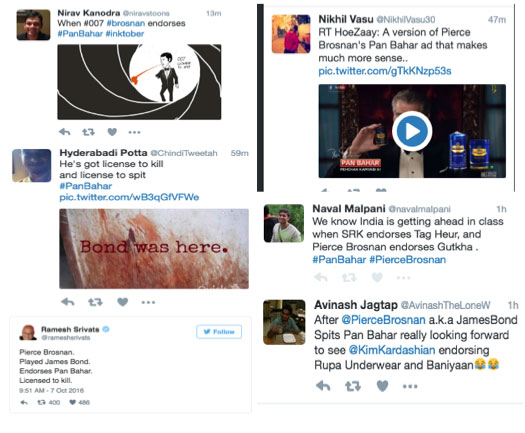
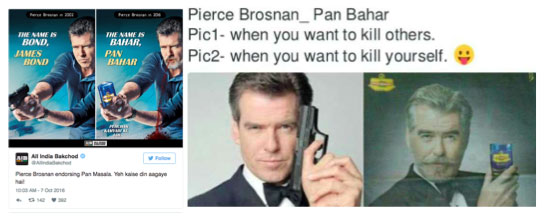
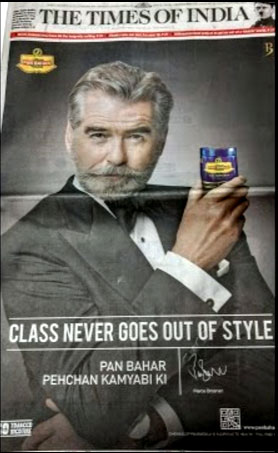
    More has been said, commented and shared on the last Friday’s seemingly innocuous front-page press ad of Pan Bahar (PAB) that was talk of social media in India. There was a flutter in the segment hyperactive in social media. Pierce Brosnan (PB), the ex-Bond endorsing such a product. It may be noted that the 007 franchise prevents a direct reference to 007. Moreover, the brand in its different avatar is not only banned in many places but is tough to imagine him enjoying it. It’s a marketing subtle difference that the endorsed brand carries ‘mouth freshener’ tag and hence does not play foul to the suggestive industry guideline. It does not violate the recommendation that such products must not use celebrity endorsement. The brand escapes with a common advertising license to execute.


    The truth remains ‘Pan Bahar’ got an opening in social media. They neither anticipated nor were they prepared for the trolls. For a change, it was the press ad and not the TVC that triggered the reaction, once again getting print an uncalled-for attention. It anyway was a full-page advertisement. Few could refuse.


    There are theories about how this happened. In the famous ‘post-rationalization’ act that the industry is well known for, many would seem possible. I have no reason not to give credence to them.


    It could be seen as a brilliant move by the agency to get a celebrity like Pierce Brosnan to penetrate and open a new segment. May be, it was the owners; hell-bent on scaling the celebrity mental barrier jumping from also ran Indian celebrities to a Hollywood item. Could the idea have originated from the agents of cash-strapped Pierce Brosnan making it an enticing offer tough to refuse? Or some crazy media maverick in the team suggested this as a route to get the amplified impact in social media at a far lower cost.


    I am never one to jump to a conclusion. So, I did what was best possible and try getting in touch with few of the consumer. The conversations suggested that Pierce Brosnan was not exactly the right choice without the 007 tag. They do not recognise this bearded face. Most of them recall the active clean shaven look of 007. So, it does not stack-up.


    If one was to evaluate this attempt as a door-opener to a completely new consumer segments and gain inroads into fashionable impressionable population, it may fail the test but is not something irregular or unexpected. Moreover, the brand has the legacy of using celebrity endorsement. Why are these so-called intellectual voices when the Indian actors continue to patronize gutka (a chewing addictive mix known for health hazards)? Oh, may be it is acceptable but why Bond of all the people endorsing this. ?


    Going by the press release, it seems a genuine act of misplaced conviction. Quoting from it: Pan Bahar, a leading FMCG brand that links its identity to success, signing iconic Bollywood stars as the face of their campaign, ups its game, presenting the Bond of all commercials, shot in distant Austin, U.S.A. with none other than Pierce Brosnan.’


    The act is justified by the creative behind it, ‘Our choice of Pierce Brosnan as brand ambassador for Pan Bahar is in line with our campaign idea of ‘Pehchan Kamyabi Ki’ (the mark of success). Thanks to his previous avatar as James Bond, Mr. Brosnan is seen the world over as a symbol of sophistication, suavity and success. And Pan Bahar, as his choice, reflects that aspiration in the consumer base we were targeting’ it definitely sounds genuine.


    I am unsure, if the spoof and jokes erupting on the subject really work for or against the brand. May be the dice is not rolling in the way the brand would want it to, but give the credit for the brand to have attempted the unexpected.


    It is not the first or the last for Indian consumer to be exposed to such an endorsement featuring Hollywood actors. It is the reaction not for the association but the brand. How could a brand like ‘Pan Bahar’ has the audacity to think and act beyond conventions?


    The tagline “Pan Bahar. Class never goes out of style,” will not have many takers. I personally do not see any harm in this upward mobile attempt of the brand. Maybe what Bollywood could not do for the brand, this old Hollywood may succeed. The strategy is a bit convoluted and not on the track, but what were you expecting in this category and a brand like ‘Pan Bahar’. It is completely synergistic with the brand’s stated approach.


    The known health hazards make the endorsement controversial. It is another instance where the consumer segment is aware that the endorser is most likely not a user. No issue there. Do we really have the same reaction to Indian Film actresses pushing soap?


    Here is the stated rationalisation of the choice which many of us will continue to find fault with. Quote from company release “For us, the decision to bring Mr. Pierce Brosnan on board as Pan Bahar’s brand ambassador speaks volumes about our vision and ambition. His class, look, style, sophistication, facial expression and body language, etc. tell a lot about the mastery, maturity and perfection, etc. – He is like a master of various talents. Pan Bahar – a master blend stands for class, success and sophistication, etc. Hence; we see our association with Mr. Brosnan as a natural fit.”


    A comment by my friend Praful Mishra puts in differently. It’s Achche Din (good days) for a desi brand and maybe not a Burrey Din (bad days) for the Hollywood stars.


    The TVC or the AV is equally obnoxious.


  • Sanjeev Kotnala: Do you have a combat strategy for a completely naked market?

    By Sanjeev Kotnala


    This is a time of great anxiety for the marketers. The traditional synchronised product development process that they so wisely learnt and understood was never a complex process. It was a seamless choreographed process. The collaborating teams from verticals like research, manufacturing, marketing, communication and sales found their unique ways to formulate benefit claims to dress up the show. The nervous consumer got his kick and the counter the sound everyone loved.


    In case of doubt, the marketers had the option to fallback on technological inspired jargon, newly initiated rituals, comparative sheets and slogans were available to enchant the consumer community. A wave of experiences and front-loading of sales was all that was needed for the brand to gain some momentum. The war of sales and distribution was fought on ground zero.


    Media and communication have always been critical for success. Slick glamour quotient upped by the celebrity endorsements along with beautiful location seduced consumers from every screen and page. Consumer continued to believe everything that was printed and screened. Moreover, consumer education in the category, product or brand usually was completed at the retail point the last point of connect.


    Marketers today are like the king with no clothes. The brand no longer can hide behind the fig leaf of campaigns and survive on after-sales service. In the era of information and technology, the new WOR (Word on Review) and comparison, nothing is hidden. The consumer does a much deeper research and finishes comparative analysis with a click. They have the power to read, listen and decipher original, copied and fake voices in reviews. Additionally, the social media allows them the chirping feedback and experience from people they trust and believe in. It is more powerful then the nest of the demonstrations and TVCs.


    Marketers rightly believed they could strengthen, create or break perceptions. I have been on that side spending nights over these discussions, and feeling elated when ever the consumer appreciated efforts by the ringing counters.


    It will be faulty to believe that the same is true today. The foundation of brand’s early imagery may still be initiated by the campaign and the buzz; however, the final skew of perceptions gets strengthened over media and input they hardly are able to control.


    Truly, in the era gone by, a unilateral unholy alliance between client and agency rarely had the consumer in sight. Earlier, role and touchpoints were very compartmentalised and hence leveraged differently, unfortunately. The boundaries have blurred.


    The consumer mindspace is cluttered and enriched with all the data and analysis much before contacting the retail salesman. We are slowly but surely moving to an era where last mile connectivity will be dominated in digital space with retail point (if at all) remaining a mere formality. The consumer belief in manufacturer statement is low. Higher credence is given to influencers, prosumers and existing users and buyers. They have their set of consumer points to refer and connect with.


    This as expected is creating a new set of third party validation of products and services. It’s not rare to find an automobile service centre calling you for good review in JD Power survey. Or the hotels and airlines follow up for fresh review with loyalty points. Earlier, such validation and reviews were more B2B-centric. Currently, they have become hygiene even for B2C and B2I.


    Brand owners and custodians may like it or not; the guard is down in the overtly naked market. The layers are slowly and surely being ripped off the celebrated positioning and promises experiences. The brand was never more naked then this.


    Unfortunately, most of the comments and reviews tend to be full of negativity and issues faced by the consumer. Not only, it’s tough for the brand to match the expectation of most of the market, but humans are known more to crib than appreciate. One cannot discount these digital pouring across social media and review sites. These are more than free unsolicited advice and feedback.


    How well-equipped is the brand to listen to the digital noise? Can it filter the contextual remarks, understand the language tonalities and its implications? Who is watching such matrices and at what frequency? How empowered is the frontline? Do they need to confer with upper management to tackle everyday situations? How good the brand is in anticipating issues? Does the brand have a cohesive policy of internal education on issues of market nakedness? There are too many right questions with few complete answers.


    What is liked and who like’s it, is a valuable trigger for future sales. More important is that the reviews also tell you what is being disliked or what are the points in product, brand or service the marketer need to iron out? Reviews are the opportunity to engage the audience. It will most likely create a positive impression if the organisation starts listening and acting on the needs.


    ‘Good news must travel, but the bad news must travel faster’. The organisation must be alive to such situations and convert them into positive experiences. There is an absolute need for efficient management of external perceptions. For this, there is a need for review, buzz and feedback promotion strategy, along with listening and monitoring the noise. In this, a system that is empowered and does not require frequent escalation works best.


    Remember that digital impressions are never can be wiped, they are permanent in nature. The organisation of today have to engage all consumers, satisfied or irritated. The only way to burry a negativity is to create higher level of positivity.


  • Sanjeev Kotnala: Model Village approach; the need of Rural CSR

    By Sanjeev Kotnala


    If one was to believe the rural masses and the message that comes loud and clear, then there is nothing called Corporate Social Responsibility. There are NGOs and charities but no CSR.


    The rural masses are clear that the need of CSR is seen as the failure of GSR or Government Social Responsibility. Truly so, as the government sees CSR as an efficient low-cost alternative towards an inclusive growth.


    If a company takes care of its employee or resource catchment area, the rural masses see it as a leveraging tool for the company final growth objectives and not as a social responsibility initiative.


    For a moment, let us distance ourselves from this point of view and try seeing CSR as a Corporate Action in Interest of Society. These CSR acts are guided by the responsibility an organisation feels towards the society. This arises from the impact of its operations on employees, community and environment. Most of the activities can be justified under this banner. However, when you add the filter of ‘Going Beyond Obligation’ and ‘Voluntary Action’, quite a few initiatives by government and private enterprise fail the test.


    Rural population is equally smart in understanding the initiatives with commercial slant and differentiating them from the one driven by passion. Not surprising that every company branded initiative is questioned. For example, If there is a dental brand which is populating oral care and hygiene in the villages, it is seen with a clear interest, and the population questioning the transparency and validity of the initiative. They are rightly able to see these as the brand’s way to push the sales of their products.


    Lacking deep understanding of the real rural area and is needs, most of CSR initiatives are fragmentally focused and restricted to the areas of health, education and environment. There are projects in infrastructure, skill enhancement with a socio-economic tint, nevertheless, hardly anything on sustainability of processes, efforts and results.


    The CSR efforts are shallow, patchy, fragmented, and obligatory. Many a time, it is just a formality. People working in these forums and organisations are not sure of the funds, Manpower, commitment and other resources. There is hardly any assurance of initiative longevity, forget about sustainability. No doubt, it faces acute talent shortage.


    The CSR still is an HR baby. Very few organisations have CSR departments and most try working through remote control. Some of them will be better off by buying into an NGO’s initiative in the area of their choice, funding and monitoring it.


    Rampant irrational mushrooming of CSR is giving birth to another problem, something that the organisations and government is yet to take cognizance of. The town-ward migration of the CSR influenced population. The current set of CSR programmes are built without any thought of how it impacts migration (the right word will be fleeing) from the rural area and economy. Currently, the prevalent education initiatives just facilitate migration. There is no understanding of ‘reverse migration’ which can be created by concentrating on employment and viable livelihood based on the resources available in the area.


    There are hardly any initiatives that completely focus on amplifying, archiving, preserving and transfer of rich rural heritage, geographical knowledge, region-specific skillsets and amplification of natural resources. The kids in the rural area are busy aping the towns with a ‘A for Apple’ approach.


    On top of that there is a fragmented sector development approach. The rural mass is subjected to lopsided treatment under the CSR umbrella. So depending upon the corporate initiative and the current fad, the village finds itself driven through the path of education, women empowerment, vaccination, swatch Bharat or such schemes. Yes, they call it scheme. It is here today and gone tomorrow.


    I am of a strong point of view that it is useless to work in just one or few areas. It requires an all-round push? Proper coordinated efforts are required. A model village approach is desirable. It is a complex ecosystem there. Here, it is essential that multipoint collaborative initiative by Government, Private ( read corporate), village and NGO should work in sync.


    There is a need for the CSR implementer to take the beneficiary in complete confidence while attempting to create sustainable socio-economic initiatives. These should be moulded and approved basis the need-gap analysis and not just transplantation of a successful project at some other point. The impact effect must be honestly tested with rigor at a pilot level before they are replicated. Hopefully, this can ensure positive transformation.


    It is true that the CSR initiatives by corporate are far more systematic, organised and monitored than that by the government. However, they are neither leak-proof pipeline for funds, nor something that is immune to target and impact manipulations.


    The rural India today needs efforts in all sectors. It means that all areas are tackled simultaneously as in a ‘Model village’ approach. Maybe there is a need for a central body that collates all the inputs and contribution and allocates them in a focused geographical area to create desired impact. The template is then used to amplify, catalyses the whole process with regional tweaking. It may be good to collate the CSR funds from corporates and divest them in a more organised fashion under a completely independent autonomous body.


    I know the mere thinking in this direction is a problem. If someone even smells of this idea reeking of huge fund deployment possibilities, the corrupts will start honing on the


    I think there is a strong need for Four-point action.

    1. Work with Model village approach and a central nodal body (explained above). Model village approach requires a simultaneous tackling of multiple areas with sustainability and self-reliance in focus. Work needs to happen across identified areas like Education, health, infrastructure, cattle welfare, farm mechanisation, local skill, localisation. Sustainable livelihood, watershed management, etc.
    2. laws to stop mushrooming crop of NGOs need to be framed. Currently, it is too easy to create a NGOs or a Not-for-profit organization. Check organisation, which are just on paper.
    3. Corporate should only be allowed to engage a pre-approved set of NGOs, which have passed certain scrutiny and have proven themselves in the field. Organisations like ‘Deepalya’, ‘Nudge’ and ‘Aid-et-action’ can really help drive CSR initiatives more effectively in the area of education, woman empowerment, skill empowerment and health.
    4. Create robust monitoring and audit process / regulation for CSR activity. Currently, CSR field visits are more of CSR tourism. The stakeholders are taken through the luxurious window of staged impressions.
    5. A corporate must choose a limited set of areas based on its strength and capabilities. This may help create focus, and avoid dilution of efforts.


    It may sound counterproductive as large organisations like Tata, GAIL, Bharat Petroleum, Infosys and Mahindra may be able and willing to act on multiple fronts in rural areas. These should be allowed to adopt an area for all round interventions without the need of a nodal body.

    …………………………………………………………………………………………………………………..

    CSR in a rural perspective is new to me. And what I above is pieced together from alumni of Agriculture Engineer colleges and IIM Agriculture Business Management as well as few NGO. The area of feedback is more centrally located and hence cannot be considered national sample. However, knowing the way success is duplicated and failure is avoided within corporate, rural and the Government ecosystem, one can with a fair degree of surety can extrapolate this for the country.


  • Sanjeev Kotnala: 101 days to the new year! Fire second cylinder on September 22… take the 100-day challenge

    By Sanjeev Kotnala


    Let me take you back to the night of December 31, 2015 and January 1, 2016. You are most likely with friends enjoying the moment. You have plans and determination in your eyes. There are resolutions you have so cleverly crafted to leave no escape route open. You are after all a highly determined person. You know and you tell yourself, the first few days are tough. It takes 21 days to break a habit. It is this year of never. I must do. I will do. A few hours alter in the afternoon of the very first day; the urges surface, and the hard determination starts crumbling. Soon, in a week’s time, the regular template life makes a backdoor entry. The belief remains but inertia creeps in.


    It is natural. After all, you are a human being. This is a phenomenon that is perfectly normal and richly documented. You soon post-rationalised your lapse and rescheduled your commitment to a date and day, that will never come.


    It is fun until the time you meet someone who has kept the promises made to self. You admire and you kick yourself. I understand the commitment demonstrated by that friend is more painful than the lapsed plans of you. Such encounters have the capacity to create a minor blip in self-esteem; you are the wounded tiger with caged dreams. You make a halfhearted bid for glory, fully aware that you will fail again.


    A year is a long period of time. Mentally, you are not prepared for it. You are part of a generation that wants to do things fast. You know the importance of speed of thought and implementation. You want instant gratification and appreciation that are not faked.


    TRANSPORT YOURSELF TO TODAY.

    Here is that day, when you can give yourself a second cylinder charge. Rekindle your passion and go for it. Re-map your dream and take the 101-day charge. Ensure that on Jan 1, 2017 when you wake up, you don’t joke about resolutions are meant to be broken, but have self-confidence to pull through the demands you will be making on self.


    COME TO TIME ZERO. NOW AND HERE.

    Re-look at what you want to do. Pick ONE, only one thing. Keep the focus. Do not dilute your efforts. Do not overburden yourself. Do not create barriers and reasons for failure. Think of what all you can do to facilitate your success.

    Break the challenge into a manageable, meaningful and measureable unit of performance. Don’t look too far in the horizon. Set up a reward system for yourself. Success must be enjoyed. This reward must be something that is more important than the challenge itself. And set up yourself for a harsh penalty, a major negative deterrent, which will stop you from failing in your commitment.


    WHAT TO DO IN 100 DAYS?

    So, you are ready to try this challenge, and you are willing to sacrifice few things to be the winner. You have a problem. You are not sure, what you should aim for. What is that will be fulfilling enough? What that will inspire you later. What you can set up as a demonstration that 100-day challenge works?

    Here are few possible examples. I am sure you will find something better than these, which is in sync with your dreams and lifestyle.

    Write a 100-day story. Or even 100 articles. Meet 100 new people for one-on-one. Appreciate 100 people for their expertise. Sing in the shower for 100 days. Visit 100 friends. Delete 100 connections on Facebook, one connection at a time. So wicked. Visit 100 religious places in your city, the big or small, it does not matter. Look at 100 successful people’s life sketch and get your learning. Deep-dive into your life, get ready for autobiographical learning, relive 100 moments and decipher what they meant to you, take 100 photos, Break 100 patterns that are part of your life. Volunteer 100 hours of community service. Execute that award-winning creative idea that you failed to find sponsors last year.

    It is not to do something that you were anyway doing. For example, you should decide to share 100 motivational quote on your Tweet or Facebook, only if you were not already doing it. The 101-day challenge becomes interesting when you take something new and challenging. When you plan to break or create a passion or habit.


    ANNOUNCE YOUR CHALLENGE TO FRIENDS AND RELATIVES.

    Yes, a public announcement helps. Request them to help you to live your challenge. Make this set your influencers and watch keeper. Report to them. Talk to them about your challenge.

    Record your journey with a hastag #100daysof…….. on Twitter or Instagram. Give yourself small rewards during the period, say on 25th, 50th and 75th day. And then on the night of 31st December 2016, take a deep breath, compliment yourself and make a new beginning with a far more robust and aligned 100-day challenge.


  • Sanjeev Kotnala: Are you adding to the creative noise with unwanted, uninteresting, uninspiring crap?

    By Sanjeev Kotnala


    It is not new that the monolithic marketing departments are crumbling, ever held tenderly by the omnipresent but not so omnipotent all-knowing marketing director. Fragmented media channels along with the emergence of multiple touch points have created a need for expert zones and pockets of specialisation. The ever-exploitable unsatisfied lust of an overtly voyeuristic customer has been pushing them to work at a feverish pace, like an assembly line producing template output. We know how the memory, association, attention span and engagement patience has been dropping through the generations.


    The digital era is placing immense pressure on real-time interaction; it demands that the content is refreshed faster than it is consumed. In the process, creativity is taking a backseat. The brand guidelines are suffocating. The ‘Crap-trap’ is now a reality. The marketing department has no alternative but to be aggressive.


    In this chaos, the experience being delivered has very tenuous links to strategy, insights, creative directions or brand ethos. The pressure to keep producing innovative content across multiple engagement points is making marketers, and associates shoot from the hip.


    ‘The idea can come from anywhere’ is not just a motivating statement. It is feverishly being practised. The smallest of buoyancy in an observation is known to be amplified as an experiment. The net result: the world is being littered with Crap-trapped-creative.


    It will need a very inward focused deep look for the brands to evaluate what they have been producing and serving to the market. Hopefully, it will lead to some awakening, maybe the cycle could be reversed.


    The multiple associates and their subfragmented niches have really smothered the idea of brand custodians. There is BTL custodian, ATL Custodian, Digital Custodian, Social Media Custodian, Media Custodians and the new tangents are created every year. Each of them is never fully clued to the brand history, ethos, strategic intent and future path. Moreover, they are incestuous and rigid in their development processes and implementation paths. Not surprising that we get non-synchronised ill-aligned impressions of brand intent.


    Maybe it is time to bring it all together. Creating a single entity may not be possible or advisable, but they need to be highly coordinated to help make the marketing drive more efficient and smooth. A new process path needs to be determined that will rein them together at the client or the associates level.


    It’s time that the real regionalisation of creative nuances and efforts is speeded up. The need to stand apart and preserve the regional identities, culture and nuance is strengthening among communities faster than the rate at which the global village is shrinking.


    The almost static media plans with cut-pasted star media cast need to be a lot more dynamic. This calls for continuous education and experimentation. Unfortunately, retainership constrained associates with thing margin to breath are at their wits end to find funds for it. The bigger associates have a bit of headway leveraging their scale. Nevertheless, they need to see the emerging market with new lens.


    The ‘do not fix until it is broken’ altitude to manage, and leverage insights will no longer work. The market and consumers are moving at a differential pace. The thinly PowerPoint defined boundaries of the core-primary-secondary target group, and constituencies are merging and getting redefined at a fast pace.


    In such a situation, the answers are tough to find.


    The need to experiment and the willingness to learn from failures and move on will play an important role. It will need multiple centres of excellences across touchpoints. Alternatively, our efforts to reach across them may not help brand building.


    Moreover, there is enough pressure on the thinly sliced and fragmented marketing budget. The fund available for development and creative engagement across media is being compromised. In the process, many deserving and sometimes really critical research initiatives are getting buried or delayed.


    Ultimately, the brand is responsible for its own crap tower. The long-term brand perceptions are being sacrificed in a world where perception is stronger than reality, and the reality is adulterated with perceptions.


    I like this quote from Pritchard, P&G’s brand chief (in a Warc newsletter), which is also the foundation of this piece. He shares that when P&G internally analysed their work, ‘they concluded that as the world was getting louder and more complex, we were simply just adding to the noise’. He adds: ‘The people we serve are voting with their fingertips; they are saying that too much of our advertising is unwanted, uninteresting, uninspiring, therefore: ineffective,’


    I truly am able to sympathise with the current breed of marketers and their inbuilt inefficiencies.


    Trust me. The way to fight this ongoing battle is not too complicated.


    It is a question of exercising self-discipline, a promise not to accept mediocrity in creativity. It is far, far better for your TG to be exposed for shorter time to the right creative experience than to be exposed multiple times across c touch points with a crap-trapped content.


    Here is a humble request: take a pause, a deep breath, analyse your work, take that research call, build on insights and local understanding and say no to mediocrity. Your aim is not only to continue engaging your current and potential TG across multiple touch points, but to help all the horses (touch points) of the chariot ( Marketing initiative) run in a synchronised fashion.


    It is not just the best horse, but may the best charioteer wins. And if you are on the agency side, stop blaming the client for your weakness.


  • Sanjeev Kotnala: News Media Credibility at Stake

    By Sanjeev Kotnala


    There is not much to substantiate, but I fear news media credibility in the second most trusted nation* has taken a beating. It may be just at the edge, ready to give politicians a run for bias and distrust.


    Social media is surely (not suddenly) becoming the media of trust. Word-of-Mouth (WOM) was always more credible. Belief on reviews and photos by actual consumers on travel, food and other site are loud examples of impact. It is not without issues, and cross-checks are definitely advised. Nevertheless, the personal touch and trust with the sources help push the trust factor.


    I have been talking to people on the subject, and there is a constant voice that is getting amplified with time. We have passed or are at the tipping point. The audience now firmly believes no news media is unbiased. No media is fearless. No one is interested or has the courage to speak and bring out the truth. The era when news was objective, impartial, fair and balanced are over. News now is created, supported, sponsored, bought, biased, tweaked, skewed and saturated with unidirectional presentation. May be the level of trust in news media is as low as that for advertising that gets featured.


    When I listen to statements like these, I get confused, where does the bias lie? Who is really biased? Why is this distrust so dominant? Is it that most of the news is not fitting into the audience approval pattern? The audience attitudinally now suspects every statement unless it is Google-verified. May be, it is just a cumulative result of numerous incidences where trust has been misplaced. The tectonic pressure has been building for long. The day is not far, when distrust could be so dominating that trust will remain alive only as a research parameter.


    Everyone amongst the fickle-minded easily-swayed audience has his or her favourite… depending on which part of the country one resides in…  Unfortunately, many of the news channels are referred as comedy channels. Some of the newspapers, including few large setups and brands are termed rags. Salacious reporting, extortion cases, exposes of recorded conversation, unjustified leaks, women insensitive reporting, unqualified silence or hunt of people and parties and many more cases have been catalytic in erosion of trust. That should worry us. The trust in them has already hit rock bottom.


    On the other hand, when questioned, people quote journalists, writers, presenters and columnists. They are the ones audiences trust. That too a time when ‘presstitute’ as a term has been gaining currency, social media seem to have taken up the job of the citizen watchdog and amplified voice. This is not a new phenomenon. The only difference is that earlier trust in these individuals coexisted with trust on the titles.


    Today, in the fight of eyeballs and time before the audience, high decibel media trials and laughable breaking news happen with higher frequency. On the other side, a lot many stories lose their stream and are allowed to die on the sidelines due to lack of interest, follow-up or non-transparent decisions and pressures. Most of the journalists today seem to be in need for a refresher course in norms of journalistic conduct.


    While we are on this subject, we must understand the audience tendency to distort, delete and generalise. Their get a distinct unreasonable comfort in creating patterns of acceptable standards and biases. So, just smile, compare with your own list and move on.


    These uncertainties are acceptable in the era of sharply polarised reactions. The media is also suspect for having lost the courage to speak out or amplify a particular vice. Currently, media is happy with deliberately presenting stories in stinking neutrality, expecting the audience to triangulate with other sources.


    The strong voices earlier generation has grown up to erupts at puzzling rarity. Sadly, even newspapers known for their dabang expression are losing ther sheen for failing to take the stories to their logical end. The voyeuristic audience is seeking new highs and suffers from short-term memory and inability of prolonged orgasm over really investigative news.


    Hence, it is not surprising that only a handful of media brands makes to a ‘Most Trusted Brand’ list. Even if the fieldwork area and market size skew of the field work was corrected, I am not sure how many of the strong major newspapers would have made to the list.


    India does not suffer from direct corporate ownership of media as some of the other countries. Yet, commercialisation and advertising dependency have impacted the way a journalist now dreams and delivers. And sometime you worry that the dreams and ambitions of a journalist are as pure or polluted as the river Ganga. Subhash Chandra of the Zee group (one of the brands on the ‘Most Trusted Brand’ list ) has been raising the issue of funding and transparency in media ownership. No one seems to be interested in taking it to logical end.


    The news industry is not a case of lack of talent or funds. However, I suspect that there is a definitive inertia amongst industry stakeholders to push the agenda. I would believe that most newspapers take their credibility seriously. They have been touchy about it. It is one thing that they cherish. I know, while trying to reinvent and rejuvenate themselves, many media news brands have been experimenting with strategies to regain the lost sheen of trust. Is that not like locking the barn after the horse has bolted?


    Thankfully, audiences have a growing list of independent news sources accessible on the internet. The trust needle has shifted, and it now points in favour of social media. To regain the fast eroding trust, the news media needs to be careful of the tonality of content and more so not be willing to sell space in the guise of sponsored item or native advertising.


    • In 2015, India moved up to second most trusted nation in 27 ranked nations. An Edelman report carried PM Narendra Modi picture on the cover. The ring of six trusted nations was completed by UAE (84% Trust), India (79% Trust), Indonesia (78% Trust), China! (75% Trust), Singapore (65% Trust) and Netherland (64% Trust) as per the measurement scale.

    ……………………………..

    With 28 years of corporate experience, Sanjeev Kotnala is founder of Intradia World, a brand, marketing and management advisory. His focus area includes Ideation and Innovation; he also conducts specialised workshops like IDEAHarvest, Liberate and InNoWait. For soft skill training, he follows SHIFT (Specific High-Intensity Frequent training), a process of continuous training with frequent shorter sessions. Email sanjeev@intradia.in tweet @s_kotnala web: www.intradia.in www.sanjeevkotnala.com.


  • Sanjeev Kotnala: Can Public-Private Participation work for TOKYO 2020?

    By Sanjeev Kotnala


    There has been enough talk of 1.2 billion dejected people celebrating whiff of successes. The results do not take away from the efforts of the athletes. However, it does push each of us to introspection, as to what could be the key to these chronic highs and lows.


    The Olympics is over and for a change. There have been low undercurrents of blame trading. Is it because the citizen of the country had resigned to the fate, or maybe they have realised that there is a narrow gap remaining to be bridged in a lot many sports?


    We have been plagued by Leander and Bhupati’s hopefully last hurray, Narsingh Yadav court drama and disgraceful exit, the athlete who fainted, the non-officials officially taking the trip, non-specialist or wrong specialist doctors. Additionally all, the archers, shooters, badminton players not peaking at the right moment made it that much heart-breaking.


    The government promising Sindhu a foreigner coach reeked of not only of a foreigner-is-best bias but also underselling the efforts of people like Gopichand, who flourished in spite of lack of push and support from the government. Read these comments as a crib around the paan corner in Indian markets by a common man.


    The common man wants justice and pride. He or she is not worried about the blame games and the enquires. The faith is broken and the trust was lost many Olympics back. The country has long been addicted to limited success, so a 4th place; a semi’s defeat is celebrated with the same gusto.


    Successes (medals) are the outcome, and that comes when you start refusing to accept anything less than it. It sounds stupid, but from 1.2 billion people, only participants who have real chance to make to finals and qualify should be considered for the event and not because they qualified a place. I know this is vague but promises a far better step than the irrelevant medical team sent by Indian Olympic Association.


    As a tax-paying citizen, it seems ridiculous that the funds are invested and lost in the ministry, the unnecessary contingent bloating officials.


    If India as a country (and not talking about the participants like Shobha De does) is no longer wanting to be again sleepwalk through these events, then it calls for certain disruption efforts much more imaginative than the TOP scheme. I personally suspect that a true genuine Public-Private Participation could help.


    Some silly suggestions include:

    THE CORPORATE OPPORTUNITIES. When government fails to work in an unbiased manner and create a system to deliver on its social responsibilities, the onus comes on the corporate and private parties to deliver it under the umbrella of Corporate Social Responsibility. Though winning medals cannot be considered CSR, but placing a smile of pride and the resultant confidence in the eyes of citizens of a country definitely should be considered CSR.

    :: Support of identified prospects by corporate should be completely tax deductible. Consider Sports support, sponsorship, and promotion in certain way CSR subject and investments.

    :: Let brands take on specific sports stars under tripartite agreements with government and fully work behind them. Legally ensure that for a predesignated periodthe winner is associated exclsuively with the brand that supported and invested in them, When brands are assured of better protected returns, their investments in sports will rise.

    :: Build an Olympian framework, so that the so-called sudden well-wishers are not allowed to claim association by rewarding winners. Create some exclusivity even in honoring any Olympian.

    :: Create a process where rewards are announced a year in advance by willing parties and are accepted within the framework.


    LIFE OF A PARTICIPATING SPORTSPERSON

    :: Work towards removing uncertainties from the life of a sportsperson.
    :: Let brands freely invest in them so that at a certain level, they know that their devotion will result in lifelong support.
    :: Create the fear against doping. Instead of doping just disqualifying, treat is equivalent to a crime against nation. As the nation loses much more than the sportspersons.


    SPORTS COMMISSIONER MISSION. Create and appoint an SPORTS COMMISSIONER and give him or her a complete authority at par with EC of the SC. Associate this team’s future with disproportionate rewards on performance.

    :: Kill or not the Olympic committee and the various bodies but decongest them of political involvement. Like cricket, get the professionals in, the regime period controlled, the conflict of interest checked and get as many past performer in the system as possible.
    :: Delink politics, religion, film and cricket from this sport movement.
    :: Get the trainers, the sportsman and the relevant body (comprising past Olympians) agreed upon. Ensure that the required support teams remain unchanged for the selected staff.
    :: Create a project and be opening transparent before the nation on the milestones expected. Be supportive to one performing and drop the one who fails to move up the expected path. Engage the identified sports people on the process of heightened exposure. Give them the facilities and stage to train and perform and ruthlessly drop the non-performing.


  • Sanjeev Kotnala: The power of effective one-on-ones in media sales

    By Sanjeev Kotnala


    Sales and marketing of media brands have been experiencing a change, they are not comfortable with. ‘whatsapp me’, ‘Let’s skype’ and ‘send a email’ are replacing ‘let’s discuss’ and let’s meet’.


    If you seriously believe ‘One-on-Ones’ that were the backbone of legendary media relationship marketing/ selling of yesteryears are threatened by the evolving technology, social media and complexities in life, then you are in for a shock.


    On the one side, the frequency of one-on-ones has decreased and the opportunities have minimised, on the other side, the importance of it has only amplified. It is never a waste of time.


    Essentially, nowadays, you are rarely getting the desired window to score; hence, you need to be armed with tools to make them work best for you. Wishing things away do not work in corporate life. Sulking and cribbing about the decreased window does nothing but assures you decreased involvement and engagement.


    Before anything else, the first step would be the toughest. Stop considering yourself as a vendor, space/timeseller or associate and start looking at yourself, the client and the agency as a team (yes, it is really tough but possible). Suddenly, the perspective changes and there emerges a possibility for you to contribute and work toward a unified objective; focused effective and efficient targeting of the brand’s message ensuring revenue for the client. With this, the solution you present will always be better than the last one. Moreover, they will be honest, transparent and hard working. Your involvement will not stop at the RO (release order), but you will willingly liaison with operations for placement in the most ambient environment suited for the brand. It will culminate with that post-release call to the client post, a step that most fail to complete.


    All you have to do is to look for the brand’s interest. Life should not be restricted and biased with where the reading of monthly target meter.

    To do so, you need to know and appreciate what makes the client have a sleepless night, what is the priorities, what insight has given birth to the campaign and how is the client or the agency expecting it to work out?

    I am not talking about something new, revolutionary or disruptive. The experts of yesteryears were masters at it, but the current generation is losing the skill.


    Maybe it needs you to release the agency and the client from the mundane, pressurised, follow-up, wasteful meetings and replace them with productive, confirmed, formal knowledge sharing co-creation-led one-on-ones.


    Create and share well in advance what you would want to learn from them and what you will share. Decide what you are providing and refine it, until the time it starts making sense to the client and for the brand. Instead of sharing issues and problems, try to charge these one-on-ones with positivity, learning and process efficiency enhancers to tackle the issues / problems experienced in past or being anticipated in the future.


    This will help you enhance the efficiency of connects. They will make the day-to-day working more effective and efficient. It will prevent rusting of relationship. You will have no reasons to react to the rumours in the industry or play the vicious game of long-tail emails.


    One-on-one gives you flexibility to have a microscopic or telescopic view of the relationship. It is possible for you to define the depth of the vision you are comfortable with. This formalised interaction can help cushioning the unspoken Power-Gap between client-agency and media.


    Stop one-on-one from becoming a ritual that is ticked off in your KRA / KPI or ‘to-do list’. Ensure that the parties involved to have something to share and learn. Something valuable is traded for the time invested in it. And most importantly there is a conclusion or future steps agreed upon.


    The real success of effective one-on-one is when the client or the agency instead of dreading them, start looking forward to these interactions. Do send that small bullet list of discussion- agreement and follow up points as the foundation and reference to the next one-on-one.


    The semi-formal setup adds to the success of one-on-one, but primarily it is still about the content, that is shared and discussed. It will help differentiate and strengthen the feeling of interdependence. Properly used and leverage, these can help you becoming the first port of call for your category of media for the client and the agency. And that is what you always wanted.


  • Sanjeev Kotnala: Are media sellers & marketers in sync with changing B2B realities?

    By Sanjeev Kotnala


    I was reading an article by brand strategist Tony Eades titled ‘Want Better ROI  On Your B2B Marketing Strategy? Ditch The Sales Pipeline And Focus On The Customer’ . It immediately struck a chord with me, and I started reflecting at the scenario in India and the established template in media sales and marketing processes. How dependent media teams are and the largely misunderstood relationship selling?


    I agree with Eades when he says ‘You probably don’t need us to tell you that buyer behavior has undergone a revolution over the last few years. Most likely, the media brands have a better track of feeling this change in behavior.


    Yes, they have factored the fragmentation of media choices, advent and somewhat soft tsunami of digital and social media. The shift to experiential and BTL activation is huge.


    Nevertheless, the story remains the same. Media sales and marketing are like the medical representative outside a specialist doctor. Hopefully, in this case without much of foreign tours, conferences and commission that the honourable profession is now plagued with.


    The constant need to have a facetime, opening of uninteresting data loaded intellectually crippled presentations, the need to be making a stake for the share of spacetime and wallet are mostly given as an excuse for the highly lethargic and robotic approach in sales and marketing.


    They make rounds of client and agencies for that whiff of an approaching campaign. They are fast to strike. Some of them act like vultures waiting for the kill by others.


    Few media houses of repute have been fast to see the change and work with a newly defined skew towards clients. Most fearing backlash from media agencies just dreams of it and fails to take the step.


    In India, in traditional and more so print, the final customer is fully in control to demand and dictate price, and the way deals are structured. Sale is having a tough time with many unanswered questions.


    Technology is affecting other businesses. The decision-maker is not wanting repeated encounters with the salesperson. However, we find that in media selling, there is a fight for facetime. The need for transparency dictated by the new code of business, and governance is something that is yet to touch the surrounding wall of media deals, in terms of both value and treatment.


    There is not much of initiative (other than few publications) for making the media agencies and client fully appreciate their level of engagement and involvement with their audiences. And definitely none of them have utilised the available technology to provide an eased out experience to them, at their time and their convenience. Something they can access at a click of a mouse or blink of an eye.


    It is time that mediasellers and marketers find newer ways to engage and impress on to the buyers, planners and clients, the need to be associated with them. This may not come because of numeric advantage. However, a well-researched audience mapping, multimedia leveraging studies, industry papers, is something prescribed for the current times but missing in reality.


    The salesperson will still be important and play a pivotal role if s/he is willing to redefine the role to added responsibility of understanding client operations, needs, demands and act as a solution provider. In few cases for it to happen, media houses will have to regain the trust, redefine their reason of existence and recalibrating their responses.


    If media brands can be that much sensitive to its B2B customer as they are about the audiences. If they can realign the budgets and their insight mining efforts in this direction, a lot more is possible.


    Eades goes on a step further and suggests for B2B businesses a possibility of “merging sales teams with marketing departments, and engages them in the process of B2B customer engagement. Because of their experience in the field, their knowledge of customer pain points and motivations is invaluable, and gives marketers plenty to work with.” I t is not so much of a radical thought. Some of the media companies have partially tried this experiment with some success.


    I am not really sure about the way media companies can leverage social media. However, there is a constant need for media brands to use this media. There is a possibility of creating media preferences by justified use of the media, which is beyond credit sharing and self-praise.


    Moreover, none of the traditional media companies have really used data analytics and predictive tools to full capabilities. I fear if they have real data captured in a way that it can be mapped and synchronised for analytics.


    I agree with his statement “Before we can become truly customer-focused, we need to let go of traditional sales and marketing ideologies, and learn to navigate the world of digital marketing with a holistic mindset. Giving the customer a range of touch points by adopting automated marketing and social into a comprehensive B2B marketing strategy is the way to go if we want to move forward.’” The only area where I doubt its validity for B2B India Media marketing, and sales is about ‘adopting automated marketing’. But then maybe I do not have the wisdom necessary to see that far into the future.


    The moot point is simply an often repeated question. Do you think your media sales and marketing efforts have really taken into consideration the tectonic shift in media agency’s buyers, planners and clients?


    …………

    Sanjeev Kotnala with 28 years of corporate experience is the Founder of Intradia World. A Brand, Marketing & Management Advisor, he focuses on IDEATION (Harvest and Liberate) and INNOVATION (InNoWait) process and workshops. He is also a certified Life & ‘Mid life transition’ coach.Email sanjeev@intradia.in tweet @s_kotnala web: www.intradia.in  www.sanjeevkotnala.com.


  • Sanjeev Kotnala: Lessons from marriage that can help you in job situation

    By Sanjeev Kotnala


    Like everything else in life there is no certainty on how things will shape up. However, it is for you to try reducing the uncertainties associated with it. Searching for the right candidate or searching for the right job needs a similar set of precautions. The organisation and candidate do not short-term affairs and definitely not a relationship that goes sour.


    Great family legacy, education, thinking compatibility, matching of all qualities, hobbies and interest is no guarantee of a successful happy married life. It is true for jobs too. A good resume, reference, past performance and interview are not enough. Like in case of marriage, there is a money, time and effort cost because of failed marriage, there is a huge cost of attrition that is more than money.


    People are chasing dreams fueled by their passion. Hence, they are looking at more than a list of duties. They are seeking a purpose that may come because of love or key areas of responsibility. Oversell in every sphere always leads to disaster. Over expectation and under delivery is the most common mistake. It is better to be honest and avoid any kind of misrepresentation and misinterpretation.


    Though not necessarily true for marriage, promoting candidates within the organisation instead of scouting outside should be preferred. They know the organisational culture. If the growth is within the same role expertise definition, they are faster to slip into new role and make an impact. Moreover, it gives other employees something to look forward to and acts as a motivation push.


    Many marriages in Indian context have been lost due to the magic of the 15-minute ‘love over first tea’ syndrome. It is true for jobs too. Many candidates and interviewers put a high degree of faith on these short interactions. Seriously, there are very few-trained interviewers who are probing to understand the candidates, most of them are busy validating impressions created by the resume and their initial meeting. Unfortunately, the gap is too tough to be bridged.


    However, it is wrong to consider an interview a waste. For a candidate, meeting the prospective direct senior (spouse) is important enough. Meanwhile, the interested candidate is busy saying and behaving in a manner that will help him pass the test and get the job.


    This is the reason that many recruiters are moving from interviews to skill testing. Many place candidates are asked to present their solution to existing business solutions, something like dating and a live-in relationship.


    We carry stereotypes and are biased because of our own unsaid rules and understanding. People at times treat beauty as the first filter for marriage. An arranged marriage gets biased towards known families, shared background, social class and ethnicity. Recruiters and candidates are no different and find it tough not to be influenced by such biases.


    One of the biggest common mistakes in both marriage and recruitment is hiring and marrying a person less qualified than you. It starts with protecting your own turf and the level of confidence. Marrying or hiring more qualified should work. Unfortunately, the societal structure has always pushed people to hire lessor qualified candidates. In effect, most end up rejecting an overqualified candidate.


    Many single men and women are results of their hyped expectations and waiting for the perfect match. Many candidates have wasted themselves waiting for the perfect job to maximise their potential. Positions remain vacant affecting organisational efficiencies and result, because of wait for the perfect candidate. You rarely get it. Perfection is always work in progress.


    I am in no way suggesting that one could marry or hire a wrong candidate till the right match is found. Neither am I asking to wait forever, nor am I asking you to rush. However, making an open-eyed conscious decision, altering expectation, redesigning dreams and passions, leveraging newfound qualities may be the best way forward. In job, it is possible to use a freelance, consultant or interims until you do get a candidate who satisfies your revised benchmarks. Unfortunately, marriage does not give you such an option.


    In marriage, families are known to make elaborate background checks than they do in case of jobs. References alone are not enough. In both cases, it is your life and hence, your being selfish and wanting to do more than superficial reference checks is desirable. This is true for hiring a candidate too.


    Your being cautious on these elementary issues will go a long way in finding the right candidate, the right job and maybe even the best spouse for you.


    Sanjeev Kotnala with 28 years of corporate experience is the founder of Intradia World; a Brand, Marketing & Management Advisory. His focus area includes Ideation and Innovation; he also conducts specialized workshops like IDEAHarvest, Liberate and InNoWait. For soft skill training, he follows SHIFT (Specific High-Intensity Frequent training), a process of continuous training with frequent shorter sessions. Email sanjeev@intradia.in tweet @s_kotnala web: www.intradia.inwww.sanjeevkotnala.com.