Tag: Sanjeev Kotnala

  • Sanjeev Kotnala: Keep developing your Brand Katha 

    Sanjeev KotnalaBy Sanjeev Kotnala


    Ramayana, Mahabharata, Vishu Avatars, Rishi Munni Katha, Chandragupta, Chanakya and the Katha of many more Raja-Maharaja are some of the best examples of Brand Katha. In addition to being part of religion, mythology or history, they continue to deliver on their premises and promise, keeping the audience engaged, involved and in the discussion. Most retain relevance without a change as they were and are the only source. What you tend to get is some new interpretation. And that is where today’s brands need to relook at and re-evaluate their efforts in Brand Katha – Brand Storytelling.

    Today the access and availability of products, services and brand information are democratised, and the peer and consumer reviews are corrupted and cluttered. Result- the consumer is more aware and, at the same time, more confused than ever.

    Some call it the death of Branding and advertising, and I see it further asking brands to engage more in their branding and marketing efforts to influence consumers. These consumer decisions are not rational, logical decisions but more emotional.

    Brand story or Brand Katha can influence consumers to make a favourable decision. It can serve two primary purposes; making the brand the preferred brand in the choice set or/and allowing the brand to charge a premium.

    DIFFERENT LEVELS OF BRAND INTIMACY.

    We know some of the brands at a more intimate level than others. These brands interact with us by sharing their lineage, legacy, history, achievements, and failure. We know what they stand for, what we can expect from them, and how much we can trust them. These impressions are flavoured with our expectations and experience and our alignment with the brand Katha.

    WORKS FOR BOTH PERSONAL AND COMMERCIAL BRANDS.

    Consumers know a lot about Tata, Maruti, Amul, Times of India, AAJ TAK, Dainik Bhaskar, Reliance, Adani, OYO, shaadi.com, Jet-Airways, Paper-boat, and HERO. They also know personality brands like Narendra Modi, Mamta Banerjee, PV Sindhu, Sachin, Virat, SRK, Aamir khan, RJ and Kapil Sharma.

    Whether the brand operates in a commercial or personal space does not matter. The more the stakeholders, including the consumer’s current or potential, know, understand, and empathise with the brand, the better they are placed to decide and/or most likely to use, refer to, recommend, and prefer it.

    Hardik Pandya, the ace allrounder in the Indian team, is doing great for his brand. So good that no one now discusses the controversial episode of Koffee with Karan. He captained Gujarat Lions and won the IPL Trophy as a leader. The confident, almost understanding gesture before hitting the winning six in India Vs Pakistan Asia Cup Match is grand for the brand Hardik Pandya. No doubt reports suggest that his brand endorsement fee has risen by 30-40%, and he is expected to endorse some 20- brands in future.

    BRAND IMPRESSIONS

    Brand impressions, in addition to the brand experience, result from perceptions based on media inputs/exposures and selected vignettes the brand shares. This way, the brand helps consumers connect the dots and understand it.

    The trick is to treat the Brand Katha not as a one-time effort and output. See it as a continuum, where new chapters are being written and shared with the stakeholders on a regular frequency. Every brand communication is part of Brand Katha, working towards creating the desired brand image in the mind of current and potential users. Working in tandem with brand experiences, chapters of Brand Katha can help create prosumers.

    ADDRESS EXTERNAL AND INTERNAL AUDIENCES.

    Brand Katha can do wonders with the internal customer’s confidence and motivation, and it can help attract talents and even gain a better market presence.

    Brand Katha can help distil consumer expectations and decrease the extra noise and enhance positive feelings about the brand. And, in case of a crisis, it can help the brand recover fast. Remember the case of Maggi, Pepsi some years back or even the recent JJ baby Powder issue?

    BRAND KATHA.

    Brand Katha is not a placement PPT, corporate AV, or website. Multiple units collectively create the final masterpiece, where every communication is yet another relevant chapter in the coherent brand novel. Each with a start, middle, and end, creating a valid linkage with the brand’s past and future while staying in the present.

    The case of Dainik Bhaskar- Number 1 from Day 1- has been chronicled in media, taught in Management schools, and presented to many brand senior leadership. Dainik Bhaskar is known for its scale of thinking, speed of action, and questioning the current practices. And that is the essence of its brand Katha.

    Brands like TATA have books about their approach, and a rich number of anecdotal tales shared all over social media. The recent AMUL two-pager in TOI covering 75 years of India, as seen through Amul’s hoardings, is another chapter of a very focused Brand Katha. Amul has also told its story through a Movie, and its MD’s high-frequency media presence helps amplify the brand Katha.

    BRAND KATHA BASICS.

    The basics for a Brand Katha chapter are no different than what the brand should consider for every piece of communication. It must be authentic – reflect the true story, happening, objectives, vision and/or the culture. and true to your company’s story and culture. It should be exciting and engaging as a creative expression so that it can amplify the message. It must be well produced- as the quality would also reflect the brand approach. Don’t overload a communication with everything you want to communicate. Write individual chapters of Brand Katha with a focused plan. Ensure that the desired message is firmly embedded in the chapter and reaches the audience. And for a better impact- don’t state or say something- demonstrate with an example.

    The focus of Brand Katha is the consumers and defined audiences. Presenting things from their lens may not always be possible, but their viewpoint and desired reaction must always guide your efforts.

    And once again- Brand Katha needs to be treated as a living organism – an adaptive continuum to changing needs and situations, remaining entrenched in its basic philosophy and promise.

    NET-NET

    Brand custodians should re-evaluate their brand Katha’s understanding among the external and internal stakeholders. Please take action to strengthen their knowledge, understanding and brand experience.



  • Everyone has their Right to Individuality, but….


    By Sanjeev Kotnala


    Sanjeev KotnalaPeople look up to people in position of responsibility  as ideological icons and role models. They scrutinise their every action. Result, people in position of responsibility lose the freedom to live life as free individual. They are forced to wear mask. It usually is a question of time before the mask slips. In simple terms people in position of responsibility – don’t dance or drink.

    Should this be the case? Many would say yes.

    People are in position of responsibility everywhere; in politics, organisations, sports, courts, art, science, armed forces and even family set-up. Some of these positions have strict guidelines on how the person must behave and expectations of the stakeholders. Some have unwritten rules, norms, and past precedents to guide behaviour. And mostly they are  contextual and comparative. The expectation-experience gap irritates the stakeholders and frustrates the person at the position.


    THERE IS ALWAYS AN ALTERRNATIVE.

    So, the alternative is, to fight for the right to live life the way one wants or give in to the constraints. This leads to polarised views. Most people in the position of responsibility will fight for their privacy and right to live a modular life. And other people will want people in position of responsibility  to live life in a continuum of model behaviour. It is after all  easy to have higher expectations from others, and some will always consider it on case to case basis.


    THE YOUNGEST PM SHOWS THE RIGHT TO INDIVIDUAL LIFE

    Sanna Marin (36 years), the Prime Minister of Finland and the youngest PM in the world, was called irresponsible after a video of her partying and dancing with friends was leaked on social media.

    The youngest PM rightly defended herself. She said, “I have a family life, a work life and also my free time, and I spend time with my friends”, stating she has done nothing irresponsible or illegal. She took a drug test to kill the possible rumours, to legally protect herself and clear doubts about her taking drugs at the party. #SolidarityWithSanna trended with Finnish women sharing their partying videos.

    Many raise a question, would she have been at her logical, responsible best if there was some emergency where she may have been asked to take decisions? Now, that is not too much to ask or expect. But do we all who raise these questions live with the same standards?

    Sanna Marin also said that she had nothing “to conceal or hide” and was determined to continue to be “the same person as I have been until now … I have free time that I spend with my friends. I’m pretty sure that’s the same as many people my age”.

    It is okay till it is within the bounds of privacy and not shared. Once it is in a public space, it is open to different interpretations, and other expectations define the experience. The only irresponsible thing was her believing that the video taken would remain private.

    She has taken the other alternative and said that let the elections (whenever they happen) decide if she is right or wrong.

    This situation differed in an earlier episode when she partied after meeting a person diagnosed with Covid. But, she then apologised. She is perfectly right  in defining the boundaries and her right to freedom to live like an individual.


    THE BORIS CASE

    Boris Johnson attending a birthday party was a different case. It was a period of Covid-imposed restrictions. And the behaviour, by any stretch of the imagination, irresponsible. It is  a case of behaving wrongly.

    On the other side, Boris apologised to Queen Elizabeth after it became known that his staff partied in Downing Street on the eve of the queen’s husband, Prince Philip’s funeral in April 2021. It is a case of irresponsible official behaviour that somewhat overlaps with individual life.  So, things are contextual.


    CORPORATE LIFE.

    What is true for politicians is true for corporate leaders. The case of Ashneer Grover and the leaked phone call in which he allegedly threatened and abused Kotak Bank’s employee over Nykaa’s IPO. It was not expected from him, and the behaviour was improper for the position of responsibility as the founder of BharatPe.

    Paytm founder and CEO Vijay Shekhar Sharma’s arrest for rash driving is also such a case. Accidents happen, but people make up their minds quickly. Earlier his abusive speech at PayTm annual conference was shared and trolled for irresponsible improper behaviour and not meeting the expectations.


    WHERE DO YOU DRAW THE LINE?

    It raises the question, when does work, family and personal life start and end? Many would say that such jobs are  24X7, and the personal-professional lives overlap.  Does that mean that a  Judge,  PM, Ministers, Chief of staff, Bureaucrats and people in the position of responsibility should never dance, party or drink?  Sounds like too much of a punishment.


    NEARER HOME

    The concept of responsible behaviour in the position of responsibility does not seem to operate. And this holds for personal and professional life. If the past is the trendsetter or example the country has, expecting anything different is living in an illusion.

    Unfortunately, when it is about politicians, in a democracy, the voters should carry the blame for repeatedly electing people known for behaving irresponsibly.


    NET-NET

    I believe that the person in the position of responsibility has the right to have a personal life. It should not matter what the person does outside their work life unless they do something unethical and illegal.

    However, society expects different rules to apply to people in the position of responsibility. Their lives are under scrutiny in the new world of easy information access and availability. They are role models, and the positions come with expectations. Some of them may be tough for many to follow. But that is the price they must pay.

    Or, they can like Sanna Marin take such expectations head-on.

    I hope Sanna Marin pushes people to re-evaluate their expectations. Expecting people not to live life in a constrained, caged environment which could force them  to live a double life. Wear a mask, and masks do slip at times.

    And as citizen stakeholders, we should not make a mountain out of a molehill, and we must not take such a slight digression into a debate; maybe that will be best for all of us.


    Sanjeev Kotnala is a senior business strategist and educator. He writes on MxMIndia on Wednesdays, and sometimes on other days as well. His views here are personal.


  • Tiranga everywhere


    By Sanjeev Kotnala


    Sanjeev KotnalaAs I look outside, I can see that the density of Tiranga decorations is slowly decreasing. And am sure that in a few days, it will be tough to catch a sight of the tricolour in the near vicinity. Unlike other years, there was something different. The energy and public participation were like any other major community/ religious festival.


    Yes, there was the usual hoisting of the national flag, a march past and the patriotic songs blaring since morning.


    The permission to fly the Tiranga at home is not new. It was in 1995 that Navin Jindal approached the courts as the Flag Code prohibited flying the tricolour by private citizens. The Supreme Court’s 2004 judgment allowed every citizen to fly the national flag with respect, dignity and honour, thus making it a fundamental right. However, more changes were needed in the Flag Code before the Har Ghar Tiranga festival could be pushed. The Flag Code of India, 2002 was amended permitting national flags which were machine-made or made of polyester and earlier handmade khadi material. Further amendment on July 19 2022, allowed the flag during day and night, thus paving the way for the nationwide celebration.


    It is different that if one strictly followed the Flag Code, many citizens could be under scrutiny and penalised for Flag misuse. Understanding the passion and the festivity – many incidents have been overlooked as they confirmed flying the flag with respect and right intent.


    There was a marked difference in the level of respect and care demonstrated by the citizens. There was social media communication on how, when and where to fly the Tiranga. How to dispose of and what to do after the festival. Some brands sensing the opportunity, have come forward for the proper disposal of Tiranga with all respect and care. We need more of it.


    The government could be faulted for not using the opportunity to push educating citizens about the national flag and anthem. It could have been done by communicating it through media- and would have been a minor part of the overall cost. Maybe the media could have done it on their own.


    It is essential to impart this knowledge, respect, and care in the early stages of education- at the school level. In marketing and branding terms, this was a 75th year celebration, a window of opportunity to recharge the nation. A perfect window for a Har Ghar Tiranga campaign.


    Further, it may be noted that the government, as part of the Har Ghar Tiranga, urged the citizens to fly Tiranga at their homes. However, the citizens have the full freedom and fundamental right to fly Tiranga every day and night of the year.


    TIRANGA SHOULD UNITE, NOT DIVIDE.

    Tiranga is a national pride that every citizen respects and cares for. So, making it in any way associated with religious and regional symbolism is a waste. One was surprised that SRK and Aamir Khan flying Tiranga at their residence was news for all the wrong reasons. Flying Tiranga or not flying it is in no way a measure of someone’s Desh bhakti – patriotism or nationalistic sentiments. It should remain so.


    NET-NET

    I hope this does not remain a one-time campaign. I hope we use the two opportunities almost six months apart, Independence and Republic Day, to celebrate the nation. And for that to continue and be purposefully pushed, we need to be cautious, educated, and respectful in handling the nation’s pride- our Tiranga.

    I hope that in future, we do not have to make do with wrongly crafted, poorly printed and shoddily cut fabric as the tricolour. I wish that we get back to only hand-woven Khadi material Tiranga. Perhaps, it is time that we have a set window for the national anthem and hoisting of the flag across the nation on such a day.


  • Sanjeev Kotnala: OTP Frauds – Banks should consider collective action

    Sanjeev KotnalaBy Sanjeev Kotnala


    OTP, short for One Time Password, is equally an advantage and a possible threat. Not a single day passes without a report of some or the other person being duped through digital payments, and where OTP is an essential part of the trail. No one wants to be a victim; however, the possibilities exist every time they interact and transact.


    Jamtara – Sabka Number Ayega on Netflix was an eyeopener for most banking and credit card users. However, its impact on controlling or reducing potential fraud was and is limiting.


    People are aware of the need not to share OTP and know how they can be trapped and lose money. Banks – including the central; bank- RBI has been relentlessly communicating and warning every account holder and digital wallet holder of the possibilities.


    The mail inbox is full of emailers from banks, and the SMS (now even WhatsApp) has the relevant warning flashing from time to time.


    So, what is happening? And some simple possibilities come to mind.


    Maybe we are not reaching the most venerable potential victims through our media choices.


    Maybe, people have become somewhat complacent knowing that they can and, in the case of credit cards, a bit protected against their own mistakes.


    Maybe the OTP is so much of an everyday process that it is shared between family members.


    Maybe the communication is not crafted well enough for the most venerable potential victims to understand.


    Maybe the fraudsters are always a step ahead of the banks and regulatory bodies.


    Maybe the communication by individual banks is defined by their own understanding, and the consumer gets too many different signals.


    Maybe at this stage of fragmented media- rising media cost and shortened attention span- the brands in digital payments and netbanking need to look at the situation afresh.


    Maybe it is time for a collective collaborative combined effort from the banks and digital wallets. Which can give them the advantage of a concentrated, focused media approach.


    As a brand collective, it will fuel safe usage, and the brands can fight the market war on functional benefits.


    Maybe it will help reduce the liability of banks for such frauds.


    Maybe it is an impractical wish in these competitive times. Perhaps someone will take the initiative and see merit in it.


    In the past, the Sunday Ya Monday, Roz Khaao Andey did tge magic. Motorola led the communication with multiple pager service providers and was hugely successful. Maybe there is some merit in thinking collective approach and addressing the problem. It will not solve it; however, it may help reduce the same.


  • Sanjeev Kotnala: Is Maharashtra Tourism missing out on something?

    By Sanjeev Kotnala


    Sanjeev KotnalaThe Maharashtra Tourism Development Corporation has developed a network of properties and destinations from beaches to forts, temples to yatras. However, it will be not unjustified to say that they have failed to connect the dots and create circuits. Even the Ashta Vinayak circuit is not developed to its potential. Forget the Sambhaji Raje circuit, surprisingly, in the  state there is no circuit on Chhatrapati Shivaji Maharaj for interested parties and the local population. Chhatrapati Shivaji Maharaj and Sambhaji Raje tourist circuits can help the population better know and appreciate the history and keep the pride high.


    This is a possibility with high potential. The book Sambhaji by Vishwas Patil brought me near to the history and the bravery of Sambhaji Raje. As a person it created enough curiosity and interest to visit few trademark geographical highpoints – but when one checks on the net there is no tourist circuit by private or Government operators fulfilling what can be a huge latent need.


    Super brilliant- Sambhaji – by Vishwas Patil – A Review

    The book Sambhaji by Vishwas Patil translated into English by Vikrant Pande was with me for long. @indicaacademy has delivered it under their 1000 Reviewer programme; the sheer length of the book- more than 500 pages and not knowing what to expect was the barrier. The interest was fuelled when the erstwhile Shiv Sena government in Maharashtra announced the renaming of Aurangabad as Sambhaji Nagar. It was one of their last decisions on June 29, 2022, before Chief Minister Uddhav Thackeray resigned.

    I have lived in Mumbai since 2004 and have often heard about Chhatrapati Shivaji Maharaj. I have hardly heard people referring much to Chhatrapati Sambhaji Maharaj, the Maratha king, who never lost a battle, never knelt before the Mughals and kept the Hindu Swaraj flag flying despite some who sold their souls for money.


    SAMBHAJI, THE BOOK

    Sambhaji Maharaj, the Second Maratha Chhatrapati, succeeded the great Shivaji Maharaj at a very young age. From the time of his coronation till his death, he fought the Mughals for eight consecutive years. During this period, none of the Maratha Fort was ever captured by the Mughals led by their king- Aurangzeb. He was just 32 when he was captured and assassinated.

    The book, as the name suggests, is about Chhatrapati Sambhaji, his life and his battles. His thinking and his passion for the Hindu Swaraj.

    It is a fictional biographical account of Sambhaji. It presents an observer’s point of view into his journey – from birth, love and care of parents to coronation battle to his death. It helps you  see through the mind of Sambhaji Maharaj and his life. His resolve to honour the dream of his father. His team of advisors, along with the traitors and the damage they inflicted.


    SAMBHAJI SIDE IMPACT.

    I have always planned but never been to Rajgarh Fort or the Janjira Fort, and I have made road trips coming down the steep slopes of Sahyadari at Mahad. Places that I now see in a different light. The book helps visualise these places, battles, and the lead characters.

    Now, soon I will visit Rajgarh Fort, and next time around won’t come back from a Kashid-Murd trip without visiting the famed Janjira Fort. History would have been different if Shivaji Raje or Sambhaji Raje had won this fort. I do hope that Maharashtra will build strong Shivaji and Sambhaji tourist circuits.


    UNPUTDOWNABLE 

    It is simply an unputdownable book. Worked into multiple standalone linear 22 episodic chapters for you to take breathers in between. However, while reading, I was so curious to know what happens next that this book of more than 500 pages took less than three days between my busy schedule to complete.

    I missed a representative map of Maharashtra in the book- a comparative map for the reader to visualise directions and action, spaces and the cities or the forts mentioned in the story.


    NET-NET

    Sambhaji – the book is exciting and engaging and brilliantly transcreated (I prefer that to a typical translator) by Vikrant Pande. The book has impressed me, and I plan to read the two other books by Vishwas Patil. Mahanayak- Netaji Subhas Chandra Bose, and Panipat – the Third Battle of Panipat.

    I must appreciate Vikrant Pande, the trans-creator for his excellent work. I can’t read Marathi (not that I can speak the language), and without Vikrant, I would have missed out on the brilliant work of Vishwas Patil.

    I recommend you to read this book. And I do hope that the English transcreation will widen the readers for Vishwas Patil’s work in Marathi and many more to experience the fabulous writing and efforts of Vikrant Pande.

    I rate Vishwas Patil as a better storyteller than Aish Tripathi, Ashwin Sanghi and Anand Neelakantan. If you are comfortable reading in Marathi, I will push you to read the Marathi original version.


    Triva Aurangabad And Sambhaji Nagar

    Aurangabad was founded in 1610 by Malik Ambar, the Siddi general of the Nizamshahi dynasty of Ahmadnagar. The city was named Khirki or Khadki at the time. In 1626, Malik’s son Fateh Khan changed the name to Fatehpur. In 1653, the Mughal Emperor Aurangzeb invaded Deccan and made Fatehpur his capital- and renamed it Aurangabad. On May 8, 1988, Sena head Balasaheb Thackeray announced the renaming of the city to Sambhaji Nagar after Sambhaji Maharaj. In 1995, the Aurangabad Corporation passed a resolution to do so. Just before resigning on June 29,2022, the Shiv Sena government decided to rename it Sambhaji Nagar. The current Eknath Shinde-Devendra Fadnavis government wants the name to Chhatrapati Sambhajinagar


  • Humour & Consistency in Advertising


    By Sanjeev Kotnala


    Sanjeev KotnalaI love brands that are consistent in their communication. And really appreciate brands using humour without missing the point and amplifying the proposition. The audience rarely consumes media for advertising. Hence, if the brand communication can deliver the message with humour, it may be better received.


    I remember the series of It’s Different  ad series by Maggi Hot and Sweet sauce way back in late 1980s and early 90s with Javed Jaffrey. It retained humour but did not pack the same punch when it was revived with Nawazuddin Siddiqui and Javed Jaffrey or with the Imli Pichkoo ad again with Jaffrey. Additionally the older generation would remember Doobara nahi ppoochna– Chloromint or the brilliant ads of HappyDent.


    In the recent past, Policy Bazaar using the Devdoot to decide who would go to hell or heaven was well-appreciated. And then there was Shetty OLX used car series. OLX leveraged the well-known and hugely followed act of Rohit Shetty blowing cars in movies. So, OLX offering the best price for a used, be it a ‘Ghoomti Hui Car; ‘Boombastic Car’, or any other, becomes so relatable. The casting of Sharman Joshi as the insurance salesman/agent adds to the impact. The proposition remains ‘best-price’ for pre-owned cars and the ease of selling. Time the confidence of buying a pre-owned vehicle from OLX is also addressed.


    https://youtu.be/Q3qV-jmJykc


    What3word 3×3 Matrix

    What3words is a location-based technology app dividing the whole world into a matrix of 3m x 3m squares. And thus provides a more accurate address. The brand uses Vijay Raaz as the person giving directions to the delivery boy in his overused style. We know how long and convoluted Indian addresses are and how difficult it is to provide the right direction. The conversation between Vijay Raaz and the delivery boy trying to follow is relatable. The problem is solved in the end with the use of what3words.


    Swiggy Rasogula Waale Uncle

    Swiggy has used the Rasogullawaale uncle smartly across the years. And the humour of the situation is not lost on people. The faster delivery, simple single item delivery and other messages are an integral part of the story. And then, in Swiggy Instamart, the delivery speed is amplified using humour- be it a soap or watching the match in peace.


    Flipkart Superwoman

    After a long time, Flipkart seems to have got their communication act right. And they hopefully have been able to get out of the overused creative device of Kids masquerading as an adult. It was losing steam. Alia Bhatt is the Flipkart superwoman helping the citizens and talking about 1-hour delivery for white goods! Though the idea is a bit stretched, it works.


    Cadbury Fuse Bhari Khali

    However, the Khali ad of Cadbury’s fuse is humorous. And the rationale of Bhari Bhook- Bhari Hath- and bhari– loaded Cadbury fuse is a bit stretched. The humour stops working when you have to explain the whole premise of your communication.


    Cred Takes The Cake

    While discussing these, I would include the Cred TVC across the years – and here, I am not referring to motivational severe, experiential or behavioural Cred videos. The Cred ad featuring Ravi Shastri was a class act.


    https://youtube.com/watch?v=vLHpfulLcUE


    Net-Net

    A humorous approach to brand message tends to keep it more relatable, engaged and maybe better remembered. If given a choice between a logical rationale full of brand support facts and a humorous, playful story around the brand- we know what the right choice is.


    Not-so-humourous – The creative burnout

    Some days back, an early morning WhatsApp message pushed me to watch Kill Your Darlings. It is a documentary film about the world of modern advertising and the creative talent defining it. Presented by ‘togetherr’, produced by Drive Studios and directed by Adam Bonke and Christian Bonke. It is a journey through the eyes of a young female creative and interviews with advertising legends, creative marketers and new talent in the creative industry. The voices were clear in their point of view on where modern advertising with the existing agency-client model is in problem. Almost all talked of the pressure, business, margin and the need to work freely as a team. The resulting suffocation due to demands where they end up almost like slaves! A few still believe it is the broken agency, not the model of providing creative solutions. That the networks are under pressure and hence it may not be the most fun with clothes on- is a result of it. Think everyone in advertising – marketing should watch this video.

  • Is there a market for sex toys?


    By Sanjeev Kotnala


    Sanjeev KotnalaTTK Healthcare launched D2C sexual pleasure fulfilment sex toys e-superstore called Love Depot. The launch campaign #ThePleasureIsAllYours crafted by ‘The Glitch’ was released across select digital platforms. To watch the film, click here. It only plays on YouTube, as it is an age-restricted video (based on Community Guidelines).


    The film showcases the range of sex toys you can buy at Love Depot. It shows a spectrum of pleasure tactics amplified with sex toys. In the process, it highlights individual choices when it comes to sexual pleasure.


    Sexual Wellness Market

    As per earlier  estimates the global sexual wellness market was valued at $74 billion in 2019 and expected to be $108 billion in 2027  and expected to grow at CAGR 4.62% between 2021 to 2027. Sexual wellness includes products like Intimate Hygiene, female & make grooming, sexual wellness, delay sprays, sex enhancer supplements, sex toys  and pleasure products. Another report by Allied market Research places  the sexual wellness market to be $2.09 billion by 2030 this report pegged 2020 market in India at $1.15 billion.


    Lack of Sex Education

    One does not need research in the social and culturally constrained Indian environment where there is a lack of sex education. Even though it is the land of Kamasutra, it is the land of heightened, oppressed and unexpressed sexual fantasies. Forget access to sex toys. Anything other than typical traditional accepted positions and demands – everything else is abnormal, unaccepted and seen as unnatural.

    There is a massive chasm in the expectation and experience of sexual fulfilment. Understanding sex as a duty, a responsibility, and a way of giving birth to the next generation overpowers the need for sexual pleasure.


    Sexual Pleasure slowly getting its Due

    The current generation is slowly breaking these clutches. They are willing to express their individuality and choice and demand a new height of sexual pleasure, even if it includes using sex toys individually or with a partner.

    The TTK survey points out that over 81% of the women are dissatisfied with their sexual life, and 71 never experienced climax. Understandingly the range of products in the Vulva owner section is more. And no doubt there is an equal percentage on the male side that has other problems.

    In the Indian context, there is limited awareness of sex toys, which are considered more for personal use. The film does not miss the opportunity to break the misconception by pointing out that sex toys can even help couples reach a new level of pleasure. A visit to the site has me educated on the range and kind of toys that are available.

    I admire the head of the marketing  Vishal Vyas, TTK Healthcare, categorically introducing a few things while making the statement. He says, “Love Depot is built on one of the cornerstones of sexual wellness that we often let fall between the cracks: pleasure. … everyone deserves to seek and conquer the peaks of sexual fulfilment. It is structured to provide the shopper, regardless of gender identity or sexual preferences – an empowering experience, offering both choice and control. And it’s driven by a single-minded purpose – to close the pleasure deficit in the market”. One single statement that tells the story of the market.


    LoveDepot.com

    The site Lovedepot.com is well-designed. And as expected opens only after over 18 self-declaration. The copy like ‘we ship pleasure you manufacture it’, ‘Invite a little pleasure’, ‘Its official pleasure has an address’ and ‘Invite a little pleasure’ is to the mark.

    Interestingly and rightly, a small quiz helps you choose the right product. I like the way the site asks you a simple question. The choice is, Are you a penis owner or a Vulva owner, instead of the usual Male or Female. And the section Penis love- starts with a cliché- why should girls have all the fun?

    But choosing a sex toy until you have researched or know what you want is confusing. For example, the male section or the penis owners have multiple filters. So decide if you want a toy that is powered, non-powered or rechargeable. ABS plastic or silicon. Brands like Bathmatefifty shades of greySatisfier and Tenga and  Skore. And if you were looking for a masturbator or a penis pump.

    Each product has sections like product details, features, how to use, faqs and user review. I feel it is underplayed and needs more information. Some seem more complicated, and as the how-to-use does not come with graphic visual or illustrative details, it can hold people back.

    The user review seems a suspect, with the reviews’ names and dates looking like more of a copywriter job. And some of the text with Pheromone Activating Spray could be exaggerated and misleading product performance in case it was a press ad. Check it out; it is written well.


    Delivery of Sex Toys

    Love Depot promises attractively packaged products discretely delivered. But is silent on Pick-up space or time slots when the person can get them without worrying about others knowing. A long time back, some company (I don’t recall the name) tried marketing a limited range of sex toys but did not pick them up due to delivery issues. Maybe Love Depot has done the homework. Without a clear explanation of the process, the customer hesitancy will hold much back.
    One has seen some of the sexual wellness products prominently displayed in large medical stores, but that is just awareness build-up.  In a country where buying of sanitary napkins and condoms is still seen as a task, sexual wellness products have a long way to go. The digital platform for discovery- education and purchase will help the category. The  dependence on the street shops for these products will drop with the ease of purchase on e-commerce.


    Pricing is no Issue

    Price is something that will not work as a deterrent in the market. As such, Love Depot has many international brands and its own products offered across a wide range of price points. The brand has always been at the forefront of the male contraceptive brand like Skore– keeping the pleasure component high.


    Educating Prosumers and Consumers on Sex Toys

    There has to be a lot more to address the choice-control and awareness of the toys and their proper usage. The act of getting Dr Tanaya Narendra (@dr_cuterus) on social media to co-create educational content for the consumer is the right step. And the thought that the doctor amplifies is absolutely right, “We must leave shame behind and empower people with what they necessarily have to know about their sexual needs. I am quite excited to be partnering with Love Depot, which will not merely be a product marketplace but will also be a platform that makes all visitors aware of their entitlement to pleasure, and at the same time, educates them on the role of innovative and contemporary pleasure-providing products”.

    However, the prefix doctor educating the consumer makes it a problem. The brand may do itself and its customers good by extending the base and including an easy-to-relate character more like a confidant without a doctor prefix. Unfortunately, the best educator ambassador in this area- Sunny Leone, is with the competition- Manforce.

    The Indian masses are not fully aware of sec toy usage. They are a curious lot, and the curiosity could lead to some mishaps.


    Net-net

    TTK takes another step to be ahead in the business of sexual pleasure. They need a lot more to do to educate the consumer. Initially ensuring discreet deliveries and building on acceptance of the products. Maybe some more product placements in OTT could help. Possibly restricted videos could be of help. But much more must be done to make it gain wider acceptance and drop the stigma of talking about or using it.

    It might help to focus more on individual usage. As couple usage, in a way, hints at some lack of capabilities on the partner’s part to satisfy. Women feel inadequate to suggest, and the man is not inclined to offer anyway. So, it is. Catch-22 situation.


  • Aligning the Brand Chakras


    By Sanjeev Kotnala


    Sanjeev KotnalaDentsu Webchutney is the Creative Agency of the Year at Cannes Lions 2022. It makes all of us in the advertising and marketing industry feel proud. It deserves a round of applause for winning and raising the bar for others to follow. The creative for Vice Media’s ‘The Unfiltered History Tour’ that led the surge is all about an innovative solution where the thought and execution have a complete brand alignment. Such a creative solution needs the client and agency’s alignment across Brand Chakras and commitment.


    A Different Picture

    In the case of regional brands and owner-driven organisations, a consultant needs to make a lot more effort to educate the client. There is a gap in understanding the science, art and craft of communication. The consultants often have to innovate the processes or create shortcuts to drive home a point. We recently worked with two clients to make a point on Brand Alignment. This is that story.


    The Initial, Baby Steps

    The client finally agreed to do a project, an experiment without expectations. However, as the data started coming in, we realised we were on to something good despite the unscientific process. The inferences were directional and of tremendous value.

    It was an eyeopener for the client, who was wary of investing in extensive research. The exercise probed at Brand Archetype, Personification and Brand Alignment across critical stakeholders. The simple exercise helped top management rethink the brand image and the stakeholder perceptions.

    The brand is a dominant regional legacy player in the FMCG category. The rising input cost threatened margins, and active competition finally made the client sign for the experimental study of brand perception and imagery across stakeholder groups at the budget was challenging, if not impossible.


    Personification surprises the Brand Team

    A detailed brand personification exercise threw some interesting results. The exercise involved a wide section of groups, including Top Management, Employees (10 years+ Less than 2 Year and others) cutting across sales, accounts and manufacturing. Additional external segments like retailers, distributors, modern trade and customers were also probed.

    The personification cue card used Bollywood stars of the last 60 years, including actresses, villains, comedians, and character artists. Bollywood was used as respondents could easily associate with it.

    We expected the dominant well-established brand to have some degree of uniformity in personification. However, the results showed how fragmented and inconsistent the imagery was. The brand team and the consultant had enough arguments and explanations for the results.


    Brand Archetype

    This was directional. So, we expanded the scope with Brand Architype. The respondents were unaware of the purpose, thus helping decrease the possible bias and noise in the analysis.

    The team expected the brand to reflect one of the 12 archetypes as the dominant archetype in its core market. Surprisingly, the output showed two dominant archetypes and eight others registering their presence in stakeholders. Clearly, the imagery and understanding were not as sharply defined as the client believed till now.

    Important was the spread of associated brand archetypes across segments. There was no consistency even in the top management, and it took time to sink in. The new employees saw it quite differently than the old employees. The sales, retail, and distributors had different impressions reflecting polarised archetypes.


    Corrective Actions Need Time

    Clearly, the brand alignment and imagery were not consistent. A result of past tactical reactions to market situations. It was easy to hypothesise possible reasons for fragmented impressions and somewhat unwarranted perceptions.

    The brand team and management collective now focus on the brand to reflect the desired archetype through interaction, experience and communication. The management was willing to wait for results. Significantly, another client bought on to the idea and initiated the project to understand brand perception and imagery across internal and external audiences.


    Organisation Brand Alignment Chakra

    This experiment and the results were not unexpected. As the organisation grows, departments become independent silos of power, action and culture. Often, these are not aligned with each other, resulting in a defused image.


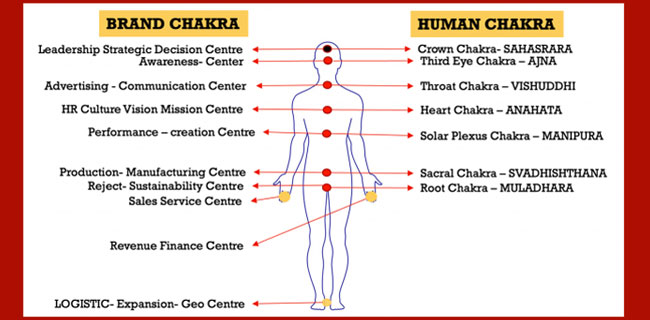
    Brand Chakra

    Most readers would be familiar with the seven chakras. Now, using it as a foundation and treating the organisation as a human being, we can interpret Brand Chakra differently.

    1. CROWN CHAKRAor the Sahasrara Chakra is the Top management. It is the thinking area and area where strategic decisions are taken. Typically also, the head office with Lo and L1 leadership level in direct consultation with the owners.

    2. THIRD EYE CHAKRAor the Ajna Chakra is the research and awareness area. One that scans the market for the probortunies, analyses the situation and feeds to the Crown chakra. This is also the centre that looks inward into capability and capacity build-up and keeps the organisation future-ready. It is also the innovation and product development centre.

    3. THROAT CHAKRAor the Vishuddha Chakra is the Advertising and communication area. This develops campaigns and activities to help achieve the brand’s relevance and impressions.

    4. HEART CHAKRAor the Anahata Chakra is the HR-policy-vision-mission defining Chakra. It is also responsible for the organisation’s culture.

    5. SOLAR PLEXES CHARAor Manipura Chakra is the Power Chakra that comes on the performance of products and services and the financial stability area.

    6. SACRAL CHAKRAor the Svadhisthana Chakra is the place for excitement and creation, including sexuality. The area of manufacturing or production departments are part of it.

    7. ROOT CHAKRAor the Muladhara Chakra is about removing waste products. The power centre works on sustainability and the treatment of waste products.


    Additional Chakras

    In addition, there are three more Brand Chakras for the organisation.

    8. SALES CHAKRA. The right palm is the giver area. It represents the sales department responsible for the experience and expectation brand chakra.

    9. REVENUE CHAKRA. The left palm, receiving area. The accounts and finance department is responsible for the current or future brand revenue.

    10. MOVEMENT CHAKRA.The legs. The logistics and service brand delivery centre. Also responsible for geographical expansion of the markets.


    The Collective Brand Chakra Alignment

    The collective perception is the final summation of the impression on the external audience. It get primarily defined by the interaction of the brand centres with the stakeholders. The Crown Chakra interaction defines financial market impressions. The sales Chakra and third eye chakra determine the consumer reaction, and the retail or trade will be represented by sales and the Revenue Chakra.


    The Alignment Process

    We tried to be extensive and inclusive. In addition, to knowing the archetype and related brand personification at the Brand chakra level, we also looked at how the departments saw each other and the competition. This gave us a matrix of internal and external imagery across power centres – the brand chakras.

    Each department was taken through the findings along with the desired Brand Archetype and personification as agreed with the leadership team. It gives the team individual-level filters to evaluate their contribution toward Chakra alignment. The Idea Harvest workshop provided a platform for a detailed discussion and help determinen the  actionable.

    The brand team is now entrusted with the task of cultivating a dominant brand Archetype reflected across the segments internal and external.


    Net-net

    The Brand Archetype and brand personification exercises are simple, and it is something people can understand easily. Hence, it can always help to define and direct activities.

    A well-aligned active Brand Chakra ensures everyone works toward the same delivery and experience, thus streamlining/aligning their focus and being more efficient and effective.

    I am excited about this low-cost exercise to help the brand re-evaluate and focus on future action lines. Am open to suggestions and interaction with Brands interested in doing this simple exercise.


  • Protests fuel a Backward march


    By Sanjeev Kotnala


    Sanjeev KotnalaAs a citizen of the nation burning with protest one or the other things, I am confused and undoubtedly disillusioned with the country and its capability or potential to move forward. We seem too agile and opportunist in finding reasons to violently protest for Region, Religion, Politics, Language or Government actions. And naturally, advertising is the farthest thing in my mind, though I believe that the communication could have been far better handled somewhere.

    Shaheen Bagh to farmer protest. CAA to Gyan Vyapi to Agnipath. We find windows of synchronised, well-orchestrated protests — not from an average citizen’s angst or observations. It is evident that behind such gross violent protests are bigger fishes with more significant stakeholders fuelling and funding them.


    Simple Questions

    The question that comes to mind is simple. How come, in each of these instances, the government has not been able to present them in a better form? Not necessarily more acceptable, but definitely where the reactions are controlled. How come no one in government could visualise the possible scenario? In the case of Agnipath, it was WIP for the last two years. And how come, if they did, they did not prepare for the reaction control?

    One may say that typically ill-informed and judgmental citizens do not have the intellectual width to pace counter argument on some schemes and policies. I am not fully aware of all the policies and the media biases. But I know they have a sound logic for being created and pushed for. Unfortunately, plans on paper are mere plans till they are executed.


    Protest Damage

    The damage these protests are doing is enormous to the country. It is disrupting the national fabric, which is already strained. It is pulling down the nation. It is raising questions about the government’s capability to run the country. A government that is in power with a decent majority. It faces the legacy and the after effect of the earlier appeasement policies that never tried to be disruptive.

    We live in a nation with multiple political agendas that are opportunistic and illogical. There is never a thought of the national future and well-being. And this is not true of the current opposition but also of other parties. The schemes launched are future-oriented and good for the nation. Yes, these policies or schemes rub some stakeholders wrongly and badly. But it is expected-there is no programme and policy that will always be good-good for everyone. However, our welfare state doesn’t talk the language.


    Ill-framed, Ill-informed

    There is always an afterthought. The points are not placed in their right spirit. The branding and the communication campaign still follow the basic governmental advertisement model of achievements. It rarely talks and concentrates on the possible impact on the consumers of the scheme. It is time for the government to consider using the best of the services for their campaigns. No guarantee it will solve every problem- but I think it will create a better climate.

    The government should also stop presenting everything as a scheme and a policy.

    The government in a welfare state with responsibility and accountability for laws and running of the nation: not necessarily, the businesses. It decides citizenship. But, because of myopic political promises, it is expected to be a job and job security provider. It has to create the climate for such a situation, not micro-manage it.


    Nothing Deters the Protestors.

    Protestors protest and burn public as well as private properties. They know nothing will happen to them. Every government has been unable to find a way and demonstrate a faster judicial process or an exemplary penalty to deter others from doing so. The police force is a puppet of the powers. It is highly ill-equipped. The surveillance camera doesn’t prevent the rioters. The riot blue dye is not available. Pellets bullets cannot be fired. Guns cannot be charged, and the lathies are nothing before the well-prepared protestors. The cases run for ages. Things are forgotten, cases withdrawn, and a new subject to protest keeps the nation on its toes.

    This is one area where the government- central or state has to think and, if need be, invest in them. Maybe even have fast courts for deciding the cases. Maybe bar the protestors from every government support- but only the protestor, neither the property nor the family. Unless the property is non-regularised and not approved! And these regularising of the encroachment on land, national ambition, and emotions should not be allowed.


    Net-net

    Till the government does not start doing a proper communication and the rioters of every reason are not summarily prosecuted, we should be ready for such protests. And if needs be, keep a tight check on what appears in the media. The nation does not just want to know. The country wants to see a positive, optimistic proactive government delivering. And if possible, the opposition join hands for issues of national interest and oppose those that are not.


    Sanjeev Kotnala is a senior business strategist and educator. He writes on MxMIndia on Wednesdays. His views here are personal


  • If self-regulation fails…


    By Sanjeev Kotnala


    Sanjeev KotnalaGood news. ASCI acted fast. It is debatable who acted first to ban/ withdraw the controversial Layer’r Shot ad. Was it the government or the Advertising Standards Council of India (ASCI)? I am glad someone did. However, the story has died fast. Everyone is okay after the ad is withdrawn and a vague apology tendered. One does not know the mandatory approvals, who approved, and why there is no further action?


    Meanwhile, the government got into the act. The Central Consumer Protection Authority (CCPA) released new guidelines against misleading advertisements. It says surrogate advertising is now banned- was it allowed earlier? The celebrity must disclose association and do due diligence before endorsing – was that not the case?


    Meanwhile, ASCI released new guidelines on Harmful Gender-Stereotype in advertising. It aims to encourage advertisers to create progressive gender depictions. It is okay if the ground realities are different and do not reflect this expected holier-than-thou depiction in advertisements.


    This reminds me of Sunny Deol’s famous dialogue; Guideline pe Guideline pe guideline- nahi milte hai toh misleading advertisements se chutti.


    Minister Calls ASCI act

    I read the overdramatic comment of the Union Minister for Women and Child Development, Mrs Smriti Irani and I smiled. She said, “If women were valued enough, we wouldn’t need guidelines”. I believe she would know the reality.

    However, she made a relevant observation on ASCI members and their engagement. Of the 800 ASCI members, just three members (officebearers) were at the guideline event. That’s how integral ASCI is to the industry. That is how concerned, involved, and serious the industry is towards self-regulation?


    Intent does not Count

    The guidelines on Harmful Gender-Stereotype in advertising call for not including gender stereotypes likely to cause harm or serious or widespread offence. For ASCI, it is a strong step towards a more responsible and progressive narrative. Well, I am not so sure. We know how guidelines are exploited, played with, and not adhered to by advertisers.

    The truth is that most creative and client teams do not know the guidelines and don’t understand them. Brands simply don’t give a damn to ASCI, given that it only seeks a polite enquiry and request to withdraw the offending advertisement.


    Things have changed a bit 

    ASCI has streamlined the processes. There are quick processes to address the problem. But withdrawing the ad with no public apology shows ASCI has no bite. In most cases, the advertisement achieves its objective before ASCI request a withdrawal.  However, the ASCI service #GetItRight, get the creative pre-checked at the production stage, returns a 404 error!


    Different strokes

    Surprisingly, large brands and big advertisers regularly feature in the quarterly reports of offending work. ASCI guidelines have no say on advertorials, political and Government advertisements.


    Will ASCI guidelines restrict creativity?

    In today’s world of rapid information exchange, heightened point-of-views and hardened social voices help nudge the brands in the right direction. But storytellers must have creative licenses.

    Is ASCI not asking too much for brands to reinforce unrealistic and undesirable gender ideals or expectations. For example, expecting a woman to return from work may not be shown as solely responsible for doing household duties while others around her are at leisure. Remember Airtel.


    Should advertising worry about social reform?

    When the guidelines become constraining, they will be questioned.

    Should advertising stop reflecting the social and cultural realities?

    Will it not make them irrelevant, ineffective, and tough to relate to?

    Should advertising aim to nudge people towards the right desired way of life?

    Or should the ground realities change before advertising reflects it?

    Are we not giving advertising too much credit for possibly impacting human behaviour?

    Are guidelines not trying to dictate what should be controlled by the market forces?


    Net-net

    Advertising is becoming a tough maze with all the guidelines. There is too much of what not to do. Maybe creative teams see it as a decent challenge. But this forced wokeness is wrong.

    The brands should be free to tell the story how they want and ensure that no misinformation or false promise is being made. And that it does not hurt religious, regional, language or gender groups or objectify any gender.  And if there are guidelines there should be a robust way to implement them by Sham, Daam, Dand or Bhed. (Logic, cost, Penalty and differentiation/doubt).


    Let us understand, that ASCI cannot do much till the corporates, the marketing and the brand owners take the initiative. Self-regulation is all about knowing and doing things consciously as per the guidelines. Till the time ASCI does not have real teeth to penalise and persuade brands for breach of guidelines, they may just remain guidelines.


    Not against self-regulation

    I am not against self-regulation; it is crucial. As an industry we all owe to the society the right way of promotion. If the industry continues to fail at self-regulation. In that case, someone like government will have to regulate it, which will be a sad day for the industry.

    I am all for effective self-regulation, where there is one expectation from every stakeholder, and the regulating authority has the right to take action. Where every team member on the client and the agency side understands and appreciated the need for the guidelines, maybe then they will follow it better. Maybe I am asking for too much.


  • Sanjeev Kotnala: The Magic Eye Peep Hole Barrier 

    Sanjeev KotnalaBy Sanjeev Kotnala


    The world is made up of Probortunities doors, and they can open both ways. They can be considered an opportunity or a problem as per the hue of the glasses. To know the truth, all one needs to do is open the door, step through it and embrace the new world.


    Sorry, It is not so simple even if you know the situation reasonably well. Even if one is supremely confident and charged enough to boldly open the door. There is always an element of doubt that stops us, and we hesitate and re-evaluate, leading to delays.


    Desiring Perfection And Certainties

    Magic Eye represents the desire for more information than available, thinking it will help make the right decisions and face uncertainties, some real and some assumed. In the cautious approach, one loses momentum, and the probortunity disappears. Everything seems to be a mirage. And no one knows what way the things would have moved.

    Remember, perfection is a myth, and there is never complete information or certainty in time, efforts and results. And hence, there cannot be a perfect decision. At best, it could be the best decision basis the information available and possible alternatives.

    The outside world is chaotic and in complete flux. At any given point if time, it is being pulled in multiple directions by the invested stakeholders while we stare at the door and think of the magic eye.


    Open The Door

    Mysteries are revealed when the door the opened. One will know if the door leads to opportunities, challenges, unchartered paths, problems, solutions, or something unknown only when the door is opened. The truth is that no one knows beyond the door unless one opens it.

    Naturally, anxiety takes over. Dark threatening clouds of uncertainties cast shadows of mistrust. Capability and compatibilities are questioned. Imaginary negativism raises its ugly hood making one doubt the potential and possibilities. In the process, the present gets overpowered and crippled by past experiences and future expectations. One forgets the task and the need to remain and live in the moment.

    Everyone wants to be sure, get guaranteed results, and be prepared for the future. The funny part is everyone knows that the future is vague, and no one has seen it. There is no way to predict, and the best experiences or education cannot guarantee it.

    Future is never in your hands. It takes shape at (n-1)th moment and dies immediately in the present. One gets so entangled in biases of past experiences that one stops living the moment. We forget that the future is a chase of uncertainties, and the past is a reservoir of experiences and learnings.


    Magic Eye

    Where there is a door, there is always a magic eye. Physical, metaphorical or imaginary. It facilitates a one-way vision into the possible future or past. It helps with what is there on the other side. But like every magic eye, it is a one-way window, and it can, at best, look back into the past. The magic eye does not help look at the future because the future does not exist in the present.

    Life’s magic eye is unlike what you find in the hotel rooms. It allows you to look back onto the corridor you walked before, and it does not allow the view to the inside of the room. Anyway, neither the vision nor the need for the vision is the same.


    We Seek Hints Of Possibilities

    Don’t get me wrong, but there are moments when keeping the door closed and ignoring the magic eye may be the best policy. Enjoying the comfort of dark uncertainties is more soothing. But, it will never last; it is not meant to last. A newly heightened awareness will surround with time, and one will hopefully act. One will start building own algorithms for the magic eye or absence of a magic eye.

    There are multiple doors of opportunities, problems, and challenges surrounding us in our professional and personal life. The magic eye is mounted on all these doors. So, expect to walk the corridor of life using a one-way magic eye. However, remember that your magic eye on the door of probortunities could be a senior, confidant, consultant, or colleague.

    Get comfortable with the vague future and amplified scenarios. Enjoy the beauty of inferred realities. At some stage and hopeful the right stage, one will move with a degree of uncertainty to open the door. Because stagnation is not life, movement is. So, the door will need to be opened at some stage, magic eye or not.


    Collective Push

    Most of us are happy to live with a collective failure than chase risky individual success. Hence we tend to democratically move and decide to look through a magic eye that cannot guarantee a 20:20 vision.

    A Simple magic eye gives a tunnelled vision. Some with experience can have a wide-angle view, hoping to catch the hidden clues at the edges. And, when it does not make sense, we ask experts to interpret the images.

    Detailed vision depends on many parameters. The height of the mounted magic eye. How early do we seek vision interpretations? How important is it to open the door and face uncertainties?


    Magic Eye Advisors

    People claim to interpret magic eye visions, and they can hopefully make sense of the magic-eye vision. However, they really don’t have skin in the game, and they don’t have to finally push the door open and take the step. They, too, suffer from the bias resulting from past vision interpretations, experiences, and expectations.

    The inexperienced person has an uncomplicated unbiased view, and they see hazy pictures. But, they are more open to taking the plunge with uncertainties. They know life to be uncertain, so they have a higher degree of acceptance of uncertainties.

    In corporate life, the magic eye promotes a cautious approach, collectivism of decision making and vision interpretations.

    Corporations expect a hostile competitive environment. And they want giant magic eyes or one with a better field of vision. This, in turn, gets reflected in risk-averse behaviour and procrastination, and the doors remain untested.


    Closing the Door

    There must be some merit in being bold and closing the magic eye, facing the uncertainties directly. In the process, defining and deciding which side of the door one wants to be. There are always multiple options.

    Playing to the inherent fear and being cautious, we try installing windows where the magic eye was. Sometimes, it does not makes any difference, and the magic eye and the windows remain ornamental.

    So trust me, it is more fun to ignore the magic eye, open the door, step outside and learn by experience than to be over cautious and try multiple magic eyes for the elusive insight. Multiple magic eyes could result in differential images combining to create a collage one may not be able to make sense of.


    Net-Net

    Ultimately, every one of us has to decide individually what to do with the magic eye mounted on our doors. Many are the victim of the magic-eye barrier. The magic eye-stopping them from moving forward. They know that it is time to close a few magic eyes in life and open a few more doors. But, then, as I said, knowledge and vision are not everything.

    The decision, as they say, is always yours.

    The magic eye is directional and a tool to help, not the crutches for you to ride.


  • Missing the effective ‘Call for action’


    By Sanjeev Kotnala


    Sanjeev KotnalaCall to Action buttons and phrases like Buy, Shop, Order, Reserve, Save, Add to the cart, Pick, View, Click, Try, Subscribe, Sign up etc shout for attention in digital communication. And why not? ‘Call To Action’ also called CTA in advertising, is the next step or action the marketer wants the consumer to take. It was an integral part of traditional advertising, pushing and nudging customers down the sales funnel by taking the desired action. And the client, in the absence of any other measurement, used calls, walk-ins, and requests as a measurement of the effectiveness of the communication.

    Surf ki khareedari mai his samajdhari hai, Joh Biwi se Saachmuh Kare pyaar Woh Prestige Se Kaise Kare inkaar, I love you Rasna, ECE bulb Lana, are some good examples of disguised call for action. The Call To Action can also be a visual device. Like the person drinking Sprite or Katrina licking the aamrass drop, or Pepsi ho abhi.  The best example however has been the COINBASE  QR code ad during Super Bowl 2022.


    Missing Call To Action

    While we see ‘Call To Action’ extensively used in guiding customer reaction and action in digital space, it seems to be losing its appeal in traditional media. Coming from an old school of advertising, the lack of a ‘Call To Action’ does not sit well with me, and not that it needs to be upfront, bold and on the face.

    ‘Padharo mare desh’, ‘Kuch Din Toh Gujaro Gujrat mai’ – are all-powerful ‘Call To Action’. But even in recent state tourism print ads and posters, the Call To Action is missing- why?

    Cred has spent a large part of its marketing spends with IPL without a ‘Call To Action’. The main communication does not ask you to download, register or subscribe to the app. While the powerplay communication places the possibility of winning the entire credit card payment has some ‘Call To Action’.


    Call To Action – a dying art

    Earlier writers took pride in writing the perfect ‘Call To Action’. And, yes, the ‘Call To Action’ could drastically impact the success of a campaign as it impacts conversion rates. The effectiveness of a ‘Call To Action’ drastically improves if there is an apparent reason or emotion attached to it. For example, ‘call today to schedule your free consultation!’ or ‘Sign here never to miss the weekly update’ or ‘order today for 1-day shipping or even a simple- ‘Avail 55% discount on Fresh Stocks- Now’. In digital, they are mostly undifferentiated buttons.


    Leaving too much for the Consumer

    Have we started believing that advertising may not work that much to nudge? Or do we think that the customer intuitively knows what to do? I am not sure. So, I smile and appreciate the Wimzo ad where Dhoni silently gestures, and you lip-read it to mean, ‘Download Now’. I even think the Dream11 advertisement with, ‘Mai yeh kar leta hu, aap tab tak Dream 11 par team banao‘ does a good enough job. And so does ‘Slice the Slow’ or even when the ad tells you to invest after speaking with the experts- Sahi Hai.

    May be the overload of information and reviews has democratised product expectations. The advertisers are only interested in making consumers better aware of the proposition through traditional media and nudging them through other channels. As if they would want the potential customer to take an unbiased decision without being pushed and influenced. But, then advertising  is about influencing, guiding and nudging the consumer towards the brand goals. And , it better have well crafted ‘Call To Action’ to nudge the consumers.