Tag: Sam Balsara

  • GroupM bags Airtel account, to set up independent unit; Milestone Brandcom bags Airtel’s Outdoor biz

    By Pritha Mitra Dasgupta [see update at the end of this story]


    GroupM has bagged Bharti Airtel’s media account excluding outdoor, replacing Madison as the media manager of India’s largest mobile carrier by revenue and subscribers after a decade.


    The size of Airtel’s media account is upwards of Rs 400 crore, say industry sources, with estimated spends of Rs 350 crore in above-the-line (ATL) advertising and Rs 50 crore on out-of-home (OOH) media.


    Milestone Brandcom, which is the outdoor unit of Dentsu Aegis Media, has won the outdoor mandate, said a top official at Airtel. The firm’s creative mandate is split between WPP agency J Walter Thompson, Dentsu Aegis Network agency Taproot and Cartwheel. In response to an email sent to Airtel, a company spokesperson said, “No comments.”


    CVL Srinivas

    CVL Srinivas, CEO of GroupM South Asia, said, “We are delighted with the Airtel win.” He said the group will set up a separate ‘team Airtel’ to manage the account. It will be like a parallel unit within the group.


    GroupM is in the process of promoting an internal talent to head the Airtel team, who will report to Srinivas.


    Madison has been handling Airtel’s main media account since 2005 and its outdoor duties since 2010. The shift in accounts is only for India.


    Top officials in know said Madison will continue to handle Airtel account in Sri Lanka.


    Officials said the biggest reason behind this shift is because Airtel is looking for a strong partner to help it strategise through this extremely dynamic category. This was especially considering the digital space, “in which Madison has completely missed the bus”, one of them said.


    Sam Balsara

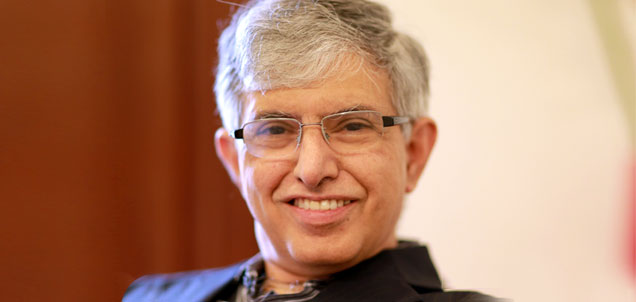
    Sam Balsara, CMD at Madison World, said: “Nothing went wrong. You win some. You lose some. Fortunately we win more than we lose.” He said, “Whilst we are sorry to part with Airtel, its impact on total revenue of Madison Media would be very marginal.


    It was one of about a dozen large accounts of Madison Media, one of over 50 accounts of Madison Media and one of over 200 of Madison World.”


    Airtel had called for two separate pitches. In November last year it put its media mandate on the block including television, print, radio, cinema and digital. This year it called for a separate pitch for the outdoor mandate.


    Source:The Economic Times

    Copyright © 2015, Bennett, Coleman & Co. Ltd.

    All Rights Reserved, Licensed to republish


    [MxMIndia Correspondent adds:

    It is learnt that GroupM will set up an independent unit to take care of the Airtel account


  • ‘Achhe din’ are here again for adspends: Sam Balsara


    Because it’s the sentiment that counts, Sam Balsara, Chairman and MD of Madison World, tells Labonita Ghosh soon after the presentation of the Pitch Madison Advertising Outlook 2015. The current mood of optimism in India Inc, he feels, will translate into greater adspends, based on the expectation of a strong tomorrow.


    Senior industry person Deepak Parekh recently said that the ‘achhe din’ haven’t really arrived for Indian business. Would you echo a similar sentiment with respect to adspends and advertisers in India?

    It’s very important to understand that advertising works on India Inc’s sentiments, because everybody knows that you have to advertise first before you can get results on the ground. The advertiser has to make an investment first in advertising. So what does he base his advertising decisions on? He bases it on sentiment. He understands the mood of the nation, the mood of India Inc, what is happening today and expected to happen tomorrow, and takes a decision – on how much to spend on advertising – based on this. Clearly, he is guided by his P/L. But whether or not he should increase his investment on advertising is dependent on sentiment. Beyond doubt today, sentiment is high. My understanding is perhaps Mr Parekh was referring to the high, bullish sentiment not yet translating into higher sales for brands. Fortunately, it has translated into higher market valuation. I’m no expert, but I guess like advertising, the stock market, too, works on sentiment. So it is the expectation of a strong tomorrow on which you are valued today. Otherwise why are companies like Flipkart and Snapdeal valued so high? They have nothing to show for, except what we can expect from them in the years to come.


    In the light of the fact that there is no Parliamentary election this year only sporting actions, would you justify your forecast as realistic?

    Our forecast is always realistic. We never put out an either optimistic or pessimistic figure. It is a realistic figure, and that is why you will see that although we consider ourselves bullish, our actual forecast in 9.6 per cent versus what we’ve achieved in 2014 which is 16.4 per cent.This is so because last year, almost 50% of the increment came on account of the Lok Sabha elections. That will not be the case this year. But there are several other reasons – the World Cup, the continued aggressive push by e-commerce, other social media and apps; the appearance of Phase III in radio by the end of the year; the launch of new channels; geo-targetting becoming possible by newer advertisers and newer brands emerging and such. It is because of all this that we expect the television market to grow by 10%, and print by 5%, on the back of increased government spending.


    Could you specifically comment on print growth, particularly with respect to magazines and regional papers?

    We are extremely bullish about regional papers. English newspapers have already taken a hit in terms of percentage contribution. In the last decade, the contribution of English newspapers was dominant. All other languages, put together,could not match up to it. Today this is no longer the case. Now Hindi is the single largest language segment in terms of spend, and English is trailing behind it. And this will be the case in 2015 as well.


    Magazines are a niche player, and I think increasingly, we are seeing a not very healthy trend in magazines in terms of growth. We think the future of magazines is in niche magazines rather than general-purpose publications. Magazines that are focused on specific areas, like cooking or golf or architecture, these have a sensible future. As an advertiser, if I am interested in particular products, I will look at only those magazines that relate to these. For instance, if I want to sell golf balls, I don’t have to advertise in India Today because that ad will be wasted since non-golfers also read the magazine. I should, instead, advertise in a golf magazine which will provide restricted, focussed circulation. That focus will be of immense value to the product-specific advertiser. That is why magazine advertising as a segment is so small.


    Does all the sound and fury of news television attract good spends?

    It does. News television goes to male audiences, who are otherwise difficult to catch. So news channels are a useful medium for advertisers who want to speak to men. We saw in the genre by spend, the largest is Hindi satellite TV, followed by Tamil satellite TV and news comes in third.


    Digital growth may be high, but in terms of real spends it’s still low. Is it just a lot of euphoria?

    By end of 2015, digital will account for 12%, but its growing at 30% (whereas print is growing at 5%). That’s why there is euphoria. But you can’t forget that while print is already at 40% plus, digital is simply growing from 10 to 12 %.


    This interview first appeared in dna of brands dated February 23, 2015


  • Adspend to grow 9.6% in 2015: Madison


    By Labonita Ghosh


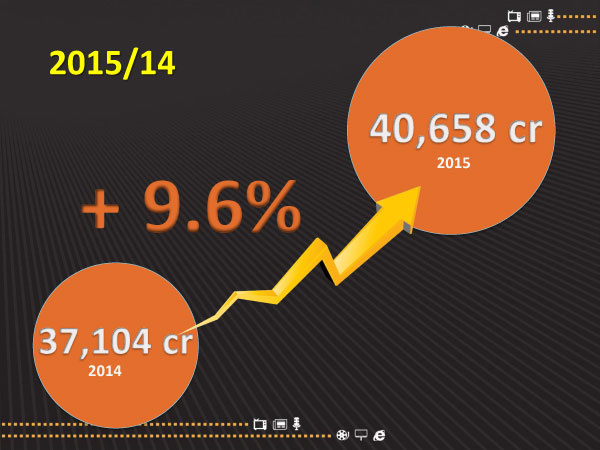
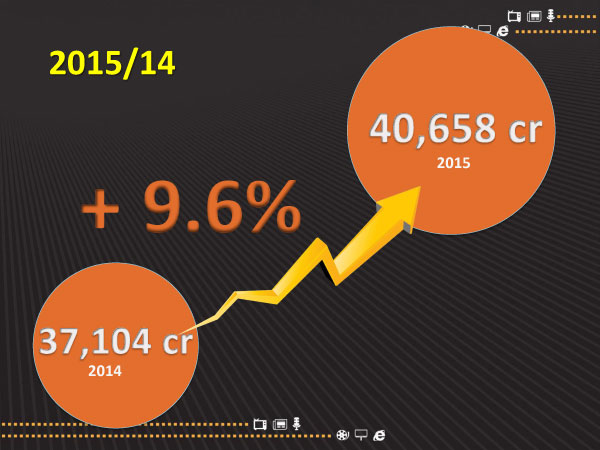
    The advertising industry is likely to grow 9.6 per cent this year, says the Pitch Madison Advertising Outlook Report 2015 released last Friday. While this looks like a tepid sequel to a blockbuster year – in 2014, the industry grew by a whopping 16.4% – the forecast is not without promises. For one, the slight uptick takes the total advertising market to Rs. 40,658 crore by end of 2015, from Rs 37,103 crore last year. Last year’s spurt was largely because of the spend on the Lok Sabha and some Assembly elections, says Sam Balsara, CMD of Madison World, which put the report together along with Pitch magazine. “The projection for 2015 is bullish, though tempered by the fact that this is not an election year,” says Mr Balsara. “There are other options, like the World Cup, the continued aggressive push by e-commerce companies, the launch of new channels and the emergence of new advertisers and new brands.”


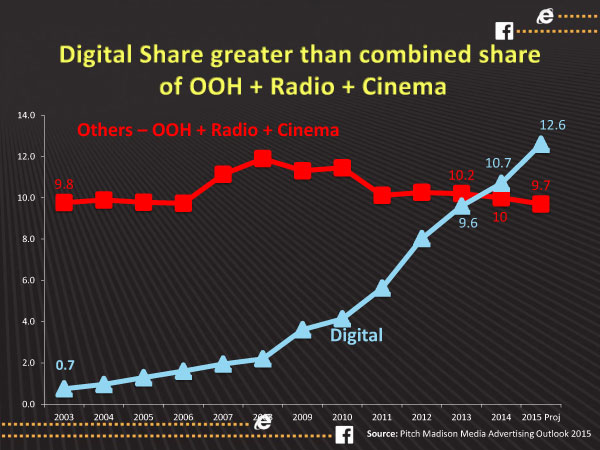
    Among the more significant findings, print media continues to be the largest sector in advertising, and is expected to grab a 40% share this year. Brand advertising in print is likely to exceed Rs 16,000 crore. TV is next in line, and expected to touch Rs 15,500 crore. Digital, which has grown phenomenally in the last five years, is now larger than Outdoor, Cinema and Radio put together, will corner 12.6% of the market.


    The report finds that the FMCG sector, which has always been a dominant player on TV (contributing over 50%) is now also the largest contributor to print media for a second successive year. Though this contribution is just 13%. “Projections for the FMCG sector appear rosy, which is heartening,” says GK Suresh, Head of Marketing (Foods Division) at ITC, adding: “If this continues, I don’t see any reason media spends should not keep increasing as well. This provides a lot of confidence to manufacturers to launch new products, and companies to invest more in existing brands. I think the report forecast is fairly accurate; perhaps even a little conservative when it comes to FMCG.” While the print market constitutes many categories, FMCG, auto, education and real estate together contribute 43% of the total. For TV, the big players are telecom, digital, e-commerce and auto.


    “I would’ve expected FMCG spends in print to grow more rapidly,” adds Mr Suresh, “mainly because it offers many more opportunities to sharp-focus your advertising, and has less wastage than TV. But we in FMCG are really struggling with digital media right now. Everybody knows it’s growing and we need to be out there, but many of us are using it as just another medium.”


    According to Piyush Mathur, President, Nielsen India, the 9.6 % projection, close to a double-digit growth, is a realistic one. “A lot is riding on e-commerce, which is at an early stage and that means a lot will happen in 2015 and 2016,” he says. “As e-commerce companies get bigger valuations, there will be more spending on advertising.”


    Still, there are a few things advertisers need to do differently, says Mr Balsara. According to him, they should focus on effectiveness, and not just on efficiency, while always keeping in mind that the reason they advertise, is to increase their brand parameters. “I have seen marketing teams to be painfully slow on certain media decisions,” he adds. “We often suffer from analysis-paralysis.” Mr Balsara says most brands fail to take full advantage of what the media has to offer by under-resourcing their campaigns. “They will be well advised to focus on fewer brands of theirs, ignore some brands and advertise those few brands heavily,” he adds. “A corollary to this is that since budgets are often limited by P/L considerations, you need to prioritise markets sharply. Spend and exposure in Priority One markets should be at least three times that of Priority Three markets. Otherwise prioritisation is meaningless, and only remains in the hands of the brand manager.” Worryingly, Mr Balsara says he also finds that as media spends get larger and larger, media decisions get taken at lower levels. “These require greater involvement of the corner-room,” he says, and more participation by senior media agency leaders.


    This story first appeared in ‘dna of brands’ issued dated Febuary 23, 2015


  • Highlights of Sam Balsara’s presentation of the Pitch Madison Media Advertising Outlook 2015


    Hello and welcome to the Pitch Madison Media Advertising Outlook 2015.Thank you very much for coming this afternoon to find out about what happened in 2014 and what is our prognosis for 2015 in terms of media spends in different media and different categories.We have put together an interesting and hopefully educative afternoon with accomplished speakers talking about subjects ranging from Media to Fmcg to elections to the new age digital companies to corporate advertising.
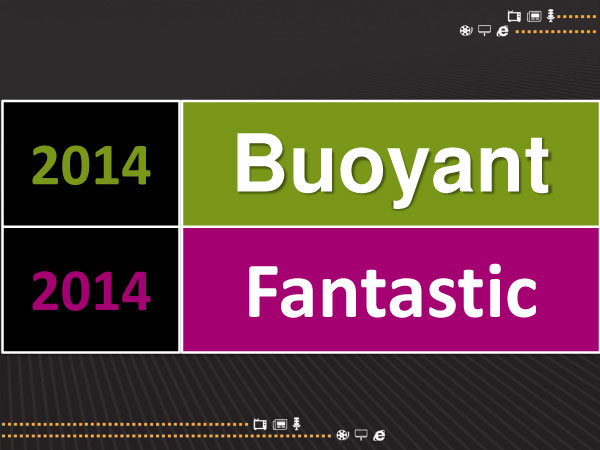
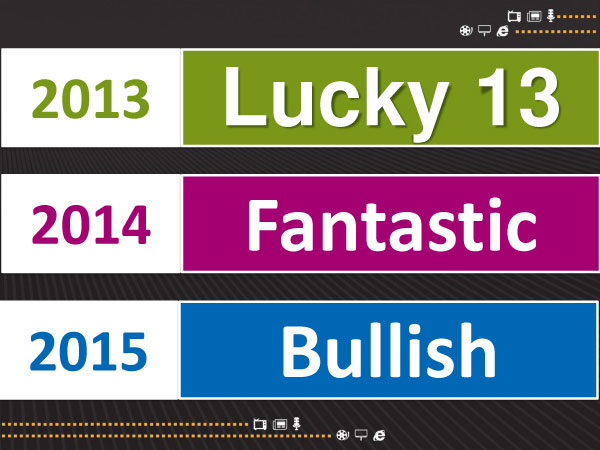
    Last year we said that 2014 would be a Buoyant year and am delighted to inform you that we were right!I would now describe the year just gone by as FANTASTIC!
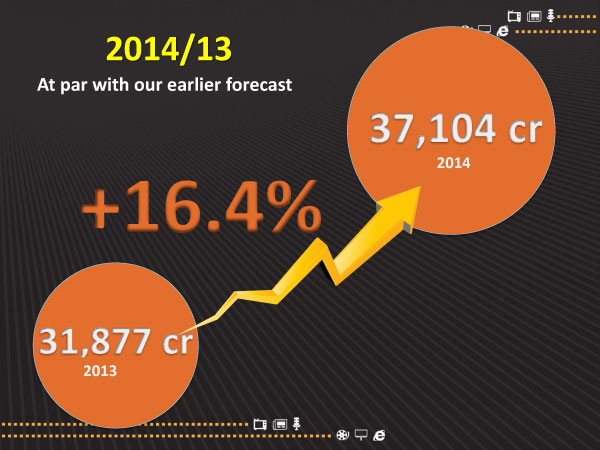
    Why do I say Fantastic?The Indian advertising industry in 2014 grew by 16.4%, almost at par with our forecast of 16.8%. When we projected a growth rate of 16.8% last February mostMedia professionals felt the projected growth was too high and Media sales professionals wondered if their bosses were going to increase their sales targets!

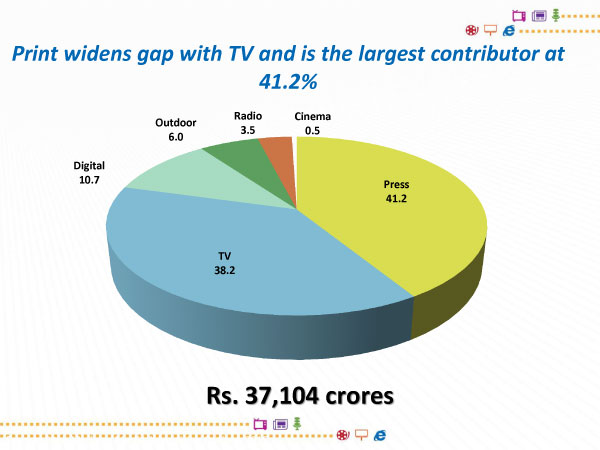
    In terms of absolute numbers, the advertising industry increased by Rs. 5,200 Crs and touched Rs. 37,100 crs in 2014.

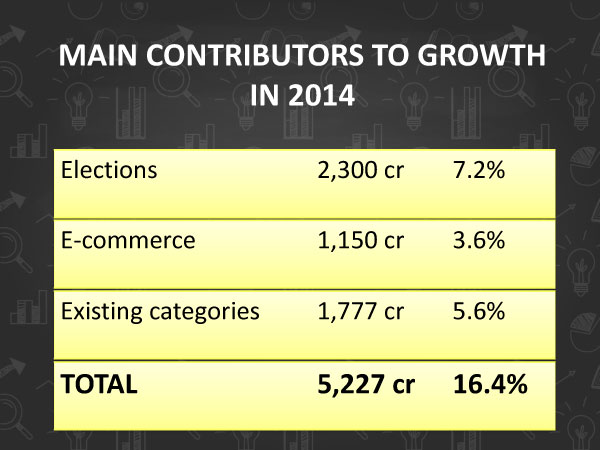
    The 2 main categories that have fuelled the overall growth in 2014 were the Lok Sabha general elections along with the 5 state elections, and E-commerce players contributing as much as Rs 2,300 Crs and Rs 1,150 Crs. respectively. Thus almost half the growth came from Elections alone and the 2 categories account for 2/3rd of the growth. Of the 16.4% growth rate registered in 2014 it is significant to note that nearly 7.2 percentage points is on account of elections alone, 3.6 percentage points is on account of E-commerce. It is again significant to note that existing categories contributed to only 5.6 percentage points of the overall growth.
    What is our growth forecast for 2015?
    Whilst the growth in 2014 was Fantastic, mainly because of election spends, we are equally bullish for 2015 too but our forecast has to recognize that 2015 is not an election year.
    A 9.6% growth rate, is what we forecast in 2015 which will take the industry further up to reach nearly 41000 crores. We expect the overall market to grow by more than Rs. 3500+ crores
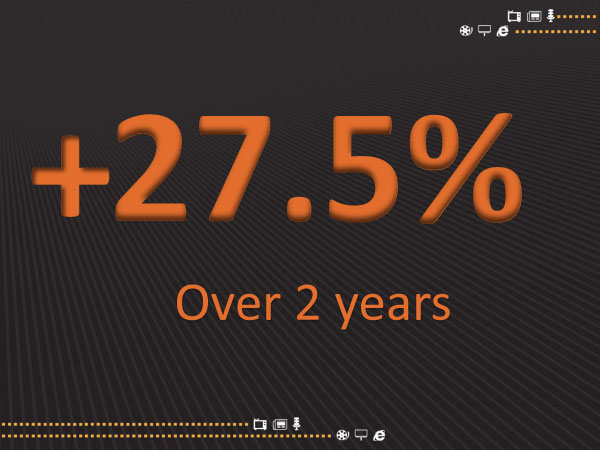
    That’s a spectacular growth of 27.5% over 2 years
    Note, this figure of 9.6% should be compared with the like to like category growth of 5.6% achieved in 2014 and not the overall growth of 16.4%. A stable government at the centre that is focusing on growth of the Indian economy, positive market sentiment, upbeat consumer confidence and India once again attracting global attention, are all the reasons why we are doubling our growth forecast to 9.6% from the earlier years like to like growth of 5.6%.
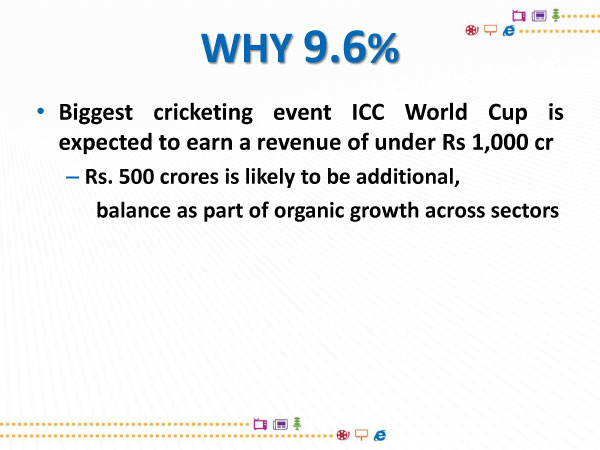
    Getting into the details of why 9.6% Biggest cricketing event ICC World Cup already underway is expected to earn a revenue of almost a 1,000 crores Rs. 500 crores is likely to be additional, just because of world cup and the balance as part of organic growth across sectors
    Other contributing factors to growth are likely to be: New advertisers Separate sales of HD channels, hopefully will attract new premium brands to advertising Facility of Geo targeting ads will attract more, local and retail advertisers on TV New channel launches from existing networks Further push by E-commerce companies and mobile and social apps Spends on Assembly elections in Delhi and two other states Increased government spending on print, since the new government strongly believes in communicating with their electorate about their new thinking, concepts, etc We are confident that government will finally launch phase 3 expansion no later than September 2015, and since a very large number of radio stations are expected to open up, this should pull in atleast Rs. 70 crores of additional advertising revenue in the last quarter of the year
    Here’s a 13 year review of the advertising market, having gone up from under 10,000 crores to almost 41,000 crores over 13 years. We have thus achieved a compounded annual average growth rate of 13% over these 12 years, but it is significant to note that the rate of growth in the last 6 years has been under 10%. Whilst, it appears that the advertising industry has grown steadily over these 13 years, the trend in growth rates as you can see is a wildly fluctuating one.
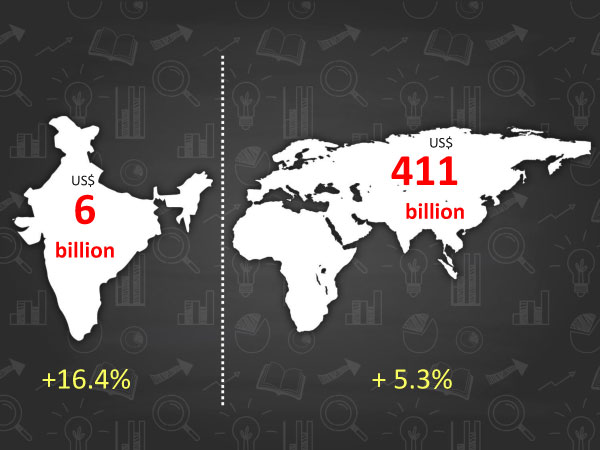
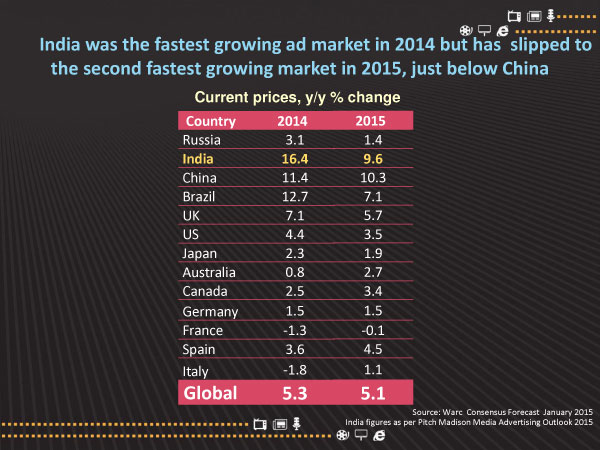
    Compared to India’s growth of 16.4%, the global advertising market grew by just 5.3% but of course in absolute terms the global advertising market is now estimated at US $ 411 billion where as India is at 6 billion which puts India’s share at a far from respectable 1.50%
    India maintained its 12th rank in the global ad market. The US further increased its share which now stands at almost 43% of the global market. China also increased its contribution from 11% to 14% and has overtaken Japan as the second largest advertising market. Japan has dropped significantly in terms of contribution from 13 to 9%.
    India was the fastest growing ad market in 2014 but may slip to the second position in 2015, just below China
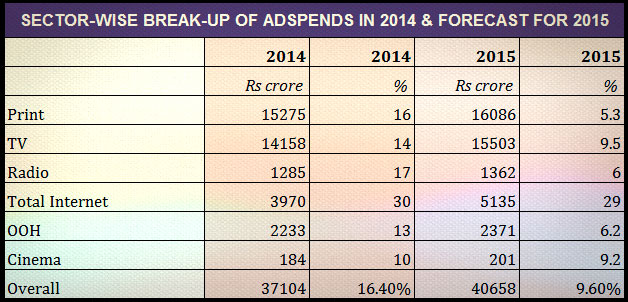
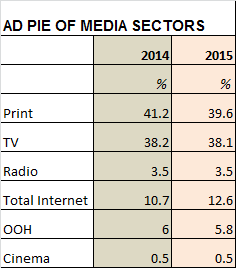
    Coming back to India, let’s look at the Medium wise figures. Print continues to be the largest segment and accounts for 41.2%, followed closely by TV at 38.2%. The gap between Print and TV has marginally widened. Digital has now got used to occupying the 3rd place with a 11% share. Outdoor, Radio and Cinema make up for the balance 10%.
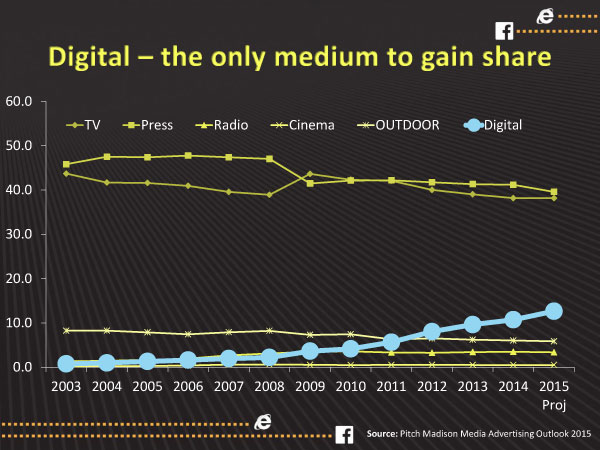
    Digital continues to be the only medium to grow share at the expense of TV + Print + OOH. Radio & Cinema have maintained overall share.
    Digital continues to be the only medium to grow share at the expense of TV + Print + OOH. Radio & Cinema have maintained overall share.
    It is interesting to note that the combined share of OOH, Radio and Cinema is lower than the share of Digital.
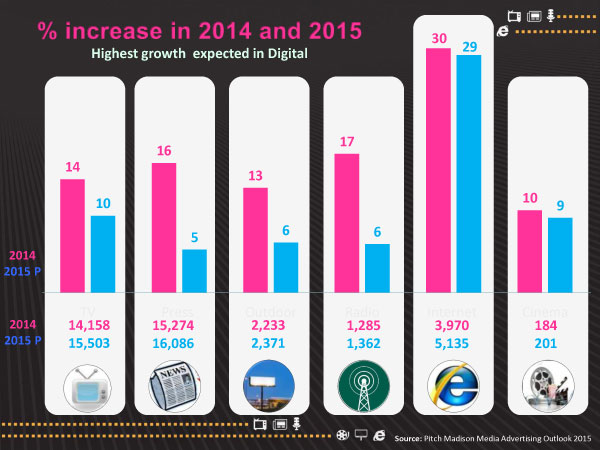
    In terms of growth rates, Digital grew the most in 2014 followed by Radio, Print, TV and OOH in percentage terms. In 2015, we expect TV to grow faster than all other media except digital at 10%.
    Moving to Television
    Television last year grew at 14% to reach Rs. 14,158 Crs but has dropped its contribution to total advertising and is now at 38%. The 2 main categories that have fuelled the overall growth of TV industry in 2014 are Lok Sabha general elections along with 5 state elections, and E-commerce players. The total spending by these 2 categories is in excess of Rs.1,050 Crs out of the total growth of Rs. 1,700+ crs. However this year we expect TV to grow by 9.5% on the back of ICC Cricket WC, Assembly elections in 3 states, HD Channels, Geo Targeting on TV, and new channel launches
    Hindi GEC contributes nearly 27% of the overall TV revenue and continues to remain the leader of the pack. A change in the pecking order saw Tamil Nadu C&S overtaking News to occupy the second rank with their ad revenues growing in contribution from 7.2% to 8.5%.
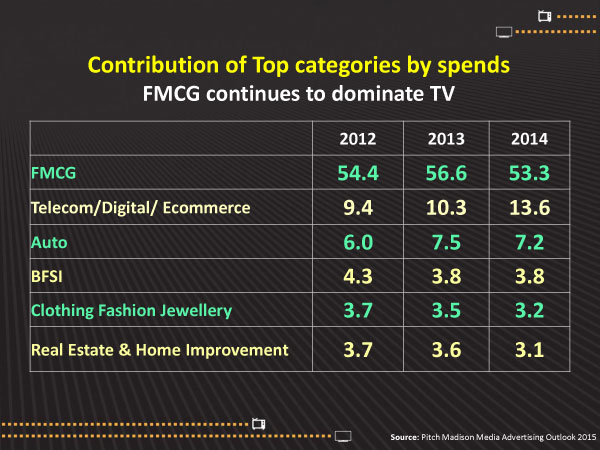
    In terms of category contribution, the pecking order remains the same with a marginal 3percentage points shift in contribution from FMCG to Ecommerce. FMCG, continues to rule the roost contributing 54% share of total TV spends (down from last year’s 57%), followed by Telecom/Digital/ Ecommerce (14%) & Auto (7%).
    In TV, the total FCT consumption has grown by over 18% in 2014. But if you take only those channels which existed in 2013, the growth in FCT comes down to 6.4%. Length of Average duration of a commercial seems to be inching up in the last 3 years and is now firmly at 24 seconds.
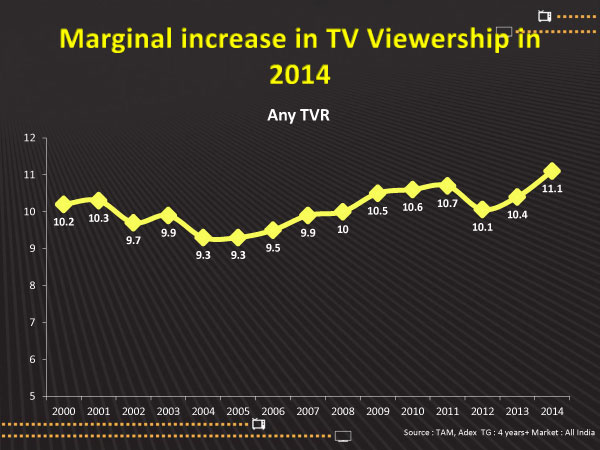
    There is a significant increase in average viewership of any TV channel of 7% in all day parts, but an even higher 11% increase in off prime. The drop that we had seen in 2012 has now been made up and more
    Let’s review Print
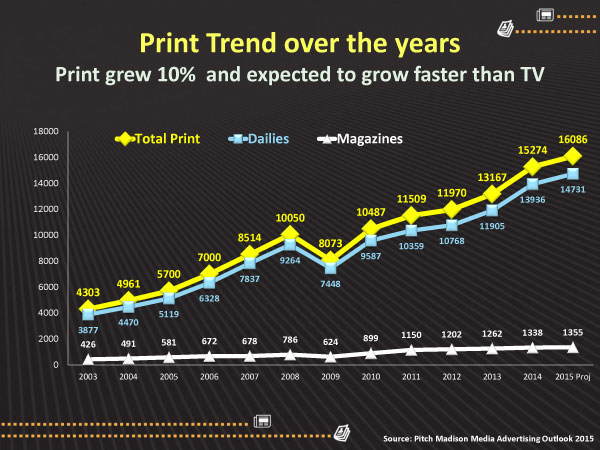
    Print grew by 16% to reach Rs. 15,274 Crs and continues to be the largest contributor in the total advertising pie with a share of 41%. Dailies has grown by 17% and is in line with our earlier projections. Magazines too have grown by 6% and is in line with our projections. Of the total growth of around Rs. 2100 Crs, nearly 85% or Rs. 1,800 Crs has been contributed by Elections & E-commerce players. Increase in advertising during festival season by smaller and retail advertisers has also contributed to the growth. And we expect Print to grow by another 5.3% in 2015.
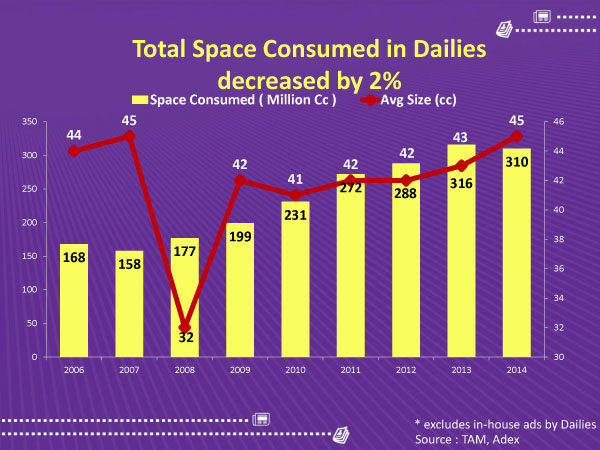
    Total space consumed in Dailies decreased by 2% but the average size of an ad also marginally increased to 45 col. cms.
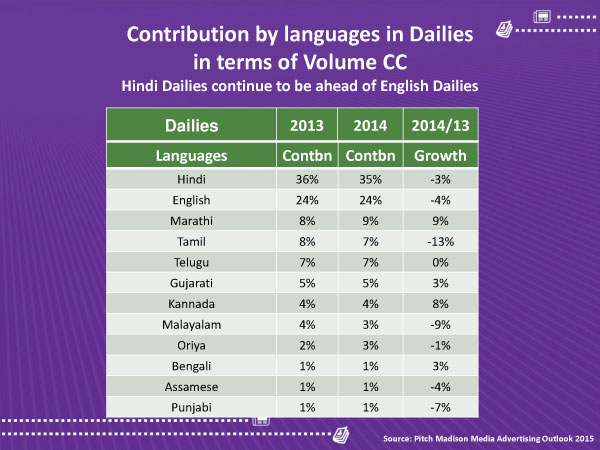
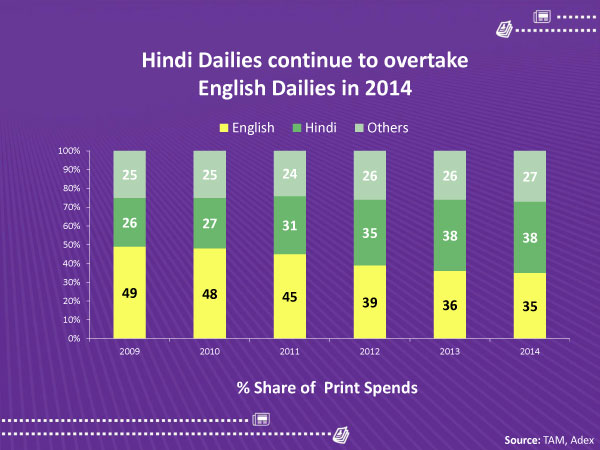
    In terms of Volume of advertising space consumed, Hindi Dailies continue to be ahead of English Dailies contributing 35% of the total volume from Dailies while English Dailies contribute 24%.
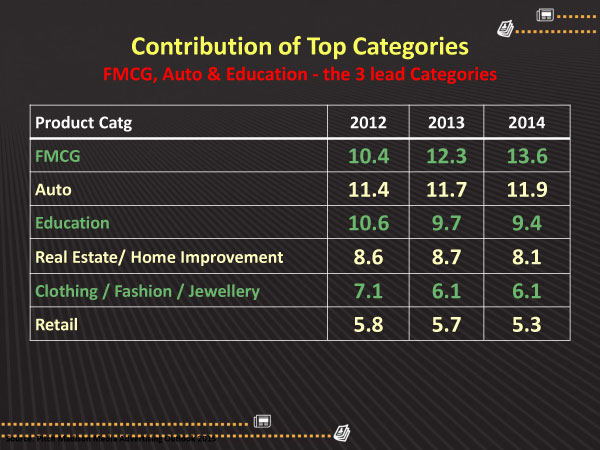
    It is significant to note that for the second consecutive year, FMCG is the largest contributor even in Print, although the contribution is only at 13.6% compared to TV where its contribution is 53%. For years FMCG was not a major contributor and it was Auto, Education and Real Estate that ruled the roost in Print. These categories along with clothing, fashion, jewellery and retail together contribute to only 40% of the total print spends.
    2014 also saw Hindi Dailies topple English with a share of 38% in spends. The dominance of English newspapers is declining for the second year. Hindi newspapers are now firmly the largest contributor to the Print advertising pie.
    Moving on to RADIO
    Radio being a local medium was extensively used by all political parties including individual candidates for campaigning during the Lok Sabha general elections & 5 State elections. Radio has grown by 17% as against earlier growth projection of 15%. This growth is despite Phase 3 not coming into force as anticipated at the start of 2014. E-commerce advertisers have also used the radio medium extensively for all their tactical offer based campaigns. The growth has also come on the back of higher inventory being sold across stations. Radio has maintained its share of 3.5% of the total advertising pie with total revenue of Rs.1,285 crores in 2014, an increase of nearly Rs. 190 crores over 2013.
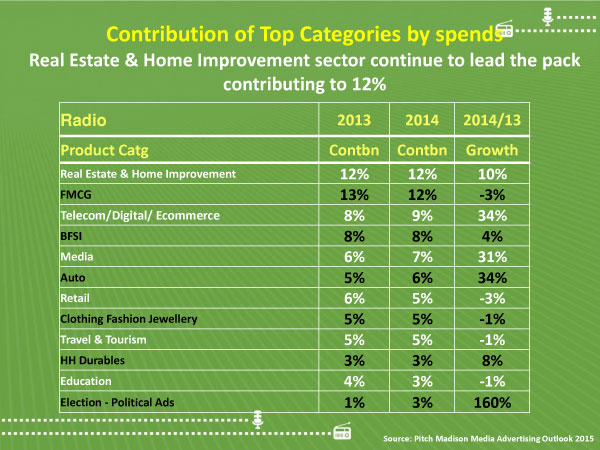
    In terms of category contribution, Real Estate & Home Improvement sector continue to lead the pack contributing to 12% of total Radio spends followed by Telecom/Digital and Ecommerce (9%) & BFSI ( 8%). Revenue from Ecommerce players sees the highest growth rate in 2015 followed by Auto and Media , while revenue from FMCG & Corporate sector shows decline in growth.
    Let’s see CINEMA
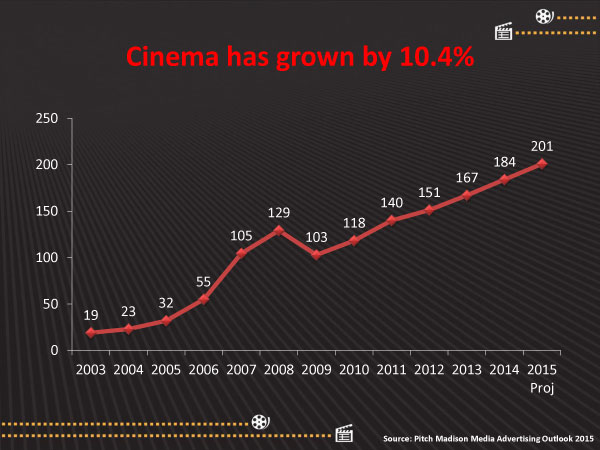
    Cinema has grown by 10% as against the projected growth rate of 7% and is at 0.5% contribution to advertising pie with total revenue of Rs. 184 crores in 2014. The rapid expansion of multiplexes in tier I and II cities is a big reason for the growth of cinema advertising in India
    Let’s see what’s happening in OUTDOOR
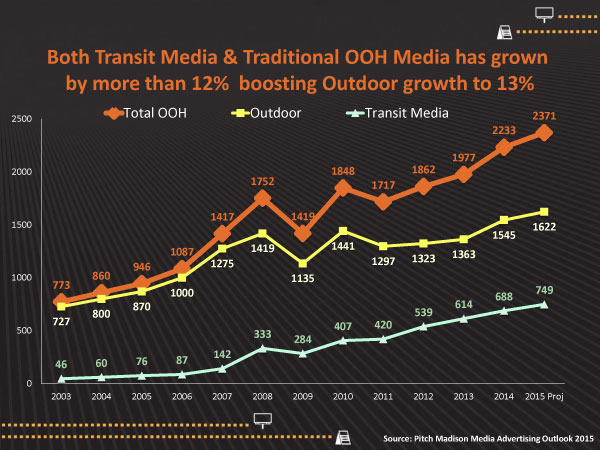
    The total Outdoor spends grew by 12.9% in 2014. Conventional Outdoor, against the projected 7% growth, grew by 13%. Transit Media too grew by 12% as against projected growth of 10%. Political parties spent heavily on OOH for both Lok Sabha Elections & 5 State Assembly Elections. E-Commerce category too gained momentum in 2014. Transit media rode on the back of new T2 terminal in Mumbai, initiation of Metro services in Mumbai & higher organic spends in Kolkata. Organic growth was seen in categories like Telecom, Automobile, BFSI and Retail. Outdoor has maintained its share of 6% of the total advertising pie in 2014 with total revenue of Rs. 2,233 crores, an increase of Rs. 256 crores over 2013.
    Finally we come to Digital
    Display including Video, Social and Mobile grows by 33% while Search increases by only 26%. With more FMCG and telecom players getting into the fray, Video, social and mobile formats saw larger traction. Given the explosion seen in smartphone adoption, we expect the trend to continue in the coming years
    So as you can see there has been a lot of action in the media world and to squeeze value out of this busy, noisy, media world, advertisers need to do a few things differently.I have 5 pieces of advise for my advertiser friends.
    My first piece of advise is to focus on effectiveness and not only on efficiency. Media seems to get the worst of everyone on rates. But Brands should not forget that the reason they advertise is to improve their brand health parameters and we have seen that certain properties, events and festivals, though expensive can impact brand health parameters in a substantial way, justifying the premium over vanilla buys.
    Experiment should be our mantra. And here our guiding principle should be “Fail often, fail fast”. I have often seen marketing teams are painfully slow on certain media decisions. We often suffer from analysis paralysis.
    Our recent experience with BJP and the aggressive e-commerce spends on Print and TV in the last year have ably demonstrated that “Media can Move Mountains”. But, in my view most brands fail to take full advantage of what media has to offer by under-resourcing their campaigns. Better to focus on few brands and advertise them heavily.
    A corollary point, I would like to make is that since budgets are finite and often limited by P&L considerations, you need to prioritize markets very sharply and in the priority 1 markets spend and exposure must be atleast twice that of priority 3 markets, otherwise prioritization is meaningless.
    For some unexplicable reasons I have noticed that as media spends get larger and larger, media decisions are been taken at lower and lower levels. If you want media to work its magic for you, greater involvement of corner rooms is required.
    Thank you
  • Sam Balsara revives talks to sell Madison World’s 75% stake in Madison Media and Outdoor: ET report

    By Pritha Mitra Dasgupta


    Sam Balsara, chairman and managing director of advertising and media buying house Madison World, has revived talks to sell majority stakes in the firm’s media buying and outdoor advertising businesses to the world’s largest advertising network WPP, multiple advertising executives in the know told The Economic Times.


    According to them, while Mr Balsara is also in talks with other advertising networks, including Dentsu Aegis Media, WPP has outbid Dentsu in price and is likely to close the deal in the next two months. Mr Balsara declined to confirm the development, saying, “We are not in active or serious discussions with anyone.”


    In an e-mail response to queries, he added, “Yes, it is true that many agencies have expressed an interest in acquiring part stake in Madison, but we are in no hurry. I must mention that we are not closed to a partnership as long as the partnership can help us improve the quality of service to our clients.”Ashish Bhasin, India chairman and South Asia CEO at Dentsu Aegis Network, denied that the network is in the fray for acquiring Madison Media. “Not at all,” he said.


    According to top officials in both Madison and WPP, Mr Balsara is looking to offload 75% equity in Madison Media and Madison Outdoor, which includes Madison Media’s Sri Lanka unit that handles Proctor & Gamble (P&G) and Airtel accounts among other clients.


    Rest of the businesses of Madison World, including BMB (creative), Madison PR, MATES (entertainment) and PMG (sports marketing), will be retained by Mr Balsara and his daughter Lara Balsara, who is currently the executive director at Madison World.


    According to industry sources, Madison Media’s current revenue is close to Rs 100 crore and therefore the valuation of the deal should be in the region of Rs 250-300 crore. But Mr Balsara’s asking price is over Rs 500 crore, they said.


    Industry executives said CVL Srinivas, CEO at GroupM South Asia, and Prashant Kumar, CEO of South Asia at MindShare, are facilitating the deal for WPP. Srinivas said: “We do not wish to comment on market rumours.” Mr Balsara’s elder brother, who is a chartered accountant by profession, is believed to be helping him with the negotiations.


    While some in the industry said that Mr Balsara may completely exit the media and the outdoor business, the man himself denied it. “We are not interested in exiting the business,” Mr Balsara said. “I am alive and as active as ever before and 2014 has been the best year for Madison World.”


    Ahead of the Lok Sabha elections last year, Madison won the Bharatiya Janata Party’s (BJP) media mandate and helped the party design a corporate style campaign.


    Source:The Economic Times

    Copyright © 2015, Bennett, Coleman & Co. Ltd.

    All Rights Reserved, Licensed to republish


  • Ogilvy & Mather powers government initiative to save 25,000 mw of electricity

    By Pritha Mitra Dasgupta


    The power ministry has launched a mega advertising campaign saying the country can save 25,000 MW of electricity every year by just being prudent. The first TV commercial of the campaign, with ‘Bijli Bachao, Desh Banao’ tagline, was unveiled on December 14 to mark the national energy conservation day.


    Piyush Pandey

    “This is part of a huge campaign which the ministry has planned and will be launched in phases,” said Piyush Pandey, executive chairman at Ogilvy & Mather India, which designed the campaign. The first leg of the campaign showcases school children as torchbearers of this initiative. The ministry has launched an on-ground school contact programme. The Bureau of Energy Efficiency hopes to register 1,000 schools on its portal in the next one year to will help spread the message.


    The power ministry recently roped in Pandey, Sam Balsara, CMD at Madison World, and Sunil Alagh, a marketing consultant, as part of its publicity committee. While the first leg of the ad campaign talks about saving domestic energy, the ministry has planned a separate campaign on how industries can save energy too.


    “The ministry will involve people from all walks of life to advocate the message as change of behaviour towards energy consumption and usage is the need of the day. I believe this campaign should go on even when we have saved enough power and energy,” said Pandey.


    Source:The Economic Times

    Copyright © 2014, Bennett, Coleman & Co. Ltd. All Rights Reserved

    Licensed to republish


  • Ad Club’s Media Review sets its date with members

    By A Correspondent


    The Advertising Club’s Media Review has been a hit with the members over the years. It started out with a solo speaker presenting his perspective and the luminaries that did the event as sole presenters included Sam Balsara, Sameer Nair and Subhash Chandraji.


    Later the format was tweaked and presented as a panel discussion. Some of the luminaries who were panelists included Nandini Dias, Pratap Bose, Punitha Arumugam, R. Gowthaman, Farokh Balsara etc. This year the event will have three experts presenting for 30 minutes each followed by a QnA session with the audience.


    Discovery Communications India has come on board as Presenting Sponsor whereas PepsiCo India Holdings Private Limited will be the Associate Sponsor.


  • Airtel calls for media agency pitch

    By Pritha Dasgupta


    Bharti Airtel, India’s largest mobile carrier by revenue and subscribers, has called for a media agency pitch. It is touted as one of the biggest advertising pitches of 2014.


    The company has just finished the process of sending out invites to leading media agencies including the Sam Balsara-led Madison World, which has been handling the account for the past 11 years. According to people in the know, other agencies in the fray include one of GroupM agencies, Lodestar, Dentsu Aegis Network, OMD and ZenithOptimedia.


    “Airtel has made all the media agencies sign a non-disclosure agreement barring them from talking about the pitch process,” said an executive with knowledge of the matter.


    Airtel has been calling for media pitches once every five years and the last time it reviewed the account was in early 2010, he said.


    Airtel didn’t respond an email seeking comment. A top executive at the New Delhi-based company said it “is just a part of the evolution process” as it periodically reviews the contract. “This time too we want to see who’s offering what and at what price,“ he said.Globally, Airtel is the fourth largest mobile telecommunications company by subscribers, with more than 300 million subscribers across 20 countries as of end-September. It is the largest cellular service provider in India, with over 200 million subscribers.


    During the last pitch process, Madison had faced stiff competition from agencies like TME, Starcom MediaVest, Percept, Mediaedge:cia (MEC) and Lintas Media Group. This year, it will be up against the mighty GroupM ­ the biggest media agency of the country.


    Interestingly, GroupM already has four telecom companies in its portfolio ­ Vodafone, Tata Docomo, Idea Cellular and Reliance Communications. “GroupM has five media agencies and four telecom clients. So they can still look at adding one more telecom business to its kitty,“ said a top industry executive in the know.When Madison retained the account in 2010, it was also given the outdoor duties of Airtel which were initially handled by Portland, a unit of GroupM.


    Later, Madison set up a dedicated outdoor team to handle the Airtel account.


    Source:The Economic Times

    Copyright © 2014, Bennett, Coleman & Co. Ltd. All Rights Reserved

    Licensed to republish


  • Piyush Pandey, Sunil Alagh & Sam Balsara to contribute in government’s save-power drive

    By Mitul Thakkar & Pritha Mitra Dasgupta


    The power ministry is tapping the imagination of advertising gurus to hammer home the message that India can save 25,000MW of energy every year by being prudent.


    The Piyush Goyal-led ministry has roped in Ogilvy & Mather India executive chairman Piyush Pandey, Madison World chairman and MD Sam Balsara and Sunil Alagh, a marketing consultant, for a compelling campaign around saving and efficient use of electricity. “We are all helping the committee as individuals. We are now waiting for the brief,” Pandey said. “The idea is to bring awareness on saving power and ways of using power in the correct way.”


    Despite having an installed power generation capacity of over 250,000 MW, about 5% of India’s close to 600,000 villages remain deprived of electricity, while power supply in most rural areas is erratic, mainly due to high consumption in urban areas.


    Some experts say the government’s efforts to cut electricity wastage need to be supplement strategies to reach out to the industrial and agriculture sectors where energy conservation potential is estimated at over 23%.


    As per the ministry’s estimates, close to 25,000 MW of energy can be saved annually.


    The ministry, sources say, may rope in prominent faces as brand ambassadors to energise its “saving electricity” campaigns which, thus far, are perceived to have not achieved much. An efficient power sector tops the priority list of Narendra Modi, who as chief minister had turned around Gujarat’s utilities and showcased them as a development model.


    In its election manifesto earlier this year, the BJP promised uninterrupted power supply for all. Government agencies like the Bureau of Energy Efficiency have taken several steps to improve energy efficiency and promote power saving.


    Ogilvy’s sister agency, Soho Square and Madison, helped the BJP with its Lok Sabha poll campaign, which too was led by Union minister Piyush Goyal, Mr Pandey and Mr Balsara, and the trio continue to work on campaigns for state assembly elections. Asked if he is open to joining more committee’s within government, Pandey said, “I am open to helping out on any call. But I can’t spread myself too thin and then fail to deliver the work.”


    Meanwhile, there are talks that Mr Modi wants Mr Pandey to lead communications for both the government and the party. Although Pandey denied having received any such offer, several top executives at WPP said the offer includes maintaining agency relations and supervising government projects like ‘Swachh Bharat Abhiyan’, ‘Clean Ganga’ and ‘Jan Dhan Yojana’, among others.


    Source:The Economic Times

    Copyright © 2014, Bennett, Coleman & Co. Ltd. All Rights Reserved

    Licensed to republish


  • What Ticks for Indian Consumers


    Last year, when we carried the contents of our first Annual, the articles went on and on and on. So this year, we thought we’d give it a slip and just restrict the Annual to the print (and eventually archived in an e-edition). But given the treasure trove of content and knowledge, there have been several requests from our readers (and some of our guest writers) to publish these every day over the next month.


    Given that there are over a hundred articles in the second edition of the Annual, we will carry two or three articles every day and try and conclude our series by early September.


    The insights and views were broken down into the following strata and components of the average Indian household: Family, Women, Men, Young Adult/Teen, Kids.


    So, read on and with the first of our two writers: R Balki and Sam Balsara from the ‘Family Section’:


    The changing family dynamics


    By R Balki


    There are two parts to this change. While of course there are more and more independent nuclear families with one or two children, there is still a huge part of India that lives in joint families. The most interesting change is here, in the dynamics within the joint family. While two or more families still live together there is more and more focus by each individual family, within the joint structure, on its own needs. It is no longer one rule, one way of life for the whole group. There is an unsaid, unspoken understanding of the need for independent progress in a seemingly dependant framework.


    In the nuclear family, while the concern for children, their schooling, and aspirations for their higher education is still foremost in a couple’s life, there is an increasing focus on their individual futures too. It is no longer selfish to worry about ‘myself ‘ and ‘my’ future and ‘what I am going to be professionally’ while taking care of children. Of course, there still are some women who give up everything for their children’s sake or some men who put their careers on different tracks from what they like it to be for the sake of their children. But I think this sacrificial number is fast decreasing.


    Couples with no children are on the rise. They make a conscious decision not to have children and focus on themselves. There are more and more examples that demonstrate that a child is not a necessity for happiness.


    ‘Fragmentation is never a friend of advertisers, segmentation is’
     

    By Sam Balsara


    The consumerism story is likely to continue in India for a while. We have a one billion-plus population and there are several people who are continuously coming from the non-consumption segment into the consumption segment. Indeed there is plenty of headroom for consumption in India. Though there might be some disturbances, on the macro level, the consumption story of India is very strong.


    Even today, for instance, there are millions of people who are yet to enter the toothpaste market, they use dant manjan. These people will come in the toothpaste market… and that will happen irrespective of the growth rate. In the 1960s and ’70s we all thought that population was a major concern. However, we have now realized that it is actually a source of strength. What we need to focus on is to have an educated and employable population, which is the key concern area.


    From collective to individualistic society

    India is moving from being a collective society to an individualistic society. It is an outcome of westernization and urbanization. Everything is becoming very individual and one family-centric. It brings about its own opportunities for the marketer. The concept of a family soap that existed until recently probably is dying. You create products and you create advertising for almost each member of the family – the mother, the father, the grandmother, the grandfather, married son, child, teenager… It creates opportunities for marketers to further segment, target and appeal to each of the individual people.


    Socio-economic reasons for change

    Awareness is the biggest reason for change. People of every region are more aware of how life is led in the world outside. Examples open the mind. There’s a belief that there can be a better life and it is possible to experience it. Earlier women were always made to feel guilty if they were worried about their future. It was always about the children’s future and the man’s progress. Today women are clearly saying, ‘I am equal, I have my future too’. It is like a volcano. The years of suppression is making this change so powerful that it is the biggest driving force of our times.


    Rural and urban family

    It is difficult and dangerous to generalise families as rural and urban. Many urban people behave like Neanderthal families stuck in the past, while several families from villages or small towns think and behave like they are in some of the most developed countries. Be it environmental consciousness, be it entrepreneurship or just social thought process. There can no longer be a blind generalisation that if you are in a certain place or from a certain economic background this is how you will be.


    Again awareness, exposure to life outside the community, an increasing respect for the Individual in the smallest sections of society is the reason for this behaviour.


    From collective to individualistic society

    It is indeed a paradox. As we are talking of the emancipation of the individual, male, female or family there is a parallel push that is driving us back to togetherness. Bad governance, the state of our bureaucracy, the increasing corruption that is threatening to ruin our nation… All these threats are going to need collective solving and a spirit of togetherness like we have never seen after Independence. There are too many wrongs, too many fears, too much to lose. Funny. Just when we were beginning to enjoy our selfishness and individual progress after years, we have to, with far greater awareness, make some sacrifices and come together for survival. The small spurt of selfish behaviour will have to go back to collective consciousness, collective thinking and collective living. We can only be ok if we are all ok.


    Man’s role

    The male species is at last truly evolving. It has had to unlearn or re-learn a number of things. It is learning a different kind of sensitivity. The era of blind dominance of ‘I earn so I am the king of the family is gone’. Men are being forced to acknowledge and appreciate the role of the home-maker. In fact, with women double hatting, co-earning and managing homes, things are changing so rapidly that men are slowly getting prepared to be formally relegated to second place, way behind women. In the family and society. Of course, there are cases where this is not true, but they are all fast changing. Sometimes by force, sometimes by just awareness.


    Brands & families

    Today when a brand connects with one member of the family, other members of the family too get connected with it quickly. They communicate with each other far more. Children are more intelligent than parents in a lot of cases today. They are more technologically sound, aware and solve a lot of their parents’ technological problems. Today’s family is actually more like a group of friends.


    India’s consumerism story

    Yes, there are malls. Yes, there are more international and national brands than ever before. But this is just still a teaser of things to come. Indian consumerism has just begun.


    Increasing population a problem

    Population still is our biggest problem. We may have very cleverly converted what was our biggest problem into an asset as far as the world market is concerned. But it is still our biggest threat. Consumerism is only one small corner in the asset list, there are so many liabilities. Where is the infrastructure to support this kind of population? Everything is crumbling. Social and health issues abound. Economic disparity is growing dangerously. You can sense the turbulence and restlessness. India is the most polarised nation, where the rich are few but very, very rich and the poor are many. As the population increases further, this polarisation will only increase.


    We Indians have always been fantastic at leaping. We have leapt straight from no telephones in most houses to the mobile digital world. From illiteracy to the internet. Consumerism will also leap many phases because of the internet. From not even being aware of a thing called ‘marketing’ to almost an all knowing cynical attitude to every marketing push. Today consumers are far more intelligent about marketing and how things are marketed. Marketing can no longer be a ‘permissible con’. It needs to respect this evolving consumer.


    Future readiness of marketers

    Any marketer who believes in leading the consumer is future ready. Any communicator who believes in adding to a consumer’s life is future ready. Those that just follow the consumer are always behind. And will never be future ready. Consumers lose respect for brands that just look at their lives and borrow from it to momentarily connect with them. Consumers look up to brands that have shown them a new way. Always. These brands will always be future ready. As they are leading the consumer to a new future.


    On another dimension, to make an impact in media today is becoming increasingly expensive. To make an economically viable product that can be marketed to individual members of the family and to make it commercially viable is a challenge. Going forward as you get more targeted media, things hopefully will ease out.


    Changing family dynamics

    Man’s role has substantially changed from being an autocrat ruling the family with a heavy strict hand. The change is definitely more visible in urban areas. He has become more responsive to his family’s needs, their likes and dislikes. What they eat, what they wear, car they use, school children go to, holiday destinations have all become participative decisions where the entire family participates.


    I think children are becoming difficult to reach partly because of the advertisers own stringent guidelines based on their social responsibility. Many of the large advertisers impose restrictions on us not to directly reach children and try to influence them directly because that is considered socially irresponsible.


    Consumer expectations & marketer readiness

    Consumers are becoming more demanding, less tolerant, more finicky, more discerning, choosier; this is a continuum where everyone is moving up on the scale. Are the marketers ready for the consumers of tomorrow? I guess not. I don’t think we are ready for every change but obviously nobody is really ready for all change. Marketers do a lot of research on their products and in what consumers need but possibly not enough research is done on how the consumer is thinking and how his lifestyle and habits are changing.


    Having said that, marketers have realized that it is a folly to launch products ahead of their time. For example, some 10 years ago, many advertisers had made big splash about bath gel and it did seem it was a little ahead of its time then. I believe that from a marketing point of view and from economic viability and sustainability point of view, it is always better to be few years late than a few years early.


    Key challenges for traditional media

    The biggest challenge is the problem of plenty. There is just too much of media, too much fragmentation and media is not well segmented. That is a challenge. Fragmentation is never a friend of advertisers, segmentation is. Fragmentation makes impactful communication difficult.


    Social media has emerged strongly in India in the last few years. Marketers have been quick to jump to this bandwagon. I don’t think we have really been able to exploit the power of this medium though. Facebook is also becoming a little cautious, they don’t want to commercialise it too much and make their users unhappy. We should be able to figure out a better way for engaging with this community of millions of users that is readily available.


    Mobile as a medium of advertising

    Mobile would emerge as a strong advertising medium in years to come. It is a medium that is always on, and is personal. It can also be voice-based, breaking the illiteracy barrier. The price of smart phones is also coming down. It has a lot going for it except its small screen size.


    Theoretically, precise targeting should be possible but in actual practice it has remained restricted to targeting by time and by geography. According to me there are too many regulatory issues that prevent it from becoming a dream medium. Once these are taken care of, mobile advertising would definitely grow exponentially.


    Happiness quotient

    It is definitely true that happiness has become more elusive now. Despite so much of material wealth, the level of unhappiness seems to have gone up. However, this is nothing new or unexpected. It is again the consequence of westernisation, urbanisation and more prosperity.


    Possibly there is opportunity for marketers to capitalize on happiness as a product benefit in an abstract way and not in a material way. Instead of saying it makes your hair darker, or makes you taller or thinner or things like that, they can say buy my product and it will make you happy.


    – (As told to Ritu Midha)

    Tomorrow: Men – Rana Barua and Ashish Bhasin


  • How advertising helped Modi get on road to PM


    By Shobhana Nair


    It’s a campaign that’s sure to enter India’s advertising hall of fame. A blitzkrieg that marketing boys from across the country are drooling over. The advertising mania around Brand Modi began a few months ago in right earnest. The seeds had been sown by way of a belligerent presence on the social media ended on the counting day.


    Piyush Pandey

    While the victory of Prime Minister-designate Narendra Modi has been attributed to many factors, one can’t overlook the advertising muscle put behind promoting a great brand. As Piyush Pandey, Executive Chairman and Creative Director for Ogilvy & Mather India and South Asia says, “You can only position and market something which is good and based on what the product is all about. Nobody has ever been able to sell a bad product. Nobody can as people are not stupid. So a good product is presented with its attributes and the marketing of the brand which was done by Soho Square is only a presentation of what is good in its intrinsic value.” A team of 25-odd creatives, planners and account management were working round the clock for three months in Mumbai and Delhi on the job. Soho Square, a part WPP’s Ogilvy & Mather India, bagged the account after nine rounds of pitching.  “The brief was to firstly, address the common man’s key issues through a comprehensive agenda and secondly, project Mr Modi as the next PM this country deserves,” shares Anuraag Khandelwal, Executive Creative Director and Creative Head, Soho Square, Mumbai.


    Ad campaigns like Abki Baar Modi Sarkar, Janata Maaf Nahin Karegi and Achche Din Aane Waale Hain were able to convey both – the current sentiment of the country and the BJP mandate – powerfully and effectively.


    Prasoon Joshi

    There was also Prasoon Joshi and his team from McCann’s TAG too who were involved to articulate the philosophical aspect of the party. Desh Ki Pukaar, Modi Sarkaar and Desh Nahi Jhugne Doonga were some of the campaigns which Joshi was involved in. “It is very important to know what your product has to offer and what people need. Only then will it resonate with the people. One of my biggest learning is that you need to have a right product, the right ingredients and you can’t confuse people with 10 things.”


    “Modi was portrayed as a single-minded person of the party with one single mandate. There has to be clarity of focus & product has to be superior. A great campaign in isolation will not work,” says Joshi.


    Ask the brand gurus on why the campaigns worked in favour of Modi and here comes the reply. Jagdeep Kapoor, Brand Guru & CMD, Samsika Marketing feels that the communication and advertising was simply strategic. “It entered the minds and heart, but more important was the great performance of Brand Modi over the decade, which helped them communicate.”


    Harish Bijoor

    Well-known brand expert and CEO, Harish Bijoor Consults Inc gives a thumbs up to Modi’s marketing, “Modi is the ultimate political marketer. He had able support, and he was decisive in the way he managed his campaign. His campaign was a 360-degree campaign that had everyone else watching with awe. The best of product marketing gyaan was brought into this campaign. And it worked. Modi is a product. And this product promised what the people wanted. And in him people saw a strong and decisive leader, someone who was an anti-thesis of sorts to the persona India was used to in the past decade with Manmohan Singh at the helm of affairs.”


    The media buying and planning was handled by Sam Balsara’s Madison World and he admits that a campaign as large as this came with its set of challenges. “Outdoor in UP posed huge challenges because of unfair play by the ruling party in granting permissions for putting up hoardings. The other challenge was negotiations with media, some of whom artificially inflated their rates for political campaigns! Random numbers floating around in the media of the budget of our campaign made our task more difficult.”


    While it may appear to have been all hunky-dory as one looks back at the BJP’s advertising campaign, Piyush Pandey adds: “No brand is built in a few months; a brand is built over a period of time. What Narendra Modi has done in the last 10 years has been valuable to him.”


    Pandey also hastens to add that good advertising wasn’t the only reason for the Modi’s success. “No election is ever won or lost because of advertising. Advertising is only an element. Advertising only presents it. With a great product, I can do great marketing.”  Indeed.


  • Sam Balsara on the BJP’s Media Magic


    By Shobhana Nair


    While there’s no doubting the fact that it was Narendra Modi who led the Bharatiya Janata Party to victory, there were many who worked backstage to create the message. MxMIndia spoke with Sam Balsara, Chairman & Managing Director of Madison World, the media planning and buying agency that worked along with Team Modi to pull of what was decidedly the biggest ever political campaign the country has ever seen. Excerpts from an interview:


    Learnings for other Advertisers:

    > Don’t under-spend; most brands make that mistake and dilute their campaigns and sometimes waste the entire advertising money

    > To change consumer behaviour or establish brand preference - multi-media is a must


    What the new government must do:

    The new government must focus on growth in economy and provide incentives for that, provide infrastructure, make India the toast of the world once again, not focus on giving doles to the poor. Even if you distribute all the money to the poor there isn’t enough money to go around. It needs to focus on growing the economy. Most of India’s problems would get taken care of. In the media area, it must not interfere and allow free market forces to play.


    How did the mandate come to Madison? Who from the BJP called you and how and why did you decide to work on the campaign?

    We were first contacted by Prashant Kishore in Ahmedabad through our client Lodha. Subsequently, we were contacted by Ajay Singh and Arun Narendranath. Then we met Piyush Goyal and Arun Jaitley. We entered the fray late. All major agencies were competing for the account. What won us the business was a lot of detail work revolving around media reach in different constituencies, grouping them in three priorities and summating the whole strategy in an elegant 10 pillar strategy. Our reputation for transparency and integrity sealed the deal.


    When you took on the mandate, or any time during the campaign, did you get any direct brief from Narendra Modi?

    Lara has met Narendra Modi. I haven’t, yet.


    When you took on the job was there any apprehension about delivering it? Political parties like BJP, RSS are known to be conservative, not open to modern ideas and so on. Was there a problem on that count?

    We were confident of delivering on our product not just because of faith in our own experience, expertise and capability but we knew we had a strong product, compared to competition. Advertising works brilliantly for a good product, but kills a bad product fast.


    For the first time ever in India a political party was presented as a brand. Was BJP open to this idea from the beginning? How did you sell your ideas?

    Yes. That was the very reason they reached out to professionals and then played a supportive role, not an interfering role. I must say the people at BJP are not the politician stereotypes; they are smart, savvy and intelligent managers who have left their corporate jobs to help the nation catch up on lost time.


    Reaching out to media dark markets like UP and Bihar seemed to be a big challenge for BJP. How did you resolve that?

    These markets did pose a challenge and obviously got our greater share of our attention. In addition to mass media these markets got intensive below-the-line support.


    What were some of the biggest challenges you faced while executing the campaign? We have heard in many regions district magistrates refused to cooperate.

    Outdoor in UP especially, posed huge challenges because of unfair play by the ruling party in granting permissions for putting up hoardings. The other challenge was negotiations with media, some of whom artificially inflated their rates for political campaigns! Random numbers floating around in the media of the budget of our campaign made our task more difficult. Ultimately, it worked out well and we were able to do our job without fear or favour and I hope the media owners are also happy.


    Will you call this the toughest campaign of your career?

    What made it tough were the frequent changes based on feedback from state units communicated to us through BJP HQs that necessitated my team to work almost every night till 3 and 4 am. Work-day timings for the team changed from 9 to 5 to 12 noon to 3am. In many cases we succeeded in releasing jackets in newspapers at four hours’ notice (2am to 6am) and TV spots too at 2 hours notice. We launched the campaign on cricket. You can’t do better than that, based on our experience and the creative also was specially created for cricket.
     

    Going forward, will you continue to work for BJP or the new government? Has there been any discussion?

    We hope so. In addition, what I would really like is for the Government of India to appoint us as media advisors for all their advertising! We could make a huge difference in terms of efficiency and effectiveness. Communication is a very important element in the nation-building process. Most political parties unfortunately think of it only at election time.
     

    A number of people said BJP spent close to Rs 5000 crore for the election ad campaign. What do you have to say to that?

    That is indeed the finest compliment that Madison Media has ever received. The actual is just a miniscule fraction of that number, but I am not at liberty to reveal the number. Some professionals have put the mass media campaign at Rs 1000 crore. I am offering a prize to anyone, mass media professionals included who can guess or calculate the exact number spent in mass media! The BJP campaign has once again proven that mass media has the power to move mountains; that mass media is not expensive as it is thought to be and multi-media is essential for effectiveness. I must also admit that in my view NDA would have won anyway; they had a strong product and the competition was weak. What our campaign achieved is that it cost effectively raised the pitch to a crescendo, constituency by constituency as polling day neared which converted a communication task into what you in media call a Modi WAVE that resulted in a landslide victory for the BJP.