 Last week I underwent some major dental work. Dealing with excruciating pain and dizziness induced by a bouquet of medicines, I took to Netflix for comfort. Partly my objective was to try and doze off, hence I deliberately chose not so addictive content. And I decided to watch the much acclaimed (read slammed) Ranbir Kapoor starrer, Animal.
For those unfamiliar with the title, the film is a dark crime thriller directed by Sandeep Reddy Vanga. The story revolves around Ranvijay (Ranbir) who craves for his industrialist father’s (Anil Kapoor) attention. He returns home from the US after several years, following the news of a fatal attack on his father. The rest of the (longish) movie is centered around bloody revenge, quite full of gore and violence.
What’s my problem with the film? Not just mine, let’s list down some of the controversies surrounding this cinematic creation. It’s almost three hours of mindless action. One that shouts of masculine toxicity. Women characters have no room in the plot. You can count the number of times they are allowed a few words, only to be shut up by their husband(s) and brother.
Vanga toys with obsession as one of the key emotions defining his protagonist, similar to his earlier production, Kabir Singh. An unhealthy fixation with a lover, father or another relation almost justifies the violent display on screen, the shrill in dialogues and the evil in action. And women are mute spectators, if not participants in this ghastly exposé of masculinity.
I must confess, in the first couple of scenes where the young Ranvijay is seen neglected by his busy, wealthy father, I felt a sense of empathy towards the little boy. But the feeling didn’t last too long because the little boy quickly evolves (reads regresses) into a rich entitled brat, who turns up with a gun to her sister’s college classroom. All in the name of ‘protecting’ her.
And then there’s the bad guy, the antagonist played by Bobby Deol. Although Abrar (Bobby) shows up much later in the film, towards the latter half, the scenes laden with ferocious machismo are equally exhausting to watch. There is a similar story of mental trauma experienced in early childhood that the filmmaker uses as an excuse for the irrational behaviour.
Both broken men in some ways, at loggerheads to protect their kin. But that’s not it. What’s interesting is that both these characters have a form of disability. Abrar has a speech impairment, he needs his brother to act as the interpreter, who uses signs to communicate with him. Ranvijay loses his hearing as well as taste and smell after sustaining several bullets. In fact, after the attack, he is a medical miracle, walking, talking, and fighting despite a failing heart, no bladder control and several injuries.
None of the film reviews have looked at why the filmmaker uses disability in curating the two main characters. For quite some time after watching the movie, I was also confused if the hearing or speech impairment is used to highlight a vulnerability. I am not sure.
But here’s how I see it. For the longest time, Indian cinema has either pitied or ridiculed disability on the silver screen. Ranvijay and Abrar are both brutal, they are disabled too. Their condition doesn’t get in the way of their (dirty) business. However, skewed it may sound, it is empowering in a way. And there is no sympathy generation given their inability to taste, hear, smell, or speak. In fact, in more recent films like Andhadhun and Kaabil, the characters are ridden with flaws, they are not the typical heroes. It’s almost refreshing to see disability coloured with a streak of anger, violence, trickery, deviousness and more.
These are all human emotions, associated with a person with disability as much as any other non-disabled individual. So, irrespective of how much I disliked the film for its senseless action, played up chauvinism, I managed to find something I couldn’t entirely dismiss.
Of course, the film is far away from a utopian world that respects and includes the marginalised communities, including women, persons with disability, elderly, or any other weaker minority. And yet I managed to stay awake and watch it till the very end. Morbid fascination, I guess.
Wondering why MxMIndia publishes a disability advocacy column? Well, we strongly feel that the media can dramatically transform the world for persons with disabilities. This series attempts to help bring forth issues that the media must champion to create a truly inclusive and accessible India. Writing this column is Shruti Pushkarna, a former journalist and now a disability inclusion advocate based in New Delhi. Her views here are personal. To access the archives of her 80-plus columns, please visit: https://www.mxmindia.com/category/ columns/shruti-pushkarna/
If you have a view on the issues raise or would like to align with MxMIndia on this cause, write to us at editor [at] mxmindia.com.

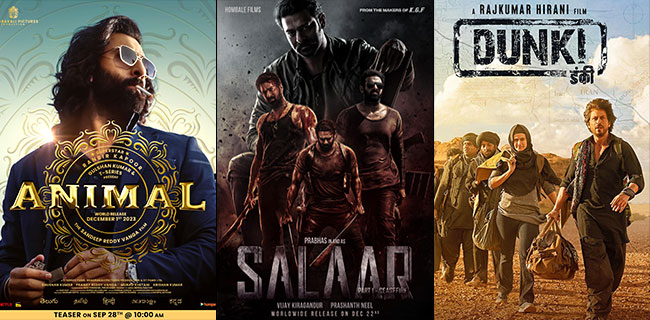
 It’s a huge Friday at the box office today. Ranbir Kapoor starrer Animal, directed by Sandeep Reddy Vanga, releases today, and is set to witness one of the highest openings in Hindi cinema, with even a shot at the 50 Cr first-day box-office, a mark that only four Hindi films have ever achieved.