Tag: Procter & Gamble

  • Whisper launches fifth edition of Keep Girls In School programme

    Feminine-care brand Whisper, from the house of Procter & Gamble, is raising awareness about– the early onset of menstruation among young girls — as part of the fifth edition of its #KeepGirlsInSchool (KGIS) movement.

    Said Rajdeepak Das, Chief Creative Officer, Publicis Groupe – South Asia and Chairman Leo Burnett – South Asia: “Our ongoing research about the changing conversations around menstruation identified a glaring anomaly – girls today are getting their periods much earlier than before. However, they are being educated about periods at a much later stage or oftentimes not at all. Whisper and Leo Burnett have been on a journey to keep girls in school for a long time and we wanted to bridge this gap. Our latest work talks to the 8-year-olds in a language they can understand, with a heartwarming song that teaches them that getting periods means they are healthy. The goal is to not just teach the little girls but also use the song as a tool to equip her ecosystem- parents and educators, enabling them to teach periods in an empowering manner.”

    Added Girish Kalyanaraman, Vice President & Category Leader – India Feminine Care at Procter & Gamble: “There is a seismic shift happening in period biology. This heightens the need to educate girls early on and to prepare them to embrace this biological process. Through this initiative, we strive to educate them about how periods are healthy and how they can take care of themselves on their period days. Every year, Whisper goes to more than 60,000 schools to create period education programmes and we are now also going to younger standards. Consumers too can do their bit buying a Whisper Ultra pack which will help us educate and donate pads to one girl to keep her in school.”

  • Gerry D’Angelo joins MMC Advisory Board

    By Our Staff


    Media Marketing Compliance (MMC) has announced that Gerry D’Angelo, the former Vice President of Global Media at Procter & Gamble, has joined its Advisory Board.


    He joins Nick Manning, MMC chair and co-founder of Manning Gottlieb Media (now M G OMD), and other MMC directors to contribute their strategic insights and industry expertise as MMC ramps up its growth.


    Said Manning: 
“Gerry is one of the brightest minds in the industry. He remains passionate about delivering best practice across the media landscape and brings a valuable perspective to the MMC Advisory Board as it continues to define the media financial compliance industry.”


  • Filter Coffee bags mandate for Pantene

    By Our Staff


    Filter Coffee Co (FCC) has secured the digital marketing mandate, which includes social media and e-commerce, for Pantene of Procter & Gamble.  The full-service agency is set to take charge of comprehensive responsibilities, managing social media, e-commerce, and content production.


    Notes a communique: “After another competitive multi-agency pitch, this collaboration reinforces FCC’s position as a key player working with beauty and skin care brands, promising a journey filled with innovation, flair, and creativity.” Filter Coffee Co is headquartered in Mumbai and is headed by Anuja Deora Sanctis, its founder.


  • Whisper unveils fourth edition of its #KeepGirlsInSchool movement

    By Our Staff


    Feminine-care brand Whisper, from the house of Procter & Gamble, has unveiled a new film titled ‘The Missing Chapter’ as part of the fourth edition of its #KeepGirlsInSchool (KGIS) movement. This time, the new film aims to educate mothers on the biology of periods so that they, in turn, can educate their daughters on periods including menstrual hygiene and using sanitary pads during their monthly cycles. The film is conceptualized by Leo Burnett.


    Said Girish Kalyanaraman – Vice President and Category Leader, Feminine Care, Procter & Gamble India: “For a natural process like periods, it is very important that parents educate their young daughters correctly. In most parts of India, we’ve seen that mothers themselves are unaware about the biology of periods and the ways to manage it. As a result, menstrual hygiene is compromised. This leads to girls staying at home during their period days every month and they slowly start falling behind eventually dropping out of school altogether. Our film ‘The Missing chapter’ aims to address this and spread awareness among mothers so that the next generation of women is empowered and educated to manage their periods and keep girls in school.”


    Added Rajdeepak Das, CEO & Chief Creative Officer, Leo Burnett – South Asia: “A mother is the first teacher of a child, the one who imparts life’s most important lessons. Thus she could be a powerful ally in our journey with Whisper to Keep Girls in School. But in India, mothers themselves lack the education to teach their daughters about periods. Our focus this year is to educate mothers, create a chain of positive information, and break the cycle of ignorance.”


  • Old Spice launches new campaign

    By Our Staff


    Old Spice has launched a new campaign for its range of Old Spice Zero Gas Deodorants. It is curated by Media Monks.


    Said Rohini Venkateswaran (Vice President, Skin & Personal Care India, Procter & Gamble): “Building off our rich heritage on Old Spice, our new campaign is a reminder for every Indian guy to smell new possibilities, realise his true potential within and manifest his own greatness” “Old Spice encourages every man to be the most awesome version of himself, while providing great smelling products to make him feel his best.”


  • Cross-media measurement, finally?!


    By A Correspondent


    The World Federaation of Advertisers has facilitated a programme to expedite the implementation of a new wave of cross-media measurement solution. This is being coordinated by global brands and leading national advertiser associations (which includes the Indian Society of Advertisers, and with involvement from partners from across the ecosystem.

    According to a report on the WFA website, the proposal was developed in partnership with digital platforms, including Facebook and Google, and will now be tested by the UK and US, with ISBA and the ANA respectively leading local efforts.

    The business case for improved cross media measurement is clear:

    :: Separate measurement systems preclude an understanding of true Reach and Frequency. This means there are considerable amounts of impressions bought which are driving diminishing or even negative value to advertisers. There is scope to prevent the wastage of billions of dollarsthrough better measurement which, in turn, improves ROI;

    :: Equally, an improved consumer experiencecan be delivered through avoiding the excessive ad frequencies which some have been exposed to. This is critical to avoid an apathetic (or outright hostile), reception towards advertising from our audiences;

    :: Lastly, improved measurement enables the sell-side to better value their inventoryto attract ad spending;


    Notes a communique: “The barriers to delivering better solutions worldwide are more political and commercial than technological. Our approach to break the deadlock has been to start with the advertiser. We believe that most progress can be made, and consensus arrived at, when the industry aligns around advertiser needs, as documented in the Industry Framework, Establishing Principles For A New Approach To Cross-Media Measurement.” Adding: “This has involved cross-industry consultation with advertisers, agencies, broadcasters, measurement companies and platforms. The goal has been to create a catalyst for local development of new solutions.”

    Adds the report on the WFA website:

    Alongside the Framework, the WFA is also publishing a real-world Technical Proposal for a cross-media measurement solution, which meets the principles outlined in the Framework, including on transparency, neutrality and auditing.

    This has been developed in partnership with digital platforms and shared and discussed extensively with the industry. It utilises a panel and census approach (via publisher logs) to give advertisers far greater understanding of the Reach and Frequency of their campaigns across TV and digital media (including both video and other formats).

    The Proposal leverages a Virtual ID (VID) and differential privacy methods to preserve privacy while preventing double-counting of impressions across media. In delivering improved cross-media frequency control, consumers will also benefit by not being unintentionally targeted by the same ad across different media channels, potentially addressing one of the key motivators behind ad blocking.

    Critically, the Proposal acknowledges that measurement is a local business and requires considerable local governance alongside the need for some global (or ‘common’) components to drive consistency and scale. Any aspects of the proposal that require bespoke technology will be open sourced.

    It has been tested via an international open comment and peer review exercise earlier this summer, organised by the WFA and involving several hundreds of the industry’s most prominent measurement professionals. This has allowed the wider industry to fully scrutinise, challenge and change the Proposal.

    The baton has been passed on to national advertiser associations, and ISBA’s cross-media measurement group, ‘Origin’, and the ANA will now independently explore how the components in the Proposal can be adapted to suit local stakeholder needs, ahead of implementation in their respective markets. Validation efforts will place particular care and focus on how TV data will be integrated with digital data within the Proposal. Both initiatives will focus on ensuring the priorities of advertisers are met while also taking an approach that reflects the needs of broadcasters as well as the changing digital media landscape.

    Several other markets and organisations are also looking closely at the components in the Proposal, with a view to possible implementation on the back of the US and UK work.

    This announcement reflects nearly 18 months’ work, which was prompted by the WFA’s Global Media Board, comprising 14 key advertisers and associations. Measurement is a key priority for advertisers and the WFA is committed to providing an ongoing platform to share learnings and to develop the ideas and concepts outlined in both the Industry Framework and the Technical Proposal.

    This approach has been supported by the whole WFA membership but the initiative has been steered by several prominent advertisers and advertiser associations, including ACA (Canada), ANA (US), ISBA (UK), Union des Marques (FR), OWM (DE), Deutsche Telekom, Mars, Mastercard, Nestlé, PepsiCo, Procter & Gamble, The Coca-Cola Company, Unilever and others. The Media Rating Council (MRC) has also been involved in this work throughout.

    “Advertisers have long struggled with poor quality data that doesn’t allow them to properly assess how best to invest their ad budgets across multiple platforms and media. This body of work provides a blueprint to build a cross-media measurement solution that responds to advertiser needs. The WFA is proud to have facilitated this work in partnership with key markets, platforms and broadcasters and looks forward to seeing it widely implemented across geographies,” said Stephan Loerke, CEO of the WFA.

    “Cross-media measurement is viewed as the ‘holy grail’ for marketers – as it optimizes marketing decision making for driving business and brand growth. ANA has championed measurement development that is viewed through the lens of the marketer for several years. This collaboration with WFA, ISBA and other partners has been galvanizing as it provides the foundation to build local solutions to this highly complex issue. The ANA has been proud to participate in this global venture,” said Bob Liodice, President and CEO of ANA.

    “For some time ISBA’s members have made the development of independent, accountable cross-media measurement our highest priority. The articulation of a clear advertiser-driven ‘North Star’ and a strong framework of global principles are significant milestones. We look forward to working in partnership to validate the proposed technical approach and to developing a UK solution that leverages the global blueprint,” said Phil Smith, Director General of ISBA.

    “Procter & Gamble has been a proponent of media audience research since the earliest days of broadcast media and is proud to be at the forefront of this breakthrough initiative in partnership with digital platforms, television broadcasters and other major advertisers. We need complete, open, transparent and future-proofed cross media measurement to enable consumers to have a better viewing experience with less annoying repetition, advertisers to be confident that their media budgets are being invested effectively and efficiently, and media companies to be rewarded for delivering high levels of reach and engagement. This is mission-critical, the time is now, we know it won’t be easy, but there has never been a stronger plan, and we need everybody to join in to make it happen.” said Kanishka Das, Senior Director, Global Media Analytics & Insights at Procter & Gamble.

    “Since early 2019 Unilever has championed cross-media measurement, with the aim of delivering greater transparency as part of our Responsibility Framework. The business case is clear, broadcasters and platforms alike can better value their inventory to attract ad spending, while delivering stronger outcomes for advertisers and driving greater effectiveness of spend. But cross-media measurement potentially has a more profound impact than this for our consumers. By driving transparency across all platforms to better understand levels of engagement holistically, it enables improved ad relevance and reduces excessive frequency, ultimately providing a better consumer experience. This programme, from its guiding principles led by Unilever’s Responsibility Framework to the technical blueprint produced by the WFA, ISBA, ANA and a diverse collection of advertisers, is a critical step towards providing more accountable, transparent and accurate media measurement for all parties,” said Sarah Mansfield, VP Global Media, Unilever.

    “The process of developing cross-media measurement solutions has been a long journey.  The development of a solution is complex and requires careful planning. There are many challenges that we face; many of these are not technical but instead breaking down barriers that have been established by decades of legacy ways of working. To solve this, we need to think and collaborate across boundaries. We have worked hard to establish a solid start with this Framework and Technical Proposal, and we believe this provides a solid starting point.  In each geography, a lot of work needs to be done to bring it to life in each country. Marketers steadfastly believe that developing this solution is a critical element in the ability to improve the consumer experience and help the industry operate more productively.  We urge our partners in the industry to understand this goal, the benefits of this initiative, and work collaboratively to drive success of this program and all our businesses,” said Ben Jankowski, Senior Vice President, Media, Mastercard.

    “Cross-media measurement is a global topic that needs to be answered locally, as every region has different starting positions and demands. I rate it as a great success by the WFA to develop a technical proposal that has the potential to be adopted around the globe and enrich independent local measurement eco-systems,” said Norman Wagner, Head of Group Media, Deutsche Telekom.



  • Grey group’s campaign for P&G Ambi Pur

    By A Correspondent


    Grey’s latest film for Ambi Pur tackles the common problem of ‘hard to get rid of’ damp smells, which may linger even in the cleanest household during the monsoons.


    Talking about the campaign, Vivek Bhambhani, Group Creative Director, Grey Group said: ”People get used to malodours in their home and little do they know that when guests come over, they truly suffer. And in our country, there’s a famous saying for people who don’t pay attention to what’s right in front of them: Aankh khol ke dekho .Taking this colloquial phrase forward, we created the idea: Aankh kholke nahi, naak khole dekho. (Which means, don’t just open your eyes, open your nose to see.)So in the execution, we exaggerated the malodour for the consumer, so that they finally realise the malodour that’s right below their nose.”


    Added Sana Zaman, Brand Director, Procter & Gamble: “For our consumer having a good smelling home that welcomes guests and family is as important as a home that appears clean. And with this new campaign, we are trying to take a fun but very relevant approach towards ‘invisible smells’ in Indian homes – be it that dreaded monsoon odour from indoor drying of clothes or the lingering smell of food in your car. When you clean your home you don’t just make it appear clean but also clear away all dust and dirt. Similarly, Ambi Pur’s brand objective is to not just mask the odour but to eliminate it completely, leaving behind a delightful fresh fragrance.”


  • Whisper launches new campaign to #KeepGirlsInSchool

    By A Correspondent


    Procter & Gamble brand Whisper has released its latest campaign to #KeepGirlsInSchool and prevent them from dropping out when they get their periods. As part of this campaign, Whisper launched its new film that aims to create awareness on how even today, girls across India drop out of school on hitting puberty. The film brings to light the startling fact that 1 in 5 girls are dropping out of school each year and we don’t even notice. To bridge this gap, Whisper reinforces its pledge to double the impact of their existing menstrual hygiene education program by reaching five crore girls by 2022.


    The film, conceptualised by Leo Burnett, sheds light on how girls go missing from school during periods and nobody notices. Said Chetna Soni, Category Leader – Feminine Care, P&G Indian sub-continent: “Whisper has become synonymous with challenging societal barriers to menstrual hygiene in the country through its path-breaking campaigns and #KeepGirlsInSchool is the latest edition in the brand’s illustrious history. We pioneered breaking period taboos by using our voice in advertising and media through trail-blazing award-winning campaign #TouchThePickle and following it up with revolutionary campaigns like #SitImproper and #WhispersBreakSilence.”


    Added Rajdeepak Das, Managing Director – India & Chief Creative Officer Leo Burnett South Asia “It is shocking to know that even today in India, 1 in 5 girls drop out of school because of period hygiene. We have been partnering with Whisper to not only tell this moving story, but with the #KeepGirlsinSchool initiative we want to jolt people with the reality of these numbers and encourage everyone to join us in our movement to towards achieving 100% menstrual hygiene in the country.”


  • P&G’s Kainaz Gazder named Jury Head at APAC Effie

    By A Correspondent


    Effie Asia Pacific has announced Procter & Gamble’s (P&G) Kainaz Gazder in its third set of Heads of Jury for the 2020 APAC Effie Awards.


    Kainaz Gazder

    With nearly 25 years in the FMCG industry, Kainaz Gazder has built a track record in launching new brands, turning around struggling businesses and taking strong businesses to greater heights. Starting out with P&G India in 1996, Gazder has been credited for numerous business-building and award-winning brand campaigns.


    Commenting on her appointment, Gazder said: “An Effie award is a global symbol of achievement, representing ideas that build brands. As a brand builder for over 20 years, I am thrilled to help champion the most effective ideas as a Head of Jury for the APAC Effies.”


  • Gayatri Yadav quits Star, to turn independent from Q4/2019

    By A Correspondent


    Gayatri Yadav

    Gayatri Yadav, the high profile President & Head-Consumer Strategy and Innovation, Star India has quit. According to information we have received, Yadav will continue at Star till end-September 2019 after which, as per sources, she is mulling turning independent and starting her own business


    An MBA from IIM Calcutta, Yadav started out with a four-year stint at Procter & Gamble and then worked for a little over 14 years at General Mills where she was Marketing Director. She joined Star India in April 2011 as Exec President – Marketing and Communications until she assumed the new role in 2016.


  • P&G’s Pritchard continues to walk all over his agencies

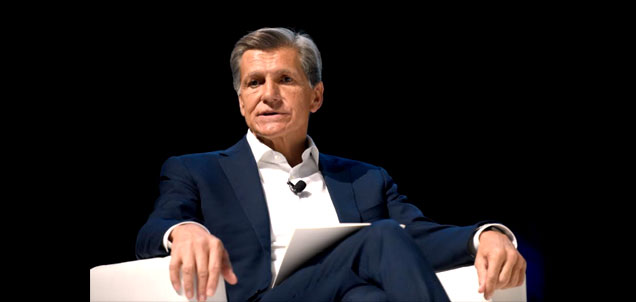
    Mark Pritchard at Cannes Lions 2017​


    By Prabhakar Mundkur [updated]


    There seems to be no stopping Mark Pritchard, Chief Brand Officer at Procter & Gamble (P&G).  Almost every week, the man walks all over the advertising industry hammering it into pulp. And the ad industry having lost its spine a few decades ago, is happy to let him walk all over them.


    The latest disruption that he has created in the advertising business is to create a unit where he has pooled the best creative resources of all his agencies into one agency called the People First agency headquartered in New York and headed by Andrea Diquez, CEO of Publicis Group Saatchi and Saatchi.


    I wonder why the three agencies even agreed to do that.  Do they not have any sense of ego?  Or has the revenue that P&G offers them forced them into submission and servility?


    Imagine Prasson, Piyush and Balki sitting in the same agency and producing work for one client.  I am sure the Indians wouldn’t agree to a formula like that?  Or would they?  Is the lure of money and profit too big to show your spine to the world’s largest advertiser?


    One could have forgiven Pritchard if what he proclaims is the new agency model had created something breakthrough and innovative.  But People First seemed to have created just another television commercial like any other agency, when they worked on Tide for the Super Bowl.  The ad failed to move me and I am unlikely to show it at my next public appearance as an example of breakthrough advertising.


    Small Creative shops no threat to Large agencies


    When the first few creative hotshops set up, some industry experts interpreted it as a threat to the large agency setup.  Taproot was a good example of a creative hotshop threatening the large agency like JWT for example when they usurped a part of the Pepsi and Airtel account.


    But now going by experience, the creative hotshop is set up only to dress up the bride.  To create a viable agency, with the sole objective of being acquired by a large group a few years later. And so alas Taproot became a part of Dentsu.


    A slew of other small hotshops followed among them Scarecrow.  Again, like Taproot but to a lesser extent it became a threat to the large agency taking little chunks of MNC and local business from other agencies.  But again, like hotshops before them the sole objective was to create an agency for acquisition.  Scarecrow has been acquired by M&C Saatchi now making it Scarecrow M&C Saatchi.


    Some will remember that M&C Saatchi has not had an illustrious existence in this country.  The agency floated around for a while without making any waves before leaving the country altogether.


    But it seems that with the new acquisition of Scarecrow, M&C Saatchi may have more to benefit from the partnership than Scarecrow. A quick look at the M&C Saatchi global website reveals that its global accounts might have not much leverage in India :Nandos, HBO, Natwest, Lexusetc are unlikely to affect the fortunes of either Scarecrow or M & C Saatchi, significantly.


    But of course, there is an upside as always.  The owners of Scarecrow will become rich and M&C Saatchi can drop one more pin on its global map of offices.  Besides Scarecrow of course can show off an international halo.


    Are India clients likely to work with New York agencies?

    One would have thought that Indian clients would never have considered working with a New York agency for many reasons. Time, distance, understanding of culture, and several other constraints.


    But much is being made of Nadia Chauhan’s appointment of Sagmeister and Walsh the New York-based agency that works on Parle Agro’sFrooti.


    In a new splash all over the Indian trade journals, both Nadia and Jessica Walsh a partner with Sagmeister Walsh raved about each other.


    The commercial itself was a little unimpressive according to me.


    The commercial features Alia Bhatt and is a combination of real life and animation.  As usual and like most Frooti ads the commercial was totally execution oriented and lacked any unique advertising idea for the brand.


    The graphics also reminded me of a style that the agency has developed of using post-modern art with strong graphics which they seem to be doing with all their other brands as well.


    I wonder if this was meant to show the world that Frooti has a New York agency or was the move only to slight its previous agency Creativeland Asia which was the Frooti agency for nine years.


  • How Whisper sent a loud message via ‘Touch the Pickle’


    Whisper’s curiously-titled but hard-hitting campaign was awarded the Grand Prix in the newly-created Glass Lion category at Cannes Lions this year. The awards went to creative agency BBDO India. Spokespersons from the brand’s parent company, Procter & Gamble, responded to questions from Dyanne Coelho on why the movement, which aims to eradicate the taboos and age-old myths around menstruation, received an overwhelming response both at the international festival as well as back in India.


    How did the idea behind Whisper’s ‘Touch the Pickle’ campaign come about?

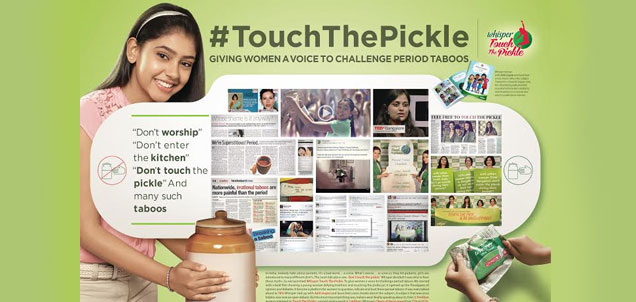
    Whisper’s brand purpose is to advocate for, and empower, women, to reach their fullest potential. The Touch the Pickle movement was conceived when we realised that a majority of Indian women feel restricted from achieving their dreams because of irrational taboos around menstruation. We believe women should not feel restricted on their period days, and an overwhelming number of women across the country responded to our campaign with their own stories of breaking taboos. A survey by market research firm Ipsos on understanding these taboos revealed that among urban women, 59 per cent still don’t touch pickle, and more than half prefer not to venture out of their homes, during their periods. In light of these findings, Whisper embarked upon the journey to launch a nationwide movement — across not just TV but also PR and digital. ‘Touch the Pickle’ was one of the most irrational taboos and was an apt metaphor for all the other irrational taboos that hold women back.


    Many argue that these so-called taboos have been passed down over years because they are healthy practices women should adhere to, during menstruation. And that it is only now that these practices are being labelled taboos. How would you respond to that?

    There are two kinds of taboos that Indian women follow. Irrational taboos, like not washing their hair, not touching the pickle, sleeping in areas away from the house, have no relevance to menstruation today and are age-old myths imposed by families that considered periods as impure. The other set, like not wearing whites, not leaving the house and not exercising, started at a time when good sanitary protection did not exist and women had to use cloth, rags or even sand or ash during periods. Today, when there is superior technology in terms of sanitary pads, women shouldn’t worry about following such unreasonable practices. About 99 per cent of gynaecologists believe sanitary napkins are the best form of protection during menstruation as per a national study by the Feminine and Infant Hygiene Association and Ipsos. In the 21st century, when there is a solution, there is no need for women to restrict themselves.


    Was the impact to the campaign different in Tier II and III cities from the metros?

    An eyeopener for us during the research conducted by Ipsos is that even in urban towns, most of these taboos are still observed. For example, 65 per cent of women from urban India perceive periods as an obstacle in achieving their full potential and some 54 per cent are not allowed to water plants at this time. Our focus has been to drive awareness of the irrelevance of these taboos and encourage consumers to help change the social behaviour and gender inequality that restricts them. We’ve done this in different ways via TV, PR and digital, but we’ve also focused on educating young women and their communities on menstrual hygiene. We’ve also pledged to educate 15 million girls by 2017 on menstrual hygiene, and saw this impact in the sudden surge of conversations, discussions and debates women across India were having around menstruation, where many of them were questioning the myths that were holding them back.


    The campaign received positive publicity elsewhere in the world, more than in India. What do you think the reason for that is?

    Touch the Pickle was an integrated movement not restricted only to television. Women Achievers like Aditi Gupta (founder of Menstrupedia), Ishita Malviya (India’s first female surfer), Nungshi and Tashi (the first twins to scale Mt Everest), anthropologist Suneela Garg and film personalities like Parineeti Chopra, Kalki Koechlin and Shradha Kapoor, all came together to support this movement to eradicate taboos. The winds of change are blowing through India and the world, and insights regarding taboos around menstruation resonated with global audiences because taboos related to periods are not an Indian phenomenon only.


    There are some who believe that while this campaign had a positive impact on many in India, it also paints a socially-regressive view of our society, when that is not the case.

    Although 65 per cent of Indian urban women observed these taboos, 82 per cent wanted to break free of them. Interestingly observing irrational taboos is not just an Indian thing. Across the world, women hide their sanitary pads. You will find it heartening to know that in the last year, a surge of Indian women have expressed how normal menstruation is, and how important it is to eradicate these taboos — whether it is the Jamia Millia university [campaign], the Rupi Kaur Instagram incident or even the Menstrupedia comic (which we partnered with) which educates women on menstruation. This means Indian women are empowered and unstoppable in leading this movement.


    Has the campaign resulted in a growth in sales for Whisper? If so, by how much?

    Touch the Pickle was an integrated movement across touchpoints, including PR, TV and digital, where the central idea was the consumers’ need to be empowered and lead this change. Consumers rewarded us by choosing Whisper, and we have seen our business grow in the last year.


    After the overwhelming response it got, are you thinking of running the campaign again?

    We are thankful to Cannes Lions International Festival of Creativity and Lean In for instituting this much-deserved award category, the Glass Lion, and awarding us a Grand Prix. We have our partner agencies BBDO, Madison PR, Mediacom, Quasar and Encompass to thank. This is an important movement and we’ll continue to stand for empowering women.


    Â